
August Macke
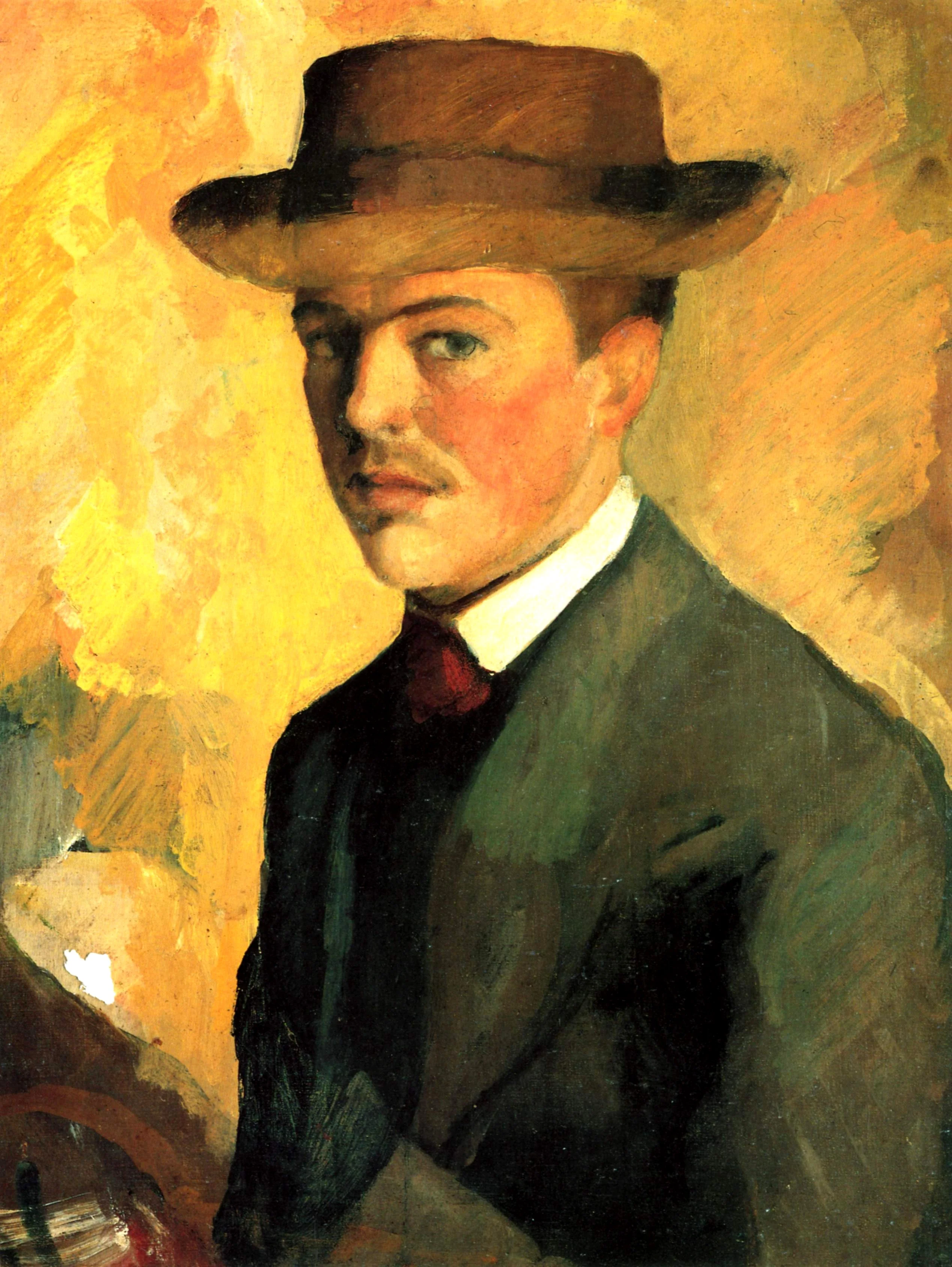
Image from Wikipedia
Image from Wikipedia
August Macke: Radiance, Modernity and the Cheerful Revolution of Expressionism
An Artist Who Set Color in Motion
August Macke is among the defining German painters of Expressionism. Born on January 3, 1887, in Meschede and fallen on September 26, 1914, at Perthes-lès-Hurlus in Champagne, he developed a body of work with exceptional density and radiance in just about ten years. His name today stands for an art that not only depicts light but transforms it into luminous color surfaces, clear compositions, and an almost musical harmony. ([de.wikipedia.org](https://de.wikipedia.org/wiki/August_Macke?utm_source=openai))
Although Macke was not a musician, his oeuvre possesses a striking rhythmic quality: figures, landscapes, and city scenes arrange themselves into compositions that are driven by repetition, timing, and color harmony. For this reason, he continues to fascinate art lovers, museums, and collectors alike. His paintings appear cheerful, filled with light, and modern, without ever seeming superficial. ([de.wikipedia.org](https://de.wikipedia.org/wiki/August_Macke?utm_source=openai))
Biography: Early Influences and Artistic Breakthrough
August Macke grew up in a cultured, educated environment and found an early passion for drawing. His education and engagement with various styles quickly brought him to the central questions of modernity: How can perception be condensed? How can color carry meaning? How does a distinct image arise from the visible world? The early works still show influences of Symbolist and Impressionist tendencies before Macke shaped his distinctive style. ([de.wikipedia.org](https://de.wikipedia.org/wiki/August_Macke?utm_source=openai))
As a young man, Macke worked not only as a painter but also as a stage designer and costume designer. These experiences sharpened his eye for surfaces, spatial effects, and staging. His engagement with theater, decor, and movement left traces in his painting: figures often appear as part of a consciously composed scene, where each form responds to the others. ([dhm.de](https://www.dhm.de/lemo/biografie/august-macke?utm_source=openai))
The Path to Modernity: The Blue Rider, Paris, and New Impulses
A decisive phase in Macke's artistic development was his encounter with the avant-garde movements of European modernity. Through Franz Marc, he came into contact with Wassily Kandinsky and temporarily moved within the circle of the "Blue Rider." Macke participated in both exhibitions of the group and contributed to broadening their artistic horizons. At the same time, he remained independent and did not fully adopt the spiritually metaphysical positions of the circle. ([augustmacke.org](https://www.augustmacke.org/biography.html?utm_source=openai))
Trips to Paris and engagement with the Fauves had a profound impact on his painting. The influence is evident in the sharply contrasting color fields, intensified radiance, and a generous composition. However, Macke transformed these stimuli into a very personal visual language: less dramatic than many Expressionists, yet more open, elegant, and carried by an almost paradisiacal clarity. ([dhm.de](https://www.dhm.de/lemo/biografie/august-macke?utm_source=openai))
The Typical Macke Painting: Light, Color, and a Harmonious World
The style for which Macke is famous today emerged from his intensive engagement with the effects of light and with pure, harmoniously related colors. His paintings largely avoid the tragic and instead seek a whole world in which humans and their surroundings appear in balance. This cheerful attitude distinguishes him from many contemporaries and makes his art immediately accessible. ([de.wikipedia.org](https://de.wikipedia.org/wiki/August_Macke?utm_source=openai))
Motifs that captured his interest included pedestrians, dancers, acrobats, shop window scenes, animal subjects, and garden images. In these subjects, movement condenses into a visual choreography. Particularly, the shop window images showcase his modern sensibility: reflections, street life, and interiors merge into picture spaces that capture and poetically heighten urban perspectives. ([deutsche-biographie.de](https://www.deutsche-biographie.de/sfz55453.html?utm_source=openai))
Trip to Tunis, Maturity and the Focus on the Here and Now
One of the most significant milestones in Macke's work was the trip to Tunis in 1914. In this journey, his use of color distilled into an extraordinary lightness, where light and form appear almost crystalline. The trip marks a peak in his work, as the previously developed influences from Impressionism, Fauvism, and Orphism transitioned into an independent, mature visual language. ([treccani.it](https://www.treccani.it/enciclopedia/august-macke/?utm_source=openai))
His later works shift the paradise not to distant metaphysical realms, but into visible reality. Everyday scenes, movements, and encounters become carriers of a positive worldview. In doing so, Macke created an art that celebrates life without idealizing it, and precisely in this balance lies its lasting impact. ([august-macke-haus.de](https://www.august-macke-haus.de/august-macke/leben-und-werk/?utm_source=openai))
Work, Reception, and Cultural Influence
Macke's artistic breakthrough was not only tied to his painting but also to his network. He facilitated contact with Bernhard Koehler and later became actively involved in the Rhineland for the artistic-political concerns of the "Blue Rider." His role was not that of an isolated genius, but of an active co-designer of modernity. ([rheinische-geschichte.lvr.de](https://rheinische-geschichte.lvr.de/Persoenlichkeiten/august-macke/DE-2086/lido/57c9469241d290.28232784?utm_source=openai))
Today, works from his final creative phase are regarded as the "typical Mackes" and hold a firm place in the collective visual memory. They are highly valued in the art market and are present in museums as well as in reproductions, calendars, and publications. Macke's cultural influence thus extends far beyond art history: his visual language represents a modern longing for clarity, joy in color, and an orderly world. ([august-macke-haus.de](https://www.august-macke-haus.de/en/august-macke/life-and-work/?utm_source=openai))
Why August Macke Continues to Fascinate Today
August Macke uniquely combines artistic modernity with emotional accessibility. His paintings show how radically color, light, and composition can create a new reality without overwhelming the viewer. Those who engage with Macke encounter a form of Expressionism that doesn’t scream but shines. ([de.wikipedia.org](https://de.wikipedia.org/wiki/August_Macke?utm_source=openai))
This mixture of formal clarity, sensual colorfulness, and optimistic perception of the world is precisely what makes him exciting. Macke remains a contemporary artist because his paintings still fulfill a rare longing: the pursuit of harmony, openness, and beauty in everyday life. A visit to a museum displaying works by August Macke is always worthwhile, as his paintings reveal their full impact only in the direct experience of viewing the original. ([august-macke-haus.de](https://www.august-macke-haus.de/august-macke/leben-und-werk/?utm_source=openai))
Official Channels of August Macke:
- Instagram: No official profile found
- Facebook: No official profile found
- YouTube: No official profile found
- Spotify: No official profile found
- TikTok: No official profile found
Sources:
- LeMO - Biography August Macke
- Wikipedia - August Macke
- August Macke Biography
- German Biography - Macke, August
- August Macke House - Life and Work
- August Macke House - Life and Work
- Städel Museum - Digital Collection August Macke
- Portal Rhineland History - August Macke
- Wikipedia: Image and Text Source
Upcoming Events
SUNDAY GUIDED TOUR at the August Macke House Museum
Public tour of the former home and studio
Finissage "Visions of Modernity – August Macke and Max Ernst"