
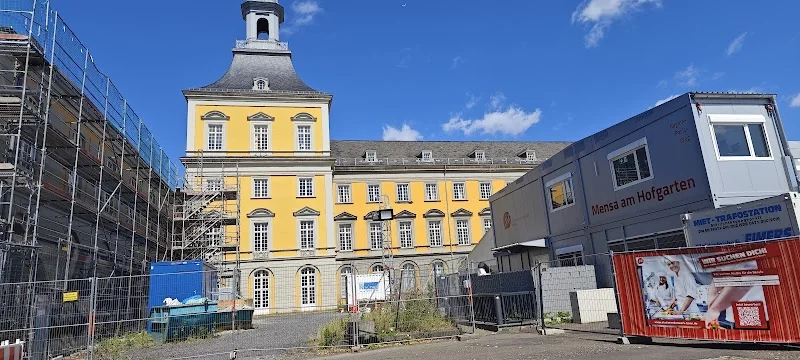
Bonn
Regina-Pacis-Weg 1, 53113 Bonn, Deutschland
University Museum Bonn | Opening Hours & Directions
The University Museum Bonn is not a loud, overloaded museum, but a place where science and city history meet in a very concentrated form. Those who enter the building at Regina-Pacis-Weg 1 experience not only an exhibition but a showcase for the development of one of Germany's most traditional universities. The museum is located in the main building of the University of Bonn and utilizes the rooms of the former student library, which gives the visit a special historical atmosphere. It is precisely this connection of place, content, and architecture that makes it appealing: Here, history is not told abstractly, but is visible at an authentic location. The University Museum sees itself as a gateway to research, teaching, and university memory culture, aimed at all those who want to experience Bonn beyond classic city guides. Particularly pleasant for visitors are the clear visiting hours, free admission, and the central location in close proximity to Bonn's city center. Those who have little time can easily combine their visit with a walk through the city center, while those who want to delve deeper will find numerous points of connection in the permanent exhibition, guided tours, and changing thematic presentations. For those specifically searching for University Museum Bonn, University Bonn Museum, or University Museum Uni Bonn, the site offers a quick overview of the most important information that truly matters for planning on-site.
Opening Hours, Admission, and Visit Planning at the University Museum Bonn
The most important information for most visitors is the opening hours. The University Museum Bonn is open from Wednesday to Sunday from 12:00 to 17:00. This makes the house conveniently timed for city walks in the afternoon, visits after work, or a relaxed weekend outing. Additionally, admission is free, making access particularly low-threshold and making the museum attractive for spontaneous visits. So, for those who want to make a cultural detour in Bonn without long planning, they will find a very accessible offer here. For visit planning, it is still worthwhile to consciously check the opening hours, as it is closed on public holidays and individual special cases, such as short-term closures, may occur. This is normal for smaller science-related museums, but it means in everyday life: A quick look at the current information before heading to Bonn is sensible. The open structure fits well with the character of the house. The museum does not primarily aim to impress with spectacular individual objects but with the understandable communication of university history. This makes it suitable for both people who are encountering the history of the University of Bonn for the first time and for guests who are already interested in academic traditions, university history, or Bonn's role as a research location. It is also practical that the visit can be easily combined with other destinations in the city center. Those spending the afternoon in the center can incorporate the museum as a quiet and content-rich program point. Especially due to the free admission, it is also a good option for families, students, alumni, and visitors from home and abroad who are looking for a serious, compact, and easily accessible stop. The University Museum Bonn is thus an example of how a cultural offering can still be very high-quality and content-rich without an admission barrier.
Directions to the University Museum Bonn and Parking at the Main Building
The directions to the University Museum Bonn are manageable due to the central location, although one should be aware that the museum is located directly in the urban environment of the university. Those arriving by public transport can take tram lines 16, 63, or 66 from the main train station, departing from platform 2 towards Godesberg, Rheinaue, or Bad Honnef. After just one stop, you get off at the University/Market stop, exit via the Kaiserplatz exit, and then head towards the main building. The path leads to the southwest wing of the castle or main building, where the University Museum is located. This route is very direct for Bonn connoisseurs, and for first-time visitors, it is especially pleasant because it is clearly described and allows for a visit to the museum without complicated detours. Those arriving by car should pay attention to the typical city center logic of Bonn. The university mentions, among other routes, the A 565 with exit Poppelsdorf or the A 562 with exit Bonn-Center. In both cases, it leads via B9 or Adenauerallee and further towards Hofgarten or Stockenstraße. Parking is available in the surrounding underground garages of Bonn's city center; the market underground garage is also specifically mentioned. This is helpful as it allows for a realistic parking plan to be made in advance. For a relaxed visit, it is advisable not to hope for a direct parking space at the building but to plan the city center underground garages as a regular solution. The University Museum is thus primarily a location for well-organized city visits. Those who are already walking in Bonn benefit particularly from the proximity to other central points. The location connects museum visits, city walks, and historical surroundings in a very practical way. Especially the combination of public transport connections and city center parking garages makes the journey flexible and well-planned for different types of visitors. This fits well with a museum that sees itself as an open access point to university history, not as an isolated specialized place on the outskirts of the city.
Permanent Exhibition: 200 Years of Bonn University History
The centerpiece of the house is the permanent exhibition, which the University Museum itself sees as a showcase of science. The content revolves around the development of the Rheinische Friedrich-Wilhelms-University Bonn, which looks back on nearly two hundred years of history. The exhibition bridges the past and the present, making visible why the University of Bonn is described as a traditionally modern university. This tension is what makes the museum visit so interesting: On one hand, it deals with historical development, academic traditions, and institutional memory; on the other hand, it addresses how science, research, and the university's self-understanding have changed to this day. The permanent exhibition is divided into six thematic focuses. It addresses the idea of the University of Bonn as a traditionally modern institution, its internationality and collaborations, its role as a research university, the natural sciences and medicine, the humanities, and notable students. This is complemented by a chronological overview of university history. Thus, it does not create a mere collection of objects but a clearly structured path through 200 years of higher education and science in Bonn. In its external impact, the museum is therefore understandable for both historically interested individuals and curious laypeople. Those who visit the house receive not only data and names but also a narrative order. This is important because university history can quickly seem dry otherwise. However, the museum shows that scientific development can be anchored in very concrete things, people, and traditions. The official description also emphasizes that the University of Bonn wanted to create a unity of retrospective on history and access to different forms of science in the museum. This makes the place didactically valuable and atmospherically dense. Those interested in the emergence, development, and self-presentation of a research university will find here a compact but intellectually demanding overview. For visitors to Bonn, the permanent exhibition is thus one of the most interesting ways to experience the city not only as a place of politics and Rhine romance but as a center of academic and scientific culture.
Guided Tours, Sunday Tours, and Group Visits
A special added value of the University Museum Bonn is the guided tours. They make the visit even more accessible because the exhibition becomes livelier through explanations, contextualizations, and thematic focuses. Particularly attractive are the public Sunday tours, which take place every Sunday from 15:00 to 16:00. According to official information, these tours are offered as small group tours starting from three people. This is important for individual visitors because they can team up with other guests if necessary or plan a visit better with friends, family, or colleagues. The Sunday tour is free and provides insights into the unique history of the University of Bonn based on selected objects. This is precisely where the University Museum can showcase its scientific heritage particularly well: The objects serve not only for illustration but as anchors for historical contexts. In addition, the museum offers individual tours for groups, with groups of five to twenty people mentioned. So, if you come with a club, a school class, a travel group, an alumni round, or with colleagues, you can coordinate a desired appointment and prepare the visit specifically. This significantly expands the utility of the museum beyond spontaneous individual visits. For groups, it is particularly important that the museum is clearly focused on conveying Bonn's university and science history. In public communication, this history is explicitly told from the early founding environment through the Prince University and the capital university of the Bonn Republic to the international excellence and research university of the present. This provides an excellent basis for tours that convey both historical knowledge and institutional identity. Therefore, those who use tours as a decision factor will find a very coherent offer here. The University Museum Bonn is not only a place to look at but also to understand, ask questions, and contextualize. Especially for visitors looking for a compact cultural framework beyond university historical topics, the combination of free admission and guided mediation is particularly convincing.
Temporary Exhibitions, Highlights, and Scientific Collection
In addition to the permanent exhibition, the University Museum Bonn also thrives on its temporary exhibitions. The university points out that a variety of exhibitions are offered annually and that the next special exhibition is always being prepared. This makes the museum dynamic, as it does not remain with a single fixed narrative thread but continually adds new themes, perspectives, and questions to the university's memory. In recent years, the spectrum has ranged from the history of science to cultural-historical presentations to exhibitions with social or artistic orientation. Examples from the recent program landscape show that the museum is open to interdisciplinary approaches and also addresses current debates. This adds additional relevance for returning visitors. Those who were there a year ago can experience a different exhibition today and thus learn about a new aspect of the Bonn university world. The collection itself is also remarkable. The official description mentions objects from the areas of academic customs and traditions, including gowns and caps, seals and seal impressions, gifts from foreign delegations, congratulatory certificates for anniversaries, carnival orders of the University of Bonn, and similar pieces. Additionally, materials from research and teaching, such as microscopes, glass plates, and heliometers, are included. Such objects show that science consists not only of texts and theories but also always of things, devices, symbols, and rituals. Particularly interesting is that the collection is still being built and that the University Museum remains closely connected to the university archive. There, the history of the university is preserved over several thousand meters of shelves. This archival depth distinguishes the museum from many other institutions and explains why the exhibition can appear so well-founded and source-close. Those interested in university symbolism, scientific working tools, and the cultural side of research will find an authentic environment here. The combination of temporary exhibitions, collection, and archive makes the University Museum Bonn a lively place where historical substance and current mediation come together. This is precisely the ideal combination for a university museum: It not only preserves but also continually updates its own history.
Reviews and Visitor Impressions for the University Museum Bonn
Those looking for reviews for the University Museum Bonn usually want to quickly know whether the visit is worthwhile and what impressions other guests have gathered. The provided Google data speaks a very clear language here: The museum receives 4.8 out of 5 stars based on 8 reviews. Although the number of ratings is not huge, the trend clearly points in a very positive direction. For a location of this kind, this is a good indication, as university museums often do not impress through mass attraction but through competence, atmosphere, and understandability. This is precisely where the Bonn house's strength lies. It is historical but not dusty, scientific but not inaccessible, centrally located but not overcrowded. In practice, this creates a visitor impression that many people perceive as calm, educational, and pleasantly focused. Additionally, the free admission and the Sunday tours provide another low-threshold offer. This improves the overall impression because visitors can try out without financial risk whether they are interested in the exhibition. This openness is particularly important for museum visits: Those who come spontaneously do not want to think long about whether the journey is worthwhile. The University Museum Bonn offers a good mix of manageable size and content density for this purpose. Those who only have a short hour can get a compact overview. Those who stay longer discover significantly more depth in the guided tours and thematic focuses. The positive rating can therefore also be explained by the hard facts: central location, free admission, clearly defined opening hours, and a professionally prepared topic with regional relevance. In total, a place emerges that is as exciting for locals as it is for guests from outside. Those reading reviews often look for a sense of the character of the house. The signal for the University Museum Bonn is friendly and convincing: It is a small, clever, and historically coherent museum that primarily scores with content and accessibility.
Barrier-Free Access, Location in the Main Building, and Practical Tips
The practical location in the main building of the University of Bonn is one of the museum's most important advantages, but it also comes with some peculiarities. Access does not occur as in a classic city museum from an open museum front but via the university and its architectural stock. Officially, it is pointed out that barrier-free access can currently only be guaranteed from Wednesday to Friday. Visitors are advised to use the main entrance on the city center side of the university, cross the arcade courtyard, go through the southwest wing, then through the cafeteria or the vaulted hall, continue through the rose garden, and finally use the right passage to reach the entrance of the University Museum. This information is important because it creates a realistic expectation and clarifies the route for mobility-impaired individuals. Those who want to come at a specific time should therefore check the current accessibility in advance and not rely solely on general proximity to the city center. At the same time, this route description beautifully illustrates how closely the museum is connected to the historic building of the university. The visit does not simply lead into an exhibition room but through a series of university spaces that become part of the experience themselves. This makes the journey almost a small tour through Bonn's university architecture. It is also practical that the museum visit fits into the surroundings of Bonn's center. Those who want to walk through the city center after the exhibition visit have short distances to other sights, gastronomy, and public transport. For travelers searching for University Museum Uni Bonn, University Bonn Museum, or University Museum Bonn, this combination of central location and clear directions is often decisive. The museum is particularly recommended for visitors who want to experience scientific history in an authentic environment without long journeys or complicated access situations. In conclusion, it can be said: Those looking for a well-accessible, free, and content-solid museum with a strong university identity are in the right place here. The University Museum Bonn combines history, research, architecture, and city location into a compact and rewarding visit experience.
Sources:
Show moreShow less
University Museum Bonn | Opening Hours & Directions
The University Museum Bonn is not a loud, overloaded museum, but a place where science and city history meet in a very concentrated form. Those who enter the building at Regina-Pacis-Weg 1 experience not only an exhibition but a showcase for the development of one of Germany's most traditional universities. The museum is located in the main building of the University of Bonn and utilizes the rooms of the former student library, which gives the visit a special historical atmosphere. It is precisely this connection of place, content, and architecture that makes it appealing: Here, history is not told abstractly, but is visible at an authentic location. The University Museum sees itself as a gateway to research, teaching, and university memory culture, aimed at all those who want to experience Bonn beyond classic city guides. Particularly pleasant for visitors are the clear visiting hours, free admission, and the central location in close proximity to Bonn's city center. Those who have little time can easily combine their visit with a walk through the city center, while those who want to delve deeper will find numerous points of connection in the permanent exhibition, guided tours, and changing thematic presentations. For those specifically searching for University Museum Bonn, University Bonn Museum, or University Museum Uni Bonn, the site offers a quick overview of the most important information that truly matters for planning on-site.
Opening Hours, Admission, and Visit Planning at the University Museum Bonn
The most important information for most visitors is the opening hours. The University Museum Bonn is open from Wednesday to Sunday from 12:00 to 17:00. This makes the house conveniently timed for city walks in the afternoon, visits after work, or a relaxed weekend outing. Additionally, admission is free, making access particularly low-threshold and making the museum attractive for spontaneous visits. So, for those who want to make a cultural detour in Bonn without long planning, they will find a very accessible offer here. For visit planning, it is still worthwhile to consciously check the opening hours, as it is closed on public holidays and individual special cases, such as short-term closures, may occur. This is normal for smaller science-related museums, but it means in everyday life: A quick look at the current information before heading to Bonn is sensible. The open structure fits well with the character of the house. The museum does not primarily aim to impress with spectacular individual objects but with the understandable communication of university history. This makes it suitable for both people who are encountering the history of the University of Bonn for the first time and for guests who are already interested in academic traditions, university history, or Bonn's role as a research location. It is also practical that the visit can be easily combined with other destinations in the city center. Those spending the afternoon in the center can incorporate the museum as a quiet and content-rich program point. Especially due to the free admission, it is also a good option for families, students, alumni, and visitors from home and abroad who are looking for a serious, compact, and easily accessible stop. The University Museum Bonn is thus an example of how a cultural offering can still be very high-quality and content-rich without an admission barrier.
Directions to the University Museum Bonn and Parking at the Main Building
The directions to the University Museum Bonn are manageable due to the central location, although one should be aware that the museum is located directly in the urban environment of the university. Those arriving by public transport can take tram lines 16, 63, or 66 from the main train station, departing from platform 2 towards Godesberg, Rheinaue, or Bad Honnef. After just one stop, you get off at the University/Market stop, exit via the Kaiserplatz exit, and then head towards the main building. The path leads to the southwest wing of the castle or main building, where the University Museum is located. This route is very direct for Bonn connoisseurs, and for first-time visitors, it is especially pleasant because it is clearly described and allows for a visit to the museum without complicated detours. Those arriving by car should pay attention to the typical city center logic of Bonn. The university mentions, among other routes, the A 565 with exit Poppelsdorf or the A 562 with exit Bonn-Center. In both cases, it leads via B9 or Adenauerallee and further towards Hofgarten or Stockenstraße. Parking is available in the surrounding underground garages of Bonn's city center; the market underground garage is also specifically mentioned. This is helpful as it allows for a realistic parking plan to be made in advance. For a relaxed visit, it is advisable not to hope for a direct parking space at the building but to plan the city center underground garages as a regular solution. The University Museum is thus primarily a location for well-organized city visits. Those who are already walking in Bonn benefit particularly from the proximity to other central points. The location connects museum visits, city walks, and historical surroundings in a very practical way. Especially the combination of public transport connections and city center parking garages makes the journey flexible and well-planned for different types of visitors. This fits well with a museum that sees itself as an open access point to university history, not as an isolated specialized place on the outskirts of the city.
Permanent Exhibition: 200 Years of Bonn University History
The centerpiece of the house is the permanent exhibition, which the University Museum itself sees as a showcase of science. The content revolves around the development of the Rheinische Friedrich-Wilhelms-University Bonn, which looks back on nearly two hundred years of history. The exhibition bridges the past and the present, making visible why the University of Bonn is described as a traditionally modern university. This tension is what makes the museum visit so interesting: On one hand, it deals with historical development, academic traditions, and institutional memory; on the other hand, it addresses how science, research, and the university's self-understanding have changed to this day. The permanent exhibition is divided into six thematic focuses. It addresses the idea of the University of Bonn as a traditionally modern institution, its internationality and collaborations, its role as a research university, the natural sciences and medicine, the humanities, and notable students. This is complemented by a chronological overview of university history. Thus, it does not create a mere collection of objects but a clearly structured path through 200 years of higher education and science in Bonn. In its external impact, the museum is therefore understandable for both historically interested individuals and curious laypeople. Those who visit the house receive not only data and names but also a narrative order. This is important because university history can quickly seem dry otherwise. However, the museum shows that scientific development can be anchored in very concrete things, people, and traditions. The official description also emphasizes that the University of Bonn wanted to create a unity of retrospective on history and access to different forms of science in the museum. This makes the place didactically valuable and atmospherically dense. Those interested in the emergence, development, and self-presentation of a research university will find here a compact but intellectually demanding overview. For visitors to Bonn, the permanent exhibition is thus one of the most interesting ways to experience the city not only as a place of politics and Rhine romance but as a center of academic and scientific culture.
Guided Tours, Sunday Tours, and Group Visits
A special added value of the University Museum Bonn is the guided tours. They make the visit even more accessible because the exhibition becomes livelier through explanations, contextualizations, and thematic focuses. Particularly attractive are the public Sunday tours, which take place every Sunday from 15:00 to 16:00. According to official information, these tours are offered as small group tours starting from three people. This is important for individual visitors because they can team up with other guests if necessary or plan a visit better with friends, family, or colleagues. The Sunday tour is free and provides insights into the unique history of the University of Bonn based on selected objects. This is precisely where the University Museum can showcase its scientific heritage particularly well: The objects serve not only for illustration but as anchors for historical contexts. In addition, the museum offers individual tours for groups, with groups of five to twenty people mentioned. So, if you come with a club, a school class, a travel group, an alumni round, or with colleagues, you can coordinate a desired appointment and prepare the visit specifically. This significantly expands the utility of the museum beyond spontaneous individual visits. For groups, it is particularly important that the museum is clearly focused on conveying Bonn's university and science history. In public communication, this history is explicitly told from the early founding environment through the Prince University and the capital university of the Bonn Republic to the international excellence and research university of the present. This provides an excellent basis for tours that convey both historical knowledge and institutional identity. Therefore, those who use tours as a decision factor will find a very coherent offer here. The University Museum Bonn is not only a place to look at but also to understand, ask questions, and contextualize. Especially for visitors looking for a compact cultural framework beyond university historical topics, the combination of free admission and guided mediation is particularly convincing.
Temporary Exhibitions, Highlights, and Scientific Collection
In addition to the permanent exhibition, the University Museum Bonn also thrives on its temporary exhibitions. The university points out that a variety of exhibitions are offered annually and that the next special exhibition is always being prepared. This makes the museum dynamic, as it does not remain with a single fixed narrative thread but continually adds new themes, perspectives, and questions to the university's memory. In recent years, the spectrum has ranged from the history of science to cultural-historical presentations to exhibitions with social or artistic orientation. Examples from the recent program landscape show that the museum is open to interdisciplinary approaches and also addresses current debates. This adds additional relevance for returning visitors. Those who were there a year ago can experience a different exhibition today and thus learn about a new aspect of the Bonn university world. The collection itself is also remarkable. The official description mentions objects from the areas of academic customs and traditions, including gowns and caps, seals and seal impressions, gifts from foreign delegations, congratulatory certificates for anniversaries, carnival orders of the University of Bonn, and similar pieces. Additionally, materials from research and teaching, such as microscopes, glass plates, and heliometers, are included. Such objects show that science consists not only of texts and theories but also always of things, devices, symbols, and rituals. Particularly interesting is that the collection is still being built and that the University Museum remains closely connected to the university archive. There, the history of the university is preserved over several thousand meters of shelves. This archival depth distinguishes the museum from many other institutions and explains why the exhibition can appear so well-founded and source-close. Those interested in university symbolism, scientific working tools, and the cultural side of research will find an authentic environment here. The combination of temporary exhibitions, collection, and archive makes the University Museum Bonn a lively place where historical substance and current mediation come together. This is precisely the ideal combination for a university museum: It not only preserves but also continually updates its own history.
Reviews and Visitor Impressions for the University Museum Bonn
Those looking for reviews for the University Museum Bonn usually want to quickly know whether the visit is worthwhile and what impressions other guests have gathered. The provided Google data speaks a very clear language here: The museum receives 4.8 out of 5 stars based on 8 reviews. Although the number of ratings is not huge, the trend clearly points in a very positive direction. For a location of this kind, this is a good indication, as university museums often do not impress through mass attraction but through competence, atmosphere, and understandability. This is precisely where the Bonn house's strength lies. It is historical but not dusty, scientific but not inaccessible, centrally located but not overcrowded. In practice, this creates a visitor impression that many people perceive as calm, educational, and pleasantly focused. Additionally, the free admission and the Sunday tours provide another low-threshold offer. This improves the overall impression because visitors can try out without financial risk whether they are interested in the exhibition. This openness is particularly important for museum visits: Those who come spontaneously do not want to think long about whether the journey is worthwhile. The University Museum Bonn offers a good mix of manageable size and content density for this purpose. Those who only have a short hour can get a compact overview. Those who stay longer discover significantly more depth in the guided tours and thematic focuses. The positive rating can therefore also be explained by the hard facts: central location, free admission, clearly defined opening hours, and a professionally prepared topic with regional relevance. In total, a place emerges that is as exciting for locals as it is for guests from outside. Those reading reviews often look for a sense of the character of the house. The signal for the University Museum Bonn is friendly and convincing: It is a small, clever, and historically coherent museum that primarily scores with content and accessibility.
Barrier-Free Access, Location in the Main Building, and Practical Tips
The practical location in the main building of the University of Bonn is one of the museum's most important advantages, but it also comes with some peculiarities. Access does not occur as in a classic city museum from an open museum front but via the university and its architectural stock. Officially, it is pointed out that barrier-free access can currently only be guaranteed from Wednesday to Friday. Visitors are advised to use the main entrance on the city center side of the university, cross the arcade courtyard, go through the southwest wing, then through the cafeteria or the vaulted hall, continue through the rose garden, and finally use the right passage to reach the entrance of the University Museum. This information is important because it creates a realistic expectation and clarifies the route for mobility-impaired individuals. Those who want to come at a specific time should therefore check the current accessibility in advance and not rely solely on general proximity to the city center. At the same time, this route description beautifully illustrates how closely the museum is connected to the historic building of the university. The visit does not simply lead into an exhibition room but through a series of university spaces that become part of the experience themselves. This makes the journey almost a small tour through Bonn's university architecture. It is also practical that the museum visit fits into the surroundings of Bonn's center. Those who want to walk through the city center after the exhibition visit have short distances to other sights, gastronomy, and public transport. For travelers searching for University Museum Uni Bonn, University Bonn Museum, or University Museum Bonn, this combination of central location and clear directions is often decisive. The museum is particularly recommended for visitors who want to experience scientific history in an authentic environment without long journeys or complicated access situations. In conclusion, it can be said: Those looking for a well-accessible, free, and content-solid museum with a strong university identity are in the right place here. The University Museum Bonn combines history, research, architecture, and city location into a compact and rewarding visit experience.
Sources:
University Museum Bonn | Opening Hours & Directions
The University Museum Bonn is not a loud, overloaded museum, but a place where science and city history meet in a very concentrated form. Those who enter the building at Regina-Pacis-Weg 1 experience not only an exhibition but a showcase for the development of one of Germany's most traditional universities. The museum is located in the main building of the University of Bonn and utilizes the rooms of the former student library, which gives the visit a special historical atmosphere. It is precisely this connection of place, content, and architecture that makes it appealing: Here, history is not told abstractly, but is visible at an authentic location. The University Museum sees itself as a gateway to research, teaching, and university memory culture, aimed at all those who want to experience Bonn beyond classic city guides. Particularly pleasant for visitors are the clear visiting hours, free admission, and the central location in close proximity to Bonn's city center. Those who have little time can easily combine their visit with a walk through the city center, while those who want to delve deeper will find numerous points of connection in the permanent exhibition, guided tours, and changing thematic presentations. For those specifically searching for University Museum Bonn, University Bonn Museum, or University Museum Uni Bonn, the site offers a quick overview of the most important information that truly matters for planning on-site.
Opening Hours, Admission, and Visit Planning at the University Museum Bonn
The most important information for most visitors is the opening hours. The University Museum Bonn is open from Wednesday to Sunday from 12:00 to 17:00. This makes the house conveniently timed for city walks in the afternoon, visits after work, or a relaxed weekend outing. Additionally, admission is free, making access particularly low-threshold and making the museum attractive for spontaneous visits. So, for those who want to make a cultural detour in Bonn without long planning, they will find a very accessible offer here. For visit planning, it is still worthwhile to consciously check the opening hours, as it is closed on public holidays and individual special cases, such as short-term closures, may occur. This is normal for smaller science-related museums, but it means in everyday life: A quick look at the current information before heading to Bonn is sensible. The open structure fits well with the character of the house. The museum does not primarily aim to impress with spectacular individual objects but with the understandable communication of university history. This makes it suitable for both people who are encountering the history of the University of Bonn for the first time and for guests who are already interested in academic traditions, university history, or Bonn's role as a research location. It is also practical that the visit can be easily combined with other destinations in the city center. Those spending the afternoon in the center can incorporate the museum as a quiet and content-rich program point. Especially due to the free admission, it is also a good option for families, students, alumni, and visitors from home and abroad who are looking for a serious, compact, and easily accessible stop. The University Museum Bonn is thus an example of how a cultural offering can still be very high-quality and content-rich without an admission barrier.
Directions to the University Museum Bonn and Parking at the Main Building
The directions to the University Museum Bonn are manageable due to the central location, although one should be aware that the museum is located directly in the urban environment of the university. Those arriving by public transport can take tram lines 16, 63, or 66 from the main train station, departing from platform 2 towards Godesberg, Rheinaue, or Bad Honnef. After just one stop, you get off at the University/Market stop, exit via the Kaiserplatz exit, and then head towards the main building. The path leads to the southwest wing of the castle or main building, where the University Museum is located. This route is very direct for Bonn connoisseurs, and for first-time visitors, it is especially pleasant because it is clearly described and allows for a visit to the museum without complicated detours. Those arriving by car should pay attention to the typical city center logic of Bonn. The university mentions, among other routes, the A 565 with exit Poppelsdorf or the A 562 with exit Bonn-Center. In both cases, it leads via B9 or Adenauerallee and further towards Hofgarten or Stockenstraße. Parking is available in the surrounding underground garages of Bonn's city center; the market underground garage is also specifically mentioned. This is helpful as it allows for a realistic parking plan to be made in advance. For a relaxed visit, it is advisable not to hope for a direct parking space at the building but to plan the city center underground garages as a regular solution. The University Museum is thus primarily a location for well-organized city visits. Those who are already walking in Bonn benefit particularly from the proximity to other central points. The location connects museum visits, city walks, and historical surroundings in a very practical way. Especially the combination of public transport connections and city center parking garages makes the journey flexible and well-planned for different types of visitors. This fits well with a museum that sees itself as an open access point to university history, not as an isolated specialized place on the outskirts of the city.
Permanent Exhibition: 200 Years of Bonn University History
The centerpiece of the house is the permanent exhibition, which the University Museum itself sees as a showcase of science. The content revolves around the development of the Rheinische Friedrich-Wilhelms-University Bonn, which looks back on nearly two hundred years of history. The exhibition bridges the past and the present, making visible why the University of Bonn is described as a traditionally modern university. This tension is what makes the museum visit so interesting: On one hand, it deals with historical development, academic traditions, and institutional memory; on the other hand, it addresses how science, research, and the university's self-understanding have changed to this day. The permanent exhibition is divided into six thematic focuses. It addresses the idea of the University of Bonn as a traditionally modern institution, its internationality and collaborations, its role as a research university, the natural sciences and medicine, the humanities, and notable students. This is complemented by a chronological overview of university history. Thus, it does not create a mere collection of objects but a clearly structured path through 200 years of higher education and science in Bonn. In its external impact, the museum is therefore understandable for both historically interested individuals and curious laypeople. Those who visit the house receive not only data and names but also a narrative order. This is important because university history can quickly seem dry otherwise. However, the museum shows that scientific development can be anchored in very concrete things, people, and traditions. The official description also emphasizes that the University of Bonn wanted to create a unity of retrospective on history and access to different forms of science in the museum. This makes the place didactically valuable and atmospherically dense. Those interested in the emergence, development, and self-presentation of a research university will find here a compact but intellectually demanding overview. For visitors to Bonn, the permanent exhibition is thus one of the most interesting ways to experience the city not only as a place of politics and Rhine romance but as a center of academic and scientific culture.
Guided Tours, Sunday Tours, and Group Visits
A special added value of the University Museum Bonn is the guided tours. They make the visit even more accessible because the exhibition becomes livelier through explanations, contextualizations, and thematic focuses. Particularly attractive are the public Sunday tours, which take place every Sunday from 15:00 to 16:00. According to official information, these tours are offered as small group tours starting from three people. This is important for individual visitors because they can team up with other guests if necessary or plan a visit better with friends, family, or colleagues. The Sunday tour is free and provides insights into the unique history of the University of Bonn based on selected objects. This is precisely where the University Museum can showcase its scientific heritage particularly well: The objects serve not only for illustration but as anchors for historical contexts. In addition, the museum offers individual tours for groups, with groups of five to twenty people mentioned. So, if you come with a club, a school class, a travel group, an alumni round, or with colleagues, you can coordinate a desired appointment and prepare the visit specifically. This significantly expands the utility of the museum beyond spontaneous individual visits. For groups, it is particularly important that the museum is clearly focused on conveying Bonn's university and science history. In public communication, this history is explicitly told from the early founding environment through the Prince University and the capital university of the Bonn Republic to the international excellence and research university of the present. This provides an excellent basis for tours that convey both historical knowledge and institutional identity. Therefore, those who use tours as a decision factor will find a very coherent offer here. The University Museum Bonn is not only a place to look at but also to understand, ask questions, and contextualize. Especially for visitors looking for a compact cultural framework beyond university historical topics, the combination of free admission and guided mediation is particularly convincing.
Temporary Exhibitions, Highlights, and Scientific Collection
In addition to the permanent exhibition, the University Museum Bonn also thrives on its temporary exhibitions. The university points out that a variety of exhibitions are offered annually and that the next special exhibition is always being prepared. This makes the museum dynamic, as it does not remain with a single fixed narrative thread but continually adds new themes, perspectives, and questions to the university's memory. In recent years, the spectrum has ranged from the history of science to cultural-historical presentations to exhibitions with social or artistic orientation. Examples from the recent program landscape show that the museum is open to interdisciplinary approaches and also addresses current debates. This adds additional relevance for returning visitors. Those who were there a year ago can experience a different exhibition today and thus learn about a new aspect of the Bonn university world. The collection itself is also remarkable. The official description mentions objects from the areas of academic customs and traditions, including gowns and caps, seals and seal impressions, gifts from foreign delegations, congratulatory certificates for anniversaries, carnival orders of the University of Bonn, and similar pieces. Additionally, materials from research and teaching, such as microscopes, glass plates, and heliometers, are included. Such objects show that science consists not only of texts and theories but also always of things, devices, symbols, and rituals. Particularly interesting is that the collection is still being built and that the University Museum remains closely connected to the university archive. There, the history of the university is preserved over several thousand meters of shelves. This archival depth distinguishes the museum from many other institutions and explains why the exhibition can appear so well-founded and source-close. Those interested in university symbolism, scientific working tools, and the cultural side of research will find an authentic environment here. The combination of temporary exhibitions, collection, and archive makes the University Museum Bonn a lively place where historical substance and current mediation come together. This is precisely the ideal combination for a university museum: It not only preserves but also continually updates its own history.
Reviews and Visitor Impressions for the University Museum Bonn
Those looking for reviews for the University Museum Bonn usually want to quickly know whether the visit is worthwhile and what impressions other guests have gathered. The provided Google data speaks a very clear language here: The museum receives 4.8 out of 5 stars based on 8 reviews. Although the number of ratings is not huge, the trend clearly points in a very positive direction. For a location of this kind, this is a good indication, as university museums often do not impress through mass attraction but through competence, atmosphere, and understandability. This is precisely where the Bonn house's strength lies. It is historical but not dusty, scientific but not inaccessible, centrally located but not overcrowded. In practice, this creates a visitor impression that many people perceive as calm, educational, and pleasantly focused. Additionally, the free admission and the Sunday tours provide another low-threshold offer. This improves the overall impression because visitors can try out without financial risk whether they are interested in the exhibition. This openness is particularly important for museum visits: Those who come spontaneously do not want to think long about whether the journey is worthwhile. The University Museum Bonn offers a good mix of manageable size and content density for this purpose. Those who only have a short hour can get a compact overview. Those who stay longer discover significantly more depth in the guided tours and thematic focuses. The positive rating can therefore also be explained by the hard facts: central location, free admission, clearly defined opening hours, and a professionally prepared topic with regional relevance. In total, a place emerges that is as exciting for locals as it is for guests from outside. Those reading reviews often look for a sense of the character of the house. The signal for the University Museum Bonn is friendly and convincing: It is a small, clever, and historically coherent museum that primarily scores with content and accessibility.
Barrier-Free Access, Location in the Main Building, and Practical Tips
The practical location in the main building of the University of Bonn is one of the museum's most important advantages, but it also comes with some peculiarities. Access does not occur as in a classic city museum from an open museum front but via the university and its architectural stock. Officially, it is pointed out that barrier-free access can currently only be guaranteed from Wednesday to Friday. Visitors are advised to use the main entrance on the city center side of the university, cross the arcade courtyard, go through the southwest wing, then through the cafeteria or the vaulted hall, continue through the rose garden, and finally use the right passage to reach the entrance of the University Museum. This information is important because it creates a realistic expectation and clarifies the route for mobility-impaired individuals. Those who want to come at a specific time should therefore check the current accessibility in advance and not rely solely on general proximity to the city center. At the same time, this route description beautifully illustrates how closely the museum is connected to the historic building of the university. The visit does not simply lead into an exhibition room but through a series of university spaces that become part of the experience themselves. This makes the journey almost a small tour through Bonn's university architecture. It is also practical that the museum visit fits into the surroundings of Bonn's center. Those who want to walk through the city center after the exhibition visit have short distances to other sights, gastronomy, and public transport. For travelers searching for University Museum Uni Bonn, University Bonn Museum, or University Museum Bonn, this combination of central location and clear directions is often decisive. The museum is particularly recommended for visitors who want to experience scientific history in an authentic environment without long journeys or complicated access situations. In conclusion, it can be said: Those looking for a well-accessible, free, and content-solid museum with a strong university identity are in the right place here. The University Museum Bonn combines history, research, architecture, and city location into a compact and rewarding visit experience.
Sources:
Frequently Asked Questions
Reviews
No reviews found