
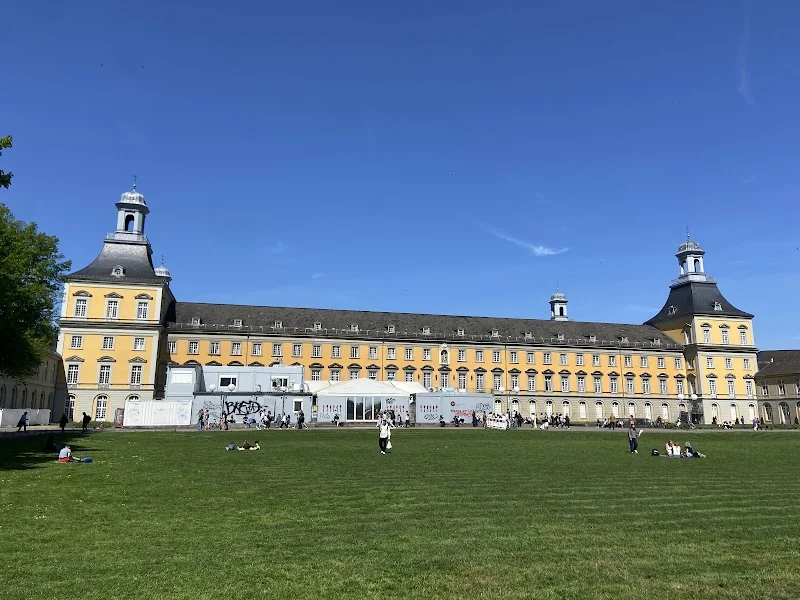
Hauptgebäude, Regina-Pacis-Weg 3, Bonn-Beuel
Regina-Pacis-Weg 3, 53113 Bonn, Germany
University of Bonn - Main Building | Address & Site Plan
The main building of the University of Bonn is much more than an administrative building. It is a piece of city history, a defining symbol of Bonn's city center, and for many visitors, the first place where the university can be experienced in its historical dimension. The baroque palace at the Hofgarten connects academic life, festive events, and the memory of the city's electoral past. Those searching for the building often seek practical answers: Where is the main entrance? What does the site plan look like? Where can one park? Which rooms are important inside? And what significance does the building have today as the major renovation is being prepared? These questions make the main building a topic of high relevance. Here, architecture, orientation, university life, and public perception intersect. The university itself describes the location as the starting point of a developed campus that has expanded from the city center throughout Bonn and beyond, while the main building continues to serve as the intellectual and spatial center. ([uni-bonn.de](https://www.uni-bonn.de/de/universitaet/ueber-die-uni/standorte/standorte?utm_source=openai))
History and Renovation of the Main Building
The history of the building begins with the baroque residence palace in the center of Bonn, which was gifted to the university by the Prussian king upon its founding in 1818 and has served as the main building ever since. Officially, the structure is described as the former residence palace of the Cologne electors; it is thus not only a university building but also a monument of political, cultural, and urban significance. Together with the Hofgarten, Poppelsdorfer Allee, and Poppelsdorfer Schloss, it forms a unique historical ensemble that continues to shape Bonn's city center today. The university also emphasizes that its campus has grown from this palace and now extends over a large number of locations. Nevertheless, the main building remains the most visible reference point of the university because it connects the memory of the founding period with the present-day reality of study, teaching, and research. The current location page also points out that the university uses numerous buildings in total and that the main building plays a key role within the historical framework. ([uni-bonn.de](https://www.uni-bonn.de/de/universitaet/ueber-die-uni/standorte/standorte?utm_source=openai))
Particularly important for the present is the upcoming comprehensive renovation. The University of Bonn describes the measure as by far the largest individual project of the coming decade; at the same time, the palace is characterized as a listed building and central to the university's location in the Hofgarten. According to official information, security measures have already begun, including the netting of the Hofgarten side of the facade in preparation for the later comprehensive renovation. This development is relevant for visitors and users because it explains why access routes, paths, and functional areas may gradually change. At the same time, the university is working on solutions for the transition period, such as interim buildings and replacement areas for lectures and other events. Official communications also mention the Forum of Knowledge, which is to take over tasks of the main building after the renovation and serve as a meeting place. For orientation on site, this means: The main building remains important, but its use will be carefully restructured in the coming years. ([uni-bonn.de](https://www.uni-bonn.de/de/universitaet/ueber-die-uni/standorte/sanierung-hauptgebaeude?utm_source=openai))
Address, Directions, and Parking at the Main Building
The official address is Regina-Pacis-Weg 3, 53113 Bonn. The building is located on the city center campus directly at the Hofgarten, making it one of the most central locations in the city. Those arriving by train can reach the main building from Bonn Central Station in just a few minutes on foot; the university explicitly mentions this short walking connection for visitors, students, and guests. Particularly convenient is the stop Universität/Markt, which is located directly at the Hofgarten meadow. According to official information, lines 16, 63, 66, 67, and 68 stop there, among others. For regional travelers, it is also interesting that line 66 offers a direct connection from Siegburg/Bonn towards the city center and stops at Universität/Markt. For this reason, the main building is perceived not only as a historical building but also as a very well-connected urban location. Anyone visiting Bonn's city center will almost inevitably pass by this building, as it is located at the edge of the Hofgarten and in close proximity to the most important urban axes. ([uni-bonn.de](https://www.uni-bonn.de/de/universitaet/unileben/veranstaltungen/unifest/anfahrt?utm_source=openai))
For those arriving by car, the University of Bonn primarily mentions the Unigarage as the most important visitor option. This parking garage is located beneath the Hofgarten meadow and offers direct access to the Hofgarten as well as an entrance via Stockenstraße. There are additional parking garages in the vicinity that are within walking distance and can be particularly useful during events in the main building. Those navigating to the location with a GPS will also benefit from the official information regarding the city center location, as the main building is well integrated into the traffic of Bonn's center but can also be heavily frequented depending on the time of day. For SEO practice, the search terms directions, parking, and site plan are closely related: Visitors generally want to know not only the address but also the quickest walking route from the train station, the appropriate stop, and the most convenient parking option. The location of the main building fits these needs very well because it allows for clear and modern visitor orientation despite its historical structure. ([uni-bonn.de](https://www.uni-bonn.de/de/universitaet/unileben/veranstaltungen/unifest/anfahrt?utm_source=openai))
Site Plan, Rooms, and the Most Important Halls in the Main Building
The official site plan of the university's main building shows how diverse the building is organized internally. On the various levels, there are, among other things, the auditorium, festival hall, senate hall, lecture halls I to XVI, as well as the arcade courtyard, light court, and cafeteria. This enumeration already makes it clear that the main building is not only a representative structure but also a functional university location with clearly defined usage areas. Several entrances are indicated on the site plan, including access via Hofgarten, Schlosskirche, Am Hof, Kaiserplatz, and Theaterplatz. This variety is important for visitors because it explains why the paths in the building may differ depending on the destination. Those attending an academic celebration, a concert, a lecture, or a museum visit typically need not only the house number but also a spatial understanding of which wing or floor the event takes place. The site plan thus serves a dual purpose: it aids in orientation and simultaneously makes the historical depth of the building visible, as the names of the halls and entrances reflect the varied history of use. ([uni-bonn.de](https://www.uni-bonn.de/de/studium/medien-studium/medien-organisation-des-studiums/medien-campus/hauptgebaeude.pdf))
Current events also show how lively these rooms are used. The University of Bonn regularly publishes dates for events taking place in the auditorium or the main building, such as academic celebrations, lectures, or musical formats. The official event calendar refers, for example, to the auditorium of the university and the festival hall as venues for concerts and festive formats. This makes it clear that the historical architecture continues to provide a concrete added value: it creates a framework suitable for public, scientific, and cultural occasions. Additionally, the Schlosskirche, located in the east wing under the east tower and only recognizable from the outside by a sign, is one of the special rooms of the building and exemplifies how closely university, church, and city history are intertwined. For visitors seeking photos, site plans, or hall designations, this spatial structure is particularly relevant because it explains the character of the building as a hybrid of monument, lecture hall center, and representative location. ([uni-bonn.de](https://www.uni-bonn.de/en/events/eroeffnung-des-akademischen-jahres-2025-26?utm_source=openai))
Opening Hours, Access, and Visitor Information
The official opening hours of the main building are clearly regulated: Monday to Friday from 07:00 to 22:00, Saturday from 07:00 to 12:45; it is closed on Sundays and public holidays. This is important information for visitors because many inquiries about the main building not only target its history but also the concrete access in everyday life. The university also points out that the city center campus with the main building is centrally located, so the visitor routes are usually short. At the same time, one should expect that access routes in or around the building may change during events or renovation phases. Especially during such times, it is advisable to check the current site page or event notice before visiting to ensure that the correct entrance and appropriate wing are used. This is particularly important when the visit is associated with a fixed appointment, such as an exam, a ceremonial event, or an official reception. With the clear time structure and central location, the main building remains a very well-planned place, even if it is in a transitional phase architecturally. ([uni-bonn.de](https://www.uni-bonn.de/de/universitaet/ueber-die-uni/standorte/standorte))
For visitors wishing to experience the building as part of a museum visit or guided tour, additional practical information applies. The university museum is located in the main building or in the palace section and is accessible via the entrance of the southwest wing; the university explicitly mentions the city center side of the building for directions and refers to parking options in the Markt-Tiefgarage as well as the paths from the main train station. Therefore, those visiting the main building for the first time should not only know the address but also specify the desired starting point within the building. This is particularly important because the building has several levels, wings, and entrances. During renovation periods, this point gains additional significance, as safety measures and detours may influence the paths. The university communicates this openly and emphasizes that the long-term preservation of the historical building and teaching is at the center. From a visitor's perspective, this means: The main building remains open and relevant, but practical access should always be planned with a current view of the official notices. ([uni-bonn.de](https://www.uni-bonn.de/de/universitaet/unileben/universitaetsmuseum/kontakt-anfahrt-oeffnungszeiten/kontakt-anfahrt-oeffnungszeiten?utm_source=openai))
Photos, Architecture, and Why the Building is So Impressive
Many people initially seek the main building of the University of Bonn for its photos. This is understandable, as the baroque facade appears particularly impressive in conjunction with the Hofgarten. Officially, the university describes the location as a historical focal point that, together with the Hofgarten and the surrounding architectural environment, forms a unique ensemble. This connection of green space, palace architecture, and urban location makes the building so photogenic. From the outside, the main building does not present itself as a sober administrative building but as a representative palace with a strong visual impact, which visitors recognize as a historical place at first glance. Those searching for images of the University of Bonn or the main building are typically interested not only in the architecture but also in the atmosphere: the interplay of city and park, the open Hofgarten space, the monumental effect of the palace, and the quiet dignity of the city center campus. The official 360-degree tour of the university also emphasizes this visual appeal and invites exploration of the university and its surroundings digitally. It becomes clear: The main building is not just a structure but a visible narrative about science, history, and urban space. ([uni-bonn.de](https://www.uni-bonn.de/de/universitaet/ueber-die-uni/standorte/standorte))
The building's special aura is also enhanced by the fact that it is not isolated in Bonn but is experienced as part of a vibrant urban context. The Hofgarten forms the green foreground, the city center the urban backdrop, and the individual room groups inside create the bridge between representation and use. For this reason, the building is suitable not only for photos but also for events, academic celebrations, and public encounters. Visitors quickly perceive that history is not museum-like and frozen here but remains integrated into the everyday life of a modern university. Even the current measures for securing and renovating do not fundamentally change this impression but rather show how seriously the university takes the preservation of the monument. This is important for long-term perception: The combination of historical architecture, central location, functional halls, and clear visitor orientation makes the main building one of the most well-known addresses in Bonn. That is why it is a particularly rewarding place for culture enthusiasts, students, guests, and photographers alike. ([uni-bonn.de](https://www.uni-bonn.de/de/universitaet/ueber-die-uni/standorte/sanierung-hauptgebaeude?utm_source=openai))
Sources:
- University of Bonn - Locations
- University of Bonn - Renovation Main Building
- University of Bonn - Main Building Site Plan
- University of Bonn - University Museum: Contact, Directions & Opening Hours
- Evangelical-Theological Faculty - Schlosskirche
- University of Bonn - Dies academicus and Events in the Main Building
Show moreShow less
University of Bonn - Main Building | Address & Site Plan
The main building of the University of Bonn is much more than an administrative building. It is a piece of city history, a defining symbol of Bonn's city center, and for many visitors, the first place where the university can be experienced in its historical dimension. The baroque palace at the Hofgarten connects academic life, festive events, and the memory of the city's electoral past. Those searching for the building often seek practical answers: Where is the main entrance? What does the site plan look like? Where can one park? Which rooms are important inside? And what significance does the building have today as the major renovation is being prepared? These questions make the main building a topic of high relevance. Here, architecture, orientation, university life, and public perception intersect. The university itself describes the location as the starting point of a developed campus that has expanded from the city center throughout Bonn and beyond, while the main building continues to serve as the intellectual and spatial center. ([uni-bonn.de](https://www.uni-bonn.de/de/universitaet/ueber-die-uni/standorte/standorte?utm_source=openai))
History and Renovation of the Main Building
The history of the building begins with the baroque residence palace in the center of Bonn, which was gifted to the university by the Prussian king upon its founding in 1818 and has served as the main building ever since. Officially, the structure is described as the former residence palace of the Cologne electors; it is thus not only a university building but also a monument of political, cultural, and urban significance. Together with the Hofgarten, Poppelsdorfer Allee, and Poppelsdorfer Schloss, it forms a unique historical ensemble that continues to shape Bonn's city center today. The university also emphasizes that its campus has grown from this palace and now extends over a large number of locations. Nevertheless, the main building remains the most visible reference point of the university because it connects the memory of the founding period with the present-day reality of study, teaching, and research. The current location page also points out that the university uses numerous buildings in total and that the main building plays a key role within the historical framework. ([uni-bonn.de](https://www.uni-bonn.de/de/universitaet/ueber-die-uni/standorte/standorte?utm_source=openai))
Particularly important for the present is the upcoming comprehensive renovation. The University of Bonn describes the measure as by far the largest individual project of the coming decade; at the same time, the palace is characterized as a listed building and central to the university's location in the Hofgarten. According to official information, security measures have already begun, including the netting of the Hofgarten side of the facade in preparation for the later comprehensive renovation. This development is relevant for visitors and users because it explains why access routes, paths, and functional areas may gradually change. At the same time, the university is working on solutions for the transition period, such as interim buildings and replacement areas for lectures and other events. Official communications also mention the Forum of Knowledge, which is to take over tasks of the main building after the renovation and serve as a meeting place. For orientation on site, this means: The main building remains important, but its use will be carefully restructured in the coming years. ([uni-bonn.de](https://www.uni-bonn.de/de/universitaet/ueber-die-uni/standorte/sanierung-hauptgebaeude?utm_source=openai))
Address, Directions, and Parking at the Main Building
The official address is Regina-Pacis-Weg 3, 53113 Bonn. The building is located on the city center campus directly at the Hofgarten, making it one of the most central locations in the city. Those arriving by train can reach the main building from Bonn Central Station in just a few minutes on foot; the university explicitly mentions this short walking connection for visitors, students, and guests. Particularly convenient is the stop Universität/Markt, which is located directly at the Hofgarten meadow. According to official information, lines 16, 63, 66, 67, and 68 stop there, among others. For regional travelers, it is also interesting that line 66 offers a direct connection from Siegburg/Bonn towards the city center and stops at Universität/Markt. For this reason, the main building is perceived not only as a historical building but also as a very well-connected urban location. Anyone visiting Bonn's city center will almost inevitably pass by this building, as it is located at the edge of the Hofgarten and in close proximity to the most important urban axes. ([uni-bonn.de](https://www.uni-bonn.de/de/universitaet/unileben/veranstaltungen/unifest/anfahrt?utm_source=openai))
For those arriving by car, the University of Bonn primarily mentions the Unigarage as the most important visitor option. This parking garage is located beneath the Hofgarten meadow and offers direct access to the Hofgarten as well as an entrance via Stockenstraße. There are additional parking garages in the vicinity that are within walking distance and can be particularly useful during events in the main building. Those navigating to the location with a GPS will also benefit from the official information regarding the city center location, as the main building is well integrated into the traffic of Bonn's center but can also be heavily frequented depending on the time of day. For SEO practice, the search terms directions, parking, and site plan are closely related: Visitors generally want to know not only the address but also the quickest walking route from the train station, the appropriate stop, and the most convenient parking option. The location of the main building fits these needs very well because it allows for clear and modern visitor orientation despite its historical structure. ([uni-bonn.de](https://www.uni-bonn.de/de/universitaet/unileben/veranstaltungen/unifest/anfahrt?utm_source=openai))
Site Plan, Rooms, and the Most Important Halls in the Main Building
The official site plan of the university's main building shows how diverse the building is organized internally. On the various levels, there are, among other things, the auditorium, festival hall, senate hall, lecture halls I to XVI, as well as the arcade courtyard, light court, and cafeteria. This enumeration already makes it clear that the main building is not only a representative structure but also a functional university location with clearly defined usage areas. Several entrances are indicated on the site plan, including access via Hofgarten, Schlosskirche, Am Hof, Kaiserplatz, and Theaterplatz. This variety is important for visitors because it explains why the paths in the building may differ depending on the destination. Those attending an academic celebration, a concert, a lecture, or a museum visit typically need not only the house number but also a spatial understanding of which wing or floor the event takes place. The site plan thus serves a dual purpose: it aids in orientation and simultaneously makes the historical depth of the building visible, as the names of the halls and entrances reflect the varied history of use. ([uni-bonn.de](https://www.uni-bonn.de/de/studium/medien-studium/medien-organisation-des-studiums/medien-campus/hauptgebaeude.pdf))
Current events also show how lively these rooms are used. The University of Bonn regularly publishes dates for events taking place in the auditorium or the main building, such as academic celebrations, lectures, or musical formats. The official event calendar refers, for example, to the auditorium of the university and the festival hall as venues for concerts and festive formats. This makes it clear that the historical architecture continues to provide a concrete added value: it creates a framework suitable for public, scientific, and cultural occasions. Additionally, the Schlosskirche, located in the east wing under the east tower and only recognizable from the outside by a sign, is one of the special rooms of the building and exemplifies how closely university, church, and city history are intertwined. For visitors seeking photos, site plans, or hall designations, this spatial structure is particularly relevant because it explains the character of the building as a hybrid of monument, lecture hall center, and representative location. ([uni-bonn.de](https://www.uni-bonn.de/en/events/eroeffnung-des-akademischen-jahres-2025-26?utm_source=openai))
Opening Hours, Access, and Visitor Information
The official opening hours of the main building are clearly regulated: Monday to Friday from 07:00 to 22:00, Saturday from 07:00 to 12:45; it is closed on Sundays and public holidays. This is important information for visitors because many inquiries about the main building not only target its history but also the concrete access in everyday life. The university also points out that the city center campus with the main building is centrally located, so the visitor routes are usually short. At the same time, one should expect that access routes in or around the building may change during events or renovation phases. Especially during such times, it is advisable to check the current site page or event notice before visiting to ensure that the correct entrance and appropriate wing are used. This is particularly important when the visit is associated with a fixed appointment, such as an exam, a ceremonial event, or an official reception. With the clear time structure and central location, the main building remains a very well-planned place, even if it is in a transitional phase architecturally. ([uni-bonn.de](https://www.uni-bonn.de/de/universitaet/ueber-die-uni/standorte/standorte))
For visitors wishing to experience the building as part of a museum visit or guided tour, additional practical information applies. The university museum is located in the main building or in the palace section and is accessible via the entrance of the southwest wing; the university explicitly mentions the city center side of the building for directions and refers to parking options in the Markt-Tiefgarage as well as the paths from the main train station. Therefore, those visiting the main building for the first time should not only know the address but also specify the desired starting point within the building. This is particularly important because the building has several levels, wings, and entrances. During renovation periods, this point gains additional significance, as safety measures and detours may influence the paths. The university communicates this openly and emphasizes that the long-term preservation of the historical building and teaching is at the center. From a visitor's perspective, this means: The main building remains open and relevant, but practical access should always be planned with a current view of the official notices. ([uni-bonn.de](https://www.uni-bonn.de/de/universitaet/unileben/universitaetsmuseum/kontakt-anfahrt-oeffnungszeiten/kontakt-anfahrt-oeffnungszeiten?utm_source=openai))
Photos, Architecture, and Why the Building is So Impressive
Many people initially seek the main building of the University of Bonn for its photos. This is understandable, as the baroque facade appears particularly impressive in conjunction with the Hofgarten. Officially, the university describes the location as a historical focal point that, together with the Hofgarten and the surrounding architectural environment, forms a unique ensemble. This connection of green space, palace architecture, and urban location makes the building so photogenic. From the outside, the main building does not present itself as a sober administrative building but as a representative palace with a strong visual impact, which visitors recognize as a historical place at first glance. Those searching for images of the University of Bonn or the main building are typically interested not only in the architecture but also in the atmosphere: the interplay of city and park, the open Hofgarten space, the monumental effect of the palace, and the quiet dignity of the city center campus. The official 360-degree tour of the university also emphasizes this visual appeal and invites exploration of the university and its surroundings digitally. It becomes clear: The main building is not just a structure but a visible narrative about science, history, and urban space. ([uni-bonn.de](https://www.uni-bonn.de/de/universitaet/ueber-die-uni/standorte/standorte))
The building's special aura is also enhanced by the fact that it is not isolated in Bonn but is experienced as part of a vibrant urban context. The Hofgarten forms the green foreground, the city center the urban backdrop, and the individual room groups inside create the bridge between representation and use. For this reason, the building is suitable not only for photos but also for events, academic celebrations, and public encounters. Visitors quickly perceive that history is not museum-like and frozen here but remains integrated into the everyday life of a modern university. Even the current measures for securing and renovating do not fundamentally change this impression but rather show how seriously the university takes the preservation of the monument. This is important for long-term perception: The combination of historical architecture, central location, functional halls, and clear visitor orientation makes the main building one of the most well-known addresses in Bonn. That is why it is a particularly rewarding place for culture enthusiasts, students, guests, and photographers alike. ([uni-bonn.de](https://www.uni-bonn.de/de/universitaet/ueber-die-uni/standorte/sanierung-hauptgebaeude?utm_source=openai))
Sources:
- University of Bonn - Locations
- University of Bonn - Renovation Main Building
- University of Bonn - Main Building Site Plan
- University of Bonn - University Museum: Contact, Directions & Opening Hours
- Evangelical-Theological Faculty - Schlosskirche
- University of Bonn - Dies academicus and Events in the Main Building
University of Bonn - Main Building | Address & Site Plan
The main building of the University of Bonn is much more than an administrative building. It is a piece of city history, a defining symbol of Bonn's city center, and for many visitors, the first place where the university can be experienced in its historical dimension. The baroque palace at the Hofgarten connects academic life, festive events, and the memory of the city's electoral past. Those searching for the building often seek practical answers: Where is the main entrance? What does the site plan look like? Where can one park? Which rooms are important inside? And what significance does the building have today as the major renovation is being prepared? These questions make the main building a topic of high relevance. Here, architecture, orientation, university life, and public perception intersect. The university itself describes the location as the starting point of a developed campus that has expanded from the city center throughout Bonn and beyond, while the main building continues to serve as the intellectual and spatial center. ([uni-bonn.de](https://www.uni-bonn.de/de/universitaet/ueber-die-uni/standorte/standorte?utm_source=openai))
History and Renovation of the Main Building
The history of the building begins with the baroque residence palace in the center of Bonn, which was gifted to the university by the Prussian king upon its founding in 1818 and has served as the main building ever since. Officially, the structure is described as the former residence palace of the Cologne electors; it is thus not only a university building but also a monument of political, cultural, and urban significance. Together with the Hofgarten, Poppelsdorfer Allee, and Poppelsdorfer Schloss, it forms a unique historical ensemble that continues to shape Bonn's city center today. The university also emphasizes that its campus has grown from this palace and now extends over a large number of locations. Nevertheless, the main building remains the most visible reference point of the university because it connects the memory of the founding period with the present-day reality of study, teaching, and research. The current location page also points out that the university uses numerous buildings in total and that the main building plays a key role within the historical framework. ([uni-bonn.de](https://www.uni-bonn.de/de/universitaet/ueber-die-uni/standorte/standorte?utm_source=openai))
Particularly important for the present is the upcoming comprehensive renovation. The University of Bonn describes the measure as by far the largest individual project of the coming decade; at the same time, the palace is characterized as a listed building and central to the university's location in the Hofgarten. According to official information, security measures have already begun, including the netting of the Hofgarten side of the facade in preparation for the later comprehensive renovation. This development is relevant for visitors and users because it explains why access routes, paths, and functional areas may gradually change. At the same time, the university is working on solutions for the transition period, such as interim buildings and replacement areas for lectures and other events. Official communications also mention the Forum of Knowledge, which is to take over tasks of the main building after the renovation and serve as a meeting place. For orientation on site, this means: The main building remains important, but its use will be carefully restructured in the coming years. ([uni-bonn.de](https://www.uni-bonn.de/de/universitaet/ueber-die-uni/standorte/sanierung-hauptgebaeude?utm_source=openai))
Address, Directions, and Parking at the Main Building
The official address is Regina-Pacis-Weg 3, 53113 Bonn. The building is located on the city center campus directly at the Hofgarten, making it one of the most central locations in the city. Those arriving by train can reach the main building from Bonn Central Station in just a few minutes on foot; the university explicitly mentions this short walking connection for visitors, students, and guests. Particularly convenient is the stop Universität/Markt, which is located directly at the Hofgarten meadow. According to official information, lines 16, 63, 66, 67, and 68 stop there, among others. For regional travelers, it is also interesting that line 66 offers a direct connection from Siegburg/Bonn towards the city center and stops at Universität/Markt. For this reason, the main building is perceived not only as a historical building but also as a very well-connected urban location. Anyone visiting Bonn's city center will almost inevitably pass by this building, as it is located at the edge of the Hofgarten and in close proximity to the most important urban axes. ([uni-bonn.de](https://www.uni-bonn.de/de/universitaet/unileben/veranstaltungen/unifest/anfahrt?utm_source=openai))
For those arriving by car, the University of Bonn primarily mentions the Unigarage as the most important visitor option. This parking garage is located beneath the Hofgarten meadow and offers direct access to the Hofgarten as well as an entrance via Stockenstraße. There are additional parking garages in the vicinity that are within walking distance and can be particularly useful during events in the main building. Those navigating to the location with a GPS will also benefit from the official information regarding the city center location, as the main building is well integrated into the traffic of Bonn's center but can also be heavily frequented depending on the time of day. For SEO practice, the search terms directions, parking, and site plan are closely related: Visitors generally want to know not only the address but also the quickest walking route from the train station, the appropriate stop, and the most convenient parking option. The location of the main building fits these needs very well because it allows for clear and modern visitor orientation despite its historical structure. ([uni-bonn.de](https://www.uni-bonn.de/de/universitaet/unileben/veranstaltungen/unifest/anfahrt?utm_source=openai))
Site Plan, Rooms, and the Most Important Halls in the Main Building
The official site plan of the university's main building shows how diverse the building is organized internally. On the various levels, there are, among other things, the auditorium, festival hall, senate hall, lecture halls I to XVI, as well as the arcade courtyard, light court, and cafeteria. This enumeration already makes it clear that the main building is not only a representative structure but also a functional university location with clearly defined usage areas. Several entrances are indicated on the site plan, including access via Hofgarten, Schlosskirche, Am Hof, Kaiserplatz, and Theaterplatz. This variety is important for visitors because it explains why the paths in the building may differ depending on the destination. Those attending an academic celebration, a concert, a lecture, or a museum visit typically need not only the house number but also a spatial understanding of which wing or floor the event takes place. The site plan thus serves a dual purpose: it aids in orientation and simultaneously makes the historical depth of the building visible, as the names of the halls and entrances reflect the varied history of use. ([uni-bonn.de](https://www.uni-bonn.de/de/studium/medien-studium/medien-organisation-des-studiums/medien-campus/hauptgebaeude.pdf))
Current events also show how lively these rooms are used. The University of Bonn regularly publishes dates for events taking place in the auditorium or the main building, such as academic celebrations, lectures, or musical formats. The official event calendar refers, for example, to the auditorium of the university and the festival hall as venues for concerts and festive formats. This makes it clear that the historical architecture continues to provide a concrete added value: it creates a framework suitable for public, scientific, and cultural occasions. Additionally, the Schlosskirche, located in the east wing under the east tower and only recognizable from the outside by a sign, is one of the special rooms of the building and exemplifies how closely university, church, and city history are intertwined. For visitors seeking photos, site plans, or hall designations, this spatial structure is particularly relevant because it explains the character of the building as a hybrid of monument, lecture hall center, and representative location. ([uni-bonn.de](https://www.uni-bonn.de/en/events/eroeffnung-des-akademischen-jahres-2025-26?utm_source=openai))
Opening Hours, Access, and Visitor Information
The official opening hours of the main building are clearly regulated: Monday to Friday from 07:00 to 22:00, Saturday from 07:00 to 12:45; it is closed on Sundays and public holidays. This is important information for visitors because many inquiries about the main building not only target its history but also the concrete access in everyday life. The university also points out that the city center campus with the main building is centrally located, so the visitor routes are usually short. At the same time, one should expect that access routes in or around the building may change during events or renovation phases. Especially during such times, it is advisable to check the current site page or event notice before visiting to ensure that the correct entrance and appropriate wing are used. This is particularly important when the visit is associated with a fixed appointment, such as an exam, a ceremonial event, or an official reception. With the clear time structure and central location, the main building remains a very well-planned place, even if it is in a transitional phase architecturally. ([uni-bonn.de](https://www.uni-bonn.de/de/universitaet/ueber-die-uni/standorte/standorte))
For visitors wishing to experience the building as part of a museum visit or guided tour, additional practical information applies. The university museum is located in the main building or in the palace section and is accessible via the entrance of the southwest wing; the university explicitly mentions the city center side of the building for directions and refers to parking options in the Markt-Tiefgarage as well as the paths from the main train station. Therefore, those visiting the main building for the first time should not only know the address but also specify the desired starting point within the building. This is particularly important because the building has several levels, wings, and entrances. During renovation periods, this point gains additional significance, as safety measures and detours may influence the paths. The university communicates this openly and emphasizes that the long-term preservation of the historical building and teaching is at the center. From a visitor's perspective, this means: The main building remains open and relevant, but practical access should always be planned with a current view of the official notices. ([uni-bonn.de](https://www.uni-bonn.de/de/universitaet/unileben/universitaetsmuseum/kontakt-anfahrt-oeffnungszeiten/kontakt-anfahrt-oeffnungszeiten?utm_source=openai))
Photos, Architecture, and Why the Building is So Impressive
Many people initially seek the main building of the University of Bonn for its photos. This is understandable, as the baroque facade appears particularly impressive in conjunction with the Hofgarten. Officially, the university describes the location as a historical focal point that, together with the Hofgarten and the surrounding architectural environment, forms a unique ensemble. This connection of green space, palace architecture, and urban location makes the building so photogenic. From the outside, the main building does not present itself as a sober administrative building but as a representative palace with a strong visual impact, which visitors recognize as a historical place at first glance. Those searching for images of the University of Bonn or the main building are typically interested not only in the architecture but also in the atmosphere: the interplay of city and park, the open Hofgarten space, the monumental effect of the palace, and the quiet dignity of the city center campus. The official 360-degree tour of the university also emphasizes this visual appeal and invites exploration of the university and its surroundings digitally. It becomes clear: The main building is not just a structure but a visible narrative about science, history, and urban space. ([uni-bonn.de](https://www.uni-bonn.de/de/universitaet/ueber-die-uni/standorte/standorte))
The building's special aura is also enhanced by the fact that it is not isolated in Bonn but is experienced as part of a vibrant urban context. The Hofgarten forms the green foreground, the city center the urban backdrop, and the individual room groups inside create the bridge between representation and use. For this reason, the building is suitable not only for photos but also for events, academic celebrations, and public encounters. Visitors quickly perceive that history is not museum-like and frozen here but remains integrated into the everyday life of a modern university. Even the current measures for securing and renovating do not fundamentally change this impression but rather show how seriously the university takes the preservation of the monument. This is important for long-term perception: The combination of historical architecture, central location, functional halls, and clear visitor orientation makes the main building one of the most well-known addresses in Bonn. That is why it is a particularly rewarding place for culture enthusiasts, students, guests, and photographers alike. ([uni-bonn.de](https://www.uni-bonn.de/de/universitaet/ueber-die-uni/standorte/sanierung-hauptgebaeude?utm_source=openai))
Sources:
- University of Bonn - Locations
- University of Bonn - Renovation Main Building
- University of Bonn - Main Building Site Plan
- University of Bonn - University Museum: Contact, Directions & Opening Hours
- Evangelical-Theological Faculty - Schlosskirche
- University of Bonn - Dies academicus and Events in the Main Building
Upcoming Events
No events found
Frequently Asked Questions
Reviews
Suiram Travel
16. March 2024
Big yellow building next to the park and the river. So impressive
Stefan Urbach (Graf von Hohenfels)
18. January 2022
Very clean and decently designed as well as very impressive especially from the outside. It is worth going here for food and drinks nearby.
Michael Abert
14. June 2022
Highly recommended
Harald Bujk
30. November 2024
jessence
10. May 2022