
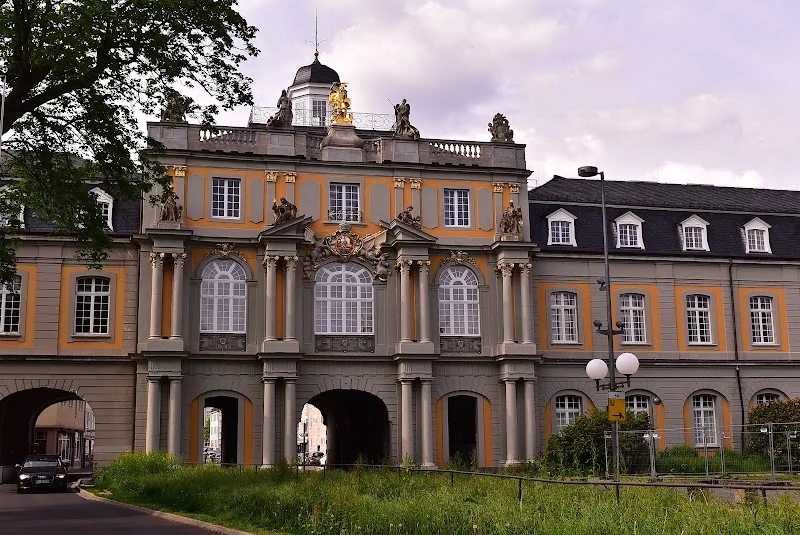
Bonn
Am Hof 1, 53113 Bonn, Deutschland
University of Bonn | Address & Degree Programs
The University of Bonn, officially Rheinische Friedrich-Wilhelms-Universität Bonn, combines tradition, research, and urban life in a compact space. The university has been rooted in the city center of Bonn since 1818, with its historic heart being the baroque main building, which was gifted to the new university by the Prussian king. Today, the university is not only a monument of academic history but also a modern research university with seven faculties, around 31,318 students, and 253 degree programs. Since 2019, Bonn has been one of the German excellence universities and also represents a campus network that extends across many buildings in the city and beyond. Those looking for address, degree programs, library, email, or job offers will find clearly structured information at the University of Bonn and an unusually dense connection between science, city, and everyday life. ([uni-bonn.de](https://www.uni-bonn.de/en/university/about-the-university/locations-1/locations))
Degree Programs at the University of Bonn: Law, Medicine, Mathematics, and Dentistry
The degree landscape at the University of Bonn is broad, clearly structured, and strongly research-oriented. The university describes its offerings through fields of study and degree programs that range from natural sciences, mathematics, and environmental sciences to medicine, life and health sciences, as well as economics, law, humanities, and teacher education. For prospective students, it is particularly important that the university not only offers a high number of subjects but also knows many pathways between bachelor's, master's, state examinations, and doctoral studies. This makes Bonn attractive for people who are still orienting themselves or are already specifically searching for a subject. The Central Student Advisory Service is the first point of contact for all questions related to studying and supports from the initial idea to the concrete application. Particularly for search queries like University Bonn degree programs or University Bonn professors, it becomes clear that the university offers both academic breadth and subject depth. ([uni-bonn.de](https://www.uni-bonn.de/de/studium/studienangebot/studienfelder))
Particularly in demand at the University of Bonn are the fields of law, medicine, mathematics, and dentistry. The Medical Faculty explicitly mentions the degree programs in Human Medicine and Dentistry and adds international master's programs in Immunology and Neurosciences, as well as the consecutive master's program in Global Health. The legal field is present not only through the classic law degree program but also through the Bachelor in Law and Economics, which combines legal and economic content and trains students in an interdisciplinary manner. Mathematics has its own profile in Bonn with the Mathematical Institute, the Mathematics department, and the Hausdorff Center for Mathematics, which is strongly visible internationally. For those searching for University Bonn Medicine or University Bonn Mathematics, it is therefore important: Bonn offers not only courses but also a dense scientific environment with research, specialization, and clear structures. ([medfak.uni-bonn.de](https://www.medfak.uni-bonn.de/en/studies-teaching))
Address, Campus, and Directions to the University of Bonn
The University of Bonn is closely connected to the city spatially and is nevertheless distributed across several locations. The official heart is located at Hof 1, 53113 Bonn. The main entrance to the main building and the arcade courtyard is accessible via Am Hof; additional entrances are located at Regina-Pacis-Weg in the Hofgarten. For public transport, the university names the stops Bonn Hauptbahnhof and Markt; from the main station, the way leads via the bus station directly towards the city center and the university. The university itself does not describe its presence as a single campus but as a network of locations that spreads across the city and includes historical sites such as the main building, the Hofgarten, and Poppelsdorf. For people searching for University Bonn address, this is particularly practical: the central location makes the university easily findable and clearly anchored in the city center of Bonn. ([uni-bonn.de](https://www.uni-bonn.de/en/university/about-the-university/locations-1/locations))
The spatial identity also includes that the university is distributed across several campus areas. The official location page mentions five main locations within Bonn and additional research and teaching sites outside the city. The central Bonn Campus houses the main building as well as the Faculty of Arts and the Department of Law, while the Poppelsdorf Campus takes an interdisciplinary approach and bundles several disciplines from different faculties. Additionally, Endenich and Castell are other locations. The university also points out that the baroque main building is currently being renovated, and university operations are therefore organized across various rooms and locations. Those arriving by car will find specific information about parking options for the Juridicum in the university or market underground garages. For daily use, however, public transport remains the clearly communicated option. ([uni-bonn.de](https://www.uni-bonn.de/en/university/about-the-university/locations-1/locations))
Library of the University of Bonn: ULB, Learning Spaces, and Subject Collections
The library is a central part of university life in Bonn. The University and State Library, short ULB, is the central lending and archival library of the university and provides university members with information, printed literature, and digital media. The university also emphasizes that the collections of all libraries are searchable via the search portal bonnus. For students and researchers, this is an important advantage because it aligns subject literature, workplaces, and service offerings within one system. Particularly for search queries like University Bonn Library, not just a building is in focus, but a networked library system with central access, digital literature supply, and clear contacts. The ULB is thus much more than a place to borrow books; it is a service core for research, study, and academic work. ([uni-bonn.de](https://www.uni-bonn.de/de/universitaet/organisation/bibliotheken/bibliotheken))
Particularly relevant for everyday life are the specific locations. The main library of the ULB is located at Adenauerallee 39 to 41 in 53113 Bonn, and the departmental library MNL for Medicine, Natural Sciences, and Agriculture is at Friedrich-Hirzebruch-Allee 4 in 53115 Bonn. In addition, there are a total of 56 decentralized libraries at the University of Bonn that provide specialized literature for specific fields of work. Many of these libraries are primarily intended for on-site use and are not regularly available for loan. For learners, this means a high density of quiet workspaces, institute-related collections, and specialized materials. So, for those wondering where to work concentrated at the University of Bonn, they will find in the ULB and in the subject libraries a very strong network that extends from the central location to individual institutes. ([uni-bonn.de](https://www.uni-bonn.de/de/universitaet/organisation/bibliotheken/bibliotheken))
Email, Uni-ID, and Login: Webmail and eCampus in Everyday Life
The digital everyday life at the University of Bonn includes email, Uni-ID, and login in a clear system. All members receive an email address in the format uni-id@uni-bonn.de, and through the webmail portal, they can access their university emails and utilize further functions of the email service. The university refers to webmail access and explains that the university email address is used for study and work-related information. Those searching under University Bonn Email or University Bonn Login are essentially looking for exactly these accesses: a personal mailbox, an official identity, and a reliable way to the university's services. The system is designed to work for students as well as for employees, researchers, and educators. ([hrz.uni-bonn.de](https://www.hrz.uni-bonn.de/de/services/e-mail-kalender-kontakte/e-mail))
The learning platform of the University of Bonn is called eCampus and is based on ILIAS. It is available to all members of the university and serves to support courses and study groups. The login is done with the Uni-ID and the associated password; the Uni-ID is the part before the @ in the university email address. According to the official instructions, courses that are set up in BASIS are automatically linked with eCampus, allowing students to find their courses there. For starting their studies, this is particularly important because many organizational questions run through the digital infrastructure. Therefore, those studying at the University of Bonn need not only the address of the university but also the interplay of email, Uni-ID, webmail, and eCampus. This connection makes university life manageable and communication with faculties, examination offices, and services significantly easier. ([ecampus-services.uni-bonn.de](https://www.ecampus-services.uni-bonn.de/de/medienpool-de/anleitungen-ecampus/anleitung_ecampus_erste_schritte_studierende_20230824.pdf/%40%40download/file/anleitung_ecampus_erste_Schritte_Studierende_20231024.pdf))
History and Academic Profile Since 1818
The history of the University of Bonn begins on October 18, 1818. The university was founded by King Friedrich Wilhelm III of Prussia and early on developed into a scientific institution with a strong tradition-conscious self-understanding. The baroque residence palace in the city center of Bonn, which the king gifted to the university, still serves as a defining symbol of the university. The official historical representation makes it clear that Bonn has been not only a university with a long past since the 19th century but also an institution whose academic rituals, buildings, and structures still remind of its founding. The annual opening of the academic year has a very long tradition at the university and goes directly back to the early days of the institution. Therefore, those searching for University Bonn History will not find an abstract chronicle but a living connection between architecture, rituals, and academic identity. ([uni-bonn.de](https://www.uni-bonn.de/de/universitaet/organisation/weitere-einrichtungen/archiv-der-universitaet/universitaetsgeschichte-1/geschichte-der-rheinischen-friedrich-wilhelms-universitaet/geschichte-der-uni-bonn?set_language=de&utm_source=openai))
Today's profile includes the claim to combine historical depth with modern excellence. The University of Bonn has been an excellence university since 2019, has eight excellence clusters, and describes itself as one of the most successful universities in the German competition. In the facts and figures, the university refers to 31,318 students, 6,769 doctoral candidates, and 253 degree programs. Additionally, there are outstanding personalities from mathematics, physics, and economics, including researchers associated with Fields Medals and Nobel Prizes. The university also emphasizes that the two German Fields Medal winners are connected to Bonn and that the mathematical profile in the city is visible worldwide. For search queries like University Bonn Professors or University Bonn History, this mix is particularly important: Bonn stands not only for the past but for a scientific environment that receives international attention and has a significant impact in many disciplines. ([uni-bonn.de](https://www.uni-bonn.de/en/university/about-the-university/facts-and-figures))
Job Offers and Working at the University of Bonn
The University of Bonn is not only a place to study but also a large employer. On the official career page, the university describes itself as an attractive employer in the middle of the city of Bonn and points out that research, teaching, learning, and working take place throughout the entire urban area. More than 6,000 people work at the university, making it one of the largest employers in the region. For those searching for University Bonn Jobs or University Bonn Job Offers, this is a strong signal: the university offers not only classic academic careers but also many professional perspectives in administration, technology, IT, training, and service. This creates a working environment that combines scientific excellence with stable organizational structures. ([uni-bonn.de](https://www.uni-bonn.de/en/university/working-at-the-university?utm_source=openai))
The job offers cover a wide range. On the career page, the university explicitly mentions professorships, science, IT, technology, administration, and training. Additionally, there are offers for traineeships, academic career paths, administrative roles, and technical specialists. The official representation emphasizes diversity, internationality, and the connection of student life with top research. It also becomes clear on the employee side that the University of Bonn collaborates closely in research, teaching, and administration and offers reliable structures in all areas. Therefore, those looking for a professorship, an academic position, or an entry into administration will find at the University of Bonn not a one-sided working world but a multifaceted environment with clear responsibilities. Particularly for the keywords University Bonn Jobs, University Bonn Professorships, and University Bonn Job Offers, this mix of size, tradition, and specialization is particularly relevant. ([uni-bonn.de](https://www.uni-bonn.de/de/universitaet/arbeiten-an-der-uni/stellenangebote?utm_source=openai))
Even for career starters and young professionals, the university is interesting. The career pages mention training, human resource development, and opportunities for trainees, which shows that Bonn addresses not only academics but also people who want to develop in technical, organizational, or administrative areas. In connection with the numerous institutes, clinics, and faculties, this creates a working landscape that goes far beyond the classic teaching operation. The university is so present in Bonn and the surrounding area that career paths in the city can be directly connected with university life. Precisely for this reason, the university often appears in search queries both as an educational institution and as an employer. Therefore, those who want not only to study but also to work or apply will find at the University of Bonn a wide and professionally structured offer. ([uni-bonn.de](https://www.uni-bonn.de/en/university/working-at-the-university?utm_source=openai))
Sources:
- University of Bonn - Facts and Figures
- University of Bonn - Locations
- University of Bonn - Faculties
- University of Bonn - Libraries
- University of Bonn HRZ - E-Mail
- Medical Faculty University of Bonn - Studies and Teaching
- University of Bonn Law and Economics - Program
- University of Bonn - Working at the University
Show moreShow less
University of Bonn | Address & Degree Programs
The University of Bonn, officially Rheinische Friedrich-Wilhelms-Universität Bonn, combines tradition, research, and urban life in a compact space. The university has been rooted in the city center of Bonn since 1818, with its historic heart being the baroque main building, which was gifted to the new university by the Prussian king. Today, the university is not only a monument of academic history but also a modern research university with seven faculties, around 31,318 students, and 253 degree programs. Since 2019, Bonn has been one of the German excellence universities and also represents a campus network that extends across many buildings in the city and beyond. Those looking for address, degree programs, library, email, or job offers will find clearly structured information at the University of Bonn and an unusually dense connection between science, city, and everyday life. ([uni-bonn.de](https://www.uni-bonn.de/en/university/about-the-university/locations-1/locations))
Degree Programs at the University of Bonn: Law, Medicine, Mathematics, and Dentistry
The degree landscape at the University of Bonn is broad, clearly structured, and strongly research-oriented. The university describes its offerings through fields of study and degree programs that range from natural sciences, mathematics, and environmental sciences to medicine, life and health sciences, as well as economics, law, humanities, and teacher education. For prospective students, it is particularly important that the university not only offers a high number of subjects but also knows many pathways between bachelor's, master's, state examinations, and doctoral studies. This makes Bonn attractive for people who are still orienting themselves or are already specifically searching for a subject. The Central Student Advisory Service is the first point of contact for all questions related to studying and supports from the initial idea to the concrete application. Particularly for search queries like University Bonn degree programs or University Bonn professors, it becomes clear that the university offers both academic breadth and subject depth. ([uni-bonn.de](https://www.uni-bonn.de/de/studium/studienangebot/studienfelder))
Particularly in demand at the University of Bonn are the fields of law, medicine, mathematics, and dentistry. The Medical Faculty explicitly mentions the degree programs in Human Medicine and Dentistry and adds international master's programs in Immunology and Neurosciences, as well as the consecutive master's program in Global Health. The legal field is present not only through the classic law degree program but also through the Bachelor in Law and Economics, which combines legal and economic content and trains students in an interdisciplinary manner. Mathematics has its own profile in Bonn with the Mathematical Institute, the Mathematics department, and the Hausdorff Center for Mathematics, which is strongly visible internationally. For those searching for University Bonn Medicine or University Bonn Mathematics, it is therefore important: Bonn offers not only courses but also a dense scientific environment with research, specialization, and clear structures. ([medfak.uni-bonn.de](https://www.medfak.uni-bonn.de/en/studies-teaching))
Address, Campus, and Directions to the University of Bonn
The University of Bonn is closely connected to the city spatially and is nevertheless distributed across several locations. The official heart is located at Hof 1, 53113 Bonn. The main entrance to the main building and the arcade courtyard is accessible via Am Hof; additional entrances are located at Regina-Pacis-Weg in the Hofgarten. For public transport, the university names the stops Bonn Hauptbahnhof and Markt; from the main station, the way leads via the bus station directly towards the city center and the university. The university itself does not describe its presence as a single campus but as a network of locations that spreads across the city and includes historical sites such as the main building, the Hofgarten, and Poppelsdorf. For people searching for University Bonn address, this is particularly practical: the central location makes the university easily findable and clearly anchored in the city center of Bonn. ([uni-bonn.de](https://www.uni-bonn.de/en/university/about-the-university/locations-1/locations))
The spatial identity also includes that the university is distributed across several campus areas. The official location page mentions five main locations within Bonn and additional research and teaching sites outside the city. The central Bonn Campus houses the main building as well as the Faculty of Arts and the Department of Law, while the Poppelsdorf Campus takes an interdisciplinary approach and bundles several disciplines from different faculties. Additionally, Endenich and Castell are other locations. The university also points out that the baroque main building is currently being renovated, and university operations are therefore organized across various rooms and locations. Those arriving by car will find specific information about parking options for the Juridicum in the university or market underground garages. For daily use, however, public transport remains the clearly communicated option. ([uni-bonn.de](https://www.uni-bonn.de/en/university/about-the-university/locations-1/locations))
Library of the University of Bonn: ULB, Learning Spaces, and Subject Collections
The library is a central part of university life in Bonn. The University and State Library, short ULB, is the central lending and archival library of the university and provides university members with information, printed literature, and digital media. The university also emphasizes that the collections of all libraries are searchable via the search portal bonnus. For students and researchers, this is an important advantage because it aligns subject literature, workplaces, and service offerings within one system. Particularly for search queries like University Bonn Library, not just a building is in focus, but a networked library system with central access, digital literature supply, and clear contacts. The ULB is thus much more than a place to borrow books; it is a service core for research, study, and academic work. ([uni-bonn.de](https://www.uni-bonn.de/de/universitaet/organisation/bibliotheken/bibliotheken))
Particularly relevant for everyday life are the specific locations. The main library of the ULB is located at Adenauerallee 39 to 41 in 53113 Bonn, and the departmental library MNL for Medicine, Natural Sciences, and Agriculture is at Friedrich-Hirzebruch-Allee 4 in 53115 Bonn. In addition, there are a total of 56 decentralized libraries at the University of Bonn that provide specialized literature for specific fields of work. Many of these libraries are primarily intended for on-site use and are not regularly available for loan. For learners, this means a high density of quiet workspaces, institute-related collections, and specialized materials. So, for those wondering where to work concentrated at the University of Bonn, they will find in the ULB and in the subject libraries a very strong network that extends from the central location to individual institutes. ([uni-bonn.de](https://www.uni-bonn.de/de/universitaet/organisation/bibliotheken/bibliotheken))
Email, Uni-ID, and Login: Webmail and eCampus in Everyday Life
The digital everyday life at the University of Bonn includes email, Uni-ID, and login in a clear system. All members receive an email address in the format uni-id@uni-bonn.de, and through the webmail portal, they can access their university emails and utilize further functions of the email service. The university refers to webmail access and explains that the university email address is used for study and work-related information. Those searching under University Bonn Email or University Bonn Login are essentially looking for exactly these accesses: a personal mailbox, an official identity, and a reliable way to the university's services. The system is designed to work for students as well as for employees, researchers, and educators. ([hrz.uni-bonn.de](https://www.hrz.uni-bonn.de/de/services/e-mail-kalender-kontakte/e-mail))
The learning platform of the University of Bonn is called eCampus and is based on ILIAS. It is available to all members of the university and serves to support courses and study groups. The login is done with the Uni-ID and the associated password; the Uni-ID is the part before the @ in the university email address. According to the official instructions, courses that are set up in BASIS are automatically linked with eCampus, allowing students to find their courses there. For starting their studies, this is particularly important because many organizational questions run through the digital infrastructure. Therefore, those studying at the University of Bonn need not only the address of the university but also the interplay of email, Uni-ID, webmail, and eCampus. This connection makes university life manageable and communication with faculties, examination offices, and services significantly easier. ([ecampus-services.uni-bonn.de](https://www.ecampus-services.uni-bonn.de/de/medienpool-de/anleitungen-ecampus/anleitung_ecampus_erste_schritte_studierende_20230824.pdf/%40%40download/file/anleitung_ecampus_erste_Schritte_Studierende_20231024.pdf))
History and Academic Profile Since 1818
The history of the University of Bonn begins on October 18, 1818. The university was founded by King Friedrich Wilhelm III of Prussia and early on developed into a scientific institution with a strong tradition-conscious self-understanding. The baroque residence palace in the city center of Bonn, which the king gifted to the university, still serves as a defining symbol of the university. The official historical representation makes it clear that Bonn has been not only a university with a long past since the 19th century but also an institution whose academic rituals, buildings, and structures still remind of its founding. The annual opening of the academic year has a very long tradition at the university and goes directly back to the early days of the institution. Therefore, those searching for University Bonn History will not find an abstract chronicle but a living connection between architecture, rituals, and academic identity. ([uni-bonn.de](https://www.uni-bonn.de/de/universitaet/organisation/weitere-einrichtungen/archiv-der-universitaet/universitaetsgeschichte-1/geschichte-der-rheinischen-friedrich-wilhelms-universitaet/geschichte-der-uni-bonn?set_language=de&utm_source=openai))
Today's profile includes the claim to combine historical depth with modern excellence. The University of Bonn has been an excellence university since 2019, has eight excellence clusters, and describes itself as one of the most successful universities in the German competition. In the facts and figures, the university refers to 31,318 students, 6,769 doctoral candidates, and 253 degree programs. Additionally, there are outstanding personalities from mathematics, physics, and economics, including researchers associated with Fields Medals and Nobel Prizes. The university also emphasizes that the two German Fields Medal winners are connected to Bonn and that the mathematical profile in the city is visible worldwide. For search queries like University Bonn Professors or University Bonn History, this mix is particularly important: Bonn stands not only for the past but for a scientific environment that receives international attention and has a significant impact in many disciplines. ([uni-bonn.de](https://www.uni-bonn.de/en/university/about-the-university/facts-and-figures))
Job Offers and Working at the University of Bonn
The University of Bonn is not only a place to study but also a large employer. On the official career page, the university describes itself as an attractive employer in the middle of the city of Bonn and points out that research, teaching, learning, and working take place throughout the entire urban area. More than 6,000 people work at the university, making it one of the largest employers in the region. For those searching for University Bonn Jobs or University Bonn Job Offers, this is a strong signal: the university offers not only classic academic careers but also many professional perspectives in administration, technology, IT, training, and service. This creates a working environment that combines scientific excellence with stable organizational structures. ([uni-bonn.de](https://www.uni-bonn.de/en/university/working-at-the-university?utm_source=openai))
The job offers cover a wide range. On the career page, the university explicitly mentions professorships, science, IT, technology, administration, and training. Additionally, there are offers for traineeships, academic career paths, administrative roles, and technical specialists. The official representation emphasizes diversity, internationality, and the connection of student life with top research. It also becomes clear on the employee side that the University of Bonn collaborates closely in research, teaching, and administration and offers reliable structures in all areas. Therefore, those looking for a professorship, an academic position, or an entry into administration will find at the University of Bonn not a one-sided working world but a multifaceted environment with clear responsibilities. Particularly for the keywords University Bonn Jobs, University Bonn Professorships, and University Bonn Job Offers, this mix of size, tradition, and specialization is particularly relevant. ([uni-bonn.de](https://www.uni-bonn.de/de/universitaet/arbeiten-an-der-uni/stellenangebote?utm_source=openai))
Even for career starters and young professionals, the university is interesting. The career pages mention training, human resource development, and opportunities for trainees, which shows that Bonn addresses not only academics but also people who want to develop in technical, organizational, or administrative areas. In connection with the numerous institutes, clinics, and faculties, this creates a working landscape that goes far beyond the classic teaching operation. The university is so present in Bonn and the surrounding area that career paths in the city can be directly connected with university life. Precisely for this reason, the university often appears in search queries both as an educational institution and as an employer. Therefore, those who want not only to study but also to work or apply will find at the University of Bonn a wide and professionally structured offer. ([uni-bonn.de](https://www.uni-bonn.de/en/university/working-at-the-university?utm_source=openai))
Sources:
- University of Bonn - Facts and Figures
- University of Bonn - Locations
- University of Bonn - Faculties
- University of Bonn - Libraries
- University of Bonn HRZ - E-Mail
- Medical Faculty University of Bonn - Studies and Teaching
- University of Bonn Law and Economics - Program
- University of Bonn - Working at the University
University of Bonn | Address & Degree Programs
The University of Bonn, officially Rheinische Friedrich-Wilhelms-Universität Bonn, combines tradition, research, and urban life in a compact space. The university has been rooted in the city center of Bonn since 1818, with its historic heart being the baroque main building, which was gifted to the new university by the Prussian king. Today, the university is not only a monument of academic history but also a modern research university with seven faculties, around 31,318 students, and 253 degree programs. Since 2019, Bonn has been one of the German excellence universities and also represents a campus network that extends across many buildings in the city and beyond. Those looking for address, degree programs, library, email, or job offers will find clearly structured information at the University of Bonn and an unusually dense connection between science, city, and everyday life. ([uni-bonn.de](https://www.uni-bonn.de/en/university/about-the-university/locations-1/locations))
Degree Programs at the University of Bonn: Law, Medicine, Mathematics, and Dentistry
The degree landscape at the University of Bonn is broad, clearly structured, and strongly research-oriented. The university describes its offerings through fields of study and degree programs that range from natural sciences, mathematics, and environmental sciences to medicine, life and health sciences, as well as economics, law, humanities, and teacher education. For prospective students, it is particularly important that the university not only offers a high number of subjects but also knows many pathways between bachelor's, master's, state examinations, and doctoral studies. This makes Bonn attractive for people who are still orienting themselves or are already specifically searching for a subject. The Central Student Advisory Service is the first point of contact for all questions related to studying and supports from the initial idea to the concrete application. Particularly for search queries like University Bonn degree programs or University Bonn professors, it becomes clear that the university offers both academic breadth and subject depth. ([uni-bonn.de](https://www.uni-bonn.de/de/studium/studienangebot/studienfelder))
Particularly in demand at the University of Bonn are the fields of law, medicine, mathematics, and dentistry. The Medical Faculty explicitly mentions the degree programs in Human Medicine and Dentistry and adds international master's programs in Immunology and Neurosciences, as well as the consecutive master's program in Global Health. The legal field is present not only through the classic law degree program but also through the Bachelor in Law and Economics, which combines legal and economic content and trains students in an interdisciplinary manner. Mathematics has its own profile in Bonn with the Mathematical Institute, the Mathematics department, and the Hausdorff Center for Mathematics, which is strongly visible internationally. For those searching for University Bonn Medicine or University Bonn Mathematics, it is therefore important: Bonn offers not only courses but also a dense scientific environment with research, specialization, and clear structures. ([medfak.uni-bonn.de](https://www.medfak.uni-bonn.de/en/studies-teaching))
Address, Campus, and Directions to the University of Bonn
The University of Bonn is closely connected to the city spatially and is nevertheless distributed across several locations. The official heart is located at Hof 1, 53113 Bonn. The main entrance to the main building and the arcade courtyard is accessible via Am Hof; additional entrances are located at Regina-Pacis-Weg in the Hofgarten. For public transport, the university names the stops Bonn Hauptbahnhof and Markt; from the main station, the way leads via the bus station directly towards the city center and the university. The university itself does not describe its presence as a single campus but as a network of locations that spreads across the city and includes historical sites such as the main building, the Hofgarten, and Poppelsdorf. For people searching for University Bonn address, this is particularly practical: the central location makes the university easily findable and clearly anchored in the city center of Bonn. ([uni-bonn.de](https://www.uni-bonn.de/en/university/about-the-university/locations-1/locations))
The spatial identity also includes that the university is distributed across several campus areas. The official location page mentions five main locations within Bonn and additional research and teaching sites outside the city. The central Bonn Campus houses the main building as well as the Faculty of Arts and the Department of Law, while the Poppelsdorf Campus takes an interdisciplinary approach and bundles several disciplines from different faculties. Additionally, Endenich and Castell are other locations. The university also points out that the baroque main building is currently being renovated, and university operations are therefore organized across various rooms and locations. Those arriving by car will find specific information about parking options for the Juridicum in the university or market underground garages. For daily use, however, public transport remains the clearly communicated option. ([uni-bonn.de](https://www.uni-bonn.de/en/university/about-the-university/locations-1/locations))
Library of the University of Bonn: ULB, Learning Spaces, and Subject Collections
The library is a central part of university life in Bonn. The University and State Library, short ULB, is the central lending and archival library of the university and provides university members with information, printed literature, and digital media. The university also emphasizes that the collections of all libraries are searchable via the search portal bonnus. For students and researchers, this is an important advantage because it aligns subject literature, workplaces, and service offerings within one system. Particularly for search queries like University Bonn Library, not just a building is in focus, but a networked library system with central access, digital literature supply, and clear contacts. The ULB is thus much more than a place to borrow books; it is a service core for research, study, and academic work. ([uni-bonn.de](https://www.uni-bonn.de/de/universitaet/organisation/bibliotheken/bibliotheken))
Particularly relevant for everyday life are the specific locations. The main library of the ULB is located at Adenauerallee 39 to 41 in 53113 Bonn, and the departmental library MNL for Medicine, Natural Sciences, and Agriculture is at Friedrich-Hirzebruch-Allee 4 in 53115 Bonn. In addition, there are a total of 56 decentralized libraries at the University of Bonn that provide specialized literature for specific fields of work. Many of these libraries are primarily intended for on-site use and are not regularly available for loan. For learners, this means a high density of quiet workspaces, institute-related collections, and specialized materials. So, for those wondering where to work concentrated at the University of Bonn, they will find in the ULB and in the subject libraries a very strong network that extends from the central location to individual institutes. ([uni-bonn.de](https://www.uni-bonn.de/de/universitaet/organisation/bibliotheken/bibliotheken))
Email, Uni-ID, and Login: Webmail and eCampus in Everyday Life
The digital everyday life at the University of Bonn includes email, Uni-ID, and login in a clear system. All members receive an email address in the format uni-id@uni-bonn.de, and through the webmail portal, they can access their university emails and utilize further functions of the email service. The university refers to webmail access and explains that the university email address is used for study and work-related information. Those searching under University Bonn Email or University Bonn Login are essentially looking for exactly these accesses: a personal mailbox, an official identity, and a reliable way to the university's services. The system is designed to work for students as well as for employees, researchers, and educators. ([hrz.uni-bonn.de](https://www.hrz.uni-bonn.de/de/services/e-mail-kalender-kontakte/e-mail))
The learning platform of the University of Bonn is called eCampus and is based on ILIAS. It is available to all members of the university and serves to support courses and study groups. The login is done with the Uni-ID and the associated password; the Uni-ID is the part before the @ in the university email address. According to the official instructions, courses that are set up in BASIS are automatically linked with eCampus, allowing students to find their courses there. For starting their studies, this is particularly important because many organizational questions run through the digital infrastructure. Therefore, those studying at the University of Bonn need not only the address of the university but also the interplay of email, Uni-ID, webmail, and eCampus. This connection makes university life manageable and communication with faculties, examination offices, and services significantly easier. ([ecampus-services.uni-bonn.de](https://www.ecampus-services.uni-bonn.de/de/medienpool-de/anleitungen-ecampus/anleitung_ecampus_erste_schritte_studierende_20230824.pdf/%40%40download/file/anleitung_ecampus_erste_Schritte_Studierende_20231024.pdf))
History and Academic Profile Since 1818
The history of the University of Bonn begins on October 18, 1818. The university was founded by King Friedrich Wilhelm III of Prussia and early on developed into a scientific institution with a strong tradition-conscious self-understanding. The baroque residence palace in the city center of Bonn, which the king gifted to the university, still serves as a defining symbol of the university. The official historical representation makes it clear that Bonn has been not only a university with a long past since the 19th century but also an institution whose academic rituals, buildings, and structures still remind of its founding. The annual opening of the academic year has a very long tradition at the university and goes directly back to the early days of the institution. Therefore, those searching for University Bonn History will not find an abstract chronicle but a living connection between architecture, rituals, and academic identity. ([uni-bonn.de](https://www.uni-bonn.de/de/universitaet/organisation/weitere-einrichtungen/archiv-der-universitaet/universitaetsgeschichte-1/geschichte-der-rheinischen-friedrich-wilhelms-universitaet/geschichte-der-uni-bonn?set_language=de&utm_source=openai))
Today's profile includes the claim to combine historical depth with modern excellence. The University of Bonn has been an excellence university since 2019, has eight excellence clusters, and describes itself as one of the most successful universities in the German competition. In the facts and figures, the university refers to 31,318 students, 6,769 doctoral candidates, and 253 degree programs. Additionally, there are outstanding personalities from mathematics, physics, and economics, including researchers associated with Fields Medals and Nobel Prizes. The university also emphasizes that the two German Fields Medal winners are connected to Bonn and that the mathematical profile in the city is visible worldwide. For search queries like University Bonn Professors or University Bonn History, this mix is particularly important: Bonn stands not only for the past but for a scientific environment that receives international attention and has a significant impact in many disciplines. ([uni-bonn.de](https://www.uni-bonn.de/en/university/about-the-university/facts-and-figures))
Job Offers and Working at the University of Bonn
The University of Bonn is not only a place to study but also a large employer. On the official career page, the university describes itself as an attractive employer in the middle of the city of Bonn and points out that research, teaching, learning, and working take place throughout the entire urban area. More than 6,000 people work at the university, making it one of the largest employers in the region. For those searching for University Bonn Jobs or University Bonn Job Offers, this is a strong signal: the university offers not only classic academic careers but also many professional perspectives in administration, technology, IT, training, and service. This creates a working environment that combines scientific excellence with stable organizational structures. ([uni-bonn.de](https://www.uni-bonn.de/en/university/working-at-the-university?utm_source=openai))
The job offers cover a wide range. On the career page, the university explicitly mentions professorships, science, IT, technology, administration, and training. Additionally, there are offers for traineeships, academic career paths, administrative roles, and technical specialists. The official representation emphasizes diversity, internationality, and the connection of student life with top research. It also becomes clear on the employee side that the University of Bonn collaborates closely in research, teaching, and administration and offers reliable structures in all areas. Therefore, those looking for a professorship, an academic position, or an entry into administration will find at the University of Bonn not a one-sided working world but a multifaceted environment with clear responsibilities. Particularly for the keywords University Bonn Jobs, University Bonn Professorships, and University Bonn Job Offers, this mix of size, tradition, and specialization is particularly relevant. ([uni-bonn.de](https://www.uni-bonn.de/de/universitaet/arbeiten-an-der-uni/stellenangebote?utm_source=openai))
Even for career starters and young professionals, the university is interesting. The career pages mention training, human resource development, and opportunities for trainees, which shows that Bonn addresses not only academics but also people who want to develop in technical, organizational, or administrative areas. In connection with the numerous institutes, clinics, and faculties, this creates a working landscape that goes far beyond the classic teaching operation. The university is so present in Bonn and the surrounding area that career paths in the city can be directly connected with university life. Precisely for this reason, the university often appears in search queries both as an educational institution and as an employer. Therefore, those who want not only to study but also to work or apply will find at the University of Bonn a wide and professionally structured offer. ([uni-bonn.de](https://www.uni-bonn.de/en/university/working-at-the-university?utm_source=openai))
Sources:
- University of Bonn - Facts and Figures
- University of Bonn - Locations
- University of Bonn - Faculties
- University of Bonn - Libraries
- University of Bonn HRZ - E-Mail
- Medical Faculty University of Bonn - Studies and Teaching
- University of Bonn Law and Economics - Program
- University of Bonn - Working at the University
Upcoming Events
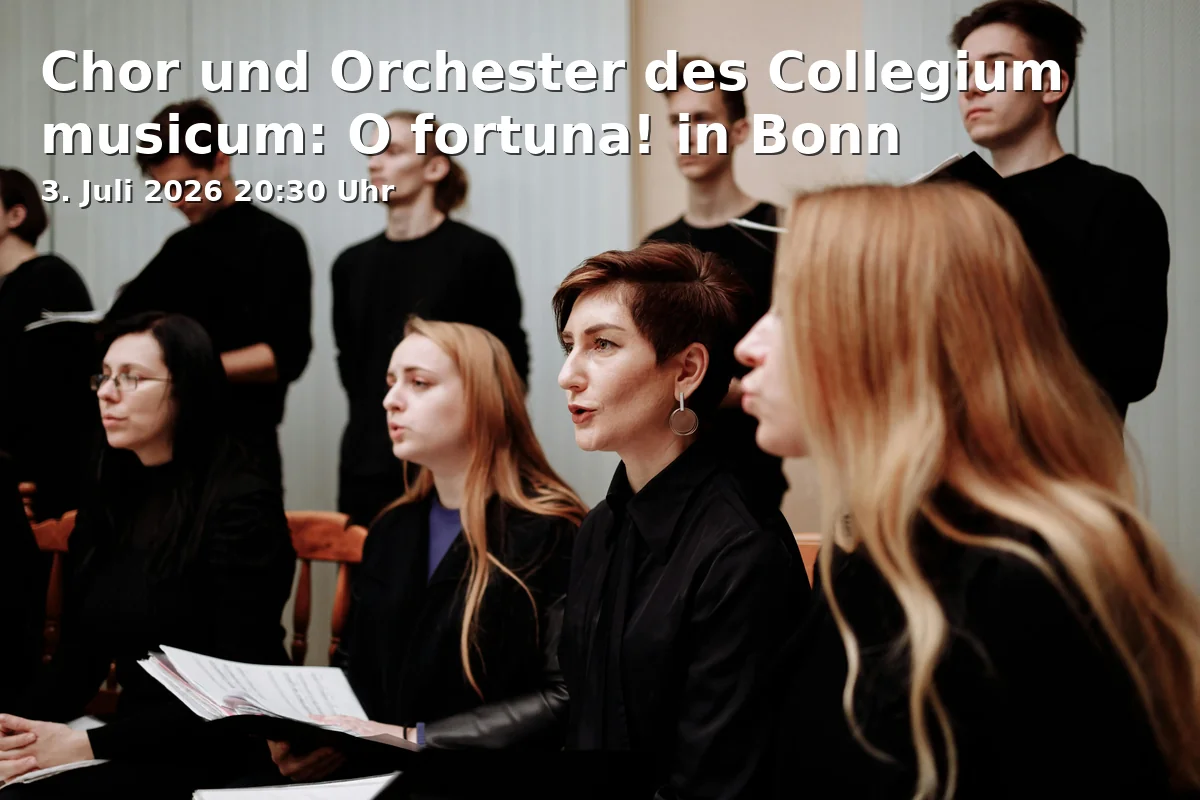
Choir and Orchestra of Collegium musicum: O fortuna! in Bonn
A summer evening full of choral power and orchestral colors in Bonn: O fortuna! brings Carmen and Carmina Burana to the auditorium. 03.07.2026. #Bonn #Concert
Jazz Choir of the University of Bonn live in Bonn - Auditorium of the University of Bonn Concert 2026
An evening full of choral sound, emotion, and live atmosphere in Bonn: The Jazz Choir of the University of Bonn sings in the Auditorium of the University of Bonn. #Bonn #Concert
Big Band of the University of Bonn
Free Jazz Night in Bonn: The Big Band of the University of Bonn plays in the auditorium with drive, groove, and great live atmosphere. 07/21/2026 at 8:30 PM. #Bonn #Jazz

Musical Camerata: Earth Man Cosmos in Bonn
A summer evening full of sound colors in Bonn: Musical Camerata plays Earth Man Cosmos in the auditorium of the University of Bonn. Free admission, great symphony, strong emotions. #Bonn #Concert
Student Wind Orchestra Bonn
Summery wind sound in Bonn: The Student Wind Orchestra invites you to the semester closing in the auditorium. 25.07.2026, 8:30 PM, free admission. #Bonn #Concert
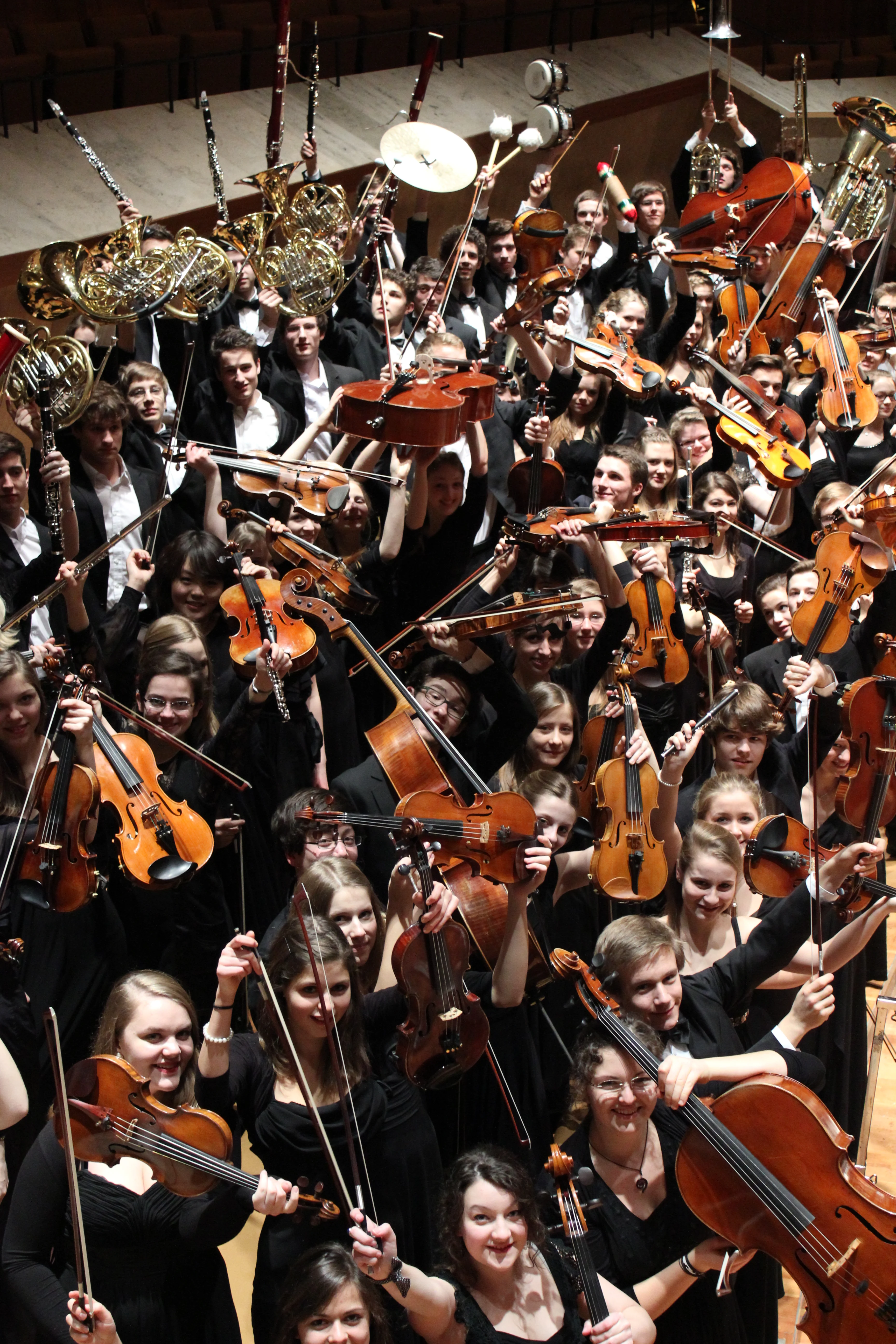
Federal Youth Orchestra live in Bonn - Aula der Universität Bonn Concert 2026
A summer evening full of orchestral excitement in Bonn: The Federal Youth Orchestra plays in the Aula der Universität. 28.07.2026, tickets starting at 38 euros. #LiveMusic
Frequently Asked Questions
Reviews
Miracle Ukah
21. July 2022
The University of Bonn, which is translated (Universität Bonn), is a public university located in Bonn, North Rhine-Westphalia, Germany. It's a big university not too far from the city's central station, and it's within walking distance from the city's Hauptbahnhof. It's also easily accessible by bus.
Doddy Juli Irawan
30. August 2019
Visit this university for the agriculture world congress, very beautiful university and I love the building!
Mercy Kamau
21. January 2022
Looks pretty though I don't attend the university, I just pass it by on my way.
Milena Ivanova
19. August 2022
Pretty much destroyed my mental health and disorganized -1/10 would not recommend.
Leonard Schrahe
26. September 2021
Had a concert here, it was a very nice place.