
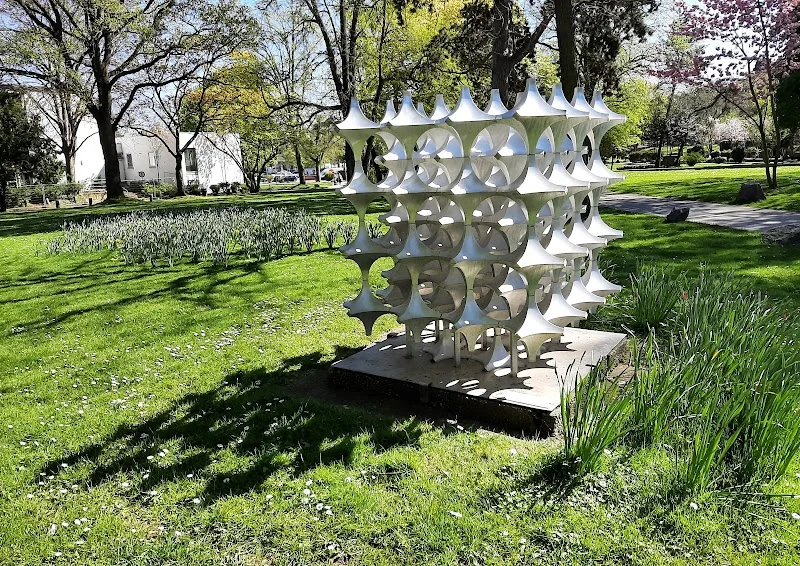
Bonn
Koblenzer Str. 80, 53177 Bonn-Bad Godesberg, Deutschland
Drinking Pavilion at the City Hall | Events & Program
The Drinking Pavilion at the City Hall is a small but unusually versatile cultural venue in the city park of Bonn-Bad Godesberg. It is closely related to the City Hall, the Kurfürsten spring, and the history of the spa park: The spring was developed as a recognized healing spring in 1962, the pavilion was built as a serving place in 1969/70, and since 2017, the association Bürger.Bad.Godesberg e.V. has ensured that the healing water is served regularly again. Today, the place is not only a drinking pavilion but also a meeting point, event space, stage for civic engagement, and a piece of living architectural and urban history. Those who know the name only as a simple location entry will discover here an ensemble that brings together water, architecture, culture, and community in a small space. ([buergerbadgodesberg.de](https://buergerbadgodesberg.de/der-trinkpavillon/))
Events, Music in the Park, and the Current Program
The most visible theme surrounding the Drinking Pavilion is undoubtedly the event life. Particularly well-known is the series Music in the Park, which takes place on the pavilion's terrace and offers an open, approachable concert experience during the warm months. The association describes the format as outdoors on the terrace, with the option to move to the Drinking Pavilion in case of bad weather or to adjust the event by agreement. Bands from Bonn or the surrounding area typically perform, usually bringing their own equipment and having a playing time from 19:00 to a maximum of 22:00. The hat collection is also part of the character of the format: There is no classic fixed fee, but a model with voluntary contributions that supports cultural work and ongoing operations. This mixture of freedom, closeness, and local anchoring is what makes the place appealing. ([buergerbadgodesberg.de](https://buergerbadgodesberg.de/musik-veranstaltungsformate-musik-im-park/))
The range is broader than one would expect from a small pavilion. The MIZ classifies the Drinking Pavilion as a cultural center and mentions a wide spectrum from pop, rock, jazz, and classical music to readings, film screenings, and art exhibitions. According to the MIZ, around 25 concerts and jam sessions take place there annually in various series, either in the pavilion itself or on the terrace. The Bonn event calendar also shows that the place is used as a lively open-air and cultural address: Concerts like Music in the Park are announced there with free admission, and the atmosphere is more relaxed, park-like, and communal than urban and anonymous. This is precisely where the strength lies: The Drinking Pavilion is not a mass venue, but a format for encounters where music is experienced very directly. ([miz.org](https://miz.org/en/institutions/trinkpavillon-kulturzentrum-i36900))
Moreover, the versatility throughout the year is noteworthy. Music in the Park EXTRA is aimed at bands from Bonn and the surrounding area and is particularly relevant in the months before and after summer; other dates around the pavilion range from carillon events to discussion formats, readings, and smaller cultural evenings. This makes the Drinking Pavilion particularly interesting for inquiries about events, programs, concerts, Music in the Park, and Bad Godesberg. Those looking for a location that not only offers a space but also has a clear cultural profile will find exactly that here: an open stage in the green that promotes local art and is still professionally organized. ([buergerbadgodesberg.de](https://buergerbadgodesberg.de/musik-veranstaltungsformate-musik-im-park/))
History of the Kurfürsten Spring and the Drinking Pavilion as a Place with Healing Water
The history of the Drinking Pavilion begins with the water. In 1962, the Kurfürsten spring was drilled as a recognized healing spring; since then, the healing water, a hydrogen carbonate-chloride mineral water, has been extracted. The Drinking Pavilion was created as a serving place in 1969/70, making the spring architecturally and functionally visible. The name is therefore not just decorative but describes the original idea of the place very precisely: People should drink healing water here, linger, and experience the spa park as a place to stay. The Drinking Pavilion thus belongs to that post-war and spa culture in which health, public life, and urban design were closely connected. For today's visitors, this is exciting because the place did not arise from an event trend but from a concrete spa-historical function. ([buergerbadgodesberg.de](https://buergerbadgodesberg.de/der-trinkpavillon/))
Since 2017, the association Bürger.Bad.Godesberg e.V. has been shaping the revival of the pavilion. The official association page describes that the pavilion was awakened from a long slumber and has been regularly open since then. This is important for the perception of the place because the Drinking Pavilion is not simply a monument behind glass but a building that is actually used: for serving the Kurfürsten spring, for meetings, for lectures, for neighborhood initiatives, and for cultural formats. This active maintenance distinguishes the location from many other historical buildings that are beautiful but hardly present in everyday life. Here, history does not remain abstract but is continued through volunteer work and programming. ([buergerbadgodesberg.de](https://buergerbadgodesberg.de/der-trinkpavillon-als-veranstaltungs-location/))
The connection to the City Hall enhances this historical character. The association points out that its headquarters is located in the Drinking Pavilion and that the City Hall is in close proximity. In the information about the Path of Democracy, the City Hall is described as part of the post-war history of Germany; important events and political encounters took place there, including the extraordinary SPD party congress of 1959 with the Godesberg Program. The Drinking Pavilion is therefore not isolated but is situated in a context of spa park, City Hall, urban history, and democratic remembrance. Those interested in history will not find a museum in the classical sense here but a place where the past, present, and civic use intertwine. ([buergerbadgodesberg.de](https://buergerbadgodesberg.de/weg-der-demokratie/))
Architecture, Building Culture, and Special Details at the Pavilion
Architecturally, the Drinking Pavilion is much more than a simple serving room. The association's page emphasizes that the architectural fundamentals of the City Hall were incorporated and convincingly implemented in the construction. Particularly striking is the cubic, i.e., cube-shaped design, which, together with the wide roof overhang, creates an almost floating character. This makes the building appear light and open, even though it is constructively clearly defined. In the city park, this form unfolds its effect: The pavilion is not monumental but striking, and it sets a counterpoint to the surrounding vegetation and the larger City Hall. For visitors, this is an important impression because the place gains its quality not through size but through the careful connection of form, location, and use. ([buergerbadgodesberg.de](https://buergerbadgodesberg.de/der-trinkpavillon/))
Inside, this idea continues. There is the healing water itself and a large water basin with a terrace, so that one, as the association's page puts it, goes over the water to the water. This motif makes the pavilion particularly vivid: The element of water is not only content but also a spatial experience. Additionally, there is an 80-meter-long frieze in the attic zone with plant ornaments, designed by Carl van Ackeren. Such details show that the building was seriously conceived as a designed ensemble in its time and not as a casual functional unit. Especially for inquiries about images, architecture, and special features, it is worth highlighting these decorative elements and the clear proportions, as they give the pavilion an independent profile. ([buergerbadgodesberg.de](https://buergerbadgodesberg.de/der-trinkpavillon/))
Another special detail is the sound installation developed by the artist Andreas Oldörp in connection with bonnhoeren and the Beethoven Foundation. It was installed below the balcony and was intended to make the water audible. Thus, the place has also been perceived as a sound space for years. Furthermore, the City Hall and the Drinking Pavilion are protected as historical monuments, which underscores their significance for local building culture. In combination with the carillon nearby, an ensemble is created in which architecture, sound, landscape, and memory intertwine. The Drinking Pavilion is therefore not only an event space but also an example of how monument protection can go hand in hand with vibrant use. ([buergerbadgodesberg.de](https://buergerbadgodesberg.de/der-trinkpavillon/))
Capacity, Equipment, and Barrier-Free Access
For many visitors and organizers, practical details are crucial, and here too, the Drinking Pavilion provides clear information. The association states a maximum capacity of 95 people for events in the pavilion. Additionally, the room can be equipped with conference tables for about 24 people if needed, making the place suitable for both small cultural events and meetings and association formats. Upon request, a screen, projector, and microphone equipment can be provided. This makes the pavilion suitable not only for concerts but also for lectures, readings, small conferences, and presentations. This is particularly interesting for local groups because the space is surprisingly flexible despite its compact size. ([buergerbadgodesberg.de](https://buergerbadgodesberg.de/der-trinkpavillon-als-veranstaltungs-location/))
The MIZ classifies the pavilion as a cultural center and adds a slightly different perspective on capacity: It mentions around 90 seats in the pavilion and up to 1,000 people in the park. These figures show that the place can appear very differently depending on the format. Inside, it is intentionally intimate and close, while outside it can become part of a larger park event. For SEO searches, this combination is important because users often search for terms like capacity, seating plan, or seats. The Drinking Pavilion does not present the image of a large hall but rather that of a manageable, flexibly usable cultural space with park access. ([miz.org](https://miz.org/en/institutions/trinkpavillon-kulturzentrum-i36900?utm_source=openai))
There are also specific details regarding accessibility. The access to the building is barrier-free from the City Hall, but the toilet facilities in the pavilion itself are not accessible; when the City Hall is open, barrier-free toilets can be used there. For people with limited mobility, this is an important practical note that should not be missing from a location description. Additionally, there is the availability of drinks according to the price list, a backstage room for music events, and the clear organizational integration of the association. All of this shows: The Drinking Pavilion is small but not improvised. It is a thoughtfully operated place with limited but meaningful equipment, which becomes attractive precisely because of its clear size. ([buergerbadgodesberg.de](https://buergerbadgodesberg.de/der-trinkpavillon-als-veranstaltungs-location/))
Access, Parking, and Location in the City Park of Bad Godesberg
The location of the Drinking Pavilion is one of its greatest advantages. It is located at Koblenzer Straße 80 in 53177 Bonn-Bad Godesberg, directly by the city park and in close proximity to the City Hall. Those looking for access, parking, or public transport options will benefit from the fact that the place is very clearly anchored in the urban structure. For events in the park, the association mentions the public parking lot opposite the City Hall as a practical option; additionally, access through the spa park for loading and unloading is permitted, while the lawns may not be driven on, and vehicles should not remain in the park during the event. These rules are important because they connect the protection of green spaces with usable logistics. ([buergerbadgodesberg.de](https://buergerbadgodesberg.de/musik-veranstaltungsformate-musik-im-park/))
The surroundings also help with orientation. The city of Bonn describes in its tree trail for the city park that a nature trail begins opposite the City Hall parking lot. This indirectly shows how closely the City Hall, park, and Drinking Pavilion are connected. The public space is designed here so that visitors can find their way well and do not experience the pavilion as a hidden special place but as part of a larger, well-developed ensemble area. For guests arriving from the train station or other parts of Bonn, it is also relevant that the City Hall stop is in close proximity and equipped with an elevator and escalator. This makes the way from public transport practical and suitable for everyday use. ([bonn.de](https://www.bonn.de/themen-entdecken/umwelt-natur/stadtbaeume/baumlehrpfad-bad-godesberg.php?loc=en&utm_source=openai))
For event planning, the location is also a plus. Music in the Park can be set up outside on the terrace, and if necessary, the event can be moved to the Drinking Pavilion. This means that the place and its surroundings work together: The park provides atmosphere, the City Hall offers infrastructure, and the pavilion connects both. This is precisely why the place is so relevant for inquiries about access, parking, City Hall, spa park, and Bad Godesberg. Those looking for a small location with urban infrastructure while also being in a quiet, green area will find a rare combination here. ([buergerbadgodesberg.de](https://buergerbadgodesberg.de/musik-veranstaltungsformate-musik-im-park/))
Opening Hours, Booking, and Diverse Uses
The Drinking Pavilion thrives not only on individual events but also on its regular daily operations. Volunteers open the pavilion and the Kurfürsten spring on fixed weekdays: Wednesdays and Sundays variably from 15:00 to 17:00, Tuesdays and Thursdays as part of the creative circle also from 15:00 to 17:00, and Saturdays from 12:00 to 13:30. These opening hours are important for visitors who want to experience the place itself, drink healing water, or come into contact with the volunteers, not just attend an event. The pavilion is thus not just an event location but also a well-maintained, regularly opened place for encounters. ([buergerbadgodesberg.de](https://buergerbadgodesberg.de/der-trinkpavillon-als-veranstaltungs-location/))
Moreover, the uses are broader than its name might suggest. The association mentions other functions such as association-owned events, meetings of various social groups, external events, use as a private event space for active members, and even the playing venue of the Godesberg Chess Club 1929 e.V. for youth and adults. Additionally, the space is available for exhibitions, such as an exhibition on the development of Bad Godesberg's city center or for presentations from the ISEK environment. This makes it clear that the Drinking Pavilion is not only used culturally but also socially and civically. Inquiries about readings, groups, associations, exhibitions, or space in Bad Godesberg encounter a real offer here and not just a decorative shell. ([buergerbadgodesberg.de](https://buergerbadgodesberg.de/der-trinkpavillon-als-veranstaltungs-location/))
The association also links the place to a larger historical and social context. In the information about the Path of Democracy, the Drinking Pavilion is mentioned as the association's headquarters; in close proximity lies the City Hall, which is embedded in German post-war history. This creates a location that brings together leisure, remembrance, culture, and civic engagement. This is precisely why the Drinking Pavilion is so well suited for an SEO page: It serves not just a single keyword but a whole thematic family of events, programs, parking, access, opening hours, history, and special features. Those who visit the place experience not an interchangeable event format but a vibrant part of Bad Godesberg with a clear identity and high recognition value. ([buergerbadgodesberg.de](https://buergerbadgodesberg.de/weg-der-demokratie/))
Sources:
- Bürger.Bad.Godesberg e.V. - The Drinking Pavilion in Bad Godesberg
- Bürger.Bad.Godesberg e.V. - The Drinking Pavilion as an Event Location
- Bürger.Bad.Godesberg e.V. - Music in the Park
- Bürger.Bad.Godesberg e.V. - Path of Democracy
- Music Council MIZ - Drinking Pavilion Cultural Center
- Federal City Bonn - Bad Keys: Music in the Park
Show moreShow less
Drinking Pavilion at the City Hall | Events & Program
The Drinking Pavilion at the City Hall is a small but unusually versatile cultural venue in the city park of Bonn-Bad Godesberg. It is closely related to the City Hall, the Kurfürsten spring, and the history of the spa park: The spring was developed as a recognized healing spring in 1962, the pavilion was built as a serving place in 1969/70, and since 2017, the association Bürger.Bad.Godesberg e.V. has ensured that the healing water is served regularly again. Today, the place is not only a drinking pavilion but also a meeting point, event space, stage for civic engagement, and a piece of living architectural and urban history. Those who know the name only as a simple location entry will discover here an ensemble that brings together water, architecture, culture, and community in a small space. ([buergerbadgodesberg.de](https://buergerbadgodesberg.de/der-trinkpavillon/))
Events, Music in the Park, and the Current Program
The most visible theme surrounding the Drinking Pavilion is undoubtedly the event life. Particularly well-known is the series Music in the Park, which takes place on the pavilion's terrace and offers an open, approachable concert experience during the warm months. The association describes the format as outdoors on the terrace, with the option to move to the Drinking Pavilion in case of bad weather or to adjust the event by agreement. Bands from Bonn or the surrounding area typically perform, usually bringing their own equipment and having a playing time from 19:00 to a maximum of 22:00. The hat collection is also part of the character of the format: There is no classic fixed fee, but a model with voluntary contributions that supports cultural work and ongoing operations. This mixture of freedom, closeness, and local anchoring is what makes the place appealing. ([buergerbadgodesberg.de](https://buergerbadgodesberg.de/musik-veranstaltungsformate-musik-im-park/))
The range is broader than one would expect from a small pavilion. The MIZ classifies the Drinking Pavilion as a cultural center and mentions a wide spectrum from pop, rock, jazz, and classical music to readings, film screenings, and art exhibitions. According to the MIZ, around 25 concerts and jam sessions take place there annually in various series, either in the pavilion itself or on the terrace. The Bonn event calendar also shows that the place is used as a lively open-air and cultural address: Concerts like Music in the Park are announced there with free admission, and the atmosphere is more relaxed, park-like, and communal than urban and anonymous. This is precisely where the strength lies: The Drinking Pavilion is not a mass venue, but a format for encounters where music is experienced very directly. ([miz.org](https://miz.org/en/institutions/trinkpavillon-kulturzentrum-i36900))
Moreover, the versatility throughout the year is noteworthy. Music in the Park EXTRA is aimed at bands from Bonn and the surrounding area and is particularly relevant in the months before and after summer; other dates around the pavilion range from carillon events to discussion formats, readings, and smaller cultural evenings. This makes the Drinking Pavilion particularly interesting for inquiries about events, programs, concerts, Music in the Park, and Bad Godesberg. Those looking for a location that not only offers a space but also has a clear cultural profile will find exactly that here: an open stage in the green that promotes local art and is still professionally organized. ([buergerbadgodesberg.de](https://buergerbadgodesberg.de/musik-veranstaltungsformate-musik-im-park/))
History of the Kurfürsten Spring and the Drinking Pavilion as a Place with Healing Water
The history of the Drinking Pavilion begins with the water. In 1962, the Kurfürsten spring was drilled as a recognized healing spring; since then, the healing water, a hydrogen carbonate-chloride mineral water, has been extracted. The Drinking Pavilion was created as a serving place in 1969/70, making the spring architecturally and functionally visible. The name is therefore not just decorative but describes the original idea of the place very precisely: People should drink healing water here, linger, and experience the spa park as a place to stay. The Drinking Pavilion thus belongs to that post-war and spa culture in which health, public life, and urban design were closely connected. For today's visitors, this is exciting because the place did not arise from an event trend but from a concrete spa-historical function. ([buergerbadgodesberg.de](https://buergerbadgodesberg.de/der-trinkpavillon/))
Since 2017, the association Bürger.Bad.Godesberg e.V. has been shaping the revival of the pavilion. The official association page describes that the pavilion was awakened from a long slumber and has been regularly open since then. This is important for the perception of the place because the Drinking Pavilion is not simply a monument behind glass but a building that is actually used: for serving the Kurfürsten spring, for meetings, for lectures, for neighborhood initiatives, and for cultural formats. This active maintenance distinguishes the location from many other historical buildings that are beautiful but hardly present in everyday life. Here, history does not remain abstract but is continued through volunteer work and programming. ([buergerbadgodesberg.de](https://buergerbadgodesberg.de/der-trinkpavillon-als-veranstaltungs-location/))
The connection to the City Hall enhances this historical character. The association points out that its headquarters is located in the Drinking Pavilion and that the City Hall is in close proximity. In the information about the Path of Democracy, the City Hall is described as part of the post-war history of Germany; important events and political encounters took place there, including the extraordinary SPD party congress of 1959 with the Godesberg Program. The Drinking Pavilion is therefore not isolated but is situated in a context of spa park, City Hall, urban history, and democratic remembrance. Those interested in history will not find a museum in the classical sense here but a place where the past, present, and civic use intertwine. ([buergerbadgodesberg.de](https://buergerbadgodesberg.de/weg-der-demokratie/))
Architecture, Building Culture, and Special Details at the Pavilion
Architecturally, the Drinking Pavilion is much more than a simple serving room. The association's page emphasizes that the architectural fundamentals of the City Hall were incorporated and convincingly implemented in the construction. Particularly striking is the cubic, i.e., cube-shaped design, which, together with the wide roof overhang, creates an almost floating character. This makes the building appear light and open, even though it is constructively clearly defined. In the city park, this form unfolds its effect: The pavilion is not monumental but striking, and it sets a counterpoint to the surrounding vegetation and the larger City Hall. For visitors, this is an important impression because the place gains its quality not through size but through the careful connection of form, location, and use. ([buergerbadgodesberg.de](https://buergerbadgodesberg.de/der-trinkpavillon/))
Inside, this idea continues. There is the healing water itself and a large water basin with a terrace, so that one, as the association's page puts it, goes over the water to the water. This motif makes the pavilion particularly vivid: The element of water is not only content but also a spatial experience. Additionally, there is an 80-meter-long frieze in the attic zone with plant ornaments, designed by Carl van Ackeren. Such details show that the building was seriously conceived as a designed ensemble in its time and not as a casual functional unit. Especially for inquiries about images, architecture, and special features, it is worth highlighting these decorative elements and the clear proportions, as they give the pavilion an independent profile. ([buergerbadgodesberg.de](https://buergerbadgodesberg.de/der-trinkpavillon/))
Another special detail is the sound installation developed by the artist Andreas Oldörp in connection with bonnhoeren and the Beethoven Foundation. It was installed below the balcony and was intended to make the water audible. Thus, the place has also been perceived as a sound space for years. Furthermore, the City Hall and the Drinking Pavilion are protected as historical monuments, which underscores their significance for local building culture. In combination with the carillon nearby, an ensemble is created in which architecture, sound, landscape, and memory intertwine. The Drinking Pavilion is therefore not only an event space but also an example of how monument protection can go hand in hand with vibrant use. ([buergerbadgodesberg.de](https://buergerbadgodesberg.de/der-trinkpavillon/))
Capacity, Equipment, and Barrier-Free Access
For many visitors and organizers, practical details are crucial, and here too, the Drinking Pavilion provides clear information. The association states a maximum capacity of 95 people for events in the pavilion. Additionally, the room can be equipped with conference tables for about 24 people if needed, making the place suitable for both small cultural events and meetings and association formats. Upon request, a screen, projector, and microphone equipment can be provided. This makes the pavilion suitable not only for concerts but also for lectures, readings, small conferences, and presentations. This is particularly interesting for local groups because the space is surprisingly flexible despite its compact size. ([buergerbadgodesberg.de](https://buergerbadgodesberg.de/der-trinkpavillon-als-veranstaltungs-location/))
The MIZ classifies the pavilion as a cultural center and adds a slightly different perspective on capacity: It mentions around 90 seats in the pavilion and up to 1,000 people in the park. These figures show that the place can appear very differently depending on the format. Inside, it is intentionally intimate and close, while outside it can become part of a larger park event. For SEO searches, this combination is important because users often search for terms like capacity, seating plan, or seats. The Drinking Pavilion does not present the image of a large hall but rather that of a manageable, flexibly usable cultural space with park access. ([miz.org](https://miz.org/en/institutions/trinkpavillon-kulturzentrum-i36900?utm_source=openai))
There are also specific details regarding accessibility. The access to the building is barrier-free from the City Hall, but the toilet facilities in the pavilion itself are not accessible; when the City Hall is open, barrier-free toilets can be used there. For people with limited mobility, this is an important practical note that should not be missing from a location description. Additionally, there is the availability of drinks according to the price list, a backstage room for music events, and the clear organizational integration of the association. All of this shows: The Drinking Pavilion is small but not improvised. It is a thoughtfully operated place with limited but meaningful equipment, which becomes attractive precisely because of its clear size. ([buergerbadgodesberg.de](https://buergerbadgodesberg.de/der-trinkpavillon-als-veranstaltungs-location/))
Access, Parking, and Location in the City Park of Bad Godesberg
The location of the Drinking Pavilion is one of its greatest advantages. It is located at Koblenzer Straße 80 in 53177 Bonn-Bad Godesberg, directly by the city park and in close proximity to the City Hall. Those looking for access, parking, or public transport options will benefit from the fact that the place is very clearly anchored in the urban structure. For events in the park, the association mentions the public parking lot opposite the City Hall as a practical option; additionally, access through the spa park for loading and unloading is permitted, while the lawns may not be driven on, and vehicles should not remain in the park during the event. These rules are important because they connect the protection of green spaces with usable logistics. ([buergerbadgodesberg.de](https://buergerbadgodesberg.de/musik-veranstaltungsformate-musik-im-park/))
The surroundings also help with orientation. The city of Bonn describes in its tree trail for the city park that a nature trail begins opposite the City Hall parking lot. This indirectly shows how closely the City Hall, park, and Drinking Pavilion are connected. The public space is designed here so that visitors can find their way well and do not experience the pavilion as a hidden special place but as part of a larger, well-developed ensemble area. For guests arriving from the train station or other parts of Bonn, it is also relevant that the City Hall stop is in close proximity and equipped with an elevator and escalator. This makes the way from public transport practical and suitable for everyday use. ([bonn.de](https://www.bonn.de/themen-entdecken/umwelt-natur/stadtbaeume/baumlehrpfad-bad-godesberg.php?loc=en&utm_source=openai))
For event planning, the location is also a plus. Music in the Park can be set up outside on the terrace, and if necessary, the event can be moved to the Drinking Pavilion. This means that the place and its surroundings work together: The park provides atmosphere, the City Hall offers infrastructure, and the pavilion connects both. This is precisely why the place is so relevant for inquiries about access, parking, City Hall, spa park, and Bad Godesberg. Those looking for a small location with urban infrastructure while also being in a quiet, green area will find a rare combination here. ([buergerbadgodesberg.de](https://buergerbadgodesberg.de/musik-veranstaltungsformate-musik-im-park/))
Opening Hours, Booking, and Diverse Uses
The Drinking Pavilion thrives not only on individual events but also on its regular daily operations. Volunteers open the pavilion and the Kurfürsten spring on fixed weekdays: Wednesdays and Sundays variably from 15:00 to 17:00, Tuesdays and Thursdays as part of the creative circle also from 15:00 to 17:00, and Saturdays from 12:00 to 13:30. These opening hours are important for visitors who want to experience the place itself, drink healing water, or come into contact with the volunteers, not just attend an event. The pavilion is thus not just an event location but also a well-maintained, regularly opened place for encounters. ([buergerbadgodesberg.de](https://buergerbadgodesberg.de/der-trinkpavillon-als-veranstaltungs-location/))
Moreover, the uses are broader than its name might suggest. The association mentions other functions such as association-owned events, meetings of various social groups, external events, use as a private event space for active members, and even the playing venue of the Godesberg Chess Club 1929 e.V. for youth and adults. Additionally, the space is available for exhibitions, such as an exhibition on the development of Bad Godesberg's city center or for presentations from the ISEK environment. This makes it clear that the Drinking Pavilion is not only used culturally but also socially and civically. Inquiries about readings, groups, associations, exhibitions, or space in Bad Godesberg encounter a real offer here and not just a decorative shell. ([buergerbadgodesberg.de](https://buergerbadgodesberg.de/der-trinkpavillon-als-veranstaltungs-location/))
The association also links the place to a larger historical and social context. In the information about the Path of Democracy, the Drinking Pavilion is mentioned as the association's headquarters; in close proximity lies the City Hall, which is embedded in German post-war history. This creates a location that brings together leisure, remembrance, culture, and civic engagement. This is precisely why the Drinking Pavilion is so well suited for an SEO page: It serves not just a single keyword but a whole thematic family of events, programs, parking, access, opening hours, history, and special features. Those who visit the place experience not an interchangeable event format but a vibrant part of Bad Godesberg with a clear identity and high recognition value. ([buergerbadgodesberg.de](https://buergerbadgodesberg.de/weg-der-demokratie/))
Sources:
- Bürger.Bad.Godesberg e.V. - The Drinking Pavilion in Bad Godesberg
- Bürger.Bad.Godesberg e.V. - The Drinking Pavilion as an Event Location
- Bürger.Bad.Godesberg e.V. - Music in the Park
- Bürger.Bad.Godesberg e.V. - Path of Democracy
- Music Council MIZ - Drinking Pavilion Cultural Center
- Federal City Bonn - Bad Keys: Music in the Park
Drinking Pavilion at the City Hall | Events & Program
The Drinking Pavilion at the City Hall is a small but unusually versatile cultural venue in the city park of Bonn-Bad Godesberg. It is closely related to the City Hall, the Kurfürsten spring, and the history of the spa park: The spring was developed as a recognized healing spring in 1962, the pavilion was built as a serving place in 1969/70, and since 2017, the association Bürger.Bad.Godesberg e.V. has ensured that the healing water is served regularly again. Today, the place is not only a drinking pavilion but also a meeting point, event space, stage for civic engagement, and a piece of living architectural and urban history. Those who know the name only as a simple location entry will discover here an ensemble that brings together water, architecture, culture, and community in a small space. ([buergerbadgodesberg.de](https://buergerbadgodesberg.de/der-trinkpavillon/))
Events, Music in the Park, and the Current Program
The most visible theme surrounding the Drinking Pavilion is undoubtedly the event life. Particularly well-known is the series Music in the Park, which takes place on the pavilion's terrace and offers an open, approachable concert experience during the warm months. The association describes the format as outdoors on the terrace, with the option to move to the Drinking Pavilion in case of bad weather or to adjust the event by agreement. Bands from Bonn or the surrounding area typically perform, usually bringing their own equipment and having a playing time from 19:00 to a maximum of 22:00. The hat collection is also part of the character of the format: There is no classic fixed fee, but a model with voluntary contributions that supports cultural work and ongoing operations. This mixture of freedom, closeness, and local anchoring is what makes the place appealing. ([buergerbadgodesberg.de](https://buergerbadgodesberg.de/musik-veranstaltungsformate-musik-im-park/))
The range is broader than one would expect from a small pavilion. The MIZ classifies the Drinking Pavilion as a cultural center and mentions a wide spectrum from pop, rock, jazz, and classical music to readings, film screenings, and art exhibitions. According to the MIZ, around 25 concerts and jam sessions take place there annually in various series, either in the pavilion itself or on the terrace. The Bonn event calendar also shows that the place is used as a lively open-air and cultural address: Concerts like Music in the Park are announced there with free admission, and the atmosphere is more relaxed, park-like, and communal than urban and anonymous. This is precisely where the strength lies: The Drinking Pavilion is not a mass venue, but a format for encounters where music is experienced very directly. ([miz.org](https://miz.org/en/institutions/trinkpavillon-kulturzentrum-i36900))
Moreover, the versatility throughout the year is noteworthy. Music in the Park EXTRA is aimed at bands from Bonn and the surrounding area and is particularly relevant in the months before and after summer; other dates around the pavilion range from carillon events to discussion formats, readings, and smaller cultural evenings. This makes the Drinking Pavilion particularly interesting for inquiries about events, programs, concerts, Music in the Park, and Bad Godesberg. Those looking for a location that not only offers a space but also has a clear cultural profile will find exactly that here: an open stage in the green that promotes local art and is still professionally organized. ([buergerbadgodesberg.de](https://buergerbadgodesberg.de/musik-veranstaltungsformate-musik-im-park/))
History of the Kurfürsten Spring and the Drinking Pavilion as a Place with Healing Water
The history of the Drinking Pavilion begins with the water. In 1962, the Kurfürsten spring was drilled as a recognized healing spring; since then, the healing water, a hydrogen carbonate-chloride mineral water, has been extracted. The Drinking Pavilion was created as a serving place in 1969/70, making the spring architecturally and functionally visible. The name is therefore not just decorative but describes the original idea of the place very precisely: People should drink healing water here, linger, and experience the spa park as a place to stay. The Drinking Pavilion thus belongs to that post-war and spa culture in which health, public life, and urban design were closely connected. For today's visitors, this is exciting because the place did not arise from an event trend but from a concrete spa-historical function. ([buergerbadgodesberg.de](https://buergerbadgodesberg.de/der-trinkpavillon/))
Since 2017, the association Bürger.Bad.Godesberg e.V. has been shaping the revival of the pavilion. The official association page describes that the pavilion was awakened from a long slumber and has been regularly open since then. This is important for the perception of the place because the Drinking Pavilion is not simply a monument behind glass but a building that is actually used: for serving the Kurfürsten spring, for meetings, for lectures, for neighborhood initiatives, and for cultural formats. This active maintenance distinguishes the location from many other historical buildings that are beautiful but hardly present in everyday life. Here, history does not remain abstract but is continued through volunteer work and programming. ([buergerbadgodesberg.de](https://buergerbadgodesberg.de/der-trinkpavillon-als-veranstaltungs-location/))
The connection to the City Hall enhances this historical character. The association points out that its headquarters is located in the Drinking Pavilion and that the City Hall is in close proximity. In the information about the Path of Democracy, the City Hall is described as part of the post-war history of Germany; important events and political encounters took place there, including the extraordinary SPD party congress of 1959 with the Godesberg Program. The Drinking Pavilion is therefore not isolated but is situated in a context of spa park, City Hall, urban history, and democratic remembrance. Those interested in history will not find a museum in the classical sense here but a place where the past, present, and civic use intertwine. ([buergerbadgodesberg.de](https://buergerbadgodesberg.de/weg-der-demokratie/))
Architecture, Building Culture, and Special Details at the Pavilion
Architecturally, the Drinking Pavilion is much more than a simple serving room. The association's page emphasizes that the architectural fundamentals of the City Hall were incorporated and convincingly implemented in the construction. Particularly striking is the cubic, i.e., cube-shaped design, which, together with the wide roof overhang, creates an almost floating character. This makes the building appear light and open, even though it is constructively clearly defined. In the city park, this form unfolds its effect: The pavilion is not monumental but striking, and it sets a counterpoint to the surrounding vegetation and the larger City Hall. For visitors, this is an important impression because the place gains its quality not through size but through the careful connection of form, location, and use. ([buergerbadgodesberg.de](https://buergerbadgodesberg.de/der-trinkpavillon/))
Inside, this idea continues. There is the healing water itself and a large water basin with a terrace, so that one, as the association's page puts it, goes over the water to the water. This motif makes the pavilion particularly vivid: The element of water is not only content but also a spatial experience. Additionally, there is an 80-meter-long frieze in the attic zone with plant ornaments, designed by Carl van Ackeren. Such details show that the building was seriously conceived as a designed ensemble in its time and not as a casual functional unit. Especially for inquiries about images, architecture, and special features, it is worth highlighting these decorative elements and the clear proportions, as they give the pavilion an independent profile. ([buergerbadgodesberg.de](https://buergerbadgodesberg.de/der-trinkpavillon/))
Another special detail is the sound installation developed by the artist Andreas Oldörp in connection with bonnhoeren and the Beethoven Foundation. It was installed below the balcony and was intended to make the water audible. Thus, the place has also been perceived as a sound space for years. Furthermore, the City Hall and the Drinking Pavilion are protected as historical monuments, which underscores their significance for local building culture. In combination with the carillon nearby, an ensemble is created in which architecture, sound, landscape, and memory intertwine. The Drinking Pavilion is therefore not only an event space but also an example of how monument protection can go hand in hand with vibrant use. ([buergerbadgodesberg.de](https://buergerbadgodesberg.de/der-trinkpavillon/))
Capacity, Equipment, and Barrier-Free Access
For many visitors and organizers, practical details are crucial, and here too, the Drinking Pavilion provides clear information. The association states a maximum capacity of 95 people for events in the pavilion. Additionally, the room can be equipped with conference tables for about 24 people if needed, making the place suitable for both small cultural events and meetings and association formats. Upon request, a screen, projector, and microphone equipment can be provided. This makes the pavilion suitable not only for concerts but also for lectures, readings, small conferences, and presentations. This is particularly interesting for local groups because the space is surprisingly flexible despite its compact size. ([buergerbadgodesberg.de](https://buergerbadgodesberg.de/der-trinkpavillon-als-veranstaltungs-location/))
The MIZ classifies the pavilion as a cultural center and adds a slightly different perspective on capacity: It mentions around 90 seats in the pavilion and up to 1,000 people in the park. These figures show that the place can appear very differently depending on the format. Inside, it is intentionally intimate and close, while outside it can become part of a larger park event. For SEO searches, this combination is important because users often search for terms like capacity, seating plan, or seats. The Drinking Pavilion does not present the image of a large hall but rather that of a manageable, flexibly usable cultural space with park access. ([miz.org](https://miz.org/en/institutions/trinkpavillon-kulturzentrum-i36900?utm_source=openai))
There are also specific details regarding accessibility. The access to the building is barrier-free from the City Hall, but the toilet facilities in the pavilion itself are not accessible; when the City Hall is open, barrier-free toilets can be used there. For people with limited mobility, this is an important practical note that should not be missing from a location description. Additionally, there is the availability of drinks according to the price list, a backstage room for music events, and the clear organizational integration of the association. All of this shows: The Drinking Pavilion is small but not improvised. It is a thoughtfully operated place with limited but meaningful equipment, which becomes attractive precisely because of its clear size. ([buergerbadgodesberg.de](https://buergerbadgodesberg.de/der-trinkpavillon-als-veranstaltungs-location/))
Access, Parking, and Location in the City Park of Bad Godesberg
The location of the Drinking Pavilion is one of its greatest advantages. It is located at Koblenzer Straße 80 in 53177 Bonn-Bad Godesberg, directly by the city park and in close proximity to the City Hall. Those looking for access, parking, or public transport options will benefit from the fact that the place is very clearly anchored in the urban structure. For events in the park, the association mentions the public parking lot opposite the City Hall as a practical option; additionally, access through the spa park for loading and unloading is permitted, while the lawns may not be driven on, and vehicles should not remain in the park during the event. These rules are important because they connect the protection of green spaces with usable logistics. ([buergerbadgodesberg.de](https://buergerbadgodesberg.de/musik-veranstaltungsformate-musik-im-park/))
The surroundings also help with orientation. The city of Bonn describes in its tree trail for the city park that a nature trail begins opposite the City Hall parking lot. This indirectly shows how closely the City Hall, park, and Drinking Pavilion are connected. The public space is designed here so that visitors can find their way well and do not experience the pavilion as a hidden special place but as part of a larger, well-developed ensemble area. For guests arriving from the train station or other parts of Bonn, it is also relevant that the City Hall stop is in close proximity and equipped with an elevator and escalator. This makes the way from public transport practical and suitable for everyday use. ([bonn.de](https://www.bonn.de/themen-entdecken/umwelt-natur/stadtbaeume/baumlehrpfad-bad-godesberg.php?loc=en&utm_source=openai))
For event planning, the location is also a plus. Music in the Park can be set up outside on the terrace, and if necessary, the event can be moved to the Drinking Pavilion. This means that the place and its surroundings work together: The park provides atmosphere, the City Hall offers infrastructure, and the pavilion connects both. This is precisely why the place is so relevant for inquiries about access, parking, City Hall, spa park, and Bad Godesberg. Those looking for a small location with urban infrastructure while also being in a quiet, green area will find a rare combination here. ([buergerbadgodesberg.de](https://buergerbadgodesberg.de/musik-veranstaltungsformate-musik-im-park/))
Opening Hours, Booking, and Diverse Uses
The Drinking Pavilion thrives not only on individual events but also on its regular daily operations. Volunteers open the pavilion and the Kurfürsten spring on fixed weekdays: Wednesdays and Sundays variably from 15:00 to 17:00, Tuesdays and Thursdays as part of the creative circle also from 15:00 to 17:00, and Saturdays from 12:00 to 13:30. These opening hours are important for visitors who want to experience the place itself, drink healing water, or come into contact with the volunteers, not just attend an event. The pavilion is thus not just an event location but also a well-maintained, regularly opened place for encounters. ([buergerbadgodesberg.de](https://buergerbadgodesberg.de/der-trinkpavillon-als-veranstaltungs-location/))
Moreover, the uses are broader than its name might suggest. The association mentions other functions such as association-owned events, meetings of various social groups, external events, use as a private event space for active members, and even the playing venue of the Godesberg Chess Club 1929 e.V. for youth and adults. Additionally, the space is available for exhibitions, such as an exhibition on the development of Bad Godesberg's city center or for presentations from the ISEK environment. This makes it clear that the Drinking Pavilion is not only used culturally but also socially and civically. Inquiries about readings, groups, associations, exhibitions, or space in Bad Godesberg encounter a real offer here and not just a decorative shell. ([buergerbadgodesberg.de](https://buergerbadgodesberg.de/der-trinkpavillon-als-veranstaltungs-location/))
The association also links the place to a larger historical and social context. In the information about the Path of Democracy, the Drinking Pavilion is mentioned as the association's headquarters; in close proximity lies the City Hall, which is embedded in German post-war history. This creates a location that brings together leisure, remembrance, culture, and civic engagement. This is precisely why the Drinking Pavilion is so well suited for an SEO page: It serves not just a single keyword but a whole thematic family of events, programs, parking, access, opening hours, history, and special features. Those who visit the place experience not an interchangeable event format but a vibrant part of Bad Godesberg with a clear identity and high recognition value. ([buergerbadgodesberg.de](https://buergerbadgodesberg.de/weg-der-demokratie/))
Sources:
- Bürger.Bad.Godesberg e.V. - The Drinking Pavilion in Bad Godesberg
- Bürger.Bad.Godesberg e.V. - The Drinking Pavilion as an Event Location
- Bürger.Bad.Godesberg e.V. - Music in the Park
- Bürger.Bad.Godesberg e.V. - Path of Democracy
- Music Council MIZ - Drinking Pavilion Cultural Center
- Federal City Bonn - Bad Keys: Music in the Park
Upcoming Events
KÔRNEL & The Walking Whale: Music in the Park in Bonn
A free summer evening in Bonn: KÔRNEL & The Walking Whale play Music in the Park at the Drinking Pavilion. Alternative sounds, park atmosphere, and goosebumps under the open sky. #Bonn #MusicInThePark
CARILLON - Summer Festival of Associations 2026
A summer festival with heart: CARILLON transforms Bad Godesberg into a vibrant open-air experience full of community culture, sound, and encounters. #Bonn #BadGodesberg #SummerFestival
Taste Of Woodstock - Music in the Park in Bonn
A summer evening for folk-rock fans: Taste Of Woodstock brings Bonn into park mood on 08.07.2026. Free, live, and full of harmony. #Bonn #LiveMusic
The Cosmos of the Kuna on the Islands off Panama and Colombia
An exciting lecture evening in Bonn: The Cosmos of the Kuna connects culture, history, and climate change. On 27.08.2026 at 6:30 PM, free entry. #Bonn #Kuna
Frequently Asked Questions
Reviews
Nurin Alziyana Fasha
16. August 2019
Love nature
Dagmar Feddersen
12. June 2024
Nice place to enjoy music events in a relaxed way while having a drink
Nataliia
18. October 2022
Chess for all age groups!
Wolfgang Schiffer
27. December 2024
Great music event
Dischi
15. July 2019
Great concert atmosphere outdoors!