
Bonn
Brahmsstraße 14, 53121 Bonn, Deutschland
Trinitatiskirche Bonn | Photos & Services
The Trinitatiskirche Bonn in Endenich is much more than a classic parish church: It is a spiritual meeting point, concert venue, neighborhood space, and a visible center of a community that describes itself with the guiding principle "Wide Spaces - Room for Diversity." The Protestant community includes Endenich as well as parts of Poppelsdorf and Weststadt, was rebuilt in the mid-1950s, and continues to shape public life in Bonn's western district. Those looking for photos, services, concerts, or practical information will find a location that emphasizes openness, music, and participation. This is particularly evident in the many offerings for families, children, youth, choirs, and visitors, in the strong musical tradition, and in the clear integration into the life of the neighborhood. For seekers, the Trinitatiskirche Bonn is therefore a church with a profile: historically grown, actively used, and practically well accessible. ([trinitatis-bonn.ekir.de](https://trinitatis-bonn.ekir.de/unsere-gemeinde/))
Photos, Architecture, and the Unique Character of Trinitatiskirche Bonn
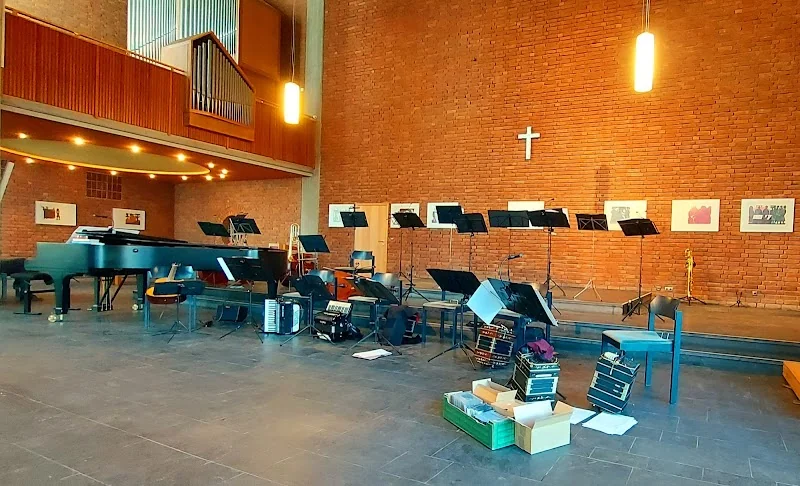
Those looking for photos of the Trinitatiskirche Bonn quickly discover a space with a clear signature: The church was consecrated in 1957, but its construction phase dates back to 1956 when the groundbreaking took place. The commemorative publication for the 50th anniversary describes the interior as simple and concise, with unplastered bricks that give the space a warm, yet very honest appearance. This character makes the church photogenic because it does not rely on overwhelming impressions but on calm, concentration, and good proportions. In addition, details have been added over the years: The organ was expanded in 1961 and 1962, the bells rang starting in 1964, and a large stained glass window was added several years after the consecration. The result is a space that appears historically grown yet remains open to new uses. The community also uses the church space for art, exhibitions, and concerts, allowing photos to showcase different facets: sometimes the liturgical center, sometimes the cultural stage, sometimes the relaxed atmosphere in the community center. This multifacetedness is one reason why images of the Trinitatiskirche Bonn work so well - they tell not only of architecture but of life in the space. On the official pages and at Beethovenfest, the church appears as a place that conveys strong impressions both from the outside and from within. ([trinitatis-bonn.ekir.de](https://trinitatis-bonn.ekir.de/wp-content/uploads/2023/06/Trini-Festschrift_50Jahre-Trini_2007.pdf))
Services, Taizé Celebrations, and the Spiritual Profile
A central area of interest regarding the Trinitatiskirche Bonn concerns the services, and here the community is very clear in its offerings. The regular Sunday service takes place at 10:00 AM. On the first Sunday of the month, communion is celebrated with grape juice, consciously choosing an open and family-friendly format. Additionally, there is a children's service on Fridays at 3:30 PM, and on the last Sunday of the month, a service with Taizé songs and communion takes place at 6:00 PM. This mix shows how broad the spiritual offerings are: traditional Sunday services, child-friendly formats, and meditative evening services with a Taizé character. The community's guiding principle aligns with this, as it speaks of open doors, participation, music, prayer, and silence. The invitation to participate is particularly important: The community sees itself as a house where different generations are welcome - from toddlers to seniors, from singles to large families. Therefore, those looking for a church that can be experienced rather than just visited will find in Trinitatis a place with a clear spiritual identity and high accessibility. This makes the location equally interesting for regular community visits as for guests seeking a special service, a Taizé celebration, or a church concert. ([bonn-evangelisch.de](https://bonn-evangelisch.de/inhalt/trinitatis/?utm_source=openai))
Concerts, Choirs, and Cultural Events in Trinitatis
Another strong theme surrounding the Trinitatiskirche Bonn is music. According to the community, the Förderkreis tr-i-molo organizes around 50 concerts of various styles each year, and this diversity shapes the profile of the place. The concerts usually take place on Fridays or Sundays, except on the last Sunday of the month, and are tailored to the character of the church space. The official artist information explains that the church itself is typically used as a concert venue, but other rooms in the community center are also available for smaller formats. The seating arrangement is variable, making the use flexible: The church space accommodates up to 200 listeners, the large community hall about 80, and the small community hall about 50. A Steinway Model D concert grand piano is available in the church space, and a smaller piano is in the large community hall. Additionally, there is a vibrant choir life: Various choirs and musical groups utilize the spaces, ranging from church vocal music to Taizé songs to modern songs and pop-oriented formats. Therefore, the place is not only interesting for classic church visits but also for cultural audiences specifically looking for concert programs, rehearsal spaces, or a musical atmosphere. The combination of acoustically suitable church space, flexible community rooms, and active music work makes Trinitatis one of the prominent music addresses in Bonn's western district. ([trinitatis-bonn.ekir.de](https://trinitatis-bonn.ekir.de/wp-content/uploads/2023/06/trimolo-Informationen-fuer-KuenstlerInnen.pdf))
Access, Public Transport, and Barrier-Free Access
For visitors, the practical accessibility of the Trinitatiskirche Bonn is an important point of interest. The official address is Brahmsstraße 14, 53121 Bonn. As direct public transport connections, the community mentions bus lines 606 and 607 with the stop Brahmsstraße. This makes traveling uncomplicated, especially when coming from the Bonn city area or neighboring districts. Beethovenfest also lists the location with this address and additionally emphasizes that the venue is barrier-free. The community itself points out a wheelchair-accessible entrance and an induction loop for the hearing impaired. For events, services, and concerts, this is a significant advantage, as the location is not only accessible but also as inclusive as possible. The location in Endenich is also culturally well embedded: Beethovenfest assigns the Trinitatiskirche to the Bonn-Endenich cultural mile, a closely networked environment with other cultural venues in immediate proximity. For inquiries about access, barrier-free access, location, or route, the church is therefore a clearly defined and well-documented place. Those not arriving by car will find a simple solution with the bus lines; those relying on barrier-free access will also receive reliable information. This combination of public accessibility and accessible infrastructure is one reason why the Trinitatiskirche functions equally as an event venue and community space. ([bonn-evangelisch.de](https://bonn-evangelisch.de/inhalt/trinitatis/?utm_source=openai))
History Since 1957 and the Role in the Endenich District
The history of the Trinitatiskirche Bonn is closely linked to the development of Bonn's western district. The church was consecrated in 1957, and the community describes itself as relatively young, as it only emerged in the mid-1950s. The community page also provides a specific number: Currently, the community has 3,261 members. This is important because it shows that Trinitatis is not a small peripheral church, but a vibrant local community with a clear anchoring in the district. The historical commemorative publication for the 50th anniversary reports that services were already held in the completed community hall at the end of 1956 before the church itself was finished. Construction began in July 1956, and the consecration followed on October 13, 1957. In retrospect, it becomes clear how much the community was shaped by the post-war years: People from different directions came together, and the community developed into a place of openness, discussion, and social engagement. Today, this also includes cooperation in the neighborhood as well as ecumenical connections with the district. The Rat & Tat Foundation has been active since 1997 and promotes diaconal work and neighborhood assistance, especially in Endenich and Weststadt. Thus, the church is visible not only as a building but as a social hub. To understand the location, one should therefore not only look at the architecture but also at the role of the community in the district: It is a place of worship, cultural space, and neighborhood institution at the same time. ([trinitatis-bonn.ekir.de](https://trinitatis-bonn.ekir.de/unsere-gemeinde/))
Community Hall, Art, Spaces, and Practical Use
The Trinitatiskirche Bonn is also interesting because of its spaces, as it thinks far beyond the classic church space. The community center offers three different rooms suitable for smaller events, which can be viewed in advance. The large community hall accommodates about 80 people, while the small community hall accommodates about 50. Concerts usually take place in the church, but the rooms can be used flexibly, for example, for rehearsals, groups, smaller formats, or supplementary program points. Particularly exciting is the connection between church and art: Since the 1990s, the community has invited artists to exhibit their works in the church. The exhibitions utilize the entrance area, church space, and pavilion of the community center and are accessible daily except Mondays from 10 AM to 7 PM over a period of six weeks. This aligns very well with the community motto, as the spaces are meant to be open and facilitate encounters. For events, this means an unusually versatile infrastructure: liturgical space, concert venue, exhibition site, and community hall seamlessly blend into one another. Therefore, those looking for a venue with character will find here a location that is both functional and atmospherically strong. The clear room layout is also practical for music, discussions, readings, or community evenings, and the existing seating can be adjusted according to the format. This is exactly what makes Trinitatis attractive for organizers, ensembles, and visitors: It is a place that not only looks beautiful but can actually adapt to different needs. ([trinitatis-bonn.ekir.de](https://trinitatis-bonn.ekir.de/wp-content/uploads/2023/06/trimolo-Informationen-fuer-KuenstlerInnen.pdf))
Children, Youth, and Diaconate as the Heart of the Community
A significant part of the profile of the Trinitatiskirche Bonn is the social and family offerings. The community operates a daycare center and the children's and youth center JAP, which has existed since 1973 and operates as an Open Door recognized by the Landschaftsverband Rheinland. The JAP is open to children and teenagers, offering leisure activities, cafeteria services, group and course programs, holiday programs, and retreats. This makes it clear that the community does not only take place on Sundays but is present in the daily lives of many families. Other offerings also demonstrate this breadth: The community describes itself as a place where people from toddlers to seniors are welcome. The pages also feature choir offerings, family formats, movement and health courses, as well as discussion and community offerings. The diaconal dimension is concretized through the Rat & Tat Foundation, which promotes self-help, neighborhood assistance, and support in difficult life situations. This connection of faith, music, family work, and social responsibility is a central reason why the Trinitatiskirche is perceived so strongly in Bonn's western district. Those looking for a church that does not limit itself to sacred Sunday moments but also considers children, youth, parents, and older people will find here a very clear example. This is also important from an SEO perspective: The location is relevant not only as a church but also as a lively community complex with relevance for families, culture enthusiasts, and people seeking community. ([trinitatis-bonn.ekir.de](https://trinitatis-bonn.ekir.de/jap/?utm_source=openai))
Sources:
- Evangelical Church District Bonn - Trinitatiskirche Bonn-Endenich ([bonn-evangelisch.de](https://bonn-evangelisch.de/inhalt/trinitatis/?utm_source=openai))
- Evangelical Trinitatiskirche Bonn - Community Profile ([trinitatis-bonn.ekir.de](https://trinitatis-bonn.ekir.de/trinitatiskirchengemeinde/))
- Evangelical Trinitatiskirche Bonn - Our Services ([trinitatis-bonn.ekir.de](https://trinitatis-bonn.ekir.de/unsere-gottesdienste/?utm_source=openai))
- tr-i-molo - Information for Artists ([trinitatis-bonn.ekir.de](https://trinitatis-bonn.ekir.de/wp-content/uploads/2023/06/trimolo-Informationen-fuer-KuenstlerInnen.pdf))
- Trini Commemorative Publication 50 Years Trinitatis 2007 ([trinitatis-bonn.ekir.de](https://trinitatis-bonn.ekir.de/wp-content/uploads/2023/06/Trini-Festschrift_50Jahre-Trini_2007.pdf))
- Beethovenfest - Trinitatiskirche ([beethovenfest.de](https://www.beethovenfest.de/en/locations/trinitatiskirche/45?utm_source=openai))
Show moreShow less
Trinitatiskirche Bonn | Photos & Services
The Trinitatiskirche Bonn in Endenich is much more than a classic parish church: It is a spiritual meeting point, concert venue, neighborhood space, and a visible center of a community that describes itself with the guiding principle "Wide Spaces - Room for Diversity." The Protestant community includes Endenich as well as parts of Poppelsdorf and Weststadt, was rebuilt in the mid-1950s, and continues to shape public life in Bonn's western district. Those looking for photos, services, concerts, or practical information will find a location that emphasizes openness, music, and participation. This is particularly evident in the many offerings for families, children, youth, choirs, and visitors, in the strong musical tradition, and in the clear integration into the life of the neighborhood. For seekers, the Trinitatiskirche Bonn is therefore a church with a profile: historically grown, actively used, and practically well accessible. ([trinitatis-bonn.ekir.de](https://trinitatis-bonn.ekir.de/unsere-gemeinde/))
Photos, Architecture, and the Unique Character of Trinitatiskirche Bonn
Those looking for photos of the Trinitatiskirche Bonn quickly discover a space with a clear signature: The church was consecrated in 1957, but its construction phase dates back to 1956 when the groundbreaking took place. The commemorative publication for the 50th anniversary describes the interior as simple and concise, with unplastered bricks that give the space a warm, yet very honest appearance. This character makes the church photogenic because it does not rely on overwhelming impressions but on calm, concentration, and good proportions. In addition, details have been added over the years: The organ was expanded in 1961 and 1962, the bells rang starting in 1964, and a large stained glass window was added several years after the consecration. The result is a space that appears historically grown yet remains open to new uses. The community also uses the church space for art, exhibitions, and concerts, allowing photos to showcase different facets: sometimes the liturgical center, sometimes the cultural stage, sometimes the relaxed atmosphere in the community center. This multifacetedness is one reason why images of the Trinitatiskirche Bonn work so well - they tell not only of architecture but of life in the space. On the official pages and at Beethovenfest, the church appears as a place that conveys strong impressions both from the outside and from within. ([trinitatis-bonn.ekir.de](https://trinitatis-bonn.ekir.de/wp-content/uploads/2023/06/Trini-Festschrift_50Jahre-Trini_2007.pdf))
Services, Taizé Celebrations, and the Spiritual Profile
A central area of interest regarding the Trinitatiskirche Bonn concerns the services, and here the community is very clear in its offerings. The regular Sunday service takes place at 10:00 AM. On the first Sunday of the month, communion is celebrated with grape juice, consciously choosing an open and family-friendly format. Additionally, there is a children's service on Fridays at 3:30 PM, and on the last Sunday of the month, a service with Taizé songs and communion takes place at 6:00 PM. This mix shows how broad the spiritual offerings are: traditional Sunday services, child-friendly formats, and meditative evening services with a Taizé character. The community's guiding principle aligns with this, as it speaks of open doors, participation, music, prayer, and silence. The invitation to participate is particularly important: The community sees itself as a house where different generations are welcome - from toddlers to seniors, from singles to large families. Therefore, those looking for a church that can be experienced rather than just visited will find in Trinitatis a place with a clear spiritual identity and high accessibility. This makes the location equally interesting for regular community visits as for guests seeking a special service, a Taizé celebration, or a church concert. ([bonn-evangelisch.de](https://bonn-evangelisch.de/inhalt/trinitatis/?utm_source=openai))
Concerts, Choirs, and Cultural Events in Trinitatis
Another strong theme surrounding the Trinitatiskirche Bonn is music. According to the community, the Förderkreis tr-i-molo organizes around 50 concerts of various styles each year, and this diversity shapes the profile of the place. The concerts usually take place on Fridays or Sundays, except on the last Sunday of the month, and are tailored to the character of the church space. The official artist information explains that the church itself is typically used as a concert venue, but other rooms in the community center are also available for smaller formats. The seating arrangement is variable, making the use flexible: The church space accommodates up to 200 listeners, the large community hall about 80, and the small community hall about 50. A Steinway Model D concert grand piano is available in the church space, and a smaller piano is in the large community hall. Additionally, there is a vibrant choir life: Various choirs and musical groups utilize the spaces, ranging from church vocal music to Taizé songs to modern songs and pop-oriented formats. Therefore, the place is not only interesting for classic church visits but also for cultural audiences specifically looking for concert programs, rehearsal spaces, or a musical atmosphere. The combination of acoustically suitable church space, flexible community rooms, and active music work makes Trinitatis one of the prominent music addresses in Bonn's western district. ([trinitatis-bonn.ekir.de](https://trinitatis-bonn.ekir.de/wp-content/uploads/2023/06/trimolo-Informationen-fuer-KuenstlerInnen.pdf))
Access, Public Transport, and Barrier-Free Access
For visitors, the practical accessibility of the Trinitatiskirche Bonn is an important point of interest. The official address is Brahmsstraße 14, 53121 Bonn. As direct public transport connections, the community mentions bus lines 606 and 607 with the stop Brahmsstraße. This makes traveling uncomplicated, especially when coming from the Bonn city area or neighboring districts. Beethovenfest also lists the location with this address and additionally emphasizes that the venue is barrier-free. The community itself points out a wheelchair-accessible entrance and an induction loop for the hearing impaired. For events, services, and concerts, this is a significant advantage, as the location is not only accessible but also as inclusive as possible. The location in Endenich is also culturally well embedded: Beethovenfest assigns the Trinitatiskirche to the Bonn-Endenich cultural mile, a closely networked environment with other cultural venues in immediate proximity. For inquiries about access, barrier-free access, location, or route, the church is therefore a clearly defined and well-documented place. Those not arriving by car will find a simple solution with the bus lines; those relying on barrier-free access will also receive reliable information. This combination of public accessibility and accessible infrastructure is one reason why the Trinitatiskirche functions equally as an event venue and community space. ([bonn-evangelisch.de](https://bonn-evangelisch.de/inhalt/trinitatis/?utm_source=openai))
History Since 1957 and the Role in the Endenich District
The history of the Trinitatiskirche Bonn is closely linked to the development of Bonn's western district. The church was consecrated in 1957, and the community describes itself as relatively young, as it only emerged in the mid-1950s. The community page also provides a specific number: Currently, the community has 3,261 members. This is important because it shows that Trinitatis is not a small peripheral church, but a vibrant local community with a clear anchoring in the district. The historical commemorative publication for the 50th anniversary reports that services were already held in the completed community hall at the end of 1956 before the church itself was finished. Construction began in July 1956, and the consecration followed on October 13, 1957. In retrospect, it becomes clear how much the community was shaped by the post-war years: People from different directions came together, and the community developed into a place of openness, discussion, and social engagement. Today, this also includes cooperation in the neighborhood as well as ecumenical connections with the district. The Rat & Tat Foundation has been active since 1997 and promotes diaconal work and neighborhood assistance, especially in Endenich and Weststadt. Thus, the church is visible not only as a building but as a social hub. To understand the location, one should therefore not only look at the architecture but also at the role of the community in the district: It is a place of worship, cultural space, and neighborhood institution at the same time. ([trinitatis-bonn.ekir.de](https://trinitatis-bonn.ekir.de/unsere-gemeinde/))
Community Hall, Art, Spaces, and Practical Use
The Trinitatiskirche Bonn is also interesting because of its spaces, as it thinks far beyond the classic church space. The community center offers three different rooms suitable for smaller events, which can be viewed in advance. The large community hall accommodates about 80 people, while the small community hall accommodates about 50. Concerts usually take place in the church, but the rooms can be used flexibly, for example, for rehearsals, groups, smaller formats, or supplementary program points. Particularly exciting is the connection between church and art: Since the 1990s, the community has invited artists to exhibit their works in the church. The exhibitions utilize the entrance area, church space, and pavilion of the community center and are accessible daily except Mondays from 10 AM to 7 PM over a period of six weeks. This aligns very well with the community motto, as the spaces are meant to be open and facilitate encounters. For events, this means an unusually versatile infrastructure: liturgical space, concert venue, exhibition site, and community hall seamlessly blend into one another. Therefore, those looking for a venue with character will find here a location that is both functional and atmospherically strong. The clear room layout is also practical for music, discussions, readings, or community evenings, and the existing seating can be adjusted according to the format. This is exactly what makes Trinitatis attractive for organizers, ensembles, and visitors: It is a place that not only looks beautiful but can actually adapt to different needs. ([trinitatis-bonn.ekir.de](https://trinitatis-bonn.ekir.de/wp-content/uploads/2023/06/trimolo-Informationen-fuer-KuenstlerInnen.pdf))
Children, Youth, and Diaconate as the Heart of the Community
A significant part of the profile of the Trinitatiskirche Bonn is the social and family offerings. The community operates a daycare center and the children's and youth center JAP, which has existed since 1973 and operates as an Open Door recognized by the Landschaftsverband Rheinland. The JAP is open to children and teenagers, offering leisure activities, cafeteria services, group and course programs, holiday programs, and retreats. This makes it clear that the community does not only take place on Sundays but is present in the daily lives of many families. Other offerings also demonstrate this breadth: The community describes itself as a place where people from toddlers to seniors are welcome. The pages also feature choir offerings, family formats, movement and health courses, as well as discussion and community offerings. The diaconal dimension is concretized through the Rat & Tat Foundation, which promotes self-help, neighborhood assistance, and support in difficult life situations. This connection of faith, music, family work, and social responsibility is a central reason why the Trinitatiskirche is perceived so strongly in Bonn's western district. Those looking for a church that does not limit itself to sacred Sunday moments but also considers children, youth, parents, and older people will find here a very clear example. This is also important from an SEO perspective: The location is relevant not only as a church but also as a lively community complex with relevance for families, culture enthusiasts, and people seeking community. ([trinitatis-bonn.ekir.de](https://trinitatis-bonn.ekir.de/jap/?utm_source=openai))
Sources:
- Evangelical Church District Bonn - Trinitatiskirche Bonn-Endenich ([bonn-evangelisch.de](https://bonn-evangelisch.de/inhalt/trinitatis/?utm_source=openai))
- Evangelical Trinitatiskirche Bonn - Community Profile ([trinitatis-bonn.ekir.de](https://trinitatis-bonn.ekir.de/trinitatiskirchengemeinde/))
- Evangelical Trinitatiskirche Bonn - Our Services ([trinitatis-bonn.ekir.de](https://trinitatis-bonn.ekir.de/unsere-gottesdienste/?utm_source=openai))
- tr-i-molo - Information for Artists ([trinitatis-bonn.ekir.de](https://trinitatis-bonn.ekir.de/wp-content/uploads/2023/06/trimolo-Informationen-fuer-KuenstlerInnen.pdf))
- Trini Commemorative Publication 50 Years Trinitatis 2007 ([trinitatis-bonn.ekir.de](https://trinitatis-bonn.ekir.de/wp-content/uploads/2023/06/Trini-Festschrift_50Jahre-Trini_2007.pdf))
- Beethovenfest - Trinitatiskirche ([beethovenfest.de](https://www.beethovenfest.de/en/locations/trinitatiskirche/45?utm_source=openai))
Trinitatiskirche Bonn | Photos & Services
The Trinitatiskirche Bonn in Endenich is much more than a classic parish church: It is a spiritual meeting point, concert venue, neighborhood space, and a visible center of a community that describes itself with the guiding principle "Wide Spaces - Room for Diversity." The Protestant community includes Endenich as well as parts of Poppelsdorf and Weststadt, was rebuilt in the mid-1950s, and continues to shape public life in Bonn's western district. Those looking for photos, services, concerts, or practical information will find a location that emphasizes openness, music, and participation. This is particularly evident in the many offerings for families, children, youth, choirs, and visitors, in the strong musical tradition, and in the clear integration into the life of the neighborhood. For seekers, the Trinitatiskirche Bonn is therefore a church with a profile: historically grown, actively used, and practically well accessible. ([trinitatis-bonn.ekir.de](https://trinitatis-bonn.ekir.de/unsere-gemeinde/))
Photos, Architecture, and the Unique Character of Trinitatiskirche Bonn
Those looking for photos of the Trinitatiskirche Bonn quickly discover a space with a clear signature: The church was consecrated in 1957, but its construction phase dates back to 1956 when the groundbreaking took place. The commemorative publication for the 50th anniversary describes the interior as simple and concise, with unplastered bricks that give the space a warm, yet very honest appearance. This character makes the church photogenic because it does not rely on overwhelming impressions but on calm, concentration, and good proportions. In addition, details have been added over the years: The organ was expanded in 1961 and 1962, the bells rang starting in 1964, and a large stained glass window was added several years after the consecration. The result is a space that appears historically grown yet remains open to new uses. The community also uses the church space for art, exhibitions, and concerts, allowing photos to showcase different facets: sometimes the liturgical center, sometimes the cultural stage, sometimes the relaxed atmosphere in the community center. This multifacetedness is one reason why images of the Trinitatiskirche Bonn work so well - they tell not only of architecture but of life in the space. On the official pages and at Beethovenfest, the church appears as a place that conveys strong impressions both from the outside and from within. ([trinitatis-bonn.ekir.de](https://trinitatis-bonn.ekir.de/wp-content/uploads/2023/06/Trini-Festschrift_50Jahre-Trini_2007.pdf))
Services, Taizé Celebrations, and the Spiritual Profile
A central area of interest regarding the Trinitatiskirche Bonn concerns the services, and here the community is very clear in its offerings. The regular Sunday service takes place at 10:00 AM. On the first Sunday of the month, communion is celebrated with grape juice, consciously choosing an open and family-friendly format. Additionally, there is a children's service on Fridays at 3:30 PM, and on the last Sunday of the month, a service with Taizé songs and communion takes place at 6:00 PM. This mix shows how broad the spiritual offerings are: traditional Sunday services, child-friendly formats, and meditative evening services with a Taizé character. The community's guiding principle aligns with this, as it speaks of open doors, participation, music, prayer, and silence. The invitation to participate is particularly important: The community sees itself as a house where different generations are welcome - from toddlers to seniors, from singles to large families. Therefore, those looking for a church that can be experienced rather than just visited will find in Trinitatis a place with a clear spiritual identity and high accessibility. This makes the location equally interesting for regular community visits as for guests seeking a special service, a Taizé celebration, or a church concert. ([bonn-evangelisch.de](https://bonn-evangelisch.de/inhalt/trinitatis/?utm_source=openai))
Concerts, Choirs, and Cultural Events in Trinitatis
Another strong theme surrounding the Trinitatiskirche Bonn is music. According to the community, the Förderkreis tr-i-molo organizes around 50 concerts of various styles each year, and this diversity shapes the profile of the place. The concerts usually take place on Fridays or Sundays, except on the last Sunday of the month, and are tailored to the character of the church space. The official artist information explains that the church itself is typically used as a concert venue, but other rooms in the community center are also available for smaller formats. The seating arrangement is variable, making the use flexible: The church space accommodates up to 200 listeners, the large community hall about 80, and the small community hall about 50. A Steinway Model D concert grand piano is available in the church space, and a smaller piano is in the large community hall. Additionally, there is a vibrant choir life: Various choirs and musical groups utilize the spaces, ranging from church vocal music to Taizé songs to modern songs and pop-oriented formats. Therefore, the place is not only interesting for classic church visits but also for cultural audiences specifically looking for concert programs, rehearsal spaces, or a musical atmosphere. The combination of acoustically suitable church space, flexible community rooms, and active music work makes Trinitatis one of the prominent music addresses in Bonn's western district. ([trinitatis-bonn.ekir.de](https://trinitatis-bonn.ekir.de/wp-content/uploads/2023/06/trimolo-Informationen-fuer-KuenstlerInnen.pdf))
Access, Public Transport, and Barrier-Free Access
For visitors, the practical accessibility of the Trinitatiskirche Bonn is an important point of interest. The official address is Brahmsstraße 14, 53121 Bonn. As direct public transport connections, the community mentions bus lines 606 and 607 with the stop Brahmsstraße. This makes traveling uncomplicated, especially when coming from the Bonn city area or neighboring districts. Beethovenfest also lists the location with this address and additionally emphasizes that the venue is barrier-free. The community itself points out a wheelchair-accessible entrance and an induction loop for the hearing impaired. For events, services, and concerts, this is a significant advantage, as the location is not only accessible but also as inclusive as possible. The location in Endenich is also culturally well embedded: Beethovenfest assigns the Trinitatiskirche to the Bonn-Endenich cultural mile, a closely networked environment with other cultural venues in immediate proximity. For inquiries about access, barrier-free access, location, or route, the church is therefore a clearly defined and well-documented place. Those not arriving by car will find a simple solution with the bus lines; those relying on barrier-free access will also receive reliable information. This combination of public accessibility and accessible infrastructure is one reason why the Trinitatiskirche functions equally as an event venue and community space. ([bonn-evangelisch.de](https://bonn-evangelisch.de/inhalt/trinitatis/?utm_source=openai))
History Since 1957 and the Role in the Endenich District
The history of the Trinitatiskirche Bonn is closely linked to the development of Bonn's western district. The church was consecrated in 1957, and the community describes itself as relatively young, as it only emerged in the mid-1950s. The community page also provides a specific number: Currently, the community has 3,261 members. This is important because it shows that Trinitatis is not a small peripheral church, but a vibrant local community with a clear anchoring in the district. The historical commemorative publication for the 50th anniversary reports that services were already held in the completed community hall at the end of 1956 before the church itself was finished. Construction began in July 1956, and the consecration followed on October 13, 1957. In retrospect, it becomes clear how much the community was shaped by the post-war years: People from different directions came together, and the community developed into a place of openness, discussion, and social engagement. Today, this also includes cooperation in the neighborhood as well as ecumenical connections with the district. The Rat & Tat Foundation has been active since 1997 and promotes diaconal work and neighborhood assistance, especially in Endenich and Weststadt. Thus, the church is visible not only as a building but as a social hub. To understand the location, one should therefore not only look at the architecture but also at the role of the community in the district: It is a place of worship, cultural space, and neighborhood institution at the same time. ([trinitatis-bonn.ekir.de](https://trinitatis-bonn.ekir.de/unsere-gemeinde/))
Community Hall, Art, Spaces, and Practical Use
The Trinitatiskirche Bonn is also interesting because of its spaces, as it thinks far beyond the classic church space. The community center offers three different rooms suitable for smaller events, which can be viewed in advance. The large community hall accommodates about 80 people, while the small community hall accommodates about 50. Concerts usually take place in the church, but the rooms can be used flexibly, for example, for rehearsals, groups, smaller formats, or supplementary program points. Particularly exciting is the connection between church and art: Since the 1990s, the community has invited artists to exhibit their works in the church. The exhibitions utilize the entrance area, church space, and pavilion of the community center and are accessible daily except Mondays from 10 AM to 7 PM over a period of six weeks. This aligns very well with the community motto, as the spaces are meant to be open and facilitate encounters. For events, this means an unusually versatile infrastructure: liturgical space, concert venue, exhibition site, and community hall seamlessly blend into one another. Therefore, those looking for a venue with character will find here a location that is both functional and atmospherically strong. The clear room layout is also practical for music, discussions, readings, or community evenings, and the existing seating can be adjusted according to the format. This is exactly what makes Trinitatis attractive for organizers, ensembles, and visitors: It is a place that not only looks beautiful but can actually adapt to different needs. ([trinitatis-bonn.ekir.de](https://trinitatis-bonn.ekir.de/wp-content/uploads/2023/06/trimolo-Informationen-fuer-KuenstlerInnen.pdf))
Children, Youth, and Diaconate as the Heart of the Community
A significant part of the profile of the Trinitatiskirche Bonn is the social and family offerings. The community operates a daycare center and the children's and youth center JAP, which has existed since 1973 and operates as an Open Door recognized by the Landschaftsverband Rheinland. The JAP is open to children and teenagers, offering leisure activities, cafeteria services, group and course programs, holiday programs, and retreats. This makes it clear that the community does not only take place on Sundays but is present in the daily lives of many families. Other offerings also demonstrate this breadth: The community describes itself as a place where people from toddlers to seniors are welcome. The pages also feature choir offerings, family formats, movement and health courses, as well as discussion and community offerings. The diaconal dimension is concretized through the Rat & Tat Foundation, which promotes self-help, neighborhood assistance, and support in difficult life situations. This connection of faith, music, family work, and social responsibility is a central reason why the Trinitatiskirche is perceived so strongly in Bonn's western district. Those looking for a church that does not limit itself to sacred Sunday moments but also considers children, youth, parents, and older people will find here a very clear example. This is also important from an SEO perspective: The location is relevant not only as a church but also as a lively community complex with relevance for families, culture enthusiasts, and people seeking community. ([trinitatis-bonn.ekir.de](https://trinitatis-bonn.ekir.de/jap/?utm_source=openai))
Sources:
- Evangelical Church District Bonn - Trinitatiskirche Bonn-Endenich ([bonn-evangelisch.de](https://bonn-evangelisch.de/inhalt/trinitatis/?utm_source=openai))
- Evangelical Trinitatiskirche Bonn - Community Profile ([trinitatis-bonn.ekir.de](https://trinitatis-bonn.ekir.de/trinitatiskirchengemeinde/))
- Evangelical Trinitatiskirche Bonn - Our Services ([trinitatis-bonn.ekir.de](https://trinitatis-bonn.ekir.de/unsere-gottesdienste/?utm_source=openai))
- tr-i-molo - Information for Artists ([trinitatis-bonn.ekir.de](https://trinitatis-bonn.ekir.de/wp-content/uploads/2023/06/trimolo-Informationen-fuer-KuenstlerInnen.pdf))
- Trini Commemorative Publication 50 Years Trinitatis 2007 ([trinitatis-bonn.ekir.de](https://trinitatis-bonn.ekir.de/wp-content/uploads/2023/06/Trini-Festschrift_50Jahre-Trini_2007.pdf))
- Beethovenfest - Trinitatiskirche ([beethovenfest.de](https://www.beethovenfest.de/en/locations/trinitatiskirche/45?utm_source=openai))
Upcoming Events

Stars of the Summernight - The Summer Concert of the Polyphoniker
Summer Sound in Bonn: The Polyphoniker Fill the Trinity Church with Choral Magic, Pop, and Goosebumps. 05.07.2026, 6 PM, free admission. Secure your ticket now! #Bonn
Hofgarten Orchestra in Bonn: Free Summer Concert at the Trinity Church
A summer evening with great romantic sound richness: The Hofgarten Orchestra plays for free at the Trinity Church Bonn-Endenich. Secure your spot now! #Bonn
Frequently Asked Questions
Reviews
SamSunnyAnandSigamani
26. September 2021
One can sit calmly and meditate or pray. Soothing for your mind!
Egon Nilpferd
1. February 2026
Kirche aus den fünfziger Jahren mit toller Akustik für Konzerte und sehr lebendiger Gemeinde.
Ruwen Schieder
14. November 2023
The regular concerts in this church are really impressive. The space has outstanding acoustics that allow the music to shine in all its glory. The concert series includes an impressive range from classical sounds to contemporary interpretations.
Сергей Борисович
10. April 2025
Wonderful concert hall at the church. Good acoustics.
Freddy Loos
14. July 2025
Für Konzerte sehr gut geeignet.