
Bonn
Stresemannufer, 53113 Bonn, Deutschland
Stresemannufer Bonn | Access & Parking
The Stresemannufer in Bonn is one of those places where city history, riverside location, and modern orientation meet in a remarkably compact way. The street directory lists it as a bike path in Bonn-Gronau with the coordinates 50.7201849 / 7.1247574, and the Bonn street history locates the section between Dahlmannstraße and Hermann-Ehlers-Straße. The street was named in 1952 after Gustav Stresemann, one of the most influential politicians of the Weimar Republic. So today, anyone traveling along the Stresemannufer is not just passing through an arbitrary riverside address, but through a place that serves as a guide, a space of memory, and a riverside address in the Bonn federal district. This very mix makes the location so valuable for visitors, event guests, walkers, and anyone wanting to orient themselves in the former government district. ([strassen-in-deutschland.de](https://www.strassen-in-deutschland.de/23953700-stresemannufer-in-bonn.html))
What is the Stresemannufer in Bonn?
As a street name, Stresemannufer is unique in Germany, and this uniqueness makes the address so clear in navigation systems, maps, and search queries. Surrounding the section are well-known axes of the federal district such as Platz der Vereinten Nationen, Heussallee, Karl-Carstens-Straße, Welckerstraße, Charles-de-Gaulle-Straße, and Wilhelm-Spiritus-Ufer. For visitors, this is practical because the Stresemannufer can be read not only as a destination but also as a line of orientation along the Rhine. Anyone arriving here immediately recognizes: This is a place between water, institutions, and urban movement, where the topography of the Bonn Republic is still reflected in the street network today. The street location is thus not only geographically but also historically significant. ([strassen-in-deutschland.de](https://www.strassen-in-deutschland.de/23953700-stresemannufer-in-bonn.html))
The name itself refers to Gustav Stresemann, and thus to a political biography that is consciously carried along in the Bonn context. In the vicinity of the former government district, this naming takes on special weight because here streets, buildings, and riverside paths are not merely functional traffic areas but part of a historical narrative. The Stresemannufer reminds us of a phase of German politics when Bonn was the federal city, and it lies exactly where this past remains visible in the urban landscape. So, anyone searching for Stresemannufer Bonn finds not only an address by the river but a place where memory culture and everyday use overlap without interruption. This dual function is a key reason why the riverside is so interesting for visitors: it is simultaneously a path, a landmark, and a historically significant backdrop. ([de.wikipedia.org](https://de.wikipedia.org/wiki/Liste_der_Stra%C3%9Fen_im_Bonner_Ortsteil_Gronau))
Access to the Stresemannufer by train, bus, and on foot
The access to the Stresemannufer is especially well organized for guests of the World Conference Center Bonn, as the official arrival is clearly focused on public transport. From Bonn Central Station, the tram lines 16/63 or 66 go towards Bad Godesberg or Königswinter or Bad Honnef to the stop Heussallee/Museumsmeile. From there, according to WCCB, it is about 450 meters on foot along Heussallee to Platz der Vereinten Nationen, and then just a short walk to the main entrances. Bus access is also possible with lines 610 and 611 to the Deutsche Welle stop. After that, it goes again along Heussallee towards the congress center. For many visitors, this combination is ideal because it leads directly to the event area without complicated detours. ([worldccbonn.com](https://www.worldccbonn.com/en/contact/))
Another practical option is the DB stop Bonn UN Campus. The World Conference Center Bonn indicates a walking distance of about 750 meters via Genscherallee and Heussallee to the destination. Especially for guests coming from Cologne, the Rhein-Sieg-Kreis, or the Middle Rhine, this option can be very sensible depending on the connection. This is important for the Stresemannufer itself because the place functions less as an isolated street in everyday life but as part of a well-connected network of stops, squares, and riverside paths. Those arriving without a car benefit doubly: the routes are easy to read, and the federal district is designed for short distances between public transport, the Rhine, and the event location. For this reason, the Stresemannufer is a very pleasant address for visitors who want to experience Bonn relaxed and without searching for parking. ([worldccbonn.com](https://www.worldccbonn.com/en/contact/))
Parking at the Stresemannufer and in the Bonn Environmental Zone
For arriving by car, the official WCCB site mentions two central options: the parking garage Karl-Carstens-Straße 4 and the parking lot Charles-de-Gaulle-Straße. The parking garage is open 24 hours, the entrance height is 2.10 meters, and there are ten parking spaces for people with disabilities available on the ground floor. Access is via Welckerstraße, making it easy to locate in the district. The fees are also clearly regulated: 2.00 euros per hour or part thereof, plus a day ticket for 18.00 euros. For guests of conferences, receptions, or large events, this is a reliable solution because the parking garage is located directly in the vicinity of the World Conference Center Bonn, allowing for short distances to the Stresemannufer. ([worldccbonn.com](https://www.worldccbonn.com/en/contact/))
As a second option, the official access mentions the parking lot Charles-de-Gaulle-Straße. This parking lot is also open 24 hours; the first hour costs 1.50 euros, from the fourth hour, it is 1.00 euro per hour, and a day ticket costs 12.00 euros. Additionally, there are two barrier-free parking spaces in the immediate vicinity at the end of Charles-de-Gaulle-Straße. It is also practically important to note the Bonn environmental zone: the WCCB is located within it, and since July 1, 2014, only vehicles with a green environmental badge are allowed to enter. Therefore, anyone driving to the Stresemannufer or to an event in the district should check the environmental badge, access, and parking options in advance. For visitors with electric vehicles, it is interesting that charging stations are also available in the parking garage. This way, the area is not only accessible but also prepared for modern mobility. ([worldccbonn.com](https://www.worldccbonn.com/en/contact/))
World Conference Center Bonn: former Federal House and Plenary Hall
The Stresemannufer is closely linked to the World Conference Center Bonn, and the official history of the house makes this connection particularly clear. Bonn became the provisional seat of federal organs in 1949; the Bundestag initially met at the Pedagogical Academy. In the following decades, parliamentarians used the expansion of the academy building as a meeting place before the old plenary hall was demolished in 1987. The new plenary hall was built according to the plans of Günter Behnisch, with construction beginning in 1988 and inauguration in 1992. Since autumn 1999, the former plenary hall has been part of the current World Conference Center Bonn and can be used for events of all kinds. Thus, the area at the Stresemannufer has remained not only a historical site but also a productive part of Bonn's conference landscape. ([worldccbonn.com](https://www.worldccbonn.com/en/))
Today, the World Conference Center Bonn has a total capacity of up to 7,000 people for the main building and the former plenary hall. Additionally, the official capacity overview lists 1,230 seats in the plenary chamber and 3,730 seats in Hall New York. This makes the location one of the most significant event addresses in the city of Bonn, especially when international conferences, political meetings, or hybrid formats are in demand. Notably, the combination of historical architecture and modern use: the former parliamentary building is not only a monument but also a functional event location. Therefore, anyone visiting the Stresemannufer experiences the waterfront of a house that has transformed from the provisional Bonn Republic into an internationally used conference address. This transformation is a central part of the identity of the place and continues to shape the impression visitors receive when looking at the riverside. ([worldccbonn.com](https://www.worldccbonn.com/))
Old Waterworks, Langer Eugen, and UN Campus in the Neighborhood
Around the Stresemannufer, several buildings condense that explain the political and international significance of the Bonn federal district. The LVR spot on the Federal House describes the plenary hall as the last architectural testimony of the Bonn Republic and emphasizes that the room, where the first all-German parliament met from 1992 to 1999, is still considered an important document of the Federal Republic and the city of Bonn. At the same time, the plenary hall is accessible via the Rhine promenade or the Stresemannufer. This makes it clear that the riverside line is not only a beautiful path by the water but also a direct address of political memory. Anyone standing here looks at a place where the history of German democracy remains spatially tangible and does not only exist in archives. ([click-rhein.lvr.de](https://click-rhein.lvr.de/detail/spot/20785))
The Old Waterworks and Langer Eugen also belong to this closely set neighborhood. KuLaDig describes the Old Waterworks as a facility between Hermann-Ehlers-Straße and Stresemannufer; in the image descriptions, the entrance is shown as the area where the German Bundestag was housed from 1986 to 1992. Langer Eugen, on the other hand, was the office high-rise of the Bundestag members until 1999 and is now a central structure of the UN Campus. The Democracy Path website additionally emphasizes that the building now houses several UN institutions. In the immediate vicinity is also the Deutsche Welle, which is mentioned in the official representation of the Langer Eugen location as a neighboring building. For visitors, this results in a very dense ensemble of Bundestag history, international use, and modern media and conference landscape. ([kuladig.de](https://www.kuladig.de/Objektansicht/O-21103-20111109-4))
Rhine Promenade, L'Allumé, and the View of the Bonn Riverside
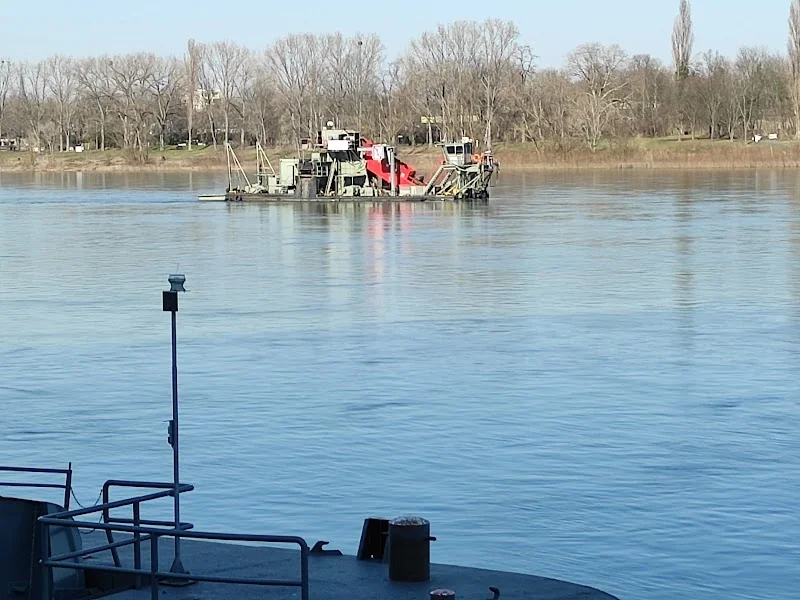
The Stresemannufer is not only an address for access and history but also a very prominent section of the Bonn Rhine promenade. The Bonn descriptions show the sculpture L'Allumé directly at the riverside promenade in front of the former Federal House at the height of the former plenary hall. The ten-meter-high steel artwork by Mark di Suvero has been there since 1990 and, with its strong construction, is a striking eye-catcher by the river. Especially in conjunction with the riverside path, the water, and the political architecture, a picture emerges that makes Bonn very typical in a small space: visible, public, and historically charged. The sculpture thus serves as more than just art in the urban space; it also acts as a visual counterbalance to the heavy institutional architecture in the background. ([bonn.wiki](https://bonn.wiki/wiki/Stresemannufer))
Therefore, anyone walking along the Stresemannufer experiences an unusually dense mix of Rhine, art, memory culture, and contemporary event use. The area is not an extensive leisure park with many stations but a compact section where very different layers overlap just a few steps apart: riverside, path, parliamentary heritage, conference center, and UN neighborhood. This is particularly advantageous for guests of the World Conference Center Bonn, as the surroundings can be quickly explored from here, and orientation along the major axes of the federal district remains simple. For walks along the water, for short distances between appointments and evening programs, or for an initial overview of the Bonn federal city, the Stresemannufer is therefore particularly interesting. It connects the Rhine with one of the most historically significant addresses in the city and makes this connection immediately tangible in everyday life. ([strassen-in-deutschland.de](https://www.strassen-in-deutschland.de/23953700-stresemannufer-in-bonn.html))
Sources:
- World Conference Center Bonn – Contact & Delivery ([worldccbonn.com](https://www.worldccbonn.com/en/contact/))
- World Conference Center Bonn – Welcome to the WCCB! ([worldccbonn.com](https://www.worldccbonn.com/en/the-company/welcome-to-the-wccb/))
- World Conference Center Bonn – Main page and capacities ([worldccbonn.com](https://www.worldccbonn.com/))
- Streets in Germany – Stresemannufer in Bonn ([strassen-in-deutschland.de](https://www.strassen-in-deutschland.de/23953700-stresemannufer-in-bonn.html))
- List of streets in the Bonn district of Gronau – Wikipedia ([de.wikipedia.org](https://de.wikipedia.org/wiki/Liste_der_Stra%C3%9Fen_im_Bonner_Ortsteil_Gronau))
- KuLaDig – Old Waterworks Bonn ([kuladig.de](https://www.kuladig.de/Objektansicht/O-21103-20111109-4))
- Path of Democracy – Langer Eugen ([wegderdemokratie.de](https://www.wegderdemokratie.de/en/langer-eugen))
- ClickRhein – Federal House Bonn ([click-rhein.lvr.de](https://click-rhein.lvr.de/detail/spot/20785))
- Bonn.wiki – Stresemannufer ([bonn.wiki](https://bonn.wiki/wiki/Stresemannufer))
Show moreShow less
Stresemannufer Bonn | Access & Parking
The Stresemannufer in Bonn is one of those places where city history, riverside location, and modern orientation meet in a remarkably compact way. The street directory lists it as a bike path in Bonn-Gronau with the coordinates 50.7201849 / 7.1247574, and the Bonn street history locates the section between Dahlmannstraße and Hermann-Ehlers-Straße. The street was named in 1952 after Gustav Stresemann, one of the most influential politicians of the Weimar Republic. So today, anyone traveling along the Stresemannufer is not just passing through an arbitrary riverside address, but through a place that serves as a guide, a space of memory, and a riverside address in the Bonn federal district. This very mix makes the location so valuable for visitors, event guests, walkers, and anyone wanting to orient themselves in the former government district. ([strassen-in-deutschland.de](https://www.strassen-in-deutschland.de/23953700-stresemannufer-in-bonn.html))
What is the Stresemannufer in Bonn?
As a street name, Stresemannufer is unique in Germany, and this uniqueness makes the address so clear in navigation systems, maps, and search queries. Surrounding the section are well-known axes of the federal district such as Platz der Vereinten Nationen, Heussallee, Karl-Carstens-Straße, Welckerstraße, Charles-de-Gaulle-Straße, and Wilhelm-Spiritus-Ufer. For visitors, this is practical because the Stresemannufer can be read not only as a destination but also as a line of orientation along the Rhine. Anyone arriving here immediately recognizes: This is a place between water, institutions, and urban movement, where the topography of the Bonn Republic is still reflected in the street network today. The street location is thus not only geographically but also historically significant. ([strassen-in-deutschland.de](https://www.strassen-in-deutschland.de/23953700-stresemannufer-in-bonn.html))
The name itself refers to Gustav Stresemann, and thus to a political biography that is consciously carried along in the Bonn context. In the vicinity of the former government district, this naming takes on special weight because here streets, buildings, and riverside paths are not merely functional traffic areas but part of a historical narrative. The Stresemannufer reminds us of a phase of German politics when Bonn was the federal city, and it lies exactly where this past remains visible in the urban landscape. So, anyone searching for Stresemannufer Bonn finds not only an address by the river but a place where memory culture and everyday use overlap without interruption. This dual function is a key reason why the riverside is so interesting for visitors: it is simultaneously a path, a landmark, and a historically significant backdrop. ([de.wikipedia.org](https://de.wikipedia.org/wiki/Liste_der_Stra%C3%9Fen_im_Bonner_Ortsteil_Gronau))
Access to the Stresemannufer by train, bus, and on foot
The access to the Stresemannufer is especially well organized for guests of the World Conference Center Bonn, as the official arrival is clearly focused on public transport. From Bonn Central Station, the tram lines 16/63 or 66 go towards Bad Godesberg or Königswinter or Bad Honnef to the stop Heussallee/Museumsmeile. From there, according to WCCB, it is about 450 meters on foot along Heussallee to Platz der Vereinten Nationen, and then just a short walk to the main entrances. Bus access is also possible with lines 610 and 611 to the Deutsche Welle stop. After that, it goes again along Heussallee towards the congress center. For many visitors, this combination is ideal because it leads directly to the event area without complicated detours. ([worldccbonn.com](https://www.worldccbonn.com/en/contact/))
Another practical option is the DB stop Bonn UN Campus. The World Conference Center Bonn indicates a walking distance of about 750 meters via Genscherallee and Heussallee to the destination. Especially for guests coming from Cologne, the Rhein-Sieg-Kreis, or the Middle Rhine, this option can be very sensible depending on the connection. This is important for the Stresemannufer itself because the place functions less as an isolated street in everyday life but as part of a well-connected network of stops, squares, and riverside paths. Those arriving without a car benefit doubly: the routes are easy to read, and the federal district is designed for short distances between public transport, the Rhine, and the event location. For this reason, the Stresemannufer is a very pleasant address for visitors who want to experience Bonn relaxed and without searching for parking. ([worldccbonn.com](https://www.worldccbonn.com/en/contact/))
Parking at the Stresemannufer and in the Bonn Environmental Zone
For arriving by car, the official WCCB site mentions two central options: the parking garage Karl-Carstens-Straße 4 and the parking lot Charles-de-Gaulle-Straße. The parking garage is open 24 hours, the entrance height is 2.10 meters, and there are ten parking spaces for people with disabilities available on the ground floor. Access is via Welckerstraße, making it easy to locate in the district. The fees are also clearly regulated: 2.00 euros per hour or part thereof, plus a day ticket for 18.00 euros. For guests of conferences, receptions, or large events, this is a reliable solution because the parking garage is located directly in the vicinity of the World Conference Center Bonn, allowing for short distances to the Stresemannufer. ([worldccbonn.com](https://www.worldccbonn.com/en/contact/))
As a second option, the official access mentions the parking lot Charles-de-Gaulle-Straße. This parking lot is also open 24 hours; the first hour costs 1.50 euros, from the fourth hour, it is 1.00 euro per hour, and a day ticket costs 12.00 euros. Additionally, there are two barrier-free parking spaces in the immediate vicinity at the end of Charles-de-Gaulle-Straße. It is also practically important to note the Bonn environmental zone: the WCCB is located within it, and since July 1, 2014, only vehicles with a green environmental badge are allowed to enter. Therefore, anyone driving to the Stresemannufer or to an event in the district should check the environmental badge, access, and parking options in advance. For visitors with electric vehicles, it is interesting that charging stations are also available in the parking garage. This way, the area is not only accessible but also prepared for modern mobility. ([worldccbonn.com](https://www.worldccbonn.com/en/contact/))
World Conference Center Bonn: former Federal House and Plenary Hall
The Stresemannufer is closely linked to the World Conference Center Bonn, and the official history of the house makes this connection particularly clear. Bonn became the provisional seat of federal organs in 1949; the Bundestag initially met at the Pedagogical Academy. In the following decades, parliamentarians used the expansion of the academy building as a meeting place before the old plenary hall was demolished in 1987. The new plenary hall was built according to the plans of Günter Behnisch, with construction beginning in 1988 and inauguration in 1992. Since autumn 1999, the former plenary hall has been part of the current World Conference Center Bonn and can be used for events of all kinds. Thus, the area at the Stresemannufer has remained not only a historical site but also a productive part of Bonn's conference landscape. ([worldccbonn.com](https://www.worldccbonn.com/en/))
Today, the World Conference Center Bonn has a total capacity of up to 7,000 people for the main building and the former plenary hall. Additionally, the official capacity overview lists 1,230 seats in the plenary chamber and 3,730 seats in Hall New York. This makes the location one of the most significant event addresses in the city of Bonn, especially when international conferences, political meetings, or hybrid formats are in demand. Notably, the combination of historical architecture and modern use: the former parliamentary building is not only a monument but also a functional event location. Therefore, anyone visiting the Stresemannufer experiences the waterfront of a house that has transformed from the provisional Bonn Republic into an internationally used conference address. This transformation is a central part of the identity of the place and continues to shape the impression visitors receive when looking at the riverside. ([worldccbonn.com](https://www.worldccbonn.com/))
Old Waterworks, Langer Eugen, and UN Campus in the Neighborhood
Around the Stresemannufer, several buildings condense that explain the political and international significance of the Bonn federal district. The LVR spot on the Federal House describes the plenary hall as the last architectural testimony of the Bonn Republic and emphasizes that the room, where the first all-German parliament met from 1992 to 1999, is still considered an important document of the Federal Republic and the city of Bonn. At the same time, the plenary hall is accessible via the Rhine promenade or the Stresemannufer. This makes it clear that the riverside line is not only a beautiful path by the water but also a direct address of political memory. Anyone standing here looks at a place where the history of German democracy remains spatially tangible and does not only exist in archives. ([click-rhein.lvr.de](https://click-rhein.lvr.de/detail/spot/20785))
The Old Waterworks and Langer Eugen also belong to this closely set neighborhood. KuLaDig describes the Old Waterworks as a facility between Hermann-Ehlers-Straße and Stresemannufer; in the image descriptions, the entrance is shown as the area where the German Bundestag was housed from 1986 to 1992. Langer Eugen, on the other hand, was the office high-rise of the Bundestag members until 1999 and is now a central structure of the UN Campus. The Democracy Path website additionally emphasizes that the building now houses several UN institutions. In the immediate vicinity is also the Deutsche Welle, which is mentioned in the official representation of the Langer Eugen location as a neighboring building. For visitors, this results in a very dense ensemble of Bundestag history, international use, and modern media and conference landscape. ([kuladig.de](https://www.kuladig.de/Objektansicht/O-21103-20111109-4))
Rhine Promenade, L'Allumé, and the View of the Bonn Riverside
The Stresemannufer is not only an address for access and history but also a very prominent section of the Bonn Rhine promenade. The Bonn descriptions show the sculpture L'Allumé directly at the riverside promenade in front of the former Federal House at the height of the former plenary hall. The ten-meter-high steel artwork by Mark di Suvero has been there since 1990 and, with its strong construction, is a striking eye-catcher by the river. Especially in conjunction with the riverside path, the water, and the political architecture, a picture emerges that makes Bonn very typical in a small space: visible, public, and historically charged. The sculpture thus serves as more than just art in the urban space; it also acts as a visual counterbalance to the heavy institutional architecture in the background. ([bonn.wiki](https://bonn.wiki/wiki/Stresemannufer))
Therefore, anyone walking along the Stresemannufer experiences an unusually dense mix of Rhine, art, memory culture, and contemporary event use. The area is not an extensive leisure park with many stations but a compact section where very different layers overlap just a few steps apart: riverside, path, parliamentary heritage, conference center, and UN neighborhood. This is particularly advantageous for guests of the World Conference Center Bonn, as the surroundings can be quickly explored from here, and orientation along the major axes of the federal district remains simple. For walks along the water, for short distances between appointments and evening programs, or for an initial overview of the Bonn federal city, the Stresemannufer is therefore particularly interesting. It connects the Rhine with one of the most historically significant addresses in the city and makes this connection immediately tangible in everyday life. ([strassen-in-deutschland.de](https://www.strassen-in-deutschland.de/23953700-stresemannufer-in-bonn.html))
Sources:
- World Conference Center Bonn – Contact & Delivery ([worldccbonn.com](https://www.worldccbonn.com/en/contact/))
- World Conference Center Bonn – Welcome to the WCCB! ([worldccbonn.com](https://www.worldccbonn.com/en/the-company/welcome-to-the-wccb/))
- World Conference Center Bonn – Main page and capacities ([worldccbonn.com](https://www.worldccbonn.com/))
- Streets in Germany – Stresemannufer in Bonn ([strassen-in-deutschland.de](https://www.strassen-in-deutschland.de/23953700-stresemannufer-in-bonn.html))
- List of streets in the Bonn district of Gronau – Wikipedia ([de.wikipedia.org](https://de.wikipedia.org/wiki/Liste_der_Stra%C3%9Fen_im_Bonner_Ortsteil_Gronau))
- KuLaDig – Old Waterworks Bonn ([kuladig.de](https://www.kuladig.de/Objektansicht/O-21103-20111109-4))
- Path of Democracy – Langer Eugen ([wegderdemokratie.de](https://www.wegderdemokratie.de/en/langer-eugen))
- ClickRhein – Federal House Bonn ([click-rhein.lvr.de](https://click-rhein.lvr.de/detail/spot/20785))
- Bonn.wiki – Stresemannufer ([bonn.wiki](https://bonn.wiki/wiki/Stresemannufer))
Stresemannufer Bonn | Access & Parking
The Stresemannufer in Bonn is one of those places where city history, riverside location, and modern orientation meet in a remarkably compact way. The street directory lists it as a bike path in Bonn-Gronau with the coordinates 50.7201849 / 7.1247574, and the Bonn street history locates the section between Dahlmannstraße and Hermann-Ehlers-Straße. The street was named in 1952 after Gustav Stresemann, one of the most influential politicians of the Weimar Republic. So today, anyone traveling along the Stresemannufer is not just passing through an arbitrary riverside address, but through a place that serves as a guide, a space of memory, and a riverside address in the Bonn federal district. This very mix makes the location so valuable for visitors, event guests, walkers, and anyone wanting to orient themselves in the former government district. ([strassen-in-deutschland.de](https://www.strassen-in-deutschland.de/23953700-stresemannufer-in-bonn.html))
What is the Stresemannufer in Bonn?
As a street name, Stresemannufer is unique in Germany, and this uniqueness makes the address so clear in navigation systems, maps, and search queries. Surrounding the section are well-known axes of the federal district such as Platz der Vereinten Nationen, Heussallee, Karl-Carstens-Straße, Welckerstraße, Charles-de-Gaulle-Straße, and Wilhelm-Spiritus-Ufer. For visitors, this is practical because the Stresemannufer can be read not only as a destination but also as a line of orientation along the Rhine. Anyone arriving here immediately recognizes: This is a place between water, institutions, and urban movement, where the topography of the Bonn Republic is still reflected in the street network today. The street location is thus not only geographically but also historically significant. ([strassen-in-deutschland.de](https://www.strassen-in-deutschland.de/23953700-stresemannufer-in-bonn.html))
The name itself refers to Gustav Stresemann, and thus to a political biography that is consciously carried along in the Bonn context. In the vicinity of the former government district, this naming takes on special weight because here streets, buildings, and riverside paths are not merely functional traffic areas but part of a historical narrative. The Stresemannufer reminds us of a phase of German politics when Bonn was the federal city, and it lies exactly where this past remains visible in the urban landscape. So, anyone searching for Stresemannufer Bonn finds not only an address by the river but a place where memory culture and everyday use overlap without interruption. This dual function is a key reason why the riverside is so interesting for visitors: it is simultaneously a path, a landmark, and a historically significant backdrop. ([de.wikipedia.org](https://de.wikipedia.org/wiki/Liste_der_Stra%C3%9Fen_im_Bonner_Ortsteil_Gronau))
Access to the Stresemannufer by train, bus, and on foot
The access to the Stresemannufer is especially well organized for guests of the World Conference Center Bonn, as the official arrival is clearly focused on public transport. From Bonn Central Station, the tram lines 16/63 or 66 go towards Bad Godesberg or Königswinter or Bad Honnef to the stop Heussallee/Museumsmeile. From there, according to WCCB, it is about 450 meters on foot along Heussallee to Platz der Vereinten Nationen, and then just a short walk to the main entrances. Bus access is also possible with lines 610 and 611 to the Deutsche Welle stop. After that, it goes again along Heussallee towards the congress center. For many visitors, this combination is ideal because it leads directly to the event area without complicated detours. ([worldccbonn.com](https://www.worldccbonn.com/en/contact/))
Another practical option is the DB stop Bonn UN Campus. The World Conference Center Bonn indicates a walking distance of about 750 meters via Genscherallee and Heussallee to the destination. Especially for guests coming from Cologne, the Rhein-Sieg-Kreis, or the Middle Rhine, this option can be very sensible depending on the connection. This is important for the Stresemannufer itself because the place functions less as an isolated street in everyday life but as part of a well-connected network of stops, squares, and riverside paths. Those arriving without a car benefit doubly: the routes are easy to read, and the federal district is designed for short distances between public transport, the Rhine, and the event location. For this reason, the Stresemannufer is a very pleasant address for visitors who want to experience Bonn relaxed and without searching for parking. ([worldccbonn.com](https://www.worldccbonn.com/en/contact/))
Parking at the Stresemannufer and in the Bonn Environmental Zone
For arriving by car, the official WCCB site mentions two central options: the parking garage Karl-Carstens-Straße 4 and the parking lot Charles-de-Gaulle-Straße. The parking garage is open 24 hours, the entrance height is 2.10 meters, and there are ten parking spaces for people with disabilities available on the ground floor. Access is via Welckerstraße, making it easy to locate in the district. The fees are also clearly regulated: 2.00 euros per hour or part thereof, plus a day ticket for 18.00 euros. For guests of conferences, receptions, or large events, this is a reliable solution because the parking garage is located directly in the vicinity of the World Conference Center Bonn, allowing for short distances to the Stresemannufer. ([worldccbonn.com](https://www.worldccbonn.com/en/contact/))
As a second option, the official access mentions the parking lot Charles-de-Gaulle-Straße. This parking lot is also open 24 hours; the first hour costs 1.50 euros, from the fourth hour, it is 1.00 euro per hour, and a day ticket costs 12.00 euros. Additionally, there are two barrier-free parking spaces in the immediate vicinity at the end of Charles-de-Gaulle-Straße. It is also practically important to note the Bonn environmental zone: the WCCB is located within it, and since July 1, 2014, only vehicles with a green environmental badge are allowed to enter. Therefore, anyone driving to the Stresemannufer or to an event in the district should check the environmental badge, access, and parking options in advance. For visitors with electric vehicles, it is interesting that charging stations are also available in the parking garage. This way, the area is not only accessible but also prepared for modern mobility. ([worldccbonn.com](https://www.worldccbonn.com/en/contact/))
World Conference Center Bonn: former Federal House and Plenary Hall
The Stresemannufer is closely linked to the World Conference Center Bonn, and the official history of the house makes this connection particularly clear. Bonn became the provisional seat of federal organs in 1949; the Bundestag initially met at the Pedagogical Academy. In the following decades, parliamentarians used the expansion of the academy building as a meeting place before the old plenary hall was demolished in 1987. The new plenary hall was built according to the plans of Günter Behnisch, with construction beginning in 1988 and inauguration in 1992. Since autumn 1999, the former plenary hall has been part of the current World Conference Center Bonn and can be used for events of all kinds. Thus, the area at the Stresemannufer has remained not only a historical site but also a productive part of Bonn's conference landscape. ([worldccbonn.com](https://www.worldccbonn.com/en/))
Today, the World Conference Center Bonn has a total capacity of up to 7,000 people for the main building and the former plenary hall. Additionally, the official capacity overview lists 1,230 seats in the plenary chamber and 3,730 seats in Hall New York. This makes the location one of the most significant event addresses in the city of Bonn, especially when international conferences, political meetings, or hybrid formats are in demand. Notably, the combination of historical architecture and modern use: the former parliamentary building is not only a monument but also a functional event location. Therefore, anyone visiting the Stresemannufer experiences the waterfront of a house that has transformed from the provisional Bonn Republic into an internationally used conference address. This transformation is a central part of the identity of the place and continues to shape the impression visitors receive when looking at the riverside. ([worldccbonn.com](https://www.worldccbonn.com/))
Old Waterworks, Langer Eugen, and UN Campus in the Neighborhood
Around the Stresemannufer, several buildings condense that explain the political and international significance of the Bonn federal district. The LVR spot on the Federal House describes the plenary hall as the last architectural testimony of the Bonn Republic and emphasizes that the room, where the first all-German parliament met from 1992 to 1999, is still considered an important document of the Federal Republic and the city of Bonn. At the same time, the plenary hall is accessible via the Rhine promenade or the Stresemannufer. This makes it clear that the riverside line is not only a beautiful path by the water but also a direct address of political memory. Anyone standing here looks at a place where the history of German democracy remains spatially tangible and does not only exist in archives. ([click-rhein.lvr.de](https://click-rhein.lvr.de/detail/spot/20785))
The Old Waterworks and Langer Eugen also belong to this closely set neighborhood. KuLaDig describes the Old Waterworks as a facility between Hermann-Ehlers-Straße and Stresemannufer; in the image descriptions, the entrance is shown as the area where the German Bundestag was housed from 1986 to 1992. Langer Eugen, on the other hand, was the office high-rise of the Bundestag members until 1999 and is now a central structure of the UN Campus. The Democracy Path website additionally emphasizes that the building now houses several UN institutions. In the immediate vicinity is also the Deutsche Welle, which is mentioned in the official representation of the Langer Eugen location as a neighboring building. For visitors, this results in a very dense ensemble of Bundestag history, international use, and modern media and conference landscape. ([kuladig.de](https://www.kuladig.de/Objektansicht/O-21103-20111109-4))
Rhine Promenade, L'Allumé, and the View of the Bonn Riverside
The Stresemannufer is not only an address for access and history but also a very prominent section of the Bonn Rhine promenade. The Bonn descriptions show the sculpture L'Allumé directly at the riverside promenade in front of the former Federal House at the height of the former plenary hall. The ten-meter-high steel artwork by Mark di Suvero has been there since 1990 and, with its strong construction, is a striking eye-catcher by the river. Especially in conjunction with the riverside path, the water, and the political architecture, a picture emerges that makes Bonn very typical in a small space: visible, public, and historically charged. The sculpture thus serves as more than just art in the urban space; it also acts as a visual counterbalance to the heavy institutional architecture in the background. ([bonn.wiki](https://bonn.wiki/wiki/Stresemannufer))
Therefore, anyone walking along the Stresemannufer experiences an unusually dense mix of Rhine, art, memory culture, and contemporary event use. The area is not an extensive leisure park with many stations but a compact section where very different layers overlap just a few steps apart: riverside, path, parliamentary heritage, conference center, and UN neighborhood. This is particularly advantageous for guests of the World Conference Center Bonn, as the surroundings can be quickly explored from here, and orientation along the major axes of the federal district remains simple. For walks along the water, for short distances between appointments and evening programs, or for an initial overview of the Bonn federal city, the Stresemannufer is therefore particularly interesting. It connects the Rhine with one of the most historically significant addresses in the city and makes this connection immediately tangible in everyday life. ([strassen-in-deutschland.de](https://www.strassen-in-deutschland.de/23953700-stresemannufer-in-bonn.html))
Sources:
- World Conference Center Bonn – Contact & Delivery ([worldccbonn.com](https://www.worldccbonn.com/en/contact/))
- World Conference Center Bonn – Welcome to the WCCB! ([worldccbonn.com](https://www.worldccbonn.com/en/the-company/welcome-to-the-wccb/))
- World Conference Center Bonn – Main page and capacities ([worldccbonn.com](https://www.worldccbonn.com/))
- Streets in Germany – Stresemannufer in Bonn ([strassen-in-deutschland.de](https://www.strassen-in-deutschland.de/23953700-stresemannufer-in-bonn.html))
- List of streets in the Bonn district of Gronau – Wikipedia ([de.wikipedia.org](https://de.wikipedia.org/wiki/Liste_der_Stra%C3%9Fen_im_Bonner_Ortsteil_Gronau))
- KuLaDig – Old Waterworks Bonn ([kuladig.de](https://www.kuladig.de/Objektansicht/O-21103-20111109-4))
- Path of Democracy – Langer Eugen ([wegderdemokratie.de](https://www.wegderdemokratie.de/en/langer-eugen))
- ClickRhein – Federal House Bonn ([click-rhein.lvr.de](https://click-rhein.lvr.de/detail/spot/20785))
- Bonn.wiki – Stresemannufer ([bonn.wiki](https://bonn.wiki/wiki/Stresemannufer))
Frequently Asked Questions
Reviews
No reviews found