
Bonn
Koblenzer Str. 80, 53177 Bonn, Deutschland
Stadthalle Bonn-Bad Godesberg | Events & Parking
The Stadthalle Bonn-Bad Godesberg is much more than a former event venue: It is a piece of city history, a listed monument from the post-war period, and a prominent landmark between the spa park, train station, and pedestrian zone. Today, those searching for photos, events, or parking will not find just any multipurpose hall here, but a building that has shaped the political and cultural identity of Bad Godesberg for decades. Since 1955, the building has stood at the eastern edge of the spa park and, together with the Redoute, city theater, town hall, and the green surroundings, forms an ensemble that is almost identity-forming for the district. The current condition is also important: Since 2020, the hall has been closed, so inquiries about tickets or programs are more related to the historical operation and urban context than to an ongoing hall plan. This mixture of memory, architecture, and location makes the venue interesting to this day, as it is perceived not only as a building but as part of an entire urban memory. ([stadthalle-bad-godesberg.de](https://www.stadthalle-bad-godesberg.de/))
Events, Program, and Current Status
The most important search topic around the Stadthalle remains events. Historically, the hall was a true multipurpose venue: political congresses, cultural evenings, exhibitions, private celebrations, club events, and banquets took place here for decades. The hall became particularly well-known due to the SPD special party conference in 1959, where the Godesberg Program was adopted. The official history of the hall also describes it as a meeting point for politics and culture, with 3,676 events documented for the year 2004, including 1,991 meetings of groups, social institutions, and clubs. This clearly shows that the venue was never just a classic concert hall but a social and political hub in the district. Those who know the hall today from search engines often think simultaneously of event history, city marketing, and the transformation of a place that had enormous frequency over decades and has left traces in many Bonn biographies. ([stadthalle-bad-godesberg.de](https://www.stadthalle-bad-godesberg.de/))
However, for today's users, it is crucial that regular operations have been suspended since the closure in 2020. At that time, rusted tension rods in the main hall were identified as a safety risk; an expert report attributed the damage to issues during construction work and later interventions. Therefore, inquiries about the program in 2025, tickets, or seating plans should always be read in the context of the building's status. Those searching for current events in Bonn must clearly distinguish the Stadthalle from ongoing event operations. Content-wise, it remains relevant because search intentions primarily focus on history, location, room structure, and memories of past events. This is precisely what makes the venue so exciting for SEO: The hall is not just an event location but an event in the city's history that remains present in research, press, and local memory. ([stadthalle-bad-godesberg.de](https://www.stadthalle-bad-godesberg.de/))
Access, Stop, and Parking
Visitors benefit from the central location in Bad Godesberg when accessing the venue. The address is Koblenzer Str. 80, Bonn, 53177 Germany, and the hall is in close proximity to the train station, pedestrian zone, and town hall. Particularly important for public transport access is the stop Bad Godesberg Stadthalle: The station plan shows tracks, entrance, elevator, escalator, and several bus connections. According to the hall's history, the facility became even better accessible in 1994 with the city rail tunnel, as the stop was directly connected to the building. For seekers, this is a strong signal: The Stadthalle was and is very well integrated into traffic. Those coming from Bonn or the Rhein-Sieg area will find a location that is not hidden in a peripheral area but lies in the middle of a densely connected city center designed for short distances, orientation, and visibility. ([event.dlr.de](https://event.dlr.de/veranstaltungsort/stadthalle-bad-godesberg/))
The surroundings are also helpful for orientation. The site is located at the edge of the spa park, near the Rigal'sche Wiese and the Kurfürstenquelle, right in the middle of a green yet urban area. The Bonn park side also lists parking spaces and describes the main areas as wheelchair accessible, which outlines the basic usability of the surroundings. This is particularly important for inquiries about parking or access, as the hall does not stand isolated but is part of a smaller urban ensemble with strong pedestrian and public transport connections. The mixture of green spaces, stops, parking options, and short distances significantly shapes the first impression. Therefore, those arriving on-site experience not just a single property but an entire quarter that continues to tell the historical spa town logic of Bad Godesberg. ([bonn.de](https://www.bonn.de/bonn-erleben/aktiv-und-unterwegs/parks-und-gaerten/stadtpark-bad-godesberg.php?loc=en&utm_source=openai))
Halls, Conference Rooms, and Capacities
The room structure is one of the reasons why the Stadthalle was booked so often. According to city marketing, it has two large halls, conference rooms, and a restaurant. The hall's history adds to the picture with the park hall, which was added in 1979 and could be used for 20 to 100 people depending on the layout, as well as the fountain hall added in 1991 for up to 40 people. Also in 1991, the foyer with five skylights, ventilation, floors, ceilings, and lighting were renovated. This shows that the venue could respond to various event sizes and was designed not only for large events but also for smaller formats. For visitors, this is particularly relevant because search terms like seating plan, capacity, or best seats often arise from the desire to understand a hall not only externally but also in its internal logic. ([bad-godesberg.info](https://bad-godesberg.info/seheswuerigkeiten/die-stadthalle-bad-godesberg))
Particularly interesting are the documented usage figures from 2004. At that time, private events ranged from 10 to 800 people, banquets could accommodate up to 1,200 guests, fairs and exhibitions ranged between 50 and 1,500 people, and club and group meetings were the largest block with 1,991 appointments. These figures explain why the Stadthalle was perceived as so versatile: It was a place for both small and large occasions, a venue for celebrations, political meetings, culture, and professional events. The range of formats also shows why the building was so present in the city. Even if it is currently closed, these usage data remain important because they make the former role of the house as a flexible, urban event center comprehensible. ([stadthalle-bad-godesberg.de](https://www.stadthalle-bad-godesberg.de/))
History and Godesberg Program
The history of the Stadthalle begins with the economic upheaval after World War II. Bad Godesberg almost completely lost its traditional tourism, prompting the city to consider a new cultural project starting in 1947. Several inquiries from different directions ultimately led to the municipality taking over the construction itself. In 1955, the building was completed according to plans by Wilhelm and Dirk Denninger; it was ceremoniously opened on December 15, 1955, in front of 700 invited guests. Even then, it was clear that the hall was to serve as a home for clubs, cultural formats, and political events and would give the city a modern outlook toward the future. The question of the location was also consciously resolved: The proximity to the town hall, the good acoustic location, and the minimal impact on green spaces played an important role in the decision. Thus, a building was created that was intended from the outset to be a municipal center and not just a single event shell. ([stadthalle-bad-godesberg.de](https://www.stadthalle-bad-godesberg.de/))
Historically, the place became even more important later. On November 15, 1959, the SPD adopted the Godesberg Program here, which profoundly changed the party and made the Stadthalle known nationwide. In 2012, the building was entered into the monument list, in 2019 it was recognized as a place of democracy, and it was included in the path of democracy. In 2020, the closure followed due to safety issues in the main hall. Therefore, those searching for history, monument protection, or the Godesberg Program will find here a house that extends far beyond local significance. It stands for the idea that architecture and politics can shape each other: A place that was initially intended as a municipal cultural house later became a symbol for federal political realignments and a monument that simultaneously evokes memory and debate. ([stadthalle-bad-godesberg.de](https://www.stadthalle-bad-godesberg.de/))
Architecture in the Spa Park and the Surroundings of Bad Godesberg
Architecturally, the Stadthalle fits perfectly into the image of the spa park and post-war modernism. The official history describes a light, dynamic form that captures the spirit of the 1950s; the final integration into the spa park has been attributed to Heinrich Raderschall. The structure originally developed by the Denningers was complemented by later renovations, so that the flat building today almost connects with its arms reaching into the park. Together with the Redoute and the city theater, the hall forms the famous architectural triad at the edge of the spa park. For photos and visual impressions, this contrast between park landscape and building form is particularly appealing, as the building does not stand monumentally above the landscape but appears embedded in it, thus unfolding a very unique, calm presence. ([stadthalle-bad-godesberg.de](https://www.stadthalle-bad-godesberg.de/))
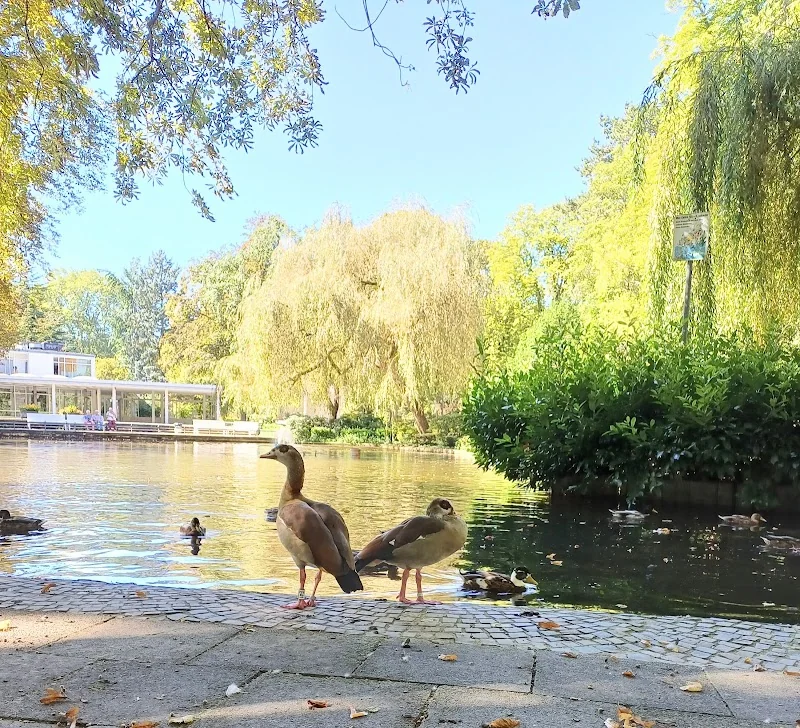
The surroundings also explain why the location is so present in many search inquiries. The Bad Godesberg city park and the Redoutenpark together form about eight hectares of green center of the former spa town, with old trees, open sightlines, and the oval pond opposite the Stadthalle. To the west lies the Kurfürstenquelle, to the south the Rigal'sche Wiese, and between the parks, the facility still reminds of the history of the spa town. Particularly interesting is also the current connection to nature: In 2024, 62 trees were marked in the city park for two educational trails, and one of the two trails starts opposite the Stadthalle parking lot next to the tennis court. Therefore, those searching for photos often mean not only the building itself but the overall atmosphere of the place: park, water, historical neighborhood, and a building that, despite its closure, functions as a landmark. ([bonn.de](https://www.bonn.de/bonn-erleben/aktiv-und-unterwegs/parks-und-gaerten/stadtpark-bad-godesberg.php?loc=en&utm_source=openai))
Sources:
Show moreShow less
Stadthalle Bonn-Bad Godesberg | Events & Parking
The Stadthalle Bonn-Bad Godesberg is much more than a former event venue: It is a piece of city history, a listed monument from the post-war period, and a prominent landmark between the spa park, train station, and pedestrian zone. Today, those searching for photos, events, or parking will not find just any multipurpose hall here, but a building that has shaped the political and cultural identity of Bad Godesberg for decades. Since 1955, the building has stood at the eastern edge of the spa park and, together with the Redoute, city theater, town hall, and the green surroundings, forms an ensemble that is almost identity-forming for the district. The current condition is also important: Since 2020, the hall has been closed, so inquiries about tickets or programs are more related to the historical operation and urban context than to an ongoing hall plan. This mixture of memory, architecture, and location makes the venue interesting to this day, as it is perceived not only as a building but as part of an entire urban memory. ([stadthalle-bad-godesberg.de](https://www.stadthalle-bad-godesberg.de/))
Events, Program, and Current Status
The most important search topic around the Stadthalle remains events. Historically, the hall was a true multipurpose venue: political congresses, cultural evenings, exhibitions, private celebrations, club events, and banquets took place here for decades. The hall became particularly well-known due to the SPD special party conference in 1959, where the Godesberg Program was adopted. The official history of the hall also describes it as a meeting point for politics and culture, with 3,676 events documented for the year 2004, including 1,991 meetings of groups, social institutions, and clubs. This clearly shows that the venue was never just a classic concert hall but a social and political hub in the district. Those who know the hall today from search engines often think simultaneously of event history, city marketing, and the transformation of a place that had enormous frequency over decades and has left traces in many Bonn biographies. ([stadthalle-bad-godesberg.de](https://www.stadthalle-bad-godesberg.de/))
However, for today's users, it is crucial that regular operations have been suspended since the closure in 2020. At that time, rusted tension rods in the main hall were identified as a safety risk; an expert report attributed the damage to issues during construction work and later interventions. Therefore, inquiries about the program in 2025, tickets, or seating plans should always be read in the context of the building's status. Those searching for current events in Bonn must clearly distinguish the Stadthalle from ongoing event operations. Content-wise, it remains relevant because search intentions primarily focus on history, location, room structure, and memories of past events. This is precisely what makes the venue so exciting for SEO: The hall is not just an event location but an event in the city's history that remains present in research, press, and local memory. ([stadthalle-bad-godesberg.de](https://www.stadthalle-bad-godesberg.de/))
Access, Stop, and Parking
Visitors benefit from the central location in Bad Godesberg when accessing the venue. The address is Koblenzer Str. 80, Bonn, 53177 Germany, and the hall is in close proximity to the train station, pedestrian zone, and town hall. Particularly important for public transport access is the stop Bad Godesberg Stadthalle: The station plan shows tracks, entrance, elevator, escalator, and several bus connections. According to the hall's history, the facility became even better accessible in 1994 with the city rail tunnel, as the stop was directly connected to the building. For seekers, this is a strong signal: The Stadthalle was and is very well integrated into traffic. Those coming from Bonn or the Rhein-Sieg area will find a location that is not hidden in a peripheral area but lies in the middle of a densely connected city center designed for short distances, orientation, and visibility. ([event.dlr.de](https://event.dlr.de/veranstaltungsort/stadthalle-bad-godesberg/))
The surroundings are also helpful for orientation. The site is located at the edge of the spa park, near the Rigal'sche Wiese and the Kurfürstenquelle, right in the middle of a green yet urban area. The Bonn park side also lists parking spaces and describes the main areas as wheelchair accessible, which outlines the basic usability of the surroundings. This is particularly important for inquiries about parking or access, as the hall does not stand isolated but is part of a smaller urban ensemble with strong pedestrian and public transport connections. The mixture of green spaces, stops, parking options, and short distances significantly shapes the first impression. Therefore, those arriving on-site experience not just a single property but an entire quarter that continues to tell the historical spa town logic of Bad Godesberg. ([bonn.de](https://www.bonn.de/bonn-erleben/aktiv-und-unterwegs/parks-und-gaerten/stadtpark-bad-godesberg.php?loc=en&utm_source=openai))
Halls, Conference Rooms, and Capacities
The room structure is one of the reasons why the Stadthalle was booked so often. According to city marketing, it has two large halls, conference rooms, and a restaurant. The hall's history adds to the picture with the park hall, which was added in 1979 and could be used for 20 to 100 people depending on the layout, as well as the fountain hall added in 1991 for up to 40 people. Also in 1991, the foyer with five skylights, ventilation, floors, ceilings, and lighting were renovated. This shows that the venue could respond to various event sizes and was designed not only for large events but also for smaller formats. For visitors, this is particularly relevant because search terms like seating plan, capacity, or best seats often arise from the desire to understand a hall not only externally but also in its internal logic. ([bad-godesberg.info](https://bad-godesberg.info/seheswuerigkeiten/die-stadthalle-bad-godesberg))
Particularly interesting are the documented usage figures from 2004. At that time, private events ranged from 10 to 800 people, banquets could accommodate up to 1,200 guests, fairs and exhibitions ranged between 50 and 1,500 people, and club and group meetings were the largest block with 1,991 appointments. These figures explain why the Stadthalle was perceived as so versatile: It was a place for both small and large occasions, a venue for celebrations, political meetings, culture, and professional events. The range of formats also shows why the building was so present in the city. Even if it is currently closed, these usage data remain important because they make the former role of the house as a flexible, urban event center comprehensible. ([stadthalle-bad-godesberg.de](https://www.stadthalle-bad-godesberg.de/))
History and Godesberg Program
The history of the Stadthalle begins with the economic upheaval after World War II. Bad Godesberg almost completely lost its traditional tourism, prompting the city to consider a new cultural project starting in 1947. Several inquiries from different directions ultimately led to the municipality taking over the construction itself. In 1955, the building was completed according to plans by Wilhelm and Dirk Denninger; it was ceremoniously opened on December 15, 1955, in front of 700 invited guests. Even then, it was clear that the hall was to serve as a home for clubs, cultural formats, and political events and would give the city a modern outlook toward the future. The question of the location was also consciously resolved: The proximity to the town hall, the good acoustic location, and the minimal impact on green spaces played an important role in the decision. Thus, a building was created that was intended from the outset to be a municipal center and not just a single event shell. ([stadthalle-bad-godesberg.de](https://www.stadthalle-bad-godesberg.de/))
Historically, the place became even more important later. On November 15, 1959, the SPD adopted the Godesberg Program here, which profoundly changed the party and made the Stadthalle known nationwide. In 2012, the building was entered into the monument list, in 2019 it was recognized as a place of democracy, and it was included in the path of democracy. In 2020, the closure followed due to safety issues in the main hall. Therefore, those searching for history, monument protection, or the Godesberg Program will find here a house that extends far beyond local significance. It stands for the idea that architecture and politics can shape each other: A place that was initially intended as a municipal cultural house later became a symbol for federal political realignments and a monument that simultaneously evokes memory and debate. ([stadthalle-bad-godesberg.de](https://www.stadthalle-bad-godesberg.de/))
Architecture in the Spa Park and the Surroundings of Bad Godesberg
Architecturally, the Stadthalle fits perfectly into the image of the spa park and post-war modernism. The official history describes a light, dynamic form that captures the spirit of the 1950s; the final integration into the spa park has been attributed to Heinrich Raderschall. The structure originally developed by the Denningers was complemented by later renovations, so that the flat building today almost connects with its arms reaching into the park. Together with the Redoute and the city theater, the hall forms the famous architectural triad at the edge of the spa park. For photos and visual impressions, this contrast between park landscape and building form is particularly appealing, as the building does not stand monumentally above the landscape but appears embedded in it, thus unfolding a very unique, calm presence. ([stadthalle-bad-godesberg.de](https://www.stadthalle-bad-godesberg.de/))
The surroundings also explain why the location is so present in many search inquiries. The Bad Godesberg city park and the Redoutenpark together form about eight hectares of green center of the former spa town, with old trees, open sightlines, and the oval pond opposite the Stadthalle. To the west lies the Kurfürstenquelle, to the south the Rigal'sche Wiese, and between the parks, the facility still reminds of the history of the spa town. Particularly interesting is also the current connection to nature: In 2024, 62 trees were marked in the city park for two educational trails, and one of the two trails starts opposite the Stadthalle parking lot next to the tennis court. Therefore, those searching for photos often mean not only the building itself but the overall atmosphere of the place: park, water, historical neighborhood, and a building that, despite its closure, functions as a landmark. ([bonn.de](https://www.bonn.de/bonn-erleben/aktiv-und-unterwegs/parks-und-gaerten/stadtpark-bad-godesberg.php?loc=en&utm_source=openai))
Sources:
Stadthalle Bonn-Bad Godesberg | Events & Parking
The Stadthalle Bonn-Bad Godesberg is much more than a former event venue: It is a piece of city history, a listed monument from the post-war period, and a prominent landmark between the spa park, train station, and pedestrian zone. Today, those searching for photos, events, or parking will not find just any multipurpose hall here, but a building that has shaped the political and cultural identity of Bad Godesberg for decades. Since 1955, the building has stood at the eastern edge of the spa park and, together with the Redoute, city theater, town hall, and the green surroundings, forms an ensemble that is almost identity-forming for the district. The current condition is also important: Since 2020, the hall has been closed, so inquiries about tickets or programs are more related to the historical operation and urban context than to an ongoing hall plan. This mixture of memory, architecture, and location makes the venue interesting to this day, as it is perceived not only as a building but as part of an entire urban memory. ([stadthalle-bad-godesberg.de](https://www.stadthalle-bad-godesberg.de/))
Events, Program, and Current Status
The most important search topic around the Stadthalle remains events. Historically, the hall was a true multipurpose venue: political congresses, cultural evenings, exhibitions, private celebrations, club events, and banquets took place here for decades. The hall became particularly well-known due to the SPD special party conference in 1959, where the Godesberg Program was adopted. The official history of the hall also describes it as a meeting point for politics and culture, with 3,676 events documented for the year 2004, including 1,991 meetings of groups, social institutions, and clubs. This clearly shows that the venue was never just a classic concert hall but a social and political hub in the district. Those who know the hall today from search engines often think simultaneously of event history, city marketing, and the transformation of a place that had enormous frequency over decades and has left traces in many Bonn biographies. ([stadthalle-bad-godesberg.de](https://www.stadthalle-bad-godesberg.de/))
However, for today's users, it is crucial that regular operations have been suspended since the closure in 2020. At that time, rusted tension rods in the main hall were identified as a safety risk; an expert report attributed the damage to issues during construction work and later interventions. Therefore, inquiries about the program in 2025, tickets, or seating plans should always be read in the context of the building's status. Those searching for current events in Bonn must clearly distinguish the Stadthalle from ongoing event operations. Content-wise, it remains relevant because search intentions primarily focus on history, location, room structure, and memories of past events. This is precisely what makes the venue so exciting for SEO: The hall is not just an event location but an event in the city's history that remains present in research, press, and local memory. ([stadthalle-bad-godesberg.de](https://www.stadthalle-bad-godesberg.de/))
Access, Stop, and Parking
Visitors benefit from the central location in Bad Godesberg when accessing the venue. The address is Koblenzer Str. 80, Bonn, 53177 Germany, and the hall is in close proximity to the train station, pedestrian zone, and town hall. Particularly important for public transport access is the stop Bad Godesberg Stadthalle: The station plan shows tracks, entrance, elevator, escalator, and several bus connections. According to the hall's history, the facility became even better accessible in 1994 with the city rail tunnel, as the stop was directly connected to the building. For seekers, this is a strong signal: The Stadthalle was and is very well integrated into traffic. Those coming from Bonn or the Rhein-Sieg area will find a location that is not hidden in a peripheral area but lies in the middle of a densely connected city center designed for short distances, orientation, and visibility. ([event.dlr.de](https://event.dlr.de/veranstaltungsort/stadthalle-bad-godesberg/))
The surroundings are also helpful for orientation. The site is located at the edge of the spa park, near the Rigal'sche Wiese and the Kurfürstenquelle, right in the middle of a green yet urban area. The Bonn park side also lists parking spaces and describes the main areas as wheelchair accessible, which outlines the basic usability of the surroundings. This is particularly important for inquiries about parking or access, as the hall does not stand isolated but is part of a smaller urban ensemble with strong pedestrian and public transport connections. The mixture of green spaces, stops, parking options, and short distances significantly shapes the first impression. Therefore, those arriving on-site experience not just a single property but an entire quarter that continues to tell the historical spa town logic of Bad Godesberg. ([bonn.de](https://www.bonn.de/bonn-erleben/aktiv-und-unterwegs/parks-und-gaerten/stadtpark-bad-godesberg.php?loc=en&utm_source=openai))
Halls, Conference Rooms, and Capacities
The room structure is one of the reasons why the Stadthalle was booked so often. According to city marketing, it has two large halls, conference rooms, and a restaurant. The hall's history adds to the picture with the park hall, which was added in 1979 and could be used for 20 to 100 people depending on the layout, as well as the fountain hall added in 1991 for up to 40 people. Also in 1991, the foyer with five skylights, ventilation, floors, ceilings, and lighting were renovated. This shows that the venue could respond to various event sizes and was designed not only for large events but also for smaller formats. For visitors, this is particularly relevant because search terms like seating plan, capacity, or best seats often arise from the desire to understand a hall not only externally but also in its internal logic. ([bad-godesberg.info](https://bad-godesberg.info/seheswuerigkeiten/die-stadthalle-bad-godesberg))
Particularly interesting are the documented usage figures from 2004. At that time, private events ranged from 10 to 800 people, banquets could accommodate up to 1,200 guests, fairs and exhibitions ranged between 50 and 1,500 people, and club and group meetings were the largest block with 1,991 appointments. These figures explain why the Stadthalle was perceived as so versatile: It was a place for both small and large occasions, a venue for celebrations, political meetings, culture, and professional events. The range of formats also shows why the building was so present in the city. Even if it is currently closed, these usage data remain important because they make the former role of the house as a flexible, urban event center comprehensible. ([stadthalle-bad-godesberg.de](https://www.stadthalle-bad-godesberg.de/))
History and Godesberg Program
The history of the Stadthalle begins with the economic upheaval after World War II. Bad Godesberg almost completely lost its traditional tourism, prompting the city to consider a new cultural project starting in 1947. Several inquiries from different directions ultimately led to the municipality taking over the construction itself. In 1955, the building was completed according to plans by Wilhelm and Dirk Denninger; it was ceremoniously opened on December 15, 1955, in front of 700 invited guests. Even then, it was clear that the hall was to serve as a home for clubs, cultural formats, and political events and would give the city a modern outlook toward the future. The question of the location was also consciously resolved: The proximity to the town hall, the good acoustic location, and the minimal impact on green spaces played an important role in the decision. Thus, a building was created that was intended from the outset to be a municipal center and not just a single event shell. ([stadthalle-bad-godesberg.de](https://www.stadthalle-bad-godesberg.de/))
Historically, the place became even more important later. On November 15, 1959, the SPD adopted the Godesberg Program here, which profoundly changed the party and made the Stadthalle known nationwide. In 2012, the building was entered into the monument list, in 2019 it was recognized as a place of democracy, and it was included in the path of democracy. In 2020, the closure followed due to safety issues in the main hall. Therefore, those searching for history, monument protection, or the Godesberg Program will find here a house that extends far beyond local significance. It stands for the idea that architecture and politics can shape each other: A place that was initially intended as a municipal cultural house later became a symbol for federal political realignments and a monument that simultaneously evokes memory and debate. ([stadthalle-bad-godesberg.de](https://www.stadthalle-bad-godesberg.de/))
Architecture in the Spa Park and the Surroundings of Bad Godesberg
Architecturally, the Stadthalle fits perfectly into the image of the spa park and post-war modernism. The official history describes a light, dynamic form that captures the spirit of the 1950s; the final integration into the spa park has been attributed to Heinrich Raderschall. The structure originally developed by the Denningers was complemented by later renovations, so that the flat building today almost connects with its arms reaching into the park. Together with the Redoute and the city theater, the hall forms the famous architectural triad at the edge of the spa park. For photos and visual impressions, this contrast between park landscape and building form is particularly appealing, as the building does not stand monumentally above the landscape but appears embedded in it, thus unfolding a very unique, calm presence. ([stadthalle-bad-godesberg.de](https://www.stadthalle-bad-godesberg.de/))
The surroundings also explain why the location is so present in many search inquiries. The Bad Godesberg city park and the Redoutenpark together form about eight hectares of green center of the former spa town, with old trees, open sightlines, and the oval pond opposite the Stadthalle. To the west lies the Kurfürstenquelle, to the south the Rigal'sche Wiese, and between the parks, the facility still reminds of the history of the spa town. Particularly interesting is also the current connection to nature: In 2024, 62 trees were marked in the city park for two educational trails, and one of the two trails starts opposite the Stadthalle parking lot next to the tennis court. Therefore, those searching for photos often mean not only the building itself but the overall atmosphere of the place: park, water, historical neighborhood, and a building that, despite its closure, functions as a landmark. ([bonn.de](https://www.bonn.de/bonn-erleben/aktiv-und-unterwegs/parks-und-gaerten/stadtpark-bad-godesberg.php?loc=en&utm_source=openai))
Sources:
Upcoming Events
No events found
Frequently Asked Questions
Reviews
Ihor Maltsev
18. October 2022
Nice place to drink coffee and relax.
Hesham Ahmed
14. July 2020
I love this place, very nice place👍
Eric D
28. December 2018
Very nice place, I always enjoy my school programs there! RBTC Germany. Waiting for the next program.
Tuan Bui
17. June 2018
Very big place for conference but the wifi connection was so bad.
cmlopez8
21. June 2017
Centrally located. Easy access by car or public transportation.