
Bonn
Regina-Pacis-Weg 3, 53113 Bonn, Deutschland
University of Bonn | Degree Programs & NC
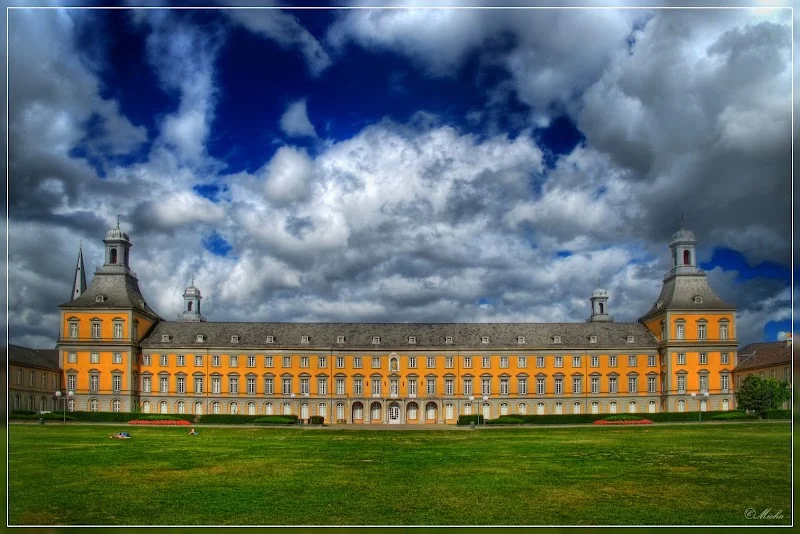
The University of Bonn is much more than a traditional main building in the city center: it is a large, research-intensive university recognized internationally, with an exceptionally broad range of study programs, a long history since 1818, and a campus that extends across Bonn and beyond. Those looking for degree programs, NC values, address, directions, psychology, medicine, law, or master's programs will find a university that combines classical academic subjects with modern top-level research. Officially, the University of Bonn offers over 200 (partial) degree programs, organizes its teaching and research into seven faculties, and complements this structure with additional research institutions and transdisciplinary areas. At the same time, the location is strongly connected to Bonn's city center: the baroque main building at Hofgarten is identity-forming, the entrances on Regina-Pacis-Weg are just as important as the paths via Am Hof, and the various city campuses also shape the daily life of students. This very mix of tradition, urban location, research strength, and diversity of studies makes the University of Bonn highly relevant for many inquiries. ([uni-bonn.de](https://www.uni-bonn.de/de/studium))
Degree Programs, Master's and Fields of Study at the University of Bonn
The primary search intention behind the keywords related to the University of Bonn is clear: many interested parties want to know what study options are available and whether their desired subject is offered at the University of Bonn. The official study page lists a spectrum from A for Agricultural Sciences to Z for Dentistry and points out that the university offers well over 200 subjects in undergraduate and postgraduate studies. This includes bachelor's and master's programs as well as state examination programs and theological degrees. For orientation, it is also important that the University of Bonn structures its academic framework into seven faculties, which form the core of research and teaching. This is a strong signal for students who are not just looking for any university, but a university with clear academic breadth, reliable structure, and academic depth. ([uni-bonn.de](https://www.uni-bonn.de/de/studium))
Particularly frequently searched subjects at the University of Bonn are medicine, law, and psychology, and here the university is very clearly positioned. Human medicine and dentistry are offered as state examination programs, law is also a state examination, and in psychology, there are several clearly defined study paths: the polyvalent B.Sc. Psychology, the B.A. Psychology as a minor, the M.Sc. Psychology, as well as the M.Sc. Psychology with a focus on Clinical Psychology and Psychotherapy. Additionally, the University of Bonn points to consecutive master's programs and international study opportunities, allowing many bachelor's graduates to transition directly into a postgraduate program. For those searching with the terms master's, medicine, law, or psychology, one thing is particularly important: the University of Bonn is not only present in these subjects but is institutionally well developed and equipped with its own faculty and institute structures. ([medfak.uni-bonn.de](https://www.medfak.uni-bonn.de/de/studium-lehre/studienangebot))
NC, Admission, and Application: How to Get Started
Around the term NC, the University of Bonn is transparent but differentiated: there is no blanket rule for all subjects, but rather specific admission procedures, selection processes, and cut-off values depending on the degree program. The official NC overview for the winter semester 2024/25 shows, for example, an NC of 1.0 for the Bachelor in Psychology, 1.4 for Law, and 1.3 for Law and Economics. At the same time, some highly sought-after state examination subjects such as medicine, pharmacy, and dentistry are linked in the overview with hochschulstart.de, confirming the separate nationwide allocation process. This is important for seekers because behind the keyword NC, there is always the question at the University of Bonn of whether the desired subject is locally restricted in admission, runs through hochschulstart, or has special selection rules only in certain semesters. ([uni-bonn.de](https://www.uni-bonn.de/de/studium/medien-studium/medien-beratung-und-service/medien-studierendensekretariat/medien-formulare/zulassungsbeschraenkte-studiengaenge-im-wintersemester-2024.pdf))
Language requirements also play a significant role in the application process. For German-speaking degree programs, the University of Bonn states on its admission page that the minimum level for application is advanced German skills from B2; for later enrollment, a DSH examination or an equivalent proof is required depending on the degree program. Furthermore, the university refers to its own application portal and an application guide that guides through the respective procedures. It is also important to note: as a public university, the University of Bonn does not charge tuition fees, but does require a semester fee. Therefore, those searching for NC, application, admission, or costs will find a clearly regulated system at the University of Bonn that relies on program specifics rather than blanket statements. For this reason, it is advisable to always check the specific subject and the specific semester. ([uni-bonn.de](https://www.uni-bonn.de/de/studium/bewerbung-zulassung-und-einschreibung/deutschkenntnisse?utm_source=openai))
Address, Directions, and Parking at the Main Building
The University of Bonn is geographically closely connected to the city center. The historic main building is located in the center of Bonn and is described by the university itself as an identity-forming address. For navigation, the university names the destination Am Hof 1, 53113 Bonn; additional entrances are located at Regina-Pacis-Weg in Hofgarten, which can be reached via Kaiserplatz. Those arriving by train should follow the signs to the bus station at Bonn Central Station, walk through the bus station, and reach the main entrance and the arcade courtyard via the street Am Hof. The next orientation for most visitors is therefore not only the pure postal address but the connection between the main train station, city center, and main building. ([uni-bonn.de](https://www.uni-bonn.de/en/university/about-the-university/locations-1/locations))
When it comes to parking, one must look a little closer at the University of Bonn, as the campus is not set up like a single campus area with a single parking lot. The university points out that its buildings are distributed throughout the city and primarily mentions public transport for the main building and parking searches on a case-by-case basis. However, for the Juridicum, the university specifies that parking options are located in the university or market underground garage and that the building is situated at Adenauerallee 24-42. This is typical for the Bonn university landscape: central city location, historic buildings, short walking distances, and varying parking and traffic solutions depending on the building complex. Therefore, those searching for address, directions, or parking should always keep the specific target building of the University of Bonn in mind. ([uni-bonn.de](https://www.uni-bonn.de/en/university/about-the-university/locations-1/locations))
History, Locations, and the Historic Ensemble in Bonn
The history of the University of Bonn officially begins in 1818. On October 18, 1818, King Friedrich Wilhelm III founded the Rheinische Friedrich-Wilhelms-Universität, and the baroque palace in Bonn's city center, which he gifted to the new university, still serves as the main building today. This connects the university's historical representation with academic continuity. The university itself emphasizes that the celebrations and traditions of the academic year have taken place since its founding on October 18 and that academic insignia such as scepters and official chains have a long tradition. For inquiries related to history, special features, or photos, this is a central point: the University of Bonn is not an anonymous new building complex but a historically grown ensemble with a clear identity. ([uni-bonn.de](https://www.uni-bonn.de/de/universitaet/organisation/weitere-einrichtungen/archiv-der-universitaet/universitaetsgeschichte-1/geschichte-der-rheinischen-friedrich-wilhelms-universitaet/geschichte-der-uni-bonn?set_language=de))
The locations also show how strongly the university is embedded in the city. The University of Bonn has around 350 buildings, of which about 250 are located in the Bonn city area; others are located outside the city. The main building, Hofgarten, Poppelsdorfer Allee, and Poppelsdorfer Schloss form a unique historic ensemble, while other campus areas are located in the city center, in Poppelsdorf, Endenich, and Castell. Additionally, there is a close connection to the Venusberg campus with the University Hospital Bonn, as well as to agricultural research and teaching locations such as Campus Klein-Altendorf, the Wiesengut in Hennef, and Gut Frankenforst. To truly understand the University of Bonn, one must see it as a city within a city: with visible history, distributed disciplines, and a presence that extends far beyond the main building. ([uni-bonn.de](https://www.uni-bonn.de/en/university/about-the-university/locations-1/locations))
Research, Rankings, and Excellence
The University of Bonn is one of the most visible research universities in Germany. Since 2019, it has been one of only eleven German universities of excellence and the only German university with six clusters of excellence; by January 2026, there will even be eight clusters. This number is not just a prestige label but an expression of a broad, internationally competitive research structure that ranges from mathematics and economics to quantum research, medicine, agriculture, and social sciences. The University of Bonn describes itself as a place where excellent minds can unleash their potential and refers to transdisciplinary research areas as defining elements of its profile. For the keyword ranking, therefore, less a single position is decisive than the recurring visibility in relevant international rankings and excellence programs. ([uni-bonn.de](https://www.uni-bonn.de/en/university))
Concrete ranking indications are also provided by the University of Bonn itself: in the official QS reporting from March 2025, seven Bonn subjects were listed among the top 100 worldwide. Among others, mathematics was mentioned with rank 57 worldwide and rank 1 in Germany, economics and econometrics with rank 61 worldwide and rank 2 in Germany, agriculture and forestry with rank 55 worldwide and rank 4 in Germany, as well as other subjects such as classical antiquity, biology, philosophy, and dentistry. Mathematics is also particularly strong, having produced one of the first excellence clusters in the field in Germany with the Hausdorff Center for Mathematics. For seekers, this means: when they ask about ranking, reputation, or excellence, the University of Bonn is not a university with sporadic strengths but a university with measurable breadth at a high level. ([uni-bonn.de](https://www.uni-bonn.de/en/news/seven-subjects-among-the-top-100-worldwide?utm_source=openai))
Jobs, Careers, and Services for Students
The University of Bonn is also clearly positioned regarding jobs and careers. On the official career pages, the university mentions more than 6,500 employees and describes itself as one of the major employers in the region. The positions range from professorships to science, IT, engineering, and administration to training and trainee offers. For those searching for jobs, this is important because the University of Bonn is not only a place of study but also a large employer where research, teaching, and administration work closely together. Especially for academics, technical professionals, or young people looking for a traineeship, the university offers a wide range of entry opportunities. ([uni-bonn.de](https://www.uni-bonn.de/en/university))
The services for students at the University of Bonn also include study counseling, application portal, international study opportunities, and a well-developed campus life. The university refers to a central study counseling service as the first point of contact for questions related to studies and offers a 360-degree tour as well as guided tours so that interested parties can get to know the campus and its surroundings in advance. This is relevant not only for photos and first impressions but also for all those dealing with address, location, mobility, and student life. Additionally, the University of Bonn organizes research, teaching, learning, and working across the entire city area, creating an exceptionally dense academic environment. Therefore, those looking for a place where scientific excellence, historical backdrop, and practical service come together will find a university in Bonn with a strong profile and high orientation assistance. ([uni-bonn.de](https://www.uni-bonn.de/de/studium))
Sources:
- University of Bonn – Studies
- University of Bonn – NC Values and Admission Procedures
- University of Bonn – Locations
- University of Bonn – Facts and Figures
- University of Bonn – Working at the University
- University of Bonn – Clusters of Excellence
- Psychology – Degree Programs and Application
- Medical Faculty – Study Offer
Show moreShow less
University of Bonn | Degree Programs & NC
The University of Bonn is much more than a traditional main building in the city center: it is a large, research-intensive university recognized internationally, with an exceptionally broad range of study programs, a long history since 1818, and a campus that extends across Bonn and beyond. Those looking for degree programs, NC values, address, directions, psychology, medicine, law, or master's programs will find a university that combines classical academic subjects with modern top-level research. Officially, the University of Bonn offers over 200 (partial) degree programs, organizes its teaching and research into seven faculties, and complements this structure with additional research institutions and transdisciplinary areas. At the same time, the location is strongly connected to Bonn's city center: the baroque main building at Hofgarten is identity-forming, the entrances on Regina-Pacis-Weg are just as important as the paths via Am Hof, and the various city campuses also shape the daily life of students. This very mix of tradition, urban location, research strength, and diversity of studies makes the University of Bonn highly relevant for many inquiries. ([uni-bonn.de](https://www.uni-bonn.de/de/studium))
Degree Programs, Master's and Fields of Study at the University of Bonn
The primary search intention behind the keywords related to the University of Bonn is clear: many interested parties want to know what study options are available and whether their desired subject is offered at the University of Bonn. The official study page lists a spectrum from A for Agricultural Sciences to Z for Dentistry and points out that the university offers well over 200 subjects in undergraduate and postgraduate studies. This includes bachelor's and master's programs as well as state examination programs and theological degrees. For orientation, it is also important that the University of Bonn structures its academic framework into seven faculties, which form the core of research and teaching. This is a strong signal for students who are not just looking for any university, but a university with clear academic breadth, reliable structure, and academic depth. ([uni-bonn.de](https://www.uni-bonn.de/de/studium))
Particularly frequently searched subjects at the University of Bonn are medicine, law, and psychology, and here the university is very clearly positioned. Human medicine and dentistry are offered as state examination programs, law is also a state examination, and in psychology, there are several clearly defined study paths: the polyvalent B.Sc. Psychology, the B.A. Psychology as a minor, the M.Sc. Psychology, as well as the M.Sc. Psychology with a focus on Clinical Psychology and Psychotherapy. Additionally, the University of Bonn points to consecutive master's programs and international study opportunities, allowing many bachelor's graduates to transition directly into a postgraduate program. For those searching with the terms master's, medicine, law, or psychology, one thing is particularly important: the University of Bonn is not only present in these subjects but is institutionally well developed and equipped with its own faculty and institute structures. ([medfak.uni-bonn.de](https://www.medfak.uni-bonn.de/de/studium-lehre/studienangebot))
NC, Admission, and Application: How to Get Started
Around the term NC, the University of Bonn is transparent but differentiated: there is no blanket rule for all subjects, but rather specific admission procedures, selection processes, and cut-off values depending on the degree program. The official NC overview for the winter semester 2024/25 shows, for example, an NC of 1.0 for the Bachelor in Psychology, 1.4 for Law, and 1.3 for Law and Economics. At the same time, some highly sought-after state examination subjects such as medicine, pharmacy, and dentistry are linked in the overview with hochschulstart.de, confirming the separate nationwide allocation process. This is important for seekers because behind the keyword NC, there is always the question at the University of Bonn of whether the desired subject is locally restricted in admission, runs through hochschulstart, or has special selection rules only in certain semesters. ([uni-bonn.de](https://www.uni-bonn.de/de/studium/medien-studium/medien-beratung-und-service/medien-studierendensekretariat/medien-formulare/zulassungsbeschraenkte-studiengaenge-im-wintersemester-2024.pdf))
Language requirements also play a significant role in the application process. For German-speaking degree programs, the University of Bonn states on its admission page that the minimum level for application is advanced German skills from B2; for later enrollment, a DSH examination or an equivalent proof is required depending on the degree program. Furthermore, the university refers to its own application portal and an application guide that guides through the respective procedures. It is also important to note: as a public university, the University of Bonn does not charge tuition fees, but does require a semester fee. Therefore, those searching for NC, application, admission, or costs will find a clearly regulated system at the University of Bonn that relies on program specifics rather than blanket statements. For this reason, it is advisable to always check the specific subject and the specific semester. ([uni-bonn.de](https://www.uni-bonn.de/de/studium/bewerbung-zulassung-und-einschreibung/deutschkenntnisse?utm_source=openai))
Address, Directions, and Parking at the Main Building
The University of Bonn is geographically closely connected to the city center. The historic main building is located in the center of Bonn and is described by the university itself as an identity-forming address. For navigation, the university names the destination Am Hof 1, 53113 Bonn; additional entrances are located at Regina-Pacis-Weg in Hofgarten, which can be reached via Kaiserplatz. Those arriving by train should follow the signs to the bus station at Bonn Central Station, walk through the bus station, and reach the main entrance and the arcade courtyard via the street Am Hof. The next orientation for most visitors is therefore not only the pure postal address but the connection between the main train station, city center, and main building. ([uni-bonn.de](https://www.uni-bonn.de/en/university/about-the-university/locations-1/locations))
When it comes to parking, one must look a little closer at the University of Bonn, as the campus is not set up like a single campus area with a single parking lot. The university points out that its buildings are distributed throughout the city and primarily mentions public transport for the main building and parking searches on a case-by-case basis. However, for the Juridicum, the university specifies that parking options are located in the university or market underground garage and that the building is situated at Adenauerallee 24-42. This is typical for the Bonn university landscape: central city location, historic buildings, short walking distances, and varying parking and traffic solutions depending on the building complex. Therefore, those searching for address, directions, or parking should always keep the specific target building of the University of Bonn in mind. ([uni-bonn.de](https://www.uni-bonn.de/en/university/about-the-university/locations-1/locations))
History, Locations, and the Historic Ensemble in Bonn
The history of the University of Bonn officially begins in 1818. On October 18, 1818, King Friedrich Wilhelm III founded the Rheinische Friedrich-Wilhelms-Universität, and the baroque palace in Bonn's city center, which he gifted to the new university, still serves as the main building today. This connects the university's historical representation with academic continuity. The university itself emphasizes that the celebrations and traditions of the academic year have taken place since its founding on October 18 and that academic insignia such as scepters and official chains have a long tradition. For inquiries related to history, special features, or photos, this is a central point: the University of Bonn is not an anonymous new building complex but a historically grown ensemble with a clear identity. ([uni-bonn.de](https://www.uni-bonn.de/de/universitaet/organisation/weitere-einrichtungen/archiv-der-universitaet/universitaetsgeschichte-1/geschichte-der-rheinischen-friedrich-wilhelms-universitaet/geschichte-der-uni-bonn?set_language=de))
The locations also show how strongly the university is embedded in the city. The University of Bonn has around 350 buildings, of which about 250 are located in the Bonn city area; others are located outside the city. The main building, Hofgarten, Poppelsdorfer Allee, and Poppelsdorfer Schloss form a unique historic ensemble, while other campus areas are located in the city center, in Poppelsdorf, Endenich, and Castell. Additionally, there is a close connection to the Venusberg campus with the University Hospital Bonn, as well as to agricultural research and teaching locations such as Campus Klein-Altendorf, the Wiesengut in Hennef, and Gut Frankenforst. To truly understand the University of Bonn, one must see it as a city within a city: with visible history, distributed disciplines, and a presence that extends far beyond the main building. ([uni-bonn.de](https://www.uni-bonn.de/en/university/about-the-university/locations-1/locations))
Research, Rankings, and Excellence
The University of Bonn is one of the most visible research universities in Germany. Since 2019, it has been one of only eleven German universities of excellence and the only German university with six clusters of excellence; by January 2026, there will even be eight clusters. This number is not just a prestige label but an expression of a broad, internationally competitive research structure that ranges from mathematics and economics to quantum research, medicine, agriculture, and social sciences. The University of Bonn describes itself as a place where excellent minds can unleash their potential and refers to transdisciplinary research areas as defining elements of its profile. For the keyword ranking, therefore, less a single position is decisive than the recurring visibility in relevant international rankings and excellence programs. ([uni-bonn.de](https://www.uni-bonn.de/en/university))
Concrete ranking indications are also provided by the University of Bonn itself: in the official QS reporting from March 2025, seven Bonn subjects were listed among the top 100 worldwide. Among others, mathematics was mentioned with rank 57 worldwide and rank 1 in Germany, economics and econometrics with rank 61 worldwide and rank 2 in Germany, agriculture and forestry with rank 55 worldwide and rank 4 in Germany, as well as other subjects such as classical antiquity, biology, philosophy, and dentistry. Mathematics is also particularly strong, having produced one of the first excellence clusters in the field in Germany with the Hausdorff Center for Mathematics. For seekers, this means: when they ask about ranking, reputation, or excellence, the University of Bonn is not a university with sporadic strengths but a university with measurable breadth at a high level. ([uni-bonn.de](https://www.uni-bonn.de/en/news/seven-subjects-among-the-top-100-worldwide?utm_source=openai))
Jobs, Careers, and Services for Students
The University of Bonn is also clearly positioned regarding jobs and careers. On the official career pages, the university mentions more than 6,500 employees and describes itself as one of the major employers in the region. The positions range from professorships to science, IT, engineering, and administration to training and trainee offers. For those searching for jobs, this is important because the University of Bonn is not only a place of study but also a large employer where research, teaching, and administration work closely together. Especially for academics, technical professionals, or young people looking for a traineeship, the university offers a wide range of entry opportunities. ([uni-bonn.de](https://www.uni-bonn.de/en/university))
The services for students at the University of Bonn also include study counseling, application portal, international study opportunities, and a well-developed campus life. The university refers to a central study counseling service as the first point of contact for questions related to studies and offers a 360-degree tour as well as guided tours so that interested parties can get to know the campus and its surroundings in advance. This is relevant not only for photos and first impressions but also for all those dealing with address, location, mobility, and student life. Additionally, the University of Bonn organizes research, teaching, learning, and working across the entire city area, creating an exceptionally dense academic environment. Therefore, those looking for a place where scientific excellence, historical backdrop, and practical service come together will find a university in Bonn with a strong profile and high orientation assistance. ([uni-bonn.de](https://www.uni-bonn.de/de/studium))
Sources:
- University of Bonn – Studies
- University of Bonn – NC Values and Admission Procedures
- University of Bonn – Locations
- University of Bonn – Facts and Figures
- University of Bonn – Working at the University
- University of Bonn – Clusters of Excellence
- Psychology – Degree Programs and Application
- Medical Faculty – Study Offer
University of Bonn | Degree Programs & NC
The University of Bonn is much more than a traditional main building in the city center: it is a large, research-intensive university recognized internationally, with an exceptionally broad range of study programs, a long history since 1818, and a campus that extends across Bonn and beyond. Those looking for degree programs, NC values, address, directions, psychology, medicine, law, or master's programs will find a university that combines classical academic subjects with modern top-level research. Officially, the University of Bonn offers over 200 (partial) degree programs, organizes its teaching and research into seven faculties, and complements this structure with additional research institutions and transdisciplinary areas. At the same time, the location is strongly connected to Bonn's city center: the baroque main building at Hofgarten is identity-forming, the entrances on Regina-Pacis-Weg are just as important as the paths via Am Hof, and the various city campuses also shape the daily life of students. This very mix of tradition, urban location, research strength, and diversity of studies makes the University of Bonn highly relevant for many inquiries. ([uni-bonn.de](https://www.uni-bonn.de/de/studium))
Degree Programs, Master's and Fields of Study at the University of Bonn
The primary search intention behind the keywords related to the University of Bonn is clear: many interested parties want to know what study options are available and whether their desired subject is offered at the University of Bonn. The official study page lists a spectrum from A for Agricultural Sciences to Z for Dentistry and points out that the university offers well over 200 subjects in undergraduate and postgraduate studies. This includes bachelor's and master's programs as well as state examination programs and theological degrees. For orientation, it is also important that the University of Bonn structures its academic framework into seven faculties, which form the core of research and teaching. This is a strong signal for students who are not just looking for any university, but a university with clear academic breadth, reliable structure, and academic depth. ([uni-bonn.de](https://www.uni-bonn.de/de/studium))
Particularly frequently searched subjects at the University of Bonn are medicine, law, and psychology, and here the university is very clearly positioned. Human medicine and dentistry are offered as state examination programs, law is also a state examination, and in psychology, there are several clearly defined study paths: the polyvalent B.Sc. Psychology, the B.A. Psychology as a minor, the M.Sc. Psychology, as well as the M.Sc. Psychology with a focus on Clinical Psychology and Psychotherapy. Additionally, the University of Bonn points to consecutive master's programs and international study opportunities, allowing many bachelor's graduates to transition directly into a postgraduate program. For those searching with the terms master's, medicine, law, or psychology, one thing is particularly important: the University of Bonn is not only present in these subjects but is institutionally well developed and equipped with its own faculty and institute structures. ([medfak.uni-bonn.de](https://www.medfak.uni-bonn.de/de/studium-lehre/studienangebot))
NC, Admission, and Application: How to Get Started
Around the term NC, the University of Bonn is transparent but differentiated: there is no blanket rule for all subjects, but rather specific admission procedures, selection processes, and cut-off values depending on the degree program. The official NC overview for the winter semester 2024/25 shows, for example, an NC of 1.0 for the Bachelor in Psychology, 1.4 for Law, and 1.3 for Law and Economics. At the same time, some highly sought-after state examination subjects such as medicine, pharmacy, and dentistry are linked in the overview with hochschulstart.de, confirming the separate nationwide allocation process. This is important for seekers because behind the keyword NC, there is always the question at the University of Bonn of whether the desired subject is locally restricted in admission, runs through hochschulstart, or has special selection rules only in certain semesters. ([uni-bonn.de](https://www.uni-bonn.de/de/studium/medien-studium/medien-beratung-und-service/medien-studierendensekretariat/medien-formulare/zulassungsbeschraenkte-studiengaenge-im-wintersemester-2024.pdf))
Language requirements also play a significant role in the application process. For German-speaking degree programs, the University of Bonn states on its admission page that the minimum level for application is advanced German skills from B2; for later enrollment, a DSH examination or an equivalent proof is required depending on the degree program. Furthermore, the university refers to its own application portal and an application guide that guides through the respective procedures. It is also important to note: as a public university, the University of Bonn does not charge tuition fees, but does require a semester fee. Therefore, those searching for NC, application, admission, or costs will find a clearly regulated system at the University of Bonn that relies on program specifics rather than blanket statements. For this reason, it is advisable to always check the specific subject and the specific semester. ([uni-bonn.de](https://www.uni-bonn.de/de/studium/bewerbung-zulassung-und-einschreibung/deutschkenntnisse?utm_source=openai))
Address, Directions, and Parking at the Main Building
The University of Bonn is geographically closely connected to the city center. The historic main building is located in the center of Bonn and is described by the university itself as an identity-forming address. For navigation, the university names the destination Am Hof 1, 53113 Bonn; additional entrances are located at Regina-Pacis-Weg in Hofgarten, which can be reached via Kaiserplatz. Those arriving by train should follow the signs to the bus station at Bonn Central Station, walk through the bus station, and reach the main entrance and the arcade courtyard via the street Am Hof. The next orientation for most visitors is therefore not only the pure postal address but the connection between the main train station, city center, and main building. ([uni-bonn.de](https://www.uni-bonn.de/en/university/about-the-university/locations-1/locations))
When it comes to parking, one must look a little closer at the University of Bonn, as the campus is not set up like a single campus area with a single parking lot. The university points out that its buildings are distributed throughout the city and primarily mentions public transport for the main building and parking searches on a case-by-case basis. However, for the Juridicum, the university specifies that parking options are located in the university or market underground garage and that the building is situated at Adenauerallee 24-42. This is typical for the Bonn university landscape: central city location, historic buildings, short walking distances, and varying parking and traffic solutions depending on the building complex. Therefore, those searching for address, directions, or parking should always keep the specific target building of the University of Bonn in mind. ([uni-bonn.de](https://www.uni-bonn.de/en/university/about-the-university/locations-1/locations))
History, Locations, and the Historic Ensemble in Bonn
The history of the University of Bonn officially begins in 1818. On October 18, 1818, King Friedrich Wilhelm III founded the Rheinische Friedrich-Wilhelms-Universität, and the baroque palace in Bonn's city center, which he gifted to the new university, still serves as the main building today. This connects the university's historical representation with academic continuity. The university itself emphasizes that the celebrations and traditions of the academic year have taken place since its founding on October 18 and that academic insignia such as scepters and official chains have a long tradition. For inquiries related to history, special features, or photos, this is a central point: the University of Bonn is not an anonymous new building complex but a historically grown ensemble with a clear identity. ([uni-bonn.de](https://www.uni-bonn.de/de/universitaet/organisation/weitere-einrichtungen/archiv-der-universitaet/universitaetsgeschichte-1/geschichte-der-rheinischen-friedrich-wilhelms-universitaet/geschichte-der-uni-bonn?set_language=de))
The locations also show how strongly the university is embedded in the city. The University of Bonn has around 350 buildings, of which about 250 are located in the Bonn city area; others are located outside the city. The main building, Hofgarten, Poppelsdorfer Allee, and Poppelsdorfer Schloss form a unique historic ensemble, while other campus areas are located in the city center, in Poppelsdorf, Endenich, and Castell. Additionally, there is a close connection to the Venusberg campus with the University Hospital Bonn, as well as to agricultural research and teaching locations such as Campus Klein-Altendorf, the Wiesengut in Hennef, and Gut Frankenforst. To truly understand the University of Bonn, one must see it as a city within a city: with visible history, distributed disciplines, and a presence that extends far beyond the main building. ([uni-bonn.de](https://www.uni-bonn.de/en/university/about-the-university/locations-1/locations))
Research, Rankings, and Excellence
The University of Bonn is one of the most visible research universities in Germany. Since 2019, it has been one of only eleven German universities of excellence and the only German university with six clusters of excellence; by January 2026, there will even be eight clusters. This number is not just a prestige label but an expression of a broad, internationally competitive research structure that ranges from mathematics and economics to quantum research, medicine, agriculture, and social sciences. The University of Bonn describes itself as a place where excellent minds can unleash their potential and refers to transdisciplinary research areas as defining elements of its profile. For the keyword ranking, therefore, less a single position is decisive than the recurring visibility in relevant international rankings and excellence programs. ([uni-bonn.de](https://www.uni-bonn.de/en/university))
Concrete ranking indications are also provided by the University of Bonn itself: in the official QS reporting from March 2025, seven Bonn subjects were listed among the top 100 worldwide. Among others, mathematics was mentioned with rank 57 worldwide and rank 1 in Germany, economics and econometrics with rank 61 worldwide and rank 2 in Germany, agriculture and forestry with rank 55 worldwide and rank 4 in Germany, as well as other subjects such as classical antiquity, biology, philosophy, and dentistry. Mathematics is also particularly strong, having produced one of the first excellence clusters in the field in Germany with the Hausdorff Center for Mathematics. For seekers, this means: when they ask about ranking, reputation, or excellence, the University of Bonn is not a university with sporadic strengths but a university with measurable breadth at a high level. ([uni-bonn.de](https://www.uni-bonn.de/en/news/seven-subjects-among-the-top-100-worldwide?utm_source=openai))
Jobs, Careers, and Services for Students
The University of Bonn is also clearly positioned regarding jobs and careers. On the official career pages, the university mentions more than 6,500 employees and describes itself as one of the major employers in the region. The positions range from professorships to science, IT, engineering, and administration to training and trainee offers. For those searching for jobs, this is important because the University of Bonn is not only a place of study but also a large employer where research, teaching, and administration work closely together. Especially for academics, technical professionals, or young people looking for a traineeship, the university offers a wide range of entry opportunities. ([uni-bonn.de](https://www.uni-bonn.de/en/university))
The services for students at the University of Bonn also include study counseling, application portal, international study opportunities, and a well-developed campus life. The university refers to a central study counseling service as the first point of contact for questions related to studies and offers a 360-degree tour as well as guided tours so that interested parties can get to know the campus and its surroundings in advance. This is relevant not only for photos and first impressions but also for all those dealing with address, location, mobility, and student life. Additionally, the University of Bonn organizes research, teaching, learning, and working across the entire city area, creating an exceptionally dense academic environment. Therefore, those looking for a place where scientific excellence, historical backdrop, and practical service come together will find a university in Bonn with a strong profile and high orientation assistance. ([uni-bonn.de](https://www.uni-bonn.de/de/studium))
Sources:
- University of Bonn – Studies
- University of Bonn – NC Values and Admission Procedures
- University of Bonn – Locations
- University of Bonn – Facts and Figures
- University of Bonn – Working at the University
- University of Bonn – Clusters of Excellence
- Psychology – Degree Programs and Application
- Medical Faculty – Study Offer
Frequently Asked Questions
Reviews
No reviews found