
Bonn
Adenauerallee 24-42, 53113 Bonn, Deutschland
Faculty of Law and Political Science Bonn | Photos & Directions
The Faculty of Law and Political Science at the University of Bonn is closely connected to the Juridicum on Adenauerallee and is one of the most significant academic locations in the city. In its official self-understanding, not only the classic Bonn law location is emphasized, but also a vibrant campus area where law and economics are thought of together. The faculty is located on the edge of Bonn's city center, south of the Hofgartenwiese, making it a place that is central, quiet, and easily accessible for students, faculty, and visitors. Those looking for photos, reviews, location maps, or specific visitor information will get a very clear picture here: The Juridicum is a functionally structured, historically interesting, and still heavily used building ensemble with a distinct academic identity. The official faculty website lists 77 professors, 290 staff members, and more than 6900 students, which vividly underscores the importance of the location for research, teaching, and administration. Orientation is relatively simple even for first-time visitors, as the address, opening hours, directions, and building structure are well documented. This makes the location exciting for both SEO and users: It is not just about a faculty, but about a place with history, everyday work, architectural profile, and clear paths for all who want to learn, work, or attend an appointment there. ([rsf.uni-bonn.de](https://www.rsf.uni-bonn.de/de))
Photos, Building Plan, and Architecture of the Juridicum
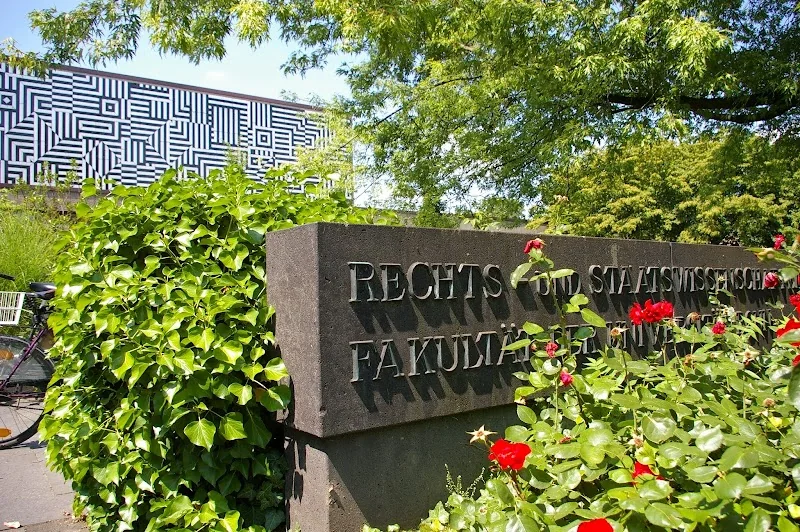
Those looking for photos of the Faculty of Law and Political Science at the University of Bonn will quickly find themselves at the Juridicum itself, as the building is not only a functional university location but also architecturally striking. The official architecture page describes the ensemble as an elongated two-story main building with a five-story tower on the east side and a seven-story tower on the west side. Both towers are connected to the main section by narrow, glazed corridors, giving the building a clear, modern, and simultaneously open appearance. The forecourt on Adenauerallee and the wall design by Victor Vasarely at the prominent lecture hall E also stand out, giving the building a recognizable character. Inside, the large entrance hall, lecture hall D with pointed gable shed roofs, and the theater-like lecture hall C are important architectural points that show how consistently the building was designed for use and impact. The two atriums with water features are also noteworthy, as they bring light into lecture halls and library rooms while creating a calm courtyard character. For visitors who want to get an impression, the images embedded on the website are particularly helpful: The location page shows the Juridicum from Adenauerallee, the architecture page documents photos from the years 1965, 1967, 1968, and 1970, and the building plan makes it clear how well the house is structured into the main section, west tower, and east tower. This combination of imagery, plan logic, and visible architectural independence ensures that photo searches and orientation go hand in hand here. The Juridicum is thus an example of how a university building can simultaneously be a workplace, a guide, and an identity-forming image object. ([jura.uni-bonn.de](https://www.jura.uni-bonn.de/juridicum/architektur))
Directions, Parking, and Juridicum Stop
The directions to the Juridicum are one of the most important points from the user's perspective, as they directly determine how uncomplicated a visit or an appointment at the faculty will be. Officially, the Faculty of Law and Political Science is located at Adenauerallee 24-42 in 53113 Bonn, directly on one of the central axes of the city. The faculty's website emphasizes that the Juridicum is located directly on Adenauerallee, thus on the B9, making it easily accessible from both the northern direction of Cologne and the southern direction of Koblenz. For public transport, the university mentions subway lines 16, 63, 66, and 68 from Bonn Central Station to the Juridicum stop. This information is particularly useful as it clearly names not only the line but also the destination, directly covering typical search queries for stops, directions, and opening hours. Those arriving by car should note that there is no public parking space on the Juridicum premises. The nearest public parking options are the university underground garage in the main building and the market underground garage. This is an important practical tip for visitors, as it prevents unnecessary detours and explains why arriving by train or subway often proves to be less stressful. The location near Hofgarten, the city center, and the train station also makes the site attractive for many routes on foot or by public transport. This combination of a central position, clear stop, and clearly named parking alternatives is a real plus for students and guests. Once the directions are understood, one quickly realizes: The Juridicum is easily accessible, but not organized as a typical car location, but as an urban university location with a consciously urban logic. ([jura.uni-bonn.de](https://www.jura.uni-bonn.de/de))
Opening Hours and Orientation at the Adenauerallee Location
Another central search and information point around the Faculty of Law and Political Science at the University of Bonn is the opening hours and orientation within the building. The Juridicum is open Monday to Thursday from 08:00 to 22:00, Friday and Saturday from 08:00 to 20:00; it is closed on Sundays. These long opening hours are particularly valuable for a university location, as they provide students, researchers, and staff with a lot of temporal flexibility. The official location page also names not only the main address but also clear access points: Entrance Adenauerallee and Entrance Lennéstraße. This dual access makes the building practically comfortable, as one can use different sides of the complex depending on the route, appointment, and target area. The site plan of the facilities also shows how the faculty is organized within the Juridicum and in the surrounding buildings. Within the Juridicum, among others, the dean's office, departmental management, various institutes, the legal seminar, the IT department, and other scientific institutions are located in the west tower and east tower. This structure is important for first-time visitors, as it explains why the location is often searched for building plans, site plans, or room overviews. The university provides several visual aids for this, such as an overview of the locations, building plans of the entrances, and a view of the upper floors. Therefore, anyone looking for the way to the dean's office, a seminar, a subject consultation, or an institute library can orient themselves very well in advance. The location is thus not only geographically central but also internally very systematically structured. Especially in a large faculty building, this is a significant advantage, as orientation is not left to chance but is supported by clear structure, good signage, and official plans. ([rsf.uni-bonn.de](https://www.rsf.uni-bonn.de/de))
History of the Faculty of Law and Political Science
The history of the Faculty of Law and Political Science is significantly older than the Juridicum itself and is one of the most important arguments when trying to understand the location in Bonn. According to the official account, teaching at the law faculty of the Bonn University began on April 19, 1819; although the university was founded in 1818, legal education only began in full form somewhat later, after suitable legal scholars had been appointed. This early phase marks the beginning of a long legal tradition in Bonn, which was shaped by different legal scientific currents in the 19th century. In 1928, the Prussian Ministry of Culture ordered the integration of economists who had previously belonged to the Faculty of Philosophy into the Faculty of Law; at the same time, the name was changed to the Faculty of Law and Political Science. This transformed the law faculty into a broader unit where law and economics came together. After the war-related destruction, teaching resumed in the winter semester of 1945/46, initially temporarily in Bad Godesberg, before moving back to the rebuilt main building in 1951. The actual new construction of the Juridicum was prepared with the laying of the foundation stone on October 11, 1963; after nearly four years of construction, the building was handed over on November 21, 1967, as an institute building for the legal and economics departments. These dates show how closely construction development and academic expansion are linked. The history of the faculty is therefore not merely a chronicle of relocations but a reflection of academic growth in Bonn. Particularly exciting is that the Juridicum did not arise in isolation but out of the need for space, scientific specialization, and the desire for a modern university building. Thus, in Bonn, a sense of tradition is combined with a new beginning: The roots reach back to the early 19th century, but the current appearance is a product of the post-war period and the university development of the 1960s. ([jura.uni-bonn.de](https://www.jura.uni-bonn.de/en/juridicum/geschichte))
Studies, Institutes, and Academic Profile in Bonn
In content, the Faculty of Law and Political Science at the University of Bonn is much more than just a building with administration and seminar rooms. The official faculty page describes it as a merger of the Department of Law and the Department of Economics, which are connected through joint programs and projects in teaching and research. This dual structure continues to shape the character of the location today and explains why the Bonn legal and economic traditions carry so much weight. The faculty also refers to 77 professors, 290 staff members, and over 6900 students, underscoring its size and academic breadth. For prospective students, it is particularly interesting that the University of Bonn is described as one of the best research universities in Germany, and the department has more than 70 partner universities in Europe and worldwide. This opens up international perspectives and shows that Bonn operates not only locally but also globally. The study page also lists twelve areas of focus, from fundamentals to corporate and capital market law to criminal sciences, comparative law, public law of sustainability, and international relations. The profile is further complemented by the bachelor's program Law and Economics, which visibly connects both academic cultures. The site plan of the facilities again shows how many institutes, chairs, and workstations are located in and around the Juridicum: such as the Institute for Commercial and Economic Law, the Institute for Tax Law, the Institute for Public Law, the Institute for International Private Law and Comparative Law, the Criminal Law Institute, the Criminological Seminar, the Legal Philosophy Seminar, and the Legal Seminar. This density of institutions makes the location scientifically vibrant and very versatile in everyday life. Those who only think of photos therefore quickly underestimate the substantive depth of this place. The Juridicum is not just a beautiful or striking building but a highly concentrated knowledge location with a clear structure, international connections, and a long tradition of academic specialization. ([rsf.uni-bonn.de](https://www.rsf.uni-bonn.de/de))
Reviews, Photos, and the First Impression on Site
Those looking for reviews of the Faculty of Law and Political Science at the University of Bonn usually want not only dry address data but also a real impression of how the location feels. This is where the official pages are particularly helpful, as they provide not only the hard facts but also images, site plans, architectural notes, and practical directions. The location page visually showcases the Juridicum, the architecture page shows historical photos from several construction phases, and the site plan makes the internal organization comprehensible. Additionally, there are notes on accessibility as well as a dedicated portrait and archive page of the Juridicum, which sharpens the view of the building as a living part of the faculty's history. For search queries about photos, this is ideal because one is not reliant on random third-party sources but can rely on officially curated images and plans. For search queries about reviews, it is worth noting that individual visitor ratings are naturally subjective, so it is sensible to compare the first impression with the reliable information from the university. Especially at the Juridicum, the facts speak for themselves: central location, clear access, long opening hours, dedicated entrance situations, well-documented institutes, and an architecturally independent building. Therefore, anyone visiting the place for the first time can already get a fairly precise idea of what to expect. This is particularly helpful for students, parents, guests from other cities, or applicants. The combination of imagery, site logic, and historical embedding ensures that the place does not feel anonymous but is very clearly recognizable. Thus, a simple search query for photos or reviews becomes a real gain in information: One sees the building, understands its structure, and can plan the visit better. ([jura.uni-bonn.de](https://www.jura.uni-bonn.de/de/fachbereich/am-juridicum?utm_source=openai))
Sources:
Show moreShow less
Faculty of Law and Political Science Bonn | Photos & Directions
The Faculty of Law and Political Science at the University of Bonn is closely connected to the Juridicum on Adenauerallee and is one of the most significant academic locations in the city. In its official self-understanding, not only the classic Bonn law location is emphasized, but also a vibrant campus area where law and economics are thought of together. The faculty is located on the edge of Bonn's city center, south of the Hofgartenwiese, making it a place that is central, quiet, and easily accessible for students, faculty, and visitors. Those looking for photos, reviews, location maps, or specific visitor information will get a very clear picture here: The Juridicum is a functionally structured, historically interesting, and still heavily used building ensemble with a distinct academic identity. The official faculty website lists 77 professors, 290 staff members, and more than 6900 students, which vividly underscores the importance of the location for research, teaching, and administration. Orientation is relatively simple even for first-time visitors, as the address, opening hours, directions, and building structure are well documented. This makes the location exciting for both SEO and users: It is not just about a faculty, but about a place with history, everyday work, architectural profile, and clear paths for all who want to learn, work, or attend an appointment there. ([rsf.uni-bonn.de](https://www.rsf.uni-bonn.de/de))
Photos, Building Plan, and Architecture of the Juridicum
Those looking for photos of the Faculty of Law and Political Science at the University of Bonn will quickly find themselves at the Juridicum itself, as the building is not only a functional university location but also architecturally striking. The official architecture page describes the ensemble as an elongated two-story main building with a five-story tower on the east side and a seven-story tower on the west side. Both towers are connected to the main section by narrow, glazed corridors, giving the building a clear, modern, and simultaneously open appearance. The forecourt on Adenauerallee and the wall design by Victor Vasarely at the prominent lecture hall E also stand out, giving the building a recognizable character. Inside, the large entrance hall, lecture hall D with pointed gable shed roofs, and the theater-like lecture hall C are important architectural points that show how consistently the building was designed for use and impact. The two atriums with water features are also noteworthy, as they bring light into lecture halls and library rooms while creating a calm courtyard character. For visitors who want to get an impression, the images embedded on the website are particularly helpful: The location page shows the Juridicum from Adenauerallee, the architecture page documents photos from the years 1965, 1967, 1968, and 1970, and the building plan makes it clear how well the house is structured into the main section, west tower, and east tower. This combination of imagery, plan logic, and visible architectural independence ensures that photo searches and orientation go hand in hand here. The Juridicum is thus an example of how a university building can simultaneously be a workplace, a guide, and an identity-forming image object. ([jura.uni-bonn.de](https://www.jura.uni-bonn.de/juridicum/architektur))
Directions, Parking, and Juridicum Stop
The directions to the Juridicum are one of the most important points from the user's perspective, as they directly determine how uncomplicated a visit or an appointment at the faculty will be. Officially, the Faculty of Law and Political Science is located at Adenauerallee 24-42 in 53113 Bonn, directly on one of the central axes of the city. The faculty's website emphasizes that the Juridicum is located directly on Adenauerallee, thus on the B9, making it easily accessible from both the northern direction of Cologne and the southern direction of Koblenz. For public transport, the university mentions subway lines 16, 63, 66, and 68 from Bonn Central Station to the Juridicum stop. This information is particularly useful as it clearly names not only the line but also the destination, directly covering typical search queries for stops, directions, and opening hours. Those arriving by car should note that there is no public parking space on the Juridicum premises. The nearest public parking options are the university underground garage in the main building and the market underground garage. This is an important practical tip for visitors, as it prevents unnecessary detours and explains why arriving by train or subway often proves to be less stressful. The location near Hofgarten, the city center, and the train station also makes the site attractive for many routes on foot or by public transport. This combination of a central position, clear stop, and clearly named parking alternatives is a real plus for students and guests. Once the directions are understood, one quickly realizes: The Juridicum is easily accessible, but not organized as a typical car location, but as an urban university location with a consciously urban logic. ([jura.uni-bonn.de](https://www.jura.uni-bonn.de/de))
Opening Hours and Orientation at the Adenauerallee Location
Another central search and information point around the Faculty of Law and Political Science at the University of Bonn is the opening hours and orientation within the building. The Juridicum is open Monday to Thursday from 08:00 to 22:00, Friday and Saturday from 08:00 to 20:00; it is closed on Sundays. These long opening hours are particularly valuable for a university location, as they provide students, researchers, and staff with a lot of temporal flexibility. The official location page also names not only the main address but also clear access points: Entrance Adenauerallee and Entrance Lennéstraße. This dual access makes the building practically comfortable, as one can use different sides of the complex depending on the route, appointment, and target area. The site plan of the facilities also shows how the faculty is organized within the Juridicum and in the surrounding buildings. Within the Juridicum, among others, the dean's office, departmental management, various institutes, the legal seminar, the IT department, and other scientific institutions are located in the west tower and east tower. This structure is important for first-time visitors, as it explains why the location is often searched for building plans, site plans, or room overviews. The university provides several visual aids for this, such as an overview of the locations, building plans of the entrances, and a view of the upper floors. Therefore, anyone looking for the way to the dean's office, a seminar, a subject consultation, or an institute library can orient themselves very well in advance. The location is thus not only geographically central but also internally very systematically structured. Especially in a large faculty building, this is a significant advantage, as orientation is not left to chance but is supported by clear structure, good signage, and official plans. ([rsf.uni-bonn.de](https://www.rsf.uni-bonn.de/de))
History of the Faculty of Law and Political Science
The history of the Faculty of Law and Political Science is significantly older than the Juridicum itself and is one of the most important arguments when trying to understand the location in Bonn. According to the official account, teaching at the law faculty of the Bonn University began on April 19, 1819; although the university was founded in 1818, legal education only began in full form somewhat later, after suitable legal scholars had been appointed. This early phase marks the beginning of a long legal tradition in Bonn, which was shaped by different legal scientific currents in the 19th century. In 1928, the Prussian Ministry of Culture ordered the integration of economists who had previously belonged to the Faculty of Philosophy into the Faculty of Law; at the same time, the name was changed to the Faculty of Law and Political Science. This transformed the law faculty into a broader unit where law and economics came together. After the war-related destruction, teaching resumed in the winter semester of 1945/46, initially temporarily in Bad Godesberg, before moving back to the rebuilt main building in 1951. The actual new construction of the Juridicum was prepared with the laying of the foundation stone on October 11, 1963; after nearly four years of construction, the building was handed over on November 21, 1967, as an institute building for the legal and economics departments. These dates show how closely construction development and academic expansion are linked. The history of the faculty is therefore not merely a chronicle of relocations but a reflection of academic growth in Bonn. Particularly exciting is that the Juridicum did not arise in isolation but out of the need for space, scientific specialization, and the desire for a modern university building. Thus, in Bonn, a sense of tradition is combined with a new beginning: The roots reach back to the early 19th century, but the current appearance is a product of the post-war period and the university development of the 1960s. ([jura.uni-bonn.de](https://www.jura.uni-bonn.de/en/juridicum/geschichte))
Studies, Institutes, and Academic Profile in Bonn
In content, the Faculty of Law and Political Science at the University of Bonn is much more than just a building with administration and seminar rooms. The official faculty page describes it as a merger of the Department of Law and the Department of Economics, which are connected through joint programs and projects in teaching and research. This dual structure continues to shape the character of the location today and explains why the Bonn legal and economic traditions carry so much weight. The faculty also refers to 77 professors, 290 staff members, and over 6900 students, underscoring its size and academic breadth. For prospective students, it is particularly interesting that the University of Bonn is described as one of the best research universities in Germany, and the department has more than 70 partner universities in Europe and worldwide. This opens up international perspectives and shows that Bonn operates not only locally but also globally. The study page also lists twelve areas of focus, from fundamentals to corporate and capital market law to criminal sciences, comparative law, public law of sustainability, and international relations. The profile is further complemented by the bachelor's program Law and Economics, which visibly connects both academic cultures. The site plan of the facilities again shows how many institutes, chairs, and workstations are located in and around the Juridicum: such as the Institute for Commercial and Economic Law, the Institute for Tax Law, the Institute for Public Law, the Institute for International Private Law and Comparative Law, the Criminal Law Institute, the Criminological Seminar, the Legal Philosophy Seminar, and the Legal Seminar. This density of institutions makes the location scientifically vibrant and very versatile in everyday life. Those who only think of photos therefore quickly underestimate the substantive depth of this place. The Juridicum is not just a beautiful or striking building but a highly concentrated knowledge location with a clear structure, international connections, and a long tradition of academic specialization. ([rsf.uni-bonn.de](https://www.rsf.uni-bonn.de/de))
Reviews, Photos, and the First Impression on Site
Those looking for reviews of the Faculty of Law and Political Science at the University of Bonn usually want not only dry address data but also a real impression of how the location feels. This is where the official pages are particularly helpful, as they provide not only the hard facts but also images, site plans, architectural notes, and practical directions. The location page visually showcases the Juridicum, the architecture page shows historical photos from several construction phases, and the site plan makes the internal organization comprehensible. Additionally, there are notes on accessibility as well as a dedicated portrait and archive page of the Juridicum, which sharpens the view of the building as a living part of the faculty's history. For search queries about photos, this is ideal because one is not reliant on random third-party sources but can rely on officially curated images and plans. For search queries about reviews, it is worth noting that individual visitor ratings are naturally subjective, so it is sensible to compare the first impression with the reliable information from the university. Especially at the Juridicum, the facts speak for themselves: central location, clear access, long opening hours, dedicated entrance situations, well-documented institutes, and an architecturally independent building. Therefore, anyone visiting the place for the first time can already get a fairly precise idea of what to expect. This is particularly helpful for students, parents, guests from other cities, or applicants. The combination of imagery, site logic, and historical embedding ensures that the place does not feel anonymous but is very clearly recognizable. Thus, a simple search query for photos or reviews becomes a real gain in information: One sees the building, understands its structure, and can plan the visit better. ([jura.uni-bonn.de](https://www.jura.uni-bonn.de/de/fachbereich/am-juridicum?utm_source=openai))
Sources:
Faculty of Law and Political Science Bonn | Photos & Directions
The Faculty of Law and Political Science at the University of Bonn is closely connected to the Juridicum on Adenauerallee and is one of the most significant academic locations in the city. In its official self-understanding, not only the classic Bonn law location is emphasized, but also a vibrant campus area where law and economics are thought of together. The faculty is located on the edge of Bonn's city center, south of the Hofgartenwiese, making it a place that is central, quiet, and easily accessible for students, faculty, and visitors. Those looking for photos, reviews, location maps, or specific visitor information will get a very clear picture here: The Juridicum is a functionally structured, historically interesting, and still heavily used building ensemble with a distinct academic identity. The official faculty website lists 77 professors, 290 staff members, and more than 6900 students, which vividly underscores the importance of the location for research, teaching, and administration. Orientation is relatively simple even for first-time visitors, as the address, opening hours, directions, and building structure are well documented. This makes the location exciting for both SEO and users: It is not just about a faculty, but about a place with history, everyday work, architectural profile, and clear paths for all who want to learn, work, or attend an appointment there. ([rsf.uni-bonn.de](https://www.rsf.uni-bonn.de/de))
Photos, Building Plan, and Architecture of the Juridicum
Those looking for photos of the Faculty of Law and Political Science at the University of Bonn will quickly find themselves at the Juridicum itself, as the building is not only a functional university location but also architecturally striking. The official architecture page describes the ensemble as an elongated two-story main building with a five-story tower on the east side and a seven-story tower on the west side. Both towers are connected to the main section by narrow, glazed corridors, giving the building a clear, modern, and simultaneously open appearance. The forecourt on Adenauerallee and the wall design by Victor Vasarely at the prominent lecture hall E also stand out, giving the building a recognizable character. Inside, the large entrance hall, lecture hall D with pointed gable shed roofs, and the theater-like lecture hall C are important architectural points that show how consistently the building was designed for use and impact. The two atriums with water features are also noteworthy, as they bring light into lecture halls and library rooms while creating a calm courtyard character. For visitors who want to get an impression, the images embedded on the website are particularly helpful: The location page shows the Juridicum from Adenauerallee, the architecture page documents photos from the years 1965, 1967, 1968, and 1970, and the building plan makes it clear how well the house is structured into the main section, west tower, and east tower. This combination of imagery, plan logic, and visible architectural independence ensures that photo searches and orientation go hand in hand here. The Juridicum is thus an example of how a university building can simultaneously be a workplace, a guide, and an identity-forming image object. ([jura.uni-bonn.de](https://www.jura.uni-bonn.de/juridicum/architektur))
Directions, Parking, and Juridicum Stop
The directions to the Juridicum are one of the most important points from the user's perspective, as they directly determine how uncomplicated a visit or an appointment at the faculty will be. Officially, the Faculty of Law and Political Science is located at Adenauerallee 24-42 in 53113 Bonn, directly on one of the central axes of the city. The faculty's website emphasizes that the Juridicum is located directly on Adenauerallee, thus on the B9, making it easily accessible from both the northern direction of Cologne and the southern direction of Koblenz. For public transport, the university mentions subway lines 16, 63, 66, and 68 from Bonn Central Station to the Juridicum stop. This information is particularly useful as it clearly names not only the line but also the destination, directly covering typical search queries for stops, directions, and opening hours. Those arriving by car should note that there is no public parking space on the Juridicum premises. The nearest public parking options are the university underground garage in the main building and the market underground garage. This is an important practical tip for visitors, as it prevents unnecessary detours and explains why arriving by train or subway often proves to be less stressful. The location near Hofgarten, the city center, and the train station also makes the site attractive for many routes on foot or by public transport. This combination of a central position, clear stop, and clearly named parking alternatives is a real plus for students and guests. Once the directions are understood, one quickly realizes: The Juridicum is easily accessible, but not organized as a typical car location, but as an urban university location with a consciously urban logic. ([jura.uni-bonn.de](https://www.jura.uni-bonn.de/de))
Opening Hours and Orientation at the Adenauerallee Location
Another central search and information point around the Faculty of Law and Political Science at the University of Bonn is the opening hours and orientation within the building. The Juridicum is open Monday to Thursday from 08:00 to 22:00, Friday and Saturday from 08:00 to 20:00; it is closed on Sundays. These long opening hours are particularly valuable for a university location, as they provide students, researchers, and staff with a lot of temporal flexibility. The official location page also names not only the main address but also clear access points: Entrance Adenauerallee and Entrance Lennéstraße. This dual access makes the building practically comfortable, as one can use different sides of the complex depending on the route, appointment, and target area. The site plan of the facilities also shows how the faculty is organized within the Juridicum and in the surrounding buildings. Within the Juridicum, among others, the dean's office, departmental management, various institutes, the legal seminar, the IT department, and other scientific institutions are located in the west tower and east tower. This structure is important for first-time visitors, as it explains why the location is often searched for building plans, site plans, or room overviews. The university provides several visual aids for this, such as an overview of the locations, building plans of the entrances, and a view of the upper floors. Therefore, anyone looking for the way to the dean's office, a seminar, a subject consultation, or an institute library can orient themselves very well in advance. The location is thus not only geographically central but also internally very systematically structured. Especially in a large faculty building, this is a significant advantage, as orientation is not left to chance but is supported by clear structure, good signage, and official plans. ([rsf.uni-bonn.de](https://www.rsf.uni-bonn.de/de))
History of the Faculty of Law and Political Science
The history of the Faculty of Law and Political Science is significantly older than the Juridicum itself and is one of the most important arguments when trying to understand the location in Bonn. According to the official account, teaching at the law faculty of the Bonn University began on April 19, 1819; although the university was founded in 1818, legal education only began in full form somewhat later, after suitable legal scholars had been appointed. This early phase marks the beginning of a long legal tradition in Bonn, which was shaped by different legal scientific currents in the 19th century. In 1928, the Prussian Ministry of Culture ordered the integration of economists who had previously belonged to the Faculty of Philosophy into the Faculty of Law; at the same time, the name was changed to the Faculty of Law and Political Science. This transformed the law faculty into a broader unit where law and economics came together. After the war-related destruction, teaching resumed in the winter semester of 1945/46, initially temporarily in Bad Godesberg, before moving back to the rebuilt main building in 1951. The actual new construction of the Juridicum was prepared with the laying of the foundation stone on October 11, 1963; after nearly four years of construction, the building was handed over on November 21, 1967, as an institute building for the legal and economics departments. These dates show how closely construction development and academic expansion are linked. The history of the faculty is therefore not merely a chronicle of relocations but a reflection of academic growth in Bonn. Particularly exciting is that the Juridicum did not arise in isolation but out of the need for space, scientific specialization, and the desire for a modern university building. Thus, in Bonn, a sense of tradition is combined with a new beginning: The roots reach back to the early 19th century, but the current appearance is a product of the post-war period and the university development of the 1960s. ([jura.uni-bonn.de](https://www.jura.uni-bonn.de/en/juridicum/geschichte))
Studies, Institutes, and Academic Profile in Bonn
In content, the Faculty of Law and Political Science at the University of Bonn is much more than just a building with administration and seminar rooms. The official faculty page describes it as a merger of the Department of Law and the Department of Economics, which are connected through joint programs and projects in teaching and research. This dual structure continues to shape the character of the location today and explains why the Bonn legal and economic traditions carry so much weight. The faculty also refers to 77 professors, 290 staff members, and over 6900 students, underscoring its size and academic breadth. For prospective students, it is particularly interesting that the University of Bonn is described as one of the best research universities in Germany, and the department has more than 70 partner universities in Europe and worldwide. This opens up international perspectives and shows that Bonn operates not only locally but also globally. The study page also lists twelve areas of focus, from fundamentals to corporate and capital market law to criminal sciences, comparative law, public law of sustainability, and international relations. The profile is further complemented by the bachelor's program Law and Economics, which visibly connects both academic cultures. The site plan of the facilities again shows how many institutes, chairs, and workstations are located in and around the Juridicum: such as the Institute for Commercial and Economic Law, the Institute for Tax Law, the Institute for Public Law, the Institute for International Private Law and Comparative Law, the Criminal Law Institute, the Criminological Seminar, the Legal Philosophy Seminar, and the Legal Seminar. This density of institutions makes the location scientifically vibrant and very versatile in everyday life. Those who only think of photos therefore quickly underestimate the substantive depth of this place. The Juridicum is not just a beautiful or striking building but a highly concentrated knowledge location with a clear structure, international connections, and a long tradition of academic specialization. ([rsf.uni-bonn.de](https://www.rsf.uni-bonn.de/de))
Reviews, Photos, and the First Impression on Site
Those looking for reviews of the Faculty of Law and Political Science at the University of Bonn usually want not only dry address data but also a real impression of how the location feels. This is where the official pages are particularly helpful, as they provide not only the hard facts but also images, site plans, architectural notes, and practical directions. The location page visually showcases the Juridicum, the architecture page shows historical photos from several construction phases, and the site plan makes the internal organization comprehensible. Additionally, there are notes on accessibility as well as a dedicated portrait and archive page of the Juridicum, which sharpens the view of the building as a living part of the faculty's history. For search queries about photos, this is ideal because one is not reliant on random third-party sources but can rely on officially curated images and plans. For search queries about reviews, it is worth noting that individual visitor ratings are naturally subjective, so it is sensible to compare the first impression with the reliable information from the university. Especially at the Juridicum, the facts speak for themselves: central location, clear access, long opening hours, dedicated entrance situations, well-documented institutes, and an architecturally independent building. Therefore, anyone visiting the place for the first time can already get a fairly precise idea of what to expect. This is particularly helpful for students, parents, guests from other cities, or applicants. The combination of imagery, site logic, and historical embedding ensures that the place does not feel anonymous but is very clearly recognizable. Thus, a simple search query for photos or reviews becomes a real gain in information: One sees the building, understands its structure, and can plan the visit better. ([jura.uni-bonn.de](https://www.jura.uni-bonn.de/de/fachbereich/am-juridicum?utm_source=openai))
Sources:

Frequently Asked Questions
Reviews
No reviews found