
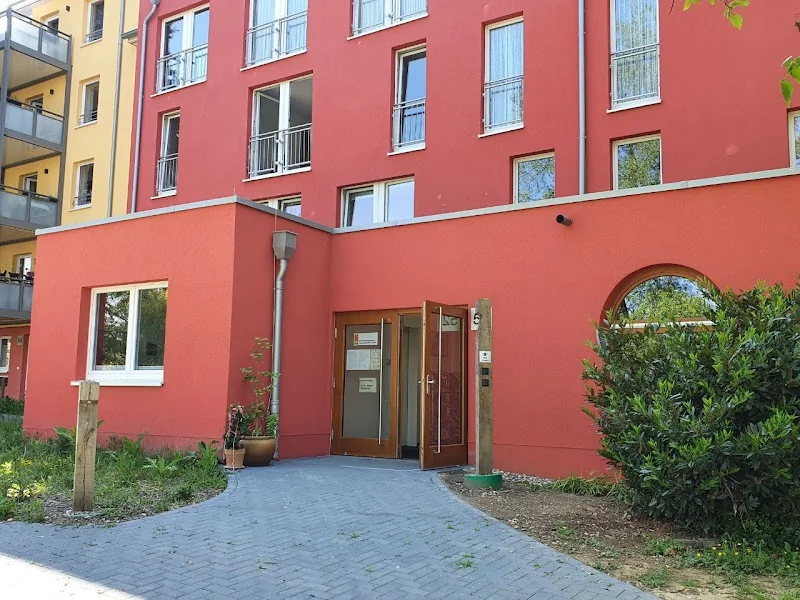
Ellesdorfer Str. 52, Bonn
Ellesdorfer Str. 52, 53179 Bonn, Germany
Neighborhood Management Lannesdorf Mehlem | Program & Fund
The Neighborhood Management Lannesdorf Mehlem is the central meeting point and the first contact for good neighborliness in the southern part of Bonn. Here, people are connected, ideas are born, and projects are implemented that concretely improve everyday life in Lannesdorf and Mehlem. The Evangelical Women's Aid in the Rhineland is responsible for the neighborhood management; the office at Ellesdorfer Straße 52 has been supporting local interactions since September 2010 and is funded by the Department for Social Affairs and Housing of the Federal City of Bonn. Those who are new to the neighborhood, want to make a difference, or simply seek connection will find open doors, conversation partners, and a diverse program – from sewing meetings to the bicycle workshop to the repair café. In addition to offerings for all generations, the neighborhood management supports residents in implementing their own ideas through the neighborhood fund and offers practical services with local partners, such as the Freebox, the free-to-borrow bicycle trailer “MehLannie,” or energy consulting “BEA next door.” Thanks to the good public transport connections – including via Bonn-Mehlem station – the address is easily accessible; those who stop by experience neighborliness as it should be: open, helpful, and vibrant.
Program and Events in Neighborhood Management Lannesdorf/Mehlem
The program of the Neighborhood Management Lannesdorf/Mehlem is intentionally designed to be close to everyday life and diverse, so that as many people from both districts can easily find each other. Regular open meeting points create commitment and orientation without building barriers. These include, for example, the Open Game Meeting for all generations, where classics as well as new board games are played, and the “Just4Fun” singing, which does not require musical knowledge and promotes spontaneous joy in collective sound. The sewing meeting – now with fixed dates during the week – offers the opportunity to repair clothing, start new projects, or simply learn from each other; sewing machines and know-how are available on-site, and beginners are welcome. Those interested in mindfulness and health can engage in gentle movement through QiGong. Families with small children will find suitable offerings in the baby and crawling area, while older adults can discuss topics that move them in the discussion group, share experiences, and maintain contacts. The monthly repair café is particularly in demand: Here, the motto is “don’t throw away, but repair.” Volunteer experts assist with typical defects – from toasters to floor lamps; woodworking or IT questions are also frequently represented. The repair café usually takes place on the first Friday of the month from 3 to 5 PM at the neighborhood office at Ellesdorfer Straße 52; since December 2025, no prior registration is required, and spontaneous visits are explicitly welcomed. Bicycles are excluded from the repair café – for that, the separate bicycle workshop is responsible, which helps keep everyday bikes in good condition with tools, tips, and the right adjustments. The annual program is complemented by formats related to sustainability: the plant exchange in spring, litter collection actions in the neighborhood, meetings of the environmental group Mehlem/Lannesdorf, or a food-sharing dinner where rescued food is processed and shared together. Also included in the calendar are Walk-&-Talk walks, where movement, exchange, and discovering the neighborhood go hand in hand, as well as thematic lectures in cooperation with the consumer advice center on digital security. Highlights also include larger, community-supported actions such as the neighborhood flea market or the neighborhood Olympics with creative participation ideas. What connects all events is the low-threshold access: It’s about encounters in the best sense – whether one just stops by for a coffee or participates regularly. The current overview with days, times, and possible changes is continuously maintained on the official website of the neighborhood management; there, new offerings arising from neighborhood ideas can also be discovered.
Address, Opening Hours, Contact, and Directions
The neighborhood office is centrally located in Lannesdorf/Mehlem: Ellesdorfer Straße 52, 53179 Bonn. The team can be reached by phone at 0228 9541 300. Since the staff are often out in the neighborhood, a brief consultation by phone or email is recommended before a visit. The office is usually staffed from Monday to Thursday from 9 AM to 2 PM. Those planning their arrival have several convenient options: With public transport, Bonn-Mehlem station is the nearest rail connection; from there, the way into the neighborhood is manageable. For individual connections, the regional transport association offers route planning. Those arriving by bicycle can park it in the immediate vicinity; the neighborhood is pleasantly navigable via side streets and short paths. For people who pay attention to accessibility, a brief phone call in advance is recommended to plan for any necessary support, as the neighborhood management team is happy to help – whether it’s about a short accompaniment, suitable access, or a seating option. Since the office has a strong impact on the neighborhood, the address is also used as a meeting point for actions: Walk-&-Talk rounds start from here, and repair cafés, sewing meetings, or consultation hours take place here. In addition, there are nearby contact points for related offerings, such as energy consulting “BEA next door” at Ellersdorfer Straße 56 (every third Wednesday of the month in the afternoon, with appointments arranged through the Bonn Energy Agency). The city portal also provides directions; the neighborhood management is listed there with address, contact, and the option for timetable information. Those visiting for the first time will quickly experience that there are short paths in both senses: Many concerns can be clarified directly, and if an offering does not take place in the house itself, the team knows the right place in the neighborhood.
Neighborhood Fund Lannesdorf/Mehlem: Funding for Projects from the Neighborhood
With the neighborhood fund, the Federal City of Bonn provides financial resources to make ideas from and for residents in Lannesdorf and Mehlem a reality. The fund supports projects in the areas of integration, social affairs, culture, education, as well as employment and qualification in the neighborhood, as well as sports and neighborhood beautification. It is important that projects serve the common good, are easily accessible, and appeal to as many people as possible – such as a movement offering for seniors, a creative action in the village square, a neighborhood festival, or a course that strengthens everyday skills. Up to 3,000 euros in funding are possible per measure. The neighborhood jury, which includes residents from both districts, decides on the applications. The process is transparent: Applications are received at the neighborhood office; the basis is the funding guidelines of the city of Bonn. In addition to the application form, there is an information sheet with the most important points – from the idea to the proof of use. The neighborhood fund has already initiated a wide range of projects: from clown workshops to drumming courses for elementary school students to storytelling cafés, language courses (“Rhenish”), a nature explorer AG at the school, self-defense courses for women, movement offerings for fall prevention training, or colorful actions in the Lannesdorf village square. Characteristically, many initiatives arise from the residents and are implemented with voluntary contributions – exactly what the fund aims to promote: responsible co-design that strengthens identification with the neighborhood. Practically, this means: If someone has an idea, they schedule an appointment at the neighborhood office, clarify open questions with the team, and then submit the application. After a review for eligibility for funding, the jury decides, usually in regular meetings. Upon a positive decision, implementation follows – often with support from the neighborhood management in communication, networking, and documentation. In this way, small budgets lead to visible improvements in everyday life and to occasions where people meet. Those unsure whether an idea fits the fund receive an honest assessment and guidance for the application process at the office.
On-Site Services: Freebox, Bicycle Trailer, and Energy Consulting
In addition to events, the neighborhood management offers practical services that noticeably help in everyday life and conserve resources. The Freebox is a visible symbol of this: true to the motto “exchange instead of buying new.” Well-preserved everyday items change hands here easily – from books to household goods to children’s games. This saves money, reduces waste, and brings people into conversation; the Freebox was funded with resources from the neighborhood fund and was featured in the WDR local news. Another highlight is “MehLannie,” the free-to-borrow cargo bicycle trailer for Lannesdorf and Mehlem. It expands the possibilities for everyday journeys when no car is available or when one consciously wants to do without it. The technical specifications are practical: an interior box size of about 88 × 58 × 24 cm, around 23 kg empty weight, about 120 liters of volume, and up to 40 kg of payload; a suitable coupling is provided when borrowing. Pickup takes place by arrangement at the garage on Ellesdorfer Straße 40 (opposite the Netto market); booking is conveniently done through the Bolle Bonn platform, and contact details appear after the reservation for scheduling. The loan is free of charge, and donations for maintenance are welcome. There is also an offering for the energy transition on a small scale: With “BEA next door,” the Bonn Energy Agency regularly comes directly into the neighborhood. Every third Wednesday of the month from 3:00 PM to 6:00 PM, a free initial consultation on energy-efficient renovation takes place – aimed at owner-occupiers, private landlords, and condominium owners. The consultation location is next to the neighborhood management at Ellersdorfer Straße 56; appointments are arranged through the Bonn Energy Agency’s website. The discussions cover typical questions – such as insulation, heating systems, funding, or a sensible renovation roadmap. Those seeking further information will find additional contact points in the service area of the neighborhood management: garden sponsorships in the neighborhood, an overview of helpful addresses, mediation and conflict counseling offers, the “Red Bin,” and a recyclable materials collection. All these components show how neighborhood work functions: low-threshold support that addresses concrete needs – and which is particularly effective due to its proximity to everyday life.
Background and Sponsorship: Since 2010 in the House of Women's Aid
The Neighborhood Management Lannesdorf/Mehlem was established under the guiding principle of “Living in Community” and has been anchored in the House of Women's Aid since September 2010. The sponsor is the Evangelical Women's Aid in the Rhineland, an organization with deep roots in Bonn and the region. From the beginning, the focus was not on a single building, but on the neighborhood: people, paths, meeting points, and the question of how neighborliness remains vibrant in everyday life. The city of Bonn commissioned neighborhood management in selected districts to strengthen social networks, link structures, and secure the future viability of the neighborhoods together with the residents. In the double neighborhood of Lannesdorf/Mehlem, this idea is particularly vividly demonstrated: long-time residents and newcomers, families, singles, and seniors contribute, try new things, and develop solutions together – from environmental projects to exchange cafés. Structurally, the neighborhood management works on several levels: it is a contact point for concerns from the neighborhood, a hub for networking between clubs, churches, schools, initiatives, and administration, and at the same time an idea laboratory where viable projects emerge from initial sketches. The neighborhood fund complements this work and provides start-up financing, while the neighborhood jury brings in the perspective of the residents. Visible traces in the urban landscape – such as a designed area, a Freebox, a well-used square – are results of a principle that works: listening, connecting, enabling. The good acceptance of the offerings is also due to the constant presence of the team in the everyday life of the neighborhood and the cooperative attitude towards partners: whether consumer advice center, Bonn Energy Agency, ADFC, church communities, or local initiatives – synergies arise everywhere. Thus, administrative projects become lived neighborliness that strengthens the character of Lannesdorf and Mehlem.
Get Involved and Volunteer: Environmental Group, Neighborhood Talks, and More
A good neighborhood is created by people who get involved. Therefore, the Neighborhood Management Lannesdorf/Mehlem explicitly invites voluntary engagement – regardless of age, origin, or prior knowledge. Those who wish to participate will find numerous opportunities with varying intensity. An uncomplicated entry can be made through recurring formats: at the repair café as a helper at the reception, at the bicycle workshop as a mechanic, at the sewing meeting with practical tips, or at the open game meeting with an eye for rules and good atmosphere. In the environmental group Mehlem/Lannesdorf, neighbors engage in climate protection and a clean environment – for example, through litter collection actions, tree sponsorships, or the care of small green spaces. Those who prefer organizing can assist in preparing the neighborhood flea market or the neighborhood Olympics; communicative people take on moderation at neighborhood talks. The neighborhood management also relies on formats that structure participation: neighborhood talks open space for concerns, gather suggestions, and prioritize topics. The working group “Cultural Spaces and Encounters” establishes partnerships so that events and meeting points are reliably available. If someone wants to implement their own idea, they first discuss it in the neighborhood office, check the next steps with the team, and can – if appropriate – submit an application to the neighborhood fund. Small budgets, clear goals, and visible results motivate and build trust. The social gain should not be underestimated: many discover new contacts, skills, and joy in doing things together through participation. For those who want to dip their toes in, a single shift at the repair café or helping out at Walk & Talk is suitable. Others take on regular tasks – from maintaining the Freebox to organizing the plant exchange. It is important: engagement is accompanied, appreciated, and remains voluntary. This creates a culture in which it is natural to support one another. Those seeking information on tasks, time commitment, or training opportunities should best contact the team directly – by phone, email, or in person during office hours. There, there are also hints about insurance, materials, and contact persons. With each contribution, the network that supports Lannesdorf and Mehlem grows – and everyone who lives here feels it.
Sources:
- Federal City of Bonn – Neighborhood Management Lannesdorf/Mehlem (official page)
- Neighborhood Management Lannesdorf/Mehlem – Homepage and Program
- Neighborhood Management Lannesdorf/Mehlem – Contact and Directions (Opening Hours, Notes)
- Neighborhood Management Lannesdorf/Mehlem – Repair Café (Rhythm, Times, Location)
- Neighborhood Management Lannesdorf/Mehlem – The Neighborhood Fund (Funding, Neighborhood Jury)
- Neighborhood Management Lannesdorf/Mehlem – MehLannie Bicycle Trailer (Data, Pickup)
- Neighborhood Management Lannesdorf/Mehlem – Freebox (Purpose, Funding)
- Neighborhood Management Lannesdorf/Mehlem – Energy Consulting BEA next door (Appointment, Location)
- Bonn Energy Agency – Consultation Bad Godesberg (BEA next door, Appointment Arrangement)
- Wikipedia – Bonn-Mehlem Station (Location and Public Transport Connection)
Show moreShow less
Neighborhood Management Lannesdorf Mehlem | Program & Fund
The Neighborhood Management Lannesdorf Mehlem is the central meeting point and the first contact for good neighborliness in the southern part of Bonn. Here, people are connected, ideas are born, and projects are implemented that concretely improve everyday life in Lannesdorf and Mehlem. The Evangelical Women's Aid in the Rhineland is responsible for the neighborhood management; the office at Ellesdorfer Straße 52 has been supporting local interactions since September 2010 and is funded by the Department for Social Affairs and Housing of the Federal City of Bonn. Those who are new to the neighborhood, want to make a difference, or simply seek connection will find open doors, conversation partners, and a diverse program – from sewing meetings to the bicycle workshop to the repair café. In addition to offerings for all generations, the neighborhood management supports residents in implementing their own ideas through the neighborhood fund and offers practical services with local partners, such as the Freebox, the free-to-borrow bicycle trailer “MehLannie,” or energy consulting “BEA next door.” Thanks to the good public transport connections – including via Bonn-Mehlem station – the address is easily accessible; those who stop by experience neighborliness as it should be: open, helpful, and vibrant.
Program and Events in Neighborhood Management Lannesdorf/Mehlem
The program of the Neighborhood Management Lannesdorf/Mehlem is intentionally designed to be close to everyday life and diverse, so that as many people from both districts can easily find each other. Regular open meeting points create commitment and orientation without building barriers. These include, for example, the Open Game Meeting for all generations, where classics as well as new board games are played, and the “Just4Fun” singing, which does not require musical knowledge and promotes spontaneous joy in collective sound. The sewing meeting – now with fixed dates during the week – offers the opportunity to repair clothing, start new projects, or simply learn from each other; sewing machines and know-how are available on-site, and beginners are welcome. Those interested in mindfulness and health can engage in gentle movement through QiGong. Families with small children will find suitable offerings in the baby and crawling area, while older adults can discuss topics that move them in the discussion group, share experiences, and maintain contacts. The monthly repair café is particularly in demand: Here, the motto is “don’t throw away, but repair.” Volunteer experts assist with typical defects – from toasters to floor lamps; woodworking or IT questions are also frequently represented. The repair café usually takes place on the first Friday of the month from 3 to 5 PM at the neighborhood office at Ellesdorfer Straße 52; since December 2025, no prior registration is required, and spontaneous visits are explicitly welcomed. Bicycles are excluded from the repair café – for that, the separate bicycle workshop is responsible, which helps keep everyday bikes in good condition with tools, tips, and the right adjustments. The annual program is complemented by formats related to sustainability: the plant exchange in spring, litter collection actions in the neighborhood, meetings of the environmental group Mehlem/Lannesdorf, or a food-sharing dinner where rescued food is processed and shared together. Also included in the calendar are Walk-&-Talk walks, where movement, exchange, and discovering the neighborhood go hand in hand, as well as thematic lectures in cooperation with the consumer advice center on digital security. Highlights also include larger, community-supported actions such as the neighborhood flea market or the neighborhood Olympics with creative participation ideas. What connects all events is the low-threshold access: It’s about encounters in the best sense – whether one just stops by for a coffee or participates regularly. The current overview with days, times, and possible changes is continuously maintained on the official website of the neighborhood management; there, new offerings arising from neighborhood ideas can also be discovered.
Address, Opening Hours, Contact, and Directions
The neighborhood office is centrally located in Lannesdorf/Mehlem: Ellesdorfer Straße 52, 53179 Bonn. The team can be reached by phone at 0228 9541 300. Since the staff are often out in the neighborhood, a brief consultation by phone or email is recommended before a visit. The office is usually staffed from Monday to Thursday from 9 AM to 2 PM. Those planning their arrival have several convenient options: With public transport, Bonn-Mehlem station is the nearest rail connection; from there, the way into the neighborhood is manageable. For individual connections, the regional transport association offers route planning. Those arriving by bicycle can park it in the immediate vicinity; the neighborhood is pleasantly navigable via side streets and short paths. For people who pay attention to accessibility, a brief phone call in advance is recommended to plan for any necessary support, as the neighborhood management team is happy to help – whether it’s about a short accompaniment, suitable access, or a seating option. Since the office has a strong impact on the neighborhood, the address is also used as a meeting point for actions: Walk-&-Talk rounds start from here, and repair cafés, sewing meetings, or consultation hours take place here. In addition, there are nearby contact points for related offerings, such as energy consulting “BEA next door” at Ellersdorfer Straße 56 (every third Wednesday of the month in the afternoon, with appointments arranged through the Bonn Energy Agency). The city portal also provides directions; the neighborhood management is listed there with address, contact, and the option for timetable information. Those visiting for the first time will quickly experience that there are short paths in both senses: Many concerns can be clarified directly, and if an offering does not take place in the house itself, the team knows the right place in the neighborhood.
Neighborhood Fund Lannesdorf/Mehlem: Funding for Projects from the Neighborhood
With the neighborhood fund, the Federal City of Bonn provides financial resources to make ideas from and for residents in Lannesdorf and Mehlem a reality. The fund supports projects in the areas of integration, social affairs, culture, education, as well as employment and qualification in the neighborhood, as well as sports and neighborhood beautification. It is important that projects serve the common good, are easily accessible, and appeal to as many people as possible – such as a movement offering for seniors, a creative action in the village square, a neighborhood festival, or a course that strengthens everyday skills. Up to 3,000 euros in funding are possible per measure. The neighborhood jury, which includes residents from both districts, decides on the applications. The process is transparent: Applications are received at the neighborhood office; the basis is the funding guidelines of the city of Bonn. In addition to the application form, there is an information sheet with the most important points – from the idea to the proof of use. The neighborhood fund has already initiated a wide range of projects: from clown workshops to drumming courses for elementary school students to storytelling cafés, language courses (“Rhenish”), a nature explorer AG at the school, self-defense courses for women, movement offerings for fall prevention training, or colorful actions in the Lannesdorf village square. Characteristically, many initiatives arise from the residents and are implemented with voluntary contributions – exactly what the fund aims to promote: responsible co-design that strengthens identification with the neighborhood. Practically, this means: If someone has an idea, they schedule an appointment at the neighborhood office, clarify open questions with the team, and then submit the application. After a review for eligibility for funding, the jury decides, usually in regular meetings. Upon a positive decision, implementation follows – often with support from the neighborhood management in communication, networking, and documentation. In this way, small budgets lead to visible improvements in everyday life and to occasions where people meet. Those unsure whether an idea fits the fund receive an honest assessment and guidance for the application process at the office.
On-Site Services: Freebox, Bicycle Trailer, and Energy Consulting
In addition to events, the neighborhood management offers practical services that noticeably help in everyday life and conserve resources. The Freebox is a visible symbol of this: true to the motto “exchange instead of buying new.” Well-preserved everyday items change hands here easily – from books to household goods to children’s games. This saves money, reduces waste, and brings people into conversation; the Freebox was funded with resources from the neighborhood fund and was featured in the WDR local news. Another highlight is “MehLannie,” the free-to-borrow cargo bicycle trailer for Lannesdorf and Mehlem. It expands the possibilities for everyday journeys when no car is available or when one consciously wants to do without it. The technical specifications are practical: an interior box size of about 88 × 58 × 24 cm, around 23 kg empty weight, about 120 liters of volume, and up to 40 kg of payload; a suitable coupling is provided when borrowing. Pickup takes place by arrangement at the garage on Ellesdorfer Straße 40 (opposite the Netto market); booking is conveniently done through the Bolle Bonn platform, and contact details appear after the reservation for scheduling. The loan is free of charge, and donations for maintenance are welcome. There is also an offering for the energy transition on a small scale: With “BEA next door,” the Bonn Energy Agency regularly comes directly into the neighborhood. Every third Wednesday of the month from 3:00 PM to 6:00 PM, a free initial consultation on energy-efficient renovation takes place – aimed at owner-occupiers, private landlords, and condominium owners. The consultation location is next to the neighborhood management at Ellersdorfer Straße 56; appointments are arranged through the Bonn Energy Agency’s website. The discussions cover typical questions – such as insulation, heating systems, funding, or a sensible renovation roadmap. Those seeking further information will find additional contact points in the service area of the neighborhood management: garden sponsorships in the neighborhood, an overview of helpful addresses, mediation and conflict counseling offers, the “Red Bin,” and a recyclable materials collection. All these components show how neighborhood work functions: low-threshold support that addresses concrete needs – and which is particularly effective due to its proximity to everyday life.
Background and Sponsorship: Since 2010 in the House of Women's Aid
The Neighborhood Management Lannesdorf/Mehlem was established under the guiding principle of “Living in Community” and has been anchored in the House of Women's Aid since September 2010. The sponsor is the Evangelical Women's Aid in the Rhineland, an organization with deep roots in Bonn and the region. From the beginning, the focus was not on a single building, but on the neighborhood: people, paths, meeting points, and the question of how neighborliness remains vibrant in everyday life. The city of Bonn commissioned neighborhood management in selected districts to strengthen social networks, link structures, and secure the future viability of the neighborhoods together with the residents. In the double neighborhood of Lannesdorf/Mehlem, this idea is particularly vividly demonstrated: long-time residents and newcomers, families, singles, and seniors contribute, try new things, and develop solutions together – from environmental projects to exchange cafés. Structurally, the neighborhood management works on several levels: it is a contact point for concerns from the neighborhood, a hub for networking between clubs, churches, schools, initiatives, and administration, and at the same time an idea laboratory where viable projects emerge from initial sketches. The neighborhood fund complements this work and provides start-up financing, while the neighborhood jury brings in the perspective of the residents. Visible traces in the urban landscape – such as a designed area, a Freebox, a well-used square – are results of a principle that works: listening, connecting, enabling. The good acceptance of the offerings is also due to the constant presence of the team in the everyday life of the neighborhood and the cooperative attitude towards partners: whether consumer advice center, Bonn Energy Agency, ADFC, church communities, or local initiatives – synergies arise everywhere. Thus, administrative projects become lived neighborliness that strengthens the character of Lannesdorf and Mehlem.
Get Involved and Volunteer: Environmental Group, Neighborhood Talks, and More
A good neighborhood is created by people who get involved. Therefore, the Neighborhood Management Lannesdorf/Mehlem explicitly invites voluntary engagement – regardless of age, origin, or prior knowledge. Those who wish to participate will find numerous opportunities with varying intensity. An uncomplicated entry can be made through recurring formats: at the repair café as a helper at the reception, at the bicycle workshop as a mechanic, at the sewing meeting with practical tips, or at the open game meeting with an eye for rules and good atmosphere. In the environmental group Mehlem/Lannesdorf, neighbors engage in climate protection and a clean environment – for example, through litter collection actions, tree sponsorships, or the care of small green spaces. Those who prefer organizing can assist in preparing the neighborhood flea market or the neighborhood Olympics; communicative people take on moderation at neighborhood talks. The neighborhood management also relies on formats that structure participation: neighborhood talks open space for concerns, gather suggestions, and prioritize topics. The working group “Cultural Spaces and Encounters” establishes partnerships so that events and meeting points are reliably available. If someone wants to implement their own idea, they first discuss it in the neighborhood office, check the next steps with the team, and can – if appropriate – submit an application to the neighborhood fund. Small budgets, clear goals, and visible results motivate and build trust. The social gain should not be underestimated: many discover new contacts, skills, and joy in doing things together through participation. For those who want to dip their toes in, a single shift at the repair café or helping out at Walk & Talk is suitable. Others take on regular tasks – from maintaining the Freebox to organizing the plant exchange. It is important: engagement is accompanied, appreciated, and remains voluntary. This creates a culture in which it is natural to support one another. Those seeking information on tasks, time commitment, or training opportunities should best contact the team directly – by phone, email, or in person during office hours. There, there are also hints about insurance, materials, and contact persons. With each contribution, the network that supports Lannesdorf and Mehlem grows – and everyone who lives here feels it.
Sources:
- Federal City of Bonn – Neighborhood Management Lannesdorf/Mehlem (official page)
- Neighborhood Management Lannesdorf/Mehlem – Homepage and Program
- Neighborhood Management Lannesdorf/Mehlem – Contact and Directions (Opening Hours, Notes)
- Neighborhood Management Lannesdorf/Mehlem – Repair Café (Rhythm, Times, Location)
- Neighborhood Management Lannesdorf/Mehlem – The Neighborhood Fund (Funding, Neighborhood Jury)
- Neighborhood Management Lannesdorf/Mehlem – MehLannie Bicycle Trailer (Data, Pickup)
- Neighborhood Management Lannesdorf/Mehlem – Freebox (Purpose, Funding)
- Neighborhood Management Lannesdorf/Mehlem – Energy Consulting BEA next door (Appointment, Location)
- Bonn Energy Agency – Consultation Bad Godesberg (BEA next door, Appointment Arrangement)
- Wikipedia – Bonn-Mehlem Station (Location and Public Transport Connection)
Neighborhood Management Lannesdorf Mehlem | Program & Fund
The Neighborhood Management Lannesdorf Mehlem is the central meeting point and the first contact for good neighborliness in the southern part of Bonn. Here, people are connected, ideas are born, and projects are implemented that concretely improve everyday life in Lannesdorf and Mehlem. The Evangelical Women's Aid in the Rhineland is responsible for the neighborhood management; the office at Ellesdorfer Straße 52 has been supporting local interactions since September 2010 and is funded by the Department for Social Affairs and Housing of the Federal City of Bonn. Those who are new to the neighborhood, want to make a difference, or simply seek connection will find open doors, conversation partners, and a diverse program – from sewing meetings to the bicycle workshop to the repair café. In addition to offerings for all generations, the neighborhood management supports residents in implementing their own ideas through the neighborhood fund and offers practical services with local partners, such as the Freebox, the free-to-borrow bicycle trailer “MehLannie,” or energy consulting “BEA next door.” Thanks to the good public transport connections – including via Bonn-Mehlem station – the address is easily accessible; those who stop by experience neighborliness as it should be: open, helpful, and vibrant.
Program and Events in Neighborhood Management Lannesdorf/Mehlem
The program of the Neighborhood Management Lannesdorf/Mehlem is intentionally designed to be close to everyday life and diverse, so that as many people from both districts can easily find each other. Regular open meeting points create commitment and orientation without building barriers. These include, for example, the Open Game Meeting for all generations, where classics as well as new board games are played, and the “Just4Fun” singing, which does not require musical knowledge and promotes spontaneous joy in collective sound. The sewing meeting – now with fixed dates during the week – offers the opportunity to repair clothing, start new projects, or simply learn from each other; sewing machines and know-how are available on-site, and beginners are welcome. Those interested in mindfulness and health can engage in gentle movement through QiGong. Families with small children will find suitable offerings in the baby and crawling area, while older adults can discuss topics that move them in the discussion group, share experiences, and maintain contacts. The monthly repair café is particularly in demand: Here, the motto is “don’t throw away, but repair.” Volunteer experts assist with typical defects – from toasters to floor lamps; woodworking or IT questions are also frequently represented. The repair café usually takes place on the first Friday of the month from 3 to 5 PM at the neighborhood office at Ellesdorfer Straße 52; since December 2025, no prior registration is required, and spontaneous visits are explicitly welcomed. Bicycles are excluded from the repair café – for that, the separate bicycle workshop is responsible, which helps keep everyday bikes in good condition with tools, tips, and the right adjustments. The annual program is complemented by formats related to sustainability: the plant exchange in spring, litter collection actions in the neighborhood, meetings of the environmental group Mehlem/Lannesdorf, or a food-sharing dinner where rescued food is processed and shared together. Also included in the calendar are Walk-&-Talk walks, where movement, exchange, and discovering the neighborhood go hand in hand, as well as thematic lectures in cooperation with the consumer advice center on digital security. Highlights also include larger, community-supported actions such as the neighborhood flea market or the neighborhood Olympics with creative participation ideas. What connects all events is the low-threshold access: It’s about encounters in the best sense – whether one just stops by for a coffee or participates regularly. The current overview with days, times, and possible changes is continuously maintained on the official website of the neighborhood management; there, new offerings arising from neighborhood ideas can also be discovered.
Address, Opening Hours, Contact, and Directions
The neighborhood office is centrally located in Lannesdorf/Mehlem: Ellesdorfer Straße 52, 53179 Bonn. The team can be reached by phone at 0228 9541 300. Since the staff are often out in the neighborhood, a brief consultation by phone or email is recommended before a visit. The office is usually staffed from Monday to Thursday from 9 AM to 2 PM. Those planning their arrival have several convenient options: With public transport, Bonn-Mehlem station is the nearest rail connection; from there, the way into the neighborhood is manageable. For individual connections, the regional transport association offers route planning. Those arriving by bicycle can park it in the immediate vicinity; the neighborhood is pleasantly navigable via side streets and short paths. For people who pay attention to accessibility, a brief phone call in advance is recommended to plan for any necessary support, as the neighborhood management team is happy to help – whether it’s about a short accompaniment, suitable access, or a seating option. Since the office has a strong impact on the neighborhood, the address is also used as a meeting point for actions: Walk-&-Talk rounds start from here, and repair cafés, sewing meetings, or consultation hours take place here. In addition, there are nearby contact points for related offerings, such as energy consulting “BEA next door” at Ellersdorfer Straße 56 (every third Wednesday of the month in the afternoon, with appointments arranged through the Bonn Energy Agency). The city portal also provides directions; the neighborhood management is listed there with address, contact, and the option for timetable information. Those visiting for the first time will quickly experience that there are short paths in both senses: Many concerns can be clarified directly, and if an offering does not take place in the house itself, the team knows the right place in the neighborhood.
Neighborhood Fund Lannesdorf/Mehlem: Funding for Projects from the Neighborhood
With the neighborhood fund, the Federal City of Bonn provides financial resources to make ideas from and for residents in Lannesdorf and Mehlem a reality. The fund supports projects in the areas of integration, social affairs, culture, education, as well as employment and qualification in the neighborhood, as well as sports and neighborhood beautification. It is important that projects serve the common good, are easily accessible, and appeal to as many people as possible – such as a movement offering for seniors, a creative action in the village square, a neighborhood festival, or a course that strengthens everyday skills. Up to 3,000 euros in funding are possible per measure. The neighborhood jury, which includes residents from both districts, decides on the applications. The process is transparent: Applications are received at the neighborhood office; the basis is the funding guidelines of the city of Bonn. In addition to the application form, there is an information sheet with the most important points – from the idea to the proof of use. The neighborhood fund has already initiated a wide range of projects: from clown workshops to drumming courses for elementary school students to storytelling cafés, language courses (“Rhenish”), a nature explorer AG at the school, self-defense courses for women, movement offerings for fall prevention training, or colorful actions in the Lannesdorf village square. Characteristically, many initiatives arise from the residents and are implemented with voluntary contributions – exactly what the fund aims to promote: responsible co-design that strengthens identification with the neighborhood. Practically, this means: If someone has an idea, they schedule an appointment at the neighborhood office, clarify open questions with the team, and then submit the application. After a review for eligibility for funding, the jury decides, usually in regular meetings. Upon a positive decision, implementation follows – often with support from the neighborhood management in communication, networking, and documentation. In this way, small budgets lead to visible improvements in everyday life and to occasions where people meet. Those unsure whether an idea fits the fund receive an honest assessment and guidance for the application process at the office.
On-Site Services: Freebox, Bicycle Trailer, and Energy Consulting
In addition to events, the neighborhood management offers practical services that noticeably help in everyday life and conserve resources. The Freebox is a visible symbol of this: true to the motto “exchange instead of buying new.” Well-preserved everyday items change hands here easily – from books to household goods to children’s games. This saves money, reduces waste, and brings people into conversation; the Freebox was funded with resources from the neighborhood fund and was featured in the WDR local news. Another highlight is “MehLannie,” the free-to-borrow cargo bicycle trailer for Lannesdorf and Mehlem. It expands the possibilities for everyday journeys when no car is available or when one consciously wants to do without it. The technical specifications are practical: an interior box size of about 88 × 58 × 24 cm, around 23 kg empty weight, about 120 liters of volume, and up to 40 kg of payload; a suitable coupling is provided when borrowing. Pickup takes place by arrangement at the garage on Ellesdorfer Straße 40 (opposite the Netto market); booking is conveniently done through the Bolle Bonn platform, and contact details appear after the reservation for scheduling. The loan is free of charge, and donations for maintenance are welcome. There is also an offering for the energy transition on a small scale: With “BEA next door,” the Bonn Energy Agency regularly comes directly into the neighborhood. Every third Wednesday of the month from 3:00 PM to 6:00 PM, a free initial consultation on energy-efficient renovation takes place – aimed at owner-occupiers, private landlords, and condominium owners. The consultation location is next to the neighborhood management at Ellersdorfer Straße 56; appointments are arranged through the Bonn Energy Agency’s website. The discussions cover typical questions – such as insulation, heating systems, funding, or a sensible renovation roadmap. Those seeking further information will find additional contact points in the service area of the neighborhood management: garden sponsorships in the neighborhood, an overview of helpful addresses, mediation and conflict counseling offers, the “Red Bin,” and a recyclable materials collection. All these components show how neighborhood work functions: low-threshold support that addresses concrete needs – and which is particularly effective due to its proximity to everyday life.
Background and Sponsorship: Since 2010 in the House of Women's Aid
The Neighborhood Management Lannesdorf/Mehlem was established under the guiding principle of “Living in Community” and has been anchored in the House of Women's Aid since September 2010. The sponsor is the Evangelical Women's Aid in the Rhineland, an organization with deep roots in Bonn and the region. From the beginning, the focus was not on a single building, but on the neighborhood: people, paths, meeting points, and the question of how neighborliness remains vibrant in everyday life. The city of Bonn commissioned neighborhood management in selected districts to strengthen social networks, link structures, and secure the future viability of the neighborhoods together with the residents. In the double neighborhood of Lannesdorf/Mehlem, this idea is particularly vividly demonstrated: long-time residents and newcomers, families, singles, and seniors contribute, try new things, and develop solutions together – from environmental projects to exchange cafés. Structurally, the neighborhood management works on several levels: it is a contact point for concerns from the neighborhood, a hub for networking between clubs, churches, schools, initiatives, and administration, and at the same time an idea laboratory where viable projects emerge from initial sketches. The neighborhood fund complements this work and provides start-up financing, while the neighborhood jury brings in the perspective of the residents. Visible traces in the urban landscape – such as a designed area, a Freebox, a well-used square – are results of a principle that works: listening, connecting, enabling. The good acceptance of the offerings is also due to the constant presence of the team in the everyday life of the neighborhood and the cooperative attitude towards partners: whether consumer advice center, Bonn Energy Agency, ADFC, church communities, or local initiatives – synergies arise everywhere. Thus, administrative projects become lived neighborliness that strengthens the character of Lannesdorf and Mehlem.
Get Involved and Volunteer: Environmental Group, Neighborhood Talks, and More
A good neighborhood is created by people who get involved. Therefore, the Neighborhood Management Lannesdorf/Mehlem explicitly invites voluntary engagement – regardless of age, origin, or prior knowledge. Those who wish to participate will find numerous opportunities with varying intensity. An uncomplicated entry can be made through recurring formats: at the repair café as a helper at the reception, at the bicycle workshop as a mechanic, at the sewing meeting with practical tips, or at the open game meeting with an eye for rules and good atmosphere. In the environmental group Mehlem/Lannesdorf, neighbors engage in climate protection and a clean environment – for example, through litter collection actions, tree sponsorships, or the care of small green spaces. Those who prefer organizing can assist in preparing the neighborhood flea market or the neighborhood Olympics; communicative people take on moderation at neighborhood talks. The neighborhood management also relies on formats that structure participation: neighborhood talks open space for concerns, gather suggestions, and prioritize topics. The working group “Cultural Spaces and Encounters” establishes partnerships so that events and meeting points are reliably available. If someone wants to implement their own idea, they first discuss it in the neighborhood office, check the next steps with the team, and can – if appropriate – submit an application to the neighborhood fund. Small budgets, clear goals, and visible results motivate and build trust. The social gain should not be underestimated: many discover new contacts, skills, and joy in doing things together through participation. For those who want to dip their toes in, a single shift at the repair café or helping out at Walk & Talk is suitable. Others take on regular tasks – from maintaining the Freebox to organizing the plant exchange. It is important: engagement is accompanied, appreciated, and remains voluntary. This creates a culture in which it is natural to support one another. Those seeking information on tasks, time commitment, or training opportunities should best contact the team directly – by phone, email, or in person during office hours. There, there are also hints about insurance, materials, and contact persons. With each contribution, the network that supports Lannesdorf and Mehlem grows – and everyone who lives here feels it.
Sources:
- Federal City of Bonn – Neighborhood Management Lannesdorf/Mehlem (official page)
- Neighborhood Management Lannesdorf/Mehlem – Homepage and Program
- Neighborhood Management Lannesdorf/Mehlem – Contact and Directions (Opening Hours, Notes)
- Neighborhood Management Lannesdorf/Mehlem – Repair Café (Rhythm, Times, Location)
- Neighborhood Management Lannesdorf/Mehlem – The Neighborhood Fund (Funding, Neighborhood Jury)
- Neighborhood Management Lannesdorf/Mehlem – MehLannie Bicycle Trailer (Data, Pickup)
- Neighborhood Management Lannesdorf/Mehlem – Freebox (Purpose, Funding)
- Neighborhood Management Lannesdorf/Mehlem – Energy Consulting BEA next door (Appointment, Location)
- Bonn Energy Agency – Consultation Bad Godesberg (BEA next door, Appointment Arrangement)
- Wikipedia – Bonn-Mehlem Station (Location and Public Transport Connection)
Upcoming Events
Self-Assertion and Self-Defense for Women
More safety, more presence, more self-confidence: In Bonn, women can expect a practical workshop with clear impulses and a strong learning atmosphere. #Bonn #SelfDefense

Self-Assertion & Self-Defense for Mother-Daughter Pairs
Together Strong in Bonn: Mother and Daughter Train Self-Assertion, Boundaries, and Safety at the House of Women's Aid. 11/07/2026, 90 Euros. #Bonn #SelfDefense
Frequently Asked Questions
Reviews
Thanaa Hamsho
16. July 2025
🥰
Azad Huseyinov
22. December 2024
Ines Jonas
1. December 2023