
Poststraße 26, Bonn
Poststraße 26, 53111 Bonn, Germany
P26 Bonn | Opening Hours & Exhibition
The P26 in the city center of Bonn is much more than just an address at Poststraße 26. The building combines university, science communication, museums, temporary exhibitions, and consulting under one roof, catering to visitors who want to not only look but also understand, discover, and be inspired in Bonn. Since its opening in October 2024, the former department store has become a modern house of knowledge and research, offering different access points to history, art, collection culture, and current research across four floors. Upon entering P26, one does not find a classic single museum, but a consciously composed ensemble of Knowledge Lab, Info Point, Global Heritage Lab, Paul-Clemen Museum, and Egyptian Museum. This mix makes the location in Bonn's city center so interesting: scientific objects are not isolated in showcases but are placed in a larger context of research, teaching, and public engagement. The result is a place where museum visits, city strolls, and university experiences naturally connect. The location between the main train station and the cathedral, the clear floor concept, and the changing exhibitions make P26 an attractive destination for culture-interested guests, students, families, and anyone looking for a vibrant science and museum space in Bonn. ([uni-bonn.de](https://www.uni-bonn.de/de/universitaet/presse-kommunikation/publikationen/forsch/forsch-2025-01/artikel/zeiten-und-wunder))
Current Exhibitions and Program at P26
The program at P26 thrives on changes, transitions, and new perspectives. For this reason, it is worthwhile to regularly check the current exhibitions, as the Knowledge Lab and the Global Heritage Lab focus not on rigid permanent displays but on continuously changing formats. For spring 2026, the exhibition “Findings and Question Marks – In the Footsteps of a Painting” has been announced or shown; according to the University of Bonn, it runs from February 6 to April 19, 2026. This is typical for the house: a single object or a single question serves as a starting point to make provenance, research practice, and scientific work visible. At the same time, the Global Heritage Lab has invited visitors since March 19, 2026, to the new exhibition “Plant Knowledge – Ecologies of Remembering and Acting.” The visitor side of the lab makes it clear that the exhibition house does not only function as a display area but also as a space for events, tours, and education. This is precisely where the special appeal of P26 arises: The building does not simply show results but reveals research processes. Visitors experience how knowledge is created, how objects tell new stories, and how university collections are transferred into a contemporary form of public engagement. Therefore, anyone looking for a program that moves between art, nature, history, and science will find in P26 not a monotonous sequence but a consciously curated interplay of themes, formats, and perspectives. The exhibitions are closely linked to the University of Bonn and provide insight into topics that extend far beyond the building. ([uni-bonn.de](https://www.uni-bonn.de/p26))
History and Concept of P26
The history of P26 is closely tied to the development of the University of Bonn and its collections. The name has been deliberately chosen to be simple: P26 stands for Poststraße 26 and thus refers to the address in the heart of the city center. The building was repurposed from a former department store and opened in October 2024 as a house of knowledge and research. The official opening report describes the project as a place where research, teaching, and public engagement come together. For the University of Bonn, P26 is a visible sign that science takes place not only in lecture halls or laboratories but also in urban spaces. The building was conceptually supported by a renowned scenography office known for other large museum projects. Across four floors, a house has been designed where each level carries its own narrative. This concept also explains why several institutions appear together in P26: The house consolidates museum work, research communication, consulting, and changing exhibitions. Thus, the university has not simply gained additional space but created a new public resonance space. It is also important to understand that the museum areas were previously housed in the main building and had to be relocated due to renovation work. A transitional space has become a permanently relevant format for the city. This mixture of interim character, future-oriented use, and public visibility gives P26 its character. It is a building that does not hide historical collections but makes them readable in a modern, urban environment. Once the concept is understood, it quickly becomes clear: P26 is not a single museum but a curated place of knowledge that makes the University of Bonn newly experienceable in the heart of the city. ([uni-bonn.de](https://www.uni-bonn.de/de/universitaet/presse-kommunikation/publikationen/forsch/forsch-2025-01/artikel/zeiten-und-wunder))
Opening Hours, Admission, and Tickets
For practical planning, P26 is very clearly organized. The museums in the building open from Wednesday to Sunday from 2 PM to 6 PM. Admission costs 4.50 euros, reduced 2.50 euros. At the same time, there are several free offerings: The exhibition on the ground floor is open Monday to Friday from 10 AM to 6 PM and also accessible on weekends in the afternoons; admission there is free. The Info Point of the University of Bonn follows this extended rhythm and is accessible Monday to Friday from 10 AM to 6 PM and Saturday and Sunday from 2 PM to 6 PM. This structure is pleasant for visitors as it allows for both classic museum hours and low-threshold access for spontaneous visits. The ticket price applies to the entire P26 building, so for the Knowledge Lab on the ground floor, the Global Heritage Lab on the 1st floor, the Paul-Clemen Museum on the 2nd floor, and the Egyptian Museum on the 3rd floor. This is an advantage for planning a longer stay, as one does not need a separate ticket for each area. Additionally, the University of Bonn points out that the former Info Point in the main building is closed. Anyone with questions about tours, events, or the use of the rooms can contact the management of P26. The house is thus not only an exhibition space but also a service point. Particularly practical is that the opening hours of the central exhibition areas are coordinated and can be easily combined with a visit to the city center. Anyone planning a culture-rich afternoon in Bonn will find reliable times, transparent prices, and an offering that feels coherent from initial orientation to museum visit. ([uni-bonn.de](https://www.uni-bonn.de/p26))
Access, Parking, and Location in Bonn's City Center
The location of P26 is one of its greatest strengths. The address Poststraße 26, 53111 Bonn, is very central in the city center and is easily accessible for pedestrians. The Egyptian Museum explicitly describes the location as central between Bonn's main train station and the cathedral. For travel by public transport, this is particularly convenient: The Info Point of the university describes the walking distance from Bonn main station as about two minutes; the stops Bonn main station, for both buses and subway, are also directly nearby. The Egyptian Museum mentions subway lines 16, 63, and 66 with the Poststraße exit and estimates the walking distance at about three minutes. The location is also easily accessible by car if one plans for city center parking garages. The museum refers to the parking garages at the main station, university, and market. The Info Point generally recommends parking in one of the parking garages in the city center. For visitors, this means: Those who do not arrive on foot or by train and bus should take advantage of the central city location and not look for a direct parking space at the house. For a place in a busy city location, this is not a disadvantage but part of the concept. P26 is not intended as an isolated campus building but as an open house within the urban fabric. Therefore, access works best as one would expect from a city center museum: centrally located, brief, clearly signposted, and easily combinable with a walk through Bonn's city. Anyone wishing to combine their visit with other errands, a city stroll, or a café visit particularly benefits from this location in the heart of the city. ([iak.uni-bonn.de](https://www.iak.uni-bonn.de/de/museen/aegyptisches-museum))
Museums, Floors, and Collections in P26
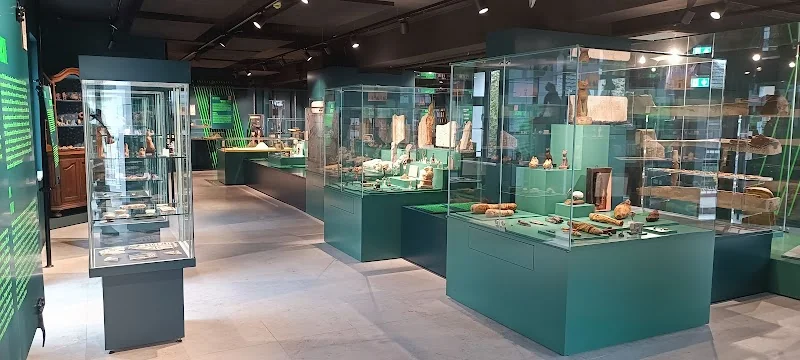
P26 impresses mainly through the diversity of its floors. On the ground floor is the Knowledge Lab Uni Bonn, often referred to as KLUB. Here, scientific collections, excellence clusters, and transdisciplinary research areas are presented in changing exhibitions. Also on the ground floor is the Info Point of the University of Bonn as the first point of contact for almost all questions related to the university. This creates a public area that provides orientation and also piques curiosity. On the 1st floor is the Global Heritage Lab, which understands itself as a laboratory for the critical reflection of museums and cultural heritage. It expands the view of collections to include global and historical perspectives. On the 2nd floor is the Paul-Clemen Museum. It displays artworks from various epochs, including originals and plaster casts, and works closely with teaching and research. The University of Bonn describes it as a workshop for visual knowledge. Finally, on the 3rd floor is the Egyptian Museum. It offers a cultural-historical panorama of pharaonic Egypt with around 1000 exhibits and is also the largest collection of Aegyptiaca in North Rhine-Westphalia. Particularly important is that the museum not only displays objects but also addresses Bonn's research, provenance issues, and appropriation phenomena. Together, these four levels do not form a random juxtaposition but a clear dramaturgy: from the entry in the Knowledge Lab through the Global Heritage Lab and the Paul-Clemen Museum to the Egyptian Museum, a wide arc from the present and research to the depths of history is condensed in the house. This makes the museum visit at P26 so unusual. Visitors encounter not only individual exhibits but also different forms of knowledge. Each floor sets its own accent, yet all together tell the same fundamental idea: collections are not silent stocks but lively places of questioning, showing, and further thinking. ([iak.uni-bonn.de](https://www.iak.uni-bonn.de/de/museen/aegyptisches-museum/besucherinformation))
Guided Tours, Accessibility, and On-Site Service
For those who want to explore P26 not just independently but experience it in depth, there are several service-oriented offerings. For inquiries about guided tours, events, or the use of the premises, the University of Bonn refers to the management of P26. This is particularly useful for groups, school classes, scientific teams, or organizers who want to use the place for more than just a short museum visit. The Egyptian Museum also offers guided tours for groups upon request; there are special tours and workshops for schools. The museum also specifies a maximum group size of 20 people. This information shows that P26 is not only an exhibition space but also a mediation place with educational aspirations. Additionally, good accessibility is a plus: the Egyptian Museum is accessible by elevator and barrier-free. This is particularly important for a building with several floors and makes the visit easier for a wide audience. The clear service infrastructure is also practical. The Info Point of the University of Bonn is centrally located in the building and serves as a point of contact for questions, advice, and informational material. For many guests, this is the first contact point in the building before they head into the exhibitions. This is complemented by a café in the building or the announced café use in the house, which makes the stay in P26 pleasant beyond the classic museum visit. A museum needs not only content but also quality of stay, and this is exactly where P26 comes in. It connects knowledge with stay, orientation with discovery, and openness with structure. Therefore, anyone planning a longer visit can easily combine several levels in P26: first orientation at the Info Point, then a tour of the exhibitions, followed by a look into the museum areas, and finally a break in the house or in the immediate city center surroundings. This makes P26 a flexible destination for spontaneous visits as well as for planned guided tours. ([uni-bonn.de](https://www.uni-bonn.de/p26))
Sources:
Show moreShow less
P26 Bonn | Opening Hours & Exhibition
The P26 in the city center of Bonn is much more than just an address at Poststraße 26. The building combines university, science communication, museums, temporary exhibitions, and consulting under one roof, catering to visitors who want to not only look but also understand, discover, and be inspired in Bonn. Since its opening in October 2024, the former department store has become a modern house of knowledge and research, offering different access points to history, art, collection culture, and current research across four floors. Upon entering P26, one does not find a classic single museum, but a consciously composed ensemble of Knowledge Lab, Info Point, Global Heritage Lab, Paul-Clemen Museum, and Egyptian Museum. This mix makes the location in Bonn's city center so interesting: scientific objects are not isolated in showcases but are placed in a larger context of research, teaching, and public engagement. The result is a place where museum visits, city strolls, and university experiences naturally connect. The location between the main train station and the cathedral, the clear floor concept, and the changing exhibitions make P26 an attractive destination for culture-interested guests, students, families, and anyone looking for a vibrant science and museum space in Bonn. ([uni-bonn.de](https://www.uni-bonn.de/de/universitaet/presse-kommunikation/publikationen/forsch/forsch-2025-01/artikel/zeiten-und-wunder))
Current Exhibitions and Program at P26
The program at P26 thrives on changes, transitions, and new perspectives. For this reason, it is worthwhile to regularly check the current exhibitions, as the Knowledge Lab and the Global Heritage Lab focus not on rigid permanent displays but on continuously changing formats. For spring 2026, the exhibition “Findings and Question Marks – In the Footsteps of a Painting” has been announced or shown; according to the University of Bonn, it runs from February 6 to April 19, 2026. This is typical for the house: a single object or a single question serves as a starting point to make provenance, research practice, and scientific work visible. At the same time, the Global Heritage Lab has invited visitors since March 19, 2026, to the new exhibition “Plant Knowledge – Ecologies of Remembering and Acting.” The visitor side of the lab makes it clear that the exhibition house does not only function as a display area but also as a space for events, tours, and education. This is precisely where the special appeal of P26 arises: The building does not simply show results but reveals research processes. Visitors experience how knowledge is created, how objects tell new stories, and how university collections are transferred into a contemporary form of public engagement. Therefore, anyone looking for a program that moves between art, nature, history, and science will find in P26 not a monotonous sequence but a consciously curated interplay of themes, formats, and perspectives. The exhibitions are closely linked to the University of Bonn and provide insight into topics that extend far beyond the building. ([uni-bonn.de](https://www.uni-bonn.de/p26))
History and Concept of P26
The history of P26 is closely tied to the development of the University of Bonn and its collections. The name has been deliberately chosen to be simple: P26 stands for Poststraße 26 and thus refers to the address in the heart of the city center. The building was repurposed from a former department store and opened in October 2024 as a house of knowledge and research. The official opening report describes the project as a place where research, teaching, and public engagement come together. For the University of Bonn, P26 is a visible sign that science takes place not only in lecture halls or laboratories but also in urban spaces. The building was conceptually supported by a renowned scenography office known for other large museum projects. Across four floors, a house has been designed where each level carries its own narrative. This concept also explains why several institutions appear together in P26: The house consolidates museum work, research communication, consulting, and changing exhibitions. Thus, the university has not simply gained additional space but created a new public resonance space. It is also important to understand that the museum areas were previously housed in the main building and had to be relocated due to renovation work. A transitional space has become a permanently relevant format for the city. This mixture of interim character, future-oriented use, and public visibility gives P26 its character. It is a building that does not hide historical collections but makes them readable in a modern, urban environment. Once the concept is understood, it quickly becomes clear: P26 is not a single museum but a curated place of knowledge that makes the University of Bonn newly experienceable in the heart of the city. ([uni-bonn.de](https://www.uni-bonn.de/de/universitaet/presse-kommunikation/publikationen/forsch/forsch-2025-01/artikel/zeiten-und-wunder))
Opening Hours, Admission, and Tickets
For practical planning, P26 is very clearly organized. The museums in the building open from Wednesday to Sunday from 2 PM to 6 PM. Admission costs 4.50 euros, reduced 2.50 euros. At the same time, there are several free offerings: The exhibition on the ground floor is open Monday to Friday from 10 AM to 6 PM and also accessible on weekends in the afternoons; admission there is free. The Info Point of the University of Bonn follows this extended rhythm and is accessible Monday to Friday from 10 AM to 6 PM and Saturday and Sunday from 2 PM to 6 PM. This structure is pleasant for visitors as it allows for both classic museum hours and low-threshold access for spontaneous visits. The ticket price applies to the entire P26 building, so for the Knowledge Lab on the ground floor, the Global Heritage Lab on the 1st floor, the Paul-Clemen Museum on the 2nd floor, and the Egyptian Museum on the 3rd floor. This is an advantage for planning a longer stay, as one does not need a separate ticket for each area. Additionally, the University of Bonn points out that the former Info Point in the main building is closed. Anyone with questions about tours, events, or the use of the rooms can contact the management of P26. The house is thus not only an exhibition space but also a service point. Particularly practical is that the opening hours of the central exhibition areas are coordinated and can be easily combined with a visit to the city center. Anyone planning a culture-rich afternoon in Bonn will find reliable times, transparent prices, and an offering that feels coherent from initial orientation to museum visit. ([uni-bonn.de](https://www.uni-bonn.de/p26))
Access, Parking, and Location in Bonn's City Center
The location of P26 is one of its greatest strengths. The address Poststraße 26, 53111 Bonn, is very central in the city center and is easily accessible for pedestrians. The Egyptian Museum explicitly describes the location as central between Bonn's main train station and the cathedral. For travel by public transport, this is particularly convenient: The Info Point of the university describes the walking distance from Bonn main station as about two minutes; the stops Bonn main station, for both buses and subway, are also directly nearby. The Egyptian Museum mentions subway lines 16, 63, and 66 with the Poststraße exit and estimates the walking distance at about three minutes. The location is also easily accessible by car if one plans for city center parking garages. The museum refers to the parking garages at the main station, university, and market. The Info Point generally recommends parking in one of the parking garages in the city center. For visitors, this means: Those who do not arrive on foot or by train and bus should take advantage of the central city location and not look for a direct parking space at the house. For a place in a busy city location, this is not a disadvantage but part of the concept. P26 is not intended as an isolated campus building but as an open house within the urban fabric. Therefore, access works best as one would expect from a city center museum: centrally located, brief, clearly signposted, and easily combinable with a walk through Bonn's city. Anyone wishing to combine their visit with other errands, a city stroll, or a café visit particularly benefits from this location in the heart of the city. ([iak.uni-bonn.de](https://www.iak.uni-bonn.de/de/museen/aegyptisches-museum))
Museums, Floors, and Collections in P26
P26 impresses mainly through the diversity of its floors. On the ground floor is the Knowledge Lab Uni Bonn, often referred to as KLUB. Here, scientific collections, excellence clusters, and transdisciplinary research areas are presented in changing exhibitions. Also on the ground floor is the Info Point of the University of Bonn as the first point of contact for almost all questions related to the university. This creates a public area that provides orientation and also piques curiosity. On the 1st floor is the Global Heritage Lab, which understands itself as a laboratory for the critical reflection of museums and cultural heritage. It expands the view of collections to include global and historical perspectives. On the 2nd floor is the Paul-Clemen Museum. It displays artworks from various epochs, including originals and plaster casts, and works closely with teaching and research. The University of Bonn describes it as a workshop for visual knowledge. Finally, on the 3rd floor is the Egyptian Museum. It offers a cultural-historical panorama of pharaonic Egypt with around 1000 exhibits and is also the largest collection of Aegyptiaca in North Rhine-Westphalia. Particularly important is that the museum not only displays objects but also addresses Bonn's research, provenance issues, and appropriation phenomena. Together, these four levels do not form a random juxtaposition but a clear dramaturgy: from the entry in the Knowledge Lab through the Global Heritage Lab and the Paul-Clemen Museum to the Egyptian Museum, a wide arc from the present and research to the depths of history is condensed in the house. This makes the museum visit at P26 so unusual. Visitors encounter not only individual exhibits but also different forms of knowledge. Each floor sets its own accent, yet all together tell the same fundamental idea: collections are not silent stocks but lively places of questioning, showing, and further thinking. ([iak.uni-bonn.de](https://www.iak.uni-bonn.de/de/museen/aegyptisches-museum/besucherinformation))
Guided Tours, Accessibility, and On-Site Service
For those who want to explore P26 not just independently but experience it in depth, there are several service-oriented offerings. For inquiries about guided tours, events, or the use of the premises, the University of Bonn refers to the management of P26. This is particularly useful for groups, school classes, scientific teams, or organizers who want to use the place for more than just a short museum visit. The Egyptian Museum also offers guided tours for groups upon request; there are special tours and workshops for schools. The museum also specifies a maximum group size of 20 people. This information shows that P26 is not only an exhibition space but also a mediation place with educational aspirations. Additionally, good accessibility is a plus: the Egyptian Museum is accessible by elevator and barrier-free. This is particularly important for a building with several floors and makes the visit easier for a wide audience. The clear service infrastructure is also practical. The Info Point of the University of Bonn is centrally located in the building and serves as a point of contact for questions, advice, and informational material. For many guests, this is the first contact point in the building before they head into the exhibitions. This is complemented by a café in the building or the announced café use in the house, which makes the stay in P26 pleasant beyond the classic museum visit. A museum needs not only content but also quality of stay, and this is exactly where P26 comes in. It connects knowledge with stay, orientation with discovery, and openness with structure. Therefore, anyone planning a longer visit can easily combine several levels in P26: first orientation at the Info Point, then a tour of the exhibitions, followed by a look into the museum areas, and finally a break in the house or in the immediate city center surroundings. This makes P26 a flexible destination for spontaneous visits as well as for planned guided tours. ([uni-bonn.de](https://www.uni-bonn.de/p26))
Sources:
P26 Bonn | Opening Hours & Exhibition
The P26 in the city center of Bonn is much more than just an address at Poststraße 26. The building combines university, science communication, museums, temporary exhibitions, and consulting under one roof, catering to visitors who want to not only look but also understand, discover, and be inspired in Bonn. Since its opening in October 2024, the former department store has become a modern house of knowledge and research, offering different access points to history, art, collection culture, and current research across four floors. Upon entering P26, one does not find a classic single museum, but a consciously composed ensemble of Knowledge Lab, Info Point, Global Heritage Lab, Paul-Clemen Museum, and Egyptian Museum. This mix makes the location in Bonn's city center so interesting: scientific objects are not isolated in showcases but are placed in a larger context of research, teaching, and public engagement. The result is a place where museum visits, city strolls, and university experiences naturally connect. The location between the main train station and the cathedral, the clear floor concept, and the changing exhibitions make P26 an attractive destination for culture-interested guests, students, families, and anyone looking for a vibrant science and museum space in Bonn. ([uni-bonn.de](https://www.uni-bonn.de/de/universitaet/presse-kommunikation/publikationen/forsch/forsch-2025-01/artikel/zeiten-und-wunder))
Current Exhibitions and Program at P26
The program at P26 thrives on changes, transitions, and new perspectives. For this reason, it is worthwhile to regularly check the current exhibitions, as the Knowledge Lab and the Global Heritage Lab focus not on rigid permanent displays but on continuously changing formats. For spring 2026, the exhibition “Findings and Question Marks – In the Footsteps of a Painting” has been announced or shown; according to the University of Bonn, it runs from February 6 to April 19, 2026. This is typical for the house: a single object or a single question serves as a starting point to make provenance, research practice, and scientific work visible. At the same time, the Global Heritage Lab has invited visitors since March 19, 2026, to the new exhibition “Plant Knowledge – Ecologies of Remembering and Acting.” The visitor side of the lab makes it clear that the exhibition house does not only function as a display area but also as a space for events, tours, and education. This is precisely where the special appeal of P26 arises: The building does not simply show results but reveals research processes. Visitors experience how knowledge is created, how objects tell new stories, and how university collections are transferred into a contemporary form of public engagement. Therefore, anyone looking for a program that moves between art, nature, history, and science will find in P26 not a monotonous sequence but a consciously curated interplay of themes, formats, and perspectives. The exhibitions are closely linked to the University of Bonn and provide insight into topics that extend far beyond the building. ([uni-bonn.de](https://www.uni-bonn.de/p26))
History and Concept of P26
The history of P26 is closely tied to the development of the University of Bonn and its collections. The name has been deliberately chosen to be simple: P26 stands for Poststraße 26 and thus refers to the address in the heart of the city center. The building was repurposed from a former department store and opened in October 2024 as a house of knowledge and research. The official opening report describes the project as a place where research, teaching, and public engagement come together. For the University of Bonn, P26 is a visible sign that science takes place not only in lecture halls or laboratories but also in urban spaces. The building was conceptually supported by a renowned scenography office known for other large museum projects. Across four floors, a house has been designed where each level carries its own narrative. This concept also explains why several institutions appear together in P26: The house consolidates museum work, research communication, consulting, and changing exhibitions. Thus, the university has not simply gained additional space but created a new public resonance space. It is also important to understand that the museum areas were previously housed in the main building and had to be relocated due to renovation work. A transitional space has become a permanently relevant format for the city. This mixture of interim character, future-oriented use, and public visibility gives P26 its character. It is a building that does not hide historical collections but makes them readable in a modern, urban environment. Once the concept is understood, it quickly becomes clear: P26 is not a single museum but a curated place of knowledge that makes the University of Bonn newly experienceable in the heart of the city. ([uni-bonn.de](https://www.uni-bonn.de/de/universitaet/presse-kommunikation/publikationen/forsch/forsch-2025-01/artikel/zeiten-und-wunder))
Opening Hours, Admission, and Tickets
For practical planning, P26 is very clearly organized. The museums in the building open from Wednesday to Sunday from 2 PM to 6 PM. Admission costs 4.50 euros, reduced 2.50 euros. At the same time, there are several free offerings: The exhibition on the ground floor is open Monday to Friday from 10 AM to 6 PM and also accessible on weekends in the afternoons; admission there is free. The Info Point of the University of Bonn follows this extended rhythm and is accessible Monday to Friday from 10 AM to 6 PM and Saturday and Sunday from 2 PM to 6 PM. This structure is pleasant for visitors as it allows for both classic museum hours and low-threshold access for spontaneous visits. The ticket price applies to the entire P26 building, so for the Knowledge Lab on the ground floor, the Global Heritage Lab on the 1st floor, the Paul-Clemen Museum on the 2nd floor, and the Egyptian Museum on the 3rd floor. This is an advantage for planning a longer stay, as one does not need a separate ticket for each area. Additionally, the University of Bonn points out that the former Info Point in the main building is closed. Anyone with questions about tours, events, or the use of the rooms can contact the management of P26. The house is thus not only an exhibition space but also a service point. Particularly practical is that the opening hours of the central exhibition areas are coordinated and can be easily combined with a visit to the city center. Anyone planning a culture-rich afternoon in Bonn will find reliable times, transparent prices, and an offering that feels coherent from initial orientation to museum visit. ([uni-bonn.de](https://www.uni-bonn.de/p26))
Access, Parking, and Location in Bonn's City Center
The location of P26 is one of its greatest strengths. The address Poststraße 26, 53111 Bonn, is very central in the city center and is easily accessible for pedestrians. The Egyptian Museum explicitly describes the location as central between Bonn's main train station and the cathedral. For travel by public transport, this is particularly convenient: The Info Point of the university describes the walking distance from Bonn main station as about two minutes; the stops Bonn main station, for both buses and subway, are also directly nearby. The Egyptian Museum mentions subway lines 16, 63, and 66 with the Poststraße exit and estimates the walking distance at about three minutes. The location is also easily accessible by car if one plans for city center parking garages. The museum refers to the parking garages at the main station, university, and market. The Info Point generally recommends parking in one of the parking garages in the city center. For visitors, this means: Those who do not arrive on foot or by train and bus should take advantage of the central city location and not look for a direct parking space at the house. For a place in a busy city location, this is not a disadvantage but part of the concept. P26 is not intended as an isolated campus building but as an open house within the urban fabric. Therefore, access works best as one would expect from a city center museum: centrally located, brief, clearly signposted, and easily combinable with a walk through Bonn's city. Anyone wishing to combine their visit with other errands, a city stroll, or a café visit particularly benefits from this location in the heart of the city. ([iak.uni-bonn.de](https://www.iak.uni-bonn.de/de/museen/aegyptisches-museum))
Museums, Floors, and Collections in P26
P26 impresses mainly through the diversity of its floors. On the ground floor is the Knowledge Lab Uni Bonn, often referred to as KLUB. Here, scientific collections, excellence clusters, and transdisciplinary research areas are presented in changing exhibitions. Also on the ground floor is the Info Point of the University of Bonn as the first point of contact for almost all questions related to the university. This creates a public area that provides orientation and also piques curiosity. On the 1st floor is the Global Heritage Lab, which understands itself as a laboratory for the critical reflection of museums and cultural heritage. It expands the view of collections to include global and historical perspectives. On the 2nd floor is the Paul-Clemen Museum. It displays artworks from various epochs, including originals and plaster casts, and works closely with teaching and research. The University of Bonn describes it as a workshop for visual knowledge. Finally, on the 3rd floor is the Egyptian Museum. It offers a cultural-historical panorama of pharaonic Egypt with around 1000 exhibits and is also the largest collection of Aegyptiaca in North Rhine-Westphalia. Particularly important is that the museum not only displays objects but also addresses Bonn's research, provenance issues, and appropriation phenomena. Together, these four levels do not form a random juxtaposition but a clear dramaturgy: from the entry in the Knowledge Lab through the Global Heritage Lab and the Paul-Clemen Museum to the Egyptian Museum, a wide arc from the present and research to the depths of history is condensed in the house. This makes the museum visit at P26 so unusual. Visitors encounter not only individual exhibits but also different forms of knowledge. Each floor sets its own accent, yet all together tell the same fundamental idea: collections are not silent stocks but lively places of questioning, showing, and further thinking. ([iak.uni-bonn.de](https://www.iak.uni-bonn.de/de/museen/aegyptisches-museum/besucherinformation))
Guided Tours, Accessibility, and On-Site Service
For those who want to explore P26 not just independently but experience it in depth, there are several service-oriented offerings. For inquiries about guided tours, events, or the use of the premises, the University of Bonn refers to the management of P26. This is particularly useful for groups, school classes, scientific teams, or organizers who want to use the place for more than just a short museum visit. The Egyptian Museum also offers guided tours for groups upon request; there are special tours and workshops for schools. The museum also specifies a maximum group size of 20 people. This information shows that P26 is not only an exhibition space but also a mediation place with educational aspirations. Additionally, good accessibility is a plus: the Egyptian Museum is accessible by elevator and barrier-free. This is particularly important for a building with several floors and makes the visit easier for a wide audience. The clear service infrastructure is also practical. The Info Point of the University of Bonn is centrally located in the building and serves as a point of contact for questions, advice, and informational material. For many guests, this is the first contact point in the building before they head into the exhibitions. This is complemented by a café in the building or the announced café use in the house, which makes the stay in P26 pleasant beyond the classic museum visit. A museum needs not only content but also quality of stay, and this is exactly where P26 comes in. It connects knowledge with stay, orientation with discovery, and openness with structure. Therefore, anyone planning a longer visit can easily combine several levels in P26: first orientation at the Info Point, then a tour of the exhibitions, followed by a look into the museum areas, and finally a break in the house or in the immediate city center surroundings. This makes P26 a flexible destination for spontaneous visits as well as for planned guided tours. ([uni-bonn.de](https://www.uni-bonn.de/p26))
Sources:
Upcoming Events
No events found
Frequently Asked Questions
Reviews
Happy CityHoppers
2. January 2026
Not much to see. QR Codes did not work. Not much info of the few artifacts available. Disappointing.
Jonas F.
17. September 2025
The university's new building in the city center. Often free and exciting temporary exhibitions are held on the ground floor. Upstairs, you'll find the Egyptian Museum and the Art History Museum. Very stylish and perfect for a shopping break. Downstairs, there's a good café in the building.
Niklas Wittich
1. February 2025
The best espresso of my life, no joke. Here you can get specialty robusta at a ridiculously low price!
Thomas Kobsch
27. January 2025
The museum (Egyptology department) is probably only here temporarily (for the next few years), and its location is so convenient that you can easily drop by. It's best to have a guide, as there aren't that many objects on display, but a lot can be said about many things.
Bachar Kanj
17. December 2024
A very interesting and diverse object! A must-see if you're in Bonn :)