
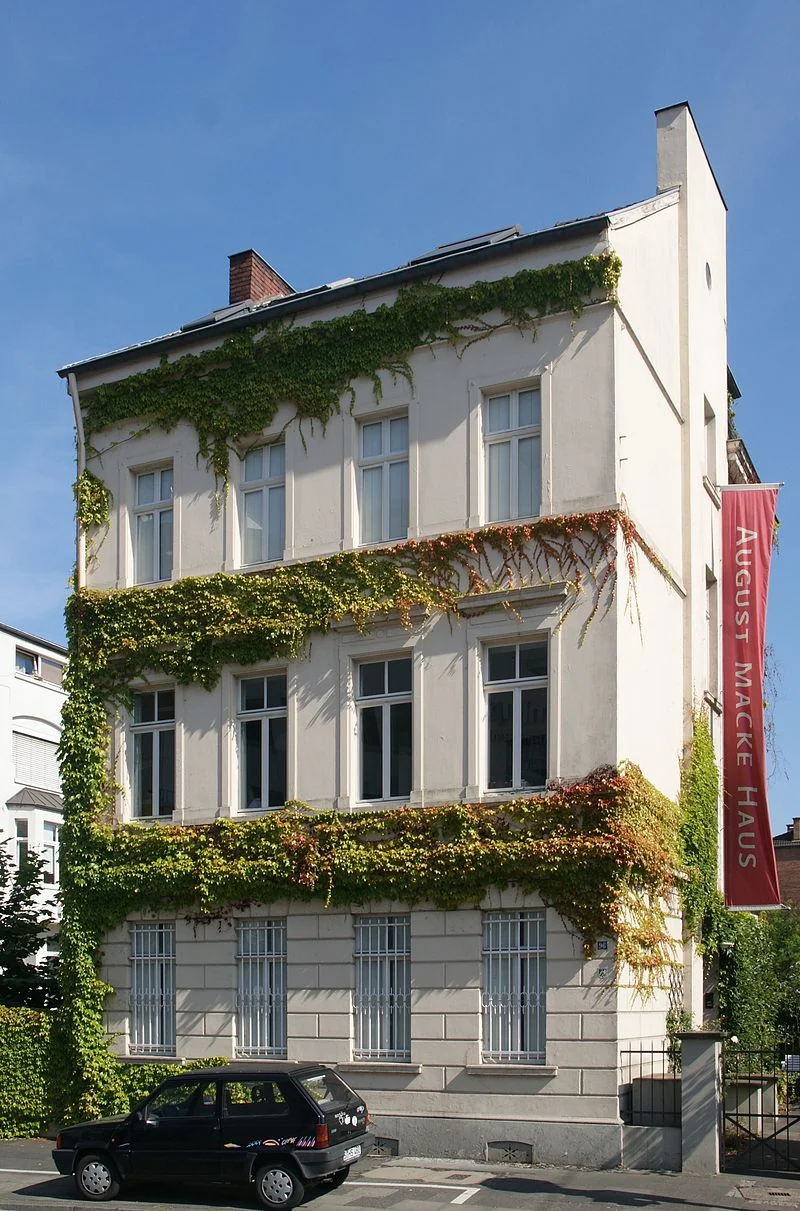
Hochstadenring 36, Bonn
Hochstadenring 36, 53119 Bonn, Germany
Museum August Macke Haus | Tickets & Opening Hours
The Museum August Macke Haus in Bonn is not an ordinary city museum, but an authentic memorial site dedicated to one of the most significant German artists of the early 20th century. Visitors to the house at Hochstadenring 36 experience not only artworks and documents but also the atmosphere of a former residential and studio house closely connected to the life of August Macke and his family. Today, the museum combines historical spaces, modern architecture, a vibrant exhibition concept, and practical visitor services into a comprehensive experience that is equally attractive to art enthusiasts, families, school classes, and visitors to Bonn. The mix of biography, expressionism, garden, café, shop, and changing special exhibitions makes this location one of the most exciting addresses in northern Bonn. Particularly appealing is the fact that the museum is situated in a house where Macke himself lived and worked, while the extension has created additional spaces for education, events, and research. This results in a place that not only tells history but also makes it spatially tangible. ([august-macke-haus.de](https://www.august-macke-haus.de/en/museum/about-us/))
Tickets, Opening Hours, and Admission Prices
For good visit planning, the current opening hours and admission prices are particularly important. The museum is open on Wednesdays from 11 AM to 5 PM, Thursdays from 11 AM to 7 PM, and Fridays, Saturdays, Sundays, and public holidays from 11 AM to 5 PM. Additionally, the museum notes closure days on Christmas Eve, December 25, January 1, and Carnival Thursday. These clear times are an advantage because they allow for easy integration of the visit into a stay in Bonn, a family outing, or an art day with multiple stops. Thursday is particularly suitable for a longer stay, as the house remains open until 7 PM and is therefore easily accessible after a city tour or workday. The opening hours make the museum predictable without relying on an unclear special regulation. For many visitors, it is also helpful that the museum has a fixed rhythm that provides security in travel planning. ([august-macke-haus.de](https://www.august-macke-haus.de/en/visit/opening-hours-prices/))
The admission prices are clearly structured and oriented towards different target groups. Adults pay 12 euros, reduced 9 euros. Children and teenagers between 7 and 18 years pay 6 euros, and children up to 6 years have free admission. The family ticket costs 24 euros, school groups up to 18 years pay 4 euros per person, and groups of ten or more also receive discounted conditions. Particularly attractive is the Happy Hour on Thursdays after 4 PM, when admission for all visitors costs 5 euros. The admission includes an audio guide for the artist's house, which adds value to the visit and is especially useful for first-time visitors. The museum also offers a range of discounts for students, trainees, people with disabilities, unemployed individuals, and various cultural cards. This pricing policy shows that the house aims for broad, inclusive access and is not only targeted at traditional museum visitors. Those coming with children can also purchase an explorer booklet and colored pencils to accompany the tour playfully. ([august-macke-haus.de](https://www.august-macke-haus.de/en/visit/opening-hours-prices/))
Directions and Parking in Bonn
The Museum August Macke Haus is located in northern Bonn and is easily accessible by public transport as well as by car. From Bonn Central Station, bus line 602 goes to Eifelstraße/August Macke Haus, and lines 604 and 605 go to the Kunstverein/Frankenbad stop. Visitors can reach the museum by tram via lines 16, 18, and 63 towards Cologne to Bonn-West/August Macke Haus. This connection is practical for guests arriving without a car or wanting to combine their museum day with other stops in the city center. Those coming from Bonn Central Station find a direct and understandable connection. This is also helpful for tourists, as the journey is not complicated and the museum remains well integrated into urban mobility. The address for the navigation device is Hochstadenring 36 in Bonn, which additionally facilitates orientation. ([august-macke-haus.de](https://www.august-macke-haus.de/besuch/anfahrt-parken/))
For those arriving by car, the museum can be reached via several highway routes, depending on the direction of travel. From Koblenz and the south, the Bonn-Endenich exit on the A565 is relevant, from Cologne the Bonn-Centrum exit on the A555/565, and from the Ruhr area or coming from Frankfurt, the route goes via A59/A565. There is a parking lot directly at the museum on Bornheimer Straße 98–100, but its capacity is limited. There is also a disabled parking space available there. It is important to note that the parking lot is currently only accessible via Eifelstraße and Bornheimer Straße due to a major construction project. Additionally, the Stadthaus garage on Weiherstraße and the DB parking garage Bonn-City at the Old Cemetery are nearby, both available all day. For visitors, this means that even if the museum parking lot is small, there are practical alternatives in the vicinity, and the visit can be easily combined with a short walk. ([august-macke-haus.de](https://www.august-macke-haus.de/besuch/anfahrt-parken/))
History of the House and August Macke
The historical depth of the Museum August Macke Haus is one of the most important reasons why the visit is so impressive. The building was the former residential and studio house of August Macke, one of the most significant and popular German artists of the early 20th century. Macke lived here with his family from early 1911 until August 1914, during his most productive years. Bonn had been the center of his life since 1900, and in 1903 he met the then 15-year-old Elisabeth Gerhardt, his later wife, in the city. When the young family returned to Bonn in the autumn of 1910, Elisabeth's family provided them with the house at the corner of Bornheimer Straße and Hochstadenring as their new home. The building itself was constructed in 1877/78, later acquired with the property, and remodeled by Macke in his sense. This biographical anchoring is central to the museum visit because it makes the place understandable not only as an exhibition space but also as a living space of an artist. ([august-macke-haus.de](https://www.august-macke-haus.de/en/august-macke/wohn-und-atelierhaus/))
Particularly exciting is the spatial development of the house. The attic was converted into a bright studio according to Macke's plans in the winter of 1910/11. For this, the roof shape was changed, windows were added on both sides and as skylights, creating a space of about 40 square meters with optimal lighting conditions. Many of his most famous works were created in this studio, including paintings with views from the windows onto the immediate surroundings. Together with his friend Franz Marc, Macke also painted the programmatic mural Paradise in the studio in the autumn of 1912. The family's living situation was open and hospitable; the house became a meeting point for the young Rhineland art scene and a starting point for Macke's art-political engagement. Today, those who walk through the rooms can still sense this productive atmosphere, even though the house has been prepared for museum purposes. The visit thus not only showcases individual paintings but also illustrates how much living space, studio, family, and artistic development intertwined for Macke. ([august-macke-haus.de](https://www.august-macke-haus.de/en/august-macke/wohn-und-atelierhaus/))
After Macke's early death in World War I, the house remained part of the family history. Elisabeth Macke lived there with her second husband Lothar Erdmann and their children until 1925, after which the building was mainly rented out. In the 1980s, there was even a proposal to convert it into a restaurant, but civic engagement prevented the demolition. In 1989, the city of Bonn was able to acquire the house, and in 1991 it was opened to visitors after restoration. Over eighty special exhibitions on August Macke and his artistic environment, especially on Rhineland Expressionism, solidified the reputation of the house. In 2010/11, the building was extensively renovated, and between 2015 and 2017, a modern extension was added, which was opened as the Museum August Macke Haus on December 3, 2017. Since early 2019, the Museum August Macke Haus gGmbH has operated the house together with the association and the foundation as shareholders. This development shows how a threatened historical building has become a professionally managed art museum. ([august-macke-haus.de](https://www.august-macke-haus.de/en/august-macke/wohn-und-atelierhaus/))
Exhibitions, Collection, and Research
The Museum August Macke Haus sees itself not only as a memorial site but also as a research and exhibition institution. According to its official self-presentation, the house preserves the memory and work of August Macke and the Rhineland Expressionists, researches the relevant topics, and conveys them through special exhibitions and events. To this end, the museum collects works and documents by August Macke and his artistic environment and maintains an archive and a library. Particularly important is that the 2017 extension has expanded the house to 14 rooms, allowing for a significantly more comprehensive and thematically structured presentation today. Visitors thus see not only individual paintings but also a content-structured biography and art exhibition that places the artist in his historical context. This is of interest to anyone who is curious about the connection between work, contemporary history, and artistic networks. The combination of collection, research, and education makes the house a place that goes far beyond a classic memorial. ([august-macke-haus.de](https://www.august-macke-haus.de/en/museum/about-us/))
Currently, the museum is showing the special exhibition Modernist Visions – August Macke and Max Ernst from April 2 to August 23, 2026. The exhibition is conceived on the occasion of the 50th anniversary of Max Ernst's death and highlights his early artistic beginnings in the context of Rhineland Expressionism as well as his close connections to August Macke. According to the museum, Max Ernst was a regular guest at the Bonn house and exhibited for the first time in 1913 in an exhibition of the Rhineland Expressionists organized by Macke. The exhibition brings together around 80 works, including paintings, graphics, sketches, sculptures, photographs, and contemporary documents. A special focus is on Luise Straus and Elisabeth Gerhardt as central female figures in the artists' environment. Thus, the museum also fulfills its claim in 2026 to tell historical content from new perspectives and not just repeat a fixed memorial image. Those looking for exhibitions, current programs, or a lively museum visit will find a compelling reason to visit here. ([august-macke-haus.de](https://www.august-macke-haus.de/en/ausstellungen/sonderausstellung/))
Accessibility and Practical Services
A major advantage of the museum is its accessibility. The Museum August Macke Haus is fully accessible for wheelchair users; all levels and rooms can be accessed with a wheelchair or walker. A wheelchair is available for free at the ticket counter, and it can be reserved in advance by phone or email if needed. In all exhibition rooms, folding chairs or fixed seating are available, making the visit significantly more pleasant for people with limited endurance. The accessible restroom and cloakroom are also easily reachable in the basement. Additionally, appropriately marked guide dogs and assistance dogs are allowed in the museum. For visitors with mobility impairments, it is also important that there is a disabled parking space at the museum parking lot on Bornheimer Straße 98–100. This ensures that the house offers thoughtful, practical accessibility that is not only formally present but genuinely useful in everyday life. This is particularly remarkable and enhances the visit, especially in a house with historical rooms and an extension. ([august-macke-haus.de](https://www.august-macke-haus.de/en/visit/barrierefreiheit/))
Practical services also include the additional rooms in the extension that make the museum visit comfortable. These include reception areas, rooms for special exhibitions and events, museum education, a library, a shop, and a café. The museum is thus not only a place for viewing but also for lingering, learning, and exchanging ideas. The accessible layout and functional extension are directly related: they ensure that the historic residential house is not overloaded while remaining open and accessible. In museum practice, this is a real advantage because visitor flows are distributed, and at the same time, more quality of stay is created. Therefore, those looking for a relaxed museum visit will find clear structures instead of narrow, improvised paths. This is relevant for older visitors, families with strollers, and groups as well as for people with special needs. ([august-macke-haus.de](https://www.august-macke-haus.de/en/museum/about-us/))
Museum Café, Shop, and Visitor Experience
The museum café and shop pleasantly round off the visit. The café on the ground floor offers more than 35 indoor seats and 12 seats on the garden terrace. Cakes, coffee and tea specialties, and refreshing drinks are served. The café's opening hours are Wednesdays from 12 PM to 5:30 PM, Thursdays from 12 PM to 5:30 PM, Fridays from 12 PM to 4:30 PM, and Saturdays and Sundays from 11 AM to 4:30 PM. It is particularly pleasant that the café can also be visited without a museum visit. The museum garden has been designed in reference to Macke's garden paintings and recalls the former extensive garden behind his house. This creates a quiet place in the middle of Bonn that continues the art theme not only in the exhibition rooms but also outside. Those wishing to combine their museum visit with a break will find here more than just a classic bistro: it is an atmospheric space that invites reflection and relaxation. ([august-macke-haus.de](https://www.august-macke-haus.de/en/visit/museumscafe/))
The museum shop is also well integrated into the visit. It is located on the ground floor next to the ticket counter and gastronomy and offers literature, postcards, art prints, catalogs, publications, and posters for special exhibitions as well as selected toys, children's books, art supplies, stationery, gifts, and handicrafts. For visitors looking for a souvenir or an interesting book, this is a meaningful conclusion to the tour. In combination with the audio guide, the explorer booklet for children, and the accessible layout, a very accessible visitor experience is created. Families particularly benefit from the fact that the house is not only aesthetically pleasing but also well thought out didactically. The explorer booklet with colored pencils playfully guides children through the rooms and ensures a low-threshold approach to August Macke. Thus, the museum combines art education, quality of stay, and service at a level that makes the location in Bonn particularly distinctive. Those looking for a museum with history, atmosphere, and practical visitor friendliness will find a harmonious combination here. ([august-macke-haus.de](https://www.august-macke-haus.de/en/visit/museumsshop/))
Sources:
- Museum August Macke Haus - About us
- Museum August Macke Haus - Home and Studio
- Museum August Macke Haus - Opening Hours & Prices
- Museum August Macke Haus - Directions & Parking
- Museum August Macke Haus - Wheelchair Accessibility
- Museum August Macke Haus - Museum Café
- Museum August Macke Haus - Museum Shop
- Museum August Macke Haus - Special Exhibition
- Museum August Macke Haus - Foundation
Show moreShow less
Museum August Macke Haus | Tickets & Opening Hours
The Museum August Macke Haus in Bonn is not an ordinary city museum, but an authentic memorial site dedicated to one of the most significant German artists of the early 20th century. Visitors to the house at Hochstadenring 36 experience not only artworks and documents but also the atmosphere of a former residential and studio house closely connected to the life of August Macke and his family. Today, the museum combines historical spaces, modern architecture, a vibrant exhibition concept, and practical visitor services into a comprehensive experience that is equally attractive to art enthusiasts, families, school classes, and visitors to Bonn. The mix of biography, expressionism, garden, café, shop, and changing special exhibitions makes this location one of the most exciting addresses in northern Bonn. Particularly appealing is the fact that the museum is situated in a house where Macke himself lived and worked, while the extension has created additional spaces for education, events, and research. This results in a place that not only tells history but also makes it spatially tangible. ([august-macke-haus.de](https://www.august-macke-haus.de/en/museum/about-us/))
Tickets, Opening Hours, and Admission Prices
For good visit planning, the current opening hours and admission prices are particularly important. The museum is open on Wednesdays from 11 AM to 5 PM, Thursdays from 11 AM to 7 PM, and Fridays, Saturdays, Sundays, and public holidays from 11 AM to 5 PM. Additionally, the museum notes closure days on Christmas Eve, December 25, January 1, and Carnival Thursday. These clear times are an advantage because they allow for easy integration of the visit into a stay in Bonn, a family outing, or an art day with multiple stops. Thursday is particularly suitable for a longer stay, as the house remains open until 7 PM and is therefore easily accessible after a city tour or workday. The opening hours make the museum predictable without relying on an unclear special regulation. For many visitors, it is also helpful that the museum has a fixed rhythm that provides security in travel planning. ([august-macke-haus.de](https://www.august-macke-haus.de/en/visit/opening-hours-prices/))
The admission prices are clearly structured and oriented towards different target groups. Adults pay 12 euros, reduced 9 euros. Children and teenagers between 7 and 18 years pay 6 euros, and children up to 6 years have free admission. The family ticket costs 24 euros, school groups up to 18 years pay 4 euros per person, and groups of ten or more also receive discounted conditions. Particularly attractive is the Happy Hour on Thursdays after 4 PM, when admission for all visitors costs 5 euros. The admission includes an audio guide for the artist's house, which adds value to the visit and is especially useful for first-time visitors. The museum also offers a range of discounts for students, trainees, people with disabilities, unemployed individuals, and various cultural cards. This pricing policy shows that the house aims for broad, inclusive access and is not only targeted at traditional museum visitors. Those coming with children can also purchase an explorer booklet and colored pencils to accompany the tour playfully. ([august-macke-haus.de](https://www.august-macke-haus.de/en/visit/opening-hours-prices/))
Directions and Parking in Bonn
The Museum August Macke Haus is located in northern Bonn and is easily accessible by public transport as well as by car. From Bonn Central Station, bus line 602 goes to Eifelstraße/August Macke Haus, and lines 604 and 605 go to the Kunstverein/Frankenbad stop. Visitors can reach the museum by tram via lines 16, 18, and 63 towards Cologne to Bonn-West/August Macke Haus. This connection is practical for guests arriving without a car or wanting to combine their museum day with other stops in the city center. Those coming from Bonn Central Station find a direct and understandable connection. This is also helpful for tourists, as the journey is not complicated and the museum remains well integrated into urban mobility. The address for the navigation device is Hochstadenring 36 in Bonn, which additionally facilitates orientation. ([august-macke-haus.de](https://www.august-macke-haus.de/besuch/anfahrt-parken/))
For those arriving by car, the museum can be reached via several highway routes, depending on the direction of travel. From Koblenz and the south, the Bonn-Endenich exit on the A565 is relevant, from Cologne the Bonn-Centrum exit on the A555/565, and from the Ruhr area or coming from Frankfurt, the route goes via A59/A565. There is a parking lot directly at the museum on Bornheimer Straße 98–100, but its capacity is limited. There is also a disabled parking space available there. It is important to note that the parking lot is currently only accessible via Eifelstraße and Bornheimer Straße due to a major construction project. Additionally, the Stadthaus garage on Weiherstraße and the DB parking garage Bonn-City at the Old Cemetery are nearby, both available all day. For visitors, this means that even if the museum parking lot is small, there are practical alternatives in the vicinity, and the visit can be easily combined with a short walk. ([august-macke-haus.de](https://www.august-macke-haus.de/besuch/anfahrt-parken/))
History of the House and August Macke
The historical depth of the Museum August Macke Haus is one of the most important reasons why the visit is so impressive. The building was the former residential and studio house of August Macke, one of the most significant and popular German artists of the early 20th century. Macke lived here with his family from early 1911 until August 1914, during his most productive years. Bonn had been the center of his life since 1900, and in 1903 he met the then 15-year-old Elisabeth Gerhardt, his later wife, in the city. When the young family returned to Bonn in the autumn of 1910, Elisabeth's family provided them with the house at the corner of Bornheimer Straße and Hochstadenring as their new home. The building itself was constructed in 1877/78, later acquired with the property, and remodeled by Macke in his sense. This biographical anchoring is central to the museum visit because it makes the place understandable not only as an exhibition space but also as a living space of an artist. ([august-macke-haus.de](https://www.august-macke-haus.de/en/august-macke/wohn-und-atelierhaus/))
Particularly exciting is the spatial development of the house. The attic was converted into a bright studio according to Macke's plans in the winter of 1910/11. For this, the roof shape was changed, windows were added on both sides and as skylights, creating a space of about 40 square meters with optimal lighting conditions. Many of his most famous works were created in this studio, including paintings with views from the windows onto the immediate surroundings. Together with his friend Franz Marc, Macke also painted the programmatic mural Paradise in the studio in the autumn of 1912. The family's living situation was open and hospitable; the house became a meeting point for the young Rhineland art scene and a starting point for Macke's art-political engagement. Today, those who walk through the rooms can still sense this productive atmosphere, even though the house has been prepared for museum purposes. The visit thus not only showcases individual paintings but also illustrates how much living space, studio, family, and artistic development intertwined for Macke. ([august-macke-haus.de](https://www.august-macke-haus.de/en/august-macke/wohn-und-atelierhaus/))
After Macke's early death in World War I, the house remained part of the family history. Elisabeth Macke lived there with her second husband Lothar Erdmann and their children until 1925, after which the building was mainly rented out. In the 1980s, there was even a proposal to convert it into a restaurant, but civic engagement prevented the demolition. In 1989, the city of Bonn was able to acquire the house, and in 1991 it was opened to visitors after restoration. Over eighty special exhibitions on August Macke and his artistic environment, especially on Rhineland Expressionism, solidified the reputation of the house. In 2010/11, the building was extensively renovated, and between 2015 and 2017, a modern extension was added, which was opened as the Museum August Macke Haus on December 3, 2017. Since early 2019, the Museum August Macke Haus gGmbH has operated the house together with the association and the foundation as shareholders. This development shows how a threatened historical building has become a professionally managed art museum. ([august-macke-haus.de](https://www.august-macke-haus.de/en/august-macke/wohn-und-atelierhaus/))
Exhibitions, Collection, and Research
The Museum August Macke Haus sees itself not only as a memorial site but also as a research and exhibition institution. According to its official self-presentation, the house preserves the memory and work of August Macke and the Rhineland Expressionists, researches the relevant topics, and conveys them through special exhibitions and events. To this end, the museum collects works and documents by August Macke and his artistic environment and maintains an archive and a library. Particularly important is that the 2017 extension has expanded the house to 14 rooms, allowing for a significantly more comprehensive and thematically structured presentation today. Visitors thus see not only individual paintings but also a content-structured biography and art exhibition that places the artist in his historical context. This is of interest to anyone who is curious about the connection between work, contemporary history, and artistic networks. The combination of collection, research, and education makes the house a place that goes far beyond a classic memorial. ([august-macke-haus.de](https://www.august-macke-haus.de/en/museum/about-us/))
Currently, the museum is showing the special exhibition Modernist Visions – August Macke and Max Ernst from April 2 to August 23, 2026. The exhibition is conceived on the occasion of the 50th anniversary of Max Ernst's death and highlights his early artistic beginnings in the context of Rhineland Expressionism as well as his close connections to August Macke. According to the museum, Max Ernst was a regular guest at the Bonn house and exhibited for the first time in 1913 in an exhibition of the Rhineland Expressionists organized by Macke. The exhibition brings together around 80 works, including paintings, graphics, sketches, sculptures, photographs, and contemporary documents. A special focus is on Luise Straus and Elisabeth Gerhardt as central female figures in the artists' environment. Thus, the museum also fulfills its claim in 2026 to tell historical content from new perspectives and not just repeat a fixed memorial image. Those looking for exhibitions, current programs, or a lively museum visit will find a compelling reason to visit here. ([august-macke-haus.de](https://www.august-macke-haus.de/en/ausstellungen/sonderausstellung/))
Accessibility and Practical Services
A major advantage of the museum is its accessibility. The Museum August Macke Haus is fully accessible for wheelchair users; all levels and rooms can be accessed with a wheelchair or walker. A wheelchair is available for free at the ticket counter, and it can be reserved in advance by phone or email if needed. In all exhibition rooms, folding chairs or fixed seating are available, making the visit significantly more pleasant for people with limited endurance. The accessible restroom and cloakroom are also easily reachable in the basement. Additionally, appropriately marked guide dogs and assistance dogs are allowed in the museum. For visitors with mobility impairments, it is also important that there is a disabled parking space at the museum parking lot on Bornheimer Straße 98–100. This ensures that the house offers thoughtful, practical accessibility that is not only formally present but genuinely useful in everyday life. This is particularly remarkable and enhances the visit, especially in a house with historical rooms and an extension. ([august-macke-haus.de](https://www.august-macke-haus.de/en/visit/barrierefreiheit/))
Practical services also include the additional rooms in the extension that make the museum visit comfortable. These include reception areas, rooms for special exhibitions and events, museum education, a library, a shop, and a café. The museum is thus not only a place for viewing but also for lingering, learning, and exchanging ideas. The accessible layout and functional extension are directly related: they ensure that the historic residential house is not overloaded while remaining open and accessible. In museum practice, this is a real advantage because visitor flows are distributed, and at the same time, more quality of stay is created. Therefore, those looking for a relaxed museum visit will find clear structures instead of narrow, improvised paths. This is relevant for older visitors, families with strollers, and groups as well as for people with special needs. ([august-macke-haus.de](https://www.august-macke-haus.de/en/museum/about-us/))
Museum Café, Shop, and Visitor Experience
The museum café and shop pleasantly round off the visit. The café on the ground floor offers more than 35 indoor seats and 12 seats on the garden terrace. Cakes, coffee and tea specialties, and refreshing drinks are served. The café's opening hours are Wednesdays from 12 PM to 5:30 PM, Thursdays from 12 PM to 5:30 PM, Fridays from 12 PM to 4:30 PM, and Saturdays and Sundays from 11 AM to 4:30 PM. It is particularly pleasant that the café can also be visited without a museum visit. The museum garden has been designed in reference to Macke's garden paintings and recalls the former extensive garden behind his house. This creates a quiet place in the middle of Bonn that continues the art theme not only in the exhibition rooms but also outside. Those wishing to combine their museum visit with a break will find here more than just a classic bistro: it is an atmospheric space that invites reflection and relaxation. ([august-macke-haus.de](https://www.august-macke-haus.de/en/visit/museumscafe/))
The museum shop is also well integrated into the visit. It is located on the ground floor next to the ticket counter and gastronomy and offers literature, postcards, art prints, catalogs, publications, and posters for special exhibitions as well as selected toys, children's books, art supplies, stationery, gifts, and handicrafts. For visitors looking for a souvenir or an interesting book, this is a meaningful conclusion to the tour. In combination with the audio guide, the explorer booklet for children, and the accessible layout, a very accessible visitor experience is created. Families particularly benefit from the fact that the house is not only aesthetically pleasing but also well thought out didactically. The explorer booklet with colored pencils playfully guides children through the rooms and ensures a low-threshold approach to August Macke. Thus, the museum combines art education, quality of stay, and service at a level that makes the location in Bonn particularly distinctive. Those looking for a museum with history, atmosphere, and practical visitor friendliness will find a harmonious combination here. ([august-macke-haus.de](https://www.august-macke-haus.de/en/visit/museumsshop/))
Sources:
- Museum August Macke Haus - About us
- Museum August Macke Haus - Home and Studio
- Museum August Macke Haus - Opening Hours & Prices
- Museum August Macke Haus - Directions & Parking
- Museum August Macke Haus - Wheelchair Accessibility
- Museum August Macke Haus - Museum Café
- Museum August Macke Haus - Museum Shop
- Museum August Macke Haus - Special Exhibition
- Museum August Macke Haus - Foundation
Museum August Macke Haus | Tickets & Opening Hours
The Museum August Macke Haus in Bonn is not an ordinary city museum, but an authentic memorial site dedicated to one of the most significant German artists of the early 20th century. Visitors to the house at Hochstadenring 36 experience not only artworks and documents but also the atmosphere of a former residential and studio house closely connected to the life of August Macke and his family. Today, the museum combines historical spaces, modern architecture, a vibrant exhibition concept, and practical visitor services into a comprehensive experience that is equally attractive to art enthusiasts, families, school classes, and visitors to Bonn. The mix of biography, expressionism, garden, café, shop, and changing special exhibitions makes this location one of the most exciting addresses in northern Bonn. Particularly appealing is the fact that the museum is situated in a house where Macke himself lived and worked, while the extension has created additional spaces for education, events, and research. This results in a place that not only tells history but also makes it spatially tangible. ([august-macke-haus.de](https://www.august-macke-haus.de/en/museum/about-us/))
Tickets, Opening Hours, and Admission Prices
For good visit planning, the current opening hours and admission prices are particularly important. The museum is open on Wednesdays from 11 AM to 5 PM, Thursdays from 11 AM to 7 PM, and Fridays, Saturdays, Sundays, and public holidays from 11 AM to 5 PM. Additionally, the museum notes closure days on Christmas Eve, December 25, January 1, and Carnival Thursday. These clear times are an advantage because they allow for easy integration of the visit into a stay in Bonn, a family outing, or an art day with multiple stops. Thursday is particularly suitable for a longer stay, as the house remains open until 7 PM and is therefore easily accessible after a city tour or workday. The opening hours make the museum predictable without relying on an unclear special regulation. For many visitors, it is also helpful that the museum has a fixed rhythm that provides security in travel planning. ([august-macke-haus.de](https://www.august-macke-haus.de/en/visit/opening-hours-prices/))
The admission prices are clearly structured and oriented towards different target groups. Adults pay 12 euros, reduced 9 euros. Children and teenagers between 7 and 18 years pay 6 euros, and children up to 6 years have free admission. The family ticket costs 24 euros, school groups up to 18 years pay 4 euros per person, and groups of ten or more also receive discounted conditions. Particularly attractive is the Happy Hour on Thursdays after 4 PM, when admission for all visitors costs 5 euros. The admission includes an audio guide for the artist's house, which adds value to the visit and is especially useful for first-time visitors. The museum also offers a range of discounts for students, trainees, people with disabilities, unemployed individuals, and various cultural cards. This pricing policy shows that the house aims for broad, inclusive access and is not only targeted at traditional museum visitors. Those coming with children can also purchase an explorer booklet and colored pencils to accompany the tour playfully. ([august-macke-haus.de](https://www.august-macke-haus.de/en/visit/opening-hours-prices/))
Directions and Parking in Bonn
The Museum August Macke Haus is located in northern Bonn and is easily accessible by public transport as well as by car. From Bonn Central Station, bus line 602 goes to Eifelstraße/August Macke Haus, and lines 604 and 605 go to the Kunstverein/Frankenbad stop. Visitors can reach the museum by tram via lines 16, 18, and 63 towards Cologne to Bonn-West/August Macke Haus. This connection is practical for guests arriving without a car or wanting to combine their museum day with other stops in the city center. Those coming from Bonn Central Station find a direct and understandable connection. This is also helpful for tourists, as the journey is not complicated and the museum remains well integrated into urban mobility. The address for the navigation device is Hochstadenring 36 in Bonn, which additionally facilitates orientation. ([august-macke-haus.de](https://www.august-macke-haus.de/besuch/anfahrt-parken/))
For those arriving by car, the museum can be reached via several highway routes, depending on the direction of travel. From Koblenz and the south, the Bonn-Endenich exit on the A565 is relevant, from Cologne the Bonn-Centrum exit on the A555/565, and from the Ruhr area or coming from Frankfurt, the route goes via A59/A565. There is a parking lot directly at the museum on Bornheimer Straße 98–100, but its capacity is limited. There is also a disabled parking space available there. It is important to note that the parking lot is currently only accessible via Eifelstraße and Bornheimer Straße due to a major construction project. Additionally, the Stadthaus garage on Weiherstraße and the DB parking garage Bonn-City at the Old Cemetery are nearby, both available all day. For visitors, this means that even if the museum parking lot is small, there are practical alternatives in the vicinity, and the visit can be easily combined with a short walk. ([august-macke-haus.de](https://www.august-macke-haus.de/besuch/anfahrt-parken/))
History of the House and August Macke
The historical depth of the Museum August Macke Haus is one of the most important reasons why the visit is so impressive. The building was the former residential and studio house of August Macke, one of the most significant and popular German artists of the early 20th century. Macke lived here with his family from early 1911 until August 1914, during his most productive years. Bonn had been the center of his life since 1900, and in 1903 he met the then 15-year-old Elisabeth Gerhardt, his later wife, in the city. When the young family returned to Bonn in the autumn of 1910, Elisabeth's family provided them with the house at the corner of Bornheimer Straße and Hochstadenring as their new home. The building itself was constructed in 1877/78, later acquired with the property, and remodeled by Macke in his sense. This biographical anchoring is central to the museum visit because it makes the place understandable not only as an exhibition space but also as a living space of an artist. ([august-macke-haus.de](https://www.august-macke-haus.de/en/august-macke/wohn-und-atelierhaus/))
Particularly exciting is the spatial development of the house. The attic was converted into a bright studio according to Macke's plans in the winter of 1910/11. For this, the roof shape was changed, windows were added on both sides and as skylights, creating a space of about 40 square meters with optimal lighting conditions. Many of his most famous works were created in this studio, including paintings with views from the windows onto the immediate surroundings. Together with his friend Franz Marc, Macke also painted the programmatic mural Paradise in the studio in the autumn of 1912. The family's living situation was open and hospitable; the house became a meeting point for the young Rhineland art scene and a starting point for Macke's art-political engagement. Today, those who walk through the rooms can still sense this productive atmosphere, even though the house has been prepared for museum purposes. The visit thus not only showcases individual paintings but also illustrates how much living space, studio, family, and artistic development intertwined for Macke. ([august-macke-haus.de](https://www.august-macke-haus.de/en/august-macke/wohn-und-atelierhaus/))
After Macke's early death in World War I, the house remained part of the family history. Elisabeth Macke lived there with her second husband Lothar Erdmann and their children until 1925, after which the building was mainly rented out. In the 1980s, there was even a proposal to convert it into a restaurant, but civic engagement prevented the demolition. In 1989, the city of Bonn was able to acquire the house, and in 1991 it was opened to visitors after restoration. Over eighty special exhibitions on August Macke and his artistic environment, especially on Rhineland Expressionism, solidified the reputation of the house. In 2010/11, the building was extensively renovated, and between 2015 and 2017, a modern extension was added, which was opened as the Museum August Macke Haus on December 3, 2017. Since early 2019, the Museum August Macke Haus gGmbH has operated the house together with the association and the foundation as shareholders. This development shows how a threatened historical building has become a professionally managed art museum. ([august-macke-haus.de](https://www.august-macke-haus.de/en/august-macke/wohn-und-atelierhaus/))
Exhibitions, Collection, and Research
The Museum August Macke Haus sees itself not only as a memorial site but also as a research and exhibition institution. According to its official self-presentation, the house preserves the memory and work of August Macke and the Rhineland Expressionists, researches the relevant topics, and conveys them through special exhibitions and events. To this end, the museum collects works and documents by August Macke and his artistic environment and maintains an archive and a library. Particularly important is that the 2017 extension has expanded the house to 14 rooms, allowing for a significantly more comprehensive and thematically structured presentation today. Visitors thus see not only individual paintings but also a content-structured biography and art exhibition that places the artist in his historical context. This is of interest to anyone who is curious about the connection between work, contemporary history, and artistic networks. The combination of collection, research, and education makes the house a place that goes far beyond a classic memorial. ([august-macke-haus.de](https://www.august-macke-haus.de/en/museum/about-us/))
Currently, the museum is showing the special exhibition Modernist Visions – August Macke and Max Ernst from April 2 to August 23, 2026. The exhibition is conceived on the occasion of the 50th anniversary of Max Ernst's death and highlights his early artistic beginnings in the context of Rhineland Expressionism as well as his close connections to August Macke. According to the museum, Max Ernst was a regular guest at the Bonn house and exhibited for the first time in 1913 in an exhibition of the Rhineland Expressionists organized by Macke. The exhibition brings together around 80 works, including paintings, graphics, sketches, sculptures, photographs, and contemporary documents. A special focus is on Luise Straus and Elisabeth Gerhardt as central female figures in the artists' environment. Thus, the museum also fulfills its claim in 2026 to tell historical content from new perspectives and not just repeat a fixed memorial image. Those looking for exhibitions, current programs, or a lively museum visit will find a compelling reason to visit here. ([august-macke-haus.de](https://www.august-macke-haus.de/en/ausstellungen/sonderausstellung/))
Accessibility and Practical Services
A major advantage of the museum is its accessibility. The Museum August Macke Haus is fully accessible for wheelchair users; all levels and rooms can be accessed with a wheelchair or walker. A wheelchair is available for free at the ticket counter, and it can be reserved in advance by phone or email if needed. In all exhibition rooms, folding chairs or fixed seating are available, making the visit significantly more pleasant for people with limited endurance. The accessible restroom and cloakroom are also easily reachable in the basement. Additionally, appropriately marked guide dogs and assistance dogs are allowed in the museum. For visitors with mobility impairments, it is also important that there is a disabled parking space at the museum parking lot on Bornheimer Straße 98–100. This ensures that the house offers thoughtful, practical accessibility that is not only formally present but genuinely useful in everyday life. This is particularly remarkable and enhances the visit, especially in a house with historical rooms and an extension. ([august-macke-haus.de](https://www.august-macke-haus.de/en/visit/barrierefreiheit/))
Practical services also include the additional rooms in the extension that make the museum visit comfortable. These include reception areas, rooms for special exhibitions and events, museum education, a library, a shop, and a café. The museum is thus not only a place for viewing but also for lingering, learning, and exchanging ideas. The accessible layout and functional extension are directly related: they ensure that the historic residential house is not overloaded while remaining open and accessible. In museum practice, this is a real advantage because visitor flows are distributed, and at the same time, more quality of stay is created. Therefore, those looking for a relaxed museum visit will find clear structures instead of narrow, improvised paths. This is relevant for older visitors, families with strollers, and groups as well as for people with special needs. ([august-macke-haus.de](https://www.august-macke-haus.de/en/museum/about-us/))
Museum Café, Shop, and Visitor Experience
The museum café and shop pleasantly round off the visit. The café on the ground floor offers more than 35 indoor seats and 12 seats on the garden terrace. Cakes, coffee and tea specialties, and refreshing drinks are served. The café's opening hours are Wednesdays from 12 PM to 5:30 PM, Thursdays from 12 PM to 5:30 PM, Fridays from 12 PM to 4:30 PM, and Saturdays and Sundays from 11 AM to 4:30 PM. It is particularly pleasant that the café can also be visited without a museum visit. The museum garden has been designed in reference to Macke's garden paintings and recalls the former extensive garden behind his house. This creates a quiet place in the middle of Bonn that continues the art theme not only in the exhibition rooms but also outside. Those wishing to combine their museum visit with a break will find here more than just a classic bistro: it is an atmospheric space that invites reflection and relaxation. ([august-macke-haus.de](https://www.august-macke-haus.de/en/visit/museumscafe/))
The museum shop is also well integrated into the visit. It is located on the ground floor next to the ticket counter and gastronomy and offers literature, postcards, art prints, catalogs, publications, and posters for special exhibitions as well as selected toys, children's books, art supplies, stationery, gifts, and handicrafts. For visitors looking for a souvenir or an interesting book, this is a meaningful conclusion to the tour. In combination with the audio guide, the explorer booklet for children, and the accessible layout, a very accessible visitor experience is created. Families particularly benefit from the fact that the house is not only aesthetically pleasing but also well thought out didactically. The explorer booklet with colored pencils playfully guides children through the rooms and ensures a low-threshold approach to August Macke. Thus, the museum combines art education, quality of stay, and service at a level that makes the location in Bonn particularly distinctive. Those looking for a museum with history, atmosphere, and practical visitor friendliness will find a harmonious combination here. ([august-macke-haus.de](https://www.august-macke-haus.de/en/visit/museumsshop/))
Sources:
- Museum August Macke Haus - About us
- Museum August Macke Haus - Home and Studio
- Museum August Macke Haus - Opening Hours & Prices
- Museum August Macke Haus - Directions & Parking
- Museum August Macke Haus - Wheelchair Accessibility
- Museum August Macke Haus - Museum Café
- Museum August Macke Haus - Museum Shop
- Museum August Macke Haus - Special Exhibition
- Museum August Macke Haus - Foundation
Upcoming Events
No events found
Frequently Asked Questions
Reviews
Ece Aksoy
6. November 2025
Small collection in the museum. House a bit interesting.
Yifancy
19. August 2022
One of my favourite artist, August Macke. You will learn so many things about his family. By standing in the vivid paintings, you will feel him.
BCN Culinary Explorer
11. February 2018
Macke was essential part of my primary school education. His art is unique. The newly added building looks wonderful and probably explains an entrance fee of 9,50euros per adult. I could understand that some visitors might expect more. Short video about Macke`s life was insightful. Nice gift shop and small coffee place.
Peter Fransman
2. June 2019
We enjoyed the visit very much. The museum was very informative not only about Macke, but also about the era and the artistic circles of Macke and his time. Friendly staff and also a good temporary contemporary exhibition in relation wit the The Blaue Reiter group. We also admired the small but well maintained colourful. Worthwhile visiting!
Jayson Scott Grimes
2. November 2023
Really fascinating. The historic home is, in my opinion, more interesting than the exhibition space, but that's probably a matter of personal preference. The staff were all very nice.