
Bonn
Unnamed Road, 53225 Bonn, Deutschland
Mirecourtplatz | Beuel & Hans-Steger-Ufer
The Mirecourtplatz in Bonn-Beuel is not a classic event venue with a foyer, ticket counter, or fixed seating plan, but a public square by the Rhine, which is listed in municipal documents as a part area or square space. This is precisely what makes it so interesting for many search queries: Those searching for Mirecourtplatz Beuel, Mirecourtplatz Bonn, or Mirecourtstraße usually mean a place where city, river, movement, and local history come together directly. The square is located at Hans-Steger-Ufer, right in the middle of the Beuel Rhine promenade, and is used in everyday life as both a meeting point and a point of orientation. The fact that Mirecourtplatz today has its own name is no coincidence, but part of a longer German-French connection between Beuel and its partner city Mirecourt. Therefore, those who visit the place experience not only a piece of the Rhine but also a visible sign of communal memory culture. As an open space, the square is suitable for walks, starting tours, and short breaks by the water. For SEO logic, it is important: The name stands for a specific place in Bonn-Beuel, for its location by the Rhine, for the theme of town partnerships, and for its proximity to paths that lead along the river. The official classification as a square space also shows that it is a clearly defined public area, not an improvised site without reference. ([bonnorange.de](https://www.bonnorange.de/fileadmin/user_upload/downloads/sitzungen_verwaltungsrat/2026/A%C3%B6R-26014_Einladung-%C3%B6-kompakt.pdf))
Why is the square called Mirecourtplatz?
The name Mirecourtplatz is closely linked to the partnership between Beuel and Mirecourt, which is one of the most prominent municipal friendships in Bonn. According to the official information sheet of the Federal City of Bonn, the story began with a bell from the double church of Schwarzrheindorf, which was taken to France under Napoleon I at the beginning of the 19th century and eventually reached Mirecourt. In the 1960s, the connection was deepened: In 1964, a new bell was cast and consecrated in Mirecourt at the expense of the state of North Rhine-Westphalia, and in 1965, the bell Michael and Magdalena returned to Beuel along with six other new bronze bells. In 1969, the town partnership between the then still independent city of Beuel and Mirecourt was officially established. This official partnership is therefore not just a friendly name, but the result of a historical exchange process that connects religious, cultural, and civic levels. Additionally, partnership committees were established in Mirecourt in 1991 and in Beuel in 2000, which have since promoted the exchange. The 50th anniversary of the partnership was celebrated in 2019 in Beuel and Mirecourt; local city descriptions report that on this occasion, the rondel at Hans-Steger-Ufer was named Mirecourtplatz. Even though the square is small, it symbolically stands for a developed relationship that has been maintained over decades and still enables cultural encounters today. For a location page, this is particularly valuable because the name not only provides orientation but also emotional depth and recognizability. Thus, Mirecourtplatz is a place where local identity and European friendship become visible. ([bonn.de](https://www.bonn.de/medien-global/bezvst-beuel/FB_DEZI_Staedtepartnerschaft_WEB.pdf))
Location at Hans-Steger-Ufer and the connection to Mirecourtstraße
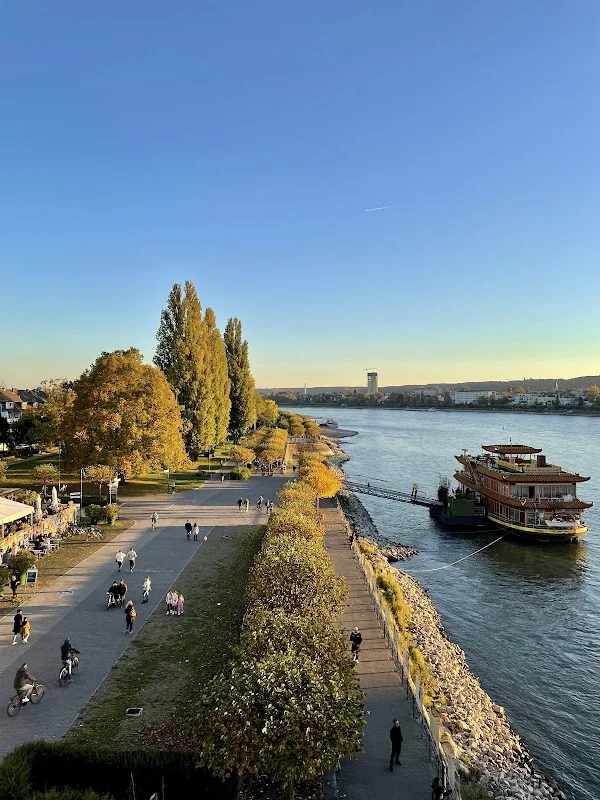
To understand Mirecourtplatz, one must consider its location by the water. The square is located at Hans-Steger-Ufer on the Beuel Rhine promenade, making it one of the most pleasant public spaces on the right bank of the Rhine. Local city descriptions place Hans-Steger-Ufer between Steinerstraße and Friedrich-Breuer-Straße; thus, Mirecourtplatz is situated in an urban yet open environment that is clearly shaped by the river. In practice, this means: The square is more of a river point than a closed square facility, more a place of arrival than a location with a fixed event operation. This is also reflected in municipal cleaning and street documents, where Mirecourtplatz is listed as its own square space or rondel. For the keyword strategy, Mirecourtstraße is additionally relevant, as it also belongs to this Beuel environment and appears in municipal street directories as its own street section. This creates a clear thematic cluster around Mirecourtplatz, Hans-Steger-Ufer, and Mirecourtstraße. In users' search intent, it is usually about spatial proximity, path guidance, orientation, and the question of what one actually finds in this part of the Rhine shore. The answer is: a public riverside place that invites movement and carries a name with history. The square is not a closed district or an indoor object, but part of the urban open space of Beuel-Mitte. This makes it interesting for both walks and occasional events, as the river here does not appear unwelcoming but functions as an open transition between the city and the Rhine. Local descriptions also mention a tiered seating area in an amphitheater-like shape, which underscores the quality of stay at the rondel and explains why the place is perceived as a meeting point. ([bonn.wiki](https://bonn.wiki/wiki/Hans-Steger-Ufer?utm_source=openai))
Events, walks, and culture around the square
The Mirecourtplatz is particularly interesting because it exists in Bonn not only as a name but also regularly appears in public events. The city of Bonn names the square as the starting point of the Three Bridges Run; there, the route begins at the Beueler Hans-Steger-Ufer and leads along the Rhine over the southern bridge, across the Bonn side, and back over the Kennedy Bridge. The family bike tour Kidical Mass also starts, according to the city's event calendar, in Beuel at Mirecourtplatz. The University of Bonn, in turn, uses the place as a meeting point for its Rhine pebble tours along the Rhine, which start at the riverside in Beuel at Mirecourtplatz or at the rondel and for which there is a limited number of places. This use shows how flexibly a public square can function: not as a rigid event hall, but as an open starting and gathering point that is easily accessible and suitable for walks, learning formats, sports events, and family activities. For visitors, this is important because the Mirecourtplatz thus becomes visible as a lively part of Beuel's Rhine everyday life. At the same time, it is worth looking at the cultural environment of the district. The official Bonn page on culture and leisure in Beuel describes the district as a significant cultural location with Pantheon, Brotfabrik, Tapetenfabrik, Junges Theater, Neuer Filmbühne, and Brückenforum. This means: Mirecourtplatz is not located in an isolated fringe area but in a district known for events, encounters, and urban life. Therefore, those searching for Mirecourtplatz Bonn Beuel are often looking not only for a geographical location but also for an entry into the leisure and event culture by the Rhine. This is precisely what makes the page valuable for SEO: The square connects walking, events, leisure, and local identity in a compact, memorable riverside location. ([bonn.de](https://www.bonn.de/veranstaltungskalender/veranstaltungen/hauptkalender/extern/42.Drei-Bruecken-Lauf.php?loc=en&utm_source=openai))
Access, parking, and practical tips for visiting
For practical planning, Mirecourtplatz should primarily be understood as a riverside location embedded in a dense urban environment. The city of Bonn points out that there are several parking options in the centers of Beuel and that Park-and-Ride facilities are available throughout the city area. This is important for visitors coming from afar or wanting to combine their visit to the square with a walk along the Rhine. At the same time, municipal traffic notices show that the Beuel Rhine area can quickly become sensitive during major events: For the Bonn Marathon, several road sections were closed in Beuel, and the city made it clear that parking is not allowed in affected areas and that for short distances, it is better to walk or ride a bike. This logic is also sensible for Mirecourtplatz, as the place is located in an area that is regularly used for runs, bike tours, and riverside activities. Therefore, anyone planning a visit should keep an eye on not only the address but also the event calendar. The square itself is publicly accessible and not bound to fixed opening hours, but the surroundings can change significantly depending on the event. For searchers, this means: Parking in Beuel is generally possible but not always ideal directly at the location. During high visitor traffic, arriving without a car is often the more relaxing choice, as the square is strongly associated with movement, promenade, and public life in the urban space. From an SEO perspective, terms like access Beuel, parking Beuel, and walk along the Rhine fit well into the thematic field of Mirecourtplatz. The practical added value lies less in a single parking area than in the question of how to integrate the square into a round trip or an event visit. This is precisely what the place is made for: arriving, having short distances, experiencing the Rhine, and, if necessary, continuing into the center of Beuel. ([bonn.de](https://www.bonn.de/themen-entdecken/verkehr-mobilitaet/Autos-parken-in-Bonn.php?loc=pl&utm_source=openai))
Why Mirecourtplatz is important for Bonn-Beuel
Mirecourtplatz is more than just a name on the city map. It is an example of how Bonn-Beuel imbues public spaces with memory, movement, and encounters. The official partnership document of the city shows that the connection to Mirecourt has grown over decades and is supported by citizen encounters, cultural exchange, and European thinking. The square at Hans-Steger-Ufer makes this relationship visible in everyday life without being loud. It is not a monumental area or a representative hall but an open place where one can directly feel the connection between the city and the river. That is why it works so well for walks, tour starts, family activities, and short breaks. Additionally, the square is embedded in a lively Beuel environment where culture, carnival, sports, and community play an important role. The municipal culture page for Beuel emphasizes the diversity of the district; the event pages of the city and the university show that Mirecourtplatz is indeed used and does not just exist on maps. Even the municipal cleaning and street documents treat the square as a clearly defined public space. For search engines, this combination is crucial: a clear location, a historical name, a reference to the partner city, concrete event usage, and a visible integration into the Rhine area. Therefore, those who visit Mirecourtplatz not only get a pretty place by the river but also a small, well-explained slice of Bonn's city history. It stands for Beuel as an open, culturally shaped district and for a partnership that has turned history into the present. Thus, a rondel at Hans-Steger-Ufer becomes a square with identity, recognizability, and real local connection. ([bonn.de](https://www.bonn.de/medien-global/bezvst-beuel/FB_DEZI_Staedtepartnerschaft_WEB.pdf))
Sources:
Show moreShow less
Mirecourtplatz | Beuel & Hans-Steger-Ufer
The Mirecourtplatz in Bonn-Beuel is not a classic event venue with a foyer, ticket counter, or fixed seating plan, but a public square by the Rhine, which is listed in municipal documents as a part area or square space. This is precisely what makes it so interesting for many search queries: Those searching for Mirecourtplatz Beuel, Mirecourtplatz Bonn, or Mirecourtstraße usually mean a place where city, river, movement, and local history come together directly. The square is located at Hans-Steger-Ufer, right in the middle of the Beuel Rhine promenade, and is used in everyday life as both a meeting point and a point of orientation. The fact that Mirecourtplatz today has its own name is no coincidence, but part of a longer German-French connection between Beuel and its partner city Mirecourt. Therefore, those who visit the place experience not only a piece of the Rhine but also a visible sign of communal memory culture. As an open space, the square is suitable for walks, starting tours, and short breaks by the water. For SEO logic, it is important: The name stands for a specific place in Bonn-Beuel, for its location by the Rhine, for the theme of town partnerships, and for its proximity to paths that lead along the river. The official classification as a square space also shows that it is a clearly defined public area, not an improvised site without reference. ([bonnorange.de](https://www.bonnorange.de/fileadmin/user_upload/downloads/sitzungen_verwaltungsrat/2026/A%C3%B6R-26014_Einladung-%C3%B6-kompakt.pdf))
Why is the square called Mirecourtplatz?
The name Mirecourtplatz is closely linked to the partnership between Beuel and Mirecourt, which is one of the most prominent municipal friendships in Bonn. According to the official information sheet of the Federal City of Bonn, the story began with a bell from the double church of Schwarzrheindorf, which was taken to France under Napoleon I at the beginning of the 19th century and eventually reached Mirecourt. In the 1960s, the connection was deepened: In 1964, a new bell was cast and consecrated in Mirecourt at the expense of the state of North Rhine-Westphalia, and in 1965, the bell Michael and Magdalena returned to Beuel along with six other new bronze bells. In 1969, the town partnership between the then still independent city of Beuel and Mirecourt was officially established. This official partnership is therefore not just a friendly name, but the result of a historical exchange process that connects religious, cultural, and civic levels. Additionally, partnership committees were established in Mirecourt in 1991 and in Beuel in 2000, which have since promoted the exchange. The 50th anniversary of the partnership was celebrated in 2019 in Beuel and Mirecourt; local city descriptions report that on this occasion, the rondel at Hans-Steger-Ufer was named Mirecourtplatz. Even though the square is small, it symbolically stands for a developed relationship that has been maintained over decades and still enables cultural encounters today. For a location page, this is particularly valuable because the name not only provides orientation but also emotional depth and recognizability. Thus, Mirecourtplatz is a place where local identity and European friendship become visible. ([bonn.de](https://www.bonn.de/medien-global/bezvst-beuel/FB_DEZI_Staedtepartnerschaft_WEB.pdf))
Location at Hans-Steger-Ufer and the connection to Mirecourtstraße
To understand Mirecourtplatz, one must consider its location by the water. The square is located at Hans-Steger-Ufer on the Beuel Rhine promenade, making it one of the most pleasant public spaces on the right bank of the Rhine. Local city descriptions place Hans-Steger-Ufer between Steinerstraße and Friedrich-Breuer-Straße; thus, Mirecourtplatz is situated in an urban yet open environment that is clearly shaped by the river. In practice, this means: The square is more of a river point than a closed square facility, more a place of arrival than a location with a fixed event operation. This is also reflected in municipal cleaning and street documents, where Mirecourtplatz is listed as its own square space or rondel. For the keyword strategy, Mirecourtstraße is additionally relevant, as it also belongs to this Beuel environment and appears in municipal street directories as its own street section. This creates a clear thematic cluster around Mirecourtplatz, Hans-Steger-Ufer, and Mirecourtstraße. In users' search intent, it is usually about spatial proximity, path guidance, orientation, and the question of what one actually finds in this part of the Rhine shore. The answer is: a public riverside place that invites movement and carries a name with history. The square is not a closed district or an indoor object, but part of the urban open space of Beuel-Mitte. This makes it interesting for both walks and occasional events, as the river here does not appear unwelcoming but functions as an open transition between the city and the Rhine. Local descriptions also mention a tiered seating area in an amphitheater-like shape, which underscores the quality of stay at the rondel and explains why the place is perceived as a meeting point. ([bonn.wiki](https://bonn.wiki/wiki/Hans-Steger-Ufer?utm_source=openai))
Events, walks, and culture around the square
The Mirecourtplatz is particularly interesting because it exists in Bonn not only as a name but also regularly appears in public events. The city of Bonn names the square as the starting point of the Three Bridges Run; there, the route begins at the Beueler Hans-Steger-Ufer and leads along the Rhine over the southern bridge, across the Bonn side, and back over the Kennedy Bridge. The family bike tour Kidical Mass also starts, according to the city's event calendar, in Beuel at Mirecourtplatz. The University of Bonn, in turn, uses the place as a meeting point for its Rhine pebble tours along the Rhine, which start at the riverside in Beuel at Mirecourtplatz or at the rondel and for which there is a limited number of places. This use shows how flexibly a public square can function: not as a rigid event hall, but as an open starting and gathering point that is easily accessible and suitable for walks, learning formats, sports events, and family activities. For visitors, this is important because the Mirecourtplatz thus becomes visible as a lively part of Beuel's Rhine everyday life. At the same time, it is worth looking at the cultural environment of the district. The official Bonn page on culture and leisure in Beuel describes the district as a significant cultural location with Pantheon, Brotfabrik, Tapetenfabrik, Junges Theater, Neuer Filmbühne, and Brückenforum. This means: Mirecourtplatz is not located in an isolated fringe area but in a district known for events, encounters, and urban life. Therefore, those searching for Mirecourtplatz Bonn Beuel are often looking not only for a geographical location but also for an entry into the leisure and event culture by the Rhine. This is precisely what makes the page valuable for SEO: The square connects walking, events, leisure, and local identity in a compact, memorable riverside location. ([bonn.de](https://www.bonn.de/veranstaltungskalender/veranstaltungen/hauptkalender/extern/42.Drei-Bruecken-Lauf.php?loc=en&utm_source=openai))
Access, parking, and practical tips for visiting
For practical planning, Mirecourtplatz should primarily be understood as a riverside location embedded in a dense urban environment. The city of Bonn points out that there are several parking options in the centers of Beuel and that Park-and-Ride facilities are available throughout the city area. This is important for visitors coming from afar or wanting to combine their visit to the square with a walk along the Rhine. At the same time, municipal traffic notices show that the Beuel Rhine area can quickly become sensitive during major events: For the Bonn Marathon, several road sections were closed in Beuel, and the city made it clear that parking is not allowed in affected areas and that for short distances, it is better to walk or ride a bike. This logic is also sensible for Mirecourtplatz, as the place is located in an area that is regularly used for runs, bike tours, and riverside activities. Therefore, anyone planning a visit should keep an eye on not only the address but also the event calendar. The square itself is publicly accessible and not bound to fixed opening hours, but the surroundings can change significantly depending on the event. For searchers, this means: Parking in Beuel is generally possible but not always ideal directly at the location. During high visitor traffic, arriving without a car is often the more relaxing choice, as the square is strongly associated with movement, promenade, and public life in the urban space. From an SEO perspective, terms like access Beuel, parking Beuel, and walk along the Rhine fit well into the thematic field of Mirecourtplatz. The practical added value lies less in a single parking area than in the question of how to integrate the square into a round trip or an event visit. This is precisely what the place is made for: arriving, having short distances, experiencing the Rhine, and, if necessary, continuing into the center of Beuel. ([bonn.de](https://www.bonn.de/themen-entdecken/verkehr-mobilitaet/Autos-parken-in-Bonn.php?loc=pl&utm_source=openai))
Why Mirecourtplatz is important for Bonn-Beuel
Mirecourtplatz is more than just a name on the city map. It is an example of how Bonn-Beuel imbues public spaces with memory, movement, and encounters. The official partnership document of the city shows that the connection to Mirecourt has grown over decades and is supported by citizen encounters, cultural exchange, and European thinking. The square at Hans-Steger-Ufer makes this relationship visible in everyday life without being loud. It is not a monumental area or a representative hall but an open place where one can directly feel the connection between the city and the river. That is why it works so well for walks, tour starts, family activities, and short breaks. Additionally, the square is embedded in a lively Beuel environment where culture, carnival, sports, and community play an important role. The municipal culture page for Beuel emphasizes the diversity of the district; the event pages of the city and the university show that Mirecourtplatz is indeed used and does not just exist on maps. Even the municipal cleaning and street documents treat the square as a clearly defined public space. For search engines, this combination is crucial: a clear location, a historical name, a reference to the partner city, concrete event usage, and a visible integration into the Rhine area. Therefore, those who visit Mirecourtplatz not only get a pretty place by the river but also a small, well-explained slice of Bonn's city history. It stands for Beuel as an open, culturally shaped district and for a partnership that has turned history into the present. Thus, a rondel at Hans-Steger-Ufer becomes a square with identity, recognizability, and real local connection. ([bonn.de](https://www.bonn.de/medien-global/bezvst-beuel/FB_DEZI_Staedtepartnerschaft_WEB.pdf))
Sources:
Mirecourtplatz | Beuel & Hans-Steger-Ufer
The Mirecourtplatz in Bonn-Beuel is not a classic event venue with a foyer, ticket counter, or fixed seating plan, but a public square by the Rhine, which is listed in municipal documents as a part area or square space. This is precisely what makes it so interesting for many search queries: Those searching for Mirecourtplatz Beuel, Mirecourtplatz Bonn, or Mirecourtstraße usually mean a place where city, river, movement, and local history come together directly. The square is located at Hans-Steger-Ufer, right in the middle of the Beuel Rhine promenade, and is used in everyday life as both a meeting point and a point of orientation. The fact that Mirecourtplatz today has its own name is no coincidence, but part of a longer German-French connection between Beuel and its partner city Mirecourt. Therefore, those who visit the place experience not only a piece of the Rhine but also a visible sign of communal memory culture. As an open space, the square is suitable for walks, starting tours, and short breaks by the water. For SEO logic, it is important: The name stands for a specific place in Bonn-Beuel, for its location by the Rhine, for the theme of town partnerships, and for its proximity to paths that lead along the river. The official classification as a square space also shows that it is a clearly defined public area, not an improvised site without reference. ([bonnorange.de](https://www.bonnorange.de/fileadmin/user_upload/downloads/sitzungen_verwaltungsrat/2026/A%C3%B6R-26014_Einladung-%C3%B6-kompakt.pdf))
Why is the square called Mirecourtplatz?
The name Mirecourtplatz is closely linked to the partnership between Beuel and Mirecourt, which is one of the most prominent municipal friendships in Bonn. According to the official information sheet of the Federal City of Bonn, the story began with a bell from the double church of Schwarzrheindorf, which was taken to France under Napoleon I at the beginning of the 19th century and eventually reached Mirecourt. In the 1960s, the connection was deepened: In 1964, a new bell was cast and consecrated in Mirecourt at the expense of the state of North Rhine-Westphalia, and in 1965, the bell Michael and Magdalena returned to Beuel along with six other new bronze bells. In 1969, the town partnership between the then still independent city of Beuel and Mirecourt was officially established. This official partnership is therefore not just a friendly name, but the result of a historical exchange process that connects religious, cultural, and civic levels. Additionally, partnership committees were established in Mirecourt in 1991 and in Beuel in 2000, which have since promoted the exchange. The 50th anniversary of the partnership was celebrated in 2019 in Beuel and Mirecourt; local city descriptions report that on this occasion, the rondel at Hans-Steger-Ufer was named Mirecourtplatz. Even though the square is small, it symbolically stands for a developed relationship that has been maintained over decades and still enables cultural encounters today. For a location page, this is particularly valuable because the name not only provides orientation but also emotional depth and recognizability. Thus, Mirecourtplatz is a place where local identity and European friendship become visible. ([bonn.de](https://www.bonn.de/medien-global/bezvst-beuel/FB_DEZI_Staedtepartnerschaft_WEB.pdf))
Location at Hans-Steger-Ufer and the connection to Mirecourtstraße
To understand Mirecourtplatz, one must consider its location by the water. The square is located at Hans-Steger-Ufer on the Beuel Rhine promenade, making it one of the most pleasant public spaces on the right bank of the Rhine. Local city descriptions place Hans-Steger-Ufer between Steinerstraße and Friedrich-Breuer-Straße; thus, Mirecourtplatz is situated in an urban yet open environment that is clearly shaped by the river. In practice, this means: The square is more of a river point than a closed square facility, more a place of arrival than a location with a fixed event operation. This is also reflected in municipal cleaning and street documents, where Mirecourtplatz is listed as its own square space or rondel. For the keyword strategy, Mirecourtstraße is additionally relevant, as it also belongs to this Beuel environment and appears in municipal street directories as its own street section. This creates a clear thematic cluster around Mirecourtplatz, Hans-Steger-Ufer, and Mirecourtstraße. In users' search intent, it is usually about spatial proximity, path guidance, orientation, and the question of what one actually finds in this part of the Rhine shore. The answer is: a public riverside place that invites movement and carries a name with history. The square is not a closed district or an indoor object, but part of the urban open space of Beuel-Mitte. This makes it interesting for both walks and occasional events, as the river here does not appear unwelcoming but functions as an open transition between the city and the Rhine. Local descriptions also mention a tiered seating area in an amphitheater-like shape, which underscores the quality of stay at the rondel and explains why the place is perceived as a meeting point. ([bonn.wiki](https://bonn.wiki/wiki/Hans-Steger-Ufer?utm_source=openai))
Events, walks, and culture around the square
The Mirecourtplatz is particularly interesting because it exists in Bonn not only as a name but also regularly appears in public events. The city of Bonn names the square as the starting point of the Three Bridges Run; there, the route begins at the Beueler Hans-Steger-Ufer and leads along the Rhine over the southern bridge, across the Bonn side, and back over the Kennedy Bridge. The family bike tour Kidical Mass also starts, according to the city's event calendar, in Beuel at Mirecourtplatz. The University of Bonn, in turn, uses the place as a meeting point for its Rhine pebble tours along the Rhine, which start at the riverside in Beuel at Mirecourtplatz or at the rondel and for which there is a limited number of places. This use shows how flexibly a public square can function: not as a rigid event hall, but as an open starting and gathering point that is easily accessible and suitable for walks, learning formats, sports events, and family activities. For visitors, this is important because the Mirecourtplatz thus becomes visible as a lively part of Beuel's Rhine everyday life. At the same time, it is worth looking at the cultural environment of the district. The official Bonn page on culture and leisure in Beuel describes the district as a significant cultural location with Pantheon, Brotfabrik, Tapetenfabrik, Junges Theater, Neuer Filmbühne, and Brückenforum. This means: Mirecourtplatz is not located in an isolated fringe area but in a district known for events, encounters, and urban life. Therefore, those searching for Mirecourtplatz Bonn Beuel are often looking not only for a geographical location but also for an entry into the leisure and event culture by the Rhine. This is precisely what makes the page valuable for SEO: The square connects walking, events, leisure, and local identity in a compact, memorable riverside location. ([bonn.de](https://www.bonn.de/veranstaltungskalender/veranstaltungen/hauptkalender/extern/42.Drei-Bruecken-Lauf.php?loc=en&utm_source=openai))
Access, parking, and practical tips for visiting
For practical planning, Mirecourtplatz should primarily be understood as a riverside location embedded in a dense urban environment. The city of Bonn points out that there are several parking options in the centers of Beuel and that Park-and-Ride facilities are available throughout the city area. This is important for visitors coming from afar or wanting to combine their visit to the square with a walk along the Rhine. At the same time, municipal traffic notices show that the Beuel Rhine area can quickly become sensitive during major events: For the Bonn Marathon, several road sections were closed in Beuel, and the city made it clear that parking is not allowed in affected areas and that for short distances, it is better to walk or ride a bike. This logic is also sensible for Mirecourtplatz, as the place is located in an area that is regularly used for runs, bike tours, and riverside activities. Therefore, anyone planning a visit should keep an eye on not only the address but also the event calendar. The square itself is publicly accessible and not bound to fixed opening hours, but the surroundings can change significantly depending on the event. For searchers, this means: Parking in Beuel is generally possible but not always ideal directly at the location. During high visitor traffic, arriving without a car is often the more relaxing choice, as the square is strongly associated with movement, promenade, and public life in the urban space. From an SEO perspective, terms like access Beuel, parking Beuel, and walk along the Rhine fit well into the thematic field of Mirecourtplatz. The practical added value lies less in a single parking area than in the question of how to integrate the square into a round trip or an event visit. This is precisely what the place is made for: arriving, having short distances, experiencing the Rhine, and, if necessary, continuing into the center of Beuel. ([bonn.de](https://www.bonn.de/themen-entdecken/verkehr-mobilitaet/Autos-parken-in-Bonn.php?loc=pl&utm_source=openai))
Why Mirecourtplatz is important for Bonn-Beuel
Mirecourtplatz is more than just a name on the city map. It is an example of how Bonn-Beuel imbues public spaces with memory, movement, and encounters. The official partnership document of the city shows that the connection to Mirecourt has grown over decades and is supported by citizen encounters, cultural exchange, and European thinking. The square at Hans-Steger-Ufer makes this relationship visible in everyday life without being loud. It is not a monumental area or a representative hall but an open place where one can directly feel the connection between the city and the river. That is why it works so well for walks, tour starts, family activities, and short breaks. Additionally, the square is embedded in a lively Beuel environment where culture, carnival, sports, and community play an important role. The municipal culture page for Beuel emphasizes the diversity of the district; the event pages of the city and the university show that Mirecourtplatz is indeed used and does not just exist on maps. Even the municipal cleaning and street documents treat the square as a clearly defined public space. For search engines, this combination is crucial: a clear location, a historical name, a reference to the partner city, concrete event usage, and a visible integration into the Rhine area. Therefore, those who visit Mirecourtplatz not only get a pretty place by the river but also a small, well-explained slice of Bonn's city history. It stands for Beuel as an open, culturally shaped district and for a partnership that has turned history into the present. Thus, a rondel at Hans-Steger-Ufer becomes a square with identity, recognizability, and real local connection. ([bonn.de](https://www.bonn.de/medien-global/bezvst-beuel/FB_DEZI_Staedtepartnerschaft_WEB.pdf))
Sources:
Frequently Asked Questions
Reviews
Cristian-Alexandru Eladi
25. October 2021
Really refreshing for a stroll along the Rhine.
Jusqua demain
2. August 2022
Chill
Rolf Groenenwald
28. November 2020
Seating arranged on stone steps in a semi-circular shape, like a forum. Beautiful view of Bonn and the Rhine. There's a playground behind the square. A great spot to enjoy a sunset.
Frank Schönhardt
26. December 2023
...that's why it's so beautiful by the Rhine 😎
Claus -Michael Klose
31. July 2023
Great view of the panorama of Bonn