
Bonn
Auf dem Godesberg 3, 53177 Bonn-Bad Godesberg, Deutschland
Michaelskapelle Bonn | History & Opening Hours
The Michaelskapelle in Bonn-Bad Godesberg is one of those places that connects an astonishing number of levels in a small space: sacred history, baroque art, a strong landscape image, and the immediate proximity to the Godesburg. Located at Auf dem Godesberg 3, just about 60 meters northwest of the castle, it does not appear as a loud tourist attraction but rather as a quiet monument that one almost casually discovers on the way up or down and then does not forget so quickly. The chapel is open daily, registered as a historical monument since 1982, and is still used for occasional services and weddings. This mix of historical depth and vibrant presence is what makes it attractive. Those searching for Michaelskapelle Bonn, Michaelskapelle Bad Godesberg, or Godesburg will therefore not only find a building but a piece of city history that continues to shape the character of the hill to this day. For visitors, this is particularly pleasant because the chapel fits into a short walk, a half-day trip, or a targeted cultural route while still maintaining a very own atmosphere. ([kuladig.de](https://www.kuladig.de/Objektansicht/KLD-356028))
History of the Michaelskapelle at Godesberg
The history of the Michaelskapelle does not begin with the current building but with an older sacred site on the Godesberg. As early as the High Middle Ages, there was a cemetery chapel dedicated to Saint Michael, which is described as a Romanesque building according to the monument list. It had to make way when the construction of the Godesburg began under the Archbishop of Cologne, Dietrich I. von Hengebach, starting in 1210. This connection is crucial for understanding the chapel because it shows that the site has stood for many centuries between fortification, memory, and religious use. During later work on the Godesburg, even graves from the 9th century were uncovered, oriented to the east, indicating an even older use of the hill as a Christian burial and prayer site. The current Michaelskapelle thus stands on a site whose history reaches far back before the baroque reconstruction and has changed repeatedly over the centuries without losing its religious imprint. ([kuladig.de](https://www.kuladig.de/Objektansicht/KLD-356028))
The current chapel was rebuilt around 1660 on the same site and again dedicated to the Archangel Michael. A drawing by the Dutch painter Lambert Doomer from 1663 already shows it in its completed state, so its new shape was clearly visible in the landscape by the middle of the 17th century. Between 1697 and 1699, Joseph Clemens of Bavaria, the then Prince-Archbishop of Cologne, had a nave built of brick added and the baroque interior designed. During this time, the Michaelskapelle became the parish church of the Order of Saint Michael and the prayer place of the Michaels Brotherhood, both founded in 1693 by Joseph Clemens in Berg am Laim. Later, the order lost significance with its relocation to the Bonn Residence Castle, but the chapel remained important for the site itself. In 1804, it was elevated to the parish church of Godesberg after the area had detached itself from the old affiliation with the parish of Rüngsdorf. It was not until the consecration of St. Marien at the foot of the hill in 1862 that it stepped back as the main parish church. This sequence explains why the Michaelskapelle can today be read as a combination of medieval prehistory, baroque renewal, and local parish tradition. ([kuladig.de](https://www.kuladig.de/Objektansicht/KLD-356028))
Baroque Furnishings and Interior
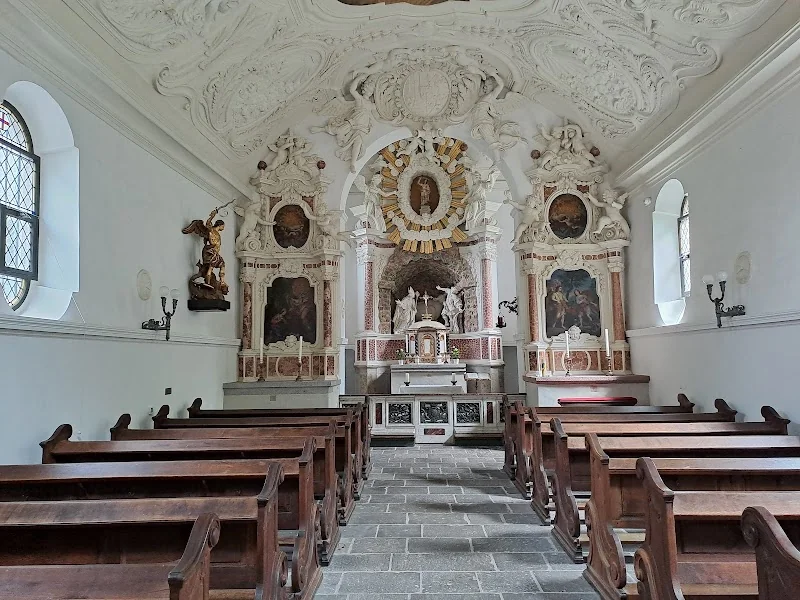
Entering the Michaelskapelle, one does not experience a large, monumental church space, but a compact, densely designed interior with a strong baroque character. The sources mention an altar with a statue of the Archangel Michael, ceiling frescoes, an organ on the left side of the entrance door, and an overall concept that transforms the small chapel into a concentrated image space. It is precisely this closeness of architecture, painting, and sculpture that creates the charm: the gaze does not get stuck in wide naves but is guided by a few precisely placed elements. The photo documentation also shows the dragon fight of the archangel as a central motif, making the name of the chapel immediately visible. For the classification of the furnishings, the sources mention different names from the crafts and fresco painting. The support association refers to Johann Schießel and the stucco artist Giovanni Pietro Castelli, while KuLaDig names Lazaro Maria Sanguinetti for the ceiling frescoes. Together, this creates the image of a carefully coordinated baroque program that was developed not by chance but on commission from the Archbishop of Cologne. ([foerderverein-michaelskapelle.de](https://foerderverein-michaelskapelle.de/die-michaelskapelle/))
The significance of this furnishing lies not only in its aesthetic quality but also in its historical rarity. The support association describes the Michaelskapelle as a baroque gem below the Godesburg and emphasizes that after restoration, it can be understood as a particularly valuable testimony to sacred architecture. This appreciation has good reasons, as the chapel was not simply preserved but actively saved through civic engagement. In 2009, the support association was formed out of concern for the miserable structural condition of the building, and in 2013/2014, a fundamental restoration followed with the support of monument preservation, the archdiocese, and the community. This is also perceptible for visitors, as the space does not appear museum-like and lifeless but rather vibrant and well-kept. Additionally, the site is more than just a baroque interior view: the connection of the building, hillside location, castle cemetery, and Godesburg creates an ensemble in which the chapel functions as both an art and memorial space. This duality makes it equally exciting for culture enthusiasts, architecture lovers, and spiritually seeking visitors. ([katholisch-in-godesberg.de](https://www.katholisch-in-godesberg.de/gemeindeleben/foerdervereine/index.html))
Opening Hours and Visits
For practical planning, the Michaelskapelle is pleasantly uncomplicated, as it is open daily. The official information from the parish states that for the summer season from April to October, it is open from 8 AM to 6 PM, and for the winter season from November to March, from 8 AM to 4 PM. This is remarkably user-friendly for a historical chapel, as many comparable sacred buildings can only be visited by appointment, guided tours, or special openings. Here, however, a short individual visit is realistic, whether in the morning after a walk, in the afternoon before descending into the valley, or as a quiet stop on a route through Bad Godesberg. Especially because the chapel is small, it is worth not planning too tightly. Just a few minutes are enough to grasp the space, but those who want to understand the baroque effect should take time for the interplay of altar, frescoes, side walls, and the close, intimate spatial effect. The opening hours make it easy to integrate this visit flexibly into a daily plan. ([katholisch-in-godesberg.de](https://www.katholisch-in-godesberg.de/ueber-uns/unsere-kirchen/))
The current use also shapes the visitor experience. The Michaelskapelle is not a mere exhibition object but an active sacred space. According to the sources, occasional services and weddings still take place there today. For visitors, this means that a quiet and respectful attitude is appropriate and that one experiences the chapel more as a living place of worship than as a classic tourist attraction. This mix is attractive to many guests because they find an authentic religious place that is still open and accessible. So those searching for Michaelskapelle opening hours usually want to know not just a time but to assess a place: How open is it, how quiet is it, how much time should I plan? The answer here is: open, quiet, and compact. The chapel is particularly well-suited for all who want to experience history not just by reading but spatially. Combined with the hillside location, a visit emerges that slows down rather than speeds up, and that fits the character of the Michaelskapelle very well. ([kuladig.de](https://www.kuladig.de/Objektansicht/KLD-356028))
Directions and Parking around the Michaelskapelle
The address of the Michaelskapelle is clear: Auf dem Godesberg 3, 53177 Bonn-Bad Godesberg. This location information is important because the Godesberg has a hillside location, and the chapel is therefore not experienced as a flat, street-visible church but as part of the historical ascent. Those arriving by car should understand the surroundings as an ensemble and not just approach the chapel in isolation. The official sources regarding the immediate surroundings do not mention a dedicated visitor parking lot for the chapel. However, for the Godesburg area, which is directly connected to the chapel, the Bonn region mentions a castle-owned parking lot at the foot of the Godesburg and the Plittersdorfer Straße stop with about 680 meters of walking distance. Practically, this means: the area is accessible, but the last stretch should be considered a small walk, not as a direct drop-off point right at the door. This information is particularly useful for those specifically looking for parking at Michaelskapelle Bonn or directions to Michaelskapelle Bonn and needing clear, reliable orientation. ([katholisch-in-godesberg.de](https://www.katholisch-in-godesberg.de/ueber-uns/unsere-kirchen/))
Especially because the chapel is located on the hill, the way is part of the experience. The official tourism information about the Godesburg makes it clear that the castle is staged with a view of the Rhine Valley, the Siebengebirge, Bad Godesberg, and Bonn, and the chapel stands in this context on the same elevation line of historical perception. Practically, this is very pleasant, as visitors can connect the Michaelskapelle with the castle and fortress area and arrive at a place where the topography is immediately palpable. When looking at the location soberly, the recommendation is simple: do not search for a large parking garage directly at the chapel, but take the Godesburg area as a starting point and plan the short remaining distance on foot. This also fits with the history of the place, which has been walked rather than simply driven to for centuries. For inquiries such as directions, parking, or parking spaces regarding the Michaelskapelle, the clean answer is therefore a combination of address information, Godesburg parking lot, and a realistic walking distance. ([visit-bonn-region.de](https://www.visit-bonn-region.de/poi/godesburg))
Godesburg, Castle Cemetery, and Bad Godesberg
The Michaelskapelle is strongest when viewed in relation to its surroundings. It is not located just anywhere in the district but directly below the Godesburg, which is considered a landmark of Bad Godesberg. The Bonn region describes the Godesburg as a viewpoint with a wide view of the Rhine Valley and Siebengebirge, and the urban tour description explicitly leads visitors from the way up to the castle to the baroque Michaelskapelle. This makes it clear: these two places belong together, even if they have different functions. The castle represents medieval power and view, while the chapel represents baroque devotion and local continuity. Between them lies the castle cemetery, which was established at the beginning of the 19th century and further enhances the historical density of the hill. For visitors, this is a very appealing connection because one can travel a short distance from the fortification to sacred architecture, from panorama to interior atmosphere, and from city history to personal silence. ([katholisch-in-godesberg.de](https://www.katholisch-in-godesberg.de/ueber-uns/unsere-kirchen/))
Bad Godesberg itself provides the urban framework. The district has grown historically, is culturally charged, and remains strongly connected to its landmarks to this day. In this context, the Michaelskapelle acts as a striking symbol for the old Godesberg: small, location-bound, historically rich, and at the same time open to today’s visitors. The tourism page of the Bonn region lists further attractions around the Godesburg, such as the theater, Redoute, and Bastei, making it easy to expand the area into a larger discovery tour. Nevertheless, the chapel remains the quietest and most intimate part of this ensemble. So those searching for Michaelskapelle Godesburg, Michaelskapelle Bad Godesberg, or attractions in Bonn will find here a point where landscape and culture touch particularly closely. For content and visit planning, this is ideal because the chapel can be explained not only through its history but also through its neighborhood. It is not an isolated building but a chapter in the larger book of the Godesberg hill. ([bonn.de](https://www.bonn.de/bonn-erleben/besichtigen-entdecken/rundfahrten/gruppen-2025/rundgang-tour-b4-bad-godesberg.php))
Guided Tours, Services, and Weddings
Another reason why the Michaelskapelle fits so well into local search queries is its lively integration into tours and community life. The city of Bonn explicitly includes a detour to the baroque Michaelskapelle in its tour through Bad Godesberg after the tour reaches the Godesburg. The support association also makes the chapel accessible through events, guided tours, and concerts. This shows that the place is not only passively preserved but actively conveyed. For visitors, this is valuable because it allows them to perceive the chapel not merely as a quiet monument but as a place where history is told and culturally passed on. Those interested in architecture, city history, or baroque sacred spaces will thus not only receive a beautiful backdrop but also an interpretable history with clear stations: predecessor building, new construction, baroque expansion, parish church phase, monument, restoration. This structure is excellent for all who seek a visit with context and do not just want to take a pretty photo. ([bonn.de](https://www.bonn.de/bonn-erleben/besichtigen-entdecken/rundfahrten/gruppen-2025/rundgang-tour-b4-bad-godesberg.php))
The current services and weddings additionally give the Michaelskapelle a personal dimension. It is not an empty museum but a place where people continue to experience religious and biographical moments. This makes it as important for the local community as for visitors from other cities. Especially for those searching for a historical place with real atmosphere, this is a strong argument. The patron saint, the Archangel Michael, is visibly present in the interior and reminds that the chapel refers not only architecturally but also content-wise to protection, hope, and spiritual orientation. In connection with the restored baroque furnishings, the hillside location, and the proximity to the Godesburg, a place emerges that does not separate past and present but intertwines them. Those who look back at the hill at the end of a visit quickly understand why the Michaelskapelle in Bonn-Bad Godesberg still receives so much attention today: it is small but significant, quiet but not mute, historical but not closed. ([kuladig.de](https://www.kuladig.de/Objektansicht/KLD-356028))
Sources:
Show moreShow less
Michaelskapelle Bonn | History & Opening Hours
The Michaelskapelle in Bonn-Bad Godesberg is one of those places that connects an astonishing number of levels in a small space: sacred history, baroque art, a strong landscape image, and the immediate proximity to the Godesburg. Located at Auf dem Godesberg 3, just about 60 meters northwest of the castle, it does not appear as a loud tourist attraction but rather as a quiet monument that one almost casually discovers on the way up or down and then does not forget so quickly. The chapel is open daily, registered as a historical monument since 1982, and is still used for occasional services and weddings. This mix of historical depth and vibrant presence is what makes it attractive. Those searching for Michaelskapelle Bonn, Michaelskapelle Bad Godesberg, or Godesburg will therefore not only find a building but a piece of city history that continues to shape the character of the hill to this day. For visitors, this is particularly pleasant because the chapel fits into a short walk, a half-day trip, or a targeted cultural route while still maintaining a very own atmosphere. ([kuladig.de](https://www.kuladig.de/Objektansicht/KLD-356028))
History of the Michaelskapelle at Godesberg
The history of the Michaelskapelle does not begin with the current building but with an older sacred site on the Godesberg. As early as the High Middle Ages, there was a cemetery chapel dedicated to Saint Michael, which is described as a Romanesque building according to the monument list. It had to make way when the construction of the Godesburg began under the Archbishop of Cologne, Dietrich I. von Hengebach, starting in 1210. This connection is crucial for understanding the chapel because it shows that the site has stood for many centuries between fortification, memory, and religious use. During later work on the Godesburg, even graves from the 9th century were uncovered, oriented to the east, indicating an even older use of the hill as a Christian burial and prayer site. The current Michaelskapelle thus stands on a site whose history reaches far back before the baroque reconstruction and has changed repeatedly over the centuries without losing its religious imprint. ([kuladig.de](https://www.kuladig.de/Objektansicht/KLD-356028))
The current chapel was rebuilt around 1660 on the same site and again dedicated to the Archangel Michael. A drawing by the Dutch painter Lambert Doomer from 1663 already shows it in its completed state, so its new shape was clearly visible in the landscape by the middle of the 17th century. Between 1697 and 1699, Joseph Clemens of Bavaria, the then Prince-Archbishop of Cologne, had a nave built of brick added and the baroque interior designed. During this time, the Michaelskapelle became the parish church of the Order of Saint Michael and the prayer place of the Michaels Brotherhood, both founded in 1693 by Joseph Clemens in Berg am Laim. Later, the order lost significance with its relocation to the Bonn Residence Castle, but the chapel remained important for the site itself. In 1804, it was elevated to the parish church of Godesberg after the area had detached itself from the old affiliation with the parish of Rüngsdorf. It was not until the consecration of St. Marien at the foot of the hill in 1862 that it stepped back as the main parish church. This sequence explains why the Michaelskapelle can today be read as a combination of medieval prehistory, baroque renewal, and local parish tradition. ([kuladig.de](https://www.kuladig.de/Objektansicht/KLD-356028))
Baroque Furnishings and Interior
Entering the Michaelskapelle, one does not experience a large, monumental church space, but a compact, densely designed interior with a strong baroque character. The sources mention an altar with a statue of the Archangel Michael, ceiling frescoes, an organ on the left side of the entrance door, and an overall concept that transforms the small chapel into a concentrated image space. It is precisely this closeness of architecture, painting, and sculpture that creates the charm: the gaze does not get stuck in wide naves but is guided by a few precisely placed elements. The photo documentation also shows the dragon fight of the archangel as a central motif, making the name of the chapel immediately visible. For the classification of the furnishings, the sources mention different names from the crafts and fresco painting. The support association refers to Johann Schießel and the stucco artist Giovanni Pietro Castelli, while KuLaDig names Lazaro Maria Sanguinetti for the ceiling frescoes. Together, this creates the image of a carefully coordinated baroque program that was developed not by chance but on commission from the Archbishop of Cologne. ([foerderverein-michaelskapelle.de](https://foerderverein-michaelskapelle.de/die-michaelskapelle/))
The significance of this furnishing lies not only in its aesthetic quality but also in its historical rarity. The support association describes the Michaelskapelle as a baroque gem below the Godesburg and emphasizes that after restoration, it can be understood as a particularly valuable testimony to sacred architecture. This appreciation has good reasons, as the chapel was not simply preserved but actively saved through civic engagement. In 2009, the support association was formed out of concern for the miserable structural condition of the building, and in 2013/2014, a fundamental restoration followed with the support of monument preservation, the archdiocese, and the community. This is also perceptible for visitors, as the space does not appear museum-like and lifeless but rather vibrant and well-kept. Additionally, the site is more than just a baroque interior view: the connection of the building, hillside location, castle cemetery, and Godesburg creates an ensemble in which the chapel functions as both an art and memorial space. This duality makes it equally exciting for culture enthusiasts, architecture lovers, and spiritually seeking visitors. ([katholisch-in-godesberg.de](https://www.katholisch-in-godesberg.de/gemeindeleben/foerdervereine/index.html))
Opening Hours and Visits
For practical planning, the Michaelskapelle is pleasantly uncomplicated, as it is open daily. The official information from the parish states that for the summer season from April to October, it is open from 8 AM to 6 PM, and for the winter season from November to March, from 8 AM to 4 PM. This is remarkably user-friendly for a historical chapel, as many comparable sacred buildings can only be visited by appointment, guided tours, or special openings. Here, however, a short individual visit is realistic, whether in the morning after a walk, in the afternoon before descending into the valley, or as a quiet stop on a route through Bad Godesberg. Especially because the chapel is small, it is worth not planning too tightly. Just a few minutes are enough to grasp the space, but those who want to understand the baroque effect should take time for the interplay of altar, frescoes, side walls, and the close, intimate spatial effect. The opening hours make it easy to integrate this visit flexibly into a daily plan. ([katholisch-in-godesberg.de](https://www.katholisch-in-godesberg.de/ueber-uns/unsere-kirchen/))
The current use also shapes the visitor experience. The Michaelskapelle is not a mere exhibition object but an active sacred space. According to the sources, occasional services and weddings still take place there today. For visitors, this means that a quiet and respectful attitude is appropriate and that one experiences the chapel more as a living place of worship than as a classic tourist attraction. This mix is attractive to many guests because they find an authentic religious place that is still open and accessible. So those searching for Michaelskapelle opening hours usually want to know not just a time but to assess a place: How open is it, how quiet is it, how much time should I plan? The answer here is: open, quiet, and compact. The chapel is particularly well-suited for all who want to experience history not just by reading but spatially. Combined with the hillside location, a visit emerges that slows down rather than speeds up, and that fits the character of the Michaelskapelle very well. ([kuladig.de](https://www.kuladig.de/Objektansicht/KLD-356028))
Directions and Parking around the Michaelskapelle
The address of the Michaelskapelle is clear: Auf dem Godesberg 3, 53177 Bonn-Bad Godesberg. This location information is important because the Godesberg has a hillside location, and the chapel is therefore not experienced as a flat, street-visible church but as part of the historical ascent. Those arriving by car should understand the surroundings as an ensemble and not just approach the chapel in isolation. The official sources regarding the immediate surroundings do not mention a dedicated visitor parking lot for the chapel. However, for the Godesburg area, which is directly connected to the chapel, the Bonn region mentions a castle-owned parking lot at the foot of the Godesburg and the Plittersdorfer Straße stop with about 680 meters of walking distance. Practically, this means: the area is accessible, but the last stretch should be considered a small walk, not as a direct drop-off point right at the door. This information is particularly useful for those specifically looking for parking at Michaelskapelle Bonn or directions to Michaelskapelle Bonn and needing clear, reliable orientation. ([katholisch-in-godesberg.de](https://www.katholisch-in-godesberg.de/ueber-uns/unsere-kirchen/))
Especially because the chapel is located on the hill, the way is part of the experience. The official tourism information about the Godesburg makes it clear that the castle is staged with a view of the Rhine Valley, the Siebengebirge, Bad Godesberg, and Bonn, and the chapel stands in this context on the same elevation line of historical perception. Practically, this is very pleasant, as visitors can connect the Michaelskapelle with the castle and fortress area and arrive at a place where the topography is immediately palpable. When looking at the location soberly, the recommendation is simple: do not search for a large parking garage directly at the chapel, but take the Godesburg area as a starting point and plan the short remaining distance on foot. This also fits with the history of the place, which has been walked rather than simply driven to for centuries. For inquiries such as directions, parking, or parking spaces regarding the Michaelskapelle, the clean answer is therefore a combination of address information, Godesburg parking lot, and a realistic walking distance. ([visit-bonn-region.de](https://www.visit-bonn-region.de/poi/godesburg))
Godesburg, Castle Cemetery, and Bad Godesberg
The Michaelskapelle is strongest when viewed in relation to its surroundings. It is not located just anywhere in the district but directly below the Godesburg, which is considered a landmark of Bad Godesberg. The Bonn region describes the Godesburg as a viewpoint with a wide view of the Rhine Valley and Siebengebirge, and the urban tour description explicitly leads visitors from the way up to the castle to the baroque Michaelskapelle. This makes it clear: these two places belong together, even if they have different functions. The castle represents medieval power and view, while the chapel represents baroque devotion and local continuity. Between them lies the castle cemetery, which was established at the beginning of the 19th century and further enhances the historical density of the hill. For visitors, this is a very appealing connection because one can travel a short distance from the fortification to sacred architecture, from panorama to interior atmosphere, and from city history to personal silence. ([katholisch-in-godesberg.de](https://www.katholisch-in-godesberg.de/ueber-uns/unsere-kirchen/))
Bad Godesberg itself provides the urban framework. The district has grown historically, is culturally charged, and remains strongly connected to its landmarks to this day. In this context, the Michaelskapelle acts as a striking symbol for the old Godesberg: small, location-bound, historically rich, and at the same time open to today’s visitors. The tourism page of the Bonn region lists further attractions around the Godesburg, such as the theater, Redoute, and Bastei, making it easy to expand the area into a larger discovery tour. Nevertheless, the chapel remains the quietest and most intimate part of this ensemble. So those searching for Michaelskapelle Godesburg, Michaelskapelle Bad Godesberg, or attractions in Bonn will find here a point where landscape and culture touch particularly closely. For content and visit planning, this is ideal because the chapel can be explained not only through its history but also through its neighborhood. It is not an isolated building but a chapter in the larger book of the Godesberg hill. ([bonn.de](https://www.bonn.de/bonn-erleben/besichtigen-entdecken/rundfahrten/gruppen-2025/rundgang-tour-b4-bad-godesberg.php))
Guided Tours, Services, and Weddings
Another reason why the Michaelskapelle fits so well into local search queries is its lively integration into tours and community life. The city of Bonn explicitly includes a detour to the baroque Michaelskapelle in its tour through Bad Godesberg after the tour reaches the Godesburg. The support association also makes the chapel accessible through events, guided tours, and concerts. This shows that the place is not only passively preserved but actively conveyed. For visitors, this is valuable because it allows them to perceive the chapel not merely as a quiet monument but as a place where history is told and culturally passed on. Those interested in architecture, city history, or baroque sacred spaces will thus not only receive a beautiful backdrop but also an interpretable history with clear stations: predecessor building, new construction, baroque expansion, parish church phase, monument, restoration. This structure is excellent for all who seek a visit with context and do not just want to take a pretty photo. ([bonn.de](https://www.bonn.de/bonn-erleben/besichtigen-entdecken/rundfahrten/gruppen-2025/rundgang-tour-b4-bad-godesberg.php))
The current services and weddings additionally give the Michaelskapelle a personal dimension. It is not an empty museum but a place where people continue to experience religious and biographical moments. This makes it as important for the local community as for visitors from other cities. Especially for those searching for a historical place with real atmosphere, this is a strong argument. The patron saint, the Archangel Michael, is visibly present in the interior and reminds that the chapel refers not only architecturally but also content-wise to protection, hope, and spiritual orientation. In connection with the restored baroque furnishings, the hillside location, and the proximity to the Godesburg, a place emerges that does not separate past and present but intertwines them. Those who look back at the hill at the end of a visit quickly understand why the Michaelskapelle in Bonn-Bad Godesberg still receives so much attention today: it is small but significant, quiet but not mute, historical but not closed. ([kuladig.de](https://www.kuladig.de/Objektansicht/KLD-356028))
Sources:
Michaelskapelle Bonn | History & Opening Hours
The Michaelskapelle in Bonn-Bad Godesberg is one of those places that connects an astonishing number of levels in a small space: sacred history, baroque art, a strong landscape image, and the immediate proximity to the Godesburg. Located at Auf dem Godesberg 3, just about 60 meters northwest of the castle, it does not appear as a loud tourist attraction but rather as a quiet monument that one almost casually discovers on the way up or down and then does not forget so quickly. The chapel is open daily, registered as a historical monument since 1982, and is still used for occasional services and weddings. This mix of historical depth and vibrant presence is what makes it attractive. Those searching for Michaelskapelle Bonn, Michaelskapelle Bad Godesberg, or Godesburg will therefore not only find a building but a piece of city history that continues to shape the character of the hill to this day. For visitors, this is particularly pleasant because the chapel fits into a short walk, a half-day trip, or a targeted cultural route while still maintaining a very own atmosphere. ([kuladig.de](https://www.kuladig.de/Objektansicht/KLD-356028))
History of the Michaelskapelle at Godesberg
The history of the Michaelskapelle does not begin with the current building but with an older sacred site on the Godesberg. As early as the High Middle Ages, there was a cemetery chapel dedicated to Saint Michael, which is described as a Romanesque building according to the monument list. It had to make way when the construction of the Godesburg began under the Archbishop of Cologne, Dietrich I. von Hengebach, starting in 1210. This connection is crucial for understanding the chapel because it shows that the site has stood for many centuries between fortification, memory, and religious use. During later work on the Godesburg, even graves from the 9th century were uncovered, oriented to the east, indicating an even older use of the hill as a Christian burial and prayer site. The current Michaelskapelle thus stands on a site whose history reaches far back before the baroque reconstruction and has changed repeatedly over the centuries without losing its religious imprint. ([kuladig.de](https://www.kuladig.de/Objektansicht/KLD-356028))
The current chapel was rebuilt around 1660 on the same site and again dedicated to the Archangel Michael. A drawing by the Dutch painter Lambert Doomer from 1663 already shows it in its completed state, so its new shape was clearly visible in the landscape by the middle of the 17th century. Between 1697 and 1699, Joseph Clemens of Bavaria, the then Prince-Archbishop of Cologne, had a nave built of brick added and the baroque interior designed. During this time, the Michaelskapelle became the parish church of the Order of Saint Michael and the prayer place of the Michaels Brotherhood, both founded in 1693 by Joseph Clemens in Berg am Laim. Later, the order lost significance with its relocation to the Bonn Residence Castle, but the chapel remained important for the site itself. In 1804, it was elevated to the parish church of Godesberg after the area had detached itself from the old affiliation with the parish of Rüngsdorf. It was not until the consecration of St. Marien at the foot of the hill in 1862 that it stepped back as the main parish church. This sequence explains why the Michaelskapelle can today be read as a combination of medieval prehistory, baroque renewal, and local parish tradition. ([kuladig.de](https://www.kuladig.de/Objektansicht/KLD-356028))
Baroque Furnishings and Interior
Entering the Michaelskapelle, one does not experience a large, monumental church space, but a compact, densely designed interior with a strong baroque character. The sources mention an altar with a statue of the Archangel Michael, ceiling frescoes, an organ on the left side of the entrance door, and an overall concept that transforms the small chapel into a concentrated image space. It is precisely this closeness of architecture, painting, and sculpture that creates the charm: the gaze does not get stuck in wide naves but is guided by a few precisely placed elements. The photo documentation also shows the dragon fight of the archangel as a central motif, making the name of the chapel immediately visible. For the classification of the furnishings, the sources mention different names from the crafts and fresco painting. The support association refers to Johann Schießel and the stucco artist Giovanni Pietro Castelli, while KuLaDig names Lazaro Maria Sanguinetti for the ceiling frescoes. Together, this creates the image of a carefully coordinated baroque program that was developed not by chance but on commission from the Archbishop of Cologne. ([foerderverein-michaelskapelle.de](https://foerderverein-michaelskapelle.de/die-michaelskapelle/))
The significance of this furnishing lies not only in its aesthetic quality but also in its historical rarity. The support association describes the Michaelskapelle as a baroque gem below the Godesburg and emphasizes that after restoration, it can be understood as a particularly valuable testimony to sacred architecture. This appreciation has good reasons, as the chapel was not simply preserved but actively saved through civic engagement. In 2009, the support association was formed out of concern for the miserable structural condition of the building, and in 2013/2014, a fundamental restoration followed with the support of monument preservation, the archdiocese, and the community. This is also perceptible for visitors, as the space does not appear museum-like and lifeless but rather vibrant and well-kept. Additionally, the site is more than just a baroque interior view: the connection of the building, hillside location, castle cemetery, and Godesburg creates an ensemble in which the chapel functions as both an art and memorial space. This duality makes it equally exciting for culture enthusiasts, architecture lovers, and spiritually seeking visitors. ([katholisch-in-godesberg.de](https://www.katholisch-in-godesberg.de/gemeindeleben/foerdervereine/index.html))
Opening Hours and Visits
For practical planning, the Michaelskapelle is pleasantly uncomplicated, as it is open daily. The official information from the parish states that for the summer season from April to October, it is open from 8 AM to 6 PM, and for the winter season from November to March, from 8 AM to 4 PM. This is remarkably user-friendly for a historical chapel, as many comparable sacred buildings can only be visited by appointment, guided tours, or special openings. Here, however, a short individual visit is realistic, whether in the morning after a walk, in the afternoon before descending into the valley, or as a quiet stop on a route through Bad Godesberg. Especially because the chapel is small, it is worth not planning too tightly. Just a few minutes are enough to grasp the space, but those who want to understand the baroque effect should take time for the interplay of altar, frescoes, side walls, and the close, intimate spatial effect. The opening hours make it easy to integrate this visit flexibly into a daily plan. ([katholisch-in-godesberg.de](https://www.katholisch-in-godesberg.de/ueber-uns/unsere-kirchen/))
The current use also shapes the visitor experience. The Michaelskapelle is not a mere exhibition object but an active sacred space. According to the sources, occasional services and weddings still take place there today. For visitors, this means that a quiet and respectful attitude is appropriate and that one experiences the chapel more as a living place of worship than as a classic tourist attraction. This mix is attractive to many guests because they find an authentic religious place that is still open and accessible. So those searching for Michaelskapelle opening hours usually want to know not just a time but to assess a place: How open is it, how quiet is it, how much time should I plan? The answer here is: open, quiet, and compact. The chapel is particularly well-suited for all who want to experience history not just by reading but spatially. Combined with the hillside location, a visit emerges that slows down rather than speeds up, and that fits the character of the Michaelskapelle very well. ([kuladig.de](https://www.kuladig.de/Objektansicht/KLD-356028))
Directions and Parking around the Michaelskapelle
The address of the Michaelskapelle is clear: Auf dem Godesberg 3, 53177 Bonn-Bad Godesberg. This location information is important because the Godesberg has a hillside location, and the chapel is therefore not experienced as a flat, street-visible church but as part of the historical ascent. Those arriving by car should understand the surroundings as an ensemble and not just approach the chapel in isolation. The official sources regarding the immediate surroundings do not mention a dedicated visitor parking lot for the chapel. However, for the Godesburg area, which is directly connected to the chapel, the Bonn region mentions a castle-owned parking lot at the foot of the Godesburg and the Plittersdorfer Straße stop with about 680 meters of walking distance. Practically, this means: the area is accessible, but the last stretch should be considered a small walk, not as a direct drop-off point right at the door. This information is particularly useful for those specifically looking for parking at Michaelskapelle Bonn or directions to Michaelskapelle Bonn and needing clear, reliable orientation. ([katholisch-in-godesberg.de](https://www.katholisch-in-godesberg.de/ueber-uns/unsere-kirchen/))
Especially because the chapel is located on the hill, the way is part of the experience. The official tourism information about the Godesburg makes it clear that the castle is staged with a view of the Rhine Valley, the Siebengebirge, Bad Godesberg, and Bonn, and the chapel stands in this context on the same elevation line of historical perception. Practically, this is very pleasant, as visitors can connect the Michaelskapelle with the castle and fortress area and arrive at a place where the topography is immediately palpable. When looking at the location soberly, the recommendation is simple: do not search for a large parking garage directly at the chapel, but take the Godesburg area as a starting point and plan the short remaining distance on foot. This also fits with the history of the place, which has been walked rather than simply driven to for centuries. For inquiries such as directions, parking, or parking spaces regarding the Michaelskapelle, the clean answer is therefore a combination of address information, Godesburg parking lot, and a realistic walking distance. ([visit-bonn-region.de](https://www.visit-bonn-region.de/poi/godesburg))
Godesburg, Castle Cemetery, and Bad Godesberg
The Michaelskapelle is strongest when viewed in relation to its surroundings. It is not located just anywhere in the district but directly below the Godesburg, which is considered a landmark of Bad Godesberg. The Bonn region describes the Godesburg as a viewpoint with a wide view of the Rhine Valley and Siebengebirge, and the urban tour description explicitly leads visitors from the way up to the castle to the baroque Michaelskapelle. This makes it clear: these two places belong together, even if they have different functions. The castle represents medieval power and view, while the chapel represents baroque devotion and local continuity. Between them lies the castle cemetery, which was established at the beginning of the 19th century and further enhances the historical density of the hill. For visitors, this is a very appealing connection because one can travel a short distance from the fortification to sacred architecture, from panorama to interior atmosphere, and from city history to personal silence. ([katholisch-in-godesberg.de](https://www.katholisch-in-godesberg.de/ueber-uns/unsere-kirchen/))
Bad Godesberg itself provides the urban framework. The district has grown historically, is culturally charged, and remains strongly connected to its landmarks to this day. In this context, the Michaelskapelle acts as a striking symbol for the old Godesberg: small, location-bound, historically rich, and at the same time open to today’s visitors. The tourism page of the Bonn region lists further attractions around the Godesburg, such as the theater, Redoute, and Bastei, making it easy to expand the area into a larger discovery tour. Nevertheless, the chapel remains the quietest and most intimate part of this ensemble. So those searching for Michaelskapelle Godesburg, Michaelskapelle Bad Godesberg, or attractions in Bonn will find here a point where landscape and culture touch particularly closely. For content and visit planning, this is ideal because the chapel can be explained not only through its history but also through its neighborhood. It is not an isolated building but a chapter in the larger book of the Godesberg hill. ([bonn.de](https://www.bonn.de/bonn-erleben/besichtigen-entdecken/rundfahrten/gruppen-2025/rundgang-tour-b4-bad-godesberg.php))
Guided Tours, Services, and Weddings
Another reason why the Michaelskapelle fits so well into local search queries is its lively integration into tours and community life. The city of Bonn explicitly includes a detour to the baroque Michaelskapelle in its tour through Bad Godesberg after the tour reaches the Godesburg. The support association also makes the chapel accessible through events, guided tours, and concerts. This shows that the place is not only passively preserved but actively conveyed. For visitors, this is valuable because it allows them to perceive the chapel not merely as a quiet monument but as a place where history is told and culturally passed on. Those interested in architecture, city history, or baroque sacred spaces will thus not only receive a beautiful backdrop but also an interpretable history with clear stations: predecessor building, new construction, baroque expansion, parish church phase, monument, restoration. This structure is excellent for all who seek a visit with context and do not just want to take a pretty photo. ([bonn.de](https://www.bonn.de/bonn-erleben/besichtigen-entdecken/rundfahrten/gruppen-2025/rundgang-tour-b4-bad-godesberg.php))
The current services and weddings additionally give the Michaelskapelle a personal dimension. It is not an empty museum but a place where people continue to experience religious and biographical moments. This makes it as important for the local community as for visitors from other cities. Especially for those searching for a historical place with real atmosphere, this is a strong argument. The patron saint, the Archangel Michael, is visibly present in the interior and reminds that the chapel refers not only architecturally but also content-wise to protection, hope, and spiritual orientation. In connection with the restored baroque furnishings, the hillside location, and the proximity to the Godesburg, a place emerges that does not separate past and present but intertwines them. Those who look back at the hill at the end of a visit quickly understand why the Michaelskapelle in Bonn-Bad Godesberg still receives so much attention today: it is small but significant, quiet but not mute, historical but not closed. ([kuladig.de](https://www.kuladig.de/Objektansicht/KLD-356028))
Sources:
Frequently Asked Questions
Reviews
No reviews found