
Auerhofstraße 9, Bonn-Bad Godesberg
Auerhofstraße 9, 53175 Bonn, Germany
Mausoleum of Carstanjen | Costs & Directions
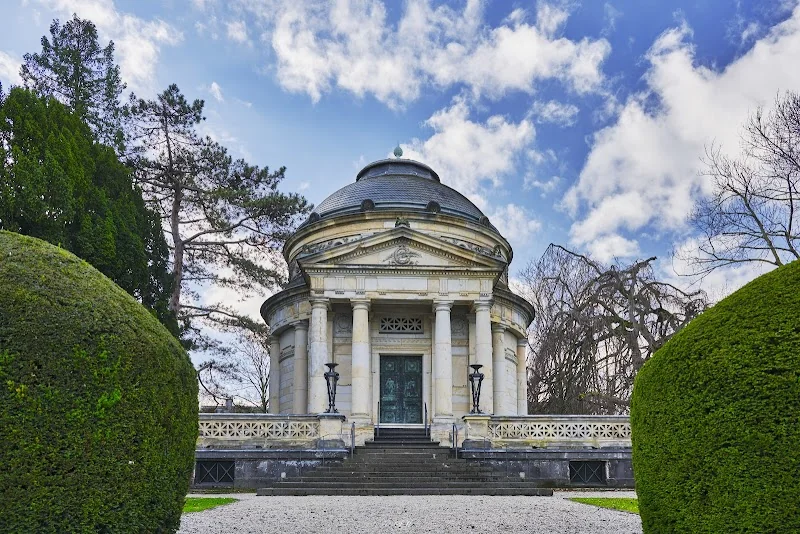
The Mausoleum of Carstanjen is one of the most unusual places in Bonn-Bad Godesberg, as it combines architecture, family history, and modern burial culture in a single complex. The neoclassical dome building is located directly on the Rhine, nestled in a park with an unobstructed view of the water, and appears both representative and tranquil. Unlike a typical monument, the mausoleum is not merely an exhibition space but an active Christian urn burial site, managed by the church since 2007. Those interested in costs, directions, opening hours, or a virtual tour are not just looking for a historical building but for a place where memory is visibly cared for. This dual role makes the complex so fascinating: it is a testament to the Rhine's Fin de siècle and at the same time a place where contemporary families can bid farewell with dignity. The park is open to the public, but the building itself is only open during burials and memorial services, shaping the atmosphere of the entire ensemble and explaining why the mausoleum is a quiet yet impressive point along the Rhine for many visitors. ([katholisch-in-godesberg.de](https://www.katholisch-in-godesberg.de/export/sites/bad-godesberg/.galleries/Plakate/Sonstiges/Broschuere-ueber-das-Mausoleum_2024_web.pdf))
History and Architecture of the Mausoleum of Carstanjen
The history of the mausoleum begins with Adolf Carstanjen, who acquired the agricultural land in the Plittersdorf meadow in 1881 and shortly thereafter had the local Auerhof transformed into a representative estate. The site has a long history; official materials mention that the history of the Auerhof dates back to the 14th century. The rise of the family was thus reflected not only in social rank but also in the form of ownership. The estate was transformed into a castle-like ensemble that visibly expressed the aspirations of a successful entrepreneurial family. The mausoleum itself was created at the end of the 19th century as a family burial site, with sources citing the construction period as 1895/96 and completion in 1897. Architects August Hertel and Skjold Neckermann are mentioned; the execution of the solid construction was undertaken by the royal government builder Johannes Kleefisch. Thus, the building is not simply an ancillary structure of the estate but a deliberately composed part of an overall complex where representation, piety, and the family's self-understanding converge. ([katholisch-in-godesberg.de](https://www.katholisch-in-godesberg.de/export/sites/bad-godesberg/.galleries/Plakate/Sonstiges/Broschuere-ueber-das-Mausoleum_2024_web.pdf))
Architecturally, the building is designed as a temple-like dome structure with a rotunda, crypt, and ceremonial access situation. A two-part outdoor staircase leads to the upper ring hall, surrounded by Ionic sandstone columns. Additionally, there is a portico, wrought-iron enclosures, and a coat-of-arms adorned bronze gate that marks the transition to the inner area. This language of forms is no coincidence but part of a very conscious staging of dignity and permanence. The mausoleum follows the taste of the late 19th century but simultaneously aims to transcend the moment: the rotunda is designed as a mourning hall, with the burial chambers located in the crypt below. Anyone observing the building immediately recognizes that not only a family grave has been created here but a place where architecture takes on a symbolic role. The structure from outside to inside, from the park area through the stairs to the farewell room and further down into the crypt, reflects a clear spatial dramaturgy that can still be felt today. ([katholisch-in-godesberg.de](https://www.katholisch-in-godesberg.de/export/sites/bad-godesberg/.galleries/Plakate/Sonstiges/Broschuere-ueber-das-Mausoleum_2024_web.pdf))
Particularly impressive is the symbolism inside. Official explanations emphasize the interplay of square and circle: the square stands for transience, the circle for infinity. The morning star, which is found in the floor mosaic and in the ornaments, refers to hope and resurrection. Laurel wreaths, star ornaments, and the clear arrangement of the spatial sequences are also part of this imagery. This is not decorative excess but a program charged with religious and cultural significance that interprets death not as an end but as a transition. Precisely for this reason, the mausoleum appears so distinctive: it combines the strict form of a classical monument with a very Christian notion of comfort and continuity. Those standing there today experience not only a place of memory but also a lesson in historical architectural language, where every detail has a function. The fact that the complex is now listed as a historical monument, restored, and repurposed enhances this impression, as the building is not museum-like frozen but continues to live on in a contemporary form. ([katholisch-in-godesberg.de](https://www.katholisch-in-godesberg.de/export/sites/bad-godesberg/.galleries/Plakate/Sonstiges/Magazin-Mausoleum-Geschichte-2024.pdf))
Costs, Reservation, and Burial at the Mausoleum of Carstanjen
Since the summer of 2007, the mausoleum has been a Christian burial site that operates according to a clearly regulated model. The official brochure states that an urn burial plot, including burial, costs 1,455 euros for a duration of 15 years and 2,305 euros for 25 years. Additional costs apply for the use of the rotunda and for the inscription on the memorial plates. Thus, while the mausoleum is an extraordinary place, it is not an opaque special model: the pricing structure is comprehensible and, according to official representation, is based on the burial fees of municipal cemeteries. For people wishing to plan ahead, reservations and options for future use are available. These are listed at 1,000 euros for 15 years and 1,500 euros for 25 years. This option makes the mausoleum particularly interesting for families seeking a reliable, dignified, and spatially unique solution without having to decide in times of mourning. ([katholisch-in-godesberg.de](https://www.katholisch-in-godesberg.de/export/sites/bad-godesberg/.galleries/Plakate/Sonstiges/Broschuere-ueber-das-Mausoleum_2024_web.pdf))
The capacity of the complex is also noteworthy: the official brochure mentions up to 3,000 urns that can be interred in the crypt. Adjacent urn burial plots can also be reserved for families and couples, making the site suitable not only for individual burials but also for cohesive burial concepts. The resting periods are at least 15 or 25 years, with longer terms possible. After the agreed period expires, the ashes will be interred on the west side of the mausoleum in the park area, while the names on the brass plaques remain. This ensures that the memory remains visible even when the actual resting period ends. This approach combines practical planning with a strong symbolic dimension: the mausoleum is a place for people who expect commitment, structure, and dignity. At the same time, it becomes clear that not only private memory is nurtured here but a form of burial that is permanently embedded in a public park and memorial complex. ([katholisch-in-godesberg.de](https://www.katholisch-in-godesberg.de/export/sites/bad-godesberg/.galleries/Plakate/Sonstiges/Magazin-Mausoleum-Geschichte-2024.pdf))
Additionally, there is the social character of the entire concept. According to official documents, the revenues from burials and reservations flow largely into projects of the Bürgerstiftung Rheinviertel. This creates a model that connects burial culture with the common good. Those reserving a place or planning a burial thus support not only the preservation of the monument but also social work in the neighborhood. For many people, this is an important aspect, as the site thereby gains societal significance beyond individual mourning. The names of the deceased are not anonymous but are visibly recorded in the park, and the history of the building is simultaneously continued. This combination of transparency, foresight, and social impact makes the Mausoleum of Carstanjen in Bonn an unusually clearly structured and human-oriented burial site. ([katholisch-in-godesberg.de](https://www.katholisch-in-godesberg.de/aktuelles/news/detail/Vier-Kirchorte-bieten-Fuehrungen-an/?utm_source=openai))
Directions, Parking, and Location on Auerhofstraße
The mausoleum is located in Bonn-Bad Godesberg in the Plittersdorf area, in close proximity to the Rhine. For orientation, the connection from Auerhofstraße, the park of Haus Carstanjen, and the church of St. Evergislus is particularly helpful, as the monument stands in a clearly readable environment and does not disappear among arbitrary residential buildings. The official venue page of the Beethoven Festival lists the address as Auerhofstraße 9, 53175 Bonn, and links it directly to route planning via Google Maps. At the same time, the church's website lists the complex with Auerhofstraße 11, indicating that different address information is used depending on the jurisdiction. For visitors, the overall location is therefore more important than the house number: those heading for Auerhofstraße and the park area can reliably find the site. This transparency is practical because the mausoleum is not a classic public building with a large reception structure but a historical site with regulated access. ([beethovenfest.de](https://www.beethovenfest.de/en/locations/mausoleum-von-carstanjen/88))
Regarding parking, the official sources mainly mention that a parking lot is listed in the directory of the Open Monument Day, without promoting a large parking facility or providing a specific number. This is important for planning: those arriving by car should not view the area as a parking garage location but as a monument-shaped riverside. Therefore, it is advisable to allow some time for the journey and to use the official route guidance. The location along the Rhine promenade is, however, an advantage, as it makes the ensemble easily discoverable and also scenically attractive. Those wishing to take a few steps before or after the visit can include the park of Haus Carstanjen, which is open year-round and freely accessible. This way, the journey becomes not just a path to the destination but a part of the visit experience itself. ([tag-des-offenen-denkmals.de](https://www.tag-des-offenen-denkmals.de/denkmal/cmb4rzied0001l504iohww3bk/mausoleum-von-carstanjen))
Opening Hours, Photos, and Virtual Tour
In everyday life, the mausoleum is not a freely accessible exhibition space but a protected place with clear rules. The official representation clearly states that the mausoleum itself is only open for burials and memorial services. The park, on the other hand, is accessible during the day; the church's brochure lists the times from 10:00 AM to 5:00 PM, parallel to the opening hours of the neighboring church. This separation is important for visitors as it makes the special role of the site visible. It is not about continuous operation or event calendars but about dignity, tranquility, and respectful handling of an active burial site. Precisely for this reason, the first impression is often quieter than many expect from tourist attractions, but also more lasting. Those visiting the site experience not a loud public place but a consciously protected environment by the Rhine. ([katholisch-in-godesberg.de](https://www.katholisch-in-godesberg.de/export/sites/bad-godesberg/.galleries/Plakate/Sonstiges/Broschuere-ueber-das-Mausoleum_2024_web.pdf))
For all those who wish to get an impression beforehand, the official site offers a 3D animation with a virtual tour through the rooms. This is particularly helpful as the interior is not freely accessible in everyday life, and photos on site are therefore not the only way to orient oneself architecturally. The virtual tour conveys the sequence of spaces from the rotunda to the crypt and makes the character of the building comprehensible even before a visit. Those looking for photos should therefore first keep an eye on the official pages and the pages for special openings, as these bring together image material, historical context, and digital impressions. Especially for a monument of this kind, this is important: a good digital introduction does not replace the on-site visit but prepares it meaningfully and helps to better understand the symbolism of the complex. ([katholisch-in-godesberg.de](https://www.katholisch-in-godesberg.de/ueber-uns/mausoleum-von-carstanjen/index.html))
Additional opening opportunities exist during special occasions such as the Open Monument Day when the mausoleum opens its otherwise closed doors to the public. Guided tours, photo documentation, and further insights into history and architecture are offered then. Also, on All Souls' Day, the crypt is open for relatives, highlighting the spiritual and familial dimension of the site. For visitors, this means: those who do not experience the complex in the context of a burial should consciously plan for the special dates or utilize the virtual tour. This creates a tiered visit model ranging from quiet park walks to professional guided tours. This mix of digital and occasionally public access is very attractive, especially for those interested in photos, architectural history, and sacred architecture. ([katholisch-in-godesberg.de](https://www.katholisch-in-godesberg.de/aktuelles/news/detail/Vier-Kirchorte-bieten-Fuehrungen-an/?utm_source=openai))
Park, Rhine View, and Special Atmosphere
The impact of the mausoleum arises not only from its architecture but from the combination with the surrounding park and proximity to the Rhine. The official brochure describes the burial site as surrounded by an idyllic park, with an unobstructed view of the Rhine. This very view opens the site outward and gives it a tranquility that one might not immediately expect from a historical mausoleum. Between the paths, green spaces, and water, an atmosphere emerges that is much more than just a pretty backdrop. It supports the character of the memorial site by connecting the representational nature of the architecture with a quiet landscape. The visible names of the deceased in the park and the orderly embedding of the burial chambers further enhance this impression. Thus, a building becomes a place where memory remains spatially tangible. ([katholisch-in-godesberg.de](https://www.katholisch-in-godesberg.de/export/sites/bad-godesberg/.galleries/Plakate/Sonstiges/Broschuere-ueber-das-Mausoleum_2024_web.pdf))
The park of Haus Carstanjen itself also contributes to this impression. The city of Bonn describes it as an independent park along the Rhine promenade, thus as part of a larger, open green space along the river. This means that the mausoleum is not isolated but integrated into an ensemble of historical and landscape elements that is typical for Bonn-Bad Godesberg. Those exploring the area on foot experience a transition between urban riverside, well-maintained green spaces, and striking architectural monuments. This is crucial for the perception of the mausoleum, as the site thrives on both distance and closeness: it is open enough to fit into the Rhine landscape and shielded enough to serve as a place of tranquility. This balance between public and silence is likely the most important reason why the location remains so special. ([bonn.de](https://www.bonn.de/bonn-erleben/aktiv-und-unterwegs/parks-und-gaerten/park-haus-carstanjen.php))
Culture of Remembrance, Foundation, and Current Use
The current form of the mausoleum is the result of a remarkable repurposing. After years of decay, the Carstanjen Foundation took over the monument, while the Catholic parish of St. Andreas and Evergislus manages the burial site. The renovation and restoration transformed the former family mausoleum into a Christian urn burial site that is now oriented towards a clear, contemporary use. Official documents mention that the reopening in 2007 took place in front of more than 600 visitors and was marked by musical accompaniment from the Beethoven Orchestra. This is more than a nice footnote: it shows that the site was not simply restored but endowed with a new public significance. History was not preserved but transferred into a living structure. ([katholisch-in-godesberg.de](https://www.katholisch-in-godesberg.de/export/sites/bad-godesberg/.galleries/Plakate/Sonstiges/Broschuere-ueber-das-Mausoleum_2024_web.pdf))
Particularly important is the culture of remembrance. The church's information emphasizes that no one is left to the anonymity of death, as the names and life dates of the deceased are recorded in the park. Mourning takes place in the rotunda, burial in the crypt, and memory remains visible in the outdoor space. This is precisely how the mausoleum acquires its current character as a dignified resting place for everyone. It is not only a place for the Carstanjen family but for people seeking a personal, orderly, and Christian form of farewell. The official communication describes this solution as a response to the needs of many people, and the social component is also strong: a large part of the proceeds flows into social projects of the Bürgerstiftung Rheinviertel. Thus, in the end, the mausoleum stands for more than architecture or history. It connects mourning, common good, and memory into a place that has a very own, quiet significance in Bonn. ([katholisch-in-godesberg.de](https://www.katholisch-in-godesberg.de/export/sites/bad-godesberg/.galleries/Plakate/Sonstiges/Broschuere-ueber-das-Mausoleum_2024_web.pdf))
For contemporary families and interested parties, this mixture of reliability and symbolism is decisive. Those seeking information about costs, reservations, or burial options do not receive an anonymous standard solution but a clearly defined place with religious, landscape, and social context. The historical building is preserved, the use is regulated, and the care of the site is tied to a foundation and a parish. This makes the Mausoleum of Carstanjen an unusual example of how a monument of civic representation can be transformed into a modern, responsible burial culture. It is precisely in this connection that its current strength lies: it is a place of history but also a place of the present. ([katholisch-in-godesberg.de](https://www.katholisch-in-godesberg.de/ueber-uns/mausoleum-von-carstanjen/index.html))
Sources:
Show moreShow less
Mausoleum of Carstanjen | Costs & Directions
The Mausoleum of Carstanjen is one of the most unusual places in Bonn-Bad Godesberg, as it combines architecture, family history, and modern burial culture in a single complex. The neoclassical dome building is located directly on the Rhine, nestled in a park with an unobstructed view of the water, and appears both representative and tranquil. Unlike a typical monument, the mausoleum is not merely an exhibition space but an active Christian urn burial site, managed by the church since 2007. Those interested in costs, directions, opening hours, or a virtual tour are not just looking for a historical building but for a place where memory is visibly cared for. This dual role makes the complex so fascinating: it is a testament to the Rhine's Fin de siècle and at the same time a place where contemporary families can bid farewell with dignity. The park is open to the public, but the building itself is only open during burials and memorial services, shaping the atmosphere of the entire ensemble and explaining why the mausoleum is a quiet yet impressive point along the Rhine for many visitors. ([katholisch-in-godesberg.de](https://www.katholisch-in-godesberg.de/export/sites/bad-godesberg/.galleries/Plakate/Sonstiges/Broschuere-ueber-das-Mausoleum_2024_web.pdf))
History and Architecture of the Mausoleum of Carstanjen
The history of the mausoleum begins with Adolf Carstanjen, who acquired the agricultural land in the Plittersdorf meadow in 1881 and shortly thereafter had the local Auerhof transformed into a representative estate. The site has a long history; official materials mention that the history of the Auerhof dates back to the 14th century. The rise of the family was thus reflected not only in social rank but also in the form of ownership. The estate was transformed into a castle-like ensemble that visibly expressed the aspirations of a successful entrepreneurial family. The mausoleum itself was created at the end of the 19th century as a family burial site, with sources citing the construction period as 1895/96 and completion in 1897. Architects August Hertel and Skjold Neckermann are mentioned; the execution of the solid construction was undertaken by the royal government builder Johannes Kleefisch. Thus, the building is not simply an ancillary structure of the estate but a deliberately composed part of an overall complex where representation, piety, and the family's self-understanding converge. ([katholisch-in-godesberg.de](https://www.katholisch-in-godesberg.de/export/sites/bad-godesberg/.galleries/Plakate/Sonstiges/Broschuere-ueber-das-Mausoleum_2024_web.pdf))
Architecturally, the building is designed as a temple-like dome structure with a rotunda, crypt, and ceremonial access situation. A two-part outdoor staircase leads to the upper ring hall, surrounded by Ionic sandstone columns. Additionally, there is a portico, wrought-iron enclosures, and a coat-of-arms adorned bronze gate that marks the transition to the inner area. This language of forms is no coincidence but part of a very conscious staging of dignity and permanence. The mausoleum follows the taste of the late 19th century but simultaneously aims to transcend the moment: the rotunda is designed as a mourning hall, with the burial chambers located in the crypt below. Anyone observing the building immediately recognizes that not only a family grave has been created here but a place where architecture takes on a symbolic role. The structure from outside to inside, from the park area through the stairs to the farewell room and further down into the crypt, reflects a clear spatial dramaturgy that can still be felt today. ([katholisch-in-godesberg.de](https://www.katholisch-in-godesberg.de/export/sites/bad-godesberg/.galleries/Plakate/Sonstiges/Broschuere-ueber-das-Mausoleum_2024_web.pdf))
Particularly impressive is the symbolism inside. Official explanations emphasize the interplay of square and circle: the square stands for transience, the circle for infinity. The morning star, which is found in the floor mosaic and in the ornaments, refers to hope and resurrection. Laurel wreaths, star ornaments, and the clear arrangement of the spatial sequences are also part of this imagery. This is not decorative excess but a program charged with religious and cultural significance that interprets death not as an end but as a transition. Precisely for this reason, the mausoleum appears so distinctive: it combines the strict form of a classical monument with a very Christian notion of comfort and continuity. Those standing there today experience not only a place of memory but also a lesson in historical architectural language, where every detail has a function. The fact that the complex is now listed as a historical monument, restored, and repurposed enhances this impression, as the building is not museum-like frozen but continues to live on in a contemporary form. ([katholisch-in-godesberg.de](https://www.katholisch-in-godesberg.de/export/sites/bad-godesberg/.galleries/Plakate/Sonstiges/Magazin-Mausoleum-Geschichte-2024.pdf))
Costs, Reservation, and Burial at the Mausoleum of Carstanjen
Since the summer of 2007, the mausoleum has been a Christian burial site that operates according to a clearly regulated model. The official brochure states that an urn burial plot, including burial, costs 1,455 euros for a duration of 15 years and 2,305 euros for 25 years. Additional costs apply for the use of the rotunda and for the inscription on the memorial plates. Thus, while the mausoleum is an extraordinary place, it is not an opaque special model: the pricing structure is comprehensible and, according to official representation, is based on the burial fees of municipal cemeteries. For people wishing to plan ahead, reservations and options for future use are available. These are listed at 1,000 euros for 15 years and 1,500 euros for 25 years. This option makes the mausoleum particularly interesting for families seeking a reliable, dignified, and spatially unique solution without having to decide in times of mourning. ([katholisch-in-godesberg.de](https://www.katholisch-in-godesberg.de/export/sites/bad-godesberg/.galleries/Plakate/Sonstiges/Broschuere-ueber-das-Mausoleum_2024_web.pdf))
The capacity of the complex is also noteworthy: the official brochure mentions up to 3,000 urns that can be interred in the crypt. Adjacent urn burial plots can also be reserved for families and couples, making the site suitable not only for individual burials but also for cohesive burial concepts. The resting periods are at least 15 or 25 years, with longer terms possible. After the agreed period expires, the ashes will be interred on the west side of the mausoleum in the park area, while the names on the brass plaques remain. This ensures that the memory remains visible even when the actual resting period ends. This approach combines practical planning with a strong symbolic dimension: the mausoleum is a place for people who expect commitment, structure, and dignity. At the same time, it becomes clear that not only private memory is nurtured here but a form of burial that is permanently embedded in a public park and memorial complex. ([katholisch-in-godesberg.de](https://www.katholisch-in-godesberg.de/export/sites/bad-godesberg/.galleries/Plakate/Sonstiges/Magazin-Mausoleum-Geschichte-2024.pdf))
Additionally, there is the social character of the entire concept. According to official documents, the revenues from burials and reservations flow largely into projects of the Bürgerstiftung Rheinviertel. This creates a model that connects burial culture with the common good. Those reserving a place or planning a burial thus support not only the preservation of the monument but also social work in the neighborhood. For many people, this is an important aspect, as the site thereby gains societal significance beyond individual mourning. The names of the deceased are not anonymous but are visibly recorded in the park, and the history of the building is simultaneously continued. This combination of transparency, foresight, and social impact makes the Mausoleum of Carstanjen in Bonn an unusually clearly structured and human-oriented burial site. ([katholisch-in-godesberg.de](https://www.katholisch-in-godesberg.de/aktuelles/news/detail/Vier-Kirchorte-bieten-Fuehrungen-an/?utm_source=openai))
Directions, Parking, and Location on Auerhofstraße
The mausoleum is located in Bonn-Bad Godesberg in the Plittersdorf area, in close proximity to the Rhine. For orientation, the connection from Auerhofstraße, the park of Haus Carstanjen, and the church of St. Evergislus is particularly helpful, as the monument stands in a clearly readable environment and does not disappear among arbitrary residential buildings. The official venue page of the Beethoven Festival lists the address as Auerhofstraße 9, 53175 Bonn, and links it directly to route planning via Google Maps. At the same time, the church's website lists the complex with Auerhofstraße 11, indicating that different address information is used depending on the jurisdiction. For visitors, the overall location is therefore more important than the house number: those heading for Auerhofstraße and the park area can reliably find the site. This transparency is practical because the mausoleum is not a classic public building with a large reception structure but a historical site with regulated access. ([beethovenfest.de](https://www.beethovenfest.de/en/locations/mausoleum-von-carstanjen/88))
Regarding parking, the official sources mainly mention that a parking lot is listed in the directory of the Open Monument Day, without promoting a large parking facility or providing a specific number. This is important for planning: those arriving by car should not view the area as a parking garage location but as a monument-shaped riverside. Therefore, it is advisable to allow some time for the journey and to use the official route guidance. The location along the Rhine promenade is, however, an advantage, as it makes the ensemble easily discoverable and also scenically attractive. Those wishing to take a few steps before or after the visit can include the park of Haus Carstanjen, which is open year-round and freely accessible. This way, the journey becomes not just a path to the destination but a part of the visit experience itself. ([tag-des-offenen-denkmals.de](https://www.tag-des-offenen-denkmals.de/denkmal/cmb4rzied0001l504iohww3bk/mausoleum-von-carstanjen))
Opening Hours, Photos, and Virtual Tour
In everyday life, the mausoleum is not a freely accessible exhibition space but a protected place with clear rules. The official representation clearly states that the mausoleum itself is only open for burials and memorial services. The park, on the other hand, is accessible during the day; the church's brochure lists the times from 10:00 AM to 5:00 PM, parallel to the opening hours of the neighboring church. This separation is important for visitors as it makes the special role of the site visible. It is not about continuous operation or event calendars but about dignity, tranquility, and respectful handling of an active burial site. Precisely for this reason, the first impression is often quieter than many expect from tourist attractions, but also more lasting. Those visiting the site experience not a loud public place but a consciously protected environment by the Rhine. ([katholisch-in-godesberg.de](https://www.katholisch-in-godesberg.de/export/sites/bad-godesberg/.galleries/Plakate/Sonstiges/Broschuere-ueber-das-Mausoleum_2024_web.pdf))
For all those who wish to get an impression beforehand, the official site offers a 3D animation with a virtual tour through the rooms. This is particularly helpful as the interior is not freely accessible in everyday life, and photos on site are therefore not the only way to orient oneself architecturally. The virtual tour conveys the sequence of spaces from the rotunda to the crypt and makes the character of the building comprehensible even before a visit. Those looking for photos should therefore first keep an eye on the official pages and the pages for special openings, as these bring together image material, historical context, and digital impressions. Especially for a monument of this kind, this is important: a good digital introduction does not replace the on-site visit but prepares it meaningfully and helps to better understand the symbolism of the complex. ([katholisch-in-godesberg.de](https://www.katholisch-in-godesberg.de/ueber-uns/mausoleum-von-carstanjen/index.html))
Additional opening opportunities exist during special occasions such as the Open Monument Day when the mausoleum opens its otherwise closed doors to the public. Guided tours, photo documentation, and further insights into history and architecture are offered then. Also, on All Souls' Day, the crypt is open for relatives, highlighting the spiritual and familial dimension of the site. For visitors, this means: those who do not experience the complex in the context of a burial should consciously plan for the special dates or utilize the virtual tour. This creates a tiered visit model ranging from quiet park walks to professional guided tours. This mix of digital and occasionally public access is very attractive, especially for those interested in photos, architectural history, and sacred architecture. ([katholisch-in-godesberg.de](https://www.katholisch-in-godesberg.de/aktuelles/news/detail/Vier-Kirchorte-bieten-Fuehrungen-an/?utm_source=openai))
Park, Rhine View, and Special Atmosphere
The impact of the mausoleum arises not only from its architecture but from the combination with the surrounding park and proximity to the Rhine. The official brochure describes the burial site as surrounded by an idyllic park, with an unobstructed view of the Rhine. This very view opens the site outward and gives it a tranquility that one might not immediately expect from a historical mausoleum. Between the paths, green spaces, and water, an atmosphere emerges that is much more than just a pretty backdrop. It supports the character of the memorial site by connecting the representational nature of the architecture with a quiet landscape. The visible names of the deceased in the park and the orderly embedding of the burial chambers further enhance this impression. Thus, a building becomes a place where memory remains spatially tangible. ([katholisch-in-godesberg.de](https://www.katholisch-in-godesberg.de/export/sites/bad-godesberg/.galleries/Plakate/Sonstiges/Broschuere-ueber-das-Mausoleum_2024_web.pdf))
The park of Haus Carstanjen itself also contributes to this impression. The city of Bonn describes it as an independent park along the Rhine promenade, thus as part of a larger, open green space along the river. This means that the mausoleum is not isolated but integrated into an ensemble of historical and landscape elements that is typical for Bonn-Bad Godesberg. Those exploring the area on foot experience a transition between urban riverside, well-maintained green spaces, and striking architectural monuments. This is crucial for the perception of the mausoleum, as the site thrives on both distance and closeness: it is open enough to fit into the Rhine landscape and shielded enough to serve as a place of tranquility. This balance between public and silence is likely the most important reason why the location remains so special. ([bonn.de](https://www.bonn.de/bonn-erleben/aktiv-und-unterwegs/parks-und-gaerten/park-haus-carstanjen.php))
Culture of Remembrance, Foundation, and Current Use
The current form of the mausoleum is the result of a remarkable repurposing. After years of decay, the Carstanjen Foundation took over the monument, while the Catholic parish of St. Andreas and Evergislus manages the burial site. The renovation and restoration transformed the former family mausoleum into a Christian urn burial site that is now oriented towards a clear, contemporary use. Official documents mention that the reopening in 2007 took place in front of more than 600 visitors and was marked by musical accompaniment from the Beethoven Orchestra. This is more than a nice footnote: it shows that the site was not simply restored but endowed with a new public significance. History was not preserved but transferred into a living structure. ([katholisch-in-godesberg.de](https://www.katholisch-in-godesberg.de/export/sites/bad-godesberg/.galleries/Plakate/Sonstiges/Broschuere-ueber-das-Mausoleum_2024_web.pdf))
Particularly important is the culture of remembrance. The church's information emphasizes that no one is left to the anonymity of death, as the names and life dates of the deceased are recorded in the park. Mourning takes place in the rotunda, burial in the crypt, and memory remains visible in the outdoor space. This is precisely how the mausoleum acquires its current character as a dignified resting place for everyone. It is not only a place for the Carstanjen family but for people seeking a personal, orderly, and Christian form of farewell. The official communication describes this solution as a response to the needs of many people, and the social component is also strong: a large part of the proceeds flows into social projects of the Bürgerstiftung Rheinviertel. Thus, in the end, the mausoleum stands for more than architecture or history. It connects mourning, common good, and memory into a place that has a very own, quiet significance in Bonn. ([katholisch-in-godesberg.de](https://www.katholisch-in-godesberg.de/export/sites/bad-godesberg/.galleries/Plakate/Sonstiges/Broschuere-ueber-das-Mausoleum_2024_web.pdf))
For contemporary families and interested parties, this mixture of reliability and symbolism is decisive. Those seeking information about costs, reservations, or burial options do not receive an anonymous standard solution but a clearly defined place with religious, landscape, and social context. The historical building is preserved, the use is regulated, and the care of the site is tied to a foundation and a parish. This makes the Mausoleum of Carstanjen an unusual example of how a monument of civic representation can be transformed into a modern, responsible burial culture. It is precisely in this connection that its current strength lies: it is a place of history but also a place of the present. ([katholisch-in-godesberg.de](https://www.katholisch-in-godesberg.de/ueber-uns/mausoleum-von-carstanjen/index.html))
Sources:
Mausoleum of Carstanjen | Costs & Directions
The Mausoleum of Carstanjen is one of the most unusual places in Bonn-Bad Godesberg, as it combines architecture, family history, and modern burial culture in a single complex. The neoclassical dome building is located directly on the Rhine, nestled in a park with an unobstructed view of the water, and appears both representative and tranquil. Unlike a typical monument, the mausoleum is not merely an exhibition space but an active Christian urn burial site, managed by the church since 2007. Those interested in costs, directions, opening hours, or a virtual tour are not just looking for a historical building but for a place where memory is visibly cared for. This dual role makes the complex so fascinating: it is a testament to the Rhine's Fin de siècle and at the same time a place where contemporary families can bid farewell with dignity. The park is open to the public, but the building itself is only open during burials and memorial services, shaping the atmosphere of the entire ensemble and explaining why the mausoleum is a quiet yet impressive point along the Rhine for many visitors. ([katholisch-in-godesberg.de](https://www.katholisch-in-godesberg.de/export/sites/bad-godesberg/.galleries/Plakate/Sonstiges/Broschuere-ueber-das-Mausoleum_2024_web.pdf))
History and Architecture of the Mausoleum of Carstanjen
The history of the mausoleum begins with Adolf Carstanjen, who acquired the agricultural land in the Plittersdorf meadow in 1881 and shortly thereafter had the local Auerhof transformed into a representative estate. The site has a long history; official materials mention that the history of the Auerhof dates back to the 14th century. The rise of the family was thus reflected not only in social rank but also in the form of ownership. The estate was transformed into a castle-like ensemble that visibly expressed the aspirations of a successful entrepreneurial family. The mausoleum itself was created at the end of the 19th century as a family burial site, with sources citing the construction period as 1895/96 and completion in 1897. Architects August Hertel and Skjold Neckermann are mentioned; the execution of the solid construction was undertaken by the royal government builder Johannes Kleefisch. Thus, the building is not simply an ancillary structure of the estate but a deliberately composed part of an overall complex where representation, piety, and the family's self-understanding converge. ([katholisch-in-godesberg.de](https://www.katholisch-in-godesberg.de/export/sites/bad-godesberg/.galleries/Plakate/Sonstiges/Broschuere-ueber-das-Mausoleum_2024_web.pdf))
Architecturally, the building is designed as a temple-like dome structure with a rotunda, crypt, and ceremonial access situation. A two-part outdoor staircase leads to the upper ring hall, surrounded by Ionic sandstone columns. Additionally, there is a portico, wrought-iron enclosures, and a coat-of-arms adorned bronze gate that marks the transition to the inner area. This language of forms is no coincidence but part of a very conscious staging of dignity and permanence. The mausoleum follows the taste of the late 19th century but simultaneously aims to transcend the moment: the rotunda is designed as a mourning hall, with the burial chambers located in the crypt below. Anyone observing the building immediately recognizes that not only a family grave has been created here but a place where architecture takes on a symbolic role. The structure from outside to inside, from the park area through the stairs to the farewell room and further down into the crypt, reflects a clear spatial dramaturgy that can still be felt today. ([katholisch-in-godesberg.de](https://www.katholisch-in-godesberg.de/export/sites/bad-godesberg/.galleries/Plakate/Sonstiges/Broschuere-ueber-das-Mausoleum_2024_web.pdf))
Particularly impressive is the symbolism inside. Official explanations emphasize the interplay of square and circle: the square stands for transience, the circle for infinity. The morning star, which is found in the floor mosaic and in the ornaments, refers to hope and resurrection. Laurel wreaths, star ornaments, and the clear arrangement of the spatial sequences are also part of this imagery. This is not decorative excess but a program charged with religious and cultural significance that interprets death not as an end but as a transition. Precisely for this reason, the mausoleum appears so distinctive: it combines the strict form of a classical monument with a very Christian notion of comfort and continuity. Those standing there today experience not only a place of memory but also a lesson in historical architectural language, where every detail has a function. The fact that the complex is now listed as a historical monument, restored, and repurposed enhances this impression, as the building is not museum-like frozen but continues to live on in a contemporary form. ([katholisch-in-godesberg.de](https://www.katholisch-in-godesberg.de/export/sites/bad-godesberg/.galleries/Plakate/Sonstiges/Magazin-Mausoleum-Geschichte-2024.pdf))
Costs, Reservation, and Burial at the Mausoleum of Carstanjen
Since the summer of 2007, the mausoleum has been a Christian burial site that operates according to a clearly regulated model. The official brochure states that an urn burial plot, including burial, costs 1,455 euros for a duration of 15 years and 2,305 euros for 25 years. Additional costs apply for the use of the rotunda and for the inscription on the memorial plates. Thus, while the mausoleum is an extraordinary place, it is not an opaque special model: the pricing structure is comprehensible and, according to official representation, is based on the burial fees of municipal cemeteries. For people wishing to plan ahead, reservations and options for future use are available. These are listed at 1,000 euros for 15 years and 1,500 euros for 25 years. This option makes the mausoleum particularly interesting for families seeking a reliable, dignified, and spatially unique solution without having to decide in times of mourning. ([katholisch-in-godesberg.de](https://www.katholisch-in-godesberg.de/export/sites/bad-godesberg/.galleries/Plakate/Sonstiges/Broschuere-ueber-das-Mausoleum_2024_web.pdf))
The capacity of the complex is also noteworthy: the official brochure mentions up to 3,000 urns that can be interred in the crypt. Adjacent urn burial plots can also be reserved for families and couples, making the site suitable not only for individual burials but also for cohesive burial concepts. The resting periods are at least 15 or 25 years, with longer terms possible. After the agreed period expires, the ashes will be interred on the west side of the mausoleum in the park area, while the names on the brass plaques remain. This ensures that the memory remains visible even when the actual resting period ends. This approach combines practical planning with a strong symbolic dimension: the mausoleum is a place for people who expect commitment, structure, and dignity. At the same time, it becomes clear that not only private memory is nurtured here but a form of burial that is permanently embedded in a public park and memorial complex. ([katholisch-in-godesberg.de](https://www.katholisch-in-godesberg.de/export/sites/bad-godesberg/.galleries/Plakate/Sonstiges/Magazin-Mausoleum-Geschichte-2024.pdf))
Additionally, there is the social character of the entire concept. According to official documents, the revenues from burials and reservations flow largely into projects of the Bürgerstiftung Rheinviertel. This creates a model that connects burial culture with the common good. Those reserving a place or planning a burial thus support not only the preservation of the monument but also social work in the neighborhood. For many people, this is an important aspect, as the site thereby gains societal significance beyond individual mourning. The names of the deceased are not anonymous but are visibly recorded in the park, and the history of the building is simultaneously continued. This combination of transparency, foresight, and social impact makes the Mausoleum of Carstanjen in Bonn an unusually clearly structured and human-oriented burial site. ([katholisch-in-godesberg.de](https://www.katholisch-in-godesberg.de/aktuelles/news/detail/Vier-Kirchorte-bieten-Fuehrungen-an/?utm_source=openai))
Directions, Parking, and Location on Auerhofstraße
The mausoleum is located in Bonn-Bad Godesberg in the Plittersdorf area, in close proximity to the Rhine. For orientation, the connection from Auerhofstraße, the park of Haus Carstanjen, and the church of St. Evergislus is particularly helpful, as the monument stands in a clearly readable environment and does not disappear among arbitrary residential buildings. The official venue page of the Beethoven Festival lists the address as Auerhofstraße 9, 53175 Bonn, and links it directly to route planning via Google Maps. At the same time, the church's website lists the complex with Auerhofstraße 11, indicating that different address information is used depending on the jurisdiction. For visitors, the overall location is therefore more important than the house number: those heading for Auerhofstraße and the park area can reliably find the site. This transparency is practical because the mausoleum is not a classic public building with a large reception structure but a historical site with regulated access. ([beethovenfest.de](https://www.beethovenfest.de/en/locations/mausoleum-von-carstanjen/88))
Regarding parking, the official sources mainly mention that a parking lot is listed in the directory of the Open Monument Day, without promoting a large parking facility or providing a specific number. This is important for planning: those arriving by car should not view the area as a parking garage location but as a monument-shaped riverside. Therefore, it is advisable to allow some time for the journey and to use the official route guidance. The location along the Rhine promenade is, however, an advantage, as it makes the ensemble easily discoverable and also scenically attractive. Those wishing to take a few steps before or after the visit can include the park of Haus Carstanjen, which is open year-round and freely accessible. This way, the journey becomes not just a path to the destination but a part of the visit experience itself. ([tag-des-offenen-denkmals.de](https://www.tag-des-offenen-denkmals.de/denkmal/cmb4rzied0001l504iohww3bk/mausoleum-von-carstanjen))
Opening Hours, Photos, and Virtual Tour
In everyday life, the mausoleum is not a freely accessible exhibition space but a protected place with clear rules. The official representation clearly states that the mausoleum itself is only open for burials and memorial services. The park, on the other hand, is accessible during the day; the church's brochure lists the times from 10:00 AM to 5:00 PM, parallel to the opening hours of the neighboring church. This separation is important for visitors as it makes the special role of the site visible. It is not about continuous operation or event calendars but about dignity, tranquility, and respectful handling of an active burial site. Precisely for this reason, the first impression is often quieter than many expect from tourist attractions, but also more lasting. Those visiting the site experience not a loud public place but a consciously protected environment by the Rhine. ([katholisch-in-godesberg.de](https://www.katholisch-in-godesberg.de/export/sites/bad-godesberg/.galleries/Plakate/Sonstiges/Broschuere-ueber-das-Mausoleum_2024_web.pdf))
For all those who wish to get an impression beforehand, the official site offers a 3D animation with a virtual tour through the rooms. This is particularly helpful as the interior is not freely accessible in everyday life, and photos on site are therefore not the only way to orient oneself architecturally. The virtual tour conveys the sequence of spaces from the rotunda to the crypt and makes the character of the building comprehensible even before a visit. Those looking for photos should therefore first keep an eye on the official pages and the pages for special openings, as these bring together image material, historical context, and digital impressions. Especially for a monument of this kind, this is important: a good digital introduction does not replace the on-site visit but prepares it meaningfully and helps to better understand the symbolism of the complex. ([katholisch-in-godesberg.de](https://www.katholisch-in-godesberg.de/ueber-uns/mausoleum-von-carstanjen/index.html))
Additional opening opportunities exist during special occasions such as the Open Monument Day when the mausoleum opens its otherwise closed doors to the public. Guided tours, photo documentation, and further insights into history and architecture are offered then. Also, on All Souls' Day, the crypt is open for relatives, highlighting the spiritual and familial dimension of the site. For visitors, this means: those who do not experience the complex in the context of a burial should consciously plan for the special dates or utilize the virtual tour. This creates a tiered visit model ranging from quiet park walks to professional guided tours. This mix of digital and occasionally public access is very attractive, especially for those interested in photos, architectural history, and sacred architecture. ([katholisch-in-godesberg.de](https://www.katholisch-in-godesberg.de/aktuelles/news/detail/Vier-Kirchorte-bieten-Fuehrungen-an/?utm_source=openai))
Park, Rhine View, and Special Atmosphere
The impact of the mausoleum arises not only from its architecture but from the combination with the surrounding park and proximity to the Rhine. The official brochure describes the burial site as surrounded by an idyllic park, with an unobstructed view of the Rhine. This very view opens the site outward and gives it a tranquility that one might not immediately expect from a historical mausoleum. Between the paths, green spaces, and water, an atmosphere emerges that is much more than just a pretty backdrop. It supports the character of the memorial site by connecting the representational nature of the architecture with a quiet landscape. The visible names of the deceased in the park and the orderly embedding of the burial chambers further enhance this impression. Thus, a building becomes a place where memory remains spatially tangible. ([katholisch-in-godesberg.de](https://www.katholisch-in-godesberg.de/export/sites/bad-godesberg/.galleries/Plakate/Sonstiges/Broschuere-ueber-das-Mausoleum_2024_web.pdf))
The park of Haus Carstanjen itself also contributes to this impression. The city of Bonn describes it as an independent park along the Rhine promenade, thus as part of a larger, open green space along the river. This means that the mausoleum is not isolated but integrated into an ensemble of historical and landscape elements that is typical for Bonn-Bad Godesberg. Those exploring the area on foot experience a transition between urban riverside, well-maintained green spaces, and striking architectural monuments. This is crucial for the perception of the mausoleum, as the site thrives on both distance and closeness: it is open enough to fit into the Rhine landscape and shielded enough to serve as a place of tranquility. This balance between public and silence is likely the most important reason why the location remains so special. ([bonn.de](https://www.bonn.de/bonn-erleben/aktiv-und-unterwegs/parks-und-gaerten/park-haus-carstanjen.php))
Culture of Remembrance, Foundation, and Current Use
The current form of the mausoleum is the result of a remarkable repurposing. After years of decay, the Carstanjen Foundation took over the monument, while the Catholic parish of St. Andreas and Evergislus manages the burial site. The renovation and restoration transformed the former family mausoleum into a Christian urn burial site that is now oriented towards a clear, contemporary use. Official documents mention that the reopening in 2007 took place in front of more than 600 visitors and was marked by musical accompaniment from the Beethoven Orchestra. This is more than a nice footnote: it shows that the site was not simply restored but endowed with a new public significance. History was not preserved but transferred into a living structure. ([katholisch-in-godesberg.de](https://www.katholisch-in-godesberg.de/export/sites/bad-godesberg/.galleries/Plakate/Sonstiges/Broschuere-ueber-das-Mausoleum_2024_web.pdf))
Particularly important is the culture of remembrance. The church's information emphasizes that no one is left to the anonymity of death, as the names and life dates of the deceased are recorded in the park. Mourning takes place in the rotunda, burial in the crypt, and memory remains visible in the outdoor space. This is precisely how the mausoleum acquires its current character as a dignified resting place for everyone. It is not only a place for the Carstanjen family but for people seeking a personal, orderly, and Christian form of farewell. The official communication describes this solution as a response to the needs of many people, and the social component is also strong: a large part of the proceeds flows into social projects of the Bürgerstiftung Rheinviertel. Thus, in the end, the mausoleum stands for more than architecture or history. It connects mourning, common good, and memory into a place that has a very own, quiet significance in Bonn. ([katholisch-in-godesberg.de](https://www.katholisch-in-godesberg.de/export/sites/bad-godesberg/.galleries/Plakate/Sonstiges/Broschuere-ueber-das-Mausoleum_2024_web.pdf))
For contemporary families and interested parties, this mixture of reliability and symbolism is decisive. Those seeking information about costs, reservations, or burial options do not receive an anonymous standard solution but a clearly defined place with religious, landscape, and social context. The historical building is preserved, the use is regulated, and the care of the site is tied to a foundation and a parish. This makes the Mausoleum of Carstanjen an unusual example of how a monument of civic representation can be transformed into a modern, responsible burial culture. It is precisely in this connection that its current strength lies: it is a place of history but also a place of the present. ([katholisch-in-godesberg.de](https://www.katholisch-in-godesberg.de/ueber-uns/mausoleum-von-carstanjen/index.html))
Sources:
Upcoming Events
No events found
Frequently Asked Questions
Reviews
Dejan Bileski - BD Media Bonn
13. September 2018
Mausoleum at a beautiful location on the River Rhine. Indoors is closed for visitors, and the basement is opened only one day a year. However, there is a possibility to see the complete object in a beautiful 3D walk-through when you visit their website.
Frits Spieker
28. September 2021
Fascinating building, beautiful early morning sunrises.
Ashish Gupta
15. June 2021
Nice spot by the river to rest for a while.
E K
24. July 2020
A beautiful mausoleum.
Paul Kroopkin
9. November 2018
Rhine Riverside - mausoleum.