
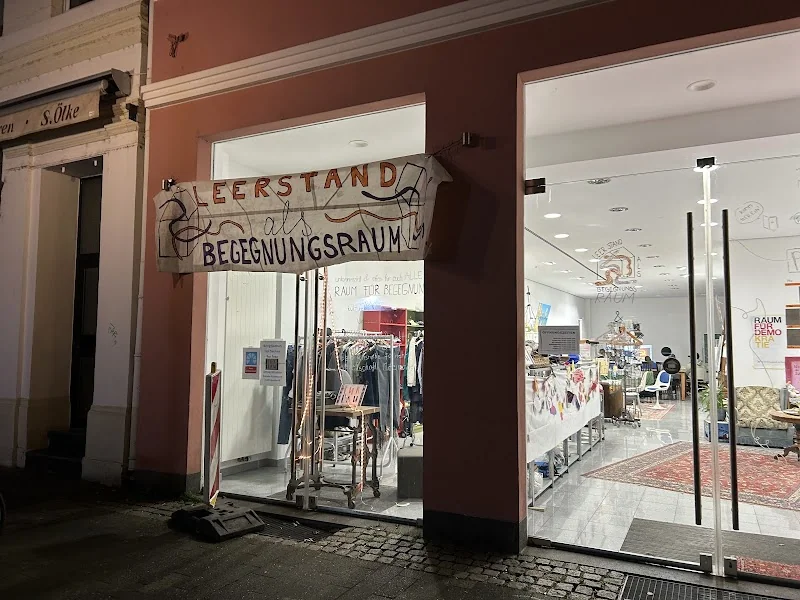
Bonn
Friedrichstraße 5, 53111 Bonn, Deutschland
Vacant Space as Meeting Place Bonn | Programming & Open Space
The vacant space as a meeting place in Bonn is more than an unusual interim use: It is a consciously open space for exchange, lingering, and joint experimentation in the city center. At Friedrichstraße 5, the concept of an open space meets a specific urban environment characterized by foot traffic, everyday routes, and short paths to Friedensplatz. The project originated in October 2023 as a student initiative of Alanus University and has since been further developed multiple times to understand vacancy not as a deficit but as a social opportunity. In May 2026, the space is also in a farewell phase, as the organizers have announced the closure at Friedrichstraße by 31.05.2026. This very mix of openness, change, and urban relevance makes the place interesting for many Bonn residents. ([begegnungsraumbonn.wordpress.com](https://begegnungsraumbonn.wordpress.com/about/))
Vacant Space as Meeting Place Bonn: Idea, Open Space, and Space of Possibilities
The basic idea of the project is clear: An empty retail space in Bonn's city center becomes a space where people can come together without the pressure to buy. The official project description refers to a meeting place that is animated with experimental formats and invites interaction with people outside one's own bubble. This is precisely the strength of this place: It is not only a space for events but also for spontaneous encounters, for conversations while passing by, and for simply being. In a city center often characterized by consumer logic, this project sets a counterpoint. It shows that an empty space does not automatically mean stagnation but can be a space of possibilities where new uses become visible. ([begegnungsraumbonn.wordpress.com](https://begegnungsraumbonn.wordpress.com/about/))
The terms open space, programming, and space of possibilities fit this location so well because they describe not only a functional use but also an attitude. The space is meant to be open to ideas from the urban community, for workshops, art, music, dance, and low-threshold formats that have no entry barriers and no consumption obligation. The initiators see the project as a response to the question of how city centers can remain lively in the future when classic retail models falter. Instead of filling it with the next store of the same chain, it is explored how dialogue, culture, and neighborhood can find a place in an empty retail space. This perspective makes the vacancy as a meeting place an example of how urban development, the common good, and culture can interconnect. ([begegnungsraumbonn.wordpress.com](https://begegnungsraumbonn.wordpress.com/about/))
The development of the idea is also part of its impact. The meeting place was not started as a finished concept but was conceived from the beginning as an open process. The team emphasizes that everyone is invited to participate, from space design to event offerings. This is precisely what distinguishes the project from purely curated cultural venues: Here, the program is created not only for the audience but with them. This creates a special mix of neighborhood feeling, political stance, and cultural practice. Therefore, anyone looking for a vacant space as a meeting place in Bonn is not just looking for an address but a model for how city centers can function differently. ([bonn4future.de](https://www.bonn4future.de/de/organisationen/leerstand-als-begegnungsraum))
Program and Programming: What Meeting Formats Are Available
The programming of the space does not follow a rigid event schedule but a variety of low-threshold formats. The official project page lists meeting formats, workshops, and smaller impulses. The program repeatedly features open and community-based offerings, such as language cafés, senior afternoons, open discussion rounds, co-working, gaming events, music formats, and exhibitions. Formats like repair cafés, intergenerational cafés, or artistic interventions are also mentioned as typical examples. This does not create a classic stage program but a mix of everyday culture, participation, and experimental use. This makes the space attractive for very different target groups: for people who just want to linger briefly, as well as for initiatives looking for a place for exchange or presentation. ([bonn4future.de](https://www.bonn4future.de/de/organisationen/leerstand-als-begegnungsraum))
A special aspect is that the programming of the vacancy is explicitly intended to be co-designed. The project is not only aimed at visitors but also at people who want to contribute ideas, co-organize events, or take on supervisory duties for a few hours. In this sense, the program is not just a calendar but a social process. The spaces are opened not only for events but also for informal use: drinking coffee, asking questions, engaging in conversation with others, or spending the day in an open atmosphere. This strengthens the position of the project as a free place in the city center. It is not a consumption-oriented meeting point but a space where neighborhood, culture, and engagement reinforce each other. Therefore, anyone searching for the keyword vacant space programming will find a practical example of what this term can mean. ([bonn4future.de](https://www.bonn4future.de/de/organisationen/leerstand-als-begegnungsraum))
The thematic breadth of the program is also remarkable. In the publicly visible announcements and the program's progression, formats from the areas of education, culture, conversation, solidarity, and the common good can be found. This includes events with migrant, intergenerational, or political references as well as musical or playful formats. The space is thus not understood as a niche place for a small scene but as an open platform for various Bonn groups. This explains why the space cannot be classified into a single category: It is a meeting place, cultural venue, temporary social meeting point, and experimental urban space at the same time. This ambiguity is not a problem but part of the concept. ([begegnungsraumbonn.wordpress.com](https://begegnungsraumbonn.wordpress.com/programm/))
Opening Hours and Participation: How Everyday Life Works On-Site
The official opening hours make it clear that the space is not only used occasionally but is meant to be present in everyday life. According to the contact page, the meeting place is open Monday to Friday from 3:00 PM to 7:00 PM, Saturday from 12:00 PM to 7:00 PM, and closed on Sundays. At the same time, opening on Sundays for events is still possible. This keeps the place flexible enough for everyday life during the week and for special formats on weekends. This structure is important because it makes the space usable for both spontaneous visits and planned meetings. Therefore, anyone looking for a clear reference to opening hours, presence, and reliability will find a simple and transparent solution here. ([begegnungsraumbonn.wordpress.com](https://begegnungsraumbonn.wordpress.com/kontakt/))
Participation in the vacant space as a meeting place is not a secondary aspect but part of its DNA. The project page describes that volunteers can help with program offerings or with hourly care and supervision tasks. The contact page also points out that support is particularly needed for supervision shifts. This means that the space thrives on people who are willing to fill it with life and secure the open hours. It is not just about classic event work but also about care work in the best sense - about presence, approachability, and the willingness to enable an open space. This creates an atmosphere that is not found in commercial venues. ([bonn4future.de](https://www.bonn4future.de/de/organisationen/leerstand-als-begegnungsraum))
Participation also includes concrete forms of support such as sponsorships, space sponsorships, and donations. The project page explains that the funding of the meeting place has been secured through various funding providers, crowdfunding, donations, and regular solidarity parties. Since the beginning of 2026, there have also been sponsorships, which can support the project monthly. This mix of engagement and funding is typical for community-driven city center projects: The space remains open because many small contributions come together. This makes it robust but also vulnerable - and that is why active participation is so important. Those who want to not only visit the vacant space as a meeting place but also maintain it will find several direct ways to get involved here. ([begegnungsraumbonn.wordpress.com](https://begegnungsraumbonn.wordpress.com/about/))
Friedrichstraße 5 in Bonn: Location, Access, and Barrier-Free Access
The address is clear: Friedrichstraße 5, 53111 Bonn. The project page and the contact page name this location as the current site of the meeting place, after the project was previously active at other inner-city addresses. Additionally, an event announcement describes the new location as very close to Friedensplatz. This is important for orientation because Friedrichstraße is centrally located in Bonn and is embedded in a tight network of pedestrian zones, stops, and parking options. Therefore, anyone heading to the vacant space as a meeting place in Bonn is moving in the heart of the city center and not in a remote area. ([begegnungsraumbonn.wordpress.com](https://begegnungsraumbonn.wordpress.com/kontakt/))
For public transport access, Friedensplatz is a sensible reference point. SWB Bus and Bahn lists Friedensplatz among the Bonn stops and provides its own location plans for it. This is practical because visitors can travel via a central urban mobility network. For drivers, BCP lists several parking garages near Friedensplatz, including the Friedensplatz garage on Oxfordstraße with 810 parking spaces and the Stadthaus garage on Weiherstraße, which is open around the clock. These options are relevant for city center visits as they allow for short distances to the destination. Therefore, anyone looking for parking at the vacant space as a meeting place will find several official underground parking solutions in the immediate vicinity of Friedrichstraße. ([swb-busundbahn.de](https://www.swb-busundbahn.de/fahrplaene/haltestellen/haltestellenlageplaene/?cHash=1d0719cb5cda42555e91fcd850226ac8&mdrv=www.swb-busundbahn.de))
Barrier-free access is also an important plus. An event announcement for the vacant space as a meeting place explicitly names the space as barrier-free accessible, with free entry and German-English openness. This is particularly central for a place of low-threshold encounters because accessibility is understood not only spatially but also socially. An open space needs not only a door without a hurdle but also a climate without unnecessary thresholds. This seems to be intended here: a place that is suitable for both a brief visit and longer stays. This makes the location not only geographically but also culturally well accessible. ([bonn.jetzt](https://bonn.jetzt/event/bazaar-als-begegnungsraum))
From Brüdergasse 4 to Brüdergasse 11 to Friedrichstraße 5: The Development of the Project
The history of the project shows how dynamic interim use can be in the city center. The official about-the-project page explains that the space was initially animated at Brüdergasse 4, but after nine months, a fast-food business moved in. Therefore, the project moved in July 2024 to Brüdergasse 11 and was finally relocated in January 2025 to its current location at Friedrichstraße 5. This development is more than just a change of address: It shows that the city center is understood as a space in flux and that vacant or soon-to-be-vacant retail spaces can be filled with meaning again and again. The history of the project is thus also a story of adaptability. ([begegnungsraumbonn.wordpress.com](https://begegnungsraumbonn.wordpress.com/about/))
The sponsorship and funding underscore this communal character. The project page names early supporters such as Alanus Impact e.V., the support association of Alanus University, the funding program Engagiert in NRW, and a crowdfunding campaign by Bonn Stadtwerke. Later, funding from the Bonn Cultural Office was added, followed by the availability fund of the city center management and, from February 2025, additional support from the Bonn Donation Parliament for the free store “für LaU.” Since December 2025, Bonn im Wandel e.V. has been the sponsoring association of the project. This development shows that the space does not function in isolation but is supported by a network of civil society, institutional, and funding policy support. ([begegnungsraumbonn.wordpress.com](https://begegnungsraumbonn.wordpress.com/about/))
In May 2026, the project is also at the end of an important phase. A current event page announces that the meeting place in Friedrichstraße will be closed by 31.05. and invites to a farewell party. This makes the current use of the place particularly interesting, as it stands not only under the sign of everyday opening but also under the sign of transition. For seekers, this means: Those still looking for vacant space as a meeting place program, opening hours, or photos will find not only an active place but also a project in a historical phase of change. Such moments are relevant for documentation, memory, and local public awareness because they show how quickly city center places can change. ([rausgegangen.de](https://rausgegangen.de/events/abschiedsfeier-leerstand-als-begegnungsraum-0/))
Photos, Press, and Why the Space Remains Important for Bonn
Anyone looking for photos of the vacant space as a meeting place will come across a website that makes the project visible and documents it. The official press review lists several reports from 2023 to 2025, showing that the space has not only arrived as an internal initiative in Bonn but also in public perception. Media reports and images help to transport the idea of the space outward: the conversion of a retail space, the atmosphere of the events, and the diversity of groups using the space. This is important for SEO and local discoverability, but above all for the question of how a city preserves its cultural interim use knowledge. ([begegnungsraumbonn.wordpress.com](https://begegnungsraumbonn.wordpress.com/pressespiegel/))
Substantively, the project stands for more than just a nice city center display. The official description emphasizes that the space should bring people together in non-ordinary ways without requiring a purchase. This is precisely the social value: The place offers an alternative to classic commercial meeting points and creates space for what is often lacking in tightly scheduled city centers - time, conversations, spontaneous contacts, and low-threshold culture. The free store “für LaU” further expands this logic by making sharing and reusing visible. Thus, the space is not only read as a meeting point but also as a practical contribution to solidarity and resource use. ([bonn4future.de](https://www.bonn4future.de/de/organisationen/leerstand-als-begegnungsraum))
This place remains important for Bonn, even if the current phase in Friedrichstraße is time-limited. The meeting place shows that the city center consists not only of trade and consumption but also of social negotiation spaces, voluntary engagement, and cultural self-organization. Its history, its opening hours, its changing programs, and the current farewell phase make it an exciting example of how vacancy can become a visible space of possibilities. And that is why it makes sense to document such places: They often disappear quickly, but their impact remains as experience, as a network, and as a model for future projects. ([begegnungsraumbonn.wordpress.com](https://begegnungsraumbonn.wordpress.com/about/))
Sources:
- Vacant Space as Meeting Place - Official Website
- Vacant Space as Meeting Place - About the Project
- Vacant Space as Meeting Place - Contact & Opening Hours
- Vacant Space as Meeting Place - Program
- Vacant Space as Meeting Place - Press Review
- Bonn in Transition / Bonn4Future - Vacant Space as Meeting Place
- Rausgegangen - Farewell Party from Vacant Space as Meeting Place
- BCP Bonn - Friedensplatz Garage
Show moreShow less
Vacant Space as Meeting Place Bonn | Programming & Open Space
The vacant space as a meeting place in Bonn is more than an unusual interim use: It is a consciously open space for exchange, lingering, and joint experimentation in the city center. At Friedrichstraße 5, the concept of an open space meets a specific urban environment characterized by foot traffic, everyday routes, and short paths to Friedensplatz. The project originated in October 2023 as a student initiative of Alanus University and has since been further developed multiple times to understand vacancy not as a deficit but as a social opportunity. In May 2026, the space is also in a farewell phase, as the organizers have announced the closure at Friedrichstraße by 31.05.2026. This very mix of openness, change, and urban relevance makes the place interesting for many Bonn residents. ([begegnungsraumbonn.wordpress.com](https://begegnungsraumbonn.wordpress.com/about/))
Vacant Space as Meeting Place Bonn: Idea, Open Space, and Space of Possibilities
The basic idea of the project is clear: An empty retail space in Bonn's city center becomes a space where people can come together without the pressure to buy. The official project description refers to a meeting place that is animated with experimental formats and invites interaction with people outside one's own bubble. This is precisely the strength of this place: It is not only a space for events but also for spontaneous encounters, for conversations while passing by, and for simply being. In a city center often characterized by consumer logic, this project sets a counterpoint. It shows that an empty space does not automatically mean stagnation but can be a space of possibilities where new uses become visible. ([begegnungsraumbonn.wordpress.com](https://begegnungsraumbonn.wordpress.com/about/))
The terms open space, programming, and space of possibilities fit this location so well because they describe not only a functional use but also an attitude. The space is meant to be open to ideas from the urban community, for workshops, art, music, dance, and low-threshold formats that have no entry barriers and no consumption obligation. The initiators see the project as a response to the question of how city centers can remain lively in the future when classic retail models falter. Instead of filling it with the next store of the same chain, it is explored how dialogue, culture, and neighborhood can find a place in an empty retail space. This perspective makes the vacancy as a meeting place an example of how urban development, the common good, and culture can interconnect. ([begegnungsraumbonn.wordpress.com](https://begegnungsraumbonn.wordpress.com/about/))
The development of the idea is also part of its impact. The meeting place was not started as a finished concept but was conceived from the beginning as an open process. The team emphasizes that everyone is invited to participate, from space design to event offerings. This is precisely what distinguishes the project from purely curated cultural venues: Here, the program is created not only for the audience but with them. This creates a special mix of neighborhood feeling, political stance, and cultural practice. Therefore, anyone looking for a vacant space as a meeting place in Bonn is not just looking for an address but a model for how city centers can function differently. ([bonn4future.de](https://www.bonn4future.de/de/organisationen/leerstand-als-begegnungsraum))
Program and Programming: What Meeting Formats Are Available
The programming of the space does not follow a rigid event schedule but a variety of low-threshold formats. The official project page lists meeting formats, workshops, and smaller impulses. The program repeatedly features open and community-based offerings, such as language cafés, senior afternoons, open discussion rounds, co-working, gaming events, music formats, and exhibitions. Formats like repair cafés, intergenerational cafés, or artistic interventions are also mentioned as typical examples. This does not create a classic stage program but a mix of everyday culture, participation, and experimental use. This makes the space attractive for very different target groups: for people who just want to linger briefly, as well as for initiatives looking for a place for exchange or presentation. ([bonn4future.de](https://www.bonn4future.de/de/organisationen/leerstand-als-begegnungsraum))
A special aspect is that the programming of the vacancy is explicitly intended to be co-designed. The project is not only aimed at visitors but also at people who want to contribute ideas, co-organize events, or take on supervisory duties for a few hours. In this sense, the program is not just a calendar but a social process. The spaces are opened not only for events but also for informal use: drinking coffee, asking questions, engaging in conversation with others, or spending the day in an open atmosphere. This strengthens the position of the project as a free place in the city center. It is not a consumption-oriented meeting point but a space where neighborhood, culture, and engagement reinforce each other. Therefore, anyone searching for the keyword vacant space programming will find a practical example of what this term can mean. ([bonn4future.de](https://www.bonn4future.de/de/organisationen/leerstand-als-begegnungsraum))
The thematic breadth of the program is also remarkable. In the publicly visible announcements and the program's progression, formats from the areas of education, culture, conversation, solidarity, and the common good can be found. This includes events with migrant, intergenerational, or political references as well as musical or playful formats. The space is thus not understood as a niche place for a small scene but as an open platform for various Bonn groups. This explains why the space cannot be classified into a single category: It is a meeting place, cultural venue, temporary social meeting point, and experimental urban space at the same time. This ambiguity is not a problem but part of the concept. ([begegnungsraumbonn.wordpress.com](https://begegnungsraumbonn.wordpress.com/programm/))
Opening Hours and Participation: How Everyday Life Works On-Site
The official opening hours make it clear that the space is not only used occasionally but is meant to be present in everyday life. According to the contact page, the meeting place is open Monday to Friday from 3:00 PM to 7:00 PM, Saturday from 12:00 PM to 7:00 PM, and closed on Sundays. At the same time, opening on Sundays for events is still possible. This keeps the place flexible enough for everyday life during the week and for special formats on weekends. This structure is important because it makes the space usable for both spontaneous visits and planned meetings. Therefore, anyone looking for a clear reference to opening hours, presence, and reliability will find a simple and transparent solution here. ([begegnungsraumbonn.wordpress.com](https://begegnungsraumbonn.wordpress.com/kontakt/))
Participation in the vacant space as a meeting place is not a secondary aspect but part of its DNA. The project page describes that volunteers can help with program offerings or with hourly care and supervision tasks. The contact page also points out that support is particularly needed for supervision shifts. This means that the space thrives on people who are willing to fill it with life and secure the open hours. It is not just about classic event work but also about care work in the best sense - about presence, approachability, and the willingness to enable an open space. This creates an atmosphere that is not found in commercial venues. ([bonn4future.de](https://www.bonn4future.de/de/organisationen/leerstand-als-begegnungsraum))
Participation also includes concrete forms of support such as sponsorships, space sponsorships, and donations. The project page explains that the funding of the meeting place has been secured through various funding providers, crowdfunding, donations, and regular solidarity parties. Since the beginning of 2026, there have also been sponsorships, which can support the project monthly. This mix of engagement and funding is typical for community-driven city center projects: The space remains open because many small contributions come together. This makes it robust but also vulnerable - and that is why active participation is so important. Those who want to not only visit the vacant space as a meeting place but also maintain it will find several direct ways to get involved here. ([begegnungsraumbonn.wordpress.com](https://begegnungsraumbonn.wordpress.com/about/))
Friedrichstraße 5 in Bonn: Location, Access, and Barrier-Free Access
The address is clear: Friedrichstraße 5, 53111 Bonn. The project page and the contact page name this location as the current site of the meeting place, after the project was previously active at other inner-city addresses. Additionally, an event announcement describes the new location as very close to Friedensplatz. This is important for orientation because Friedrichstraße is centrally located in Bonn and is embedded in a tight network of pedestrian zones, stops, and parking options. Therefore, anyone heading to the vacant space as a meeting place in Bonn is moving in the heart of the city center and not in a remote area. ([begegnungsraumbonn.wordpress.com](https://begegnungsraumbonn.wordpress.com/kontakt/))
For public transport access, Friedensplatz is a sensible reference point. SWB Bus and Bahn lists Friedensplatz among the Bonn stops and provides its own location plans for it. This is practical because visitors can travel via a central urban mobility network. For drivers, BCP lists several parking garages near Friedensplatz, including the Friedensplatz garage on Oxfordstraße with 810 parking spaces and the Stadthaus garage on Weiherstraße, which is open around the clock. These options are relevant for city center visits as they allow for short distances to the destination. Therefore, anyone looking for parking at the vacant space as a meeting place will find several official underground parking solutions in the immediate vicinity of Friedrichstraße. ([swb-busundbahn.de](https://www.swb-busundbahn.de/fahrplaene/haltestellen/haltestellenlageplaene/?cHash=1d0719cb5cda42555e91fcd850226ac8&mdrv=www.swb-busundbahn.de))
Barrier-free access is also an important plus. An event announcement for the vacant space as a meeting place explicitly names the space as barrier-free accessible, with free entry and German-English openness. This is particularly central for a place of low-threshold encounters because accessibility is understood not only spatially but also socially. An open space needs not only a door without a hurdle but also a climate without unnecessary thresholds. This seems to be intended here: a place that is suitable for both a brief visit and longer stays. This makes the location not only geographically but also culturally well accessible. ([bonn.jetzt](https://bonn.jetzt/event/bazaar-als-begegnungsraum))
From Brüdergasse 4 to Brüdergasse 11 to Friedrichstraße 5: The Development of the Project
The history of the project shows how dynamic interim use can be in the city center. The official about-the-project page explains that the space was initially animated at Brüdergasse 4, but after nine months, a fast-food business moved in. Therefore, the project moved in July 2024 to Brüdergasse 11 and was finally relocated in January 2025 to its current location at Friedrichstraße 5. This development is more than just a change of address: It shows that the city center is understood as a space in flux and that vacant or soon-to-be-vacant retail spaces can be filled with meaning again and again. The history of the project is thus also a story of adaptability. ([begegnungsraumbonn.wordpress.com](https://begegnungsraumbonn.wordpress.com/about/))
The sponsorship and funding underscore this communal character. The project page names early supporters such as Alanus Impact e.V., the support association of Alanus University, the funding program Engagiert in NRW, and a crowdfunding campaign by Bonn Stadtwerke. Later, funding from the Bonn Cultural Office was added, followed by the availability fund of the city center management and, from February 2025, additional support from the Bonn Donation Parliament for the free store “für LaU.” Since December 2025, Bonn im Wandel e.V. has been the sponsoring association of the project. This development shows that the space does not function in isolation but is supported by a network of civil society, institutional, and funding policy support. ([begegnungsraumbonn.wordpress.com](https://begegnungsraumbonn.wordpress.com/about/))
In May 2026, the project is also at the end of an important phase. A current event page announces that the meeting place in Friedrichstraße will be closed by 31.05. and invites to a farewell party. This makes the current use of the place particularly interesting, as it stands not only under the sign of everyday opening but also under the sign of transition. For seekers, this means: Those still looking for vacant space as a meeting place program, opening hours, or photos will find not only an active place but also a project in a historical phase of change. Such moments are relevant for documentation, memory, and local public awareness because they show how quickly city center places can change. ([rausgegangen.de](https://rausgegangen.de/events/abschiedsfeier-leerstand-als-begegnungsraum-0/))
Photos, Press, and Why the Space Remains Important for Bonn
Anyone looking for photos of the vacant space as a meeting place will come across a website that makes the project visible and documents it. The official press review lists several reports from 2023 to 2025, showing that the space has not only arrived as an internal initiative in Bonn but also in public perception. Media reports and images help to transport the idea of the space outward: the conversion of a retail space, the atmosphere of the events, and the diversity of groups using the space. This is important for SEO and local discoverability, but above all for the question of how a city preserves its cultural interim use knowledge. ([begegnungsraumbonn.wordpress.com](https://begegnungsraumbonn.wordpress.com/pressespiegel/))
Substantively, the project stands for more than just a nice city center display. The official description emphasizes that the space should bring people together in non-ordinary ways without requiring a purchase. This is precisely the social value: The place offers an alternative to classic commercial meeting points and creates space for what is often lacking in tightly scheduled city centers - time, conversations, spontaneous contacts, and low-threshold culture. The free store “für LaU” further expands this logic by making sharing and reusing visible. Thus, the space is not only read as a meeting point but also as a practical contribution to solidarity and resource use. ([bonn4future.de](https://www.bonn4future.de/de/organisationen/leerstand-als-begegnungsraum))
This place remains important for Bonn, even if the current phase in Friedrichstraße is time-limited. The meeting place shows that the city center consists not only of trade and consumption but also of social negotiation spaces, voluntary engagement, and cultural self-organization. Its history, its opening hours, its changing programs, and the current farewell phase make it an exciting example of how vacancy can become a visible space of possibilities. And that is why it makes sense to document such places: They often disappear quickly, but their impact remains as experience, as a network, and as a model for future projects. ([begegnungsraumbonn.wordpress.com](https://begegnungsraumbonn.wordpress.com/about/))
Sources:
- Vacant Space as Meeting Place - Official Website
- Vacant Space as Meeting Place - About the Project
- Vacant Space as Meeting Place - Contact & Opening Hours
- Vacant Space as Meeting Place - Program
- Vacant Space as Meeting Place - Press Review
- Bonn in Transition / Bonn4Future - Vacant Space as Meeting Place
- Rausgegangen - Farewell Party from Vacant Space as Meeting Place
- BCP Bonn - Friedensplatz Garage
Vacant Space as Meeting Place Bonn | Programming & Open Space
The vacant space as a meeting place in Bonn is more than an unusual interim use: It is a consciously open space for exchange, lingering, and joint experimentation in the city center. At Friedrichstraße 5, the concept of an open space meets a specific urban environment characterized by foot traffic, everyday routes, and short paths to Friedensplatz. The project originated in October 2023 as a student initiative of Alanus University and has since been further developed multiple times to understand vacancy not as a deficit but as a social opportunity. In May 2026, the space is also in a farewell phase, as the organizers have announced the closure at Friedrichstraße by 31.05.2026. This very mix of openness, change, and urban relevance makes the place interesting for many Bonn residents. ([begegnungsraumbonn.wordpress.com](https://begegnungsraumbonn.wordpress.com/about/))
Vacant Space as Meeting Place Bonn: Idea, Open Space, and Space of Possibilities
The basic idea of the project is clear: An empty retail space in Bonn's city center becomes a space where people can come together without the pressure to buy. The official project description refers to a meeting place that is animated with experimental formats and invites interaction with people outside one's own bubble. This is precisely the strength of this place: It is not only a space for events but also for spontaneous encounters, for conversations while passing by, and for simply being. In a city center often characterized by consumer logic, this project sets a counterpoint. It shows that an empty space does not automatically mean stagnation but can be a space of possibilities where new uses become visible. ([begegnungsraumbonn.wordpress.com](https://begegnungsraumbonn.wordpress.com/about/))
The terms open space, programming, and space of possibilities fit this location so well because they describe not only a functional use but also an attitude. The space is meant to be open to ideas from the urban community, for workshops, art, music, dance, and low-threshold formats that have no entry barriers and no consumption obligation. The initiators see the project as a response to the question of how city centers can remain lively in the future when classic retail models falter. Instead of filling it with the next store of the same chain, it is explored how dialogue, culture, and neighborhood can find a place in an empty retail space. This perspective makes the vacancy as a meeting place an example of how urban development, the common good, and culture can interconnect. ([begegnungsraumbonn.wordpress.com](https://begegnungsraumbonn.wordpress.com/about/))
The development of the idea is also part of its impact. The meeting place was not started as a finished concept but was conceived from the beginning as an open process. The team emphasizes that everyone is invited to participate, from space design to event offerings. This is precisely what distinguishes the project from purely curated cultural venues: Here, the program is created not only for the audience but with them. This creates a special mix of neighborhood feeling, political stance, and cultural practice. Therefore, anyone looking for a vacant space as a meeting place in Bonn is not just looking for an address but a model for how city centers can function differently. ([bonn4future.de](https://www.bonn4future.de/de/organisationen/leerstand-als-begegnungsraum))
Program and Programming: What Meeting Formats Are Available
The programming of the space does not follow a rigid event schedule but a variety of low-threshold formats. The official project page lists meeting formats, workshops, and smaller impulses. The program repeatedly features open and community-based offerings, such as language cafés, senior afternoons, open discussion rounds, co-working, gaming events, music formats, and exhibitions. Formats like repair cafés, intergenerational cafés, or artistic interventions are also mentioned as typical examples. This does not create a classic stage program but a mix of everyday culture, participation, and experimental use. This makes the space attractive for very different target groups: for people who just want to linger briefly, as well as for initiatives looking for a place for exchange or presentation. ([bonn4future.de](https://www.bonn4future.de/de/organisationen/leerstand-als-begegnungsraum))
A special aspect is that the programming of the vacancy is explicitly intended to be co-designed. The project is not only aimed at visitors but also at people who want to contribute ideas, co-organize events, or take on supervisory duties for a few hours. In this sense, the program is not just a calendar but a social process. The spaces are opened not only for events but also for informal use: drinking coffee, asking questions, engaging in conversation with others, or spending the day in an open atmosphere. This strengthens the position of the project as a free place in the city center. It is not a consumption-oriented meeting point but a space where neighborhood, culture, and engagement reinforce each other. Therefore, anyone searching for the keyword vacant space programming will find a practical example of what this term can mean. ([bonn4future.de](https://www.bonn4future.de/de/organisationen/leerstand-als-begegnungsraum))
The thematic breadth of the program is also remarkable. In the publicly visible announcements and the program's progression, formats from the areas of education, culture, conversation, solidarity, and the common good can be found. This includes events with migrant, intergenerational, or political references as well as musical or playful formats. The space is thus not understood as a niche place for a small scene but as an open platform for various Bonn groups. This explains why the space cannot be classified into a single category: It is a meeting place, cultural venue, temporary social meeting point, and experimental urban space at the same time. This ambiguity is not a problem but part of the concept. ([begegnungsraumbonn.wordpress.com](https://begegnungsraumbonn.wordpress.com/programm/))
Opening Hours and Participation: How Everyday Life Works On-Site
The official opening hours make it clear that the space is not only used occasionally but is meant to be present in everyday life. According to the contact page, the meeting place is open Monday to Friday from 3:00 PM to 7:00 PM, Saturday from 12:00 PM to 7:00 PM, and closed on Sundays. At the same time, opening on Sundays for events is still possible. This keeps the place flexible enough for everyday life during the week and for special formats on weekends. This structure is important because it makes the space usable for both spontaneous visits and planned meetings. Therefore, anyone looking for a clear reference to opening hours, presence, and reliability will find a simple and transparent solution here. ([begegnungsraumbonn.wordpress.com](https://begegnungsraumbonn.wordpress.com/kontakt/))
Participation in the vacant space as a meeting place is not a secondary aspect but part of its DNA. The project page describes that volunteers can help with program offerings or with hourly care and supervision tasks. The contact page also points out that support is particularly needed for supervision shifts. This means that the space thrives on people who are willing to fill it with life and secure the open hours. It is not just about classic event work but also about care work in the best sense - about presence, approachability, and the willingness to enable an open space. This creates an atmosphere that is not found in commercial venues. ([bonn4future.de](https://www.bonn4future.de/de/organisationen/leerstand-als-begegnungsraum))
Participation also includes concrete forms of support such as sponsorships, space sponsorships, and donations. The project page explains that the funding of the meeting place has been secured through various funding providers, crowdfunding, donations, and regular solidarity parties. Since the beginning of 2026, there have also been sponsorships, which can support the project monthly. This mix of engagement and funding is typical for community-driven city center projects: The space remains open because many small contributions come together. This makes it robust but also vulnerable - and that is why active participation is so important. Those who want to not only visit the vacant space as a meeting place but also maintain it will find several direct ways to get involved here. ([begegnungsraumbonn.wordpress.com](https://begegnungsraumbonn.wordpress.com/about/))
Friedrichstraße 5 in Bonn: Location, Access, and Barrier-Free Access
The address is clear: Friedrichstraße 5, 53111 Bonn. The project page and the contact page name this location as the current site of the meeting place, after the project was previously active at other inner-city addresses. Additionally, an event announcement describes the new location as very close to Friedensplatz. This is important for orientation because Friedrichstraße is centrally located in Bonn and is embedded in a tight network of pedestrian zones, stops, and parking options. Therefore, anyone heading to the vacant space as a meeting place in Bonn is moving in the heart of the city center and not in a remote area. ([begegnungsraumbonn.wordpress.com](https://begegnungsraumbonn.wordpress.com/kontakt/))
For public transport access, Friedensplatz is a sensible reference point. SWB Bus and Bahn lists Friedensplatz among the Bonn stops and provides its own location plans for it. This is practical because visitors can travel via a central urban mobility network. For drivers, BCP lists several parking garages near Friedensplatz, including the Friedensplatz garage on Oxfordstraße with 810 parking spaces and the Stadthaus garage on Weiherstraße, which is open around the clock. These options are relevant for city center visits as they allow for short distances to the destination. Therefore, anyone looking for parking at the vacant space as a meeting place will find several official underground parking solutions in the immediate vicinity of Friedrichstraße. ([swb-busundbahn.de](https://www.swb-busundbahn.de/fahrplaene/haltestellen/haltestellenlageplaene/?cHash=1d0719cb5cda42555e91fcd850226ac8&mdrv=www.swb-busundbahn.de))
Barrier-free access is also an important plus. An event announcement for the vacant space as a meeting place explicitly names the space as barrier-free accessible, with free entry and German-English openness. This is particularly central for a place of low-threshold encounters because accessibility is understood not only spatially but also socially. An open space needs not only a door without a hurdle but also a climate without unnecessary thresholds. This seems to be intended here: a place that is suitable for both a brief visit and longer stays. This makes the location not only geographically but also culturally well accessible. ([bonn.jetzt](https://bonn.jetzt/event/bazaar-als-begegnungsraum))
From Brüdergasse 4 to Brüdergasse 11 to Friedrichstraße 5: The Development of the Project
The history of the project shows how dynamic interim use can be in the city center. The official about-the-project page explains that the space was initially animated at Brüdergasse 4, but after nine months, a fast-food business moved in. Therefore, the project moved in July 2024 to Brüdergasse 11 and was finally relocated in January 2025 to its current location at Friedrichstraße 5. This development is more than just a change of address: It shows that the city center is understood as a space in flux and that vacant or soon-to-be-vacant retail spaces can be filled with meaning again and again. The history of the project is thus also a story of adaptability. ([begegnungsraumbonn.wordpress.com](https://begegnungsraumbonn.wordpress.com/about/))
The sponsorship and funding underscore this communal character. The project page names early supporters such as Alanus Impact e.V., the support association of Alanus University, the funding program Engagiert in NRW, and a crowdfunding campaign by Bonn Stadtwerke. Later, funding from the Bonn Cultural Office was added, followed by the availability fund of the city center management and, from February 2025, additional support from the Bonn Donation Parliament for the free store “für LaU.” Since December 2025, Bonn im Wandel e.V. has been the sponsoring association of the project. This development shows that the space does not function in isolation but is supported by a network of civil society, institutional, and funding policy support. ([begegnungsraumbonn.wordpress.com](https://begegnungsraumbonn.wordpress.com/about/))
In May 2026, the project is also at the end of an important phase. A current event page announces that the meeting place in Friedrichstraße will be closed by 31.05. and invites to a farewell party. This makes the current use of the place particularly interesting, as it stands not only under the sign of everyday opening but also under the sign of transition. For seekers, this means: Those still looking for vacant space as a meeting place program, opening hours, or photos will find not only an active place but also a project in a historical phase of change. Such moments are relevant for documentation, memory, and local public awareness because they show how quickly city center places can change. ([rausgegangen.de](https://rausgegangen.de/events/abschiedsfeier-leerstand-als-begegnungsraum-0/))
Photos, Press, and Why the Space Remains Important for Bonn
Anyone looking for photos of the vacant space as a meeting place will come across a website that makes the project visible and documents it. The official press review lists several reports from 2023 to 2025, showing that the space has not only arrived as an internal initiative in Bonn but also in public perception. Media reports and images help to transport the idea of the space outward: the conversion of a retail space, the atmosphere of the events, and the diversity of groups using the space. This is important for SEO and local discoverability, but above all for the question of how a city preserves its cultural interim use knowledge. ([begegnungsraumbonn.wordpress.com](https://begegnungsraumbonn.wordpress.com/pressespiegel/))
Substantively, the project stands for more than just a nice city center display. The official description emphasizes that the space should bring people together in non-ordinary ways without requiring a purchase. This is precisely the social value: The place offers an alternative to classic commercial meeting points and creates space for what is often lacking in tightly scheduled city centers - time, conversations, spontaneous contacts, and low-threshold culture. The free store “für LaU” further expands this logic by making sharing and reusing visible. Thus, the space is not only read as a meeting point but also as a practical contribution to solidarity and resource use. ([bonn4future.de](https://www.bonn4future.de/de/organisationen/leerstand-als-begegnungsraum))
This place remains important for Bonn, even if the current phase in Friedrichstraße is time-limited. The meeting place shows that the city center consists not only of trade and consumption but also of social negotiation spaces, voluntary engagement, and cultural self-organization. Its history, its opening hours, its changing programs, and the current farewell phase make it an exciting example of how vacancy can become a visible space of possibilities. And that is why it makes sense to document such places: They often disappear quickly, but their impact remains as experience, as a network, and as a model for future projects. ([begegnungsraumbonn.wordpress.com](https://begegnungsraumbonn.wordpress.com/about/))
Sources:
- Vacant Space as Meeting Place - Official Website
- Vacant Space as Meeting Place - About the Project
- Vacant Space as Meeting Place - Contact & Opening Hours
- Vacant Space as Meeting Place - Program
- Vacant Space as Meeting Place - Press Review
- Bonn in Transition / Bonn4Future - Vacant Space as Meeting Place
- Rausgegangen - Farewell Party from Vacant Space as Meeting Place
- BCP Bonn - Friedensplatz Garage
Frequently Asked Questions
Reviews
No reviews found