
Bonn
Bornheimer Str. 130, 53119 Bonn, Deutschland
Intersection at St. Helena | Events & Tickets
The Intersection at St. Helena is one of those places that you don't just visit, but discover. In Bonn's Nordstadt, at Bornheimer Straße 130, there is no classic multipurpose hall, but a church space with its own stance: quiet in appearance, clear in form, and open to art, music, liturgy, and conversation. Since 2004, the association Intersection at St. Helena has been responsible for the program realized there, transforming a former parish church space into a dialogue space where Christian worship and contemporary culture consciously meet. This very tension is what makes it special: The space does not want to be neutral, but rather to enable friction, resonance, and new perspectives. At the center stands a white marble altar that focuses the gaze, while the use of the space extends far beyond worship services. Therefore, those looking for events, tickets, or the current program will find not only dates here but also a clear idea of cultural openness. ([kreuzung-helena.de](https://kreuzung-helena.de/home/?utm_source=openai))
Events, Services, and the Current Program
The program of the Intersection at St. Helena is intentionally diverse. The official website and event entries clearly show that the place is not limited to a single format but is intended as a stage for different forms of expression. A recurring event is the 5vor12 service, celebrated as an open circle on every third Sunday of the month, attracting people from Bonn, Brühl, and Cologne. In addition, there are exhibitions like PEACE OF ART or TRACING LOVE, which transform the space into a temporary art experience, and concert formats like The Dissonant Series or free improvisation evenings that explore the acoustic character of the church space. Soundwalks, workshops, and discussion formats are also part of the profile. This creates a program that does not operate according to a fixed scheme but continually generates new relationships between content, space, and audience. ([kreuzung-helena.de](https://kreuzung-helena.de/home/?utm_source=openai))
For inquiries about events, programs, or services, the Intersection at St. Helena is particularly interesting because the content is not only listed on a date page but arises from a clear conceptual idea. The official project text describes the space as a place where Christian worship confronts science, social reality, and other areas of interest. This explains the range of events: sometimes liturgical and spiritual, sometimes musical and experimental, sometimes literary or discursive. This means for visitors: Those expecting an evening of free music can find just as much as someone looking for an exhibition with discussions or an open service. The place thrives on the change of perspectives, not on a single permanent concept. This keeps the program open, surprising, and thematically precise. ([kreuzung-helena.de](https://kreuzung-helena.de/das-projekt/?utm_source=openai))
This is particularly evident in the recurring categories on the website. Under services, the 5vor12 celebrations appear, under exhibitions, changing artistic projects, and under concerts, formats from jazz, improvised music, and contemporary sound art. This diversity is no coincidence but part of the association's self-understanding. The founding members explicitly wanted to create new intersections, meaning encounters that do not detach Christian faith but relate it to artistic and social practice. Therefore, those looking for a program should not only look for an event calendar but for a conceptual line: This is about dialogue, not mere programming. This also explains why many events on the website are accompanied by explanatory texts, artistic names, and contextual backgrounds. ([kreuzung-helena.de](https://kreuzung-helena.de/das-projekt/?utm_source=openai))
Tickets, Admission, and Reservations
Those searching for tickets at the Intersection at St. Helena should read the individual dates carefully, as the pricing structure is not uniform. The venue operates with an event model where some formats have free admission, others are paid, and some require registration or ticket reservation. For example, the exhibition PEACE OF ART is marked as free admission, while the concert The Dissonant Series lists ticket prices between 6 and 15 euros and offers ticket reservations via email or phone. This illustrates very well how flexibly the venue is used: Not every event follows the same rules, but each event communicates its conditions transparently in the respective date text. Therefore, for the search for tickets, not only the name of the location is crucial, but especially the specific event. ([kreuzung-helena.de](https://kreuzung-helena.de/veranstaltung/the-dissonant-series-weiterbauen-dietrich-petzold-erhard-hirt-klaus-kuervers/?utm_source=openai))
This ticket structure fits the character of the house. The Intersection at St. Helena is not a large operation with a standardized advance sales system, but a culture- and dialogue-oriented space where organizers and audiences often come into direct contact. That is why specific contacts, email addresses, or notes such as free admission, box office, reservation, or advance registration can repeatedly be found in the dates. For visitors, this is practical: One can already see on the date page whether it is an open, free event or an evening with limited seats and admission. Therefore, anyone interested in a concert, an exhibition opening, or a workshop should carefully check the respective entry and not just read the location sentence. This way, purchasing tickets or making reservations becomes quick and understandable. ([kreuzung-helena.de](https://kreuzung-helena.de/veranstaltung/the-dissonant-series-weiterbauen-dietrich-petzold-erhard-hirt-klaus-kuervers/?utm_source=openai))
Also important for the search term tickets: The Intersection at St. Helena is not a classic ticket seller with a central shop for the entire house, but a location where the rules change from format to format. Especially for artistic projects or free music evenings, reservations directly with the organizer are common, while other events like services or certain exhibitions remain openly accessible. Therefore, those optimizing for SEO for this location should reflect the spectrum: free dates, reservation-required evenings, donation-based, and regular admission prices. This mix corresponds to the real practice on site and makes the venue attractive for different target groups. At the same time, it strengthens the search intentions around programs, tickets, box office, and advance registration. ([kreuzung-helena.de](https://kreuzung-helena.de/veranstaltung/the-dissonant-series-weiterbauen-dietrich-petzold-erhard-hirt-klaus-kuervers/?utm_source=openai))
Architecture, Space, and Equipment
Architecturally, the Intersection at St. Helena is a very special place. The church building does not immediately catch the eye in the busy Bornheimer Straße, but rather on a second glance: It is embedded in the building facade, has a windowless slate front, and is only recognizable as a church by a small bell. The actual church space is located on the upper floor and reaches an almost cubic shape. According to the official description, it measures 19.6 meters in length, 18.8 meters in width, and 17 meters in height. It is illuminated only by a courtyard-side, upper-running window band, which gives the space a restrained, concentrated light atmosphere. This spatial construction is exciting for events because it does not rely on representation but on concentration, echo, and presence. ([kreuzung-helena.de](https://kreuzung-helena.de/der-ort/?utm_source=openai))
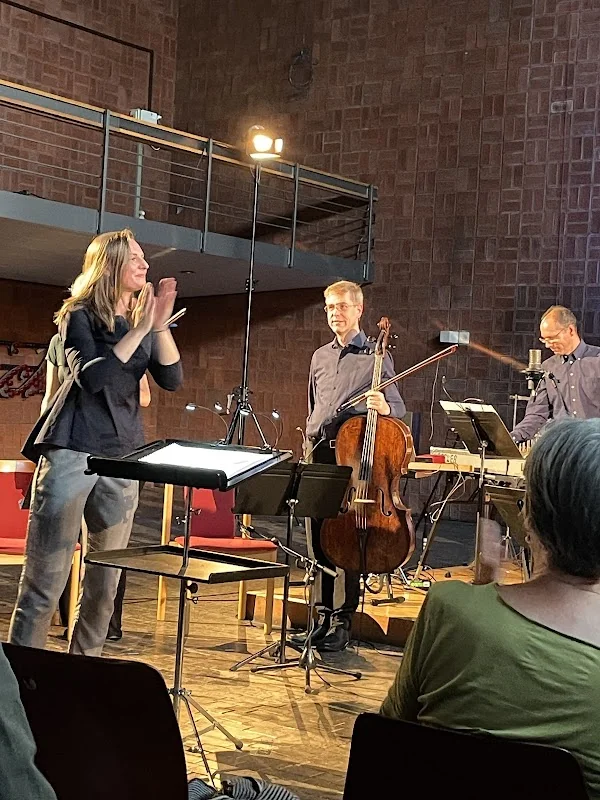
Inside, a simple room opens up with reddish-brown hollow brick walls, a flat ceiling, and a steel tube construction. On the street side, there is a simple gallery, and in the center stands the altar on a single-step wooden platform. Particularly defining is the large block of light Carrara marble, which rests on a marble column and visually and liturgically organizes the space. The official description emphasizes that this column leads through the floor into the small chapel below, where the tabernacle is located. This architecture is particularly effective for concerts and exhibitions because it does not overload the space but defines it through material, proportion, and brightness. The place thus appears both sacred, modern, and very distinctive. ([kreuzung-helena.de](https://kreuzung-helena.de/der-ort/?utm_source=openai))
The seating is also noteworthy: According to the official representation, the benches were already arranged in a U-shape around the altar before the liturgical reform of the Second Vatican Council generally shaped this closeness to the assembly. This is more than an architectural detail, as it explains why the space is so suitable for dialogical formats. Audience, artists, speakers sit not in an anonymous hall arrangement but in a constellation that allows for relationships. This is part of the appeal: The church has not become a museum space but continues to be experienced as a place where encounter, perception, and liturgical presence come together. For SEO and content, this is important because the space itself is an argument, not just the events within it. ([kreuzung-helena.de](https://kreuzung-helena.de/der-ort/?utm_source=openai))
History and Idea of the Dialogue Space
The history of the Intersection at St. Helena begins with a change in use. When the parish no longer needed the space for its services, the association Intersection at St. Helena – A Dialogue Space for Christian Worship and Contemporary Culture e.V. was established in 2004. Since then, the association has been responsible for and finances the program realized there, while the parish of St. Peter covers the maintenance costs of the building complex. This is an important basis for understanding the place: It is neither a mere rental space nor a pure community hall but a consciously developed dialogue space. The name Intersection is programmatic, as it refers to the meeting of different levels, interpretations, and cultural languages. ([kreuzung-helena.de](https://kreuzung-helena.de/der-ort/?utm_source=openai))
The official project description articulates this idea very clearly: Art and religion are in a reciprocal relationship; both need empty spaces where they can unfold their own energy, and this is precisely the space the association wants to open. This is not meant as an abstract theory but as a practical working mandate. Therefore, the Intersection at St. Helena invites experimental encounters and connects Christian worship with science, social reality, visual arts, performing arts, music, and new media. The focus is not on separation but on productive tension. The place thus becomes a multifaceted cultural resonance space where questions about life, faith, conflicts, and self-transcendence explicitly have a place. ([kreuzung-helena.de](https://kreuzung-helena.de/das-projekt/?utm_source=openai))
Architecturally and historically, it is also important to note that the church was consecrated in 1960 and designed by architects Emil Steffann and Nikolaus Rosiny. The architectural history of the building is thus closely linked to its later cultural repurposing. The official description of the location also emphasizes that the architects wanted to implement the guiding idea of the pilgrimage of peoples to the Temple Mount in Jerusalem architecturally. This explains the special mix of severity, openness, and liturgical concentration. For visitors, this means: Entering the Intersection at St. Helena is not entering just any event venue but a space with its own spiritual and architectural memory. This is what makes the location so interesting for cultural and event searches. ([kreuzung-helena.de](https://kreuzung-helena.de/der-ort/?utm_source=openai))
Access, Location, and Parking in Bonn-Nordstadt
The Intersection at St. Helena is located at Bornheimer Straße 130 in 53119 Bonn, in Bonn's Nordstadt. The location is central and urban, but not quiet: Bornheimer Straße is a busy arterial road heading north, and the church building does not stand out monumentally in the surrounding development but integrates into the street front. For access, this means primarily that the place is well anchored in the urban space and can generally be easily found, but is also more strongly shaped by the urban environment than by a closed event campus. Therefore, those coming to an event should pay attention to the directions provided by the respective organizer and not just save the address. ([kreuzung-helena.de](https://kreuzung-helena.de/der-ort/?utm_source=openai))
There is no dedicated general parking page with reserved spaces on the official website. Therefore, it is particularly practical to read the respective event or the current notices from the house. For the Beethovenfest entry in 2026, it was explicitly noted that parking on the street and at the roadside is currently not possible due to construction work. This is a time-sensitive note and may change, but it clearly shows that the parking situation in this area is not always comfortable. Therefore, arriving by public transport, on foot, or by bicycle is often the most relaxed solution for guests. Those arriving by car should check in advance whether the event has special instructions regarding access or parking options. ([beethovenfest.de](https://www.beethovenfest.de/de/veranstaltungsorte/kreuzung-an-st-helena/36?utm_source=openai))
From an SEO perspective, the topic of access and parking is also important because many visitors search for such information before purchasing tickets. The honest answer for the Intersection at St. Helena is: The address is clear, the location is central, but the house itself does not advertise its own parking spaces. At the same time, Nordstadt, with its urban structures, is well connected to public transport and is attractive for many event formats due to its proximity to Bonn's center. For example, those coming to an evening concert, an exhibition opening, or a service benefit from the urban location but should plan a small time buffer when arriving by car. Conditions can change quickly, especially with construction sites or special events. ([kreuzung-helena.de](https://kreuzung-helena.de/der-ort/?utm_source=openai))
Accessibility, Visitor Information, and Special Formats
An important practical point is accessibility. The space is located on the upper floor and is accessed via a rear stairwell, according to the official description. This means that the access is not comparable to a classic ground-level foyer. Additionally, the Beethovenfest lists the Intersection at St. Helena as an exception in its accessibility overview, for which no wheelchair spaces are designated. Therefore, it is advisable for visitors with special mobility needs to inquire in advance, especially regarding seating, admission, or support on site. Especially for smaller and individual formats, it is important to coordinate early with the organizer. ([kreuzung-helena.de](https://kreuzung-helena.de/der-ort/?utm_source=openai))
What is particularly exciting is that the Intersection at St. Helena hosts not only cultural events but also liturgical and experimental formats. Officially, the space is a place for encounters and experiments; in practice, the spectrum ranges from services to exhibitions and performances to musical boundary crossings. This explains why the place appears in both church and artistic search contexts. Those looking for events in Bonn, a special cultural space, or an alternative place for worship will find a location that consciously transcends these boundaries. The mix of sacred aura, clear architecture, and contemporary programming makes the place a unique entity in Bonn's cultural landscape. ([kreuzung-helena.de](https://kreuzung-helena.de/home/?utm_source=openai))
Prominent examples include the regular 5vor12 service, the exhibition PEACE OF ART, the show TRACING LOVE, the concert evening The Dissonant Series, and various workshops and listening formats. These examples show that the Intersection at St. Helena is both a religious and a cultural place, but not side by side, rather intertwined. This connection is attractive for visitors because it continually offers new experiences. The place demands attention, openness, and curiosity but rewards these with a very distinctive atmosphere. Therefore, those looking for a location with profile will find not just a building but an attitude here. ([kreuzung-helena.de](https://kreuzung-helena.de/veranstaltung/the-dissonant-series-weiterbauen-dietrich-petzold-erhard-hirt-klaus-kuervers/?utm_source=openai))
Sources:
Show moreShow less
Intersection at St. Helena | Events & Tickets
The Intersection at St. Helena is one of those places that you don't just visit, but discover. In Bonn's Nordstadt, at Bornheimer Straße 130, there is no classic multipurpose hall, but a church space with its own stance: quiet in appearance, clear in form, and open to art, music, liturgy, and conversation. Since 2004, the association Intersection at St. Helena has been responsible for the program realized there, transforming a former parish church space into a dialogue space where Christian worship and contemporary culture consciously meet. This very tension is what makes it special: The space does not want to be neutral, but rather to enable friction, resonance, and new perspectives. At the center stands a white marble altar that focuses the gaze, while the use of the space extends far beyond worship services. Therefore, those looking for events, tickets, or the current program will find not only dates here but also a clear idea of cultural openness. ([kreuzung-helena.de](https://kreuzung-helena.de/home/?utm_source=openai))
Events, Services, and the Current Program
The program of the Intersection at St. Helena is intentionally diverse. The official website and event entries clearly show that the place is not limited to a single format but is intended as a stage for different forms of expression. A recurring event is the 5vor12 service, celebrated as an open circle on every third Sunday of the month, attracting people from Bonn, Brühl, and Cologne. In addition, there are exhibitions like PEACE OF ART or TRACING LOVE, which transform the space into a temporary art experience, and concert formats like The Dissonant Series or free improvisation evenings that explore the acoustic character of the church space. Soundwalks, workshops, and discussion formats are also part of the profile. This creates a program that does not operate according to a fixed scheme but continually generates new relationships between content, space, and audience. ([kreuzung-helena.de](https://kreuzung-helena.de/home/?utm_source=openai))
For inquiries about events, programs, or services, the Intersection at St. Helena is particularly interesting because the content is not only listed on a date page but arises from a clear conceptual idea. The official project text describes the space as a place where Christian worship confronts science, social reality, and other areas of interest. This explains the range of events: sometimes liturgical and spiritual, sometimes musical and experimental, sometimes literary or discursive. This means for visitors: Those expecting an evening of free music can find just as much as someone looking for an exhibition with discussions or an open service. The place thrives on the change of perspectives, not on a single permanent concept. This keeps the program open, surprising, and thematically precise. ([kreuzung-helena.de](https://kreuzung-helena.de/das-projekt/?utm_source=openai))
This is particularly evident in the recurring categories on the website. Under services, the 5vor12 celebrations appear, under exhibitions, changing artistic projects, and under concerts, formats from jazz, improvised music, and contemporary sound art. This diversity is no coincidence but part of the association's self-understanding. The founding members explicitly wanted to create new intersections, meaning encounters that do not detach Christian faith but relate it to artistic and social practice. Therefore, those looking for a program should not only look for an event calendar but for a conceptual line: This is about dialogue, not mere programming. This also explains why many events on the website are accompanied by explanatory texts, artistic names, and contextual backgrounds. ([kreuzung-helena.de](https://kreuzung-helena.de/das-projekt/?utm_source=openai))
Tickets, Admission, and Reservations
Those searching for tickets at the Intersection at St. Helena should read the individual dates carefully, as the pricing structure is not uniform. The venue operates with an event model where some formats have free admission, others are paid, and some require registration or ticket reservation. For example, the exhibition PEACE OF ART is marked as free admission, while the concert The Dissonant Series lists ticket prices between 6 and 15 euros and offers ticket reservations via email or phone. This illustrates very well how flexibly the venue is used: Not every event follows the same rules, but each event communicates its conditions transparently in the respective date text. Therefore, for the search for tickets, not only the name of the location is crucial, but especially the specific event. ([kreuzung-helena.de](https://kreuzung-helena.de/veranstaltung/the-dissonant-series-weiterbauen-dietrich-petzold-erhard-hirt-klaus-kuervers/?utm_source=openai))
This ticket structure fits the character of the house. The Intersection at St. Helena is not a large operation with a standardized advance sales system, but a culture- and dialogue-oriented space where organizers and audiences often come into direct contact. That is why specific contacts, email addresses, or notes such as free admission, box office, reservation, or advance registration can repeatedly be found in the dates. For visitors, this is practical: One can already see on the date page whether it is an open, free event or an evening with limited seats and admission. Therefore, anyone interested in a concert, an exhibition opening, or a workshop should carefully check the respective entry and not just read the location sentence. This way, purchasing tickets or making reservations becomes quick and understandable. ([kreuzung-helena.de](https://kreuzung-helena.de/veranstaltung/the-dissonant-series-weiterbauen-dietrich-petzold-erhard-hirt-klaus-kuervers/?utm_source=openai))
Also important for the search term tickets: The Intersection at St. Helena is not a classic ticket seller with a central shop for the entire house, but a location where the rules change from format to format. Especially for artistic projects or free music evenings, reservations directly with the organizer are common, while other events like services or certain exhibitions remain openly accessible. Therefore, those optimizing for SEO for this location should reflect the spectrum: free dates, reservation-required evenings, donation-based, and regular admission prices. This mix corresponds to the real practice on site and makes the venue attractive for different target groups. At the same time, it strengthens the search intentions around programs, tickets, box office, and advance registration. ([kreuzung-helena.de](https://kreuzung-helena.de/veranstaltung/the-dissonant-series-weiterbauen-dietrich-petzold-erhard-hirt-klaus-kuervers/?utm_source=openai))
Architecture, Space, and Equipment
Architecturally, the Intersection at St. Helena is a very special place. The church building does not immediately catch the eye in the busy Bornheimer Straße, but rather on a second glance: It is embedded in the building facade, has a windowless slate front, and is only recognizable as a church by a small bell. The actual church space is located on the upper floor and reaches an almost cubic shape. According to the official description, it measures 19.6 meters in length, 18.8 meters in width, and 17 meters in height. It is illuminated only by a courtyard-side, upper-running window band, which gives the space a restrained, concentrated light atmosphere. This spatial construction is exciting for events because it does not rely on representation but on concentration, echo, and presence. ([kreuzung-helena.de](https://kreuzung-helena.de/der-ort/?utm_source=openai))
Inside, a simple room opens up with reddish-brown hollow brick walls, a flat ceiling, and a steel tube construction. On the street side, there is a simple gallery, and in the center stands the altar on a single-step wooden platform. Particularly defining is the large block of light Carrara marble, which rests on a marble column and visually and liturgically organizes the space. The official description emphasizes that this column leads through the floor into the small chapel below, where the tabernacle is located. This architecture is particularly effective for concerts and exhibitions because it does not overload the space but defines it through material, proportion, and brightness. The place thus appears both sacred, modern, and very distinctive. ([kreuzung-helena.de](https://kreuzung-helena.de/der-ort/?utm_source=openai))
The seating is also noteworthy: According to the official representation, the benches were already arranged in a U-shape around the altar before the liturgical reform of the Second Vatican Council generally shaped this closeness to the assembly. This is more than an architectural detail, as it explains why the space is so suitable for dialogical formats. Audience, artists, speakers sit not in an anonymous hall arrangement but in a constellation that allows for relationships. This is part of the appeal: The church has not become a museum space but continues to be experienced as a place where encounter, perception, and liturgical presence come together. For SEO and content, this is important because the space itself is an argument, not just the events within it. ([kreuzung-helena.de](https://kreuzung-helena.de/der-ort/?utm_source=openai))
History and Idea of the Dialogue Space
The history of the Intersection at St. Helena begins with a change in use. When the parish no longer needed the space for its services, the association Intersection at St. Helena – A Dialogue Space for Christian Worship and Contemporary Culture e.V. was established in 2004. Since then, the association has been responsible for and finances the program realized there, while the parish of St. Peter covers the maintenance costs of the building complex. This is an important basis for understanding the place: It is neither a mere rental space nor a pure community hall but a consciously developed dialogue space. The name Intersection is programmatic, as it refers to the meeting of different levels, interpretations, and cultural languages. ([kreuzung-helena.de](https://kreuzung-helena.de/der-ort/?utm_source=openai))
The official project description articulates this idea very clearly: Art and religion are in a reciprocal relationship; both need empty spaces where they can unfold their own energy, and this is precisely the space the association wants to open. This is not meant as an abstract theory but as a practical working mandate. Therefore, the Intersection at St. Helena invites experimental encounters and connects Christian worship with science, social reality, visual arts, performing arts, music, and new media. The focus is not on separation but on productive tension. The place thus becomes a multifaceted cultural resonance space where questions about life, faith, conflicts, and self-transcendence explicitly have a place. ([kreuzung-helena.de](https://kreuzung-helena.de/das-projekt/?utm_source=openai))
Architecturally and historically, it is also important to note that the church was consecrated in 1960 and designed by architects Emil Steffann and Nikolaus Rosiny. The architectural history of the building is thus closely linked to its later cultural repurposing. The official description of the location also emphasizes that the architects wanted to implement the guiding idea of the pilgrimage of peoples to the Temple Mount in Jerusalem architecturally. This explains the special mix of severity, openness, and liturgical concentration. For visitors, this means: Entering the Intersection at St. Helena is not entering just any event venue but a space with its own spiritual and architectural memory. This is what makes the location so interesting for cultural and event searches. ([kreuzung-helena.de](https://kreuzung-helena.de/der-ort/?utm_source=openai))
Access, Location, and Parking in Bonn-Nordstadt
The Intersection at St. Helena is located at Bornheimer Straße 130 in 53119 Bonn, in Bonn's Nordstadt. The location is central and urban, but not quiet: Bornheimer Straße is a busy arterial road heading north, and the church building does not stand out monumentally in the surrounding development but integrates into the street front. For access, this means primarily that the place is well anchored in the urban space and can generally be easily found, but is also more strongly shaped by the urban environment than by a closed event campus. Therefore, those coming to an event should pay attention to the directions provided by the respective organizer and not just save the address. ([kreuzung-helena.de](https://kreuzung-helena.de/der-ort/?utm_source=openai))
There is no dedicated general parking page with reserved spaces on the official website. Therefore, it is particularly practical to read the respective event or the current notices from the house. For the Beethovenfest entry in 2026, it was explicitly noted that parking on the street and at the roadside is currently not possible due to construction work. This is a time-sensitive note and may change, but it clearly shows that the parking situation in this area is not always comfortable. Therefore, arriving by public transport, on foot, or by bicycle is often the most relaxed solution for guests. Those arriving by car should check in advance whether the event has special instructions regarding access or parking options. ([beethovenfest.de](https://www.beethovenfest.de/de/veranstaltungsorte/kreuzung-an-st-helena/36?utm_source=openai))
From an SEO perspective, the topic of access and parking is also important because many visitors search for such information before purchasing tickets. The honest answer for the Intersection at St. Helena is: The address is clear, the location is central, but the house itself does not advertise its own parking spaces. At the same time, Nordstadt, with its urban structures, is well connected to public transport and is attractive for many event formats due to its proximity to Bonn's center. For example, those coming to an evening concert, an exhibition opening, or a service benefit from the urban location but should plan a small time buffer when arriving by car. Conditions can change quickly, especially with construction sites or special events. ([kreuzung-helena.de](https://kreuzung-helena.de/der-ort/?utm_source=openai))
Accessibility, Visitor Information, and Special Formats
An important practical point is accessibility. The space is located on the upper floor and is accessed via a rear stairwell, according to the official description. This means that the access is not comparable to a classic ground-level foyer. Additionally, the Beethovenfest lists the Intersection at St. Helena as an exception in its accessibility overview, for which no wheelchair spaces are designated. Therefore, it is advisable for visitors with special mobility needs to inquire in advance, especially regarding seating, admission, or support on site. Especially for smaller and individual formats, it is important to coordinate early with the organizer. ([kreuzung-helena.de](https://kreuzung-helena.de/der-ort/?utm_source=openai))
What is particularly exciting is that the Intersection at St. Helena hosts not only cultural events but also liturgical and experimental formats. Officially, the space is a place for encounters and experiments; in practice, the spectrum ranges from services to exhibitions and performances to musical boundary crossings. This explains why the place appears in both church and artistic search contexts. Those looking for events in Bonn, a special cultural space, or an alternative place for worship will find a location that consciously transcends these boundaries. The mix of sacred aura, clear architecture, and contemporary programming makes the place a unique entity in Bonn's cultural landscape. ([kreuzung-helena.de](https://kreuzung-helena.de/home/?utm_source=openai))
Prominent examples include the regular 5vor12 service, the exhibition PEACE OF ART, the show TRACING LOVE, the concert evening The Dissonant Series, and various workshops and listening formats. These examples show that the Intersection at St. Helena is both a religious and a cultural place, but not side by side, rather intertwined. This connection is attractive for visitors because it continually offers new experiences. The place demands attention, openness, and curiosity but rewards these with a very distinctive atmosphere. Therefore, those looking for a location with profile will find not just a building but an attitude here. ([kreuzung-helena.de](https://kreuzung-helena.de/veranstaltung/the-dissonant-series-weiterbauen-dietrich-petzold-erhard-hirt-klaus-kuervers/?utm_source=openai))
Sources:
Intersection at St. Helena | Events & Tickets
The Intersection at St. Helena is one of those places that you don't just visit, but discover. In Bonn's Nordstadt, at Bornheimer Straße 130, there is no classic multipurpose hall, but a church space with its own stance: quiet in appearance, clear in form, and open to art, music, liturgy, and conversation. Since 2004, the association Intersection at St. Helena has been responsible for the program realized there, transforming a former parish church space into a dialogue space where Christian worship and contemporary culture consciously meet. This very tension is what makes it special: The space does not want to be neutral, but rather to enable friction, resonance, and new perspectives. At the center stands a white marble altar that focuses the gaze, while the use of the space extends far beyond worship services. Therefore, those looking for events, tickets, or the current program will find not only dates here but also a clear idea of cultural openness. ([kreuzung-helena.de](https://kreuzung-helena.de/home/?utm_source=openai))
Events, Services, and the Current Program
The program of the Intersection at St. Helena is intentionally diverse. The official website and event entries clearly show that the place is not limited to a single format but is intended as a stage for different forms of expression. A recurring event is the 5vor12 service, celebrated as an open circle on every third Sunday of the month, attracting people from Bonn, Brühl, and Cologne. In addition, there are exhibitions like PEACE OF ART or TRACING LOVE, which transform the space into a temporary art experience, and concert formats like The Dissonant Series or free improvisation evenings that explore the acoustic character of the church space. Soundwalks, workshops, and discussion formats are also part of the profile. This creates a program that does not operate according to a fixed scheme but continually generates new relationships between content, space, and audience. ([kreuzung-helena.de](https://kreuzung-helena.de/home/?utm_source=openai))
For inquiries about events, programs, or services, the Intersection at St. Helena is particularly interesting because the content is not only listed on a date page but arises from a clear conceptual idea. The official project text describes the space as a place where Christian worship confronts science, social reality, and other areas of interest. This explains the range of events: sometimes liturgical and spiritual, sometimes musical and experimental, sometimes literary or discursive. This means for visitors: Those expecting an evening of free music can find just as much as someone looking for an exhibition with discussions or an open service. The place thrives on the change of perspectives, not on a single permanent concept. This keeps the program open, surprising, and thematically precise. ([kreuzung-helena.de](https://kreuzung-helena.de/das-projekt/?utm_source=openai))
This is particularly evident in the recurring categories on the website. Under services, the 5vor12 celebrations appear, under exhibitions, changing artistic projects, and under concerts, formats from jazz, improvised music, and contemporary sound art. This diversity is no coincidence but part of the association's self-understanding. The founding members explicitly wanted to create new intersections, meaning encounters that do not detach Christian faith but relate it to artistic and social practice. Therefore, those looking for a program should not only look for an event calendar but for a conceptual line: This is about dialogue, not mere programming. This also explains why many events on the website are accompanied by explanatory texts, artistic names, and contextual backgrounds. ([kreuzung-helena.de](https://kreuzung-helena.de/das-projekt/?utm_source=openai))
Tickets, Admission, and Reservations
Those searching for tickets at the Intersection at St. Helena should read the individual dates carefully, as the pricing structure is not uniform. The venue operates with an event model where some formats have free admission, others are paid, and some require registration or ticket reservation. For example, the exhibition PEACE OF ART is marked as free admission, while the concert The Dissonant Series lists ticket prices between 6 and 15 euros and offers ticket reservations via email or phone. This illustrates very well how flexibly the venue is used: Not every event follows the same rules, but each event communicates its conditions transparently in the respective date text. Therefore, for the search for tickets, not only the name of the location is crucial, but especially the specific event. ([kreuzung-helena.de](https://kreuzung-helena.de/veranstaltung/the-dissonant-series-weiterbauen-dietrich-petzold-erhard-hirt-klaus-kuervers/?utm_source=openai))
This ticket structure fits the character of the house. The Intersection at St. Helena is not a large operation with a standardized advance sales system, but a culture- and dialogue-oriented space where organizers and audiences often come into direct contact. That is why specific contacts, email addresses, or notes such as free admission, box office, reservation, or advance registration can repeatedly be found in the dates. For visitors, this is practical: One can already see on the date page whether it is an open, free event or an evening with limited seats and admission. Therefore, anyone interested in a concert, an exhibition opening, or a workshop should carefully check the respective entry and not just read the location sentence. This way, purchasing tickets or making reservations becomes quick and understandable. ([kreuzung-helena.de](https://kreuzung-helena.de/veranstaltung/the-dissonant-series-weiterbauen-dietrich-petzold-erhard-hirt-klaus-kuervers/?utm_source=openai))
Also important for the search term tickets: The Intersection at St. Helena is not a classic ticket seller with a central shop for the entire house, but a location where the rules change from format to format. Especially for artistic projects or free music evenings, reservations directly with the organizer are common, while other events like services or certain exhibitions remain openly accessible. Therefore, those optimizing for SEO for this location should reflect the spectrum: free dates, reservation-required evenings, donation-based, and regular admission prices. This mix corresponds to the real practice on site and makes the venue attractive for different target groups. At the same time, it strengthens the search intentions around programs, tickets, box office, and advance registration. ([kreuzung-helena.de](https://kreuzung-helena.de/veranstaltung/the-dissonant-series-weiterbauen-dietrich-petzold-erhard-hirt-klaus-kuervers/?utm_source=openai))
Architecture, Space, and Equipment
Architecturally, the Intersection at St. Helena is a very special place. The church building does not immediately catch the eye in the busy Bornheimer Straße, but rather on a second glance: It is embedded in the building facade, has a windowless slate front, and is only recognizable as a church by a small bell. The actual church space is located on the upper floor and reaches an almost cubic shape. According to the official description, it measures 19.6 meters in length, 18.8 meters in width, and 17 meters in height. It is illuminated only by a courtyard-side, upper-running window band, which gives the space a restrained, concentrated light atmosphere. This spatial construction is exciting for events because it does not rely on representation but on concentration, echo, and presence. ([kreuzung-helena.de](https://kreuzung-helena.de/der-ort/?utm_source=openai))
Inside, a simple room opens up with reddish-brown hollow brick walls, a flat ceiling, and a steel tube construction. On the street side, there is a simple gallery, and in the center stands the altar on a single-step wooden platform. Particularly defining is the large block of light Carrara marble, which rests on a marble column and visually and liturgically organizes the space. The official description emphasizes that this column leads through the floor into the small chapel below, where the tabernacle is located. This architecture is particularly effective for concerts and exhibitions because it does not overload the space but defines it through material, proportion, and brightness. The place thus appears both sacred, modern, and very distinctive. ([kreuzung-helena.de](https://kreuzung-helena.de/der-ort/?utm_source=openai))
The seating is also noteworthy: According to the official representation, the benches were already arranged in a U-shape around the altar before the liturgical reform of the Second Vatican Council generally shaped this closeness to the assembly. This is more than an architectural detail, as it explains why the space is so suitable for dialogical formats. Audience, artists, speakers sit not in an anonymous hall arrangement but in a constellation that allows for relationships. This is part of the appeal: The church has not become a museum space but continues to be experienced as a place where encounter, perception, and liturgical presence come together. For SEO and content, this is important because the space itself is an argument, not just the events within it. ([kreuzung-helena.de](https://kreuzung-helena.de/der-ort/?utm_source=openai))
History and Idea of the Dialogue Space
The history of the Intersection at St. Helena begins with a change in use. When the parish no longer needed the space for its services, the association Intersection at St. Helena – A Dialogue Space for Christian Worship and Contemporary Culture e.V. was established in 2004. Since then, the association has been responsible for and finances the program realized there, while the parish of St. Peter covers the maintenance costs of the building complex. This is an important basis for understanding the place: It is neither a mere rental space nor a pure community hall but a consciously developed dialogue space. The name Intersection is programmatic, as it refers to the meeting of different levels, interpretations, and cultural languages. ([kreuzung-helena.de](https://kreuzung-helena.de/der-ort/?utm_source=openai))
The official project description articulates this idea very clearly: Art and religion are in a reciprocal relationship; both need empty spaces where they can unfold their own energy, and this is precisely the space the association wants to open. This is not meant as an abstract theory but as a practical working mandate. Therefore, the Intersection at St. Helena invites experimental encounters and connects Christian worship with science, social reality, visual arts, performing arts, music, and new media. The focus is not on separation but on productive tension. The place thus becomes a multifaceted cultural resonance space where questions about life, faith, conflicts, and self-transcendence explicitly have a place. ([kreuzung-helena.de](https://kreuzung-helena.de/das-projekt/?utm_source=openai))
Architecturally and historically, it is also important to note that the church was consecrated in 1960 and designed by architects Emil Steffann and Nikolaus Rosiny. The architectural history of the building is thus closely linked to its later cultural repurposing. The official description of the location also emphasizes that the architects wanted to implement the guiding idea of the pilgrimage of peoples to the Temple Mount in Jerusalem architecturally. This explains the special mix of severity, openness, and liturgical concentration. For visitors, this means: Entering the Intersection at St. Helena is not entering just any event venue but a space with its own spiritual and architectural memory. This is what makes the location so interesting for cultural and event searches. ([kreuzung-helena.de](https://kreuzung-helena.de/der-ort/?utm_source=openai))
Access, Location, and Parking in Bonn-Nordstadt
The Intersection at St. Helena is located at Bornheimer Straße 130 in 53119 Bonn, in Bonn's Nordstadt. The location is central and urban, but not quiet: Bornheimer Straße is a busy arterial road heading north, and the church building does not stand out monumentally in the surrounding development but integrates into the street front. For access, this means primarily that the place is well anchored in the urban space and can generally be easily found, but is also more strongly shaped by the urban environment than by a closed event campus. Therefore, those coming to an event should pay attention to the directions provided by the respective organizer and not just save the address. ([kreuzung-helena.de](https://kreuzung-helena.de/der-ort/?utm_source=openai))
There is no dedicated general parking page with reserved spaces on the official website. Therefore, it is particularly practical to read the respective event or the current notices from the house. For the Beethovenfest entry in 2026, it was explicitly noted that parking on the street and at the roadside is currently not possible due to construction work. This is a time-sensitive note and may change, but it clearly shows that the parking situation in this area is not always comfortable. Therefore, arriving by public transport, on foot, or by bicycle is often the most relaxed solution for guests. Those arriving by car should check in advance whether the event has special instructions regarding access or parking options. ([beethovenfest.de](https://www.beethovenfest.de/de/veranstaltungsorte/kreuzung-an-st-helena/36?utm_source=openai))
From an SEO perspective, the topic of access and parking is also important because many visitors search for such information before purchasing tickets. The honest answer for the Intersection at St. Helena is: The address is clear, the location is central, but the house itself does not advertise its own parking spaces. At the same time, Nordstadt, with its urban structures, is well connected to public transport and is attractive for many event formats due to its proximity to Bonn's center. For example, those coming to an evening concert, an exhibition opening, or a service benefit from the urban location but should plan a small time buffer when arriving by car. Conditions can change quickly, especially with construction sites or special events. ([kreuzung-helena.de](https://kreuzung-helena.de/der-ort/?utm_source=openai))
Accessibility, Visitor Information, and Special Formats
An important practical point is accessibility. The space is located on the upper floor and is accessed via a rear stairwell, according to the official description. This means that the access is not comparable to a classic ground-level foyer. Additionally, the Beethovenfest lists the Intersection at St. Helena as an exception in its accessibility overview, for which no wheelchair spaces are designated. Therefore, it is advisable for visitors with special mobility needs to inquire in advance, especially regarding seating, admission, or support on site. Especially for smaller and individual formats, it is important to coordinate early with the organizer. ([kreuzung-helena.de](https://kreuzung-helena.de/der-ort/?utm_source=openai))
What is particularly exciting is that the Intersection at St. Helena hosts not only cultural events but also liturgical and experimental formats. Officially, the space is a place for encounters and experiments; in practice, the spectrum ranges from services to exhibitions and performances to musical boundary crossings. This explains why the place appears in both church and artistic search contexts. Those looking for events in Bonn, a special cultural space, or an alternative place for worship will find a location that consciously transcends these boundaries. The mix of sacred aura, clear architecture, and contemporary programming makes the place a unique entity in Bonn's cultural landscape. ([kreuzung-helena.de](https://kreuzung-helena.de/home/?utm_source=openai))
Prominent examples include the regular 5vor12 service, the exhibition PEACE OF ART, the show TRACING LOVE, the concert evening The Dissonant Series, and various workshops and listening formats. These examples show that the Intersection at St. Helena is both a religious and a cultural place, but not side by side, rather intertwined. This connection is attractive for visitors because it continually offers new experiences. The place demands attention, openness, and curiosity but rewards these with a very distinctive atmosphere. Therefore, those looking for a location with profile will find not just a building but an attitude here. ([kreuzung-helena.de](https://kreuzung-helena.de/veranstaltung/the-dissonant-series-weiterbauen-dietrich-petzold-erhard-hirt-klaus-kuervers/?utm_source=openai))
Sources:
Upcoming Events
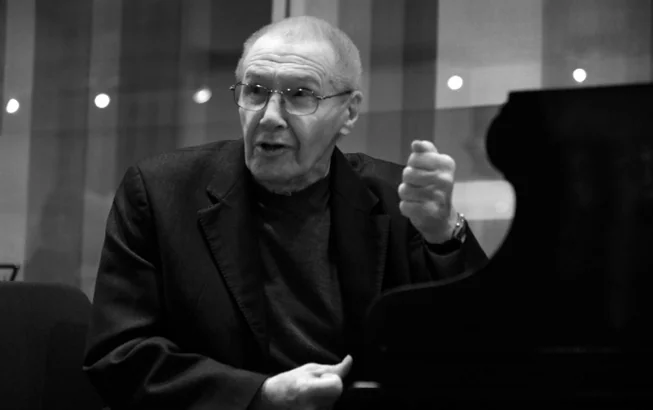
GYÖRGY KURTÁG. KAFKA-FRAGMENTS
An evening of silence, tension, and fine sound art in Bonn: György Kurtág's Kafka-Fragmente in a special church space. 27.06.2026, €21. Discover now. #CultureBonn

Beethovenfest 2026: Momi Maiga: Solo
Momi Maiga live in Bonn: Intimate solo in the special church space of the Intersection at St. Helena. 2.10.2026, 19 Euros. Secure tickets now! #Beethovenfest
Frequently Asked Questions
Reviews
Odárka
17. June 2023
Awesome concerts and great drinks. Accessible, heartfelt, the best from those who know their music. Thanks for this incredible atmosphere.
Hubert Kögler
11. November 2018
Eccentric, abstract, distant, evangelical. If you're satisfied with yourself, then it's wonderful. Strong altar, brick all around, and otherwise just calls to this and that.
Michael Wienigk
15. January 2025
Lovely personal milonga. Nice hosts. Potluck buffet, occasionally live music.
Rudolf Hoven
11. December 2022
Great avant-garde music events by in-situ-society. Today: Xenakis Festival.
Gerold von Waltersheim
2. June 2018
Very good cultural programs, artists who are not mainstream. Highly recommended. Gerold.