
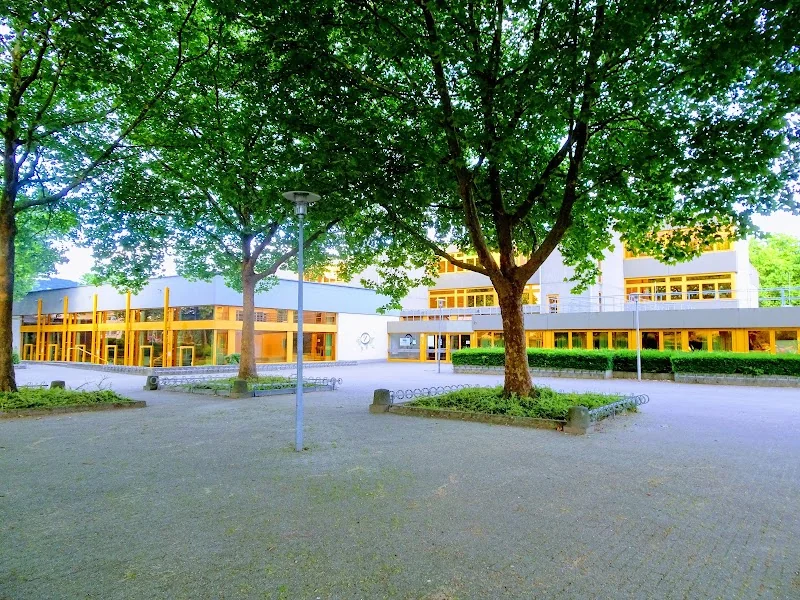
Albertus-Magnus-Straße 21, Bonn-Bad Godesberg
Albertus-Magnus-Straße 21, 53177 Bonn, Germany
Johannes-Rau-Schule | Bonn-Bad Godesberg & Pennenfeld
The Johannes-Rau-Schule is the municipal community secondary school in the Bonn district of Bad Godesberg and is located in the district of Pennenfeld, a few kilometers south of Bonn's city center. At the location Albertus-Magnus-Straße 21, the school is part of the Pennenfeld school center and thus embedded in a developed educational environment with specialized rooms, an auditorium, and sports facilities. According to the official school directory of the state of NRW, around 273 students are taught here; at the same time, the school is the only secondary school in the Bad Godesberg district according to municipal development planning. The sponsor is the federal city of Bonn. As a full-day school with inclusive education, the Johannes-Rau-Schule combines teaching, support, and practical relevance in a reliable daily rhythm. For parents and fourth graders, the date published by the city for the open house on April 18, 2026, offers a good opportunity to get an immediate impression of the rooms, concept, and school community. Those wishing to reach the school will find the public transport stop Bonn Albertus-Magnus-Str. in the neighborhood, which is served by the Bonn bus line 612; there are also connections to the light rail and regional transport via the Bad Godesberg junction. The most important contact details are recorded in the municipal school directory as well as on the school website.
School Profile, Full Day, and School Management: What Sets the Johannes-Rau-Schule Apart
As a state community secondary school of the city of Bonn, the Johannes-Rau-Schule fulfills a clear educational mandate in the secondary level I. It offers full-day instruction in an extended full-day operation; this means that the school day is rhythmized, and learning and practice phases are combined with working groups, projects, and offers for individual support. The school is officially designated as a school of inclusive education. This allows students with different support needs to learn and work together. The Ministry of School and Education NRW explicitly names support focuses such as learning, language, emotional and social development, intellectual development, hearing and communication (deaf and hard of hearing), physical and motor development, and vision (blind and visually impaired). This profile shapes the pedagogical work in teaching and in the full day as well as the cooperation with special education and extracurricular partners. Foreign language instruction includes English; as part of the full day, typical AG and trial offers, student representation work, and parent-teacher conferences are scheduled throughout the year, as the school’s calendar shows. The school culture also includes counseling, career orientation, and practical experiences – at secondary schools, internships in the upper grades are a fixed part of the educational path. Organizationally, the Johannes-Rau-Schule is three-streamed, which supports a manageable, personal learning environment. The school is led by the principal, Ms. Hahn; the naming of the school management is documented in the current schedule published by the school. Through the secretariat and the municipal information page, the contact methods (telephone, email, website) are centrally bundled. As a school under public sponsorship, the Johannes-Rau-Schule has the usual participation bodies of the school conference, parent council, and student representation. In total, this creates a profile that combines reliability in the full day with lived diversity of inclusive education and clear career orientation – precisely tailored for a secondary school in an urban area.
Access, Public Transport, and Accessibility in Pennenfeld: How to Get to the School
The address Albertus-Magnus-Straße 21 locates the Johannes-Rau-Schule in the south of Bonn, in the district of Pennenfeld in Bad Godesberg. For orientation: It is about 2.5 kilometers to the city center of Bad Godesberg, and the Bonn city center is about eight kilometers away. The neighborhood is connected to the network of Bonn Stadtwerke (SWB) and the Rhein-Sieg transport association (VRS). Particularly relevant is the stop Bonn Albertus-Magnus-Str., which is located in the immediate vicinity of the school center and is served by the Bonn bus line 612; this line connects, among other things, Pennenfeld with junctions towards Bad Godesberg and the Rhine. Those traveling further can transfer to the light rail at the stations in Bad Godesberg (train station/concert hall) and reach the school center via the buses in southern Godesberg. For those arriving by car, the municipal school page provides route options; in the residential area, there are usually public parking spaces along the streets. For parents dropping off or picking up children, it is advisable – as is common at school locations – to plan ahead with short walking distances to ease the traffic situation before school starts. Traveling barrier-free: Inclusive education makes accessible access a cross-cutting issue; this begins with reliable public transport connections and continues in the school’s daily organization. For the first visit – such as on the open house day – it is worthwhile to plan a few minutes buffer for finding a suitable parking space in the neighborhood and, if necessary, to switch to the bus. Regardless of the mode of transport, the address and contact details are centrally recorded on the municipal school page, making digital route planning (including public transport connection information) easy.
History of the Johannes-Rau-Schule and the Pennenfeld School Center
The roots of the present Johannes-Rau-Schule date back to the 1960s: In 1968, the Pennenfeld secondary school emerged from the Protestant primary school on Robert-Koch-Straße. With the new construction of the Pennenfeld school center, the move to Albertus-Magnus-Straße took place in 1976. On December 10, 1976, the school center was ceremoniously inaugurated by the then Mayor of Bonn, Hans Daniels. The new building complex was designed to meet the needs of secondary schools in the growing district and offered spacious specialized and workshop rooms, an auditorium, and a gymnasium. Over the years, in addition to the secondary school, the school center also hosted secondary school offerings: The Geschwister-Scholl-Realschule moved in at that time; later, the secondary school at the location was known as Carl-Schurz-Realschule. The communal use of specialized rooms, workshops, and sports facilities shaped daily life in the school center – a good foundation for practical learning forms, as is typical in secondary schools. In 2007, the secondary school was named Johannes-Rau-Schule – in memory of Johannes Rau (1931–2006), the later Federal President of the Federal Republic of Germany. The history of the secondary school at the location came to an end in 2021, after the Bonn city council decided in 2016 to gradually dissolve it. Remaining as the secondary school in Pennenfeld is the Johannes-Rau-Schule, which today – organized in three streams – solely covers the secondary school branch in the Bad Godesberg district. The historical development from an individual secondary school location to the named school center and back to a clearly defined secondary school location shows how closely school policy, demographics, and urban infrastructure in Bonn interact. The fact that the school center was designed for around 1,000 students explains the still noticeable spatial generosity in specialized areas, auditorium, and sports facilities. This spatial quality is not least a plus for full-day offerings and project-oriented learning.
Facilities and Rooms: Practical Subjects, Auditorium, and Sports at the Location
The spatial facilities of the Johannes-Rau-Schule and the Pennenfeld school center are a central feature of the location. Already at the inauguration, the scientific specialized rooms, the workshop center, the auditorium, and the sports hall were highlighted – infrastructure that supports practical, action-oriented learning. For experiments, technical and workshop projects, specialized rooms and workshops are available; presentations, music, and project performances benefit from the auditorium as a large gathering space. For physical education, the location has a single-field sports hall; municipal documents also list a separate gymnastics room. This range covers the sports curricula and simultaneously enables extracurricular offerings in the full day. For lesson organization, this means: Learning arrangements can specifically switch between classrooms, specialized rooms, workshops, sports hall, and auditorium throughout the day. This promotes motivation and learning effectiveness because learning and applying come together spatially. In the full-day structure, the use of the rooms can also be rhythmized more project-oriented – from AGs with a practical focus to scientific explorations to performances in the auditorium setting. The shared use of historically grown resources from the school center facilitates cooperation within the location and with external partners from the neighborhood, business, and clubs. For guests – for example, on the open house day – this spatial connection is particularly vivid: Those walking through specialized rooms and workshops experience the practical side of learning directly; those taking a seat in the auditorium feel the community character of the school; and those glancing into the sports hall recognize how naturally movement and health fit into the school day. These spatial qualities are not a minor matter but the basis for the Johannes-Rau-Schule to meaningfully link learning time, practice time, and leisure time as a full-day school – especially in secondary school, where preparation for training and careers also works through practice, projects, and presentations.
Inclusive Education, Support, and Transitions: How the School Supports Individual Paths
The official school profile as a school of inclusive education particularly shapes the Johannes-Rau-Schule. Inclusive education means that students with different support needs learn together in the classroom – with the support of special educational expertise and tailored support. The support focuses named by the state of NRW are broad: learning, language, emotional and social development, intellectual development, hearing and communication (deaf and hard of hearing), physical and motor development, and vision (blind and visually impaired). Such a range requires systematic diagnostics, team teaching approaches, and flexible learning arrangements in the full day – and it also facilitates making potentials visible, building strengths, and experiencing self-efficacy. In secondary level I, standardized learning assessments and final exams are part of the educational path: The state-wide comparative assessments VERA 8 (German, English, Mathematics) and the central exams at the end of grade 10 (ZP 10) are part of the school year cycle. The published schedule of the Johannes-Rau-Schule explicitly shows these fixed points. Career orientation is central in the secondary school branch: Internships, company explorations, and cooperation with local partners support transitions into training and further educational paths. The spatial embedding in the Pennenfeld school center – with specialized rooms, workshops, auditorium, and sports hall – is an advantage for this, as it organizationally facilitates practical-oriented formats. The three-stream organization and the manageable school size (around 273 learners) also create short paths and a reliable relationship structure between teachers, students, and parents. This is complemented by committee work (parent council, school conference) and by full-day offerings that integrate social learning, movement, and culture into everyday life. Overall, a learning environment emerges that demands performance, enables support, and provides orientation – with a view to the various school leaving certificates of the secondary school and the pathways into training or further education.
Open House Day, Information, and Insights for Families
For parents of fourth graders and interested students, the open house day is the best opportunity to get to know the Johannes-Rau-Schule personally. The official event calendar of the city of Bonn names Saturday, April 18, 2026, from 10:00 AM to 1:00 PM as the date for the open house. On this morning, teachers, students, and school management can typically be approached directly; rooms, specialized areas, and full-day offerings can be viewed on-site. It is particularly helpful to combine the visit with arrival via public transport: The stop Bonn Albertus-Magnus-Str. is located in the neighborhood and is served by bus line 612 – from there, it is only a few minutes' walk to the school grounds. Those arriving by car should plan some time for parking in the residential area, as there is no designated parking garage at the location. For initial impressions in advance, it is worthwhile to look at the school website and the municipal information pages, which bundle the official contact details. Since the Johannes-Rau-Schule is located in the historic Pennenfeld school center, photos of specialized rooms, workshops, auditorium, and sports hall provide a good impression of how practical and communal learning takes place here. It is also sensible to take a look at the published schedule of the current school year: It provides orientation about parent-teacher conferences, meetings, exam dates (including VERA 8 and ZP 10), and special action days. Those interested in the educational profile will also find in the official entries the designation of inclusive education with its support focuses – an important note for families who value inclusive learning environments. Overall, the open house day is a compact, reliable format to experience the working methods, rooms, and atmosphere of the Johannes-Rau-Schule up close and to clarify individual questions about certificates, full day, or transitions.
Context: The Johannes-Rau-Schule in the Bad Godesberg District
Bad Godesberg is a traditional educational location with dense school infrastructure – especially in the area of high schools. The Johannes-Rau-Schule clearly profiles itself as the only secondary school in the district: It fills an important gap in the offerings of secondary schools and bundles full-day, practical relevance, and inclusion at the Pennenfeld location. The integration into the district is also evident in terms of transport: Through the junctions Bad Godesberg train station and concert hall, the light rail and bus network are closely linked; the location is easily accessible from the city and districts south of the center – including Pennenfeld, Lannesdorf, Mehlem, and Plittersdorf. For spatial orientation, robust key data from municipal documents are helpful: The school center is about 2.5 kilometers from the Godesberg city center; the Bonn city center is about eight kilometers away. The fact that the Pennenfeld school center was designed for a capacity of around 1,000 learners explains the still usable reserves in specialized rooms, auditorium, and sports halls – a location advantage that counts especially in the full day. In this environment, the connection of teaching, individual support, career orientation, and school community can be particularly well lived. Those who know Bad Godesberg as a residential and educational location also know that cultural offerings, clubs, sports, and local recreation are closely intertwined – this also benefits a secondary school with a full-day profile that wants to make learning tangible and relies on cooperation in the neighborhood. As a result, the Johannes-Rau-Schule positions itself as a reliable, inclusive place of learning in the south of Bonn – with clear connections, reliable organization, and an educational profile that meets the needs of many children and adolescents.
Sources:
- Federal City of Bonn – Johannes-Rau-Schule (School Sponsor, Contact, School Type)
- MSB NRW – School Search: Johannes-Rau-Schule (School Number 140673)
- Bonn.wiki – Johannes-Rau-Schule (Address, History of the School Center)
- Johannes-Rau-Schule Bonn – Schedule 2025/2026 (PDF; School Management, Annual Planning)
- Federal City of Bonn – Open House Day Johannes-Rau-Schule (April 18, 2026, 10 AM – 1 PM)
- VRS – Bus Network 2026 Bonn/Rhein-Sieg (Stop Directory; Albertus-Magnus-Str.)
- Federal City of Bonn – ISEK Bad Godesberg (Only Secondary School, Three-Stream, Distances)
Show moreShow less
Johannes-Rau-Schule | Bonn-Bad Godesberg & Pennenfeld
The Johannes-Rau-Schule is the municipal community secondary school in the Bonn district of Bad Godesberg and is located in the district of Pennenfeld, a few kilometers south of Bonn's city center. At the location Albertus-Magnus-Straße 21, the school is part of the Pennenfeld school center and thus embedded in a developed educational environment with specialized rooms, an auditorium, and sports facilities. According to the official school directory of the state of NRW, around 273 students are taught here; at the same time, the school is the only secondary school in the Bad Godesberg district according to municipal development planning. The sponsor is the federal city of Bonn. As a full-day school with inclusive education, the Johannes-Rau-Schule combines teaching, support, and practical relevance in a reliable daily rhythm. For parents and fourth graders, the date published by the city for the open house on April 18, 2026, offers a good opportunity to get an immediate impression of the rooms, concept, and school community. Those wishing to reach the school will find the public transport stop Bonn Albertus-Magnus-Str. in the neighborhood, which is served by the Bonn bus line 612; there are also connections to the light rail and regional transport via the Bad Godesberg junction. The most important contact details are recorded in the municipal school directory as well as on the school website.
School Profile, Full Day, and School Management: What Sets the Johannes-Rau-Schule Apart
As a state community secondary school of the city of Bonn, the Johannes-Rau-Schule fulfills a clear educational mandate in the secondary level I. It offers full-day instruction in an extended full-day operation; this means that the school day is rhythmized, and learning and practice phases are combined with working groups, projects, and offers for individual support. The school is officially designated as a school of inclusive education. This allows students with different support needs to learn and work together. The Ministry of School and Education NRW explicitly names support focuses such as learning, language, emotional and social development, intellectual development, hearing and communication (deaf and hard of hearing), physical and motor development, and vision (blind and visually impaired). This profile shapes the pedagogical work in teaching and in the full day as well as the cooperation with special education and extracurricular partners. Foreign language instruction includes English; as part of the full day, typical AG and trial offers, student representation work, and parent-teacher conferences are scheduled throughout the year, as the school’s calendar shows. The school culture also includes counseling, career orientation, and practical experiences – at secondary schools, internships in the upper grades are a fixed part of the educational path. Organizationally, the Johannes-Rau-Schule is three-streamed, which supports a manageable, personal learning environment. The school is led by the principal, Ms. Hahn; the naming of the school management is documented in the current schedule published by the school. Through the secretariat and the municipal information page, the contact methods (telephone, email, website) are centrally bundled. As a school under public sponsorship, the Johannes-Rau-Schule has the usual participation bodies of the school conference, parent council, and student representation. In total, this creates a profile that combines reliability in the full day with lived diversity of inclusive education and clear career orientation – precisely tailored for a secondary school in an urban area.
Access, Public Transport, and Accessibility in Pennenfeld: How to Get to the School
The address Albertus-Magnus-Straße 21 locates the Johannes-Rau-Schule in the south of Bonn, in the district of Pennenfeld in Bad Godesberg. For orientation: It is about 2.5 kilometers to the city center of Bad Godesberg, and the Bonn city center is about eight kilometers away. The neighborhood is connected to the network of Bonn Stadtwerke (SWB) and the Rhein-Sieg transport association (VRS). Particularly relevant is the stop Bonn Albertus-Magnus-Str., which is located in the immediate vicinity of the school center and is served by the Bonn bus line 612; this line connects, among other things, Pennenfeld with junctions towards Bad Godesberg and the Rhine. Those traveling further can transfer to the light rail at the stations in Bad Godesberg (train station/concert hall) and reach the school center via the buses in southern Godesberg. For those arriving by car, the municipal school page provides route options; in the residential area, there are usually public parking spaces along the streets. For parents dropping off or picking up children, it is advisable – as is common at school locations – to plan ahead with short walking distances to ease the traffic situation before school starts. Traveling barrier-free: Inclusive education makes accessible access a cross-cutting issue; this begins with reliable public transport connections and continues in the school’s daily organization. For the first visit – such as on the open house day – it is worthwhile to plan a few minutes buffer for finding a suitable parking space in the neighborhood and, if necessary, to switch to the bus. Regardless of the mode of transport, the address and contact details are centrally recorded on the municipal school page, making digital route planning (including public transport connection information) easy.
History of the Johannes-Rau-Schule and the Pennenfeld School Center
The roots of the present Johannes-Rau-Schule date back to the 1960s: In 1968, the Pennenfeld secondary school emerged from the Protestant primary school on Robert-Koch-Straße. With the new construction of the Pennenfeld school center, the move to Albertus-Magnus-Straße took place in 1976. On December 10, 1976, the school center was ceremoniously inaugurated by the then Mayor of Bonn, Hans Daniels. The new building complex was designed to meet the needs of secondary schools in the growing district and offered spacious specialized and workshop rooms, an auditorium, and a gymnasium. Over the years, in addition to the secondary school, the school center also hosted secondary school offerings: The Geschwister-Scholl-Realschule moved in at that time; later, the secondary school at the location was known as Carl-Schurz-Realschule. The communal use of specialized rooms, workshops, and sports facilities shaped daily life in the school center – a good foundation for practical learning forms, as is typical in secondary schools. In 2007, the secondary school was named Johannes-Rau-Schule – in memory of Johannes Rau (1931–2006), the later Federal President of the Federal Republic of Germany. The history of the secondary school at the location came to an end in 2021, after the Bonn city council decided in 2016 to gradually dissolve it. Remaining as the secondary school in Pennenfeld is the Johannes-Rau-Schule, which today – organized in three streams – solely covers the secondary school branch in the Bad Godesberg district. The historical development from an individual secondary school location to the named school center and back to a clearly defined secondary school location shows how closely school policy, demographics, and urban infrastructure in Bonn interact. The fact that the school center was designed for around 1,000 students explains the still noticeable spatial generosity in specialized areas, auditorium, and sports facilities. This spatial quality is not least a plus for full-day offerings and project-oriented learning.
Facilities and Rooms: Practical Subjects, Auditorium, and Sports at the Location
The spatial facilities of the Johannes-Rau-Schule and the Pennenfeld school center are a central feature of the location. Already at the inauguration, the scientific specialized rooms, the workshop center, the auditorium, and the sports hall were highlighted – infrastructure that supports practical, action-oriented learning. For experiments, technical and workshop projects, specialized rooms and workshops are available; presentations, music, and project performances benefit from the auditorium as a large gathering space. For physical education, the location has a single-field sports hall; municipal documents also list a separate gymnastics room. This range covers the sports curricula and simultaneously enables extracurricular offerings in the full day. For lesson organization, this means: Learning arrangements can specifically switch between classrooms, specialized rooms, workshops, sports hall, and auditorium throughout the day. This promotes motivation and learning effectiveness because learning and applying come together spatially. In the full-day structure, the use of the rooms can also be rhythmized more project-oriented – from AGs with a practical focus to scientific explorations to performances in the auditorium setting. The shared use of historically grown resources from the school center facilitates cooperation within the location and with external partners from the neighborhood, business, and clubs. For guests – for example, on the open house day – this spatial connection is particularly vivid: Those walking through specialized rooms and workshops experience the practical side of learning directly; those taking a seat in the auditorium feel the community character of the school; and those glancing into the sports hall recognize how naturally movement and health fit into the school day. These spatial qualities are not a minor matter but the basis for the Johannes-Rau-Schule to meaningfully link learning time, practice time, and leisure time as a full-day school – especially in secondary school, where preparation for training and careers also works through practice, projects, and presentations.
Inclusive Education, Support, and Transitions: How the School Supports Individual Paths
The official school profile as a school of inclusive education particularly shapes the Johannes-Rau-Schule. Inclusive education means that students with different support needs learn together in the classroom – with the support of special educational expertise and tailored support. The support focuses named by the state of NRW are broad: learning, language, emotional and social development, intellectual development, hearing and communication (deaf and hard of hearing), physical and motor development, and vision (blind and visually impaired). Such a range requires systematic diagnostics, team teaching approaches, and flexible learning arrangements in the full day – and it also facilitates making potentials visible, building strengths, and experiencing self-efficacy. In secondary level I, standardized learning assessments and final exams are part of the educational path: The state-wide comparative assessments VERA 8 (German, English, Mathematics) and the central exams at the end of grade 10 (ZP 10) are part of the school year cycle. The published schedule of the Johannes-Rau-Schule explicitly shows these fixed points. Career orientation is central in the secondary school branch: Internships, company explorations, and cooperation with local partners support transitions into training and further educational paths. The spatial embedding in the Pennenfeld school center – with specialized rooms, workshops, auditorium, and sports hall – is an advantage for this, as it organizationally facilitates practical-oriented formats. The three-stream organization and the manageable school size (around 273 learners) also create short paths and a reliable relationship structure between teachers, students, and parents. This is complemented by committee work (parent council, school conference) and by full-day offerings that integrate social learning, movement, and culture into everyday life. Overall, a learning environment emerges that demands performance, enables support, and provides orientation – with a view to the various school leaving certificates of the secondary school and the pathways into training or further education.
Open House Day, Information, and Insights for Families
For parents of fourth graders and interested students, the open house day is the best opportunity to get to know the Johannes-Rau-Schule personally. The official event calendar of the city of Bonn names Saturday, April 18, 2026, from 10:00 AM to 1:00 PM as the date for the open house. On this morning, teachers, students, and school management can typically be approached directly; rooms, specialized areas, and full-day offerings can be viewed on-site. It is particularly helpful to combine the visit with arrival via public transport: The stop Bonn Albertus-Magnus-Str. is located in the neighborhood and is served by bus line 612 – from there, it is only a few minutes' walk to the school grounds. Those arriving by car should plan some time for parking in the residential area, as there is no designated parking garage at the location. For initial impressions in advance, it is worthwhile to look at the school website and the municipal information pages, which bundle the official contact details. Since the Johannes-Rau-Schule is located in the historic Pennenfeld school center, photos of specialized rooms, workshops, auditorium, and sports hall provide a good impression of how practical and communal learning takes place here. It is also sensible to take a look at the published schedule of the current school year: It provides orientation about parent-teacher conferences, meetings, exam dates (including VERA 8 and ZP 10), and special action days. Those interested in the educational profile will also find in the official entries the designation of inclusive education with its support focuses – an important note for families who value inclusive learning environments. Overall, the open house day is a compact, reliable format to experience the working methods, rooms, and atmosphere of the Johannes-Rau-Schule up close and to clarify individual questions about certificates, full day, or transitions.
Context: The Johannes-Rau-Schule in the Bad Godesberg District
Bad Godesberg is a traditional educational location with dense school infrastructure – especially in the area of high schools. The Johannes-Rau-Schule clearly profiles itself as the only secondary school in the district: It fills an important gap in the offerings of secondary schools and bundles full-day, practical relevance, and inclusion at the Pennenfeld location. The integration into the district is also evident in terms of transport: Through the junctions Bad Godesberg train station and concert hall, the light rail and bus network are closely linked; the location is easily accessible from the city and districts south of the center – including Pennenfeld, Lannesdorf, Mehlem, and Plittersdorf. For spatial orientation, robust key data from municipal documents are helpful: The school center is about 2.5 kilometers from the Godesberg city center; the Bonn city center is about eight kilometers away. The fact that the Pennenfeld school center was designed for a capacity of around 1,000 learners explains the still usable reserves in specialized rooms, auditorium, and sports halls – a location advantage that counts especially in the full day. In this environment, the connection of teaching, individual support, career orientation, and school community can be particularly well lived. Those who know Bad Godesberg as a residential and educational location also know that cultural offerings, clubs, sports, and local recreation are closely intertwined – this also benefits a secondary school with a full-day profile that wants to make learning tangible and relies on cooperation in the neighborhood. As a result, the Johannes-Rau-Schule positions itself as a reliable, inclusive place of learning in the south of Bonn – with clear connections, reliable organization, and an educational profile that meets the needs of many children and adolescents.
Sources:
- Federal City of Bonn – Johannes-Rau-Schule (School Sponsor, Contact, School Type)
- MSB NRW – School Search: Johannes-Rau-Schule (School Number 140673)
- Bonn.wiki – Johannes-Rau-Schule (Address, History of the School Center)
- Johannes-Rau-Schule Bonn – Schedule 2025/2026 (PDF; School Management, Annual Planning)
- Federal City of Bonn – Open House Day Johannes-Rau-Schule (April 18, 2026, 10 AM – 1 PM)
- VRS – Bus Network 2026 Bonn/Rhein-Sieg (Stop Directory; Albertus-Magnus-Str.)
- Federal City of Bonn – ISEK Bad Godesberg (Only Secondary School, Three-Stream, Distances)
Johannes-Rau-Schule | Bonn-Bad Godesberg & Pennenfeld
The Johannes-Rau-Schule is the municipal community secondary school in the Bonn district of Bad Godesberg and is located in the district of Pennenfeld, a few kilometers south of Bonn's city center. At the location Albertus-Magnus-Straße 21, the school is part of the Pennenfeld school center and thus embedded in a developed educational environment with specialized rooms, an auditorium, and sports facilities. According to the official school directory of the state of NRW, around 273 students are taught here; at the same time, the school is the only secondary school in the Bad Godesberg district according to municipal development planning. The sponsor is the federal city of Bonn. As a full-day school with inclusive education, the Johannes-Rau-Schule combines teaching, support, and practical relevance in a reliable daily rhythm. For parents and fourth graders, the date published by the city for the open house on April 18, 2026, offers a good opportunity to get an immediate impression of the rooms, concept, and school community. Those wishing to reach the school will find the public transport stop Bonn Albertus-Magnus-Str. in the neighborhood, which is served by the Bonn bus line 612; there are also connections to the light rail and regional transport via the Bad Godesberg junction. The most important contact details are recorded in the municipal school directory as well as on the school website.
School Profile, Full Day, and School Management: What Sets the Johannes-Rau-Schule Apart
As a state community secondary school of the city of Bonn, the Johannes-Rau-Schule fulfills a clear educational mandate in the secondary level I. It offers full-day instruction in an extended full-day operation; this means that the school day is rhythmized, and learning and practice phases are combined with working groups, projects, and offers for individual support. The school is officially designated as a school of inclusive education. This allows students with different support needs to learn and work together. The Ministry of School and Education NRW explicitly names support focuses such as learning, language, emotional and social development, intellectual development, hearing and communication (deaf and hard of hearing), physical and motor development, and vision (blind and visually impaired). This profile shapes the pedagogical work in teaching and in the full day as well as the cooperation with special education and extracurricular partners. Foreign language instruction includes English; as part of the full day, typical AG and trial offers, student representation work, and parent-teacher conferences are scheduled throughout the year, as the school’s calendar shows. The school culture also includes counseling, career orientation, and practical experiences – at secondary schools, internships in the upper grades are a fixed part of the educational path. Organizationally, the Johannes-Rau-Schule is three-streamed, which supports a manageable, personal learning environment. The school is led by the principal, Ms. Hahn; the naming of the school management is documented in the current schedule published by the school. Through the secretariat and the municipal information page, the contact methods (telephone, email, website) are centrally bundled. As a school under public sponsorship, the Johannes-Rau-Schule has the usual participation bodies of the school conference, parent council, and student representation. In total, this creates a profile that combines reliability in the full day with lived diversity of inclusive education and clear career orientation – precisely tailored for a secondary school in an urban area.
Access, Public Transport, and Accessibility in Pennenfeld: How to Get to the School
The address Albertus-Magnus-Straße 21 locates the Johannes-Rau-Schule in the south of Bonn, in the district of Pennenfeld in Bad Godesberg. For orientation: It is about 2.5 kilometers to the city center of Bad Godesberg, and the Bonn city center is about eight kilometers away. The neighborhood is connected to the network of Bonn Stadtwerke (SWB) and the Rhein-Sieg transport association (VRS). Particularly relevant is the stop Bonn Albertus-Magnus-Str., which is located in the immediate vicinity of the school center and is served by the Bonn bus line 612; this line connects, among other things, Pennenfeld with junctions towards Bad Godesberg and the Rhine. Those traveling further can transfer to the light rail at the stations in Bad Godesberg (train station/concert hall) and reach the school center via the buses in southern Godesberg. For those arriving by car, the municipal school page provides route options; in the residential area, there are usually public parking spaces along the streets. For parents dropping off or picking up children, it is advisable – as is common at school locations – to plan ahead with short walking distances to ease the traffic situation before school starts. Traveling barrier-free: Inclusive education makes accessible access a cross-cutting issue; this begins with reliable public transport connections and continues in the school’s daily organization. For the first visit – such as on the open house day – it is worthwhile to plan a few minutes buffer for finding a suitable parking space in the neighborhood and, if necessary, to switch to the bus. Regardless of the mode of transport, the address and contact details are centrally recorded on the municipal school page, making digital route planning (including public transport connection information) easy.
History of the Johannes-Rau-Schule and the Pennenfeld School Center
The roots of the present Johannes-Rau-Schule date back to the 1960s: In 1968, the Pennenfeld secondary school emerged from the Protestant primary school on Robert-Koch-Straße. With the new construction of the Pennenfeld school center, the move to Albertus-Magnus-Straße took place in 1976. On December 10, 1976, the school center was ceremoniously inaugurated by the then Mayor of Bonn, Hans Daniels. The new building complex was designed to meet the needs of secondary schools in the growing district and offered spacious specialized and workshop rooms, an auditorium, and a gymnasium. Over the years, in addition to the secondary school, the school center also hosted secondary school offerings: The Geschwister-Scholl-Realschule moved in at that time; later, the secondary school at the location was known as Carl-Schurz-Realschule. The communal use of specialized rooms, workshops, and sports facilities shaped daily life in the school center – a good foundation for practical learning forms, as is typical in secondary schools. In 2007, the secondary school was named Johannes-Rau-Schule – in memory of Johannes Rau (1931–2006), the later Federal President of the Federal Republic of Germany. The history of the secondary school at the location came to an end in 2021, after the Bonn city council decided in 2016 to gradually dissolve it. Remaining as the secondary school in Pennenfeld is the Johannes-Rau-Schule, which today – organized in three streams – solely covers the secondary school branch in the Bad Godesberg district. The historical development from an individual secondary school location to the named school center and back to a clearly defined secondary school location shows how closely school policy, demographics, and urban infrastructure in Bonn interact. The fact that the school center was designed for around 1,000 students explains the still noticeable spatial generosity in specialized areas, auditorium, and sports facilities. This spatial quality is not least a plus for full-day offerings and project-oriented learning.
Facilities and Rooms: Practical Subjects, Auditorium, and Sports at the Location
The spatial facilities of the Johannes-Rau-Schule and the Pennenfeld school center are a central feature of the location. Already at the inauguration, the scientific specialized rooms, the workshop center, the auditorium, and the sports hall were highlighted – infrastructure that supports practical, action-oriented learning. For experiments, technical and workshop projects, specialized rooms and workshops are available; presentations, music, and project performances benefit from the auditorium as a large gathering space. For physical education, the location has a single-field sports hall; municipal documents also list a separate gymnastics room. This range covers the sports curricula and simultaneously enables extracurricular offerings in the full day. For lesson organization, this means: Learning arrangements can specifically switch between classrooms, specialized rooms, workshops, sports hall, and auditorium throughout the day. This promotes motivation and learning effectiveness because learning and applying come together spatially. In the full-day structure, the use of the rooms can also be rhythmized more project-oriented – from AGs with a practical focus to scientific explorations to performances in the auditorium setting. The shared use of historically grown resources from the school center facilitates cooperation within the location and with external partners from the neighborhood, business, and clubs. For guests – for example, on the open house day – this spatial connection is particularly vivid: Those walking through specialized rooms and workshops experience the practical side of learning directly; those taking a seat in the auditorium feel the community character of the school; and those glancing into the sports hall recognize how naturally movement and health fit into the school day. These spatial qualities are not a minor matter but the basis for the Johannes-Rau-Schule to meaningfully link learning time, practice time, and leisure time as a full-day school – especially in secondary school, where preparation for training and careers also works through practice, projects, and presentations.
Inclusive Education, Support, and Transitions: How the School Supports Individual Paths
The official school profile as a school of inclusive education particularly shapes the Johannes-Rau-Schule. Inclusive education means that students with different support needs learn together in the classroom – with the support of special educational expertise and tailored support. The support focuses named by the state of NRW are broad: learning, language, emotional and social development, intellectual development, hearing and communication (deaf and hard of hearing), physical and motor development, and vision (blind and visually impaired). Such a range requires systematic diagnostics, team teaching approaches, and flexible learning arrangements in the full day – and it also facilitates making potentials visible, building strengths, and experiencing self-efficacy. In secondary level I, standardized learning assessments and final exams are part of the educational path: The state-wide comparative assessments VERA 8 (German, English, Mathematics) and the central exams at the end of grade 10 (ZP 10) are part of the school year cycle. The published schedule of the Johannes-Rau-Schule explicitly shows these fixed points. Career orientation is central in the secondary school branch: Internships, company explorations, and cooperation with local partners support transitions into training and further educational paths. The spatial embedding in the Pennenfeld school center – with specialized rooms, workshops, auditorium, and sports hall – is an advantage for this, as it organizationally facilitates practical-oriented formats. The three-stream organization and the manageable school size (around 273 learners) also create short paths and a reliable relationship structure between teachers, students, and parents. This is complemented by committee work (parent council, school conference) and by full-day offerings that integrate social learning, movement, and culture into everyday life. Overall, a learning environment emerges that demands performance, enables support, and provides orientation – with a view to the various school leaving certificates of the secondary school and the pathways into training or further education.
Open House Day, Information, and Insights for Families
For parents of fourth graders and interested students, the open house day is the best opportunity to get to know the Johannes-Rau-Schule personally. The official event calendar of the city of Bonn names Saturday, April 18, 2026, from 10:00 AM to 1:00 PM as the date for the open house. On this morning, teachers, students, and school management can typically be approached directly; rooms, specialized areas, and full-day offerings can be viewed on-site. It is particularly helpful to combine the visit with arrival via public transport: The stop Bonn Albertus-Magnus-Str. is located in the neighborhood and is served by bus line 612 – from there, it is only a few minutes' walk to the school grounds. Those arriving by car should plan some time for parking in the residential area, as there is no designated parking garage at the location. For initial impressions in advance, it is worthwhile to look at the school website and the municipal information pages, which bundle the official contact details. Since the Johannes-Rau-Schule is located in the historic Pennenfeld school center, photos of specialized rooms, workshops, auditorium, and sports hall provide a good impression of how practical and communal learning takes place here. It is also sensible to take a look at the published schedule of the current school year: It provides orientation about parent-teacher conferences, meetings, exam dates (including VERA 8 and ZP 10), and special action days. Those interested in the educational profile will also find in the official entries the designation of inclusive education with its support focuses – an important note for families who value inclusive learning environments. Overall, the open house day is a compact, reliable format to experience the working methods, rooms, and atmosphere of the Johannes-Rau-Schule up close and to clarify individual questions about certificates, full day, or transitions.
Context: The Johannes-Rau-Schule in the Bad Godesberg District
Bad Godesberg is a traditional educational location with dense school infrastructure – especially in the area of high schools. The Johannes-Rau-Schule clearly profiles itself as the only secondary school in the district: It fills an important gap in the offerings of secondary schools and bundles full-day, practical relevance, and inclusion at the Pennenfeld location. The integration into the district is also evident in terms of transport: Through the junctions Bad Godesberg train station and concert hall, the light rail and bus network are closely linked; the location is easily accessible from the city and districts south of the center – including Pennenfeld, Lannesdorf, Mehlem, and Plittersdorf. For spatial orientation, robust key data from municipal documents are helpful: The school center is about 2.5 kilometers from the Godesberg city center; the Bonn city center is about eight kilometers away. The fact that the Pennenfeld school center was designed for a capacity of around 1,000 learners explains the still usable reserves in specialized rooms, auditorium, and sports halls – a location advantage that counts especially in the full day. In this environment, the connection of teaching, individual support, career orientation, and school community can be particularly well lived. Those who know Bad Godesberg as a residential and educational location also know that cultural offerings, clubs, sports, and local recreation are closely intertwined – this also benefits a secondary school with a full-day profile that wants to make learning tangible and relies on cooperation in the neighborhood. As a result, the Johannes-Rau-Schule positions itself as a reliable, inclusive place of learning in the south of Bonn – with clear connections, reliable organization, and an educational profile that meets the needs of many children and adolescents.
Sources:
- Federal City of Bonn – Johannes-Rau-Schule (School Sponsor, Contact, School Type)
- MSB NRW – School Search: Johannes-Rau-Schule (School Number 140673)
- Bonn.wiki – Johannes-Rau-Schule (Address, History of the School Center)
- Johannes-Rau-Schule Bonn – Schedule 2025/2026 (PDF; School Management, Annual Planning)
- Federal City of Bonn – Open House Day Johannes-Rau-Schule (April 18, 2026, 10 AM – 1 PM)
- VRS – Bus Network 2026 Bonn/Rhein-Sieg (Stop Directory; Albertus-Magnus-Str.)
- Federal City of Bonn – ISEK Bad Godesberg (Only Secondary School, Three-Stream, Distances)
Upcoming Events
No events found
Frequently Asked Questions
Reviews
No reviews found