
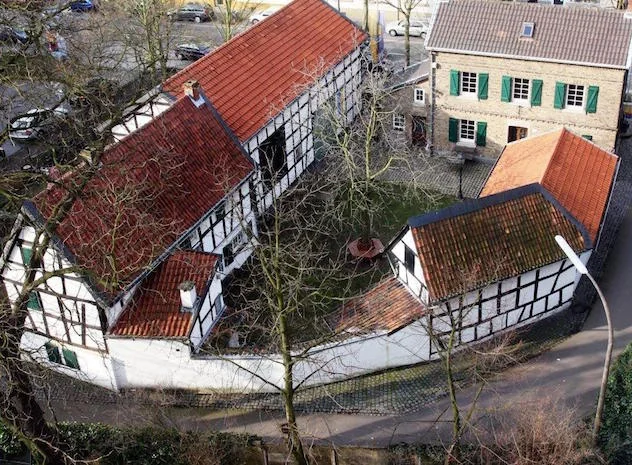
Wagnergasse 2-4, Bonn-Beuel
Wagnergasse 2-4, 53225 Bonn, Germany
Heimatmuseum Beuel | Opening Hours & Events
The Heimatmuseum Beuel is much more than a small collection of local memorabilia. It is a lively place for city history, customs, and everyday culture on the right bank of the Rhine in Bonn. Officially, the Heimat- und Geschichtsverein describes the museum as the oldest local history museum in the Bonn area; at the same time, the city of Bonn invites visitors to not only remember the past in Beuel but to experience it visibly. Those who visit the house encounter a mix of historical ensemble, carefully curated exhibition areas, a herb garden, and a strong connection to Beuel's identity. The content ranges from prehistory to the municipal reorganization of 1969, linking early trades such as fishing, shipping, and laundry with life, work, and living around the turn of the century. Additionally, there are changing exhibitions, thematic tours, a virtual tour, and offerings for groups, families, and children. This combination makes the Heimatmuseum Beuel an address that is interesting for both spontaneous visitors and targeted cultural-historical research. ([hgv-beuel.de](https://www.hgv-beuel.de/heimatmuseum))
Opening Hours, Directions, and Parking at Heimatmuseum Beuel
The practical information is clear and user-friendly. According to the official website, the museum is open on Wednesdays, Saturdays, and Sundays from 3:00 PM to 5:00 PM. Admission is free, and donations are welcome. Groups can arrange a guided tour outside of regular opening hours; the association also points out that tours can be conducted in the local dialect upon request. For families, there is a children's rally aimed at preschool and elementary school children that playfully accompanies the museum visit. The offerings are complemented by thematic tours, such as those on sayings related to the house, school life during the Kaiser era, Saint Adelheid, and Pützchen's Market, or through the museum's herb garden. This makes the visit not only flexible but also particularly diverse in content. ([hgv-beuel.de](https://www.hgv-beuel.de/oeffnungszeiten))
For directions, the official address is immediately helpful: Heimatmuseum Beuel, Wagnergasse 2-4, 53225 Bonn. The association describes the house as easily accessible by car, bicycle, on foot, and by public transport. Particularly practical are the specific public transport instructions: Bus lines 606, 633, and 529 go to the Beuel Krankenhaus stop; from there, it is about a 50-meter walk. You can reach the Konrad-Adenauer-Platz stop with several bus lines as well as the light rail lines 66, 67, 62, and 65; from there, it is approximately 500 meters. From Beuel train station, it is about a 900-meter walk, accessible via regional trains RE8 and RB27. Parking is also possible in the immediate vicinity, according to the association. For visitors looking for a museum with short distances and manageable orientation effort, this is a significant advantage. The location in the heart of Beuel, near St. Josef and the St. Josef Clinic, enhances the impression of an urban yet charming setting. ([hgv-beuel.de](https://www.hgv-beuel.de/oeffnungszeiten))
History of the Heimatmuseum Beuel and its Beuel Roots
The history of the museum is closely linked to the commitment of the Heimat- und Geschichtsverein Beuel am Rhein. The association was founded on March 8, 1947; one of its main goals was to instill a sense of home in new citizens and to preserve the history of the district. Almost four decades later, this wish became reality: On June 7, 1986, the Heimatmuseum Beuel opened in the oldest remaining half-timbered house in Beuel, Wagnergasse 2, which was then still privately owned by the association's chairman, Dieter Haese. This gave Beuel its first local history museum in the Bonn area. The official association page emphasizes that this house quickly gained popularity and grew through numerous donations from the public. This closeness to the community is still part of the museum's identity today: it is not a distant archive but a collective memory that has been carried by the people of Beuel and Bonn for decades. ([hgv-beuel.de](https://www.hgv-beuel.de/das-museum-geschichte))
The architectural development of the ensemble explains why the museum visit feels so atmospheric. After the half-timbered house was opened, the city of Bonn purchased the neighboring house at Wagnergasse 2, a brick house from the previous century, renovated it, and made it available to the museum in 1989. This allowed for further collections to be brought together and sensibly distributed between the two houses. In 1991, the reconstruction of a historic barn from Wachtberg, which was built in 1662, began; the topping-out ceremony was celebrated in 1992, and a few years later, the work was essentially completed. In 1994, the gatehouse followed, which now houses administrative and archival parts and completes the courtyard complex. In the association's texts, the ensemble is not coincidentally described as a museum island. It combines half-timbering, brick, courtyard character, and historical outbuildings into a place where the development of Beuel can not only be explained but also experienced spatially. For SEO and for real visitors, this is crucial: those looking for history, authenticity, and an organically grown place will find here not an artificially staged museum building but an organically grown historical structure. ([hgv-beuel.de](https://www.hgv-beuel.de/das-museum-geschichte))
Content-wise, the museum spans the arc from deep history to more recent city history. The association explicitly states that one can learn everything about the historical development on Beueler soil from the mammoth to the territorial reform of 1969. The thematic focuses include the early Beuel trades of fishing, shipping, and laundry, as well as insights into life, work, and living around the turn of the century. This fits very well with Beuel's position as a right-bank city district with its own history and strong everyday culture. The city of Bonn also emphasizes that Beuel has a settlement history dating back to the Neolithic period and that numerous associations contribute to the preservation of local heritage. The Heimatmuseum is thus not only a local showcase but a central place where the long development of the district is condensed. This connection of scientifically grounded presentation and local engagement is particularly relevant for people searching for Heimatmuseum Beuel history, Heimatmuseum Bonn Beuel, or Beueler past. ([hgv-beuel.de](https://www.hgv-beuel.de/heimatmuseum))
Photos, Images, and Virtual Tour of the Museum
Those looking for photos, images, or a first visual impression will find the association's website very helpful. There is a virtual tour that shows various buildings and areas of the museum: memorial courtyard, half-timbered house, brick house, barn, herb garden, stable, shed, gatehouse, and courtyard. This structure is more than just a simple image archive. It makes the museum spatially understandable and helps in preparing for the visit. This is particularly useful for families, school classes, and people who want to orient themselves in advance. The association also points out that the museum can be comfortably explored on a computer or mobile device. A film about the Heimatmuseum is also explicitly recommended. Thus, the website fulfills exactly what searches for Heimatmuseum Beuel photos or images of Heimatmuseum Beuel expect: a visually strong, informative preliminary impression without replacing the real encounter on site. ([hgv-beuel.de](https://www.hgv-beuel.de/heimatmuseum))
The visual language of the house is deliberately lively. On the tour page, the comic artist Sebastian Jenal, known as Özi, points the way to the museum with his drawing and introduces characters and motifs that visitors can expect there: the goat Aphrodite, the Frenchman Napoleon, the Beuel laundry princess, the Rhineland Saint Martin, and the Oberkasseler dog. This mix of historical information and narrative imagery is a key to the museum's external impact. It makes Beuel not only explainable but memorable. The individual objects on the website are also part of this narrative style. In the exhibit pages, items are connected with stories, so that an everyday object becomes a piece of cultural memory. So, those searching online for images will find here not a sterile gallery but a curated visual narrative that conveys the character of the house very well: local, loving, narrative, and historically anchored. This is a strong signal for search engines and for people who want to see what to expect before a visit. ([hgv-beuel.de](https://www.hgv-beuel.de/das-museum-virtueller-rundgang))
Events, Temporary Exhibitions, and Thematic Tours
An important part of museum life takes place in the museum barn. The association states that interesting temporary exhibitions take place there from time to time. This is particularly interesting for searches for Heimatmuseum Beuel upcoming events or Heimatmuseum Beuel exhibitions, as the house sees itself not only as a permanent showcase but also as a place for changing cultural-historical formats. The website documents, for example, a cooperation with the Goldfuß Museum of the University of Bonn under the title “400 Million Years of Beuel.” Extraordinary fossils and colorful panels were displayed to explore the deep past of the region. The background was a renovation of the Poppelsdorf museum building, which temporarily relocated scientific exchange to other locations. Such cooperations show that the Heimatmuseum Beuel is open to partnership projects and can also take up natural history topics when they fit the space and region. ([hgv-beuel.de](https://www.hgv-beuel.de/veranstaltungen-ausstellungen))
Another example is the special exhibition on Beueler Weiberfastnacht titled “Wäschereien, Wäscherinnen un de Wieverfastelovend.” It presents Beuel as a laundry village and the cradle of Weiberfastnacht, deliberately focusing on women's work and women's solidarity. This is where the museum's particular strength is evident: it connects local everyday history with larger societal questions. This is complemented by the thematic tours of the association, such as those on sayings related to the house, school life during the Kaiser era, Saint Adelheid, and Pützchen's Market, or a tour through the herb garden. Such tours are free for groups, and registration by email is required. Dialect tours are also offered. Those who understand events not just as a list of dates but as an experience will find here exactly the right mix of history, language, customs, and personal engagement. Thus, the museum very precisely meets the search intent behind phrases like upcoming events, tours, exhibitions, and programs. ([hgv-beuel.de](https://www.hgv-beuel.de/veranstaltungen-ausstellungen))
Registry Office, Weddings, and Special Occasions at Heimatmuseum Beuel
The Heimatmuseum Beuel is also a place for special life events. The association explicitly states that weddings can be held at the museum, and registration is done through the registry office of the city of Bonn. This makes the house suitable for couples who wish for a civil wedding in a historical, regionally anchored setting. The combination of half-timbering, courtyard complex, museum atmosphere, and Beuel history creates a very personal backdrop. This is not just any wedding venue but a place with identity and symbolic power. For SEO, the search intent Heimatmuseum Beuel registry office is particularly relevant, as it combines practical information with emotional added value. Those planning a wedding are not just looking for an administrative location but a setting that fits the occasion. The museum offers exactly that through its historical surroundings and proximity to Bonn's registry office structures. ([hgv-beuel.de](https://www.hgv-beuel.de/veranstaltungen-hochzeiten))
The special charm is further enhanced by Beueler traditions. The city of Bonn describes Beuel as the cradle of Weiberfastnacht; the first Beuel women's committee was founded there in 1824, triggered by a women's movement of the laundresses who resisted the dominance of men and the exploitation of their work. The city's view of Weiberfastnacht also highlights that this custom is much more than just carnival. It stands for emancipation, independent identity, and lived customs. This is precisely why weddings, customs events, and museum visits in Beuel fit together so well: they reflect a district where history does not lie on the shelf but continues to live in everyday life. In this sense, the Heimatmuseum Beuel is also a place for symbolically charged moments, whether it be a wedding, an anniversary, or a visit in the context of Beuel's carnival tradition. For visitors looking for an emotional yet factually credible place, this is a strong argument. ([bonn.de](https://www.bonn.de/bonn-erleben/ausgehen-und-erleben/beueler-weiberfastnacht.php))
Herb Garden, Exhibits, and Everyday History from Beuel
A special feature of the Heimatmuseum Beuel is the herb garden behind the museum barn. The association describes the house garden as designed like a small garden around 1600 and today as a herb garden with predominantly native plants. It offers information and suggestions for practical application in the home, kitchen, natural cosmetics, and health care. Additionally, the website lists over fifty different herbs, marked with both German and Latin names. This is attractive for visitors who do not just want to view historical rooms but also seek a sensory and everyday access to the region. The herb garden links botany, home culture, and knowledge tradition, fitting excellently with the character of the entire ensemble. For searches for Heimatmuseum Beuel herb garden, this is a very strong, distinct thematic field. ([hgv-beuel.de](https://www.hgv-beuel.de/der-kraeutergarten))
The exhibits themselves are also chosen to tell everyday history. The official website collects many background information under “Exhibits and Their History,” which visitors can access before or during their visit on a computer or smartphone. Items such as toilet paper and outhouse, a toothbrush, a bunker door, basalt stones, a salute cannon, and much more appear there. Such objects are not mere curiosities but examples of how large historical lines can be shown through small things: hygiene, work, technology, war, transport, infrastructure, and social change. Additionally, the Heimat- und Geschichtsverein has a regional specialist library with about 3,000 books and brochures, mostly about the right-bank Bonn district of Beuel. There are also a museum shop and digital information offerings. So, those searching for a place that not only looks beautiful but also has substantial content will find in the Heimatmuseum Beuel a dense network of space, object, text, and memory. This mix makes the location particularly interesting for culture enthusiasts, families, school classes, and local research. ([hgv-beuel.de](https://www.hgv-beuel.de/heimatmuseum))
In the end, the Heimatmuseum Beuel clearly shows why it occupies a special place in Bonn and beyond. It connects the oldest remaining half-timbered house in Beuel, a historic brick building, the reconstructed barn from the 17th century, the gatehouse, and the herb garden into an ensemble that combines historical depth with lively use. At the same time, it is surprisingly accessible due to opening hours, free tours, group offerings, changing exhibitions, wedding possibilities, and a virtual tour. This balance between authenticity and accessibility makes the location strong for visitors searching for Heimatmuseum Bonn Beuel, Heimatmuseum Beuel photos, Heimatmuseum Beuel opening hours, or Heimatmuseum Beuel upcoming events. The museum is not a loud trendy place but a reliable, content-rich cultural site with a strong local soul. And that is why it appears sustainable online as well as on-site: once someone has been there, they understand Beuel as history to touch and as a present with depth of memory. ([hgv-beuel.de](https://www.hgv-beuel.de/heimatmuseum))
Sources:
- Heimatmuseum Beuel – Heimat- und Geschichtsverein Beuel
- Opening Hours and Directions – Heimat- und Geschichtsverein Beuel
- Exhibitions – Heimat- und Geschichtsverein Beuel
- Weddings – Heimat- und Geschichtsverein Beuel
- Virtual Tour – Heimat- und Geschichtsverein Beuel
- Heritage. Customs. – Federal City of Bonn
- Beueler Weiberfastnacht – Federal City of Bonn
Show moreShow less
Heimatmuseum Beuel | Opening Hours & Events
The Heimatmuseum Beuel is much more than a small collection of local memorabilia. It is a lively place for city history, customs, and everyday culture on the right bank of the Rhine in Bonn. Officially, the Heimat- und Geschichtsverein describes the museum as the oldest local history museum in the Bonn area; at the same time, the city of Bonn invites visitors to not only remember the past in Beuel but to experience it visibly. Those who visit the house encounter a mix of historical ensemble, carefully curated exhibition areas, a herb garden, and a strong connection to Beuel's identity. The content ranges from prehistory to the municipal reorganization of 1969, linking early trades such as fishing, shipping, and laundry with life, work, and living around the turn of the century. Additionally, there are changing exhibitions, thematic tours, a virtual tour, and offerings for groups, families, and children. This combination makes the Heimatmuseum Beuel an address that is interesting for both spontaneous visitors and targeted cultural-historical research. ([hgv-beuel.de](https://www.hgv-beuel.de/heimatmuseum))
Opening Hours, Directions, and Parking at Heimatmuseum Beuel
The practical information is clear and user-friendly. According to the official website, the museum is open on Wednesdays, Saturdays, and Sundays from 3:00 PM to 5:00 PM. Admission is free, and donations are welcome. Groups can arrange a guided tour outside of regular opening hours; the association also points out that tours can be conducted in the local dialect upon request. For families, there is a children's rally aimed at preschool and elementary school children that playfully accompanies the museum visit. The offerings are complemented by thematic tours, such as those on sayings related to the house, school life during the Kaiser era, Saint Adelheid, and Pützchen's Market, or through the museum's herb garden. This makes the visit not only flexible but also particularly diverse in content. ([hgv-beuel.de](https://www.hgv-beuel.de/oeffnungszeiten))
For directions, the official address is immediately helpful: Heimatmuseum Beuel, Wagnergasse 2-4, 53225 Bonn. The association describes the house as easily accessible by car, bicycle, on foot, and by public transport. Particularly practical are the specific public transport instructions: Bus lines 606, 633, and 529 go to the Beuel Krankenhaus stop; from there, it is about a 50-meter walk. You can reach the Konrad-Adenauer-Platz stop with several bus lines as well as the light rail lines 66, 67, 62, and 65; from there, it is approximately 500 meters. From Beuel train station, it is about a 900-meter walk, accessible via regional trains RE8 and RB27. Parking is also possible in the immediate vicinity, according to the association. For visitors looking for a museum with short distances and manageable orientation effort, this is a significant advantage. The location in the heart of Beuel, near St. Josef and the St. Josef Clinic, enhances the impression of an urban yet charming setting. ([hgv-beuel.de](https://www.hgv-beuel.de/oeffnungszeiten))
History of the Heimatmuseum Beuel and its Beuel Roots
The history of the museum is closely linked to the commitment of the Heimat- und Geschichtsverein Beuel am Rhein. The association was founded on March 8, 1947; one of its main goals was to instill a sense of home in new citizens and to preserve the history of the district. Almost four decades later, this wish became reality: On June 7, 1986, the Heimatmuseum Beuel opened in the oldest remaining half-timbered house in Beuel, Wagnergasse 2, which was then still privately owned by the association's chairman, Dieter Haese. This gave Beuel its first local history museum in the Bonn area. The official association page emphasizes that this house quickly gained popularity and grew through numerous donations from the public. This closeness to the community is still part of the museum's identity today: it is not a distant archive but a collective memory that has been carried by the people of Beuel and Bonn for decades. ([hgv-beuel.de](https://www.hgv-beuel.de/das-museum-geschichte))
The architectural development of the ensemble explains why the museum visit feels so atmospheric. After the half-timbered house was opened, the city of Bonn purchased the neighboring house at Wagnergasse 2, a brick house from the previous century, renovated it, and made it available to the museum in 1989. This allowed for further collections to be brought together and sensibly distributed between the two houses. In 1991, the reconstruction of a historic barn from Wachtberg, which was built in 1662, began; the topping-out ceremony was celebrated in 1992, and a few years later, the work was essentially completed. In 1994, the gatehouse followed, which now houses administrative and archival parts and completes the courtyard complex. In the association's texts, the ensemble is not coincidentally described as a museum island. It combines half-timbering, brick, courtyard character, and historical outbuildings into a place where the development of Beuel can not only be explained but also experienced spatially. For SEO and for real visitors, this is crucial: those looking for history, authenticity, and an organically grown place will find here not an artificially staged museum building but an organically grown historical structure. ([hgv-beuel.de](https://www.hgv-beuel.de/das-museum-geschichte))
Content-wise, the museum spans the arc from deep history to more recent city history. The association explicitly states that one can learn everything about the historical development on Beueler soil from the mammoth to the territorial reform of 1969. The thematic focuses include the early Beuel trades of fishing, shipping, and laundry, as well as insights into life, work, and living around the turn of the century. This fits very well with Beuel's position as a right-bank city district with its own history and strong everyday culture. The city of Bonn also emphasizes that Beuel has a settlement history dating back to the Neolithic period and that numerous associations contribute to the preservation of local heritage. The Heimatmuseum is thus not only a local showcase but a central place where the long development of the district is condensed. This connection of scientifically grounded presentation and local engagement is particularly relevant for people searching for Heimatmuseum Beuel history, Heimatmuseum Bonn Beuel, or Beueler past. ([hgv-beuel.de](https://www.hgv-beuel.de/heimatmuseum))
Photos, Images, and Virtual Tour of the Museum
Those looking for photos, images, or a first visual impression will find the association's website very helpful. There is a virtual tour that shows various buildings and areas of the museum: memorial courtyard, half-timbered house, brick house, barn, herb garden, stable, shed, gatehouse, and courtyard. This structure is more than just a simple image archive. It makes the museum spatially understandable and helps in preparing for the visit. This is particularly useful for families, school classes, and people who want to orient themselves in advance. The association also points out that the museum can be comfortably explored on a computer or mobile device. A film about the Heimatmuseum is also explicitly recommended. Thus, the website fulfills exactly what searches for Heimatmuseum Beuel photos or images of Heimatmuseum Beuel expect: a visually strong, informative preliminary impression without replacing the real encounter on site. ([hgv-beuel.de](https://www.hgv-beuel.de/heimatmuseum))
The visual language of the house is deliberately lively. On the tour page, the comic artist Sebastian Jenal, known as Özi, points the way to the museum with his drawing and introduces characters and motifs that visitors can expect there: the goat Aphrodite, the Frenchman Napoleon, the Beuel laundry princess, the Rhineland Saint Martin, and the Oberkasseler dog. This mix of historical information and narrative imagery is a key to the museum's external impact. It makes Beuel not only explainable but memorable. The individual objects on the website are also part of this narrative style. In the exhibit pages, items are connected with stories, so that an everyday object becomes a piece of cultural memory. So, those searching online for images will find here not a sterile gallery but a curated visual narrative that conveys the character of the house very well: local, loving, narrative, and historically anchored. This is a strong signal for search engines and for people who want to see what to expect before a visit. ([hgv-beuel.de](https://www.hgv-beuel.de/das-museum-virtueller-rundgang))
Events, Temporary Exhibitions, and Thematic Tours
An important part of museum life takes place in the museum barn. The association states that interesting temporary exhibitions take place there from time to time. This is particularly interesting for searches for Heimatmuseum Beuel upcoming events or Heimatmuseum Beuel exhibitions, as the house sees itself not only as a permanent showcase but also as a place for changing cultural-historical formats. The website documents, for example, a cooperation with the Goldfuß Museum of the University of Bonn under the title “400 Million Years of Beuel.” Extraordinary fossils and colorful panels were displayed to explore the deep past of the region. The background was a renovation of the Poppelsdorf museum building, which temporarily relocated scientific exchange to other locations. Such cooperations show that the Heimatmuseum Beuel is open to partnership projects and can also take up natural history topics when they fit the space and region. ([hgv-beuel.de](https://www.hgv-beuel.de/veranstaltungen-ausstellungen))
Another example is the special exhibition on Beueler Weiberfastnacht titled “Wäschereien, Wäscherinnen un de Wieverfastelovend.” It presents Beuel as a laundry village and the cradle of Weiberfastnacht, deliberately focusing on women's work and women's solidarity. This is where the museum's particular strength is evident: it connects local everyday history with larger societal questions. This is complemented by the thematic tours of the association, such as those on sayings related to the house, school life during the Kaiser era, Saint Adelheid, and Pützchen's Market, or a tour through the herb garden. Such tours are free for groups, and registration by email is required. Dialect tours are also offered. Those who understand events not just as a list of dates but as an experience will find here exactly the right mix of history, language, customs, and personal engagement. Thus, the museum very precisely meets the search intent behind phrases like upcoming events, tours, exhibitions, and programs. ([hgv-beuel.de](https://www.hgv-beuel.de/veranstaltungen-ausstellungen))
Registry Office, Weddings, and Special Occasions at Heimatmuseum Beuel
The Heimatmuseum Beuel is also a place for special life events. The association explicitly states that weddings can be held at the museum, and registration is done through the registry office of the city of Bonn. This makes the house suitable for couples who wish for a civil wedding in a historical, regionally anchored setting. The combination of half-timbering, courtyard complex, museum atmosphere, and Beuel history creates a very personal backdrop. This is not just any wedding venue but a place with identity and symbolic power. For SEO, the search intent Heimatmuseum Beuel registry office is particularly relevant, as it combines practical information with emotional added value. Those planning a wedding are not just looking for an administrative location but a setting that fits the occasion. The museum offers exactly that through its historical surroundings and proximity to Bonn's registry office structures. ([hgv-beuel.de](https://www.hgv-beuel.de/veranstaltungen-hochzeiten))
The special charm is further enhanced by Beueler traditions. The city of Bonn describes Beuel as the cradle of Weiberfastnacht; the first Beuel women's committee was founded there in 1824, triggered by a women's movement of the laundresses who resisted the dominance of men and the exploitation of their work. The city's view of Weiberfastnacht also highlights that this custom is much more than just carnival. It stands for emancipation, independent identity, and lived customs. This is precisely why weddings, customs events, and museum visits in Beuel fit together so well: they reflect a district where history does not lie on the shelf but continues to live in everyday life. In this sense, the Heimatmuseum Beuel is also a place for symbolically charged moments, whether it be a wedding, an anniversary, or a visit in the context of Beuel's carnival tradition. For visitors looking for an emotional yet factually credible place, this is a strong argument. ([bonn.de](https://www.bonn.de/bonn-erleben/ausgehen-und-erleben/beueler-weiberfastnacht.php))
Herb Garden, Exhibits, and Everyday History from Beuel
A special feature of the Heimatmuseum Beuel is the herb garden behind the museum barn. The association describes the house garden as designed like a small garden around 1600 and today as a herb garden with predominantly native plants. It offers information and suggestions for practical application in the home, kitchen, natural cosmetics, and health care. Additionally, the website lists over fifty different herbs, marked with both German and Latin names. This is attractive for visitors who do not just want to view historical rooms but also seek a sensory and everyday access to the region. The herb garden links botany, home culture, and knowledge tradition, fitting excellently with the character of the entire ensemble. For searches for Heimatmuseum Beuel herb garden, this is a very strong, distinct thematic field. ([hgv-beuel.de](https://www.hgv-beuel.de/der-kraeutergarten))
The exhibits themselves are also chosen to tell everyday history. The official website collects many background information under “Exhibits and Their History,” which visitors can access before or during their visit on a computer or smartphone. Items such as toilet paper and outhouse, a toothbrush, a bunker door, basalt stones, a salute cannon, and much more appear there. Such objects are not mere curiosities but examples of how large historical lines can be shown through small things: hygiene, work, technology, war, transport, infrastructure, and social change. Additionally, the Heimat- und Geschichtsverein has a regional specialist library with about 3,000 books and brochures, mostly about the right-bank Bonn district of Beuel. There are also a museum shop and digital information offerings. So, those searching for a place that not only looks beautiful but also has substantial content will find in the Heimatmuseum Beuel a dense network of space, object, text, and memory. This mix makes the location particularly interesting for culture enthusiasts, families, school classes, and local research. ([hgv-beuel.de](https://www.hgv-beuel.de/heimatmuseum))
In the end, the Heimatmuseum Beuel clearly shows why it occupies a special place in Bonn and beyond. It connects the oldest remaining half-timbered house in Beuel, a historic brick building, the reconstructed barn from the 17th century, the gatehouse, and the herb garden into an ensemble that combines historical depth with lively use. At the same time, it is surprisingly accessible due to opening hours, free tours, group offerings, changing exhibitions, wedding possibilities, and a virtual tour. This balance between authenticity and accessibility makes the location strong for visitors searching for Heimatmuseum Bonn Beuel, Heimatmuseum Beuel photos, Heimatmuseum Beuel opening hours, or Heimatmuseum Beuel upcoming events. The museum is not a loud trendy place but a reliable, content-rich cultural site with a strong local soul. And that is why it appears sustainable online as well as on-site: once someone has been there, they understand Beuel as history to touch and as a present with depth of memory. ([hgv-beuel.de](https://www.hgv-beuel.de/heimatmuseum))
Sources:
- Heimatmuseum Beuel – Heimat- und Geschichtsverein Beuel
- Opening Hours and Directions – Heimat- und Geschichtsverein Beuel
- Exhibitions – Heimat- und Geschichtsverein Beuel
- Weddings – Heimat- und Geschichtsverein Beuel
- Virtual Tour – Heimat- und Geschichtsverein Beuel
- Heritage. Customs. – Federal City of Bonn
- Beueler Weiberfastnacht – Federal City of Bonn
Heimatmuseum Beuel | Opening Hours & Events
The Heimatmuseum Beuel is much more than a small collection of local memorabilia. It is a lively place for city history, customs, and everyday culture on the right bank of the Rhine in Bonn. Officially, the Heimat- und Geschichtsverein describes the museum as the oldest local history museum in the Bonn area; at the same time, the city of Bonn invites visitors to not only remember the past in Beuel but to experience it visibly. Those who visit the house encounter a mix of historical ensemble, carefully curated exhibition areas, a herb garden, and a strong connection to Beuel's identity. The content ranges from prehistory to the municipal reorganization of 1969, linking early trades such as fishing, shipping, and laundry with life, work, and living around the turn of the century. Additionally, there are changing exhibitions, thematic tours, a virtual tour, and offerings for groups, families, and children. This combination makes the Heimatmuseum Beuel an address that is interesting for both spontaneous visitors and targeted cultural-historical research. ([hgv-beuel.de](https://www.hgv-beuel.de/heimatmuseum))
Opening Hours, Directions, and Parking at Heimatmuseum Beuel
The practical information is clear and user-friendly. According to the official website, the museum is open on Wednesdays, Saturdays, and Sundays from 3:00 PM to 5:00 PM. Admission is free, and donations are welcome. Groups can arrange a guided tour outside of regular opening hours; the association also points out that tours can be conducted in the local dialect upon request. For families, there is a children's rally aimed at preschool and elementary school children that playfully accompanies the museum visit. The offerings are complemented by thematic tours, such as those on sayings related to the house, school life during the Kaiser era, Saint Adelheid, and Pützchen's Market, or through the museum's herb garden. This makes the visit not only flexible but also particularly diverse in content. ([hgv-beuel.de](https://www.hgv-beuel.de/oeffnungszeiten))
For directions, the official address is immediately helpful: Heimatmuseum Beuel, Wagnergasse 2-4, 53225 Bonn. The association describes the house as easily accessible by car, bicycle, on foot, and by public transport. Particularly practical are the specific public transport instructions: Bus lines 606, 633, and 529 go to the Beuel Krankenhaus stop; from there, it is about a 50-meter walk. You can reach the Konrad-Adenauer-Platz stop with several bus lines as well as the light rail lines 66, 67, 62, and 65; from there, it is approximately 500 meters. From Beuel train station, it is about a 900-meter walk, accessible via regional trains RE8 and RB27. Parking is also possible in the immediate vicinity, according to the association. For visitors looking for a museum with short distances and manageable orientation effort, this is a significant advantage. The location in the heart of Beuel, near St. Josef and the St. Josef Clinic, enhances the impression of an urban yet charming setting. ([hgv-beuel.de](https://www.hgv-beuel.de/oeffnungszeiten))
History of the Heimatmuseum Beuel and its Beuel Roots
The history of the museum is closely linked to the commitment of the Heimat- und Geschichtsverein Beuel am Rhein. The association was founded on March 8, 1947; one of its main goals was to instill a sense of home in new citizens and to preserve the history of the district. Almost four decades later, this wish became reality: On June 7, 1986, the Heimatmuseum Beuel opened in the oldest remaining half-timbered house in Beuel, Wagnergasse 2, which was then still privately owned by the association's chairman, Dieter Haese. This gave Beuel its first local history museum in the Bonn area. The official association page emphasizes that this house quickly gained popularity and grew through numerous donations from the public. This closeness to the community is still part of the museum's identity today: it is not a distant archive but a collective memory that has been carried by the people of Beuel and Bonn for decades. ([hgv-beuel.de](https://www.hgv-beuel.de/das-museum-geschichte))
The architectural development of the ensemble explains why the museum visit feels so atmospheric. After the half-timbered house was opened, the city of Bonn purchased the neighboring house at Wagnergasse 2, a brick house from the previous century, renovated it, and made it available to the museum in 1989. This allowed for further collections to be brought together and sensibly distributed between the two houses. In 1991, the reconstruction of a historic barn from Wachtberg, which was built in 1662, began; the topping-out ceremony was celebrated in 1992, and a few years later, the work was essentially completed. In 1994, the gatehouse followed, which now houses administrative and archival parts and completes the courtyard complex. In the association's texts, the ensemble is not coincidentally described as a museum island. It combines half-timbering, brick, courtyard character, and historical outbuildings into a place where the development of Beuel can not only be explained but also experienced spatially. For SEO and for real visitors, this is crucial: those looking for history, authenticity, and an organically grown place will find here not an artificially staged museum building but an organically grown historical structure. ([hgv-beuel.de](https://www.hgv-beuel.de/das-museum-geschichte))
Content-wise, the museum spans the arc from deep history to more recent city history. The association explicitly states that one can learn everything about the historical development on Beueler soil from the mammoth to the territorial reform of 1969. The thematic focuses include the early Beuel trades of fishing, shipping, and laundry, as well as insights into life, work, and living around the turn of the century. This fits very well with Beuel's position as a right-bank city district with its own history and strong everyday culture. The city of Bonn also emphasizes that Beuel has a settlement history dating back to the Neolithic period and that numerous associations contribute to the preservation of local heritage. The Heimatmuseum is thus not only a local showcase but a central place where the long development of the district is condensed. This connection of scientifically grounded presentation and local engagement is particularly relevant for people searching for Heimatmuseum Beuel history, Heimatmuseum Bonn Beuel, or Beueler past. ([hgv-beuel.de](https://www.hgv-beuel.de/heimatmuseum))
Photos, Images, and Virtual Tour of the Museum
Those looking for photos, images, or a first visual impression will find the association's website very helpful. There is a virtual tour that shows various buildings and areas of the museum: memorial courtyard, half-timbered house, brick house, barn, herb garden, stable, shed, gatehouse, and courtyard. This structure is more than just a simple image archive. It makes the museum spatially understandable and helps in preparing for the visit. This is particularly useful for families, school classes, and people who want to orient themselves in advance. The association also points out that the museum can be comfortably explored on a computer or mobile device. A film about the Heimatmuseum is also explicitly recommended. Thus, the website fulfills exactly what searches for Heimatmuseum Beuel photos or images of Heimatmuseum Beuel expect: a visually strong, informative preliminary impression without replacing the real encounter on site. ([hgv-beuel.de](https://www.hgv-beuel.de/heimatmuseum))
The visual language of the house is deliberately lively. On the tour page, the comic artist Sebastian Jenal, known as Özi, points the way to the museum with his drawing and introduces characters and motifs that visitors can expect there: the goat Aphrodite, the Frenchman Napoleon, the Beuel laundry princess, the Rhineland Saint Martin, and the Oberkasseler dog. This mix of historical information and narrative imagery is a key to the museum's external impact. It makes Beuel not only explainable but memorable. The individual objects on the website are also part of this narrative style. In the exhibit pages, items are connected with stories, so that an everyday object becomes a piece of cultural memory. So, those searching online for images will find here not a sterile gallery but a curated visual narrative that conveys the character of the house very well: local, loving, narrative, and historically anchored. This is a strong signal for search engines and for people who want to see what to expect before a visit. ([hgv-beuel.de](https://www.hgv-beuel.de/das-museum-virtueller-rundgang))
Events, Temporary Exhibitions, and Thematic Tours
An important part of museum life takes place in the museum barn. The association states that interesting temporary exhibitions take place there from time to time. This is particularly interesting for searches for Heimatmuseum Beuel upcoming events or Heimatmuseum Beuel exhibitions, as the house sees itself not only as a permanent showcase but also as a place for changing cultural-historical formats. The website documents, for example, a cooperation with the Goldfuß Museum of the University of Bonn under the title “400 Million Years of Beuel.” Extraordinary fossils and colorful panels were displayed to explore the deep past of the region. The background was a renovation of the Poppelsdorf museum building, which temporarily relocated scientific exchange to other locations. Such cooperations show that the Heimatmuseum Beuel is open to partnership projects and can also take up natural history topics when they fit the space and region. ([hgv-beuel.de](https://www.hgv-beuel.de/veranstaltungen-ausstellungen))
Another example is the special exhibition on Beueler Weiberfastnacht titled “Wäschereien, Wäscherinnen un de Wieverfastelovend.” It presents Beuel as a laundry village and the cradle of Weiberfastnacht, deliberately focusing on women's work and women's solidarity. This is where the museum's particular strength is evident: it connects local everyday history with larger societal questions. This is complemented by the thematic tours of the association, such as those on sayings related to the house, school life during the Kaiser era, Saint Adelheid, and Pützchen's Market, or a tour through the herb garden. Such tours are free for groups, and registration by email is required. Dialect tours are also offered. Those who understand events not just as a list of dates but as an experience will find here exactly the right mix of history, language, customs, and personal engagement. Thus, the museum very precisely meets the search intent behind phrases like upcoming events, tours, exhibitions, and programs. ([hgv-beuel.de](https://www.hgv-beuel.de/veranstaltungen-ausstellungen))
Registry Office, Weddings, and Special Occasions at Heimatmuseum Beuel
The Heimatmuseum Beuel is also a place for special life events. The association explicitly states that weddings can be held at the museum, and registration is done through the registry office of the city of Bonn. This makes the house suitable for couples who wish for a civil wedding in a historical, regionally anchored setting. The combination of half-timbering, courtyard complex, museum atmosphere, and Beuel history creates a very personal backdrop. This is not just any wedding venue but a place with identity and symbolic power. For SEO, the search intent Heimatmuseum Beuel registry office is particularly relevant, as it combines practical information with emotional added value. Those planning a wedding are not just looking for an administrative location but a setting that fits the occasion. The museum offers exactly that through its historical surroundings and proximity to Bonn's registry office structures. ([hgv-beuel.de](https://www.hgv-beuel.de/veranstaltungen-hochzeiten))
The special charm is further enhanced by Beueler traditions. The city of Bonn describes Beuel as the cradle of Weiberfastnacht; the first Beuel women's committee was founded there in 1824, triggered by a women's movement of the laundresses who resisted the dominance of men and the exploitation of their work. The city's view of Weiberfastnacht also highlights that this custom is much more than just carnival. It stands for emancipation, independent identity, and lived customs. This is precisely why weddings, customs events, and museum visits in Beuel fit together so well: they reflect a district where history does not lie on the shelf but continues to live in everyday life. In this sense, the Heimatmuseum Beuel is also a place for symbolically charged moments, whether it be a wedding, an anniversary, or a visit in the context of Beuel's carnival tradition. For visitors looking for an emotional yet factually credible place, this is a strong argument. ([bonn.de](https://www.bonn.de/bonn-erleben/ausgehen-und-erleben/beueler-weiberfastnacht.php))
Herb Garden, Exhibits, and Everyday History from Beuel
A special feature of the Heimatmuseum Beuel is the herb garden behind the museum barn. The association describes the house garden as designed like a small garden around 1600 and today as a herb garden with predominantly native plants. It offers information and suggestions for practical application in the home, kitchen, natural cosmetics, and health care. Additionally, the website lists over fifty different herbs, marked with both German and Latin names. This is attractive for visitors who do not just want to view historical rooms but also seek a sensory and everyday access to the region. The herb garden links botany, home culture, and knowledge tradition, fitting excellently with the character of the entire ensemble. For searches for Heimatmuseum Beuel herb garden, this is a very strong, distinct thematic field. ([hgv-beuel.de](https://www.hgv-beuel.de/der-kraeutergarten))
The exhibits themselves are also chosen to tell everyday history. The official website collects many background information under “Exhibits and Their History,” which visitors can access before or during their visit on a computer or smartphone. Items such as toilet paper and outhouse, a toothbrush, a bunker door, basalt stones, a salute cannon, and much more appear there. Such objects are not mere curiosities but examples of how large historical lines can be shown through small things: hygiene, work, technology, war, transport, infrastructure, and social change. Additionally, the Heimat- und Geschichtsverein has a regional specialist library with about 3,000 books and brochures, mostly about the right-bank Bonn district of Beuel. There are also a museum shop and digital information offerings. So, those searching for a place that not only looks beautiful but also has substantial content will find in the Heimatmuseum Beuel a dense network of space, object, text, and memory. This mix makes the location particularly interesting for culture enthusiasts, families, school classes, and local research. ([hgv-beuel.de](https://www.hgv-beuel.de/heimatmuseum))
In the end, the Heimatmuseum Beuel clearly shows why it occupies a special place in Bonn and beyond. It connects the oldest remaining half-timbered house in Beuel, a historic brick building, the reconstructed barn from the 17th century, the gatehouse, and the herb garden into an ensemble that combines historical depth with lively use. At the same time, it is surprisingly accessible due to opening hours, free tours, group offerings, changing exhibitions, wedding possibilities, and a virtual tour. This balance between authenticity and accessibility makes the location strong for visitors searching for Heimatmuseum Bonn Beuel, Heimatmuseum Beuel photos, Heimatmuseum Beuel opening hours, or Heimatmuseum Beuel upcoming events. The museum is not a loud trendy place but a reliable, content-rich cultural site with a strong local soul. And that is why it appears sustainable online as well as on-site: once someone has been there, they understand Beuel as history to touch and as a present with depth of memory. ([hgv-beuel.de](https://www.hgv-beuel.de/heimatmuseum))
Sources:
- Heimatmuseum Beuel – Heimat- und Geschichtsverein Beuel
- Opening Hours and Directions – Heimat- und Geschichtsverein Beuel
- Exhibitions – Heimat- und Geschichtsverein Beuel
- Weddings – Heimat- und Geschichtsverein Beuel
- Virtual Tour – Heimat- und Geschichtsverein Beuel
- Heritage. Customs. – Federal City of Bonn
- Beueler Weiberfastnacht – Federal City of Bonn
Upcoming Events
No events found
Frequently Asked Questions
Reviews
D.M. Wildenhoff
19. January 2018
Very nice place to stay for a while to get the best way to go through it.
Kiran Bretschneider
8. February 2020
Small but nice and informative.
Majid Akvan
9. June 2024
Super.
Katharina F.
25. November 2023
We visited the Beuel Local History Museum on a Sunday and were immediately greeted by the museum's volunteer staff. Since it was Open Monument Day, there were quite a few visitors, who, like us, were very kindly guided through the museum by the staff. We learned many interesting details about the function and origin of old tools and household items. Besides a kitchen with many utensils from bygone eras, a living room and a bedroom on the upper floor can also be seen in a historic timber-framed building. There is also a historic barber's shop, a classroom, and a small collection of old toys. In the adjacent building, an old barn, the focus on the ground floor is on the "washerwomen," who were once very numerous in the region around Beuel, while the upper floor is dedicated to Rhine shipping. Among the stables on the grounds are a blacksmith's shop and a shoemaker's workshop with many historic tools from earlier times. Right at the entrance, in a brick building, you'll find a wealth of information about the region's history spread across three floors, from the "Oberkassel people" of the Paleolithic era, through the Roman period, to 1969, when Beuel became a district of Bonn. In the enclosed courtyard, there are many small details to discover, and behind the barn, you'll find a small herb garden and an exhibition of larger agricultural implements and typical exhibits from companies that were once based in the region. 🅿️ Parking directly at the museum is very limited and not explicitly belonging to the museum. However, there is a parking lot belonging to the hospital in Beuel about 150 meters away, which is subject to a fee on weekdays. ♿ The museum has limited accessibility; the upper floors are not accessible for wheelchair users. 🚾 Clean public restrooms are available within the museum complex. 💶 Admission is free, but small donations are very welcome 😉 ✅ Tip: Afterward, you can take a short stroll along the beautifully landscaped Rhine promenade in Beuel. ➡️ Conclusion: A highly recommended small but excellent local history museum, lovingly run and maintained by dedicated volunteers. Five stars ⭐⭐⭐⭐⭐
Jakob Sodoge
22. October 2025
A lovingly constructed and well-maintained local museum. It's worth a visit and immersing yourself in a piece of the past.