
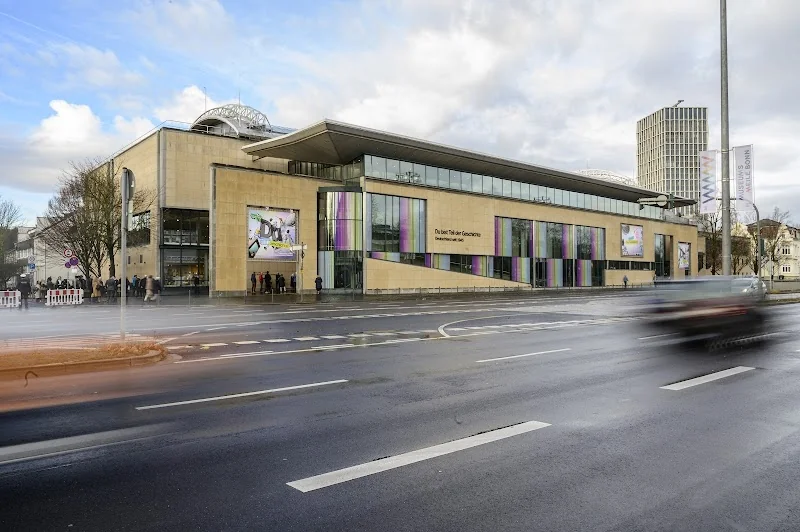
Bonn
Willy-Brandt-Allee 14, 53113 Bonn, Deutschland
House of History Bonn | Opening Hours & Directions
The House of History Bonn is much more than a museum with a good location by the Rhine. It is the main site of the Foundation House of History of the Federal Republic of Germany, which conveys contemporary history since 1945 with four museums in three German cities. The Bonn house was opened in 1994, and the museum building was specifically constructed for this purpose, offering a generous stage of around 22,000 square meters for exhibitions, events, service areas, and encounters. Those who enter the house experience not only historical objects but also a house designed as a communicative center: foyer, exhibition rooms, information center, museum café, museum shop, and administration are functionally interconnected, making the visit easy to follow. This mixture of architecture, collection, and mediation shapes the special appeal of the location. The new permanent exhibition is personal, interactive, and close to everyday life, telling German history since 1945 from perspectives that remain close to people's lives. ([hdg.de](https://www.hdg.de/stiftung/organisation/))
For inquiries regarding the House of History Bonn, opening hours, directions, parking, admission, tours, children, and café, the most important message is clear: The visit is free, well-planned, and very attractive for families and groups. The house is located on the Museum Mile in Bonn, a place where culture, federal politics, and urban life intersect. At the same time, the offerings are broad enough to not only support the permanent exhibition but also include temporary exhibitions, museum gardens, lounges, shops, educational offers, and historical sites in Bonn. Those looking for a location with a real content profile will find a place here that not only exhibits history but also makes it understandable and tangible. The following sections consolidate the most important information on visiting, location, program, and practical details so that they are as helpful for visitors as they are for SEO searches for current facts. ([hdg.de](https://www.hdg.de/stiftung/organisation/))
Opening Hours, Free Admission, and Address
The opening hours are clear and user-friendly: The House of History Bonn opens from Tuesday to Friday from 9 AM to 6 PM and on Saturdays and Sundays from 10 AM to 6 PM. The museum is closed on Mondays. This makes the location suitable for visits on weekdays as well as weekend tours, for example, as part of a visit to Bonn, a family outing, or a museum tour on the Museum Mile. Particularly important for planning is that admission to the museum and all exhibitions is free. This significantly lowers the entry barrier and makes the house as attractive for spontaneous visits as for repeated visits, where one can delve deeper into the exhibition at leisure. The address is Willy-Brandt-Allee 14, 53113 Bonn. Those using the official visitor information will also find notes on holidays and special opening hours if the museum operations change on certain days. ([hdg.de](https://www.hdg.de/haus-der-geschichte/besucherinformation))
From an SEO perspective, this topic block addresses several strong search intentions: opening hours, free admission, address, and current visitor information. Content-wise, this fits well with the character of the museum, as the House of History sees itself as an open house for a broad audience. That admission is free is not only a practical piece of information but a central part of the quality of the visit: one can decide spontaneously to stay longer, take a break in the lounge, or come back another day. Those looking for the best time of day can use the morning hours during the week or the later morning on weekends when the visit should be calm and relaxed. The clear timing is also helpful for school classes, larger groups, or visitors with longer journeys. The museum is organized in such a way that admission remains free while also providing a professional visitor service. ([hdg.de](https://www.hdg.de/haus-der-geschichte/besucherinformation))
Directions and Parking at the Museum Mile Location
Access to the House of History Bonn is easily achievable by both public transport and car. Visitors can take the subway lines 16, 63, 66 to the Heussallee/Museumsmeile stop. The bus lines 610 and 611 are relevant to the Heussallee/Museumsmeile stop. Those arriving by train can use the Bonn UN Campus stop. For the walk from the train station to the museum, the visitor information mentions about five stops and approximately seven minutes travel time by subway. The museum also points out that the route from the subway station is not always immediately intuitive, and if needed, a pickup at the stop is possible if one contacts the visitor service beforehand. This is an important practical advantage for people with mobility restrictions. ([hdg.de](https://www.hdg.de/leichte-sprache/haus-der-geschichte-bonn/anfahrt-und-parken/))
Several parking options are available. Recommended are the APCOA parking garage at Museums-Meile on Emil-Nolde-Straße 11, the car and bus parking lot of Museums-Meile at Joseph-Beuys-Allee, and the parking garage at the World Conference Center Bonn on Karl-Carstens-Straße. For the navigation device, one should enter Welckerstraße, as the entrance is located there. A green environmental sticker is also required in Bonn's city center. Directly in front of the main entrance on Rheinweg, there are two disabled parking spaces, and the museum's underground garage can also be used if one contacts the barrier. The main access is at the corner of Rheinweg and Willy-Brandt-Allee, is barrier-free, and equipped with automatic doors. This makes access well thought out not only for drivers but also for guests with wheelchairs, strollers, or heavy luggage. ([hdg.de](https://www.hdg.de/leichte-sprache/haus-der-geschichte-bonn/anfahrt-und-parken/))
Guided Tours and Accompaniments for Individual Guests and Groups
The tours at the House of History Bonn are called accompaniments and are designed to be very flexible in content. Visitors can participate in public accompaniments or book a private accompaniment for groups. For groups, registration is required starting from 15 people, and the tour lasts 90 minutes. It is free of charge and can also be offered in various foreign languages upon request, including English, French, Polish, Russian, and Spanish. Public accompaniments take place several times a week and usually last 60 to 90 minutes. Therefore, those traveling alone or spontaneously on-site can also experience guided mediation without forming a large group. This makes the museum particularly interesting for individual visitors, couples, or small groups who want to not only look but truly understand. ([hdg.de](https://www.hdg.de/leichte-sprache/haus-der-geschichte-bonn/fuehrungen))
Thematically, the offering of tours is currently broad. The accompaniments relate to the new permanent exhibition You are Part of History. Germany since 1945, the special exhibition After Hitler. The German Engagement with National Socialism, as well as the museum garden. For the new permanent exhibition, public tours in German can be booked online, and group tours are organized through the visitor service. For the special exhibition, public tours are available on selected days with registration, and accompaniments through the museum garden are also planned for the weekend. This creates an offering that combines classic museum tours, thematic focus, and current mediation. Therefore, those looking for tours, programs, current exhibitions, or accompaniments will find at the House of History no rigid standard solution but a versatile mediation concept that caters to different interests and age groups. ([hdg.de](https://www.hdg.de/en/haus-der-geschichte/guided-visits/))
The New Permanent Exhibition and the Museum Garden
The new permanent exhibition is the content heart of the house. Under the title You are Part of History. Germany since 1945, the museum relies on a personal, interactive, and everyday narrative style. The focus is not only on political decisions or major societal debates but on people with their biographies, memories, and experiences. Contemporary witnesses report on life in divided and united Germany, and over 3,800 objects make the development tangible. Among other things, a self-built escape plane, a doll's cradle from the post-war period, a Ford Transit from the life of an immigrant family, and a treehouse as a symbol of environmental protests are mentioned. This is not only museum-like but narratively strong because the objects are not presented in isolation but serve as anchors for personal and societal developments. For visitors, this creates a time travel that connects the past, present, and their own life world. ([hdg.de](https://www.hdg.de/haus-der-geschichte/ausstellungen/dauerausstellung))
The current exhibition situation also includes temporary exhibitions with clear thematic focuses. The house currently shows, among other things, After Hitler. The German Engagement with National Socialism as well as the photo presentation Abandoned, Decayed, Forgotten, which addresses lost places in Germany. In parallel, the redesigned museum garden was presented for the first time in June 2026. It is intended as a green oasis and combines relaxation, play, and mediation. New elements include a green education pavilion, seating made from upcycled exhibition elements, a newly designed garden labyrinth, and a family trail station for families and children. This expands the outdoor space to a place where history, garden culture, and leisure intertwine. Those looking for construction situations, current exhibitions, museum gardens, or special features will find here a location that has visibly evolved and modernized its mediation formats. ([hdg.de](https://www.hdg.de/haus-der-geschichte))
Children, Families, and Barrier-Free Visits
The House of History Bonn is explicitly organized to be family-friendly. The visitor information emphasizes that there are offers for children of various age groups, both accompanied and unaccompanied. Strollers and carriers are welcome in the exhibitions, and elevators bring guests to the various levels of the house. There is a changing room in the basement, and there is also a quiet nursing room behind the cloakroom in the foyer. This is important for families because it keeps the museum visit manageable even with small children. At the same time, the museum points out that larger changing bags can be carried in the stroller and that children can be carried in arms, while carrying on shoulders is not recommended for safety reasons. These details show that the house is not only content-wise but also organizationally prepared for different visiting situations. ([hdg.de](https://www.hdg.de/haus-der-geschichte/besucherinformation))
In terms of accessibility, the museum also aims for a structure that is as accessible as possible. The exhibitions and functional rooms are largely wheelchair accessible, there are elevators in the foyer and stairwell, and an express elevator leads to the upper floor to the entrance of the permanent exhibition. There are individual seating areas in the exhibitions, and videos in German sign language provide additional orientation. Practical things like free cloakrooms, lockers without deposits, free Wi-Fi, and the possibility to consume drinks and food in the foyer, museum garden, and café add value for visits with children or with limited mobility, as the stay becomes pleasant not only content-wise but also logistically. Those looking for children, age, barrier-free, photos, or practical tips will find here a location that already considers many everyday hurdles. ([hdg.de](https://www.hdg.de/haus-der-geschichte/besucherinformation))
Café, Lounge, and Museum Shop
For breaks, the House of History Bonn offers the café Zwischenzeit. It is open from Tuesday to Sunday from 11 AM to 5 PM, closed on Mondays, and only accepts card payments in the café. The menu includes coffee, tea, fresh seasonal dishes, and sweet snacks, exactly what one needs between two exhibition sections or after a tour. The café is not just a side attraction but part of the overall visit: the visitor service connects the foyer, café, and exhibition access into a clear route. Therefore, those looking for a restaurant will find in the House of History primarily a well-integrated museum café that invites for breaks and lingering. For group inquiries, the café can be contacted directly. This combination of exhibition, break, and overview is an important reason for many visitors to plan a longer stay. ([hdg.de](https://www.hdg.de/haus-der-geschichte/besucherinformation))
Right next to it is the lounge, which functions as a modern library and media space. There, visitors can use magazines, newspapers, and books on German contemporary history for free, while sound chairs, tablets, free Wi-Fi, and power outlets make the lounge also interesting as a workspace and research location. The collection includes more than 180,000 volumes and makes the lounge a significant collection for GDR history, inter-German relations, biographies, and everyday culture. The offering is complemented by the museum shop, which is open from Tuesday to Sunday from 10:30 AM to 6 PM and offers selected items on contemporary history, books, postcards, and souvenirs. Therefore, those looking for a café, lounge, shop, or practical stay options discover in the House of History not only a classic museum but a place where one can also read, research, shop, and briefly unwind. ([hdg.de](https://www.hdg.de/haus-der-geschichte/lounge/))
Sources:
Show moreShow less
House of History Bonn | Opening Hours & Directions
The House of History Bonn is much more than a museum with a good location by the Rhine. It is the main site of the Foundation House of History of the Federal Republic of Germany, which conveys contemporary history since 1945 with four museums in three German cities. The Bonn house was opened in 1994, and the museum building was specifically constructed for this purpose, offering a generous stage of around 22,000 square meters for exhibitions, events, service areas, and encounters. Those who enter the house experience not only historical objects but also a house designed as a communicative center: foyer, exhibition rooms, information center, museum café, museum shop, and administration are functionally interconnected, making the visit easy to follow. This mixture of architecture, collection, and mediation shapes the special appeal of the location. The new permanent exhibition is personal, interactive, and close to everyday life, telling German history since 1945 from perspectives that remain close to people's lives. ([hdg.de](https://www.hdg.de/stiftung/organisation/))
For inquiries regarding the House of History Bonn, opening hours, directions, parking, admission, tours, children, and café, the most important message is clear: The visit is free, well-planned, and very attractive for families and groups. The house is located on the Museum Mile in Bonn, a place where culture, federal politics, and urban life intersect. At the same time, the offerings are broad enough to not only support the permanent exhibition but also include temporary exhibitions, museum gardens, lounges, shops, educational offers, and historical sites in Bonn. Those looking for a location with a real content profile will find a place here that not only exhibits history but also makes it understandable and tangible. The following sections consolidate the most important information on visiting, location, program, and practical details so that they are as helpful for visitors as they are for SEO searches for current facts. ([hdg.de](https://www.hdg.de/stiftung/organisation/))
Opening Hours, Free Admission, and Address
The opening hours are clear and user-friendly: The House of History Bonn opens from Tuesday to Friday from 9 AM to 6 PM and on Saturdays and Sundays from 10 AM to 6 PM. The museum is closed on Mondays. This makes the location suitable for visits on weekdays as well as weekend tours, for example, as part of a visit to Bonn, a family outing, or a museum tour on the Museum Mile. Particularly important for planning is that admission to the museum and all exhibitions is free. This significantly lowers the entry barrier and makes the house as attractive for spontaneous visits as for repeated visits, where one can delve deeper into the exhibition at leisure. The address is Willy-Brandt-Allee 14, 53113 Bonn. Those using the official visitor information will also find notes on holidays and special opening hours if the museum operations change on certain days. ([hdg.de](https://www.hdg.de/haus-der-geschichte/besucherinformation))
From an SEO perspective, this topic block addresses several strong search intentions: opening hours, free admission, address, and current visitor information. Content-wise, this fits well with the character of the museum, as the House of History sees itself as an open house for a broad audience. That admission is free is not only a practical piece of information but a central part of the quality of the visit: one can decide spontaneously to stay longer, take a break in the lounge, or come back another day. Those looking for the best time of day can use the morning hours during the week or the later morning on weekends when the visit should be calm and relaxed. The clear timing is also helpful for school classes, larger groups, or visitors with longer journeys. The museum is organized in such a way that admission remains free while also providing a professional visitor service. ([hdg.de](https://www.hdg.de/haus-der-geschichte/besucherinformation))
Directions and Parking at the Museum Mile Location
Access to the House of History Bonn is easily achievable by both public transport and car. Visitors can take the subway lines 16, 63, 66 to the Heussallee/Museumsmeile stop. The bus lines 610 and 611 are relevant to the Heussallee/Museumsmeile stop. Those arriving by train can use the Bonn UN Campus stop. For the walk from the train station to the museum, the visitor information mentions about five stops and approximately seven minutes travel time by subway. The museum also points out that the route from the subway station is not always immediately intuitive, and if needed, a pickup at the stop is possible if one contacts the visitor service beforehand. This is an important practical advantage for people with mobility restrictions. ([hdg.de](https://www.hdg.de/leichte-sprache/haus-der-geschichte-bonn/anfahrt-und-parken/))
Several parking options are available. Recommended are the APCOA parking garage at Museums-Meile on Emil-Nolde-Straße 11, the car and bus parking lot of Museums-Meile at Joseph-Beuys-Allee, and the parking garage at the World Conference Center Bonn on Karl-Carstens-Straße. For the navigation device, one should enter Welckerstraße, as the entrance is located there. A green environmental sticker is also required in Bonn's city center. Directly in front of the main entrance on Rheinweg, there are two disabled parking spaces, and the museum's underground garage can also be used if one contacts the barrier. The main access is at the corner of Rheinweg and Willy-Brandt-Allee, is barrier-free, and equipped with automatic doors. This makes access well thought out not only for drivers but also for guests with wheelchairs, strollers, or heavy luggage. ([hdg.de](https://www.hdg.de/leichte-sprache/haus-der-geschichte-bonn/anfahrt-und-parken/))
Guided Tours and Accompaniments for Individual Guests and Groups
The tours at the House of History Bonn are called accompaniments and are designed to be very flexible in content. Visitors can participate in public accompaniments or book a private accompaniment for groups. For groups, registration is required starting from 15 people, and the tour lasts 90 minutes. It is free of charge and can also be offered in various foreign languages upon request, including English, French, Polish, Russian, and Spanish. Public accompaniments take place several times a week and usually last 60 to 90 minutes. Therefore, those traveling alone or spontaneously on-site can also experience guided mediation without forming a large group. This makes the museum particularly interesting for individual visitors, couples, or small groups who want to not only look but truly understand. ([hdg.de](https://www.hdg.de/leichte-sprache/haus-der-geschichte-bonn/fuehrungen))
Thematically, the offering of tours is currently broad. The accompaniments relate to the new permanent exhibition You are Part of History. Germany since 1945, the special exhibition After Hitler. The German Engagement with National Socialism, as well as the museum garden. For the new permanent exhibition, public tours in German can be booked online, and group tours are organized through the visitor service. For the special exhibition, public tours are available on selected days with registration, and accompaniments through the museum garden are also planned for the weekend. This creates an offering that combines classic museum tours, thematic focus, and current mediation. Therefore, those looking for tours, programs, current exhibitions, or accompaniments will find at the House of History no rigid standard solution but a versatile mediation concept that caters to different interests and age groups. ([hdg.de](https://www.hdg.de/en/haus-der-geschichte/guided-visits/))
The New Permanent Exhibition and the Museum Garden
The new permanent exhibition is the content heart of the house. Under the title You are Part of History. Germany since 1945, the museum relies on a personal, interactive, and everyday narrative style. The focus is not only on political decisions or major societal debates but on people with their biographies, memories, and experiences. Contemporary witnesses report on life in divided and united Germany, and over 3,800 objects make the development tangible. Among other things, a self-built escape plane, a doll's cradle from the post-war period, a Ford Transit from the life of an immigrant family, and a treehouse as a symbol of environmental protests are mentioned. This is not only museum-like but narratively strong because the objects are not presented in isolation but serve as anchors for personal and societal developments. For visitors, this creates a time travel that connects the past, present, and their own life world. ([hdg.de](https://www.hdg.de/haus-der-geschichte/ausstellungen/dauerausstellung))
The current exhibition situation also includes temporary exhibitions with clear thematic focuses. The house currently shows, among other things, After Hitler. The German Engagement with National Socialism as well as the photo presentation Abandoned, Decayed, Forgotten, which addresses lost places in Germany. In parallel, the redesigned museum garden was presented for the first time in June 2026. It is intended as a green oasis and combines relaxation, play, and mediation. New elements include a green education pavilion, seating made from upcycled exhibition elements, a newly designed garden labyrinth, and a family trail station for families and children. This expands the outdoor space to a place where history, garden culture, and leisure intertwine. Those looking for construction situations, current exhibitions, museum gardens, or special features will find here a location that has visibly evolved and modernized its mediation formats. ([hdg.de](https://www.hdg.de/haus-der-geschichte))
Children, Families, and Barrier-Free Visits
The House of History Bonn is explicitly organized to be family-friendly. The visitor information emphasizes that there are offers for children of various age groups, both accompanied and unaccompanied. Strollers and carriers are welcome in the exhibitions, and elevators bring guests to the various levels of the house. There is a changing room in the basement, and there is also a quiet nursing room behind the cloakroom in the foyer. This is important for families because it keeps the museum visit manageable even with small children. At the same time, the museum points out that larger changing bags can be carried in the stroller and that children can be carried in arms, while carrying on shoulders is not recommended for safety reasons. These details show that the house is not only content-wise but also organizationally prepared for different visiting situations. ([hdg.de](https://www.hdg.de/haus-der-geschichte/besucherinformation))
In terms of accessibility, the museum also aims for a structure that is as accessible as possible. The exhibitions and functional rooms are largely wheelchair accessible, there are elevators in the foyer and stairwell, and an express elevator leads to the upper floor to the entrance of the permanent exhibition. There are individual seating areas in the exhibitions, and videos in German sign language provide additional orientation. Practical things like free cloakrooms, lockers without deposits, free Wi-Fi, and the possibility to consume drinks and food in the foyer, museum garden, and café add value for visits with children or with limited mobility, as the stay becomes pleasant not only content-wise but also logistically. Those looking for children, age, barrier-free, photos, or practical tips will find here a location that already considers many everyday hurdles. ([hdg.de](https://www.hdg.de/haus-der-geschichte/besucherinformation))
Café, Lounge, and Museum Shop
For breaks, the House of History Bonn offers the café Zwischenzeit. It is open from Tuesday to Sunday from 11 AM to 5 PM, closed on Mondays, and only accepts card payments in the café. The menu includes coffee, tea, fresh seasonal dishes, and sweet snacks, exactly what one needs between two exhibition sections or after a tour. The café is not just a side attraction but part of the overall visit: the visitor service connects the foyer, café, and exhibition access into a clear route. Therefore, those looking for a restaurant will find in the House of History primarily a well-integrated museum café that invites for breaks and lingering. For group inquiries, the café can be contacted directly. This combination of exhibition, break, and overview is an important reason for many visitors to plan a longer stay. ([hdg.de](https://www.hdg.de/haus-der-geschichte/besucherinformation))
Right next to it is the lounge, which functions as a modern library and media space. There, visitors can use magazines, newspapers, and books on German contemporary history for free, while sound chairs, tablets, free Wi-Fi, and power outlets make the lounge also interesting as a workspace and research location. The collection includes more than 180,000 volumes and makes the lounge a significant collection for GDR history, inter-German relations, biographies, and everyday culture. The offering is complemented by the museum shop, which is open from Tuesday to Sunday from 10:30 AM to 6 PM and offers selected items on contemporary history, books, postcards, and souvenirs. Therefore, those looking for a café, lounge, shop, or practical stay options discover in the House of History not only a classic museum but a place where one can also read, research, shop, and briefly unwind. ([hdg.de](https://www.hdg.de/haus-der-geschichte/lounge/))
Sources:
House of History Bonn | Opening Hours & Directions
The House of History Bonn is much more than a museum with a good location by the Rhine. It is the main site of the Foundation House of History of the Federal Republic of Germany, which conveys contemporary history since 1945 with four museums in three German cities. The Bonn house was opened in 1994, and the museum building was specifically constructed for this purpose, offering a generous stage of around 22,000 square meters for exhibitions, events, service areas, and encounters. Those who enter the house experience not only historical objects but also a house designed as a communicative center: foyer, exhibition rooms, information center, museum café, museum shop, and administration are functionally interconnected, making the visit easy to follow. This mixture of architecture, collection, and mediation shapes the special appeal of the location. The new permanent exhibition is personal, interactive, and close to everyday life, telling German history since 1945 from perspectives that remain close to people's lives. ([hdg.de](https://www.hdg.de/stiftung/organisation/))
For inquiries regarding the House of History Bonn, opening hours, directions, parking, admission, tours, children, and café, the most important message is clear: The visit is free, well-planned, and very attractive for families and groups. The house is located on the Museum Mile in Bonn, a place where culture, federal politics, and urban life intersect. At the same time, the offerings are broad enough to not only support the permanent exhibition but also include temporary exhibitions, museum gardens, lounges, shops, educational offers, and historical sites in Bonn. Those looking for a location with a real content profile will find a place here that not only exhibits history but also makes it understandable and tangible. The following sections consolidate the most important information on visiting, location, program, and practical details so that they are as helpful for visitors as they are for SEO searches for current facts. ([hdg.de](https://www.hdg.de/stiftung/organisation/))
Opening Hours, Free Admission, and Address
The opening hours are clear and user-friendly: The House of History Bonn opens from Tuesday to Friday from 9 AM to 6 PM and on Saturdays and Sundays from 10 AM to 6 PM. The museum is closed on Mondays. This makes the location suitable for visits on weekdays as well as weekend tours, for example, as part of a visit to Bonn, a family outing, or a museum tour on the Museum Mile. Particularly important for planning is that admission to the museum and all exhibitions is free. This significantly lowers the entry barrier and makes the house as attractive for spontaneous visits as for repeated visits, where one can delve deeper into the exhibition at leisure. The address is Willy-Brandt-Allee 14, 53113 Bonn. Those using the official visitor information will also find notes on holidays and special opening hours if the museum operations change on certain days. ([hdg.de](https://www.hdg.de/haus-der-geschichte/besucherinformation))
From an SEO perspective, this topic block addresses several strong search intentions: opening hours, free admission, address, and current visitor information. Content-wise, this fits well with the character of the museum, as the House of History sees itself as an open house for a broad audience. That admission is free is not only a practical piece of information but a central part of the quality of the visit: one can decide spontaneously to stay longer, take a break in the lounge, or come back another day. Those looking for the best time of day can use the morning hours during the week or the later morning on weekends when the visit should be calm and relaxed. The clear timing is also helpful for school classes, larger groups, or visitors with longer journeys. The museum is organized in such a way that admission remains free while also providing a professional visitor service. ([hdg.de](https://www.hdg.de/haus-der-geschichte/besucherinformation))
Directions and Parking at the Museum Mile Location
Access to the House of History Bonn is easily achievable by both public transport and car. Visitors can take the subway lines 16, 63, 66 to the Heussallee/Museumsmeile stop. The bus lines 610 and 611 are relevant to the Heussallee/Museumsmeile stop. Those arriving by train can use the Bonn UN Campus stop. For the walk from the train station to the museum, the visitor information mentions about five stops and approximately seven minutes travel time by subway. The museum also points out that the route from the subway station is not always immediately intuitive, and if needed, a pickup at the stop is possible if one contacts the visitor service beforehand. This is an important practical advantage for people with mobility restrictions. ([hdg.de](https://www.hdg.de/leichte-sprache/haus-der-geschichte-bonn/anfahrt-und-parken/))
Several parking options are available. Recommended are the APCOA parking garage at Museums-Meile on Emil-Nolde-Straße 11, the car and bus parking lot of Museums-Meile at Joseph-Beuys-Allee, and the parking garage at the World Conference Center Bonn on Karl-Carstens-Straße. For the navigation device, one should enter Welckerstraße, as the entrance is located there. A green environmental sticker is also required in Bonn's city center. Directly in front of the main entrance on Rheinweg, there are two disabled parking spaces, and the museum's underground garage can also be used if one contacts the barrier. The main access is at the corner of Rheinweg and Willy-Brandt-Allee, is barrier-free, and equipped with automatic doors. This makes access well thought out not only for drivers but also for guests with wheelchairs, strollers, or heavy luggage. ([hdg.de](https://www.hdg.de/leichte-sprache/haus-der-geschichte-bonn/anfahrt-und-parken/))
Guided Tours and Accompaniments for Individual Guests and Groups
The tours at the House of History Bonn are called accompaniments and are designed to be very flexible in content. Visitors can participate in public accompaniments or book a private accompaniment for groups. For groups, registration is required starting from 15 people, and the tour lasts 90 minutes. It is free of charge and can also be offered in various foreign languages upon request, including English, French, Polish, Russian, and Spanish. Public accompaniments take place several times a week and usually last 60 to 90 minutes. Therefore, those traveling alone or spontaneously on-site can also experience guided mediation without forming a large group. This makes the museum particularly interesting for individual visitors, couples, or small groups who want to not only look but truly understand. ([hdg.de](https://www.hdg.de/leichte-sprache/haus-der-geschichte-bonn/fuehrungen))
Thematically, the offering of tours is currently broad. The accompaniments relate to the new permanent exhibition You are Part of History. Germany since 1945, the special exhibition After Hitler. The German Engagement with National Socialism, as well as the museum garden. For the new permanent exhibition, public tours in German can be booked online, and group tours are organized through the visitor service. For the special exhibition, public tours are available on selected days with registration, and accompaniments through the museum garden are also planned for the weekend. This creates an offering that combines classic museum tours, thematic focus, and current mediation. Therefore, those looking for tours, programs, current exhibitions, or accompaniments will find at the House of History no rigid standard solution but a versatile mediation concept that caters to different interests and age groups. ([hdg.de](https://www.hdg.de/en/haus-der-geschichte/guided-visits/))
The New Permanent Exhibition and the Museum Garden
The new permanent exhibition is the content heart of the house. Under the title You are Part of History. Germany since 1945, the museum relies on a personal, interactive, and everyday narrative style. The focus is not only on political decisions or major societal debates but on people with their biographies, memories, and experiences. Contemporary witnesses report on life in divided and united Germany, and over 3,800 objects make the development tangible. Among other things, a self-built escape plane, a doll's cradle from the post-war period, a Ford Transit from the life of an immigrant family, and a treehouse as a symbol of environmental protests are mentioned. This is not only museum-like but narratively strong because the objects are not presented in isolation but serve as anchors for personal and societal developments. For visitors, this creates a time travel that connects the past, present, and their own life world. ([hdg.de](https://www.hdg.de/haus-der-geschichte/ausstellungen/dauerausstellung))
The current exhibition situation also includes temporary exhibitions with clear thematic focuses. The house currently shows, among other things, After Hitler. The German Engagement with National Socialism as well as the photo presentation Abandoned, Decayed, Forgotten, which addresses lost places in Germany. In parallel, the redesigned museum garden was presented for the first time in June 2026. It is intended as a green oasis and combines relaxation, play, and mediation. New elements include a green education pavilion, seating made from upcycled exhibition elements, a newly designed garden labyrinth, and a family trail station for families and children. This expands the outdoor space to a place where history, garden culture, and leisure intertwine. Those looking for construction situations, current exhibitions, museum gardens, or special features will find here a location that has visibly evolved and modernized its mediation formats. ([hdg.de](https://www.hdg.de/haus-der-geschichte))
Children, Families, and Barrier-Free Visits
The House of History Bonn is explicitly organized to be family-friendly. The visitor information emphasizes that there are offers for children of various age groups, both accompanied and unaccompanied. Strollers and carriers are welcome in the exhibitions, and elevators bring guests to the various levels of the house. There is a changing room in the basement, and there is also a quiet nursing room behind the cloakroom in the foyer. This is important for families because it keeps the museum visit manageable even with small children. At the same time, the museum points out that larger changing bags can be carried in the stroller and that children can be carried in arms, while carrying on shoulders is not recommended for safety reasons. These details show that the house is not only content-wise but also organizationally prepared for different visiting situations. ([hdg.de](https://www.hdg.de/haus-der-geschichte/besucherinformation))
In terms of accessibility, the museum also aims for a structure that is as accessible as possible. The exhibitions and functional rooms are largely wheelchair accessible, there are elevators in the foyer and stairwell, and an express elevator leads to the upper floor to the entrance of the permanent exhibition. There are individual seating areas in the exhibitions, and videos in German sign language provide additional orientation. Practical things like free cloakrooms, lockers without deposits, free Wi-Fi, and the possibility to consume drinks and food in the foyer, museum garden, and café add value for visits with children or with limited mobility, as the stay becomes pleasant not only content-wise but also logistically. Those looking for children, age, barrier-free, photos, or practical tips will find here a location that already considers many everyday hurdles. ([hdg.de](https://www.hdg.de/haus-der-geschichte/besucherinformation))
Café, Lounge, and Museum Shop
For breaks, the House of History Bonn offers the café Zwischenzeit. It is open from Tuesday to Sunday from 11 AM to 5 PM, closed on Mondays, and only accepts card payments in the café. The menu includes coffee, tea, fresh seasonal dishes, and sweet snacks, exactly what one needs between two exhibition sections or after a tour. The café is not just a side attraction but part of the overall visit: the visitor service connects the foyer, café, and exhibition access into a clear route. Therefore, those looking for a restaurant will find in the House of History primarily a well-integrated museum café that invites for breaks and lingering. For group inquiries, the café can be contacted directly. This combination of exhibition, break, and overview is an important reason for many visitors to plan a longer stay. ([hdg.de](https://www.hdg.de/haus-der-geschichte/besucherinformation))
Right next to it is the lounge, which functions as a modern library and media space. There, visitors can use magazines, newspapers, and books on German contemporary history for free, while sound chairs, tablets, free Wi-Fi, and power outlets make the lounge also interesting as a workspace and research location. The collection includes more than 180,000 volumes and makes the lounge a significant collection for GDR history, inter-German relations, biographies, and everyday culture. The offering is complemented by the museum shop, which is open from Tuesday to Sunday from 10:30 AM to 6 PM and offers selected items on contemporary history, books, postcards, and souvenirs. Therefore, those looking for a café, lounge, shop, or practical stay options discover in the House of History not only a classic museum but a place where one can also read, research, shop, and briefly unwind. ([hdg.de](https://www.hdg.de/haus-der-geschichte/lounge/))
Sources:
Upcoming Events
Frequently Asked Questions
Reviews
Sylvia Karamanlieva
30. April 2026
HIGHLY RECOMMEND - one of the best museums I've ever been to. Story of Germany from 1945 until today - comparing different aspects in both East and West Germany. And it's for free!
Nisa
10. May 2026
Very informative and full of interactive tools to explore more about the history of Germany. However, two minus points for me: a) no ventilation inside and b) there has been a tank and an old car in the google pics but we were said that they were removed.
Ripuarisch Boennsch
2. January 2026
The new permanent exhibition traces Germany’s journey since 1945, and it does so in a way that feels anything but dry. Right at the entrance, visitors become part of a powerful media installation, blending their own silhouettes with historic moments like the fall of the Berlin Wall. You feel involved from the very first second. Instead of focusing only on politics or major events, the exhibition highlights people and their stories. Contemporary witnesses share experiences of courage, loss, hope, and new beginnings. More than 3,800 objects — from a self-built escape aircraft to a treehouse from the environmental movement — bring these stories vividly to life. A standout highlight is the original 1949 Basic Law, paired with the interactive “Your Fundamental Rights” trail, showing how hard-won these freedoms truly are. Families with young children can easily explore history through hands-on stations along a dedicated family path. The journey ends in the “Today” section, where current issues and debates take center stage. On the Voting Island, visitors can make their own views visible and literally become part of the exhibition. In short: a modern, moving, and highly engaging time travel experience that makes history tangible. Highly recommended!
Cihan E.
18. November 2025
For understanding modern German history in Bonn, I think this is a great place; it presents the period from post-war years up to reunification in a clear, chronological way, plus it’s free to visit and very easy to reach. Unfortunately, when we went, the permanent exhibition was under renovation, so we couldn’t see the main display and only visited the temporary exhibitions. Still, the atmosphere and overall organization were nice; for those planning a visit, I’d recommend checking on the official website in advance to see whether the permanent exhibition is open.
Olaf Kreutz
5. January 2026
Great place to learn about Germany's history since 1945, free to enter, no tickets required. Was really busy when we went on a weekend.