
Bonn
Kinkelstraße 4, 53227 Bonn, Deutschland
Great Protestant Church Oberkassel | Organ & Worship Service
The Great Protestant Church Oberkassel is one of the defining Protestant church spaces in the eastern part of Bonn and is closely linked to the history of the Protestant parish of Oberkassel-Königswinter. Those who enter the church at Kinkelstraße 4 experience not only a historic house of worship but also a space where architecture, liturgy, and music are consistently interrelated. This connection makes the church interesting for visitors: it serves as a preaching church, monument, concert venue, and community church simultaneously. The parish describes its history as centuries-old and yet continuously evolving; since the merger in 2022, it sees itself as Oberkassel-Königswinter with two parish districts, four churches, and a consciously musical and diaconal profile. The Great Church is the central symbol in Oberkassel and carries the memory of the earlier Protestant development of the place as well as the claim to be a contemporary place of lived faith. ([kirche-ok.de](https://www.kirche-ok.de/home/aktuelle-downloads/183-gemeindekonzeption-2024/file))
History of the Great Protestant Church Oberkassel
The origin of the Great Church does not begin with the construction year of 1907/08, but with a longer development of the parish. In the parish concept, the church community recalls that the first Protestant beginnings in Oberkassel date back to the second half of the 16th century and that the first Protestant church was completed in 1683. The later constructed Great Church thus stands in a long line of Protestant presence at the site and marks a turning point: from an older, smaller village church came a new building that was to meet the growth of the parish and its liturgical requirements of the early 20th century. The official church website describes that the larger parish representation seriously addressed the church construction question for the first time on March 25, 1905, after the royal consistory had also emphasized the necessity of a new building. This cleared the way for a construction that was not merely a replacement but an expression of a new self-understanding. ([kirche-ok.de](https://www.kirche-ok.de/home/aktuelle-downloads/183-gemeindekonzeption-2024/file))
The new church was built according to the plans of the Berlin architect Otto March, who designed a hall building with a clear, functional layout in 1907 and 1908. The consecration of the house of worship took place on November 3, 1908, and this date remains an important reference point in the history of the parish to this day. The festive publication for the consecration spoke of a new building whose motto was oriented towards the Psalm verse that one should sing a new song to the Lord. This connection between spiritual renewal and architectural breakthrough explains much of the building's impact. The church was not conceived as a representative city church in the classical sense but as a preaching church, where the visibility of the pulpit, good acoustics, and the spatial proximity of the liturgical elements play a decisive role. This makes the Great Church Oberkassel to this day a particularly clearly readable testimony to Protestant church building history. ([kirche-ok.de](https://www.kirche-ok.de/unsere-gottesdienste/unsere-kirchen/grosse-kirche-oberkassel))
Architecture, Spatial Concept, and the Wiesbaden Program
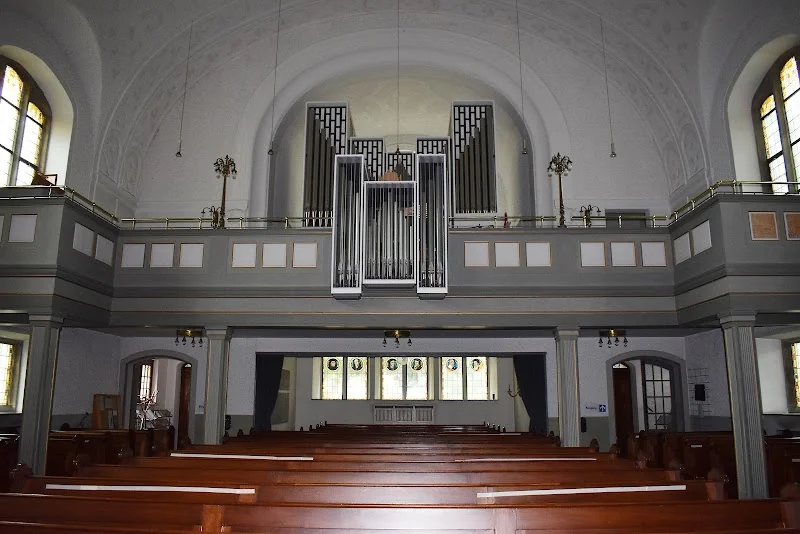
Architecturally, the Great Protestant Church Oberkassel is a hall building with a tower on the south side. The official description emphasizes simplicity, practicality, and objectivity as defining characteristics of the floor plan. In the axis of the nave, there are entrance buildings with columns and curved roofs, while the western entrance building accommodates the ascent to the gallery and the bell floor of the tower. The space consciously avoids a division into several naves. Instead, a clear, common church space is created that makes the congregation experienceable as a unity. This spatial concentration is no coincidence but an expression of the so-called Wiesbaden Program, which understands the altar, pulpit, and organ as a unit of proclamation. Precisely for this reason, the pulpit is positioned so that it is visible from all seats, and for this reason, the organ is not just an accompanying instrument but a liturgical part of the space. ([kirche-ok.de](https://www.kirche-ok.de/unsere-gottesdienste/unsere-kirchen/grosse-kirche-oberkassel))
The external and internal design also follows this idea. The church refrains from borrowing from Romanesque and Gothic styles; instead, a factual language of form dominates, which was shaped by modern Protestant ideas at the time of construction. The official description mentions that the contrast of white plaster and slate surfaces makes the architectural character visible, while the then Art Nouveau in Oberkassel only echoes in a few details like chandeliers. Particularly interesting is that the church underwent several renovation phases throughout its history: in the mid-1960s, war damage was repaired, later an unsuitable exterior paint had to be removed and replaced with natural mineral colors. In 1975, the church was recognized as having historical preservation value; a year later, it was closed due to the risk of collapse and subsequently extensively renovated. During this process, vaulted arches were uncovered, secured with steel tension rods, and wall joints were re-stabilized with special mortar. Thus, the church not only shows its time of origin but also the care with which its substance has been preserved over decades. ([kirche-ok.de](https://www.kirche-ok.de/unsere-gottesdienste/unsere-kirchen/grosse-kirche-oberkassel))
Walcker Organ, Restoration, and Church Music
A special treasure of the Great Church Oberkassel is the Walcker organ. It was built in 1908 by the organ building company Walcker from Ludwigsburg and was closely linked to the liturgical spatial concept from the beginning. The parish emphasizes that the organ should stand in the sight of the congregation, not hidden on a distant gallery. Later, there were structural changes: in 1967, the company Peter moved the console to the tower gallery using electric action, but there were sound delays. Therefore, the presbytery decided in 1972 to relocate the organ to the rear gallery. In this reconstruction, pipe material from the original Walcker organ was reused. This is a stroke of luck from today’s perspective, as the case, many pipes, and other parts like wind chests remained intact, and the historical substance was not lost. The church therefore narrates its organ history as a long process of use, change, and preservation. ([kirche-ok.de](https://www.kirche-ok.de/unsere-gottesdienste/unsere-kirchen/grosse-kirche-oberkassel))
Particularly important is the phase of restoration. During an inspection in 2017, it was noted that the old Walcker organ was infested with mold and at the same time more original substance had been preserved than initially suspected. Subsequently, the organ expert Manfred Schwartz prepared an expert opinion and a specification, and in the summer of 2020, a tendering process began, from which the company Weimbs from Hellenthal emerged as a partner. On Pentecost 2022, the Walcker organ sounded again for the first time; later, the parish was also supported by the federal and state governments as well as numerous donors. The organ page also makes it clear that church music in Oberkassel is much more than a supporting program: there are concerts, request concerts, organ projects, donation and sponsorship models, and a clearly visible integration of the Walcker organ into parish life. The parish concept for 2024 explicitly formulates this as a focus for the future: the culturally and historically significant Walcker organ has brought organ music back into consciousness and should sound even stronger together with other musical groups. This is where one of the strongest identities of the house lies: the church is not only a building but a sound space. ([kirche-ok.de](https://www.kirche-ok.de/unsere-gottesdienste/unsere-kirchen/grosse-kirche-oberkassel))
Worship Services, Dates, and Community Life in Oberkassel
The Great Church Oberkassel is still an active place of worship with a regular profile. In the parish's FAQ, it is described that on the first Sunday of the month at 11 a.m., a worship service with a focus on music is celebrated in the Great Church. On the third Sunday of the month, there is also a worship service at 11 a.m. in the Great Church Oberkassel. The parish works with a landscape of worship services in which the various churches have different focuses. Thus, the Great Church is primarily responsible for musically oriented celebrations, while other places like Dollendorf or the Christ Church in Königswinter set different accents. This structure shows that the Great Church is not an isolated sacred building but part of a consciously structured, modern parish system. For people looking for a musical worship service, a classic Sunday service, or special liturgical formats, Oberkassel is thus a clear point of contact. ([kirche-ok.de](https://www.kirche-ok.de/faq))
The community life around the Great Church is diverse. The official website refers to the current worship schedule, events, church music, and other offerings for children, youth, adults, and seniors. The cantor Stefanie Ingenhaag is mentioned on the homepage as a contact person for musical questions, choirs, and concerts. At the same time, the parish office is located at Kinkelstraße 2 and is open on Tuesdays, Wednesdays, and Fridays from 10 a.m. to 12 p.m. This is practical for visitors, as worship services, musical rehearsals, parish newsletters, and organizational questions converge in one place. The parish also describes that its work is supported by a long tradition of church music, volunteer engagement, and diaconal projects. Therefore, those who visit the Great Church Oberkassel experience not just a single appointment but a vibrant parish cosmos with concerts, choirs, worship services, and well-structured public relations. ([kirche-ok.de](https://www.kirche-ok.de/))
Address, Connections, and Helpful Visitor Information
For practical orientation, the address is especially important: The Great Protestant Church Oberkassel is located at Kinkelstraße 4 in 53227 Bonn-Oberkassel. The parish office is separately located at Kinkelstraße 2 and is accessible from the front side to Königswinterer Straße. This spatial proximity is helpful for many visitors, as church-related questions, events, and worship services are well connected. Therefore, those visiting the site for the first time will find a clear structure: the church and parish office are only a few steps apart but functionally belong to a common ensemble. The parish regularly uses the Great Church for worship services and church music; at the same time, it is described in public representation as part of a monument-preserving church network in Oberkassel. Thus, the location not only gains a religious but also a cultural-historical value that goes far beyond the actual worship service. ([kirche-ok.de](https://www.kirche-ok.de/unsere-gottesdienste/unsere-kirchen/grosse-kirche-oberkassel))
There are also specific notes on accessibility. In the program of the Day of Open Monuments, the Great Protestant Church Oberkassel was designated as wheelchair accessible; furthermore, a connection to public transport was indicated. For people arriving by public transport or relying on barrier-free access, this is an important signal. The fact that the church was opened as a monument and that visitors could explore the building on their own further underscores its publicly accessible character. Therefore, those who choose the Great Church as a destination for a visit, a worship service, or a concert encounter a place that combines historical significance, active parish work, and hospitable use. The connection of monument-protected architecture and lively use makes the special charm: the church is not museum-like and frozen but is cared for, played in, and continually opened up to the community. ([tag-des-offenen-denkmals.de](https://www.tag-des-offenen-denkmals.de/denkmal/d00ffdc8-d90a-11ec-956a-960000a15311?utm_source=openai))
Significance for Oberkassel-Königswinter and the Protestant Identity
In the larger context of the parish, the Great Church Oberkassel plays a key role. The parish concept describes the Protestant parish of Oberkassel-Königswinter as a community with two districts and four churches: the Old Protestant Church from 1683, the Great Protestant Church from 1908, the Dollendorf Church from 1973, and the Christ Church in Königswinter-Old Town. Three of these buildings are listed as historic monuments. For the parish, the Great Church is therefore not only a structural centerpiece but also a strong symbol of continuity between the past and the present. It connects the old Oberkassel tradition with the newly merged parish that has reorganized itself since 2022. Thus, anyone who looks at the church also sees a piece of Protestant cultural history on the Rhine that continues to be written to this day. ([kirche-ok.de](https://www.kirche-ok.de/home/aktuelle-downloads/183-gemeindekonzeption-2024/file))
At the same time, the building stands for a Protestant self-understanding that emphasizes proclamation, community, and musical quality. Even the historical new building aimed to be a preaching church where visibility, acoustics, and the arrangement of altar, pulpit, and organ work together. Today, the parish continues this idea in a modern form: musical worship services, concerts, choirs, organ work, and a structured parish operation are all part of it. For this reason, the Great Protestant Church Oberkassel is a good place for all who seek a church with genuine liturgical substance, impressive organ tradition, and a clear architectural profile. It is not a loud monumental building but a space that works through calm, clarity, and sound. Those who visit it encounter a house that does not hide its history but continues to make it visible in worship services, music, and community life. ([kirche-ok.de](https://www.kirche-ok.de/unsere-gottesdienste/unsere-kirchen/grosse-kirche-oberkassel))
Sources:
- Official website of the Protestant parish of Oberkassel-Königswinter ([kirche-ok.de](https://www.kirche-ok.de/))
- Brief description of the Great Church Oberkassel on the parish website ([kirche-ok.de](https://www.kirche-ok.de/unsere-gottesdienste/unsere-kirchen/grosse-kirche-oberkassel))
- Walcker Organ Oberkassel and restoration ([orgel.kirche-ok.de](https://orgel.kirche-ok.de/))
- Day of Open Monuments: Great Protestant Church Oberkassel ([tag-des-offenen-denkmals.de](https://www.tag-des-offenen-denkmals.de/denkmal/d00ffdc8-d90a-11ec-956a-960000a15311?utm_source=openai))
Mehr anzeigenWeniger anzeigen
Great Protestant Church Oberkassel | Organ & Worship Service
The Great Protestant Church Oberkassel is one of the defining Protestant church spaces in the eastern part of Bonn and is closely linked to the history of the Protestant parish of Oberkassel-Königswinter. Those who enter the church at Kinkelstraße 4 experience not only a historic house of worship but also a space where architecture, liturgy, and music are consistently interrelated. This connection makes the church interesting for visitors: it serves as a preaching church, monument, concert venue, and community church simultaneously. The parish describes its history as centuries-old and yet continuously evolving; since the merger in 2022, it sees itself as Oberkassel-Königswinter with two parish districts, four churches, and a consciously musical and diaconal profile. The Great Church is the central symbol in Oberkassel and carries the memory of the earlier Protestant development of the place as well as the claim to be a contemporary place of lived faith. ([kirche-ok.de](https://www.kirche-ok.de/home/aktuelle-downloads/183-gemeindekonzeption-2024/file))
History of the Great Protestant Church Oberkassel
The origin of the Great Church does not begin with the construction year of 1907/08, but with a longer development of the parish. In the parish concept, the church community recalls that the first Protestant beginnings in Oberkassel date back to the second half of the 16th century and that the first Protestant church was completed in 1683. The later constructed Great Church thus stands in a long line of Protestant presence at the site and marks a turning point: from an older, smaller village church came a new building that was to meet the growth of the parish and its liturgical requirements of the early 20th century. The official church website describes that the larger parish representation seriously addressed the church construction question for the first time on March 25, 1905, after the royal consistory had also emphasized the necessity of a new building. This cleared the way for a construction that was not merely a replacement but an expression of a new self-understanding. ([kirche-ok.de](https://www.kirche-ok.de/home/aktuelle-downloads/183-gemeindekonzeption-2024/file))
The new church was built according to the plans of the Berlin architect Otto March, who designed a hall building with a clear, functional layout in 1907 and 1908. The consecration of the house of worship took place on November 3, 1908, and this date remains an important reference point in the history of the parish to this day. The festive publication for the consecration spoke of a new building whose motto was oriented towards the Psalm verse that one should sing a new song to the Lord. This connection between spiritual renewal and architectural breakthrough explains much of the building's impact. The church was not conceived as a representative city church in the classical sense but as a preaching church, where the visibility of the pulpit, good acoustics, and the spatial proximity of the liturgical elements play a decisive role. This makes the Great Church Oberkassel to this day a particularly clearly readable testimony to Protestant church building history. ([kirche-ok.de](https://www.kirche-ok.de/unsere-gottesdienste/unsere-kirchen/grosse-kirche-oberkassel))
Architecture, Spatial Concept, and the Wiesbaden Program
Architecturally, the Great Protestant Church Oberkassel is a hall building with a tower on the south side. The official description emphasizes simplicity, practicality, and objectivity as defining characteristics of the floor plan. In the axis of the nave, there are entrance buildings with columns and curved roofs, while the western entrance building accommodates the ascent to the gallery and the bell floor of the tower. The space consciously avoids a division into several naves. Instead, a clear, common church space is created that makes the congregation experienceable as a unity. This spatial concentration is no coincidence but an expression of the so-called Wiesbaden Program, which understands the altar, pulpit, and organ as a unit of proclamation. Precisely for this reason, the pulpit is positioned so that it is visible from all seats, and for this reason, the organ is not just an accompanying instrument but a liturgical part of the space. ([kirche-ok.de](https://www.kirche-ok.de/unsere-gottesdienste/unsere-kirchen/grosse-kirche-oberkassel))
The external and internal design also follows this idea. The church refrains from borrowing from Romanesque and Gothic styles; instead, a factual language of form dominates, which was shaped by modern Protestant ideas at the time of construction. The official description mentions that the contrast of white plaster and slate surfaces makes the architectural character visible, while the then Art Nouveau in Oberkassel only echoes in a few details like chandeliers. Particularly interesting is that the church underwent several renovation phases throughout its history: in the mid-1960s, war damage was repaired, later an unsuitable exterior paint had to be removed and replaced with natural mineral colors. In 1975, the church was recognized as having historical preservation value; a year later, it was closed due to the risk of collapse and subsequently extensively renovated. During this process, vaulted arches were uncovered, secured with steel tension rods, and wall joints were re-stabilized with special mortar. Thus, the church not only shows its time of origin but also the care with which its substance has been preserved over decades. ([kirche-ok.de](https://www.kirche-ok.de/unsere-gottesdienste/unsere-kirchen/grosse-kirche-oberkassel))
Walcker Organ, Restoration, and Church Music
A special treasure of the Great Church Oberkassel is the Walcker organ. It was built in 1908 by the organ building company Walcker from Ludwigsburg and was closely linked to the liturgical spatial concept from the beginning. The parish emphasizes that the organ should stand in the sight of the congregation, not hidden on a distant gallery. Later, there were structural changes: in 1967, the company Peter moved the console to the tower gallery using electric action, but there were sound delays. Therefore, the presbytery decided in 1972 to relocate the organ to the rear gallery. In this reconstruction, pipe material from the original Walcker organ was reused. This is a stroke of luck from today’s perspective, as the case, many pipes, and other parts like wind chests remained intact, and the historical substance was not lost. The church therefore narrates its organ history as a long process of use, change, and preservation. ([kirche-ok.de](https://www.kirche-ok.de/unsere-gottesdienste/unsere-kirchen/grosse-kirche-oberkassel))
Particularly important is the phase of restoration. During an inspection in 2017, it was noted that the old Walcker organ was infested with mold and at the same time more original substance had been preserved than initially suspected. Subsequently, the organ expert Manfred Schwartz prepared an expert opinion and a specification, and in the summer of 2020, a tendering process began, from which the company Weimbs from Hellenthal emerged as a partner. On Pentecost 2022, the Walcker organ sounded again for the first time; later, the parish was also supported by the federal and state governments as well as numerous donors. The organ page also makes it clear that church music in Oberkassel is much more than a supporting program: there are concerts, request concerts, organ projects, donation and sponsorship models, and a clearly visible integration of the Walcker organ into parish life. The parish concept for 2024 explicitly formulates this as a focus for the future: the culturally and historically significant Walcker organ has brought organ music back into consciousness and should sound even stronger together with other musical groups. This is where one of the strongest identities of the house lies: the church is not only a building but a sound space. ([kirche-ok.de](https://www.kirche-ok.de/unsere-gottesdienste/unsere-kirchen/grosse-kirche-oberkassel))
Worship Services, Dates, and Community Life in Oberkassel
The Great Church Oberkassel is still an active place of worship with a regular profile. In the parish's FAQ, it is described that on the first Sunday of the month at 11 a.m., a worship service with a focus on music is celebrated in the Great Church. On the third Sunday of the month, there is also a worship service at 11 a.m. in the Great Church Oberkassel. The parish works with a landscape of worship services in which the various churches have different focuses. Thus, the Great Church is primarily responsible for musically oriented celebrations, while other places like Dollendorf or the Christ Church in Königswinter set different accents. This structure shows that the Great Church is not an isolated sacred building but part of a consciously structured, modern parish system. For people looking for a musical worship service, a classic Sunday service, or special liturgical formats, Oberkassel is thus a clear point of contact. ([kirche-ok.de](https://www.kirche-ok.de/faq))
The community life around the Great Church is diverse. The official website refers to the current worship schedule, events, church music, and other offerings for children, youth, adults, and seniors. The cantor Stefanie Ingenhaag is mentioned on the homepage as a contact person for musical questions, choirs, and concerts. At the same time, the parish office is located at Kinkelstraße 2 and is open on Tuesdays, Wednesdays, and Fridays from 10 a.m. to 12 p.m. This is practical for visitors, as worship services, musical rehearsals, parish newsletters, and organizational questions converge in one place. The parish also describes that its work is supported by a long tradition of church music, volunteer engagement, and diaconal projects. Therefore, those who visit the Great Church Oberkassel experience not just a single appointment but a vibrant parish cosmos with concerts, choirs, worship services, and well-structured public relations. ([kirche-ok.de](https://www.kirche-ok.de/))
Address, Connections, and Helpful Visitor Information
For practical orientation, the address is especially important: The Great Protestant Church Oberkassel is located at Kinkelstraße 4 in 53227 Bonn-Oberkassel. The parish office is separately located at Kinkelstraße 2 and is accessible from the front side to Königswinterer Straße. This spatial proximity is helpful for many visitors, as church-related questions, events, and worship services are well connected. Therefore, those visiting the site for the first time will find a clear structure: the church and parish office are only a few steps apart but functionally belong to a common ensemble. The parish regularly uses the Great Church for worship services and church music; at the same time, it is described in public representation as part of a monument-preserving church network in Oberkassel. Thus, the location not only gains a religious but also a cultural-historical value that goes far beyond the actual worship service. ([kirche-ok.de](https://www.kirche-ok.de/unsere-gottesdienste/unsere-kirchen/grosse-kirche-oberkassel))
There are also specific notes on accessibility. In the program of the Day of Open Monuments, the Great Protestant Church Oberkassel was designated as wheelchair accessible; furthermore, a connection to public transport was indicated. For people arriving by public transport or relying on barrier-free access, this is an important signal. The fact that the church was opened as a monument and that visitors could explore the building on their own further underscores its publicly accessible character. Therefore, those who choose the Great Church as a destination for a visit, a worship service, or a concert encounter a place that combines historical significance, active parish work, and hospitable use. The connection of monument-protected architecture and lively use makes the special charm: the church is not museum-like and frozen but is cared for, played in, and continually opened up to the community. ([tag-des-offenen-denkmals.de](https://www.tag-des-offenen-denkmals.de/denkmal/d00ffdc8-d90a-11ec-956a-960000a15311?utm_source=openai))
Significance for Oberkassel-Königswinter and the Protestant Identity
In the larger context of the parish, the Great Church Oberkassel plays a key role. The parish concept describes the Protestant parish of Oberkassel-Königswinter as a community with two districts and four churches: the Old Protestant Church from 1683, the Great Protestant Church from 1908, the Dollendorf Church from 1973, and the Christ Church in Königswinter-Old Town. Three of these buildings are listed as historic monuments. For the parish, the Great Church is therefore not only a structural centerpiece but also a strong symbol of continuity between the past and the present. It connects the old Oberkassel tradition with the newly merged parish that has reorganized itself since 2022. Thus, anyone who looks at the church also sees a piece of Protestant cultural history on the Rhine that continues to be written to this day. ([kirche-ok.de](https://www.kirche-ok.de/home/aktuelle-downloads/183-gemeindekonzeption-2024/file))
At the same time, the building stands for a Protestant self-understanding that emphasizes proclamation, community, and musical quality. Even the historical new building aimed to be a preaching church where visibility, acoustics, and the arrangement of altar, pulpit, and organ work together. Today, the parish continues this idea in a modern form: musical worship services, concerts, choirs, organ work, and a structured parish operation are all part of it. For this reason, the Great Protestant Church Oberkassel is a good place for all who seek a church with genuine liturgical substance, impressive organ tradition, and a clear architectural profile. It is not a loud monumental building but a space that works through calm, clarity, and sound. Those who visit it encounter a house that does not hide its history but continues to make it visible in worship services, music, and community life. ([kirche-ok.de](https://www.kirche-ok.de/unsere-gottesdienste/unsere-kirchen/grosse-kirche-oberkassel))
Sources:
- Official website of the Protestant parish of Oberkassel-Königswinter ([kirche-ok.de](https://www.kirche-ok.de/))
- Brief description of the Great Church Oberkassel on the parish website ([kirche-ok.de](https://www.kirche-ok.de/unsere-gottesdienste/unsere-kirchen/grosse-kirche-oberkassel))
- Walcker Organ Oberkassel and restoration ([orgel.kirche-ok.de](https://orgel.kirche-ok.de/))
- Day of Open Monuments: Great Protestant Church Oberkassel ([tag-des-offenen-denkmals.de](https://www.tag-des-offenen-denkmals.de/denkmal/d00ffdc8-d90a-11ec-956a-960000a15311?utm_source=openai))
Great Protestant Church Oberkassel | Organ & Worship Service
The Great Protestant Church Oberkassel is one of the defining Protestant church spaces in the eastern part of Bonn and is closely linked to the history of the Protestant parish of Oberkassel-Königswinter. Those who enter the church at Kinkelstraße 4 experience not only a historic house of worship but also a space where architecture, liturgy, and music are consistently interrelated. This connection makes the church interesting for visitors: it serves as a preaching church, monument, concert venue, and community church simultaneously. The parish describes its history as centuries-old and yet continuously evolving; since the merger in 2022, it sees itself as Oberkassel-Königswinter with two parish districts, four churches, and a consciously musical and diaconal profile. The Great Church is the central symbol in Oberkassel and carries the memory of the earlier Protestant development of the place as well as the claim to be a contemporary place of lived faith. ([kirche-ok.de](https://www.kirche-ok.de/home/aktuelle-downloads/183-gemeindekonzeption-2024/file))
History of the Great Protestant Church Oberkassel
The origin of the Great Church does not begin with the construction year of 1907/08, but with a longer development of the parish. In the parish concept, the church community recalls that the first Protestant beginnings in Oberkassel date back to the second half of the 16th century and that the first Protestant church was completed in 1683. The later constructed Great Church thus stands in a long line of Protestant presence at the site and marks a turning point: from an older, smaller village church came a new building that was to meet the growth of the parish and its liturgical requirements of the early 20th century. The official church website describes that the larger parish representation seriously addressed the church construction question for the first time on March 25, 1905, after the royal consistory had also emphasized the necessity of a new building. This cleared the way for a construction that was not merely a replacement but an expression of a new self-understanding. ([kirche-ok.de](https://www.kirche-ok.de/home/aktuelle-downloads/183-gemeindekonzeption-2024/file))
The new church was built according to the plans of the Berlin architect Otto March, who designed a hall building with a clear, functional layout in 1907 and 1908. The consecration of the house of worship took place on November 3, 1908, and this date remains an important reference point in the history of the parish to this day. The festive publication for the consecration spoke of a new building whose motto was oriented towards the Psalm verse that one should sing a new song to the Lord. This connection between spiritual renewal and architectural breakthrough explains much of the building's impact. The church was not conceived as a representative city church in the classical sense but as a preaching church, where the visibility of the pulpit, good acoustics, and the spatial proximity of the liturgical elements play a decisive role. This makes the Great Church Oberkassel to this day a particularly clearly readable testimony to Protestant church building history. ([kirche-ok.de](https://www.kirche-ok.de/unsere-gottesdienste/unsere-kirchen/grosse-kirche-oberkassel))
Architecture, Spatial Concept, and the Wiesbaden Program
Architecturally, the Great Protestant Church Oberkassel is a hall building with a tower on the south side. The official description emphasizes simplicity, practicality, and objectivity as defining characteristics of the floor plan. In the axis of the nave, there are entrance buildings with columns and curved roofs, while the western entrance building accommodates the ascent to the gallery and the bell floor of the tower. The space consciously avoids a division into several naves. Instead, a clear, common church space is created that makes the congregation experienceable as a unity. This spatial concentration is no coincidence but an expression of the so-called Wiesbaden Program, which understands the altar, pulpit, and organ as a unit of proclamation. Precisely for this reason, the pulpit is positioned so that it is visible from all seats, and for this reason, the organ is not just an accompanying instrument but a liturgical part of the space. ([kirche-ok.de](https://www.kirche-ok.de/unsere-gottesdienste/unsere-kirchen/grosse-kirche-oberkassel))
The external and internal design also follows this idea. The church refrains from borrowing from Romanesque and Gothic styles; instead, a factual language of form dominates, which was shaped by modern Protestant ideas at the time of construction. The official description mentions that the contrast of white plaster and slate surfaces makes the architectural character visible, while the then Art Nouveau in Oberkassel only echoes in a few details like chandeliers. Particularly interesting is that the church underwent several renovation phases throughout its history: in the mid-1960s, war damage was repaired, later an unsuitable exterior paint had to be removed and replaced with natural mineral colors. In 1975, the church was recognized as having historical preservation value; a year later, it was closed due to the risk of collapse and subsequently extensively renovated. During this process, vaulted arches were uncovered, secured with steel tension rods, and wall joints were re-stabilized with special mortar. Thus, the church not only shows its time of origin but also the care with which its substance has been preserved over decades. ([kirche-ok.de](https://www.kirche-ok.de/unsere-gottesdienste/unsere-kirchen/grosse-kirche-oberkassel))
Walcker Organ, Restoration, and Church Music
A special treasure of the Great Church Oberkassel is the Walcker organ. It was built in 1908 by the organ building company Walcker from Ludwigsburg and was closely linked to the liturgical spatial concept from the beginning. The parish emphasizes that the organ should stand in the sight of the congregation, not hidden on a distant gallery. Later, there were structural changes: in 1967, the company Peter moved the console to the tower gallery using electric action, but there were sound delays. Therefore, the presbytery decided in 1972 to relocate the organ to the rear gallery. In this reconstruction, pipe material from the original Walcker organ was reused. This is a stroke of luck from today’s perspective, as the case, many pipes, and other parts like wind chests remained intact, and the historical substance was not lost. The church therefore narrates its organ history as a long process of use, change, and preservation. ([kirche-ok.de](https://www.kirche-ok.de/unsere-gottesdienste/unsere-kirchen/grosse-kirche-oberkassel))
Particularly important is the phase of restoration. During an inspection in 2017, it was noted that the old Walcker organ was infested with mold and at the same time more original substance had been preserved than initially suspected. Subsequently, the organ expert Manfred Schwartz prepared an expert opinion and a specification, and in the summer of 2020, a tendering process began, from which the company Weimbs from Hellenthal emerged as a partner. On Pentecost 2022, the Walcker organ sounded again for the first time; later, the parish was also supported by the federal and state governments as well as numerous donors. The organ page also makes it clear that church music in Oberkassel is much more than a supporting program: there are concerts, request concerts, organ projects, donation and sponsorship models, and a clearly visible integration of the Walcker organ into parish life. The parish concept for 2024 explicitly formulates this as a focus for the future: the culturally and historically significant Walcker organ has brought organ music back into consciousness and should sound even stronger together with other musical groups. This is where one of the strongest identities of the house lies: the church is not only a building but a sound space. ([kirche-ok.de](https://www.kirche-ok.de/unsere-gottesdienste/unsere-kirchen/grosse-kirche-oberkassel))
Worship Services, Dates, and Community Life in Oberkassel
The Great Church Oberkassel is still an active place of worship with a regular profile. In the parish's FAQ, it is described that on the first Sunday of the month at 11 a.m., a worship service with a focus on music is celebrated in the Great Church. On the third Sunday of the month, there is also a worship service at 11 a.m. in the Great Church Oberkassel. The parish works with a landscape of worship services in which the various churches have different focuses. Thus, the Great Church is primarily responsible for musically oriented celebrations, while other places like Dollendorf or the Christ Church in Königswinter set different accents. This structure shows that the Great Church is not an isolated sacred building but part of a consciously structured, modern parish system. For people looking for a musical worship service, a classic Sunday service, or special liturgical formats, Oberkassel is thus a clear point of contact. ([kirche-ok.de](https://www.kirche-ok.de/faq))
The community life around the Great Church is diverse. The official website refers to the current worship schedule, events, church music, and other offerings for children, youth, adults, and seniors. The cantor Stefanie Ingenhaag is mentioned on the homepage as a contact person for musical questions, choirs, and concerts. At the same time, the parish office is located at Kinkelstraße 2 and is open on Tuesdays, Wednesdays, and Fridays from 10 a.m. to 12 p.m. This is practical for visitors, as worship services, musical rehearsals, parish newsletters, and organizational questions converge in one place. The parish also describes that its work is supported by a long tradition of church music, volunteer engagement, and diaconal projects. Therefore, those who visit the Great Church Oberkassel experience not just a single appointment but a vibrant parish cosmos with concerts, choirs, worship services, and well-structured public relations. ([kirche-ok.de](https://www.kirche-ok.de/))
Address, Connections, and Helpful Visitor Information
For practical orientation, the address is especially important: The Great Protestant Church Oberkassel is located at Kinkelstraße 4 in 53227 Bonn-Oberkassel. The parish office is separately located at Kinkelstraße 2 and is accessible from the front side to Königswinterer Straße. This spatial proximity is helpful for many visitors, as church-related questions, events, and worship services are well connected. Therefore, those visiting the site for the first time will find a clear structure: the church and parish office are only a few steps apart but functionally belong to a common ensemble. The parish regularly uses the Great Church for worship services and church music; at the same time, it is described in public representation as part of a monument-preserving church network in Oberkassel. Thus, the location not only gains a religious but also a cultural-historical value that goes far beyond the actual worship service. ([kirche-ok.de](https://www.kirche-ok.de/unsere-gottesdienste/unsere-kirchen/grosse-kirche-oberkassel))
There are also specific notes on accessibility. In the program of the Day of Open Monuments, the Great Protestant Church Oberkassel was designated as wheelchair accessible; furthermore, a connection to public transport was indicated. For people arriving by public transport or relying on barrier-free access, this is an important signal. The fact that the church was opened as a monument and that visitors could explore the building on their own further underscores its publicly accessible character. Therefore, those who choose the Great Church as a destination for a visit, a worship service, or a concert encounter a place that combines historical significance, active parish work, and hospitable use. The connection of monument-protected architecture and lively use makes the special charm: the church is not museum-like and frozen but is cared for, played in, and continually opened up to the community. ([tag-des-offenen-denkmals.de](https://www.tag-des-offenen-denkmals.de/denkmal/d00ffdc8-d90a-11ec-956a-960000a15311?utm_source=openai))
Significance for Oberkassel-Königswinter and the Protestant Identity
In the larger context of the parish, the Great Church Oberkassel plays a key role. The parish concept describes the Protestant parish of Oberkassel-Königswinter as a community with two districts and four churches: the Old Protestant Church from 1683, the Great Protestant Church from 1908, the Dollendorf Church from 1973, and the Christ Church in Königswinter-Old Town. Three of these buildings are listed as historic monuments. For the parish, the Great Church is therefore not only a structural centerpiece but also a strong symbol of continuity between the past and the present. It connects the old Oberkassel tradition with the newly merged parish that has reorganized itself since 2022. Thus, anyone who looks at the church also sees a piece of Protestant cultural history on the Rhine that continues to be written to this day. ([kirche-ok.de](https://www.kirche-ok.de/home/aktuelle-downloads/183-gemeindekonzeption-2024/file))
At the same time, the building stands for a Protestant self-understanding that emphasizes proclamation, community, and musical quality. Even the historical new building aimed to be a preaching church where visibility, acoustics, and the arrangement of altar, pulpit, and organ work together. Today, the parish continues this idea in a modern form: musical worship services, concerts, choirs, organ work, and a structured parish operation are all part of it. For this reason, the Great Protestant Church Oberkassel is a good place for all who seek a church with genuine liturgical substance, impressive organ tradition, and a clear architectural profile. It is not a loud monumental building but a space that works through calm, clarity, and sound. Those who visit it encounter a house that does not hide its history but continues to make it visible in worship services, music, and community life. ([kirche-ok.de](https://www.kirche-ok.de/unsere-gottesdienste/unsere-kirchen/grosse-kirche-oberkassel))
Sources:
- Official website of the Protestant parish of Oberkassel-Königswinter ([kirche-ok.de](https://www.kirche-ok.de/))
- Brief description of the Great Church Oberkassel on the parish website ([kirche-ok.de](https://www.kirche-ok.de/unsere-gottesdienste/unsere-kirchen/grosse-kirche-oberkassel))
- Walcker Organ Oberkassel and restoration ([orgel.kirche-ok.de](https://orgel.kirche-ok.de/))
- Day of Open Monuments: Great Protestant Church Oberkassel ([tag-des-offenen-denkmals.de](https://www.tag-des-offenen-denkmals.de/denkmal/d00ffdc8-d90a-11ec-956a-960000a15311?utm_source=openai))
Upcoming Events
No events found
Frequently Asked Questions
Reviews
No reviews found