
Bonn
Meckenheimer Allee 166, 53115 Bonn, Deutschland
Geographical Institute of the University of Bonn | Photos & Reviews
The Geographical Institute of the University of Bonn is part of the Faculty of Mathematics and Natural Sciences and the Department of Earth Sciences. Those looking for clear orientation will find here not an ordinary visitor destination, but a scientific site with three buildings on the natural sciences campus in Bonn-Poppelsdorf, its own library, a large map collection, a C-Pool, laboratories, and a long history of the institute. For visitors, the combination of historical architecture, functional research infrastructure, and compact location is particularly interesting. The official website not only shows addresses and contacts but also pictures of the entrance, the locations, floor plans, the library, and other facilities. For this reason, the location is well-suited for users looking for photos, reviews, address, directions, and practical information. The university connects research, teaching, and service in a place that stands out in the Bonn cityscape and is also strongly embedded in the campus. ([geographie.uni-bonn.de](https://www.geographie.uni-bonn.de/de/das-institut))
Photos, Reviews, and First Impressions on Site
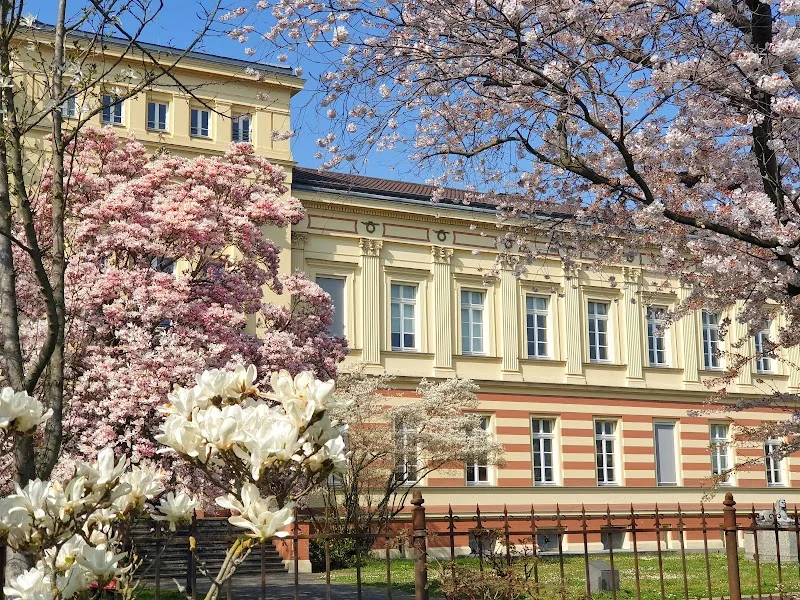
The first impression of the Geographical Institute of the University of Bonn is shaped by a building that is already part of Bonn's scientific history. The listed main building was planned since 1863 and constructed until 1867; in the official information, it is described as once the largest institute building in the world. After a vacancy in the 1970s, the complex was extensively renovated and subsequently occupied by Geography and Microbiology. Since 1983, the facility has been under monument protection. Characteristic is the four-wing building with a longitudinal section and four inner courtyards, whose street-facing transverse section is flanked by tower-like corner projections. This architectural presence makes the location stand out in photos because it offers far more than a modern institute building: it combines monumentality, science, and urban history in one place. At the same time, the complex is in immediate proximity to the Poppelsdorfer Schloss, which further enhances its external impact and embeds the institute in one of Bonn's most prominent locations. ([geographie.uni-bonn.de](https://www.geographie.uni-bonn.de/de/veranstaltungen/tag-des-offenen-denkmals-am-geographischen-institut))
If one is looking for photos or a visual impression, the official presentation of the institute is particularly helpful because it does not just list the location soberly but offers visual orientation. Among other things, the entrance of the institute, images of the locations, site plans of the individual levels, the library, the C-Pool, and the facilities inside can be seen. This is helpful for visitors who want to get an idea before an appointment and for those interested in a credible impression of the location. Unlike many purely administrative pages, Bonn Geography shows that it understands the place as a working and meeting space. Therefore, anyone looking for photos of the Geographical Institute of the University of Bonn will find not just a facade but a whole series of views that make the character of the building in Poppelsdorf comprehensible. The visual effect arises from the interplay of historical exterior architecture, functional interiors, and the visible traces of research and teaching. ([geographie.uni-bonn.de](https://www.geographie.uni-bonn.de/de/das-institut/standorte/standorte))
Locations, Address, and Campus Poppelsdorf
The Geographical Institute of the University of Bonn is distributed across three locations, all of which are located on the natural sciences campus in Bonn-Poppelsdorf. The main building is located at Meckenheimer Allee 166, 53115 Bonn, with the postal address P.O. Box 1147, 53001 Bonn. Additionally, there is the branch office for Hydrology and Water Management at Meckenheimer Allee 172 and the branch office Geozentrum at Meckenheimer Allee 176. This spatial structure is pleasant for visitors because it allows for short distances within a cohesive campus. At the same time, it shows that the institute is organized in several professional fields and the spaces are distributed accordingly. The location on a natural sciences campus underscores the interdisciplinary orientation of the building and makes it clear that geography is not thought of in isolation but in close connection with other sciences. Therefore, those visiting the place for the first time benefit from knowing the three addresses in advance and not just referring the appointment to the main building. ([geographie.uni-bonn.de](https://www.geographie.uni-bonn.de/de/das-institut/standorte/standorte))
Practically important is also the mailroom, which serves as the first point of contact and central mail office at the institute. Room inquiries can also be made there, which is relevant for internal processes and visitor questions alike. This makes it clear that the institute consists not only of research and teaching but also has a clear organizational center where many threads come together. Additionally, it is worth looking at the floor plans of the individual levels, which are available for download on the location page and facilitate orientation in the main building. Especially in a historical complex with several inner courtyards and different usage areas, this is helpful because the logic of the rooms is not immediately apparent. The official page structure therefore very consciously shows how to navigate from the address to the floor to the specific room question. For visitors looking for location, room plan, or point of contact, this is a clear advantage over a mere contact page. ([geographie.uni-bonn.de](https://www.geographie.uni-bonn.de/de/das-institut/postfachzimmer))
Library, Map Collection, and Learning at the Institute
The library of the Geographical Institute is one of the strongest reasons why the location is so attractive for students and researchers. It is located at Meckenheimer Allee 166, spans two floors, and offers various group and quiet study areas. This makes it not only a place for pure literature search but also a real learning space where collaborative work and focused reading can coexist. The opening hours are generous, from Monday to Friday, 8:00 AM to 8:00 PM, which noticeably eases everyday life in studies. Additionally, there are service offerings such as literature searches through various portals and a form for acquisition suggestions. Anyone missing an important book for a thesis or wanting to suggest a meaningful new acquisition will find a direct point of contact within the institute. Particularly valuable is also the consulting service for members of the Geographical Institute, where questions regarding literature research in bonnus and other databases can be clarified. Consultation is possible either in person or via Zoom. This creates an infrastructure that goes far beyond a classic lending point. ([geographie.uni-bonn.de](https://www.geographie.uni-bonn.de/de/einrichtungen/bibliothek/bibliothek))
The library also includes an impressive map collection with around 60,000 maps. According to the official description, it includes all official topographic works and can be used through the library. For geography, this is a central added value because maps are not only historical sources but also continue to be an important instrument of spatial analysis, teaching, and research. Additionally, the institute offers Geo-Media with a variety of audiovisual media for digital teaching as well as access to the loan of media equipment. Furthermore, there is the archive of the Geographical Institute, which preserves historical documents related to the history of the institute and selected former members. Thus, the library combines classic literature supply with map knowledge, digital material, and scientific memory culture. Anyone looking for a place where one can both learn and experience the subject's history and material culture will find here a very dense location with real substance. This mixture of service, inventory, and academic atmosphere makes the library a strong component of the institute's profile. ([geographie.uni-bonn.de](https://www.geographie.uni-bonn.de/de/einrichtungen/bibliothek/bibliothek))
C-Pool, Equipment Loan, and Technical Equipment
The C-Pool is another practical advantage of the Geographical Institute of the University of Bonn. In the computer rooms, specialized programs such as SPSS, ArcGIS, and other applications are available, and students can obtain their own account to use the computers and the internet. The administration also takes care of the ArcGIS campus license, which can be provided upon request for students and staff of the University of Bonn. The opening hours of the C-Pool follow those of the library, from Monday to Friday, 8:00 AM to 8:00 PM. This means that the digital infrastructure is closely linked to the learning times on site. For courses, term papers, empirical projects, or GIS-based analyses, this is a real location advantage because software and support do not have to be organized externally. The official presentation also makes it clear that the institute supports research and teaching with comprehensive services and aims to create ideal working conditions. For a geographical institution, this is particularly relevant because spatial analysis, cartography, and data processing are hardly conceivable today without a suitable computing environment. ([geographie.uni-bonn.de](https://www.geographie.uni-bonn.de/de/einrichtungen/c-pool/c-pool))
Closely related to the digital area is the equipment collection of the institute. It has a large pool of field and measuring devices for geographical work. This includes devices from the fields of climatology, hydrology, vegetation geography, geomorphology, and soil science, as well as aids for human geographical work such as dictation devices. The loan is possible for students and staff, for example, for field practices, exercises, theses, or research projects. However, the loan must be reserved in advance, at least five days in advance by email or phone. Returns take place during opening hours or by appointment by phone, and the devices must be returned clean and in perfect condition. This sounds very organizational, but it is an important quality factor for practical geography. Additionally, the official page of the institute also mentions geochemical and soil physics laboratories, working group laboratories, the climate station at GIUB, and the experimental facility Frankenforst as part of the infrastructure. This creates a location where digital, experimental, and field-related work closely interact. ([geographie.uni-bonn.de](https://www.geographie.uni-bonn.de/de/einrichtungen/geraetesammlung/geraetesammlung))
History, Building, and Scientific Profile
The history of the Geographical Institute of the University of Bonn goes back a long way. The official history of the institute begins in 1828 with the first habilitation of a geographer at the University of Bonn, G. B. Mendelssohn. A first geographical chair with an associated apparatus was established in 1875. Later, different institutions were merged: in 1963, the Geographical Institute, the Institute for Economic Geography, and the Seminar for Historical Geography were combined into one organizational unit. In 2000, the geographical institutes were merged into the Geographical Institute, and the move from Konviktstraße to Meckenheimer Allee 166 became effective in 2002. This development shows that the current location is not just a building name but the result of a long institutional consolidation. Therefore, those interested in the geography of the University of Bonn receive not only current research but also a historically grown structure with deep academic roots. ([geographie.uni-bonn.de](https://www.geographie.uni-bonn.de/de/das-institut))
In terms of content, the institute covers almost the entire spectrum of the subject. The scientific areas mentioned include climatology and landscape ecology, hydrology and water resources management, geomorphology, development geography, urban and regional geography, economic and social geography, cultural geography, remote sensing and GIS, as well as geography didactics. The organizational page specifies that nine scientific areas with a total of 15 working groups carry the research and teaching portfolio, thus forming the basis for teaching in seven degree programs. In addition, several degree programs and collaborations are highlighted, including the Bachelor of Science, the Bachelor of Geography Teaching, five master's programs, and international collaborations such as the Master of Science Geography of Environmental Risks and Human Security with the United Nations University. The institute is thus not only a historical building but a broadly positioned academic place with profiles between natural and social geography, methodological orientation, and international networking. This diversity explains why the location is so relevant for research, study, and public perception. ([geographie.uni-bonn.de](https://www.geographie.uni-bonn.de/de/das-institut/organisation))
Directions, Parking, and Practical Tips for Visitors
The directions to the Geographical Institute are closely linked to the location on the Poppelsdorf campus. The University of Bonn describes public transport access for this campus via Bonn main station and then by bus: From bus platform A1, lines 602 or 603 head towards Uniklinik Süd, Waldau, or Röttgen Schleife; there, one gets off at the stops Beringstraße or Am Botanischen Garten. From bus platform E, lines 604, 605, 606, or 607 head towards Ückesdorf, Duisdorf Bahnhof, or Malteser-Krankenhaus; here, the Kaufmannstraße stop is relevant. Those arriving by car should use the A565 exit Poppelsdorf from the south, drive via Reuterstraße towards B9, and continue via Jagdweg, Sternenburgstraße, and Clemens-August-Straße; from other directions, the A562 exit Bonn-Zentrum with B9 is described. For the navigation system, the university provides the Campusallee, 53115 Bonn for the Poppelsdorf campus. This information is practically relevant for the Geographical Institute because the location is directly on this campus, and visitors can orient themselves to the university's directions. ([uni-bonn.de](https://www.uni-bonn.de/de/universitaet/ueber-die-uni/standorte/standorte))
When parking, one should note that the University of Bonn provides paid parking options on the Poppelsdorf campus. This is important for visitors because the location is accessible by car, but parking space is not unlimited. Therefore, anyone with an appointment at the Geographical Institute should plan their arrival in advance and allow enough time for parking. At the same time, the location is very well embedded for pedestrians, as the institute is in immediate proximity to the Poppelsdorfer Schloss, thus situated in a well-known urban environment. The official monument page additionally emphasizes that the building has been housed in this historical complex since the 1980s. This makes the journey not only a logistical question but also a small urban experience, as the way leads into an area of Bonn where science, history, and campus atmosphere come together closely. Therefore, those visiting the institute for the first time benefit from checking public transport access, campus access, and parking regulations in advance. ([uni-bonn.de](https://www.uni-bonn.de/de/universitaet/ueber-die-uni/standorte/standorte))
Sources:
- Geographical Institute of the University of Bonn – The Institute
- Geographical Institute of the University of Bonn – Locations
- Geographical Institute of the University of Bonn – Library and Media
- Geographical Institute of the University of Bonn – C-Pool
- Geographical Institute of the University of Bonn – Organization
- Geographical Institute of the University of Bonn – Open Monument Day at the Geographical Institute
- University of Bonn – Locations and Directions to the Poppelsdorf Campus
Mehr anzeigenWeniger anzeigen
Geographical Institute of the University of Bonn | Photos & Reviews
The Geographical Institute of the University of Bonn is part of the Faculty of Mathematics and Natural Sciences and the Department of Earth Sciences. Those looking for clear orientation will find here not an ordinary visitor destination, but a scientific site with three buildings on the natural sciences campus in Bonn-Poppelsdorf, its own library, a large map collection, a C-Pool, laboratories, and a long history of the institute. For visitors, the combination of historical architecture, functional research infrastructure, and compact location is particularly interesting. The official website not only shows addresses and contacts but also pictures of the entrance, the locations, floor plans, the library, and other facilities. For this reason, the location is well-suited for users looking for photos, reviews, address, directions, and practical information. The university connects research, teaching, and service in a place that stands out in the Bonn cityscape and is also strongly embedded in the campus. ([geographie.uni-bonn.de](https://www.geographie.uni-bonn.de/de/das-institut))
Photos, Reviews, and First Impressions on Site
The first impression of the Geographical Institute of the University of Bonn is shaped by a building that is already part of Bonn's scientific history. The listed main building was planned since 1863 and constructed until 1867; in the official information, it is described as once the largest institute building in the world. After a vacancy in the 1970s, the complex was extensively renovated and subsequently occupied by Geography and Microbiology. Since 1983, the facility has been under monument protection. Characteristic is the four-wing building with a longitudinal section and four inner courtyards, whose street-facing transverse section is flanked by tower-like corner projections. This architectural presence makes the location stand out in photos because it offers far more than a modern institute building: it combines monumentality, science, and urban history in one place. At the same time, the complex is in immediate proximity to the Poppelsdorfer Schloss, which further enhances its external impact and embeds the institute in one of Bonn's most prominent locations. ([geographie.uni-bonn.de](https://www.geographie.uni-bonn.de/de/veranstaltungen/tag-des-offenen-denkmals-am-geographischen-institut))
If one is looking for photos or a visual impression, the official presentation of the institute is particularly helpful because it does not just list the location soberly but offers visual orientation. Among other things, the entrance of the institute, images of the locations, site plans of the individual levels, the library, the C-Pool, and the facilities inside can be seen. This is helpful for visitors who want to get an idea before an appointment and for those interested in a credible impression of the location. Unlike many purely administrative pages, Bonn Geography shows that it understands the place as a working and meeting space. Therefore, anyone looking for photos of the Geographical Institute of the University of Bonn will find not just a facade but a whole series of views that make the character of the building in Poppelsdorf comprehensible. The visual effect arises from the interplay of historical exterior architecture, functional interiors, and the visible traces of research and teaching. ([geographie.uni-bonn.de](https://www.geographie.uni-bonn.de/de/das-institut/standorte/standorte))
Locations, Address, and Campus Poppelsdorf
The Geographical Institute of the University of Bonn is distributed across three locations, all of which are located on the natural sciences campus in Bonn-Poppelsdorf. The main building is located at Meckenheimer Allee 166, 53115 Bonn, with the postal address P.O. Box 1147, 53001 Bonn. Additionally, there is the branch office for Hydrology and Water Management at Meckenheimer Allee 172 and the branch office Geozentrum at Meckenheimer Allee 176. This spatial structure is pleasant for visitors because it allows for short distances within a cohesive campus. At the same time, it shows that the institute is organized in several professional fields and the spaces are distributed accordingly. The location on a natural sciences campus underscores the interdisciplinary orientation of the building and makes it clear that geography is not thought of in isolation but in close connection with other sciences. Therefore, those visiting the place for the first time benefit from knowing the three addresses in advance and not just referring the appointment to the main building. ([geographie.uni-bonn.de](https://www.geographie.uni-bonn.de/de/das-institut/standorte/standorte))
Practically important is also the mailroom, which serves as the first point of contact and central mail office at the institute. Room inquiries can also be made there, which is relevant for internal processes and visitor questions alike. This makes it clear that the institute consists not only of research and teaching but also has a clear organizational center where many threads come together. Additionally, it is worth looking at the floor plans of the individual levels, which are available for download on the location page and facilitate orientation in the main building. Especially in a historical complex with several inner courtyards and different usage areas, this is helpful because the logic of the rooms is not immediately apparent. The official page structure therefore very consciously shows how to navigate from the address to the floor to the specific room question. For visitors looking for location, room plan, or point of contact, this is a clear advantage over a mere contact page. ([geographie.uni-bonn.de](https://www.geographie.uni-bonn.de/de/das-institut/postfachzimmer))
Library, Map Collection, and Learning at the Institute
The library of the Geographical Institute is one of the strongest reasons why the location is so attractive for students and researchers. It is located at Meckenheimer Allee 166, spans two floors, and offers various group and quiet study areas. This makes it not only a place for pure literature search but also a real learning space where collaborative work and focused reading can coexist. The opening hours are generous, from Monday to Friday, 8:00 AM to 8:00 PM, which noticeably eases everyday life in studies. Additionally, there are service offerings such as literature searches through various portals and a form for acquisition suggestions. Anyone missing an important book for a thesis or wanting to suggest a meaningful new acquisition will find a direct point of contact within the institute. Particularly valuable is also the consulting service for members of the Geographical Institute, where questions regarding literature research in bonnus and other databases can be clarified. Consultation is possible either in person or via Zoom. This creates an infrastructure that goes far beyond a classic lending point. ([geographie.uni-bonn.de](https://www.geographie.uni-bonn.de/de/einrichtungen/bibliothek/bibliothek))
The library also includes an impressive map collection with around 60,000 maps. According to the official description, it includes all official topographic works and can be used through the library. For geography, this is a central added value because maps are not only historical sources but also continue to be an important instrument of spatial analysis, teaching, and research. Additionally, the institute offers Geo-Media with a variety of audiovisual media for digital teaching as well as access to the loan of media equipment. Furthermore, there is the archive of the Geographical Institute, which preserves historical documents related to the history of the institute and selected former members. Thus, the library combines classic literature supply with map knowledge, digital material, and scientific memory culture. Anyone looking for a place where one can both learn and experience the subject's history and material culture will find here a very dense location with real substance. This mixture of service, inventory, and academic atmosphere makes the library a strong component of the institute's profile. ([geographie.uni-bonn.de](https://www.geographie.uni-bonn.de/de/einrichtungen/bibliothek/bibliothek))
C-Pool, Equipment Loan, and Technical Equipment
The C-Pool is another practical advantage of the Geographical Institute of the University of Bonn. In the computer rooms, specialized programs such as SPSS, ArcGIS, and other applications are available, and students can obtain their own account to use the computers and the internet. The administration also takes care of the ArcGIS campus license, which can be provided upon request for students and staff of the University of Bonn. The opening hours of the C-Pool follow those of the library, from Monday to Friday, 8:00 AM to 8:00 PM. This means that the digital infrastructure is closely linked to the learning times on site. For courses, term papers, empirical projects, or GIS-based analyses, this is a real location advantage because software and support do not have to be organized externally. The official presentation also makes it clear that the institute supports research and teaching with comprehensive services and aims to create ideal working conditions. For a geographical institution, this is particularly relevant because spatial analysis, cartography, and data processing are hardly conceivable today without a suitable computing environment. ([geographie.uni-bonn.de](https://www.geographie.uni-bonn.de/de/einrichtungen/c-pool/c-pool))
Closely related to the digital area is the equipment collection of the institute. It has a large pool of field and measuring devices for geographical work. This includes devices from the fields of climatology, hydrology, vegetation geography, geomorphology, and soil science, as well as aids for human geographical work such as dictation devices. The loan is possible for students and staff, for example, for field practices, exercises, theses, or research projects. However, the loan must be reserved in advance, at least five days in advance by email or phone. Returns take place during opening hours or by appointment by phone, and the devices must be returned clean and in perfect condition. This sounds very organizational, but it is an important quality factor for practical geography. Additionally, the official page of the institute also mentions geochemical and soil physics laboratories, working group laboratories, the climate station at GIUB, and the experimental facility Frankenforst as part of the infrastructure. This creates a location where digital, experimental, and field-related work closely interact. ([geographie.uni-bonn.de](https://www.geographie.uni-bonn.de/de/einrichtungen/geraetesammlung/geraetesammlung))
History, Building, and Scientific Profile
The history of the Geographical Institute of the University of Bonn goes back a long way. The official history of the institute begins in 1828 with the first habilitation of a geographer at the University of Bonn, G. B. Mendelssohn. A first geographical chair with an associated apparatus was established in 1875. Later, different institutions were merged: in 1963, the Geographical Institute, the Institute for Economic Geography, and the Seminar for Historical Geography were combined into one organizational unit. In 2000, the geographical institutes were merged into the Geographical Institute, and the move from Konviktstraße to Meckenheimer Allee 166 became effective in 2002. This development shows that the current location is not just a building name but the result of a long institutional consolidation. Therefore, those interested in the geography of the University of Bonn receive not only current research but also a historically grown structure with deep academic roots. ([geographie.uni-bonn.de](https://www.geographie.uni-bonn.de/de/das-institut))
In terms of content, the institute covers almost the entire spectrum of the subject. The scientific areas mentioned include climatology and landscape ecology, hydrology and water resources management, geomorphology, development geography, urban and regional geography, economic and social geography, cultural geography, remote sensing and GIS, as well as geography didactics. The organizational page specifies that nine scientific areas with a total of 15 working groups carry the research and teaching portfolio, thus forming the basis for teaching in seven degree programs. In addition, several degree programs and collaborations are highlighted, including the Bachelor of Science, the Bachelor of Geography Teaching, five master's programs, and international collaborations such as the Master of Science Geography of Environmental Risks and Human Security with the United Nations University. The institute is thus not only a historical building but a broadly positioned academic place with profiles between natural and social geography, methodological orientation, and international networking. This diversity explains why the location is so relevant for research, study, and public perception. ([geographie.uni-bonn.de](https://www.geographie.uni-bonn.de/de/das-institut/organisation))
Directions, Parking, and Practical Tips for Visitors
The directions to the Geographical Institute are closely linked to the location on the Poppelsdorf campus. The University of Bonn describes public transport access for this campus via Bonn main station and then by bus: From bus platform A1, lines 602 or 603 head towards Uniklinik Süd, Waldau, or Röttgen Schleife; there, one gets off at the stops Beringstraße or Am Botanischen Garten. From bus platform E, lines 604, 605, 606, or 607 head towards Ückesdorf, Duisdorf Bahnhof, or Malteser-Krankenhaus; here, the Kaufmannstraße stop is relevant. Those arriving by car should use the A565 exit Poppelsdorf from the south, drive via Reuterstraße towards B9, and continue via Jagdweg, Sternenburgstraße, and Clemens-August-Straße; from other directions, the A562 exit Bonn-Zentrum with B9 is described. For the navigation system, the university provides the Campusallee, 53115 Bonn for the Poppelsdorf campus. This information is practically relevant for the Geographical Institute because the location is directly on this campus, and visitors can orient themselves to the university's directions. ([uni-bonn.de](https://www.uni-bonn.de/de/universitaet/ueber-die-uni/standorte/standorte))
When parking, one should note that the University of Bonn provides paid parking options on the Poppelsdorf campus. This is important for visitors because the location is accessible by car, but parking space is not unlimited. Therefore, anyone with an appointment at the Geographical Institute should plan their arrival in advance and allow enough time for parking. At the same time, the location is very well embedded for pedestrians, as the institute is in immediate proximity to the Poppelsdorfer Schloss, thus situated in a well-known urban environment. The official monument page additionally emphasizes that the building has been housed in this historical complex since the 1980s. This makes the journey not only a logistical question but also a small urban experience, as the way leads into an area of Bonn where science, history, and campus atmosphere come together closely. Therefore, those visiting the institute for the first time benefit from checking public transport access, campus access, and parking regulations in advance. ([uni-bonn.de](https://www.uni-bonn.de/de/universitaet/ueber-die-uni/standorte/standorte))
Sources:
- Geographical Institute of the University of Bonn – The Institute
- Geographical Institute of the University of Bonn – Locations
- Geographical Institute of the University of Bonn – Library and Media
- Geographical Institute of the University of Bonn – C-Pool
- Geographical Institute of the University of Bonn – Organization
- Geographical Institute of the University of Bonn – Open Monument Day at the Geographical Institute
- University of Bonn – Locations and Directions to the Poppelsdorf Campus
Geographical Institute of the University of Bonn | Photos & Reviews
The Geographical Institute of the University of Bonn is part of the Faculty of Mathematics and Natural Sciences and the Department of Earth Sciences. Those looking for clear orientation will find here not an ordinary visitor destination, but a scientific site with three buildings on the natural sciences campus in Bonn-Poppelsdorf, its own library, a large map collection, a C-Pool, laboratories, and a long history of the institute. For visitors, the combination of historical architecture, functional research infrastructure, and compact location is particularly interesting. The official website not only shows addresses and contacts but also pictures of the entrance, the locations, floor plans, the library, and other facilities. For this reason, the location is well-suited for users looking for photos, reviews, address, directions, and practical information. The university connects research, teaching, and service in a place that stands out in the Bonn cityscape and is also strongly embedded in the campus. ([geographie.uni-bonn.de](https://www.geographie.uni-bonn.de/de/das-institut))
Photos, Reviews, and First Impressions on Site
The first impression of the Geographical Institute of the University of Bonn is shaped by a building that is already part of Bonn's scientific history. The listed main building was planned since 1863 and constructed until 1867; in the official information, it is described as once the largest institute building in the world. After a vacancy in the 1970s, the complex was extensively renovated and subsequently occupied by Geography and Microbiology. Since 1983, the facility has been under monument protection. Characteristic is the four-wing building with a longitudinal section and four inner courtyards, whose street-facing transverse section is flanked by tower-like corner projections. This architectural presence makes the location stand out in photos because it offers far more than a modern institute building: it combines monumentality, science, and urban history in one place. At the same time, the complex is in immediate proximity to the Poppelsdorfer Schloss, which further enhances its external impact and embeds the institute in one of Bonn's most prominent locations. ([geographie.uni-bonn.de](https://www.geographie.uni-bonn.de/de/veranstaltungen/tag-des-offenen-denkmals-am-geographischen-institut))
If one is looking for photos or a visual impression, the official presentation of the institute is particularly helpful because it does not just list the location soberly but offers visual orientation. Among other things, the entrance of the institute, images of the locations, site plans of the individual levels, the library, the C-Pool, and the facilities inside can be seen. This is helpful for visitors who want to get an idea before an appointment and for those interested in a credible impression of the location. Unlike many purely administrative pages, Bonn Geography shows that it understands the place as a working and meeting space. Therefore, anyone looking for photos of the Geographical Institute of the University of Bonn will find not just a facade but a whole series of views that make the character of the building in Poppelsdorf comprehensible. The visual effect arises from the interplay of historical exterior architecture, functional interiors, and the visible traces of research and teaching. ([geographie.uni-bonn.de](https://www.geographie.uni-bonn.de/de/das-institut/standorte/standorte))
Locations, Address, and Campus Poppelsdorf
The Geographical Institute of the University of Bonn is distributed across three locations, all of which are located on the natural sciences campus in Bonn-Poppelsdorf. The main building is located at Meckenheimer Allee 166, 53115 Bonn, with the postal address P.O. Box 1147, 53001 Bonn. Additionally, there is the branch office for Hydrology and Water Management at Meckenheimer Allee 172 and the branch office Geozentrum at Meckenheimer Allee 176. This spatial structure is pleasant for visitors because it allows for short distances within a cohesive campus. At the same time, it shows that the institute is organized in several professional fields and the spaces are distributed accordingly. The location on a natural sciences campus underscores the interdisciplinary orientation of the building and makes it clear that geography is not thought of in isolation but in close connection with other sciences. Therefore, those visiting the place for the first time benefit from knowing the three addresses in advance and not just referring the appointment to the main building. ([geographie.uni-bonn.de](https://www.geographie.uni-bonn.de/de/das-institut/standorte/standorte))
Practically important is also the mailroom, which serves as the first point of contact and central mail office at the institute. Room inquiries can also be made there, which is relevant for internal processes and visitor questions alike. This makes it clear that the institute consists not only of research and teaching but also has a clear organizational center where many threads come together. Additionally, it is worth looking at the floor plans of the individual levels, which are available for download on the location page and facilitate orientation in the main building. Especially in a historical complex with several inner courtyards and different usage areas, this is helpful because the logic of the rooms is not immediately apparent. The official page structure therefore very consciously shows how to navigate from the address to the floor to the specific room question. For visitors looking for location, room plan, or point of contact, this is a clear advantage over a mere contact page. ([geographie.uni-bonn.de](https://www.geographie.uni-bonn.de/de/das-institut/postfachzimmer))
Library, Map Collection, and Learning at the Institute
The library of the Geographical Institute is one of the strongest reasons why the location is so attractive for students and researchers. It is located at Meckenheimer Allee 166, spans two floors, and offers various group and quiet study areas. This makes it not only a place for pure literature search but also a real learning space where collaborative work and focused reading can coexist. The opening hours are generous, from Monday to Friday, 8:00 AM to 8:00 PM, which noticeably eases everyday life in studies. Additionally, there are service offerings such as literature searches through various portals and a form for acquisition suggestions. Anyone missing an important book for a thesis or wanting to suggest a meaningful new acquisition will find a direct point of contact within the institute. Particularly valuable is also the consulting service for members of the Geographical Institute, where questions regarding literature research in bonnus and other databases can be clarified. Consultation is possible either in person or via Zoom. This creates an infrastructure that goes far beyond a classic lending point. ([geographie.uni-bonn.de](https://www.geographie.uni-bonn.de/de/einrichtungen/bibliothek/bibliothek))
The library also includes an impressive map collection with around 60,000 maps. According to the official description, it includes all official topographic works and can be used through the library. For geography, this is a central added value because maps are not only historical sources but also continue to be an important instrument of spatial analysis, teaching, and research. Additionally, the institute offers Geo-Media with a variety of audiovisual media for digital teaching as well as access to the loan of media equipment. Furthermore, there is the archive of the Geographical Institute, which preserves historical documents related to the history of the institute and selected former members. Thus, the library combines classic literature supply with map knowledge, digital material, and scientific memory culture. Anyone looking for a place where one can both learn and experience the subject's history and material culture will find here a very dense location with real substance. This mixture of service, inventory, and academic atmosphere makes the library a strong component of the institute's profile. ([geographie.uni-bonn.de](https://www.geographie.uni-bonn.de/de/einrichtungen/bibliothek/bibliothek))
C-Pool, Equipment Loan, and Technical Equipment
The C-Pool is another practical advantage of the Geographical Institute of the University of Bonn. In the computer rooms, specialized programs such as SPSS, ArcGIS, and other applications are available, and students can obtain their own account to use the computers and the internet. The administration also takes care of the ArcGIS campus license, which can be provided upon request for students and staff of the University of Bonn. The opening hours of the C-Pool follow those of the library, from Monday to Friday, 8:00 AM to 8:00 PM. This means that the digital infrastructure is closely linked to the learning times on site. For courses, term papers, empirical projects, or GIS-based analyses, this is a real location advantage because software and support do not have to be organized externally. The official presentation also makes it clear that the institute supports research and teaching with comprehensive services and aims to create ideal working conditions. For a geographical institution, this is particularly relevant because spatial analysis, cartography, and data processing are hardly conceivable today without a suitable computing environment. ([geographie.uni-bonn.de](https://www.geographie.uni-bonn.de/de/einrichtungen/c-pool/c-pool))
Closely related to the digital area is the equipment collection of the institute. It has a large pool of field and measuring devices for geographical work. This includes devices from the fields of climatology, hydrology, vegetation geography, geomorphology, and soil science, as well as aids for human geographical work such as dictation devices. The loan is possible for students and staff, for example, for field practices, exercises, theses, or research projects. However, the loan must be reserved in advance, at least five days in advance by email or phone. Returns take place during opening hours or by appointment by phone, and the devices must be returned clean and in perfect condition. This sounds very organizational, but it is an important quality factor for practical geography. Additionally, the official page of the institute also mentions geochemical and soil physics laboratories, working group laboratories, the climate station at GIUB, and the experimental facility Frankenforst as part of the infrastructure. This creates a location where digital, experimental, and field-related work closely interact. ([geographie.uni-bonn.de](https://www.geographie.uni-bonn.de/de/einrichtungen/geraetesammlung/geraetesammlung))
History, Building, and Scientific Profile
The history of the Geographical Institute of the University of Bonn goes back a long way. The official history of the institute begins in 1828 with the first habilitation of a geographer at the University of Bonn, G. B. Mendelssohn. A first geographical chair with an associated apparatus was established in 1875. Later, different institutions were merged: in 1963, the Geographical Institute, the Institute for Economic Geography, and the Seminar for Historical Geography were combined into one organizational unit. In 2000, the geographical institutes were merged into the Geographical Institute, and the move from Konviktstraße to Meckenheimer Allee 166 became effective in 2002. This development shows that the current location is not just a building name but the result of a long institutional consolidation. Therefore, those interested in the geography of the University of Bonn receive not only current research but also a historically grown structure with deep academic roots. ([geographie.uni-bonn.de](https://www.geographie.uni-bonn.de/de/das-institut))
In terms of content, the institute covers almost the entire spectrum of the subject. The scientific areas mentioned include climatology and landscape ecology, hydrology and water resources management, geomorphology, development geography, urban and regional geography, economic and social geography, cultural geography, remote sensing and GIS, as well as geography didactics. The organizational page specifies that nine scientific areas with a total of 15 working groups carry the research and teaching portfolio, thus forming the basis for teaching in seven degree programs. In addition, several degree programs and collaborations are highlighted, including the Bachelor of Science, the Bachelor of Geography Teaching, five master's programs, and international collaborations such as the Master of Science Geography of Environmental Risks and Human Security with the United Nations University. The institute is thus not only a historical building but a broadly positioned academic place with profiles between natural and social geography, methodological orientation, and international networking. This diversity explains why the location is so relevant for research, study, and public perception. ([geographie.uni-bonn.de](https://www.geographie.uni-bonn.de/de/das-institut/organisation))
Directions, Parking, and Practical Tips for Visitors
The directions to the Geographical Institute are closely linked to the location on the Poppelsdorf campus. The University of Bonn describes public transport access for this campus via Bonn main station and then by bus: From bus platform A1, lines 602 or 603 head towards Uniklinik Süd, Waldau, or Röttgen Schleife; there, one gets off at the stops Beringstraße or Am Botanischen Garten. From bus platform E, lines 604, 605, 606, or 607 head towards Ückesdorf, Duisdorf Bahnhof, or Malteser-Krankenhaus; here, the Kaufmannstraße stop is relevant. Those arriving by car should use the A565 exit Poppelsdorf from the south, drive via Reuterstraße towards B9, and continue via Jagdweg, Sternenburgstraße, and Clemens-August-Straße; from other directions, the A562 exit Bonn-Zentrum with B9 is described. For the navigation system, the university provides the Campusallee, 53115 Bonn for the Poppelsdorf campus. This information is practically relevant for the Geographical Institute because the location is directly on this campus, and visitors can orient themselves to the university's directions. ([uni-bonn.de](https://www.uni-bonn.de/de/universitaet/ueber-die-uni/standorte/standorte))
When parking, one should note that the University of Bonn provides paid parking options on the Poppelsdorf campus. This is important for visitors because the location is accessible by car, but parking space is not unlimited. Therefore, anyone with an appointment at the Geographical Institute should plan their arrival in advance and allow enough time for parking. At the same time, the location is very well embedded for pedestrians, as the institute is in immediate proximity to the Poppelsdorfer Schloss, thus situated in a well-known urban environment. The official monument page additionally emphasizes that the building has been housed in this historical complex since the 1980s. This makes the journey not only a logistical question but also a small urban experience, as the way leads into an area of Bonn where science, history, and campus atmosphere come together closely. Therefore, those visiting the institute for the first time benefit from checking public transport access, campus access, and parking regulations in advance. ([uni-bonn.de](https://www.uni-bonn.de/de/universitaet/ueber-die-uni/standorte/standorte))
Sources:
- Geographical Institute of the University of Bonn – The Institute
- Geographical Institute of the University of Bonn – Locations
- Geographical Institute of the University of Bonn – Library and Media
- Geographical Institute of the University of Bonn – C-Pool
- Geographical Institute of the University of Bonn – Organization
- Geographical Institute of the University of Bonn – Open Monument Day at the Geographical Institute
- University of Bonn – Locations and Directions to the Poppelsdorf Campus
Upcoming Events
No events found
Frequently Asked Questions
Reviews
E K
26. July 2020
The grand building of the Department of Geography of the University of Bonn
Zoe Power
9. October 2016
May be a mineral museum? Jury's out
Lea Göbel
21. January 2025
Mega!
Onesimus Zechariah
8. July 2022
Great place
trevor ochmonek
6. January 2026
I started my studies at the Department of Geography of the University of Bonn (GIUB) with great interest and high expectations, and I have generally benefited a lot from the diverse orientation and the dedicated professors. However, there are some points that I believe urgently need improvement and that unnecessarily complicate the course of studies. A major point of criticism concerns the mandatory enrollment in minor subjects. First of all, I find the idea of an interdisciplinary approach to studies sensible. However, a significant drawback lies in the lack of communication between the institutes hosting the minor subjects and the GIUB here. The enrollment deadlines often do not run in parallel, the examination regulations are only poorly coordinated, and many important pieces of information are often lost and inadequately communicated. External factors such as the retirement of lecturers or the termination of courses are also not communicated in a timely manner or at all, causing students to regularly have to adjust their planning at short notice and inevitably miss enrollment phases without realizing it. This quickly leads to delays in the course of studies. Furthermore, I notice that while the GIUB offers a wide range of content, essential fields are not (sufficiently) covered anymore. While social and identity geography topics are very present, classic, practice-oriented areas are often neglected. There are too few seminars that are truly "hands-on." Professorships in transport geography, construction and mobility development, or modern urban planning are completely lacking, making it difficult for students with these interests to find suitable offerings. Instead, much emphasis is placed on topics like colonial history, street renaming, open book cabinets, feminist aspects, or "fear spaces in big cities." These discussions are socially relevant, but in this frequency, they are very one-sided and sometimes detached from practical application fields of geography. Overall, the GIUB is undoubtedly a traditional and strong institute in many areas. Those interested in social and cultural geography topics will find an excellent academic environment here. However, those who want to focus more on transport planning, urban development, or applied geography will quickly hit limits. The willingness to supervise theses in these areas is often lacking, or if so, only considering the aforementioned cultural/colonial geography aspects. Particularly the organizational problems between the institutes further complicate everyday student life. I wish for better coordination between subjects for future students, as well as a content expansion to include practice-oriented focuses, so that the great diversity of geography is also represented in Bonn in its full breadth.