
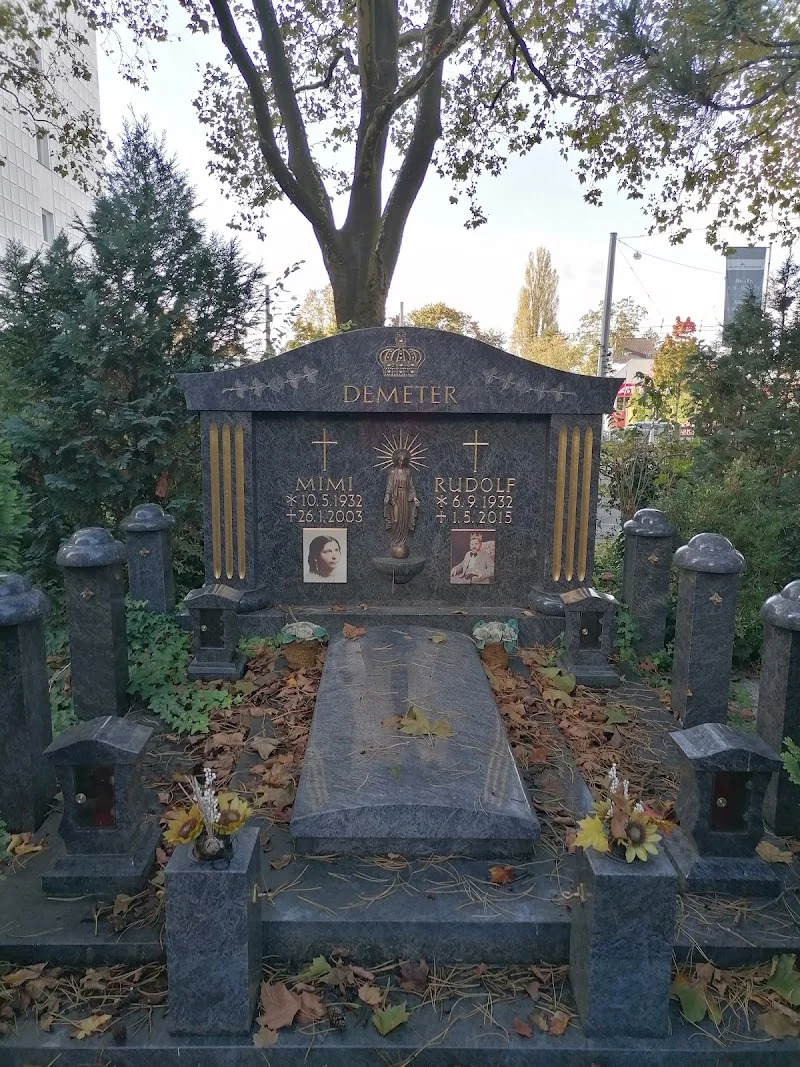
Gerbergastraße 1, Bonn
Gerbergastraße 1, 53225 Bonn, Germany
Cemetery Platanenweg | Directions & Address Bonn-Beuel
The Cemetery Platanenweg is the central municipal cemetery in the Bonn district of Beuel and a quiet place for farewell, remembrance, and reflective moments. The facility is conveniently located between Gerhardstraße and Platanenweg, making it easily accessible from all of Bonn on the right bank of the Rhine. Those seeking reliable orientation can find it at the address Gerhardstraße 1 in 53225 Bonn-Beuel; the main entrance to the mourning hall is also located there. Its proximity to Sankt-Augustiner-Straße and the tram stop Adelheidisstraße ensures that the cemetery is comfortably connected by public transport, as well as by bicycle or on foot. In addition to the functional infrastructure, the site is characterized by mature tree populations and clear pathways, allowing mourners, relatives, and visitors to intuitively find their way. Distinctive points such as the mourning hall, the war memorial, and the modern communal urn fields not only serve as orientation but also tell of the history and present of this burial site in Bonn-Beuel.
Directions and Address: How to Get to the Cemetery Platanenweg in Bonn-Beuel
The address Gerhardstraße 1, 53225 Bonn-Beuel, leads you directly to the cemetery grounds. While Platanenweg runs parallel to the cemetery area, it is Gerhardstraße that leads right up to the entrance and the mourning hall. The location between Königswinterer Straße and Sankt-Augustiner-Straße ensures easy orientation within Beuel. Coming from Beuel City or Konrad-Adenauer-Platz, you can reach the facility in just a few minutes by following Sankt-Augustiner-Straße out of town and then turning onto Gerhardstraße. The route from the Bonn Rhine Bridge is also straightforward, as Bundesstraße 56 forms the main route to which the district and thus the cemetery area are connected. For those who want to make orientation easier, the Adelheidisstraße stop can be used as a fixed point; from there, it is just a few crossings towards Gerhardstraße. The direct access via Gerhardstraße not only facilitates the delivery of floral decorations and mourning wreaths but also structures the pathways for visitors. In the immediate vicinity of the cemetery, there are craft and service businesses related to farewells and grave maintenance, including regional florists and stonemasonry businesses along Platanenweg, allowing for short distances from the order location to the grave site. For individual travel by bike, the largely flat road network in Beuel provides pleasant conditions. Those driving should plan for the fact that it is an inner-city environment; access via Gerhardstraße is the direct choice to the entrance with the mourning hall. Due to the good public transport connections, arriving by tram or on foot is particularly advisable, as it makes planning mourning ceremonies more reliable in terms of time and supports the quiet character of the place.
Public Transport Connection and Routes to the Mourning Hall: Adelheidisstraße Stop of Line 66
The tram stop Adelheidisstraße on Sankt-Augustiner-Straße is the most important public transport hub for getting to the Cemetery Platanenweg. It is served by Line 66, which functions as a fast, dense connection between Bonn, Beuel, Siegburg, and Bad Honnef. Historically and operationally, the stop is situated to facilitate direct access to the Beuel cemetery, as it is located at the level of the cemetery grounds. This means that passengers arriving from the left bank districts via the main train station or Beuel-Mitte can quickly reach the site with a transfer. From the stop, short pathways lead to Gerhardstraße, where the entrance with the mourning hall is located. This spatial proximity is particularly valuable in everyday life when burial appointments are tightly scheduled or mourning parties coordinate their arrival. The layout of the pathways in the vicinity is clear; urban crossings and sidewalks allow even larger groups to safely reach the entrance. Furthermore, the location of the stop on Sankt-Augustiner-Straße allows for good planning of deliveries for floral decorations and wreaths, as the walking distances from the nearest exit are short. Those reaching Beuel from outside can use Line 66 at many junctions, such as in Siegburg, Ramersdorf, or Beuel-Bahnhof. The tram connection from Bonn city center is also a reliable choice, especially during peak times when parking searches in inner-city residential areas naturally fluctuate. On-site, it is advisable to follow the signs to Gerhardstraße. The mourning hall is located immediately at the entrance on this side of the cemetery, making it logistically easy to plan the course of mourning ceremonies and allowing arrivals to quickly find the meeting point.
History and Development: From Ecclesiastical Burial to Municipal Facility at Platanenweg
The establishment of the cemetery at Platanenweg is closely linked to the development of Bonn on the right bank of the Rhine. After the older cemetery of St. Joseph and Paul was largely filled within a few decades due to the growing population in Beuel, the civil community decided in the 1950s to establish a new municipal cemetery at Platanenweg. With this decision, the burial culture in Beuel was increasingly oriented towards a city-managed infrastructure that considered land reserves, accessibility, and contemporary processes. The location at Platanenweg thus aimed to provide space for future generations. At the same time, the connection to the district remained palpable, as the area is still in close proximity to the established residential neighborhoods, allowing mourning to be expressed in a familiar place. To this day, these two lines shape the character of the facility: the municipal organization through the federal city of Bonn and the strong local integration in the district of Beuel. The following decades brought additional accents, such as the inclusion of a war memorial from 1927 in the monument list of the city of Bonn. This memorial was relocated to the cemetery in 1962 and connects the city's culture of remembrance with the specific place of farewell. More recently, sustainable grave forms and communally maintained facilities have come into focus, to which the establishment of communal urn fields at Platanenweg responds. Thus, the cemetery fits into a development that can be observed in many places in Germany: a mix of traditional forms of burial and more modern, maintenance-free offerings that relieve relatives of organizational burdens and ensure the horticultural quality in the long term. In summary, the Cemetery Platanenweg represents a Beuel history that preserves memory while remaining open to contemporary forms of remembrance.
Mourning Hall, Processes, and Burial Appointments: What the City of Bonn Regulates for the Cemetery Platanenweg
The mourning hall of the Cemetery Platanenweg is located immediately at the entrance on Gerhardstraße. Its location is deliberately chosen so that mourning parties, funeral companies, and delivery services have short distances, and the process of mourning ceremonies can be structured. The organizational framework for burials is formed by the cemetery and burial regulations of the federal city of Bonn in conjunction with the service information from the Office for Environment and Urban Green. Particularly relevant for practice: While the city of Bonn generally allocates burial appointments on an hourly basis, there is an exception for the Cemetery Beuel at Platanenweg. If the burial takes place at the grave, appointments can be allocated every half hour. This flexibility is especially helpful when multiple burials need to be coordinated on the same day or when ecclesiastical and secular mourning ceremonies need to be timed together. Coordination usually takes place through the commissioned funeral company, which requests the time slots from the city and plans the logistics around the mourning hall, funeral procession, and grave site. For relatives, this means that they can rely on clear framework conditions and established pathways regarding appointment allocation, the use of the mourning hall, and the specific processes. Those wishing to inform themselves about legal foundations such as resting periods, usage rights, or design specifications can find the relevant information in the municipal cemetery statute. It regulates the essential questions regarding occupancy, maintenance, design, and use of the cemetery facilities throughout the Bonn urban area. In conjunction with the local organization at Platanenweg, a reliable framework is created in which dignity, planning, and consideration come together. Practically relevant is also the public transport connection via the Adelheidisstraße stop of Line 66, which makes arrival times more predictable and thus further facilitates coordination with the mourning hall.
Communal Urn Graves and Care Concepts: Modern Grave Forms at Platanenweg
At the Cemetery Platanenweg, traditional grave forms are increasingly complemented by maintenance-free offerings. A visible example is the communal urn graves, which are managed by the Cemetery Gardener Cooperative Bonn eG in close coordination with the city of Bonn. A new communal urn field was created on the old part of the cemetery, to the left of the mourning hall. The location in close proximity to the hall facilitates pathways during mourning ceremonies and simultaneously creates a clear, dignified area for the burial of urns. Communally maintained facilities offer relatives the advantage that the basic horticultural maintenance is permanently secured, and the overall facility is kept in an appealing condition throughout the year. This alleviates where ongoing maintenance is not possible to the same extent and ensures that the cemetery as a whole presents a well-kept appearance. In consultation with funeral companies and cemetery gardening, it can be clarified which grave form best suits personal wishes and family situations. The range extends from individual urn graves to communal areas where names and dates can be recorded on central memorial stones. Choosing a grave form at Platanenweg is thus never just a functional decision but also a design decision. It connects the need for a reliable, easily accessible place with gardens of remembrance that remain cared for over the years. That this concept is visibly implemented at Platanenweg fits into a city-wide development in which cemeteries are understood as public green and memorial spaces that combine tranquility, dignity, and horticultural quality.
Orientation on Site and Special Features: Pathways, War Memorial, and Spatial References
Those entering the Cemetery Platanenweg benefit from a clearly readable pathway layout. Gerhardstraße leads right up to the entrance with the mourning hall, while Platanenweg runs along the cemetery boundary. This urban planning constellation facilitates orientation even without detailed location plans, as the mourning hall serves as the starting and meeting point for almost all processes. Within the facility, the war memorial from 1927 marks a historical landmark. It was relocated to the cemetery in 1962 and is listed in the monument list of the city of Bonn. As a visible element of the culture of remembrance, it invites quiet reflection and also serves as a point of orientation. Those moving within the grounds will find that the mature trees and the structured pathways provide ample space for both individual visitors and larger mourning processions. The communal urn areas near the mourning hall demonstrate the contemporary addition to the classic grave structure. Due to its location in the district of Beuel, the cemetery is also integrated into the everyday pathway network; the proximity to the Adelheidisstraße stop and the routing of Sankt-Augustiner-Straße as an urban axis ensure that even those unfamiliar with the area can easily find their way. The connection to major roads such as Bundesstraße 56 enhances accessibility from the urban area and surrounding regions without compromising the quiet character of the facility. For relatives organizing floral decorations or gravestone work, it is helpful that corresponding businesses are located in the vicinity of Platanenweg. This allows for good timing of orders and deliveries, especially when mourning ceremonies with subsequent burial walks are planned. All of this together makes the facility at Platanenweg a place that combines tranquility, clear structures, and good accessibility.
Legal Foundations, Deadlines, and Services: Reliable Planning within the Framework of the Municipal Statute
The use of the Cemetery Platanenweg follows, like all municipal cemeteries in Bonn, the municipal cemetery statute. It regulates, among other things, resting periods, occupancy and usage rights, as well as guidelines for design and maintenance. These legal frameworks create predictability and transparency. Additionally, the city of Bonn publishes practical service information that specifies the appointment allocation for burials. For relatives, it is particularly relevant that the city generally schedules burials on an hourly basis; however, an exception is allowed at the Cemetery Beuel at Platanenweg: Burials that take place at the grave can be scheduled every half hour. This flexibility helps coordinate processes in the mourning hall, pathways to the grave site, and the arrival of mourners harmoniously. Those preparing a burial usually clarify the details together with the funeral institute. There, the desired appointments, the use of the mourning hall, the extent of floral decorations, and possibly musical contributions are coordinated. For all other questions, municipal contacts are available, who are listed in the official portals of the federal city of Bonn. Through this coordinated collaboration, a reliable framework is created for relatives that minimizes organizational hurdles while ensuring the dignity of farewell. In combination with the good accessibility via tram line 66, the clear orientation via Gerhardstraße, and the established structures on the grounds, a picture emerges of a cemetery that creates trust both organizationally and spatially.
Sources:
- Federal City of Bonn – Burials and Burial Appointments
- Federal City of Bonn – Cemetery St. Joseph and Paul, Historical Context of the Cemetery Beuel at Platanenweg
- Wikipedia – Siegburger Bahn, Adelheidisstraße Stop at the Level of the Beuel Cemetery
- Cemetery Gardener Cooperative Bonn eG – Communal Urn Graves Platanenweg Bonn-Beuel
- Federal City of Bonn – Monument List, Entry War Memorial Cemetery Beuel
- Lebenshimmel – Cemetery Beuel, Location Reference Gerhardstraße and Platanenweg
- Citizen and Homeland Association Beuel – Meeting Point Mourning Hall Cemetery Platanenweg, Entrance Gerhardstraße
- DeutscheBiz – Cemetery Platanenweg, Address Gerhardstraße 1, 53225 Bonn
Show moreShow less
Cemetery Platanenweg | Directions & Address Bonn-Beuel
The Cemetery Platanenweg is the central municipal cemetery in the Bonn district of Beuel and a quiet place for farewell, remembrance, and reflective moments. The facility is conveniently located between Gerhardstraße and Platanenweg, making it easily accessible from all of Bonn on the right bank of the Rhine. Those seeking reliable orientation can find it at the address Gerhardstraße 1 in 53225 Bonn-Beuel; the main entrance to the mourning hall is also located there. Its proximity to Sankt-Augustiner-Straße and the tram stop Adelheidisstraße ensures that the cemetery is comfortably connected by public transport, as well as by bicycle or on foot. In addition to the functional infrastructure, the site is characterized by mature tree populations and clear pathways, allowing mourners, relatives, and visitors to intuitively find their way. Distinctive points such as the mourning hall, the war memorial, and the modern communal urn fields not only serve as orientation but also tell of the history and present of this burial site in Bonn-Beuel.
Directions and Address: How to Get to the Cemetery Platanenweg in Bonn-Beuel
The address Gerhardstraße 1, 53225 Bonn-Beuel, leads you directly to the cemetery grounds. While Platanenweg runs parallel to the cemetery area, it is Gerhardstraße that leads right up to the entrance and the mourning hall. The location between Königswinterer Straße and Sankt-Augustiner-Straße ensures easy orientation within Beuel. Coming from Beuel City or Konrad-Adenauer-Platz, you can reach the facility in just a few minutes by following Sankt-Augustiner-Straße out of town and then turning onto Gerhardstraße. The route from the Bonn Rhine Bridge is also straightforward, as Bundesstraße 56 forms the main route to which the district and thus the cemetery area are connected. For those who want to make orientation easier, the Adelheidisstraße stop can be used as a fixed point; from there, it is just a few crossings towards Gerhardstraße. The direct access via Gerhardstraße not only facilitates the delivery of floral decorations and mourning wreaths but also structures the pathways for visitors. In the immediate vicinity of the cemetery, there are craft and service businesses related to farewells and grave maintenance, including regional florists and stonemasonry businesses along Platanenweg, allowing for short distances from the order location to the grave site. For individual travel by bike, the largely flat road network in Beuel provides pleasant conditions. Those driving should plan for the fact that it is an inner-city environment; access via Gerhardstraße is the direct choice to the entrance with the mourning hall. Due to the good public transport connections, arriving by tram or on foot is particularly advisable, as it makes planning mourning ceremonies more reliable in terms of time and supports the quiet character of the place.
Public Transport Connection and Routes to the Mourning Hall: Adelheidisstraße Stop of Line 66
The tram stop Adelheidisstraße on Sankt-Augustiner-Straße is the most important public transport hub for getting to the Cemetery Platanenweg. It is served by Line 66, which functions as a fast, dense connection between Bonn, Beuel, Siegburg, and Bad Honnef. Historically and operationally, the stop is situated to facilitate direct access to the Beuel cemetery, as it is located at the level of the cemetery grounds. This means that passengers arriving from the left bank districts via the main train station or Beuel-Mitte can quickly reach the site with a transfer. From the stop, short pathways lead to Gerhardstraße, where the entrance with the mourning hall is located. This spatial proximity is particularly valuable in everyday life when burial appointments are tightly scheduled or mourning parties coordinate their arrival. The layout of the pathways in the vicinity is clear; urban crossings and sidewalks allow even larger groups to safely reach the entrance. Furthermore, the location of the stop on Sankt-Augustiner-Straße allows for good planning of deliveries for floral decorations and wreaths, as the walking distances from the nearest exit are short. Those reaching Beuel from outside can use Line 66 at many junctions, such as in Siegburg, Ramersdorf, or Beuel-Bahnhof. The tram connection from Bonn city center is also a reliable choice, especially during peak times when parking searches in inner-city residential areas naturally fluctuate. On-site, it is advisable to follow the signs to Gerhardstraße. The mourning hall is located immediately at the entrance on this side of the cemetery, making it logistically easy to plan the course of mourning ceremonies and allowing arrivals to quickly find the meeting point.
History and Development: From Ecclesiastical Burial to Municipal Facility at Platanenweg
The establishment of the cemetery at Platanenweg is closely linked to the development of Bonn on the right bank of the Rhine. After the older cemetery of St. Joseph and Paul was largely filled within a few decades due to the growing population in Beuel, the civil community decided in the 1950s to establish a new municipal cemetery at Platanenweg. With this decision, the burial culture in Beuel was increasingly oriented towards a city-managed infrastructure that considered land reserves, accessibility, and contemporary processes. The location at Platanenweg thus aimed to provide space for future generations. At the same time, the connection to the district remained palpable, as the area is still in close proximity to the established residential neighborhoods, allowing mourning to be expressed in a familiar place. To this day, these two lines shape the character of the facility: the municipal organization through the federal city of Bonn and the strong local integration in the district of Beuel. The following decades brought additional accents, such as the inclusion of a war memorial from 1927 in the monument list of the city of Bonn. This memorial was relocated to the cemetery in 1962 and connects the city's culture of remembrance with the specific place of farewell. More recently, sustainable grave forms and communally maintained facilities have come into focus, to which the establishment of communal urn fields at Platanenweg responds. Thus, the cemetery fits into a development that can be observed in many places in Germany: a mix of traditional forms of burial and more modern, maintenance-free offerings that relieve relatives of organizational burdens and ensure the horticultural quality in the long term. In summary, the Cemetery Platanenweg represents a Beuel history that preserves memory while remaining open to contemporary forms of remembrance.
Mourning Hall, Processes, and Burial Appointments: What the City of Bonn Regulates for the Cemetery Platanenweg
The mourning hall of the Cemetery Platanenweg is located immediately at the entrance on Gerhardstraße. Its location is deliberately chosen so that mourning parties, funeral companies, and delivery services have short distances, and the process of mourning ceremonies can be structured. The organizational framework for burials is formed by the cemetery and burial regulations of the federal city of Bonn in conjunction with the service information from the Office for Environment and Urban Green. Particularly relevant for practice: While the city of Bonn generally allocates burial appointments on an hourly basis, there is an exception for the Cemetery Beuel at Platanenweg. If the burial takes place at the grave, appointments can be allocated every half hour. This flexibility is especially helpful when multiple burials need to be coordinated on the same day or when ecclesiastical and secular mourning ceremonies need to be timed together. Coordination usually takes place through the commissioned funeral company, which requests the time slots from the city and plans the logistics around the mourning hall, funeral procession, and grave site. For relatives, this means that they can rely on clear framework conditions and established pathways regarding appointment allocation, the use of the mourning hall, and the specific processes. Those wishing to inform themselves about legal foundations such as resting periods, usage rights, or design specifications can find the relevant information in the municipal cemetery statute. It regulates the essential questions regarding occupancy, maintenance, design, and use of the cemetery facilities throughout the Bonn urban area. In conjunction with the local organization at Platanenweg, a reliable framework is created in which dignity, planning, and consideration come together. Practically relevant is also the public transport connection via the Adelheidisstraße stop of Line 66, which makes arrival times more predictable and thus further facilitates coordination with the mourning hall.
Communal Urn Graves and Care Concepts: Modern Grave Forms at Platanenweg
At the Cemetery Platanenweg, traditional grave forms are increasingly complemented by maintenance-free offerings. A visible example is the communal urn graves, which are managed by the Cemetery Gardener Cooperative Bonn eG in close coordination with the city of Bonn. A new communal urn field was created on the old part of the cemetery, to the left of the mourning hall. The location in close proximity to the hall facilitates pathways during mourning ceremonies and simultaneously creates a clear, dignified area for the burial of urns. Communally maintained facilities offer relatives the advantage that the basic horticultural maintenance is permanently secured, and the overall facility is kept in an appealing condition throughout the year. This alleviates where ongoing maintenance is not possible to the same extent and ensures that the cemetery as a whole presents a well-kept appearance. In consultation with funeral companies and cemetery gardening, it can be clarified which grave form best suits personal wishes and family situations. The range extends from individual urn graves to communal areas where names and dates can be recorded on central memorial stones. Choosing a grave form at Platanenweg is thus never just a functional decision but also a design decision. It connects the need for a reliable, easily accessible place with gardens of remembrance that remain cared for over the years. That this concept is visibly implemented at Platanenweg fits into a city-wide development in which cemeteries are understood as public green and memorial spaces that combine tranquility, dignity, and horticultural quality.
Orientation on Site and Special Features: Pathways, War Memorial, and Spatial References
Those entering the Cemetery Platanenweg benefit from a clearly readable pathway layout. Gerhardstraße leads right up to the entrance with the mourning hall, while Platanenweg runs along the cemetery boundary. This urban planning constellation facilitates orientation even without detailed location plans, as the mourning hall serves as the starting and meeting point for almost all processes. Within the facility, the war memorial from 1927 marks a historical landmark. It was relocated to the cemetery in 1962 and is listed in the monument list of the city of Bonn. As a visible element of the culture of remembrance, it invites quiet reflection and also serves as a point of orientation. Those moving within the grounds will find that the mature trees and the structured pathways provide ample space for both individual visitors and larger mourning processions. The communal urn areas near the mourning hall demonstrate the contemporary addition to the classic grave structure. Due to its location in the district of Beuel, the cemetery is also integrated into the everyday pathway network; the proximity to the Adelheidisstraße stop and the routing of Sankt-Augustiner-Straße as an urban axis ensure that even those unfamiliar with the area can easily find their way. The connection to major roads such as Bundesstraße 56 enhances accessibility from the urban area and surrounding regions without compromising the quiet character of the facility. For relatives organizing floral decorations or gravestone work, it is helpful that corresponding businesses are located in the vicinity of Platanenweg. This allows for good timing of orders and deliveries, especially when mourning ceremonies with subsequent burial walks are planned. All of this together makes the facility at Platanenweg a place that combines tranquility, clear structures, and good accessibility.
Legal Foundations, Deadlines, and Services: Reliable Planning within the Framework of the Municipal Statute
The use of the Cemetery Platanenweg follows, like all municipal cemeteries in Bonn, the municipal cemetery statute. It regulates, among other things, resting periods, occupancy and usage rights, as well as guidelines for design and maintenance. These legal frameworks create predictability and transparency. Additionally, the city of Bonn publishes practical service information that specifies the appointment allocation for burials. For relatives, it is particularly relevant that the city generally schedules burials on an hourly basis; however, an exception is allowed at the Cemetery Beuel at Platanenweg: Burials that take place at the grave can be scheduled every half hour. This flexibility helps coordinate processes in the mourning hall, pathways to the grave site, and the arrival of mourners harmoniously. Those preparing a burial usually clarify the details together with the funeral institute. There, the desired appointments, the use of the mourning hall, the extent of floral decorations, and possibly musical contributions are coordinated. For all other questions, municipal contacts are available, who are listed in the official portals of the federal city of Bonn. Through this coordinated collaboration, a reliable framework is created for relatives that minimizes organizational hurdles while ensuring the dignity of farewell. In combination with the good accessibility via tram line 66, the clear orientation via Gerhardstraße, and the established structures on the grounds, a picture emerges of a cemetery that creates trust both organizationally and spatially.
Sources:
- Federal City of Bonn – Burials and Burial Appointments
- Federal City of Bonn – Cemetery St. Joseph and Paul, Historical Context of the Cemetery Beuel at Platanenweg
- Wikipedia – Siegburger Bahn, Adelheidisstraße Stop at the Level of the Beuel Cemetery
- Cemetery Gardener Cooperative Bonn eG – Communal Urn Graves Platanenweg Bonn-Beuel
- Federal City of Bonn – Monument List, Entry War Memorial Cemetery Beuel
- Lebenshimmel – Cemetery Beuel, Location Reference Gerhardstraße and Platanenweg
- Citizen and Homeland Association Beuel – Meeting Point Mourning Hall Cemetery Platanenweg, Entrance Gerhardstraße
- DeutscheBiz – Cemetery Platanenweg, Address Gerhardstraße 1, 53225 Bonn
Cemetery Platanenweg | Directions & Address Bonn-Beuel
The Cemetery Platanenweg is the central municipal cemetery in the Bonn district of Beuel and a quiet place for farewell, remembrance, and reflective moments. The facility is conveniently located between Gerhardstraße and Platanenweg, making it easily accessible from all of Bonn on the right bank of the Rhine. Those seeking reliable orientation can find it at the address Gerhardstraße 1 in 53225 Bonn-Beuel; the main entrance to the mourning hall is also located there. Its proximity to Sankt-Augustiner-Straße and the tram stop Adelheidisstraße ensures that the cemetery is comfortably connected by public transport, as well as by bicycle or on foot. In addition to the functional infrastructure, the site is characterized by mature tree populations and clear pathways, allowing mourners, relatives, and visitors to intuitively find their way. Distinctive points such as the mourning hall, the war memorial, and the modern communal urn fields not only serve as orientation but also tell of the history and present of this burial site in Bonn-Beuel.
Directions and Address: How to Get to the Cemetery Platanenweg in Bonn-Beuel
The address Gerhardstraße 1, 53225 Bonn-Beuel, leads you directly to the cemetery grounds. While Platanenweg runs parallel to the cemetery area, it is Gerhardstraße that leads right up to the entrance and the mourning hall. The location between Königswinterer Straße and Sankt-Augustiner-Straße ensures easy orientation within Beuel. Coming from Beuel City or Konrad-Adenauer-Platz, you can reach the facility in just a few minutes by following Sankt-Augustiner-Straße out of town and then turning onto Gerhardstraße. The route from the Bonn Rhine Bridge is also straightforward, as Bundesstraße 56 forms the main route to which the district and thus the cemetery area are connected. For those who want to make orientation easier, the Adelheidisstraße stop can be used as a fixed point; from there, it is just a few crossings towards Gerhardstraße. The direct access via Gerhardstraße not only facilitates the delivery of floral decorations and mourning wreaths but also structures the pathways for visitors. In the immediate vicinity of the cemetery, there are craft and service businesses related to farewells and grave maintenance, including regional florists and stonemasonry businesses along Platanenweg, allowing for short distances from the order location to the grave site. For individual travel by bike, the largely flat road network in Beuel provides pleasant conditions. Those driving should plan for the fact that it is an inner-city environment; access via Gerhardstraße is the direct choice to the entrance with the mourning hall. Due to the good public transport connections, arriving by tram or on foot is particularly advisable, as it makes planning mourning ceremonies more reliable in terms of time and supports the quiet character of the place.
Public Transport Connection and Routes to the Mourning Hall: Adelheidisstraße Stop of Line 66
The tram stop Adelheidisstraße on Sankt-Augustiner-Straße is the most important public transport hub for getting to the Cemetery Platanenweg. It is served by Line 66, which functions as a fast, dense connection between Bonn, Beuel, Siegburg, and Bad Honnef. Historically and operationally, the stop is situated to facilitate direct access to the Beuel cemetery, as it is located at the level of the cemetery grounds. This means that passengers arriving from the left bank districts via the main train station or Beuel-Mitte can quickly reach the site with a transfer. From the stop, short pathways lead to Gerhardstraße, where the entrance with the mourning hall is located. This spatial proximity is particularly valuable in everyday life when burial appointments are tightly scheduled or mourning parties coordinate their arrival. The layout of the pathways in the vicinity is clear; urban crossings and sidewalks allow even larger groups to safely reach the entrance. Furthermore, the location of the stop on Sankt-Augustiner-Straße allows for good planning of deliveries for floral decorations and wreaths, as the walking distances from the nearest exit are short. Those reaching Beuel from outside can use Line 66 at many junctions, such as in Siegburg, Ramersdorf, or Beuel-Bahnhof. The tram connection from Bonn city center is also a reliable choice, especially during peak times when parking searches in inner-city residential areas naturally fluctuate. On-site, it is advisable to follow the signs to Gerhardstraße. The mourning hall is located immediately at the entrance on this side of the cemetery, making it logistically easy to plan the course of mourning ceremonies and allowing arrivals to quickly find the meeting point.
History and Development: From Ecclesiastical Burial to Municipal Facility at Platanenweg
The establishment of the cemetery at Platanenweg is closely linked to the development of Bonn on the right bank of the Rhine. After the older cemetery of St. Joseph and Paul was largely filled within a few decades due to the growing population in Beuel, the civil community decided in the 1950s to establish a new municipal cemetery at Platanenweg. With this decision, the burial culture in Beuel was increasingly oriented towards a city-managed infrastructure that considered land reserves, accessibility, and contemporary processes. The location at Platanenweg thus aimed to provide space for future generations. At the same time, the connection to the district remained palpable, as the area is still in close proximity to the established residential neighborhoods, allowing mourning to be expressed in a familiar place. To this day, these two lines shape the character of the facility: the municipal organization through the federal city of Bonn and the strong local integration in the district of Beuel. The following decades brought additional accents, such as the inclusion of a war memorial from 1927 in the monument list of the city of Bonn. This memorial was relocated to the cemetery in 1962 and connects the city's culture of remembrance with the specific place of farewell. More recently, sustainable grave forms and communally maintained facilities have come into focus, to which the establishment of communal urn fields at Platanenweg responds. Thus, the cemetery fits into a development that can be observed in many places in Germany: a mix of traditional forms of burial and more modern, maintenance-free offerings that relieve relatives of organizational burdens and ensure the horticultural quality in the long term. In summary, the Cemetery Platanenweg represents a Beuel history that preserves memory while remaining open to contemporary forms of remembrance.
Mourning Hall, Processes, and Burial Appointments: What the City of Bonn Regulates for the Cemetery Platanenweg
The mourning hall of the Cemetery Platanenweg is located immediately at the entrance on Gerhardstraße. Its location is deliberately chosen so that mourning parties, funeral companies, and delivery services have short distances, and the process of mourning ceremonies can be structured. The organizational framework for burials is formed by the cemetery and burial regulations of the federal city of Bonn in conjunction with the service information from the Office for Environment and Urban Green. Particularly relevant for practice: While the city of Bonn generally allocates burial appointments on an hourly basis, there is an exception for the Cemetery Beuel at Platanenweg. If the burial takes place at the grave, appointments can be allocated every half hour. This flexibility is especially helpful when multiple burials need to be coordinated on the same day or when ecclesiastical and secular mourning ceremonies need to be timed together. Coordination usually takes place through the commissioned funeral company, which requests the time slots from the city and plans the logistics around the mourning hall, funeral procession, and grave site. For relatives, this means that they can rely on clear framework conditions and established pathways regarding appointment allocation, the use of the mourning hall, and the specific processes. Those wishing to inform themselves about legal foundations such as resting periods, usage rights, or design specifications can find the relevant information in the municipal cemetery statute. It regulates the essential questions regarding occupancy, maintenance, design, and use of the cemetery facilities throughout the Bonn urban area. In conjunction with the local organization at Platanenweg, a reliable framework is created in which dignity, planning, and consideration come together. Practically relevant is also the public transport connection via the Adelheidisstraße stop of Line 66, which makes arrival times more predictable and thus further facilitates coordination with the mourning hall.
Communal Urn Graves and Care Concepts: Modern Grave Forms at Platanenweg
At the Cemetery Platanenweg, traditional grave forms are increasingly complemented by maintenance-free offerings. A visible example is the communal urn graves, which are managed by the Cemetery Gardener Cooperative Bonn eG in close coordination with the city of Bonn. A new communal urn field was created on the old part of the cemetery, to the left of the mourning hall. The location in close proximity to the hall facilitates pathways during mourning ceremonies and simultaneously creates a clear, dignified area for the burial of urns. Communally maintained facilities offer relatives the advantage that the basic horticultural maintenance is permanently secured, and the overall facility is kept in an appealing condition throughout the year. This alleviates where ongoing maintenance is not possible to the same extent and ensures that the cemetery as a whole presents a well-kept appearance. In consultation with funeral companies and cemetery gardening, it can be clarified which grave form best suits personal wishes and family situations. The range extends from individual urn graves to communal areas where names and dates can be recorded on central memorial stones. Choosing a grave form at Platanenweg is thus never just a functional decision but also a design decision. It connects the need for a reliable, easily accessible place with gardens of remembrance that remain cared for over the years. That this concept is visibly implemented at Platanenweg fits into a city-wide development in which cemeteries are understood as public green and memorial spaces that combine tranquility, dignity, and horticultural quality.
Orientation on Site and Special Features: Pathways, War Memorial, and Spatial References
Those entering the Cemetery Platanenweg benefit from a clearly readable pathway layout. Gerhardstraße leads right up to the entrance with the mourning hall, while Platanenweg runs along the cemetery boundary. This urban planning constellation facilitates orientation even without detailed location plans, as the mourning hall serves as the starting and meeting point for almost all processes. Within the facility, the war memorial from 1927 marks a historical landmark. It was relocated to the cemetery in 1962 and is listed in the monument list of the city of Bonn. As a visible element of the culture of remembrance, it invites quiet reflection and also serves as a point of orientation. Those moving within the grounds will find that the mature trees and the structured pathways provide ample space for both individual visitors and larger mourning processions. The communal urn areas near the mourning hall demonstrate the contemporary addition to the classic grave structure. Due to its location in the district of Beuel, the cemetery is also integrated into the everyday pathway network; the proximity to the Adelheidisstraße stop and the routing of Sankt-Augustiner-Straße as an urban axis ensure that even those unfamiliar with the area can easily find their way. The connection to major roads such as Bundesstraße 56 enhances accessibility from the urban area and surrounding regions without compromising the quiet character of the facility. For relatives organizing floral decorations or gravestone work, it is helpful that corresponding businesses are located in the vicinity of Platanenweg. This allows for good timing of orders and deliveries, especially when mourning ceremonies with subsequent burial walks are planned. All of this together makes the facility at Platanenweg a place that combines tranquility, clear structures, and good accessibility.
Legal Foundations, Deadlines, and Services: Reliable Planning within the Framework of the Municipal Statute
The use of the Cemetery Platanenweg follows, like all municipal cemeteries in Bonn, the municipal cemetery statute. It regulates, among other things, resting periods, occupancy and usage rights, as well as guidelines for design and maintenance. These legal frameworks create predictability and transparency. Additionally, the city of Bonn publishes practical service information that specifies the appointment allocation for burials. For relatives, it is particularly relevant that the city generally schedules burials on an hourly basis; however, an exception is allowed at the Cemetery Beuel at Platanenweg: Burials that take place at the grave can be scheduled every half hour. This flexibility helps coordinate processes in the mourning hall, pathways to the grave site, and the arrival of mourners harmoniously. Those preparing a burial usually clarify the details together with the funeral institute. There, the desired appointments, the use of the mourning hall, the extent of floral decorations, and possibly musical contributions are coordinated. For all other questions, municipal contacts are available, who are listed in the official portals of the federal city of Bonn. Through this coordinated collaboration, a reliable framework is created for relatives that minimizes organizational hurdles while ensuring the dignity of farewell. In combination with the good accessibility via tram line 66, the clear orientation via Gerhardstraße, and the established structures on the grounds, a picture emerges of a cemetery that creates trust both organizationally and spatially.
Sources:
- Federal City of Bonn – Burials and Burial Appointments
- Federal City of Bonn – Cemetery St. Joseph and Paul, Historical Context of the Cemetery Beuel at Platanenweg
- Wikipedia – Siegburger Bahn, Adelheidisstraße Stop at the Level of the Beuel Cemetery
- Cemetery Gardener Cooperative Bonn eG – Communal Urn Graves Platanenweg Bonn-Beuel
- Federal City of Bonn – Monument List, Entry War Memorial Cemetery Beuel
- Lebenshimmel – Cemetery Beuel, Location Reference Gerhardstraße and Platanenweg
- Citizen and Homeland Association Beuel – Meeting Point Mourning Hall Cemetery Platanenweg, Entrance Gerhardstraße
- DeutscheBiz – Cemetery Platanenweg, Address Gerhardstraße 1, 53225 Bonn
Upcoming Events
No events found
Frequently Asked Questions
Reviews
Michael H.
26. March 2022
Well-maintained and centrally located. Despite its central location, it is quiet and peaceful.
Gerke Ralf
11. October 2024
An extraordinary cemetery; we were fascinated.
Ulrich Dufaur de Louboey (Ulli)
21. January 2018
A very quiet island in the middle of Beuel. Not just good for visiting relatives...
SebS
21. April 2022
Sofia lakatosz 777
12. June 2019