
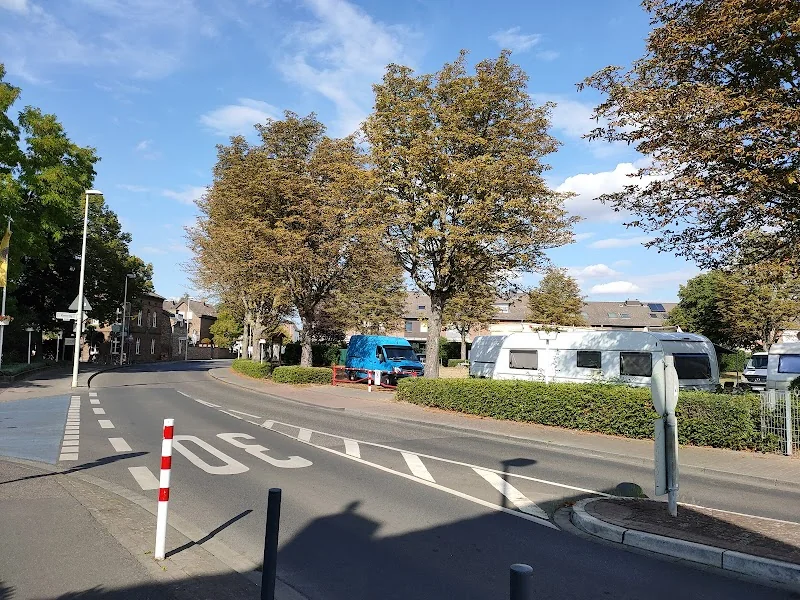
Bonn
Otto-Hahn-Straße 95-103, 53117 Bonn, Deutschland
Dorfplatz Bonn | Events & Directions
The Dorfplatz Bonn in Buschdorf is not a classic concert hall or a large multipurpose arena, but a public village and festival square that plays an surprisingly strong role in the everyday life of the district. In the found local and urban documents, it appears as a village green or festival meadow on Otto-Hahn-Straße and is described as a meeting point at the location of Otto-Hahn-Straße / corner of Klosterweg in 53117 Bonn. This gives rise to the special search intention behind the name: Those searching for the Dorfplatz usually want to know where it is located, what it is used for, what festivals take place there, and why this place is so important for Buschdorf. The square is thus more than just a space on the city map. It is an identity-forming open space where neighborhood, tradition, and spontaneous encounters overlap. For visitors, the Dorfplatz is primarily a place where one experiences Buschdorf in its local, down-to-earth, and communal form. ([karneval-in-bonn.de](https://www.karneval-in-bonn.de/clubs/bk/artic/KamelleKalender.pdf?utm_source=openai))
Events, Carnival, and Fair on the Dorfplatz Bonn
The strongest thematic line around the Dorfplatz Bonn is clearly the event and customs activities. In a Buschdorf documentation on local development, the village green or festival meadow on Otto-Hahn-Straße is explicitly associated with events such as Martin's fire, Carnival, fairs, and Maypole celebrations. This is an important indication that the square does not only exist as an open space in local perception, but as a stage for communal rituals. Such occasions hold special value in districts like Buschdorf because they connect generations: children, families, clubs, and older residents meet at a place that feels neither exclusive nor distant but is directly part of the neighborhood. The local festival committee of Buschdorf is also present as a city-listed local community structure, further emphasizing the importance of neighborhood and local life. Therefore, for search queries like “fair Buschdorf,” “Carnival Buschdorf,” or “Maypole Buschdorf,” the Dorfplatz is logically relevant. It represents that kind of neighborhood culture that does not rely on ticketing or large event infrastructure but on closeness, recognizability, and a collective feeling of home. ([bonn.de](https://www.bonn.de/medien-global/amt-61/ortsteilentwicklung/12_Dokumentation-Perspektivwerkstatt-Buschdorf.pdf?utm_source=openai))
The event practice also includes that the Dorfplatz is used not only for customs but also for low-threshold public presence. The Bonn police have announced the district service Buschdorf multiple times with the police mobile on site at the Dorfplatz, and the Sparkasse KölnBonn also lists Otto-Hahn-Straße / Dorfplatz as a stop for the Buschdorf district in its mobile branch schedule. Such uses show that the square functions far beyond just a festival area. It serves as an accessible, well-known, and everyday meeting point where public services, citizen proximity, and social presence are brought directly into the district. This combination of festival space, service point, and neighborhood space makes the Dorfplatz so interesting for people seeking practical information: It is not just about individual events but about a place that is regularly publicly used and utilized by various actors. So, if someone wants to know if something is happening at the Dorfplatz, they will find not only seasonal festivals but also occasional offerings with a strong local connection. ([presseportal.de](https://www.presseportal.de/blaulicht/pm/7304/5858807?utm_source=openai))
Where the Dorfplatz Bonn is located in Buschdorf
The most precise orientation to the Dorfplatz Bonn is: Otto-Hahn-Straße in Bonn-Buschdorf, 53117, sometimes also referred to as the corner of Klosterweg. This information is central for local searches because the square does not exist as a closed institution with an entrance hall and ticket area, but as an open space in the residential and local environment. This makes the exact location so important: Those visiting the Dorfplatz orient themselves less by a building function than by street names, neighborhood axes, and its embedding in the district. Buschdorf is located in the north of Bonn and is a distinctly perceivable district with a strong connection to its center. In urban documents, it is described as part of the Bonn district, and the perspective workshop clarifies that Buschdorf has emerged from a formerly rural district that has developed significantly over the past decades. The Dorfplatz is a clear orientation point within this structure: it is not the center of the entire city of Bonn, but certainly a identity-forming focal point within the district. For users searching for “Dorfplatz Bonn,” “Dorfplatz Buschdorf,” or “Otto-Hahn-Straße Dorfplatz,” this exact classification provides significant added value. ([karneval-in-bonn.de](https://www.karneval-in-bonn.de/clubs/bk/artic/KamelleKalender.pdf?utm_source=openai))
The surroundings of the square reflect the character of Buschdorf: not an anonymous city center area, but a district with a neighborhood structure, residential buildings, and clear reference points in public space. Bonn planning documents speak of an attractive village center with quality of stay and traffic planning for calming, with the Dorfplatz explicitly intended as the heart of the district. This formulation is important because it describes the square not only spatially but also functionally. Such a village square functions like a social anchor: Here, people meet before events, they know the paths, and they use the space informally for lingering or as a meeting point. The location on Otto-Hahn-Straße also integrates the square well into the street and path network of Buschdorf. For practical searches, this means: Those heading to the square are not looking for an event hall but an openly accessible place in the settlement structure of the district that is easily findable in everyday life and very present in local consciousness. ([bonn.de](https://www.bonn.de/medien-global/amt-61/ortsteilentwicklung/12_Dokumentation-Perspektivwerkstatt-Buschdorf.pdf))
Why the Dorfplatz is considered the heart of Buschdorf
In the Buschdorf perspective workshop, a formulation appears that is particularly enlightening for the classification of the place: traffic planning for calming, village square as heart. This statement shows that the Dorfplatz is not only seen as a space for festivals but as a spatial center where the desire for more quality of stay converges. In the same documentation, ideas for a public living room, basic supply, and a lively village center are discussed. This makes clear what role the Dorfplatz plays in the minds of those involved: it should not only look nice but serve social life. Such spaces are particularly important in established districts because they create identity and convey a sense of manageability. The Dorfplatz fulfills exactly this function. It is the place where the district meets itself. This concerns not only large events but also smaller social moments: the brief conversation at the edge of an event, waiting for an appointment, observing play and movement, or the random meeting of neighbors. That the square plays a role in urban participation processes also shows how seriously the local significance is taken. For search queries with intentions like “meeting point Buschdorf,” “Dorfplatz Bonn significance,” or “Dorfplatz Buschdorf what is that,” this is the actual answer: it is a public identity space, not just an address. ([bonn.de](https://www.bonn.de/medien-global/amt-61/ortsteilentwicklung/12_Dokumentation-Perspektivwerkstatt-Buschdorf.pdf))
The historical development of Buschdorf explains why this role is so pronounced. The formerly independent municipality was incorporated into Bonn in 1969 and grew from a rural village to a district with around 4,500 inhabitants today. The perspective workshop describes Buschdorf as a district located away from the former Cologne road, predominantly consisting of single-family and terraced houses, which has developed in several phases. Central squares often do not emerge as large urban planning spectacles in such district structures but as practical centers. The Dorfplatz is thus also a mirror of Buschdorf's development: from a village with a community structure to a Bonn district that still consciously preserves a village center. The fact that the area is described in local documents as a high-quality open space in the settlement area fits very well with this. The square is therefore not nostalgic embellishment but a modern building block of district development. It connects tradition with the present and creates a place where the name Buschdorf can be experienced directly in public space. ([bonn.de](https://www.bonn.de/medien-global/amt-61/ortsteilentwicklung/12_Dokumentation-Perspektivwerkstatt-Buschdorf.pdf?utm_source=openai))
Streetball, Open Space, and Everyday Use
Another relevant thematic complex around the Dorfplatz Bonn is the question of how the space is used outside of festivals. The Bonn playground and open space planning mentions a streetball facility for older children on Otto-Hahn-Straße. It is described as an asphalted area with two streetball stands and a protective hut, bounded by a ball-catching wall; the area can be used not only for basketball but also for other activities. This is very important for the classification of the Dorfplatz because it shows that the surroundings of the square have a clear movement and leisure function. In a district like Buschdorf, this creates additional quality of stay: an open space is not only understood as a decorative center but as an actively usable space for play, sports, and spontaneous use. This fits the character of the Dorfplatz as a meeting point for young and old. Even if the square itself is not organized as a closed sports facility, the proximity of such movement offerings shows that the local open space structure is functionally thought out. For search queries like “Dorfplatz Bonn photos,” “Dorfplatz Buschdorf leisure,” or “Dorfplatz Buschdorf basketball,” this connection is particularly helpful because it expands the image of the square: not just festival meadow but part of a lively environment with movement, openness, and everyday usability. ([bonn.de](https://www.bonn.de/medien-global/amt-51/230055-Spielplatzbedarfsplanung_2022.pdf))
Additionally, such open spaces fulfill a social balancing function in the district context. The Bonn documentation on district development describes Buschdorf as a district with much engagement for an attractive village center and a clear demand for stay and meeting spaces. In this sense, the Dorfplatz should not be viewed in isolation but as part of a network of public spaces, paths, and smaller usage islands. The openness of the square allows very different forms of use to overlap: festival operations, informal meetings, service offerings, sports activities, and local communication. Especially for an area that is locally understood as a festival meadow, this multipurpose character is a real advantage. It keeps the place lively, even when there is no fair or Maypole festival taking place. Therefore, those visiting the Dorfplatz experience not only a seasonal event location but an open space that remains constantly present in the everyday life of the district. This interplay of open space, proximity to sports, and social function is one of the most important reasons why the square works so well in Bonn-Buschdorf in search engines and in local perception. ([bonn.de](https://www.bonn.de/medien-global/amt-61/ortsteilentwicklung/12_Dokumentation-Perspektivwerkstatt-Buschdorf.pdf))
History of Buschdorf and Development of the Town Center
To truly understand the Dorfplatz, it helps to look at the history of Buschdorf. Bonn development documents describe that the district emerged from the former municipality, which had only 657 inhabitants in 1961 despite its location on the Rhine bank railway line and grew significantly after its incorporation in 1969. Today, Buschdorf is described as having around 4,500 inhabitants, with the development predominantly consisting of single-family and terraced houses. This development explains why the desire for a clear village center is so strong: the larger and more urban a district becomes, the more important identity-forming spaces are that preserve the original sense of community. The Dorfplatz fulfills exactly this task. It provides the district with a visible center where the historical self-understanding of a village connects with the reality of a Bonn district. This is exciting from the content perspective because the square can be understood not only through its current use but also through the history of the place. Buschdorf is not just any district with interchangeable space but a grown area with local memory, where the Dorfplatz stands as a symbol of continuity and neighborhood. ([bonn.de](https://www.bonn.de/medien-global/amt-61/ortsteilentwicklung/12_Dokumentation-Perspektivwerkstatt-Buschdorf.pdf?utm_source=openai))
The urban future of Buschdorf also shows that the district remains in motion. The city of Bonn is planning a sustainable, climate-neutral, and low-car new housing area in the north with the residential quarter Im Rosenfeld, including a primary school and daycare center. At the same time, the city railway line 63 is being further developed: the plans foresee an extension through Buschdorf and Auerberg to the Nordfriedhof with four new stops. These include Friedlandstraße, Schlesienstraße, the Buschdorf business park, and Friedrich-Wöhler-Straße or Nordbahnhof. This is relevant for the Dorfplatz because the square is located in a district that is to be further integrated and upgraded in the future. The development thus works in two directions: on the one hand, the preservation of the village core with festival meadow and meeting point, on the other hand, better accessibility and more urban connectivity. This mixture makes Buschdorf interesting. The Dorfplatz stands at the intersection of tradition and future. It preserves the character of the place while infrastructure, mobility, and new quarters continue to grow around it. For visitors, this means: the square is already a local focal point today, and its significance is likely to increase rather than decrease with the development of the district. ([bonn.de](https://www.bonn.de/pressemitteilungen/september-2024/wohnquartier-im-rosenfeld-buschdorf-rat-beschliesst-naechste-schritte.php?utm_source=openai))
Access, Public Transport, and the Future of Buschdorf
When it comes to access and reachability, the Dorfplatz Bonn primarily concerns its integration into the local road network and the medium-term improvement of mobility in the district. The square is located on Otto-Hahn-Straße in Buschdorf and is thus directly accessible via the neighborhood-related streets. The public planning documents for Buschdorf also show that traffic and traffic calming are important topics in the district. This fits the character of the square as an open meeting point in the residential environment: access is not an issue of a large exhibition hall but a matter of nearby paths within the district. For people who want to orient themselves, the correct address is therefore crucial. Those searching for village festivals, festival meadows, or town centers should head for Otto-Hahn-Straße or the vicinity of Klosterweg. The area is part of a grown residential and local structure and not a closed event center with a separate parking garage. This form of accessibility is typical for a village square and explains why the place lives so strongly from everyday use. ([karneval-in-bonn.de](https://www.karneval-in-bonn.de/clubs/bk/artic/KamelleKalender.pdf?utm_source=openai))
Looking to the future, the connection of the district becomes even more interesting. The Bonn city administration and the involved parties are pushing forward the extension of the city railway line 63 to Buschdorf and Auerberg; the documents available mention a 2.6-kilometer expansion with four new stops. Although the Dorfplatz itself is not named as a separate stop in these plans, the measure shows that Buschdorf is to be further upgraded in terms of transport. This means more accessibility for the district in the long term, better connections with the Bonn network, and probably more attention for its public spaces. The Dorfplatz benefits indirectly from this because a well-connected district can use its meeting points more vibrantly. At the same time, the expansion fits the overall development of the quarter, where new neighborhoods, green spaces, and stronger urban integration are being thought together. So, those searching for the Dorfplatz Bonn today find a locally shaped, well-anchored meeting point. Those looking to the future recognize a district whose public spaces and mobility structure will continue to evolve. This is precisely where the sustainable relevance of this place lies. ([bonn.de](https://www.bonn.de/themen-entdecken/verkehr-mobilitaet/verlaengerung-linie-63.php?loc=es&utm_source=openai))
Sources:
- Federal City of Bonn – Perspective Workshop Bonn-Buschdorf ([bonn.de](https://www.bonn.de/medien-global/amt-61/ortsteilentwicklung/12_Dokumentation-Perspektivwerkstatt-Buschdorf.pdf))
- Playground Needs Plan of the City of Bonn 2022 ([bonn.de](https://www.bonn.de/medien-global/amt-51/230055-Spielplatzbedarfsplanung_2022.pdf))
- Buschdorf 1907 / Time Travel Buschdorf – Stations at the Dorfplatz ([zeitreise.buschdorf.de](https://zeitreise.buschdorf.de/1907/Station.php?code=0001&utm_source=openai))
- Buschdorf local festival committee – City of Bonn ([bonn.de](https://www.bonn.de/bonn-erleben/aktiv-und-unterwegs/ortsfestausschussbuschdorf.php?loc=en&utm_source=openai))
- Bonn Police – Police Mobile on the way in Buschdorf ([presseportal.de](https://www.presseportal.de/blaulicht/pm/7304/5858807?utm_source=openai))
- Sparkasse KölnBonn – Mobile Branch Bonn ([sparkasse-koelnbonn.de](https://www.sparkasse-koelnbonn.de/content/dam/myif/sk-koelnbonn/work/dokumente/pdf/eflyer/E-Flyer%20MobileFiliale%20Bonn.pdf?n=true&utm_source=openai))
- City of Bonn – Extension of the city railway line 63 to Buschdorf/Auerberg ([bonn.de](https://www.bonn.de/themen-entdecken/verkehr-mobilitaet/verlaengerung-linie-63.php?loc=es&utm_source=openai))
- Federal City of Bonn – Residential Quarter Im Rosenfeld in Buschdorf ([bonn.de](https://www.bonn.de/pressemitteilungen/september-2024/wohnquartier-im-rosenfeld-buschdorf-rat-beschliesst-naechste-schritte.php?utm_source=openai))
Mehr anzeigenWeniger anzeigen
Dorfplatz Bonn | Events & Directions
The Dorfplatz Bonn in Buschdorf is not a classic concert hall or a large multipurpose arena, but a public village and festival square that plays an surprisingly strong role in the everyday life of the district. In the found local and urban documents, it appears as a village green or festival meadow on Otto-Hahn-Straße and is described as a meeting point at the location of Otto-Hahn-Straße / corner of Klosterweg in 53117 Bonn. This gives rise to the special search intention behind the name: Those searching for the Dorfplatz usually want to know where it is located, what it is used for, what festivals take place there, and why this place is so important for Buschdorf. The square is thus more than just a space on the city map. It is an identity-forming open space where neighborhood, tradition, and spontaneous encounters overlap. For visitors, the Dorfplatz is primarily a place where one experiences Buschdorf in its local, down-to-earth, and communal form. ([karneval-in-bonn.de](https://www.karneval-in-bonn.de/clubs/bk/artic/KamelleKalender.pdf?utm_source=openai))
Events, Carnival, and Fair on the Dorfplatz Bonn
The strongest thematic line around the Dorfplatz Bonn is clearly the event and customs activities. In a Buschdorf documentation on local development, the village green or festival meadow on Otto-Hahn-Straße is explicitly associated with events such as Martin's fire, Carnival, fairs, and Maypole celebrations. This is an important indication that the square does not only exist as an open space in local perception, but as a stage for communal rituals. Such occasions hold special value in districts like Buschdorf because they connect generations: children, families, clubs, and older residents meet at a place that feels neither exclusive nor distant but is directly part of the neighborhood. The local festival committee of Buschdorf is also present as a city-listed local community structure, further emphasizing the importance of neighborhood and local life. Therefore, for search queries like “fair Buschdorf,” “Carnival Buschdorf,” or “Maypole Buschdorf,” the Dorfplatz is logically relevant. It represents that kind of neighborhood culture that does not rely on ticketing or large event infrastructure but on closeness, recognizability, and a collective feeling of home. ([bonn.de](https://www.bonn.de/medien-global/amt-61/ortsteilentwicklung/12_Dokumentation-Perspektivwerkstatt-Buschdorf.pdf?utm_source=openai))
The event practice also includes that the Dorfplatz is used not only for customs but also for low-threshold public presence. The Bonn police have announced the district service Buschdorf multiple times with the police mobile on site at the Dorfplatz, and the Sparkasse KölnBonn also lists Otto-Hahn-Straße / Dorfplatz as a stop for the Buschdorf district in its mobile branch schedule. Such uses show that the square functions far beyond just a festival area. It serves as an accessible, well-known, and everyday meeting point where public services, citizen proximity, and social presence are brought directly into the district. This combination of festival space, service point, and neighborhood space makes the Dorfplatz so interesting for people seeking practical information: It is not just about individual events but about a place that is regularly publicly used and utilized by various actors. So, if someone wants to know if something is happening at the Dorfplatz, they will find not only seasonal festivals but also occasional offerings with a strong local connection. ([presseportal.de](https://www.presseportal.de/blaulicht/pm/7304/5858807?utm_source=openai))
Where the Dorfplatz Bonn is located in Buschdorf
The most precise orientation to the Dorfplatz Bonn is: Otto-Hahn-Straße in Bonn-Buschdorf, 53117, sometimes also referred to as the corner of Klosterweg. This information is central for local searches because the square does not exist as a closed institution with an entrance hall and ticket area, but as an open space in the residential and local environment. This makes the exact location so important: Those visiting the Dorfplatz orient themselves less by a building function than by street names, neighborhood axes, and its embedding in the district. Buschdorf is located in the north of Bonn and is a distinctly perceivable district with a strong connection to its center. In urban documents, it is described as part of the Bonn district, and the perspective workshop clarifies that Buschdorf has emerged from a formerly rural district that has developed significantly over the past decades. The Dorfplatz is a clear orientation point within this structure: it is not the center of the entire city of Bonn, but certainly a identity-forming focal point within the district. For users searching for “Dorfplatz Bonn,” “Dorfplatz Buschdorf,” or “Otto-Hahn-Straße Dorfplatz,” this exact classification provides significant added value. ([karneval-in-bonn.de](https://www.karneval-in-bonn.de/clubs/bk/artic/KamelleKalender.pdf?utm_source=openai))
The surroundings of the square reflect the character of Buschdorf: not an anonymous city center area, but a district with a neighborhood structure, residential buildings, and clear reference points in public space. Bonn planning documents speak of an attractive village center with quality of stay and traffic planning for calming, with the Dorfplatz explicitly intended as the heart of the district. This formulation is important because it describes the square not only spatially but also functionally. Such a village square functions like a social anchor: Here, people meet before events, they know the paths, and they use the space informally for lingering or as a meeting point. The location on Otto-Hahn-Straße also integrates the square well into the street and path network of Buschdorf. For practical searches, this means: Those heading to the square are not looking for an event hall but an openly accessible place in the settlement structure of the district that is easily findable in everyday life and very present in local consciousness. ([bonn.de](https://www.bonn.de/medien-global/amt-61/ortsteilentwicklung/12_Dokumentation-Perspektivwerkstatt-Buschdorf.pdf))
Why the Dorfplatz is considered the heart of Buschdorf
In the Buschdorf perspective workshop, a formulation appears that is particularly enlightening for the classification of the place: traffic planning for calming, village square as heart. This statement shows that the Dorfplatz is not only seen as a space for festivals but as a spatial center where the desire for more quality of stay converges. In the same documentation, ideas for a public living room, basic supply, and a lively village center are discussed. This makes clear what role the Dorfplatz plays in the minds of those involved: it should not only look nice but serve social life. Such spaces are particularly important in established districts because they create identity and convey a sense of manageability. The Dorfplatz fulfills exactly this function. It is the place where the district meets itself. This concerns not only large events but also smaller social moments: the brief conversation at the edge of an event, waiting for an appointment, observing play and movement, or the random meeting of neighbors. That the square plays a role in urban participation processes also shows how seriously the local significance is taken. For search queries with intentions like “meeting point Buschdorf,” “Dorfplatz Bonn significance,” or “Dorfplatz Buschdorf what is that,” this is the actual answer: it is a public identity space, not just an address. ([bonn.de](https://www.bonn.de/medien-global/amt-61/ortsteilentwicklung/12_Dokumentation-Perspektivwerkstatt-Buschdorf.pdf))
The historical development of Buschdorf explains why this role is so pronounced. The formerly independent municipality was incorporated into Bonn in 1969 and grew from a rural village to a district with around 4,500 inhabitants today. The perspective workshop describes Buschdorf as a district located away from the former Cologne road, predominantly consisting of single-family and terraced houses, which has developed in several phases. Central squares often do not emerge as large urban planning spectacles in such district structures but as practical centers. The Dorfplatz is thus also a mirror of Buschdorf's development: from a village with a community structure to a Bonn district that still consciously preserves a village center. The fact that the area is described in local documents as a high-quality open space in the settlement area fits very well with this. The square is therefore not nostalgic embellishment but a modern building block of district development. It connects tradition with the present and creates a place where the name Buschdorf can be experienced directly in public space. ([bonn.de](https://www.bonn.de/medien-global/amt-61/ortsteilentwicklung/12_Dokumentation-Perspektivwerkstatt-Buschdorf.pdf?utm_source=openai))
Streetball, Open Space, and Everyday Use
Another relevant thematic complex around the Dorfplatz Bonn is the question of how the space is used outside of festivals. The Bonn playground and open space planning mentions a streetball facility for older children on Otto-Hahn-Straße. It is described as an asphalted area with two streetball stands and a protective hut, bounded by a ball-catching wall; the area can be used not only for basketball but also for other activities. This is very important for the classification of the Dorfplatz because it shows that the surroundings of the square have a clear movement and leisure function. In a district like Buschdorf, this creates additional quality of stay: an open space is not only understood as a decorative center but as an actively usable space for play, sports, and spontaneous use. This fits the character of the Dorfplatz as a meeting point for young and old. Even if the square itself is not organized as a closed sports facility, the proximity of such movement offerings shows that the local open space structure is functionally thought out. For search queries like “Dorfplatz Bonn photos,” “Dorfplatz Buschdorf leisure,” or “Dorfplatz Buschdorf basketball,” this connection is particularly helpful because it expands the image of the square: not just festival meadow but part of a lively environment with movement, openness, and everyday usability. ([bonn.de](https://www.bonn.de/medien-global/amt-51/230055-Spielplatzbedarfsplanung_2022.pdf))
Additionally, such open spaces fulfill a social balancing function in the district context. The Bonn documentation on district development describes Buschdorf as a district with much engagement for an attractive village center and a clear demand for stay and meeting spaces. In this sense, the Dorfplatz should not be viewed in isolation but as part of a network of public spaces, paths, and smaller usage islands. The openness of the square allows very different forms of use to overlap: festival operations, informal meetings, service offerings, sports activities, and local communication. Especially for an area that is locally understood as a festival meadow, this multipurpose character is a real advantage. It keeps the place lively, even when there is no fair or Maypole festival taking place. Therefore, those visiting the Dorfplatz experience not only a seasonal event location but an open space that remains constantly present in the everyday life of the district. This interplay of open space, proximity to sports, and social function is one of the most important reasons why the square works so well in Bonn-Buschdorf in search engines and in local perception. ([bonn.de](https://www.bonn.de/medien-global/amt-61/ortsteilentwicklung/12_Dokumentation-Perspektivwerkstatt-Buschdorf.pdf))
History of Buschdorf and Development of the Town Center
To truly understand the Dorfplatz, it helps to look at the history of Buschdorf. Bonn development documents describe that the district emerged from the former municipality, which had only 657 inhabitants in 1961 despite its location on the Rhine bank railway line and grew significantly after its incorporation in 1969. Today, Buschdorf is described as having around 4,500 inhabitants, with the development predominantly consisting of single-family and terraced houses. This development explains why the desire for a clear village center is so strong: the larger and more urban a district becomes, the more important identity-forming spaces are that preserve the original sense of community. The Dorfplatz fulfills exactly this task. It provides the district with a visible center where the historical self-understanding of a village connects with the reality of a Bonn district. This is exciting from the content perspective because the square can be understood not only through its current use but also through the history of the place. Buschdorf is not just any district with interchangeable space but a grown area with local memory, where the Dorfplatz stands as a symbol of continuity and neighborhood. ([bonn.de](https://www.bonn.de/medien-global/amt-61/ortsteilentwicklung/12_Dokumentation-Perspektivwerkstatt-Buschdorf.pdf?utm_source=openai))
The urban future of Buschdorf also shows that the district remains in motion. The city of Bonn is planning a sustainable, climate-neutral, and low-car new housing area in the north with the residential quarter Im Rosenfeld, including a primary school and daycare center. At the same time, the city railway line 63 is being further developed: the plans foresee an extension through Buschdorf and Auerberg to the Nordfriedhof with four new stops. These include Friedlandstraße, Schlesienstraße, the Buschdorf business park, and Friedrich-Wöhler-Straße or Nordbahnhof. This is relevant for the Dorfplatz because the square is located in a district that is to be further integrated and upgraded in the future. The development thus works in two directions: on the one hand, the preservation of the village core with festival meadow and meeting point, on the other hand, better accessibility and more urban connectivity. This mixture makes Buschdorf interesting. The Dorfplatz stands at the intersection of tradition and future. It preserves the character of the place while infrastructure, mobility, and new quarters continue to grow around it. For visitors, this means: the square is already a local focal point today, and its significance is likely to increase rather than decrease with the development of the district. ([bonn.de](https://www.bonn.de/pressemitteilungen/september-2024/wohnquartier-im-rosenfeld-buschdorf-rat-beschliesst-naechste-schritte.php?utm_source=openai))
Access, Public Transport, and the Future of Buschdorf
When it comes to access and reachability, the Dorfplatz Bonn primarily concerns its integration into the local road network and the medium-term improvement of mobility in the district. The square is located on Otto-Hahn-Straße in Buschdorf and is thus directly accessible via the neighborhood-related streets. The public planning documents for Buschdorf also show that traffic and traffic calming are important topics in the district. This fits the character of the square as an open meeting point in the residential environment: access is not an issue of a large exhibition hall but a matter of nearby paths within the district. For people who want to orient themselves, the correct address is therefore crucial. Those searching for village festivals, festival meadows, or town centers should head for Otto-Hahn-Straße or the vicinity of Klosterweg. The area is part of a grown residential and local structure and not a closed event center with a separate parking garage. This form of accessibility is typical for a village square and explains why the place lives so strongly from everyday use. ([karneval-in-bonn.de](https://www.karneval-in-bonn.de/clubs/bk/artic/KamelleKalender.pdf?utm_source=openai))
Looking to the future, the connection of the district becomes even more interesting. The Bonn city administration and the involved parties are pushing forward the extension of the city railway line 63 to Buschdorf and Auerberg; the documents available mention a 2.6-kilometer expansion with four new stops. Although the Dorfplatz itself is not named as a separate stop in these plans, the measure shows that Buschdorf is to be further upgraded in terms of transport. This means more accessibility for the district in the long term, better connections with the Bonn network, and probably more attention for its public spaces. The Dorfplatz benefits indirectly from this because a well-connected district can use its meeting points more vibrantly. At the same time, the expansion fits the overall development of the quarter, where new neighborhoods, green spaces, and stronger urban integration are being thought together. So, those searching for the Dorfplatz Bonn today find a locally shaped, well-anchored meeting point. Those looking to the future recognize a district whose public spaces and mobility structure will continue to evolve. This is precisely where the sustainable relevance of this place lies. ([bonn.de](https://www.bonn.de/themen-entdecken/verkehr-mobilitaet/verlaengerung-linie-63.php?loc=es&utm_source=openai))
Sources:
- Federal City of Bonn – Perspective Workshop Bonn-Buschdorf ([bonn.de](https://www.bonn.de/medien-global/amt-61/ortsteilentwicklung/12_Dokumentation-Perspektivwerkstatt-Buschdorf.pdf))
- Playground Needs Plan of the City of Bonn 2022 ([bonn.de](https://www.bonn.de/medien-global/amt-51/230055-Spielplatzbedarfsplanung_2022.pdf))
- Buschdorf 1907 / Time Travel Buschdorf – Stations at the Dorfplatz ([zeitreise.buschdorf.de](https://zeitreise.buschdorf.de/1907/Station.php?code=0001&utm_source=openai))
- Buschdorf local festival committee – City of Bonn ([bonn.de](https://www.bonn.de/bonn-erleben/aktiv-und-unterwegs/ortsfestausschussbuschdorf.php?loc=en&utm_source=openai))
- Bonn Police – Police Mobile on the way in Buschdorf ([presseportal.de](https://www.presseportal.de/blaulicht/pm/7304/5858807?utm_source=openai))
- Sparkasse KölnBonn – Mobile Branch Bonn ([sparkasse-koelnbonn.de](https://www.sparkasse-koelnbonn.de/content/dam/myif/sk-koelnbonn/work/dokumente/pdf/eflyer/E-Flyer%20MobileFiliale%20Bonn.pdf?n=true&utm_source=openai))
- City of Bonn – Extension of the city railway line 63 to Buschdorf/Auerberg ([bonn.de](https://www.bonn.de/themen-entdecken/verkehr-mobilitaet/verlaengerung-linie-63.php?loc=es&utm_source=openai))
- Federal City of Bonn – Residential Quarter Im Rosenfeld in Buschdorf ([bonn.de](https://www.bonn.de/pressemitteilungen/september-2024/wohnquartier-im-rosenfeld-buschdorf-rat-beschliesst-naechste-schritte.php?utm_source=openai))
Dorfplatz Bonn | Events & Directions
The Dorfplatz Bonn in Buschdorf is not a classic concert hall or a large multipurpose arena, but a public village and festival square that plays an surprisingly strong role in the everyday life of the district. In the found local and urban documents, it appears as a village green or festival meadow on Otto-Hahn-Straße and is described as a meeting point at the location of Otto-Hahn-Straße / corner of Klosterweg in 53117 Bonn. This gives rise to the special search intention behind the name: Those searching for the Dorfplatz usually want to know where it is located, what it is used for, what festivals take place there, and why this place is so important for Buschdorf. The square is thus more than just a space on the city map. It is an identity-forming open space where neighborhood, tradition, and spontaneous encounters overlap. For visitors, the Dorfplatz is primarily a place where one experiences Buschdorf in its local, down-to-earth, and communal form. ([karneval-in-bonn.de](https://www.karneval-in-bonn.de/clubs/bk/artic/KamelleKalender.pdf?utm_source=openai))
Events, Carnival, and Fair on the Dorfplatz Bonn
The strongest thematic line around the Dorfplatz Bonn is clearly the event and customs activities. In a Buschdorf documentation on local development, the village green or festival meadow on Otto-Hahn-Straße is explicitly associated with events such as Martin's fire, Carnival, fairs, and Maypole celebrations. This is an important indication that the square does not only exist as an open space in local perception, but as a stage for communal rituals. Such occasions hold special value in districts like Buschdorf because they connect generations: children, families, clubs, and older residents meet at a place that feels neither exclusive nor distant but is directly part of the neighborhood. The local festival committee of Buschdorf is also present as a city-listed local community structure, further emphasizing the importance of neighborhood and local life. Therefore, for search queries like “fair Buschdorf,” “Carnival Buschdorf,” or “Maypole Buschdorf,” the Dorfplatz is logically relevant. It represents that kind of neighborhood culture that does not rely on ticketing or large event infrastructure but on closeness, recognizability, and a collective feeling of home. ([bonn.de](https://www.bonn.de/medien-global/amt-61/ortsteilentwicklung/12_Dokumentation-Perspektivwerkstatt-Buschdorf.pdf?utm_source=openai))
The event practice also includes that the Dorfplatz is used not only for customs but also for low-threshold public presence. The Bonn police have announced the district service Buschdorf multiple times with the police mobile on site at the Dorfplatz, and the Sparkasse KölnBonn also lists Otto-Hahn-Straße / Dorfplatz as a stop for the Buschdorf district in its mobile branch schedule. Such uses show that the square functions far beyond just a festival area. It serves as an accessible, well-known, and everyday meeting point where public services, citizen proximity, and social presence are brought directly into the district. This combination of festival space, service point, and neighborhood space makes the Dorfplatz so interesting for people seeking practical information: It is not just about individual events but about a place that is regularly publicly used and utilized by various actors. So, if someone wants to know if something is happening at the Dorfplatz, they will find not only seasonal festivals but also occasional offerings with a strong local connection. ([presseportal.de](https://www.presseportal.de/blaulicht/pm/7304/5858807?utm_source=openai))
Where the Dorfplatz Bonn is located in Buschdorf
The most precise orientation to the Dorfplatz Bonn is: Otto-Hahn-Straße in Bonn-Buschdorf, 53117, sometimes also referred to as the corner of Klosterweg. This information is central for local searches because the square does not exist as a closed institution with an entrance hall and ticket area, but as an open space in the residential and local environment. This makes the exact location so important: Those visiting the Dorfplatz orient themselves less by a building function than by street names, neighborhood axes, and its embedding in the district. Buschdorf is located in the north of Bonn and is a distinctly perceivable district with a strong connection to its center. In urban documents, it is described as part of the Bonn district, and the perspective workshop clarifies that Buschdorf has emerged from a formerly rural district that has developed significantly over the past decades. The Dorfplatz is a clear orientation point within this structure: it is not the center of the entire city of Bonn, but certainly a identity-forming focal point within the district. For users searching for “Dorfplatz Bonn,” “Dorfplatz Buschdorf,” or “Otto-Hahn-Straße Dorfplatz,” this exact classification provides significant added value. ([karneval-in-bonn.de](https://www.karneval-in-bonn.de/clubs/bk/artic/KamelleKalender.pdf?utm_source=openai))
The surroundings of the square reflect the character of Buschdorf: not an anonymous city center area, but a district with a neighborhood structure, residential buildings, and clear reference points in public space. Bonn planning documents speak of an attractive village center with quality of stay and traffic planning for calming, with the Dorfplatz explicitly intended as the heart of the district. This formulation is important because it describes the square not only spatially but also functionally. Such a village square functions like a social anchor: Here, people meet before events, they know the paths, and they use the space informally for lingering or as a meeting point. The location on Otto-Hahn-Straße also integrates the square well into the street and path network of Buschdorf. For practical searches, this means: Those heading to the square are not looking for an event hall but an openly accessible place in the settlement structure of the district that is easily findable in everyday life and very present in local consciousness. ([bonn.de](https://www.bonn.de/medien-global/amt-61/ortsteilentwicklung/12_Dokumentation-Perspektivwerkstatt-Buschdorf.pdf))
Why the Dorfplatz is considered the heart of Buschdorf
In the Buschdorf perspective workshop, a formulation appears that is particularly enlightening for the classification of the place: traffic planning for calming, village square as heart. This statement shows that the Dorfplatz is not only seen as a space for festivals but as a spatial center where the desire for more quality of stay converges. In the same documentation, ideas for a public living room, basic supply, and a lively village center are discussed. This makes clear what role the Dorfplatz plays in the minds of those involved: it should not only look nice but serve social life. Such spaces are particularly important in established districts because they create identity and convey a sense of manageability. The Dorfplatz fulfills exactly this function. It is the place where the district meets itself. This concerns not only large events but also smaller social moments: the brief conversation at the edge of an event, waiting for an appointment, observing play and movement, or the random meeting of neighbors. That the square plays a role in urban participation processes also shows how seriously the local significance is taken. For search queries with intentions like “meeting point Buschdorf,” “Dorfplatz Bonn significance,” or “Dorfplatz Buschdorf what is that,” this is the actual answer: it is a public identity space, not just an address. ([bonn.de](https://www.bonn.de/medien-global/amt-61/ortsteilentwicklung/12_Dokumentation-Perspektivwerkstatt-Buschdorf.pdf))
The historical development of Buschdorf explains why this role is so pronounced. The formerly independent municipality was incorporated into Bonn in 1969 and grew from a rural village to a district with around 4,500 inhabitants today. The perspective workshop describes Buschdorf as a district located away from the former Cologne road, predominantly consisting of single-family and terraced houses, which has developed in several phases. Central squares often do not emerge as large urban planning spectacles in such district structures but as practical centers. The Dorfplatz is thus also a mirror of Buschdorf's development: from a village with a community structure to a Bonn district that still consciously preserves a village center. The fact that the area is described in local documents as a high-quality open space in the settlement area fits very well with this. The square is therefore not nostalgic embellishment but a modern building block of district development. It connects tradition with the present and creates a place where the name Buschdorf can be experienced directly in public space. ([bonn.de](https://www.bonn.de/medien-global/amt-61/ortsteilentwicklung/12_Dokumentation-Perspektivwerkstatt-Buschdorf.pdf?utm_source=openai))
Streetball, Open Space, and Everyday Use
Another relevant thematic complex around the Dorfplatz Bonn is the question of how the space is used outside of festivals. The Bonn playground and open space planning mentions a streetball facility for older children on Otto-Hahn-Straße. It is described as an asphalted area with two streetball stands and a protective hut, bounded by a ball-catching wall; the area can be used not only for basketball but also for other activities. This is very important for the classification of the Dorfplatz because it shows that the surroundings of the square have a clear movement and leisure function. In a district like Buschdorf, this creates additional quality of stay: an open space is not only understood as a decorative center but as an actively usable space for play, sports, and spontaneous use. This fits the character of the Dorfplatz as a meeting point for young and old. Even if the square itself is not organized as a closed sports facility, the proximity of such movement offerings shows that the local open space structure is functionally thought out. For search queries like “Dorfplatz Bonn photos,” “Dorfplatz Buschdorf leisure,” or “Dorfplatz Buschdorf basketball,” this connection is particularly helpful because it expands the image of the square: not just festival meadow but part of a lively environment with movement, openness, and everyday usability. ([bonn.de](https://www.bonn.de/medien-global/amt-51/230055-Spielplatzbedarfsplanung_2022.pdf))
Additionally, such open spaces fulfill a social balancing function in the district context. The Bonn documentation on district development describes Buschdorf as a district with much engagement for an attractive village center and a clear demand for stay and meeting spaces. In this sense, the Dorfplatz should not be viewed in isolation but as part of a network of public spaces, paths, and smaller usage islands. The openness of the square allows very different forms of use to overlap: festival operations, informal meetings, service offerings, sports activities, and local communication. Especially for an area that is locally understood as a festival meadow, this multipurpose character is a real advantage. It keeps the place lively, even when there is no fair or Maypole festival taking place. Therefore, those visiting the Dorfplatz experience not only a seasonal event location but an open space that remains constantly present in the everyday life of the district. This interplay of open space, proximity to sports, and social function is one of the most important reasons why the square works so well in Bonn-Buschdorf in search engines and in local perception. ([bonn.de](https://www.bonn.de/medien-global/amt-61/ortsteilentwicklung/12_Dokumentation-Perspektivwerkstatt-Buschdorf.pdf))
History of Buschdorf and Development of the Town Center
To truly understand the Dorfplatz, it helps to look at the history of Buschdorf. Bonn development documents describe that the district emerged from the former municipality, which had only 657 inhabitants in 1961 despite its location on the Rhine bank railway line and grew significantly after its incorporation in 1969. Today, Buschdorf is described as having around 4,500 inhabitants, with the development predominantly consisting of single-family and terraced houses. This development explains why the desire for a clear village center is so strong: the larger and more urban a district becomes, the more important identity-forming spaces are that preserve the original sense of community. The Dorfplatz fulfills exactly this task. It provides the district with a visible center where the historical self-understanding of a village connects with the reality of a Bonn district. This is exciting from the content perspective because the square can be understood not only through its current use but also through the history of the place. Buschdorf is not just any district with interchangeable space but a grown area with local memory, where the Dorfplatz stands as a symbol of continuity and neighborhood. ([bonn.de](https://www.bonn.de/medien-global/amt-61/ortsteilentwicklung/12_Dokumentation-Perspektivwerkstatt-Buschdorf.pdf?utm_source=openai))
The urban future of Buschdorf also shows that the district remains in motion. The city of Bonn is planning a sustainable, climate-neutral, and low-car new housing area in the north with the residential quarter Im Rosenfeld, including a primary school and daycare center. At the same time, the city railway line 63 is being further developed: the plans foresee an extension through Buschdorf and Auerberg to the Nordfriedhof with four new stops. These include Friedlandstraße, Schlesienstraße, the Buschdorf business park, and Friedrich-Wöhler-Straße or Nordbahnhof. This is relevant for the Dorfplatz because the square is located in a district that is to be further integrated and upgraded in the future. The development thus works in two directions: on the one hand, the preservation of the village core with festival meadow and meeting point, on the other hand, better accessibility and more urban connectivity. This mixture makes Buschdorf interesting. The Dorfplatz stands at the intersection of tradition and future. It preserves the character of the place while infrastructure, mobility, and new quarters continue to grow around it. For visitors, this means: the square is already a local focal point today, and its significance is likely to increase rather than decrease with the development of the district. ([bonn.de](https://www.bonn.de/pressemitteilungen/september-2024/wohnquartier-im-rosenfeld-buschdorf-rat-beschliesst-naechste-schritte.php?utm_source=openai))
Access, Public Transport, and the Future of Buschdorf
When it comes to access and reachability, the Dorfplatz Bonn primarily concerns its integration into the local road network and the medium-term improvement of mobility in the district. The square is located on Otto-Hahn-Straße in Buschdorf and is thus directly accessible via the neighborhood-related streets. The public planning documents for Buschdorf also show that traffic and traffic calming are important topics in the district. This fits the character of the square as an open meeting point in the residential environment: access is not an issue of a large exhibition hall but a matter of nearby paths within the district. For people who want to orient themselves, the correct address is therefore crucial. Those searching for village festivals, festival meadows, or town centers should head for Otto-Hahn-Straße or the vicinity of Klosterweg. The area is part of a grown residential and local structure and not a closed event center with a separate parking garage. This form of accessibility is typical for a village square and explains why the place lives so strongly from everyday use. ([karneval-in-bonn.de](https://www.karneval-in-bonn.de/clubs/bk/artic/KamelleKalender.pdf?utm_source=openai))
Looking to the future, the connection of the district becomes even more interesting. The Bonn city administration and the involved parties are pushing forward the extension of the city railway line 63 to Buschdorf and Auerberg; the documents available mention a 2.6-kilometer expansion with four new stops. Although the Dorfplatz itself is not named as a separate stop in these plans, the measure shows that Buschdorf is to be further upgraded in terms of transport. This means more accessibility for the district in the long term, better connections with the Bonn network, and probably more attention for its public spaces. The Dorfplatz benefits indirectly from this because a well-connected district can use its meeting points more vibrantly. At the same time, the expansion fits the overall development of the quarter, where new neighborhoods, green spaces, and stronger urban integration are being thought together. So, those searching for the Dorfplatz Bonn today find a locally shaped, well-anchored meeting point. Those looking to the future recognize a district whose public spaces and mobility structure will continue to evolve. This is precisely where the sustainable relevance of this place lies. ([bonn.de](https://www.bonn.de/themen-entdecken/verkehr-mobilitaet/verlaengerung-linie-63.php?loc=es&utm_source=openai))
Sources:
- Federal City of Bonn – Perspective Workshop Bonn-Buschdorf ([bonn.de](https://www.bonn.de/medien-global/amt-61/ortsteilentwicklung/12_Dokumentation-Perspektivwerkstatt-Buschdorf.pdf))
- Playground Needs Plan of the City of Bonn 2022 ([bonn.de](https://www.bonn.de/medien-global/amt-51/230055-Spielplatzbedarfsplanung_2022.pdf))
- Buschdorf 1907 / Time Travel Buschdorf – Stations at the Dorfplatz ([zeitreise.buschdorf.de](https://zeitreise.buschdorf.de/1907/Station.php?code=0001&utm_source=openai))
- Buschdorf local festival committee – City of Bonn ([bonn.de](https://www.bonn.de/bonn-erleben/aktiv-und-unterwegs/ortsfestausschussbuschdorf.php?loc=en&utm_source=openai))
- Bonn Police – Police Mobile on the way in Buschdorf ([presseportal.de](https://www.presseportal.de/blaulicht/pm/7304/5858807?utm_source=openai))
- Sparkasse KölnBonn – Mobile Branch Bonn ([sparkasse-koelnbonn.de](https://www.sparkasse-koelnbonn.de/content/dam/myif/sk-koelnbonn/work/dokumente/pdf/eflyer/E-Flyer%20MobileFiliale%20Bonn.pdf?n=true&utm_source=openai))
- City of Bonn – Extension of the city railway line 63 to Buschdorf/Auerberg ([bonn.de](https://www.bonn.de/themen-entdecken/verkehr-mobilitaet/verlaengerung-linie-63.php?loc=es&utm_source=openai))
- Federal City of Bonn – Residential Quarter Im Rosenfeld in Buschdorf ([bonn.de](https://www.bonn.de/pressemitteilungen/september-2024/wohnquartier-im-rosenfeld-buschdorf-rat-beschliesst-naechste-schritte.php?utm_source=openai))
Upcoming Events
No events found
Frequently Asked Questions
Reviews
Udo Angsten
20. November 2024
A great and entertaining event. 😃🤡
Grillteller Uwe
3. September 2023
The crime stories were very nice as always! Thank you
Christoph Nehring
28. June 2017
Always nice events in the heart of Buschdorf
Daiane Stenmans
3. July 2019
Nice people, rolls, top-notch cakes, etc.
Igor Adolf
29. January 2018
Classy