
Bonn
Wurzerstraße 31, 53175 Bonn, Deutschland
Christuskirche Bonn | Events & Tickets
The Christuskirche at Wurzerstraße 31 in Bonn-Bad Godesberg is much more than a house of worship. It is a significant example of post-war Protestant church architecture, a vibrant meeting place for the Thomas Church community, and a special venue for services, church music, concerts, charity events, discussion offerings, and communal encounters. Located in northern Bad Godesberg between the Rhine and B 9, the church combines a clear architectural idea with an open, inviting atmosphere.
The Christuskirche was built in 1953 according to plans by architect Otto Bartning with the involvement of Otto Dörzbach. The building is listed as a historical monument and impresses with its so-called wing church concept. The central church space can be connected to the adjacent community rooms through movable folding walls. This makes the building suitable for both the normal daily life of the congregation and for larger festive services and events. Approximately 360 seats are available in the central space; with an open room structure, the capacity can grow to up to 850 seats.
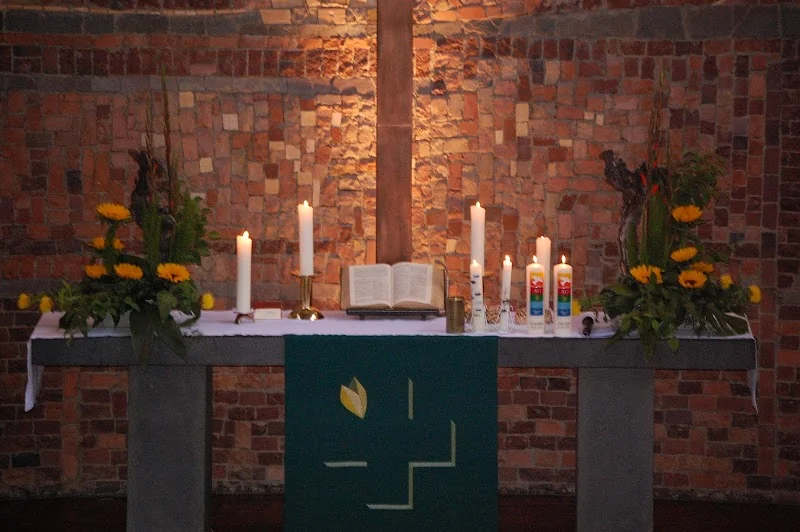
Visitors experience a bright, open space inside, with a view directed towards the altar area. An eight-meter-high copper cross stands in front of the large stone mosaic of the Transfiguration of Christ by artist Willi Sohl. The special effect arises from the interplay of light, material, room height, music, and the proximity between the altar area and the congregation. Those looking for an event in Bonn that takes place not in an anonymous multipurpose hall but in a characterful and historically significant space will find an extraordinary address in the Christuskirche.
The following information provides a comprehensive overview of events, programs, seating, history, equipment, directions, and practical visitor tips. Since service times, concerts, and individual dates may change, visitors should always check the current schedule of the Evangelical Thomas Church community in Bad Godesberg for a specific event.
Christuskirche Bonn Events and Program in Bad Godesberg
The most important search interest surrounding the Christuskirche Bonn pertains to the current program. The church is a central place for the Evangelical Thomas Church community in Bad Godesberg and is regularly used for services, special evening services, church music events, community meetings, and selected special dates. According to the community, Sunday services regularly begin at 11 a.m. Additionally, the services are broadcast via the Christuskirche's YouTube channel. This makes the church interesting for both local people and visitors who wish to follow content digitally.
The community's event calendar features not only regular services but also special formats. These may include musically themed services, seasonal celebrations, charity events, discussion offerings, community events, and dates for different age groups. Therefore, the Christuskirche is not just a venue for a single type of event. Its program arises from the church's annual cycle and the diverse community life in Plittersdorf, Hochkreuz, and the surrounding parts of Bad Godesberg.
Those looking for Christuskirche Bonn tickets should note that many events do not have a classic ticket sale like a commercial concert. Services are generally freely accessible. However, for concerts, special events, or charity formats, tickets, registrations, donations, or special access information may be required. Whether an event is free, requires registration, or can be supported at the box office depends on the respective organizer and the specific event. Therefore, the information in the current online event calendar is decisive.
For visitors, it is worthwhile to pay attention to the special atmosphere of the church space when planning the program. Music has a different effect in a church than in a theater or a classical concert hall. Organ sounds, choral music, readings, and quiet evening formats benefit from the architectural openness and the focused orientation of the space. At the same time, the flexible structure allows for larger services and communal events to be conducted with significantly more seating.
The Christuskirche is also a place where religious tradition and contemporary community work come together. The community describes its services as Lutheran-influenced and oriented towards people of today. This results in a program that can connect liturgical forms, music, encounters, and social issues. Therefore, for those searching for events in Bonn-Bad Godesberg, a combination of the terms Christuskirche Bonn events, Christuskirche program, service Christuskirche, and Thomas Church community Bad Godesberg is recommended.
Service, Church Music, and Special Events
The Christuskirche is primarily a place of worship in everyday life. In the services, according to the community's self-understanding, the heart of community life beats. The regular Sunday service provides a fixed anchor in the weekly routine and makes the church a familiar meeting point for many people. At the same time, there are special evening services that allow for a different time of day, a quieter atmosphere, or a thematic focus. For guests visiting Bad Godesberg, a service in the Christuskirche can be a good opportunity to experience the architecture and community directly.
The open design of the interior supports different forms. The space is not solely oriented towards a distant observation but was conceived as a community and everyday church. This is particularly evident in the connection between the central worship space and the side community rooms. Through the movable folding walls, the community can adapt the space to the size and character of an event. A typical Sunday service remains manageable; a festive service or a larger event can encompass the entire space complex.
Church music is another focus. The Christuskirche has a Winterhalter organ, which replaced the former organ by Paul Ott in 2019. The instrument was built by Claudius Winterhalter and has 31 registers on two manuals and a pedal. Such an organ significantly expands the musical possibilities of the church. It can accompany congregational singing, shape the liturgical process, and stand out as an independent instrument in concerts. The sound effect of an organ is always influenced by the acoustics and the spatial proportions of the church building.
At special events, choirs, instrumental ensembles, soloists, or speakers may also perform. The Christuskirche provides a strong framework for programs that connect music and word. Particularly fitting are festive church music, organ concerts, Advent and Christmas programs, Passion music, spiritual choral music, and charity events. Which dates actually take place can only be found in the current program of the community.
For visitors, it is important to adjust to a different event logic than at a commercial venue. There may not be numbered seats, no classic entry with multiple ticket counters, and no uniform ticket structure. Participation is central at services; at concerts, the conditions may vary. Visitors should read the event information carefully and use the community office or the respective contact point for any questions.
History and Architecture of the Christuskirche
The Christuskirche was built in 1953 at a time when many communities needed new spaces for a growing population and a changed church life. The design comes from Otto Bartning, one of the significant German church architects of the 20th century. Bartning shaped Protestant church construction particularly through buildings that were not only representative but also functional and community-oriented. Otto Dörzbach was involved in the Christuskirche.
The construction was realized within a year. The foundation stone was laid on January 25, 1953, and the inauguration took place on November 29, 1953. Thus, the church is one of the prominent sacred buildings of the early post-war period in Bonn-Bad Godesberg. Its creation is linked to the development of the Protestant community in Godesberg. Before the construction, there was essentially the Erlöserkirche from 1880 for the Protestant community in Godesberg. The new Christuskirche created another focal point for the northern districts and community life in Plittersdorf and Hochkreuz.
Architecturally, the church is designed as a wing church. The central space is complemented by four adjacent community rooms. If necessary, the movable wooden folding walls can be opened, allowing the community rooms to be integrated into the church space. This idea makes the Christuskirche a so-called celebration and weekday church. It can be used for Sunday worship as well as for teaching, group work, encounters, and larger events. Therefore, the architecture is not merely an external form but an expression of a specific understanding of community.
The exterior of the building appears relatively simple. However, inside, the different building bodies, the room height, and the incoming light create a special tension. Visitors' views are directed towards the altar area. There, the eleven-meter-high stone mosaic of the Transfiguration of Christ by Willi Sohl is located. In front of the mosaic rises an eight-meter-high copper cross. The combination of rough natural stone, warm-looking metal, and the open space creates a strong visual focal point.
Further furnishings complement the interior. The pulpit was designed by the Cologne sculptor Jochem Pechau. The baptismal bowl and communion utensils come from the workshop of Gotthold Schönwandt based on designs by Rudolf Koch. A chandelier created by Godesberg artist Eberhard Koch represents a globe in cubic form, with Christ understood as the light of the world at its center. These details show that the Christuskirche is shaped not only by its basic form but also by craftsmanship and symbolic design.
The church is listed as a historical monument and is considered one of the significant post-war churches of Otto Bartning. Those interested in modern church architecture, Bonn's building history, or sacred art will find a place here where history becomes directly tangible. The architecture is particularly well revealed during a quiet visit outside of large events when space, light, mosaic, and cross can be viewed without time pressure.
Seating, Capacity, and Seating Plan
The information about capacity is among the most important practical information for visitors, organizers, and seekers looking for a seating plan for the Christuskirche Bonn. The central church space offers about 360 seats. This size is suitable for regular Sunday services and smaller to medium-sized events. The arrangement creates proximity to the altar area and supports the communal orientation of the service.
However, the special strength of the Christuskirche lies in its variable room structure. By opening the movable folding walls, the four adjacent community rooms can be connected to the central church space. This increases the seating capacity to up to 850 seats. The church can thus accommodate significantly larger festive services, special celebrations, and events. The maximum capacity is therefore not equivalent to a permanently identical seating arrangement but depends on room opening, seating arrangement, event concept, and the applicable safety regulations.
A fixed seating plan like in an arena or theater is therefore only partially transferable. In a normal service, the central space is used. For a larger event, additional areas may be included. Depending on the occasion, pathways, technology, musical instruments, stages, choirs, or special liturgical elements may influence the seating arrangement. Visitors should inform themselves early for highly demanded events and arrive on time, especially if no numbered seats are allocated.
For organizers, the flexible structure offers several advantages. The Christuskirche can create an intimate atmosphere for smaller formats while also allowing for a high visitor capacity for larger occasions. This adaptability is a core component of Bartning's architecture. The spaces remain connected to community life and are not reserved solely for individual large events. This creates a venue that can respond to different target groups and formats.
When planning an event, in addition to the number of seats, other points must be considered. These include the specific room setup, escape and rescue routes, technical requirements, the position of the organ, the use of community rooms, and coordination with the church community. Binding information on seating and the maximum allowable number of visitors should therefore always be coordinated directly with those responsible. The published capacity of up to 850 seats describes the possible expanded space but does not replace an event-related permit or detailed planning.
For guests, the most important orientation remains: the central space offers around 360 seats, and with opened folding walls, up to 850 seats are possible. This flexible capacity makes the Christuskirche one of the larger Protestant churches in Bad Godesberg and explains why it appears in the search context of both services and events and concerts.
Directions to Christuskirche Bonn and Parking Information
The Christuskirche is located at Wurzerstraße 31, 53175 Bonn, in the Plittersdorf district of Bad Godesberg. The community center is situated in the northern part of Bad Godesberg between the Rhine and the federal road B 9. The community particularly includes the areas of Plittersdorf and Hochkreuz. The location combines an easily accessible inner-city address with a quiet environment that is distinctly different from large event areas or heavily frequented city centers.
For public transport access, the proximity to the Wurzerstraße subway station is an important orientation point. The community points out this proximity in its event calendar. Those arriving by bus or light rail should check the connection according to the respective event time and plan for a short walk from the stop to Wurzerstraße. For services and well-attended concerts, arriving by public transport can be a relaxed alternative to searching for parking.
Access to the open church is via the tower or library side on Hohenzollernstraße. For events, entry may be organized through a different access point depending on the format. Visitors should therefore pay attention to signage on site and instructions for the respective date. People with special mobility needs can contact the community in advance to clarify the appropriate access and local conditions.
Regarding parking, it is important to distinguish between official information and general orientation tips. The community does not mention a large visitor parking lot at the Christuskirche on the central information page. Therefore, drivers should not automatically assume reserved parking spaces on the church grounds. In the surrounding streets, local traffic signs, resident regulations, and possibly time restrictions apply. Before an event, it is advisable to allow enough time to search for a permissible parking space and not to block fire access routes, sidewalks, or private areas.
For larger events, the parking situation may be more strained. Early arrival, using public transport, and forming car pools are advisable. Those arriving by bicycle should only park in allowed parking areas and keep access routes, escape routes, and the area in front of the tower clear. Additional instructions from the organizer may apply for a specific event. These should always be prioritized over general search engine entries.
The location between the Rhine and B 9 also makes the Christuskirche interesting for a visit combined with a walk through Plittersdorf. Those who allow enough time can connect their arrival with a stay in the district. However, for services, concerts, or events, the start time should be considered. Especially for events without numbered seats, it is advisable not to arrive just a few minutes before the start.
Open Church, Community Center, and Practical Information
The Christuskirche is accessible as an open church even outside of services. According to the Evangelical Thomas Church community, it can be visited from Tuesday to Saturday from 9 a.m. to 4 p.m. Access is via the tower or library side on Hohenzollernstraße. This opening makes the church a place that is not only used during scheduled events. People can enter, find peace, light a candle, write in the prayer book, or admire the architecture.
Inside the church, there is a candle holder and a children's Bible corner with changing biblical scenes. A prayer book invites personal concerns to be recorded. The eight-meter-high copper cross in front of the mosaic offers a clear visual orientation point. The open church thus combines religious invitation, quiet reflection, and low-threshold visiting opportunities. Even people who do not wish to attend a service can get to know the space in a quiet moment.
The community center encompasses more than just the church space. Surrounding the Christuskirche are, among other things, the library, a kindergarten, a youth center, the rectory, the community office, and the family center. These facilities show that the church is designed as a center of diverse community life. The use ranges from services and church music to children's and youth work, as well as educational and encounter offerings.
The library at the Christuskirche is described as a family library for children and adults from Bad Godesberg. The family center stands for courses, encounters, and practical support in various life phases. This creates an environment in which the church functions not in isolation but as part of a social and cultural network. Visitors looking for a special location in Bonn should therefore consider that the Christuskirche is not only a historical sight but also a vibrant community site.
For planning a visit, the current opening hours and event information are crucial. Opening hours may change due to holidays, vacations, renovations, or special community events. Access to individual areas may also be regulated differently during events. Therefore, those planning a longer journey should check the community's website or the current event calendar. For organizational questions, the community office and the contacts listed on the community page are available.
The Christuskirche is suitable for many visitor groups. Those interested in architecture can engage with the work of Otto Bartning. Music lovers will find a special focus with the Winterhalter organ and the church music offerings. Families can discover the children's Bible corner, the library, and the community center's offerings. People seeking a quiet place can utilize the open church. This mix explains why the Christuskirche appears in search queries under both events and tickets as well as service, directions, history, and capacity.
The Christuskirche as a Special Event Venue in Bonn
An event in the Christuskirche takes place in a space that does not generate its effect through modern event technology or spectacular outdoor advertising but through architecture, history, and atmosphere. The church was designed for an active community. Its central space can create closeness and concentration; the side community rooms simultaneously allow for expansion and larger gatherings. This connection is interesting for organizers seeking a place with a clear identity.
The listed building provides a strong framework for church and cultural formats. Services benefit from the liturgical orientation and the visible altar area. Concerts gain an independent profile through the organ, the church space, and the special post-war architecture. Readings, discussion evenings, and charity events can utilize the calm, focused atmosphere. During seasonal events such as Advent, Christmas, Passion, or Easter, the design of the space connects with the character of the church year.
The visual language of the church is an essential part of the visitor experience. The stone mosaic of the Transfiguration of Christ draws the gaze across the entire height of the altar area. The copper cross sets a clear vertical accent. Light falls into the space and emphasizes the different materials. While modern event spaces are often neutrally designed, the Christuskirche brings its own history and symbolism. Each event enters into a dialogue with this heritage.
The flexible capacity is another advantage. For smaller events, the central space remains manageable. For larger services, the space can be expanded through the folding walls. With up to 850 seats, the church possesses a considerable size for Bad Godesberg. At the same time, use should always be coordinated with the church community, as the spatial expansion, technical equipment, seating, and organizational requirements depend on the respective concept.
Those looking for tickets or passes for an event should first identify the specific date and the respective organizer. The Christuskirche itself is a place of the Thomas Church community; therefore, not every event follows a uniform ticket model. Some dates are freely accessible, while others may require registration, a fee, or a donation. Reliable information can be found in the current online calendar, in official announcements, and possibly with the involved artists or ensembles.
As a venue in Bonn-Bad Godesberg, the Christuskirche thus offers an unusual combination: it is a historical church building, an active community center, an open spiritual place, a concert and event space, and an architectural monument. This multifunctionality shapes its character and makes it interesting for people looking for authentic places beyond standardized event spaces.
Planning a Visit: Program, Tickets, and Important Information
For a successful visit, a brief preparation is recommended. First, it should be checked whether it is a regular Sunday service, a special evening service, a concert, a charity event, or a community meeting. After that, admission, registration, start time, and access can be better assessed. According to the community, the regular Sunday services in the Christuskirche begin at 11 a.m. However, special dates may have different starting times.
For events with expected high demand, early arrival is advisable. Since a fixed seating plan with numbered seats is not published for all formats, seating may occur on a first-come, first-served basis. The actually usable capacity depends on the opened space, seating arrangement, and the event. Those coming with a group should therefore coordinate in advance and allow enough time for orientation and entry.
Visitors should also pay attention to the differences between the church's address and the access points. The official address is Wurzerstraße 31. For visiting the open church, access is mentioned via the tower or library side on Hohenzollernstraße. For events, on-site instructions or the event calendar may indicate the correct entrance. A specific route description should therefore be checked again on the day of the event.
Those visiting the Christuskirche for the first time should plan time for the space. The mosaic, the copper cross, the pulpit, the organ, and the flexible basic structure are better appreciated when the visit is not solely focused on the start of the event. Arriving early before a concert can help to perceive the atmosphere. After a service or event, depending on the date, encounters and conversations in the community's surroundings may be offered.
Photography, filming, and the use of mobile phones should always be done with consideration for the service, music, and other visitors. For professional recordings, private celebrations, cultural productions, or an event inquiry, direct coordination with the community is required. The listed substance and the ongoing community operation demand a responsible approach to space, furnishings, and inventory.
The Christuskirche Bonn stands for a visitor experience that is not limited to a single program point. Those searching for events, services, church music, architecture, or a quiet place in Bad Godesberg can connect different interests here. The history of Otto Bartning, the mosaic by Willi Sohl, the copper cross, the Winterhalter organ, the flexible room structure, and the open church together form a clear profile.
For current information, the official pages of the Evangelical Thomas Church community in Bad Godesberg are decisive. There, information about services, events, opening hours, and contacts can be found. Since dates and organizational information may change, this information should be checked before each specific visit. This way, the visit to the Christuskirche can be well prepared, and the special connection of architecture, music, community, and history can be consciously experienced.
Sources:
- Christuskirche – Evangelische Thomas-Kirchengemeinde Bad Godesberg
- Events and Calendar – Thomas Church Community Bad Godesberg
- The Christuskirche in Bad Godesberg – Godesberger Heimatblätter
- Open Christuskirche – Information Brochure of the Thomas Church Community
- Evangelical Thomas Church Community Bad Godesberg – Church District Bad Godesberg-Voreifel
- Christuskirche Bonn-Bad Godesberg – Organ Directory
Mehr anzeigenWeniger anzeigen
Christuskirche Bonn | Events & Tickets
The Christuskirche at Wurzerstraße 31 in Bonn-Bad Godesberg is much more than a house of worship. It is a significant example of post-war Protestant church architecture, a vibrant meeting place for the Thomas Church community, and a special venue for services, church music, concerts, charity events, discussion offerings, and communal encounters. Located in northern Bad Godesberg between the Rhine and B 9, the church combines a clear architectural idea with an open, inviting atmosphere.
The Christuskirche was built in 1953 according to plans by architect Otto Bartning with the involvement of Otto Dörzbach. The building is listed as a historical monument and impresses with its so-called wing church concept. The central church space can be connected to the adjacent community rooms through movable folding walls. This makes the building suitable for both the normal daily life of the congregation and for larger festive services and events. Approximately 360 seats are available in the central space; with an open room structure, the capacity can grow to up to 850 seats.
Visitors experience a bright, open space inside, with a view directed towards the altar area. An eight-meter-high copper cross stands in front of the large stone mosaic of the Transfiguration of Christ by artist Willi Sohl. The special effect arises from the interplay of light, material, room height, music, and the proximity between the altar area and the congregation. Those looking for an event in Bonn that takes place not in an anonymous multipurpose hall but in a characterful and historically significant space will find an extraordinary address in the Christuskirche.
The following information provides a comprehensive overview of events, programs, seating, history, equipment, directions, and practical visitor tips. Since service times, concerts, and individual dates may change, visitors should always check the current schedule of the Evangelical Thomas Church community in Bad Godesberg for a specific event.
Christuskirche Bonn Events and Program in Bad Godesberg
The most important search interest surrounding the Christuskirche Bonn pertains to the current program. The church is a central place for the Evangelical Thomas Church community in Bad Godesberg and is regularly used for services, special evening services, church music events, community meetings, and selected special dates. According to the community, Sunday services regularly begin at 11 a.m. Additionally, the services are broadcast via the Christuskirche's YouTube channel. This makes the church interesting for both local people and visitors who wish to follow content digitally.
The community's event calendar features not only regular services but also special formats. These may include musically themed services, seasonal celebrations, charity events, discussion offerings, community events, and dates for different age groups. Therefore, the Christuskirche is not just a venue for a single type of event. Its program arises from the church's annual cycle and the diverse community life in Plittersdorf, Hochkreuz, and the surrounding parts of Bad Godesberg.
Those looking for Christuskirche Bonn tickets should note that many events do not have a classic ticket sale like a commercial concert. Services are generally freely accessible. However, for concerts, special events, or charity formats, tickets, registrations, donations, or special access information may be required. Whether an event is free, requires registration, or can be supported at the box office depends on the respective organizer and the specific event. Therefore, the information in the current online event calendar is decisive.
For visitors, it is worthwhile to pay attention to the special atmosphere of the church space when planning the program. Music has a different effect in a church than in a theater or a classical concert hall. Organ sounds, choral music, readings, and quiet evening formats benefit from the architectural openness and the focused orientation of the space. At the same time, the flexible structure allows for larger services and communal events to be conducted with significantly more seating.
The Christuskirche is also a place where religious tradition and contemporary community work come together. The community describes its services as Lutheran-influenced and oriented towards people of today. This results in a program that can connect liturgical forms, music, encounters, and social issues. Therefore, for those searching for events in Bonn-Bad Godesberg, a combination of the terms Christuskirche Bonn events, Christuskirche program, service Christuskirche, and Thomas Church community Bad Godesberg is recommended.
Service, Church Music, and Special Events
The Christuskirche is primarily a place of worship in everyday life. In the services, according to the community's self-understanding, the heart of community life beats. The regular Sunday service provides a fixed anchor in the weekly routine and makes the church a familiar meeting point for many people. At the same time, there are special evening services that allow for a different time of day, a quieter atmosphere, or a thematic focus. For guests visiting Bad Godesberg, a service in the Christuskirche can be a good opportunity to experience the architecture and community directly.
The open design of the interior supports different forms. The space is not solely oriented towards a distant observation but was conceived as a community and everyday church. This is particularly evident in the connection between the central worship space and the side community rooms. Through the movable folding walls, the community can adapt the space to the size and character of an event. A typical Sunday service remains manageable; a festive service or a larger event can encompass the entire space complex.
Church music is another focus. The Christuskirche has a Winterhalter organ, which replaced the former organ by Paul Ott in 2019. The instrument was built by Claudius Winterhalter and has 31 registers on two manuals and a pedal. Such an organ significantly expands the musical possibilities of the church. It can accompany congregational singing, shape the liturgical process, and stand out as an independent instrument in concerts. The sound effect of an organ is always influenced by the acoustics and the spatial proportions of the church building.
At special events, choirs, instrumental ensembles, soloists, or speakers may also perform. The Christuskirche provides a strong framework for programs that connect music and word. Particularly fitting are festive church music, organ concerts, Advent and Christmas programs, Passion music, spiritual choral music, and charity events. Which dates actually take place can only be found in the current program of the community.
For visitors, it is important to adjust to a different event logic than at a commercial venue. There may not be numbered seats, no classic entry with multiple ticket counters, and no uniform ticket structure. Participation is central at services; at concerts, the conditions may vary. Visitors should read the event information carefully and use the community office or the respective contact point for any questions.
History and Architecture of the Christuskirche
The Christuskirche was built in 1953 at a time when many communities needed new spaces for a growing population and a changed church life. The design comes from Otto Bartning, one of the significant German church architects of the 20th century. Bartning shaped Protestant church construction particularly through buildings that were not only representative but also functional and community-oriented. Otto Dörzbach was involved in the Christuskirche.
The construction was realized within a year. The foundation stone was laid on January 25, 1953, and the inauguration took place on November 29, 1953. Thus, the church is one of the prominent sacred buildings of the early post-war period in Bonn-Bad Godesberg. Its creation is linked to the development of the Protestant community in Godesberg. Before the construction, there was essentially the Erlöserkirche from 1880 for the Protestant community in Godesberg. The new Christuskirche created another focal point for the northern districts and community life in Plittersdorf and Hochkreuz.
Architecturally, the church is designed as a wing church. The central space is complemented by four adjacent community rooms. If necessary, the movable wooden folding walls can be opened, allowing the community rooms to be integrated into the church space. This idea makes the Christuskirche a so-called celebration and weekday church. It can be used for Sunday worship as well as for teaching, group work, encounters, and larger events. Therefore, the architecture is not merely an external form but an expression of a specific understanding of community.
The exterior of the building appears relatively simple. However, inside, the different building bodies, the room height, and the incoming light create a special tension. Visitors' views are directed towards the altar area. There, the eleven-meter-high stone mosaic of the Transfiguration of Christ by Willi Sohl is located. In front of the mosaic rises an eight-meter-high copper cross. The combination of rough natural stone, warm-looking metal, and the open space creates a strong visual focal point.
Further furnishings complement the interior. The pulpit was designed by the Cologne sculptor Jochem Pechau. The baptismal bowl and communion utensils come from the workshop of Gotthold Schönwandt based on designs by Rudolf Koch. A chandelier created by Godesberg artist Eberhard Koch represents a globe in cubic form, with Christ understood as the light of the world at its center. These details show that the Christuskirche is shaped not only by its basic form but also by craftsmanship and symbolic design.
The church is listed as a historical monument and is considered one of the significant post-war churches of Otto Bartning. Those interested in modern church architecture, Bonn's building history, or sacred art will find a place here where history becomes directly tangible. The architecture is particularly well revealed during a quiet visit outside of large events when space, light, mosaic, and cross can be viewed without time pressure.
Seating, Capacity, and Seating Plan
The information about capacity is among the most important practical information for visitors, organizers, and seekers looking for a seating plan for the Christuskirche Bonn. The central church space offers about 360 seats. This size is suitable for regular Sunday services and smaller to medium-sized events. The arrangement creates proximity to the altar area and supports the communal orientation of the service.
However, the special strength of the Christuskirche lies in its variable room structure. By opening the movable folding walls, the four adjacent community rooms can be connected to the central church space. This increases the seating capacity to up to 850 seats. The church can thus accommodate significantly larger festive services, special celebrations, and events. The maximum capacity is therefore not equivalent to a permanently identical seating arrangement but depends on room opening, seating arrangement, event concept, and the applicable safety regulations.
A fixed seating plan like in an arena or theater is therefore only partially transferable. In a normal service, the central space is used. For a larger event, additional areas may be included. Depending on the occasion, pathways, technology, musical instruments, stages, choirs, or special liturgical elements may influence the seating arrangement. Visitors should inform themselves early for highly demanded events and arrive on time, especially if no numbered seats are allocated.
For organizers, the flexible structure offers several advantages. The Christuskirche can create an intimate atmosphere for smaller formats while also allowing for a high visitor capacity for larger occasions. This adaptability is a core component of Bartning's architecture. The spaces remain connected to community life and are not reserved solely for individual large events. This creates a venue that can respond to different target groups and formats.
When planning an event, in addition to the number of seats, other points must be considered. These include the specific room setup, escape and rescue routes, technical requirements, the position of the organ, the use of community rooms, and coordination with the church community. Binding information on seating and the maximum allowable number of visitors should therefore always be coordinated directly with those responsible. The published capacity of up to 850 seats describes the possible expanded space but does not replace an event-related permit or detailed planning.
For guests, the most important orientation remains: the central space offers around 360 seats, and with opened folding walls, up to 850 seats are possible. This flexible capacity makes the Christuskirche one of the larger Protestant churches in Bad Godesberg and explains why it appears in the search context of both services and events and concerts.
Directions to Christuskirche Bonn and Parking Information
The Christuskirche is located at Wurzerstraße 31, 53175 Bonn, in the Plittersdorf district of Bad Godesberg. The community center is situated in the northern part of Bad Godesberg between the Rhine and the federal road B 9. The community particularly includes the areas of Plittersdorf and Hochkreuz. The location combines an easily accessible inner-city address with a quiet environment that is distinctly different from large event areas or heavily frequented city centers.
For public transport access, the proximity to the Wurzerstraße subway station is an important orientation point. The community points out this proximity in its event calendar. Those arriving by bus or light rail should check the connection according to the respective event time and plan for a short walk from the stop to Wurzerstraße. For services and well-attended concerts, arriving by public transport can be a relaxed alternative to searching for parking.
Access to the open church is via the tower or library side on Hohenzollernstraße. For events, entry may be organized through a different access point depending on the format. Visitors should therefore pay attention to signage on site and instructions for the respective date. People with special mobility needs can contact the community in advance to clarify the appropriate access and local conditions.
Regarding parking, it is important to distinguish between official information and general orientation tips. The community does not mention a large visitor parking lot at the Christuskirche on the central information page. Therefore, drivers should not automatically assume reserved parking spaces on the church grounds. In the surrounding streets, local traffic signs, resident regulations, and possibly time restrictions apply. Before an event, it is advisable to allow enough time to search for a permissible parking space and not to block fire access routes, sidewalks, or private areas.
For larger events, the parking situation may be more strained. Early arrival, using public transport, and forming car pools are advisable. Those arriving by bicycle should only park in allowed parking areas and keep access routes, escape routes, and the area in front of the tower clear. Additional instructions from the organizer may apply for a specific event. These should always be prioritized over general search engine entries.
The location between the Rhine and B 9 also makes the Christuskirche interesting for a visit combined with a walk through Plittersdorf. Those who allow enough time can connect their arrival with a stay in the district. However, for services, concerts, or events, the start time should be considered. Especially for events without numbered seats, it is advisable not to arrive just a few minutes before the start.
Open Church, Community Center, and Practical Information
The Christuskirche is accessible as an open church even outside of services. According to the Evangelical Thomas Church community, it can be visited from Tuesday to Saturday from 9 a.m. to 4 p.m. Access is via the tower or library side on Hohenzollernstraße. This opening makes the church a place that is not only used during scheduled events. People can enter, find peace, light a candle, write in the prayer book, or admire the architecture.
Inside the church, there is a candle holder and a children's Bible corner with changing biblical scenes. A prayer book invites personal concerns to be recorded. The eight-meter-high copper cross in front of the mosaic offers a clear visual orientation point. The open church thus combines religious invitation, quiet reflection, and low-threshold visiting opportunities. Even people who do not wish to attend a service can get to know the space in a quiet moment.
The community center encompasses more than just the church space. Surrounding the Christuskirche are, among other things, the library, a kindergarten, a youth center, the rectory, the community office, and the family center. These facilities show that the church is designed as a center of diverse community life. The use ranges from services and church music to children's and youth work, as well as educational and encounter offerings.
The library at the Christuskirche is described as a family library for children and adults from Bad Godesberg. The family center stands for courses, encounters, and practical support in various life phases. This creates an environment in which the church functions not in isolation but as part of a social and cultural network. Visitors looking for a special location in Bonn should therefore consider that the Christuskirche is not only a historical sight but also a vibrant community site.
For planning a visit, the current opening hours and event information are crucial. Opening hours may change due to holidays, vacations, renovations, or special community events. Access to individual areas may also be regulated differently during events. Therefore, those planning a longer journey should check the community's website or the current event calendar. For organizational questions, the community office and the contacts listed on the community page are available.
The Christuskirche is suitable for many visitor groups. Those interested in architecture can engage with the work of Otto Bartning. Music lovers will find a special focus with the Winterhalter organ and the church music offerings. Families can discover the children's Bible corner, the library, and the community center's offerings. People seeking a quiet place can utilize the open church. This mix explains why the Christuskirche appears in search queries under both events and tickets as well as service, directions, history, and capacity.
The Christuskirche as a Special Event Venue in Bonn
An event in the Christuskirche takes place in a space that does not generate its effect through modern event technology or spectacular outdoor advertising but through architecture, history, and atmosphere. The church was designed for an active community. Its central space can create closeness and concentration; the side community rooms simultaneously allow for expansion and larger gatherings. This connection is interesting for organizers seeking a place with a clear identity.
The listed building provides a strong framework for church and cultural formats. Services benefit from the liturgical orientation and the visible altar area. Concerts gain an independent profile through the organ, the church space, and the special post-war architecture. Readings, discussion evenings, and charity events can utilize the calm, focused atmosphere. During seasonal events such as Advent, Christmas, Passion, or Easter, the design of the space connects with the character of the church year.
The visual language of the church is an essential part of the visitor experience. The stone mosaic of the Transfiguration of Christ draws the gaze across the entire height of the altar area. The copper cross sets a clear vertical accent. Light falls into the space and emphasizes the different materials. While modern event spaces are often neutrally designed, the Christuskirche brings its own history and symbolism. Each event enters into a dialogue with this heritage.
The flexible capacity is another advantage. For smaller events, the central space remains manageable. For larger services, the space can be expanded through the folding walls. With up to 850 seats, the church possesses a considerable size for Bad Godesberg. At the same time, use should always be coordinated with the church community, as the spatial expansion, technical equipment, seating, and organizational requirements depend on the respective concept.
Those looking for tickets or passes for an event should first identify the specific date and the respective organizer. The Christuskirche itself is a place of the Thomas Church community; therefore, not every event follows a uniform ticket model. Some dates are freely accessible, while others may require registration, a fee, or a donation. Reliable information can be found in the current online calendar, in official announcements, and possibly with the involved artists or ensembles.
As a venue in Bonn-Bad Godesberg, the Christuskirche thus offers an unusual combination: it is a historical church building, an active community center, an open spiritual place, a concert and event space, and an architectural monument. This multifunctionality shapes its character and makes it interesting for people looking for authentic places beyond standardized event spaces.
Planning a Visit: Program, Tickets, and Important Information
For a successful visit, a brief preparation is recommended. First, it should be checked whether it is a regular Sunday service, a special evening service, a concert, a charity event, or a community meeting. After that, admission, registration, start time, and access can be better assessed. According to the community, the regular Sunday services in the Christuskirche begin at 11 a.m. However, special dates may have different starting times.
For events with expected high demand, early arrival is advisable. Since a fixed seating plan with numbered seats is not published for all formats, seating may occur on a first-come, first-served basis. The actually usable capacity depends on the opened space, seating arrangement, and the event. Those coming with a group should therefore coordinate in advance and allow enough time for orientation and entry.
Visitors should also pay attention to the differences between the church's address and the access points. The official address is Wurzerstraße 31. For visiting the open church, access is mentioned via the tower or library side on Hohenzollernstraße. For events, on-site instructions or the event calendar may indicate the correct entrance. A specific route description should therefore be checked again on the day of the event.
Those visiting the Christuskirche for the first time should plan time for the space. The mosaic, the copper cross, the pulpit, the organ, and the flexible basic structure are better appreciated when the visit is not solely focused on the start of the event. Arriving early before a concert can help to perceive the atmosphere. After a service or event, depending on the date, encounters and conversations in the community's surroundings may be offered.
Photography, filming, and the use of mobile phones should always be done with consideration for the service, music, and other visitors. For professional recordings, private celebrations, cultural productions, or an event inquiry, direct coordination with the community is required. The listed substance and the ongoing community operation demand a responsible approach to space, furnishings, and inventory.
The Christuskirche Bonn stands for a visitor experience that is not limited to a single program point. Those searching for events, services, church music, architecture, or a quiet place in Bad Godesberg can connect different interests here. The history of Otto Bartning, the mosaic by Willi Sohl, the copper cross, the Winterhalter organ, the flexible room structure, and the open church together form a clear profile.
For current information, the official pages of the Evangelical Thomas Church community in Bad Godesberg are decisive. There, information about services, events, opening hours, and contacts can be found. Since dates and organizational information may change, this information should be checked before each specific visit. This way, the visit to the Christuskirche can be well prepared, and the special connection of architecture, music, community, and history can be consciously experienced.
Sources:
- Christuskirche – Evangelische Thomas-Kirchengemeinde Bad Godesberg
- Events and Calendar – Thomas Church Community Bad Godesberg
- The Christuskirche in Bad Godesberg – Godesberger Heimatblätter
- Open Christuskirche – Information Brochure of the Thomas Church Community
- Evangelical Thomas Church Community Bad Godesberg – Church District Bad Godesberg-Voreifel
- Christuskirche Bonn-Bad Godesberg – Organ Directory
Frequently Asked Questions
Reviews
Patrick Gläser (Orgel rockt)
17. February 2024
A church space from the 1950s with an exciting history, a very interesting Winterhalter organ (2019, II/P 37) - and a vibrant community. To tune an organ so clearly and cleanly in the challenging acoustic conditions of the room is a real masterpiece that the tuners from Winterhalter have truly achieved. (Still, I would wish for a bit more room sound – which is of course limited by the structural conditions.)
Bernd Meyer
5. April 2026
Great church, great pastor. Always worth seeing and hearing.
Frankie
20. February 2024
This is a very lively community. Charismatic clergy and engaged laypeople shape this congregation. The organ concerts are particularly beautiful. On an organ that was newly installed a few years ago. Also featuring modern music. The organ rocks with Patrick Gläser, for example, is played there.
Karin Wengel
23. June 2021
Very lively services that are celebrated and inspire for the whole week; great community; a cool pastor who practices his calling with energy and passion.
Norbert Klaus
20. February 2023
The service on Carnival Sunday was captivating and moving - simply great. The poignant reflections and food for thought will occupy me for a while.