
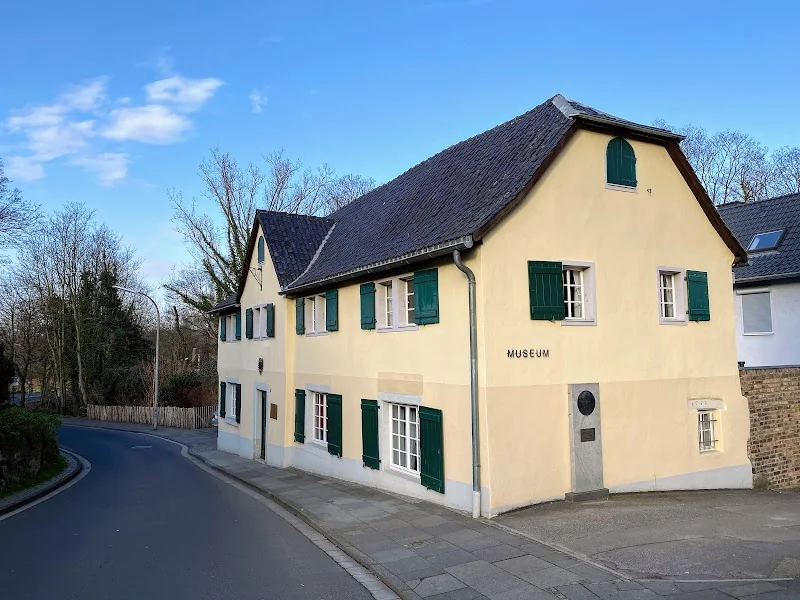
Adelheidisstraße 3, Bonn-Beuel
Adelheidisstraße 3, 53225 Bonn, Germany
Mayor-Stroof-House | History & Opening Hours
The Mayor-Stroof-House is one of those addresses in Bonn that is easily overlooked and therefore remains even more memorable. In Vilich, on the right bank of the city, the house uniquely combines architecture, regional history, and museum communication. Today, it is not only the seat of the Bonn-Rechtsrheinisch Monument and History Association but also a publicly accessible museum, a historical meeting place, and a location where the early municipal history of today's Bonn-Beuel can be impressively read. Upon entering the house, one encounters not just old walls but a carefully preserved piece of local identity that has been saved from demolition, restored, and newly opened to the public. The association's website describes the building as the “House of History in Right-Bank Bonn”; this very role is what makes the house particularly appealing. ([denkmalverein-bonn.de](https://www.denkmalverein-bonn.de/das_buergermeister_stroof_haus))
Search queries related to the house revolve mainly around three topics: the history of the building and Leonhard Stroof, practical visitor information including opening hours and directions, and the museum character with guided tours, library, and events. These focal points are quite understandable, as the Mayor-Stroof-House is simultaneously a monument, museum, and vibrant community space. Those wishing to visit often look for the exact address on Adelheidisstraße, the connection to Vilich and Beuel, or whether admission is free. These specific pieces of information are documented on the reliable association and museum pages and form the basis for a visit that is suitable for both history enthusiasts and spontaneous outings. ([denkmalverein-bonn.de](https://www.denkmalverein-bonn.de/das_buergermeister_stroof_haus))
History of the Mayor-Stroof-House in Vilich
The historical depth of the Mayor-Stroof-House begins long before Leonhard Stroof. The association's website describes that remnants of a rubble stone structure from the Middle Ages, i.e., a time before 1500, have been preserved. This includes two exterior walls of the current ground floor on the south side that enclose a buried well shaft. There is also an unexplored cellar space that indicates older construction phases. The main house itself likely dates back to the early years of the 18th century. Thus, the building is not only a residential house from a bygone era but also a layered representation of local construction and usage history, where medieval remnants, early modern substance, and later renovations overlap. Particularly noteworthy is that the house, despite the renovations, still preserves traces that make its development comprehensible. ([denkmalverein-bonn.de](https://www.denkmalverein-bonn.de/geschichte))
A crucial phase began around 1800 when Leonhard Stroof redesigned the property. The museum description notes that Stroof connected two buildings at that time, raised them, and furnished them representatively. Thus, a rural courtyard and residential ensemble became an official building expressing municipal authority. This role is closely linked to the political reorganization of the region: After centuries of rule by the Vilich Abbey, the civil community of Vilich was created in 1808 under Napoleonic administration, from which the Bonn-Beuel district later developed. Leonhard Stroof, born in 1757 and died in 1825, was the first mayor of this community and continued his office even after the transition of the Rhineland to Prussia in 1815. His residence is therefore also the first municipal official building in today's right-bank Bonn and a central place in Beuel's administrative history. ([denkmalverein-bonn.de](https://www.denkmalverein-bonn.de/das_buergermeister_stroof_haus))
The path to the current museum is also part of the history. The residential building not only survived the passage of time but was fundamentally restored in 1990. Since 2009, the Monument and History Association has presented the rescued historical and architectural monument as a public museum. The association and museum pages emphasize that the house serves not only as an exhibition site but is also understood as a historical research, education, and meeting place. This is important because it means that the house does not remain in a museum-like stagnation but actively reveals its history for today's visitors. The monument character is therefore not an end in itself but the basis of a vibrant place of remembrance that connects the emergence of Beuel, the early municipal history, and the biography of its first mayor. ([denkmalverein-bonn.de](https://www.denkmalverein-bonn.de/das_buergermeister_stroof_haus))
Opening Hours, Admission, and Guided Tours
For visitors, the practical information is pleasantly clear. According to the association's website, the Mayor-Stroof-House is open every Friday and Sunday from 3:00 PM to 6:00 PM, except on public holidays. A second association page adds that the museum is accessible on Fridays and Sundays from 3:00 PM to 6:00 PM, that no prior registration is required, and that visits are also possible by appointment. This information makes access uncomplicated: Those who come spontaneously to Bonn-Vilich can visit the house within a well-planned time window. At the same time, there is enough flexibility for special appointments, groups, or thematic tours that are not bound to regular opening hours. For a monument of this kind, this is a significant advantage, as it keeps the place open and easily accessible. ([denkmalverein-bonn.de](https://www.denkmalverein-bonn.de/das_buergermeister_stroof_haus))
The house is also consciously open regarding pricing: Admission is free. This aligns with the self-description of the association, which operates the house not only as a museum but also as an educational and meeting place. Particularly interesting is the offer of a free audio guide tour that can be used via smartphone. This way, guests receive information about the house, individual rooms, and the history without requiring extensive prior planning for the visit. For those who like to look around quietly while also wanting to learn more, this combination is very attractive. Special tours are available by appointment; thus, the house is suitable not only for the classic weekend visit but also for groups, families, history enthusiasts, or local initiatives seeking a thematic approach. The free accessibility is not a secondary aspect here but a central part of the concept. ([denkmalverein-bonn.de](https://www.denkmalverein-bonn.de/das_buergermeister_stroof_haus))
The fact that the house is also worth repeated visits is related to its density of topics. Those coming for the first time may primarily focus on the historical rooms and the historical context. Those who come a second time pay more attention to details such as the furnishings, the narrative style of the audio guide, or the connection between the house's history and municipal development. Precisely because admission is free, a very accessible visiting model emerges: a quick stop, targeted information gathering, or combining the visit with a walk through Vilich. Thus, a monument visit quickly becomes a small local discovery tour. The open hours in the late afternoon and on Sundays are particularly well suited for this. ([denkmalverein-bonn.de](https://www.denkmalverein-bonn.de/das_buergermeister_stroof_haus))
Directions to Adelheidisstraße 3 in Bonn-Vilich
The address is clear: Adelheidisstraße 3, 53225 Bonn-Vilich. Those traveling by public transport can easily reach the house from the Vilich stop of tram line 66 or from the Vilich Kloster stop of bus line 640; it is just a few minutes on foot from both stations. The Rhineland museum database additionally mentions the same public transport connection and adds a car journey via the A59, exit 41 BN-Vilich, then via Sankt Augustiner Straße, Gartenstraße, Ewigstraße, and Adelheidisstraße. Thus, the house is well connected not only in terms of content but also in terms of transport. The proximity to line 66 is particularly practical for excursions from Bonn and the surrounding area, as access is achieved without complicated detours. ([denkmalverein-bonn.de](https://www.denkmalverein-bonn.de/das_buergermeister_stroof_haus/anfahrt))
For searching for the house, the different designations are also important. Search queries include phrases like Mayor-Stroof-House Vilich, Mayor-Stroof-House Adelheidisstraße Bonn, or Mayor Street House. However, the correct and officially used spelling is Mayor-Stroof-House. Therefore, those navigating should orient themselves to this spelling and the complete address. This is especially helpful with older maps, voices from the local environment, or search results with differing spellings. Even though the surroundings are strongly characterized by residential streets, orientation remains simple: address, line 66, bus 640, and the district of Vilich are the reliable keys for arrival. ([denkmalverein-bonn.de](https://www.denkmalverein-bonn.de/das_buergermeister_stroof_haus))
The location in Vilich adds an extra charm to the visit. Instead of an anonymous museum address, guests encounter a historically shaped district whose development is closely linked to the municipal history of Beuel. The house is therefore not isolated but situated in an environment that complements the narrative of the building. Those arriving by train or bus immediately experience this connection between historical location and modern accessibility. Those driving by car follow the same historical trail in a contemporary manner. This is important for day visitors, as a visit can be planned without significant logistical effort. This is precisely what makes the Mayor-Stroof-House a good destination for short cultural stops, combinable afternoon outings, and thematic tours in right-bank Bonn. ([denkmalverein-bonn.de](https://www.denkmalverein-bonn.de/das_buergermeister_stroof_haus/anfahrt))
Rooms, Furnishings, and Historical Particularities
The interior of the Mayor-Stroof-House is by no means empty or abstract but is deliberately designed as a vivid historical space. The association's website mentions the large salon, the office, the small salon, the bedroom, the view into the well, and the attic as visible stations. This sequence of rooms already shows that the house functions not only as an exhibit but as a walkable narrative. Visitors therefore experience a residential and official house where private, administrative, and architectural functions come together. The interior views on the website also clarify that the rooms are used and staged differently without losing their historical character. The transition between representative and more intimate rooms gives the house a special atmosphere. ([denkmalverein-bonn.de](https://www.denkmalverein-bonn.de/innenansichten))
Architecturally, the building is also remarkable. It reflects the state of the early 19th century, i.e., the time between late Baroque and Biedermeier. Notable features include half-timbering from the 18th century, an outwardly urban plastered impression, a hollow tile or straw doll roof, an open fireplace, and a smoke vent on medieval rubble stone masonry. Additionally, there are hearth walls, wells, and hidden cellar vaults. Particularly noteworthy are the late Baroque interior furnishings, the Cologne stucco ceilings, wall panels, and the painting. The Rhineland museum database also describes the well-preserved painting in almost all rooms as an absolute rarity for a Rhineland half-timbered house. This makes the house a rare example of the combination of rural building form, urban aspirations, and historical living culture. ([denkmalverein-bonn.de](https://www.denkmalverein-bonn.de/das_buergermeister_stroof_haus))
Moreover, there is the museum narrative about the person Leonhard Stroof himself. In the house, guests encounter not only furniture from the late Baroque, Empire, and early Biedermeier periods but also references to Stroof's work, such as in the office. The museum description mentions a standing desk and spectacles as signs of his administrative daily life. Such details may seem small but are crucial for the historical impact: they transform the house into a place of concrete life and work. Those visiting the building thus gain not only an impression of regional architecture but also of the living conditions of a Rhineland mayor's family around two hundred years ago. This blend of architectural authenticity and narrative density is a key reason why the Mayor-Stroof-House is considered a hidden gem for culturally and historically interested visitors. ([rheinischemuseen.de](https://www.rheinischemuseen.de/museum/DE-MUS-987917))
Library, Archives, and Research On-Site
A special feature of the Mayor-Stroof-House is its function as a knowledge center. The association maintains a historical specialist library on the history of Bonn and the region. According to the library page, the collection includes books, magazines, series publications, picture folders, film DVDs, and so-called grey literature such as parish newsletters or association publications. The collection currently comprises about 1,200 titles and is considered largely complete, especially regarding the history of the Beuel district. For researchers, local historians, and family history enthusiasts, this is an enormously valuable resource, as it brings together not only standard literature but also hard-to-find regional sources. The library is cataloged and digitally accessible, facilitating targeted searches. ([denkmalverein-bonn.de](https://www.denkmalverein-bonn.de/bibliothek))
The usage is deliberately organized to be low-threshold. The library is open to everyone and can be used during the regular opening hours of the Mayor-Stroof-House; it is also accessible on other days by telephone arrangement. It is free of charge, and voluntary donations are welcome. As a reference library, it is exclusively intended for on-site study, with the historical large salon serving as the reading room. In justified individual cases, primarily for association members, limited borrowing is possible. There is also a copying machine on-site. These details show that the house is not only a place of remembrance but also a working place. Those dealing with Bonn's city history, Beuel's history, or the development of the right bank of the Rhine will find here a regionally tailored information base. ([denkmalverein-bonn.de](https://www.denkmalverein-bonn.de/bibliothek))
Content-wise, this library function fits excellently with the self-understanding of the house. The association presents the building as a museum as well as a historical meeting, research, and educational center. The website also features sections on library & archives and family research. This shows that knowledge work does not end at the entrance but is a core component of the institution. This is an important aspect, especially for local research questions, school projects, or genealogical inquiries. The Mayor-Stroof-House thus offers more than a classic exhibition: it is also a place where knowledge is organized, made accessible, and connected with the city's history. ([denkmalverein-bonn.de](https://www.denkmalverein-bonn.de/das_buergermeister_stroof_haus))
Events, StroofKOLLEG, and Living Historical Work
The Mayor-Stroof-House thrives not only on its historical substance but also on an active event program. The association points to the lecture series StroofKOLLEG, which deals with topics related to the history of Beuel. Additionally, there are film nights under the title STROOF-Kino, which regularly address local or regional historical subjects. The current association page also documents exhibitions, lectures, and thematic evenings. This is important because it makes clear that the house is not only preserved but is continuously narrated, discussed, and newly contextualized. The historical substance does not remain silent but is translated into the present through events. ([denkmalverein-bonn.de](https://www.denkmalverein-bonn.de/denkmal-und-geschichtsverein-bonn-rechtsrheinisch-spielwiese))
A particularly telling example is the exhibition surrounding the 200th anniversary of Leonhard Stroof's death. The association describes that around 9,000 reports by Stroof have been preserved, and about 100 have been selected to show a broad and sometimes curious picture of his work. Among other things, topics such as deserting soldiers, floods, market events, or the legendary story of the murderer Moll are mentioned. Such topics make it clear how closely local everyday history, administration, and social conflicts were intertwined. Additionally, there is a lapidarium with rare boundary stones in the courtyard of the museum. This also demonstrates the breadth of historical work: from paper documents to monuments to objects in the courtyard. ([denkmalverein-bonn.de](https://www.denkmalverein-bonn.de/aktuelles))
For visitors, this means: An appointment at the Mayor-Stroof-House can always look different. Sometimes architecture is in the foreground, sometimes an exhibition, sometimes a lecture or a film night. This mix makes the address particularly relevant for search queries like museum, tours, program, exhibition, or history. Those who know the place quickly realize that this is not just a residential house being viewed but a very active historical space. The house connects regional research, civic engagement, and public communication in a way that is distinctly characteristic of Bonn-Beuel. This makes it suitable for both short visits and in-depth repeat visits. ([denkmalverein-bonn.de](https://www.denkmalverein-bonn.de/denkmal-und-geschichtsverein-bonn-rechtsrheinisch-spielwiese))
Sources:
- Mayor-Stroof-House - Monument and History Association Bonn-Rechtsrheinisch e.V.
- Directions - Monument and History Association Bonn Rechtsrheinisch
- The History of the House - Monument and History Association Bonn-Rechtsrheinisch e.V.
- Library - Monument and History Association Bonn Rechtsrheinisch e.V.
- Rhineland Museums - Museum Mayor-Stroof-House
Show moreShow less
Mayor-Stroof-House | History & Opening Hours
The Mayor-Stroof-House is one of those addresses in Bonn that is easily overlooked and therefore remains even more memorable. In Vilich, on the right bank of the city, the house uniquely combines architecture, regional history, and museum communication. Today, it is not only the seat of the Bonn-Rechtsrheinisch Monument and History Association but also a publicly accessible museum, a historical meeting place, and a location where the early municipal history of today's Bonn-Beuel can be impressively read. Upon entering the house, one encounters not just old walls but a carefully preserved piece of local identity that has been saved from demolition, restored, and newly opened to the public. The association's website describes the building as the “House of History in Right-Bank Bonn”; this very role is what makes the house particularly appealing. ([denkmalverein-bonn.de](https://www.denkmalverein-bonn.de/das_buergermeister_stroof_haus))
Search queries related to the house revolve mainly around three topics: the history of the building and Leonhard Stroof, practical visitor information including opening hours and directions, and the museum character with guided tours, library, and events. These focal points are quite understandable, as the Mayor-Stroof-House is simultaneously a monument, museum, and vibrant community space. Those wishing to visit often look for the exact address on Adelheidisstraße, the connection to Vilich and Beuel, or whether admission is free. These specific pieces of information are documented on the reliable association and museum pages and form the basis for a visit that is suitable for both history enthusiasts and spontaneous outings. ([denkmalverein-bonn.de](https://www.denkmalverein-bonn.de/das_buergermeister_stroof_haus))
History of the Mayor-Stroof-House in Vilich
The historical depth of the Mayor-Stroof-House begins long before Leonhard Stroof. The association's website describes that remnants of a rubble stone structure from the Middle Ages, i.e., a time before 1500, have been preserved. This includes two exterior walls of the current ground floor on the south side that enclose a buried well shaft. There is also an unexplored cellar space that indicates older construction phases. The main house itself likely dates back to the early years of the 18th century. Thus, the building is not only a residential house from a bygone era but also a layered representation of local construction and usage history, where medieval remnants, early modern substance, and later renovations overlap. Particularly noteworthy is that the house, despite the renovations, still preserves traces that make its development comprehensible. ([denkmalverein-bonn.de](https://www.denkmalverein-bonn.de/geschichte))
A crucial phase began around 1800 when Leonhard Stroof redesigned the property. The museum description notes that Stroof connected two buildings at that time, raised them, and furnished them representatively. Thus, a rural courtyard and residential ensemble became an official building expressing municipal authority. This role is closely linked to the political reorganization of the region: After centuries of rule by the Vilich Abbey, the civil community of Vilich was created in 1808 under Napoleonic administration, from which the Bonn-Beuel district later developed. Leonhard Stroof, born in 1757 and died in 1825, was the first mayor of this community and continued his office even after the transition of the Rhineland to Prussia in 1815. His residence is therefore also the first municipal official building in today's right-bank Bonn and a central place in Beuel's administrative history. ([denkmalverein-bonn.de](https://www.denkmalverein-bonn.de/das_buergermeister_stroof_haus))
The path to the current museum is also part of the history. The residential building not only survived the passage of time but was fundamentally restored in 1990. Since 2009, the Monument and History Association has presented the rescued historical and architectural monument as a public museum. The association and museum pages emphasize that the house serves not only as an exhibition site but is also understood as a historical research, education, and meeting place. This is important because it means that the house does not remain in a museum-like stagnation but actively reveals its history for today's visitors. The monument character is therefore not an end in itself but the basis of a vibrant place of remembrance that connects the emergence of Beuel, the early municipal history, and the biography of its first mayor. ([denkmalverein-bonn.de](https://www.denkmalverein-bonn.de/das_buergermeister_stroof_haus))
Opening Hours, Admission, and Guided Tours
For visitors, the practical information is pleasantly clear. According to the association's website, the Mayor-Stroof-House is open every Friday and Sunday from 3:00 PM to 6:00 PM, except on public holidays. A second association page adds that the museum is accessible on Fridays and Sundays from 3:00 PM to 6:00 PM, that no prior registration is required, and that visits are also possible by appointment. This information makes access uncomplicated: Those who come spontaneously to Bonn-Vilich can visit the house within a well-planned time window. At the same time, there is enough flexibility for special appointments, groups, or thematic tours that are not bound to regular opening hours. For a monument of this kind, this is a significant advantage, as it keeps the place open and easily accessible. ([denkmalverein-bonn.de](https://www.denkmalverein-bonn.de/das_buergermeister_stroof_haus))
The house is also consciously open regarding pricing: Admission is free. This aligns with the self-description of the association, which operates the house not only as a museum but also as an educational and meeting place. Particularly interesting is the offer of a free audio guide tour that can be used via smartphone. This way, guests receive information about the house, individual rooms, and the history without requiring extensive prior planning for the visit. For those who like to look around quietly while also wanting to learn more, this combination is very attractive. Special tours are available by appointment; thus, the house is suitable not only for the classic weekend visit but also for groups, families, history enthusiasts, or local initiatives seeking a thematic approach. The free accessibility is not a secondary aspect here but a central part of the concept. ([denkmalverein-bonn.de](https://www.denkmalverein-bonn.de/das_buergermeister_stroof_haus))
The fact that the house is also worth repeated visits is related to its density of topics. Those coming for the first time may primarily focus on the historical rooms and the historical context. Those who come a second time pay more attention to details such as the furnishings, the narrative style of the audio guide, or the connection between the house's history and municipal development. Precisely because admission is free, a very accessible visiting model emerges: a quick stop, targeted information gathering, or combining the visit with a walk through Vilich. Thus, a monument visit quickly becomes a small local discovery tour. The open hours in the late afternoon and on Sundays are particularly well suited for this. ([denkmalverein-bonn.de](https://www.denkmalverein-bonn.de/das_buergermeister_stroof_haus))
Directions to Adelheidisstraße 3 in Bonn-Vilich
The address is clear: Adelheidisstraße 3, 53225 Bonn-Vilich. Those traveling by public transport can easily reach the house from the Vilich stop of tram line 66 or from the Vilich Kloster stop of bus line 640; it is just a few minutes on foot from both stations. The Rhineland museum database additionally mentions the same public transport connection and adds a car journey via the A59, exit 41 BN-Vilich, then via Sankt Augustiner Straße, Gartenstraße, Ewigstraße, and Adelheidisstraße. Thus, the house is well connected not only in terms of content but also in terms of transport. The proximity to line 66 is particularly practical for excursions from Bonn and the surrounding area, as access is achieved without complicated detours. ([denkmalverein-bonn.de](https://www.denkmalverein-bonn.de/das_buergermeister_stroof_haus/anfahrt))
For searching for the house, the different designations are also important. Search queries include phrases like Mayor-Stroof-House Vilich, Mayor-Stroof-House Adelheidisstraße Bonn, or Mayor Street House. However, the correct and officially used spelling is Mayor-Stroof-House. Therefore, those navigating should orient themselves to this spelling and the complete address. This is especially helpful with older maps, voices from the local environment, or search results with differing spellings. Even though the surroundings are strongly characterized by residential streets, orientation remains simple: address, line 66, bus 640, and the district of Vilich are the reliable keys for arrival. ([denkmalverein-bonn.de](https://www.denkmalverein-bonn.de/das_buergermeister_stroof_haus))
The location in Vilich adds an extra charm to the visit. Instead of an anonymous museum address, guests encounter a historically shaped district whose development is closely linked to the municipal history of Beuel. The house is therefore not isolated but situated in an environment that complements the narrative of the building. Those arriving by train or bus immediately experience this connection between historical location and modern accessibility. Those driving by car follow the same historical trail in a contemporary manner. This is important for day visitors, as a visit can be planned without significant logistical effort. This is precisely what makes the Mayor-Stroof-House a good destination for short cultural stops, combinable afternoon outings, and thematic tours in right-bank Bonn. ([denkmalverein-bonn.de](https://www.denkmalverein-bonn.de/das_buergermeister_stroof_haus/anfahrt))
Rooms, Furnishings, and Historical Particularities
The interior of the Mayor-Stroof-House is by no means empty or abstract but is deliberately designed as a vivid historical space. The association's website mentions the large salon, the office, the small salon, the bedroom, the view into the well, and the attic as visible stations. This sequence of rooms already shows that the house functions not only as an exhibit but as a walkable narrative. Visitors therefore experience a residential and official house where private, administrative, and architectural functions come together. The interior views on the website also clarify that the rooms are used and staged differently without losing their historical character. The transition between representative and more intimate rooms gives the house a special atmosphere. ([denkmalverein-bonn.de](https://www.denkmalverein-bonn.de/innenansichten))
Architecturally, the building is also remarkable. It reflects the state of the early 19th century, i.e., the time between late Baroque and Biedermeier. Notable features include half-timbering from the 18th century, an outwardly urban plastered impression, a hollow tile or straw doll roof, an open fireplace, and a smoke vent on medieval rubble stone masonry. Additionally, there are hearth walls, wells, and hidden cellar vaults. Particularly noteworthy are the late Baroque interior furnishings, the Cologne stucco ceilings, wall panels, and the painting. The Rhineland museum database also describes the well-preserved painting in almost all rooms as an absolute rarity for a Rhineland half-timbered house. This makes the house a rare example of the combination of rural building form, urban aspirations, and historical living culture. ([denkmalverein-bonn.de](https://www.denkmalverein-bonn.de/das_buergermeister_stroof_haus))
Moreover, there is the museum narrative about the person Leonhard Stroof himself. In the house, guests encounter not only furniture from the late Baroque, Empire, and early Biedermeier periods but also references to Stroof's work, such as in the office. The museum description mentions a standing desk and spectacles as signs of his administrative daily life. Such details may seem small but are crucial for the historical impact: they transform the house into a place of concrete life and work. Those visiting the building thus gain not only an impression of regional architecture but also of the living conditions of a Rhineland mayor's family around two hundred years ago. This blend of architectural authenticity and narrative density is a key reason why the Mayor-Stroof-House is considered a hidden gem for culturally and historically interested visitors. ([rheinischemuseen.de](https://www.rheinischemuseen.de/museum/DE-MUS-987917))
Library, Archives, and Research On-Site
A special feature of the Mayor-Stroof-House is its function as a knowledge center. The association maintains a historical specialist library on the history of Bonn and the region. According to the library page, the collection includes books, magazines, series publications, picture folders, film DVDs, and so-called grey literature such as parish newsletters or association publications. The collection currently comprises about 1,200 titles and is considered largely complete, especially regarding the history of the Beuel district. For researchers, local historians, and family history enthusiasts, this is an enormously valuable resource, as it brings together not only standard literature but also hard-to-find regional sources. The library is cataloged and digitally accessible, facilitating targeted searches. ([denkmalverein-bonn.de](https://www.denkmalverein-bonn.de/bibliothek))
The usage is deliberately organized to be low-threshold. The library is open to everyone and can be used during the regular opening hours of the Mayor-Stroof-House; it is also accessible on other days by telephone arrangement. It is free of charge, and voluntary donations are welcome. As a reference library, it is exclusively intended for on-site study, with the historical large salon serving as the reading room. In justified individual cases, primarily for association members, limited borrowing is possible. There is also a copying machine on-site. These details show that the house is not only a place of remembrance but also a working place. Those dealing with Bonn's city history, Beuel's history, or the development of the right bank of the Rhine will find here a regionally tailored information base. ([denkmalverein-bonn.de](https://www.denkmalverein-bonn.de/bibliothek))
Content-wise, this library function fits excellently with the self-understanding of the house. The association presents the building as a museum as well as a historical meeting, research, and educational center. The website also features sections on library & archives and family research. This shows that knowledge work does not end at the entrance but is a core component of the institution. This is an important aspect, especially for local research questions, school projects, or genealogical inquiries. The Mayor-Stroof-House thus offers more than a classic exhibition: it is also a place where knowledge is organized, made accessible, and connected with the city's history. ([denkmalverein-bonn.de](https://www.denkmalverein-bonn.de/das_buergermeister_stroof_haus))
Events, StroofKOLLEG, and Living Historical Work
The Mayor-Stroof-House thrives not only on its historical substance but also on an active event program. The association points to the lecture series StroofKOLLEG, which deals with topics related to the history of Beuel. Additionally, there are film nights under the title STROOF-Kino, which regularly address local or regional historical subjects. The current association page also documents exhibitions, lectures, and thematic evenings. This is important because it makes clear that the house is not only preserved but is continuously narrated, discussed, and newly contextualized. The historical substance does not remain silent but is translated into the present through events. ([denkmalverein-bonn.de](https://www.denkmalverein-bonn.de/denkmal-und-geschichtsverein-bonn-rechtsrheinisch-spielwiese))
A particularly telling example is the exhibition surrounding the 200th anniversary of Leonhard Stroof's death. The association describes that around 9,000 reports by Stroof have been preserved, and about 100 have been selected to show a broad and sometimes curious picture of his work. Among other things, topics such as deserting soldiers, floods, market events, or the legendary story of the murderer Moll are mentioned. Such topics make it clear how closely local everyday history, administration, and social conflicts were intertwined. Additionally, there is a lapidarium with rare boundary stones in the courtyard of the museum. This also demonstrates the breadth of historical work: from paper documents to monuments to objects in the courtyard. ([denkmalverein-bonn.de](https://www.denkmalverein-bonn.de/aktuelles))
For visitors, this means: An appointment at the Mayor-Stroof-House can always look different. Sometimes architecture is in the foreground, sometimes an exhibition, sometimes a lecture or a film night. This mix makes the address particularly relevant for search queries like museum, tours, program, exhibition, or history. Those who know the place quickly realize that this is not just a residential house being viewed but a very active historical space. The house connects regional research, civic engagement, and public communication in a way that is distinctly characteristic of Bonn-Beuel. This makes it suitable for both short visits and in-depth repeat visits. ([denkmalverein-bonn.de](https://www.denkmalverein-bonn.de/denkmal-und-geschichtsverein-bonn-rechtsrheinisch-spielwiese))
Sources:
- Mayor-Stroof-House - Monument and History Association Bonn-Rechtsrheinisch e.V.
- Directions - Monument and History Association Bonn Rechtsrheinisch
- The History of the House - Monument and History Association Bonn-Rechtsrheinisch e.V.
- Library - Monument and History Association Bonn Rechtsrheinisch e.V.
- Rhineland Museums - Museum Mayor-Stroof-House
Mayor-Stroof-House | History & Opening Hours
The Mayor-Stroof-House is one of those addresses in Bonn that is easily overlooked and therefore remains even more memorable. In Vilich, on the right bank of the city, the house uniquely combines architecture, regional history, and museum communication. Today, it is not only the seat of the Bonn-Rechtsrheinisch Monument and History Association but also a publicly accessible museum, a historical meeting place, and a location where the early municipal history of today's Bonn-Beuel can be impressively read. Upon entering the house, one encounters not just old walls but a carefully preserved piece of local identity that has been saved from demolition, restored, and newly opened to the public. The association's website describes the building as the “House of History in Right-Bank Bonn”; this very role is what makes the house particularly appealing. ([denkmalverein-bonn.de](https://www.denkmalverein-bonn.de/das_buergermeister_stroof_haus))
Search queries related to the house revolve mainly around three topics: the history of the building and Leonhard Stroof, practical visitor information including opening hours and directions, and the museum character with guided tours, library, and events. These focal points are quite understandable, as the Mayor-Stroof-House is simultaneously a monument, museum, and vibrant community space. Those wishing to visit often look for the exact address on Adelheidisstraße, the connection to Vilich and Beuel, or whether admission is free. These specific pieces of information are documented on the reliable association and museum pages and form the basis for a visit that is suitable for both history enthusiasts and spontaneous outings. ([denkmalverein-bonn.de](https://www.denkmalverein-bonn.de/das_buergermeister_stroof_haus))
History of the Mayor-Stroof-House in Vilich
The historical depth of the Mayor-Stroof-House begins long before Leonhard Stroof. The association's website describes that remnants of a rubble stone structure from the Middle Ages, i.e., a time before 1500, have been preserved. This includes two exterior walls of the current ground floor on the south side that enclose a buried well shaft. There is also an unexplored cellar space that indicates older construction phases. The main house itself likely dates back to the early years of the 18th century. Thus, the building is not only a residential house from a bygone era but also a layered representation of local construction and usage history, where medieval remnants, early modern substance, and later renovations overlap. Particularly noteworthy is that the house, despite the renovations, still preserves traces that make its development comprehensible. ([denkmalverein-bonn.de](https://www.denkmalverein-bonn.de/geschichte))
A crucial phase began around 1800 when Leonhard Stroof redesigned the property. The museum description notes that Stroof connected two buildings at that time, raised them, and furnished them representatively. Thus, a rural courtyard and residential ensemble became an official building expressing municipal authority. This role is closely linked to the political reorganization of the region: After centuries of rule by the Vilich Abbey, the civil community of Vilich was created in 1808 under Napoleonic administration, from which the Bonn-Beuel district later developed. Leonhard Stroof, born in 1757 and died in 1825, was the first mayor of this community and continued his office even after the transition of the Rhineland to Prussia in 1815. His residence is therefore also the first municipal official building in today's right-bank Bonn and a central place in Beuel's administrative history. ([denkmalverein-bonn.de](https://www.denkmalverein-bonn.de/das_buergermeister_stroof_haus))
The path to the current museum is also part of the history. The residential building not only survived the passage of time but was fundamentally restored in 1990. Since 2009, the Monument and History Association has presented the rescued historical and architectural monument as a public museum. The association and museum pages emphasize that the house serves not only as an exhibition site but is also understood as a historical research, education, and meeting place. This is important because it means that the house does not remain in a museum-like stagnation but actively reveals its history for today's visitors. The monument character is therefore not an end in itself but the basis of a vibrant place of remembrance that connects the emergence of Beuel, the early municipal history, and the biography of its first mayor. ([denkmalverein-bonn.de](https://www.denkmalverein-bonn.de/das_buergermeister_stroof_haus))
Opening Hours, Admission, and Guided Tours
For visitors, the practical information is pleasantly clear. According to the association's website, the Mayor-Stroof-House is open every Friday and Sunday from 3:00 PM to 6:00 PM, except on public holidays. A second association page adds that the museum is accessible on Fridays and Sundays from 3:00 PM to 6:00 PM, that no prior registration is required, and that visits are also possible by appointment. This information makes access uncomplicated: Those who come spontaneously to Bonn-Vilich can visit the house within a well-planned time window. At the same time, there is enough flexibility for special appointments, groups, or thematic tours that are not bound to regular opening hours. For a monument of this kind, this is a significant advantage, as it keeps the place open and easily accessible. ([denkmalverein-bonn.de](https://www.denkmalverein-bonn.de/das_buergermeister_stroof_haus))
The house is also consciously open regarding pricing: Admission is free. This aligns with the self-description of the association, which operates the house not only as a museum but also as an educational and meeting place. Particularly interesting is the offer of a free audio guide tour that can be used via smartphone. This way, guests receive information about the house, individual rooms, and the history without requiring extensive prior planning for the visit. For those who like to look around quietly while also wanting to learn more, this combination is very attractive. Special tours are available by appointment; thus, the house is suitable not only for the classic weekend visit but also for groups, families, history enthusiasts, or local initiatives seeking a thematic approach. The free accessibility is not a secondary aspect here but a central part of the concept. ([denkmalverein-bonn.de](https://www.denkmalverein-bonn.de/das_buergermeister_stroof_haus))
The fact that the house is also worth repeated visits is related to its density of topics. Those coming for the first time may primarily focus on the historical rooms and the historical context. Those who come a second time pay more attention to details such as the furnishings, the narrative style of the audio guide, or the connection between the house's history and municipal development. Precisely because admission is free, a very accessible visiting model emerges: a quick stop, targeted information gathering, or combining the visit with a walk through Vilich. Thus, a monument visit quickly becomes a small local discovery tour. The open hours in the late afternoon and on Sundays are particularly well suited for this. ([denkmalverein-bonn.de](https://www.denkmalverein-bonn.de/das_buergermeister_stroof_haus))
Directions to Adelheidisstraße 3 in Bonn-Vilich
The address is clear: Adelheidisstraße 3, 53225 Bonn-Vilich. Those traveling by public transport can easily reach the house from the Vilich stop of tram line 66 or from the Vilich Kloster stop of bus line 640; it is just a few minutes on foot from both stations. The Rhineland museum database additionally mentions the same public transport connection and adds a car journey via the A59, exit 41 BN-Vilich, then via Sankt Augustiner Straße, Gartenstraße, Ewigstraße, and Adelheidisstraße. Thus, the house is well connected not only in terms of content but also in terms of transport. The proximity to line 66 is particularly practical for excursions from Bonn and the surrounding area, as access is achieved without complicated detours. ([denkmalverein-bonn.de](https://www.denkmalverein-bonn.de/das_buergermeister_stroof_haus/anfahrt))
For searching for the house, the different designations are also important. Search queries include phrases like Mayor-Stroof-House Vilich, Mayor-Stroof-House Adelheidisstraße Bonn, or Mayor Street House. However, the correct and officially used spelling is Mayor-Stroof-House. Therefore, those navigating should orient themselves to this spelling and the complete address. This is especially helpful with older maps, voices from the local environment, or search results with differing spellings. Even though the surroundings are strongly characterized by residential streets, orientation remains simple: address, line 66, bus 640, and the district of Vilich are the reliable keys for arrival. ([denkmalverein-bonn.de](https://www.denkmalverein-bonn.de/das_buergermeister_stroof_haus))
The location in Vilich adds an extra charm to the visit. Instead of an anonymous museum address, guests encounter a historically shaped district whose development is closely linked to the municipal history of Beuel. The house is therefore not isolated but situated in an environment that complements the narrative of the building. Those arriving by train or bus immediately experience this connection between historical location and modern accessibility. Those driving by car follow the same historical trail in a contemporary manner. This is important for day visitors, as a visit can be planned without significant logistical effort. This is precisely what makes the Mayor-Stroof-House a good destination for short cultural stops, combinable afternoon outings, and thematic tours in right-bank Bonn. ([denkmalverein-bonn.de](https://www.denkmalverein-bonn.de/das_buergermeister_stroof_haus/anfahrt))
Rooms, Furnishings, and Historical Particularities
The interior of the Mayor-Stroof-House is by no means empty or abstract but is deliberately designed as a vivid historical space. The association's website mentions the large salon, the office, the small salon, the bedroom, the view into the well, and the attic as visible stations. This sequence of rooms already shows that the house functions not only as an exhibit but as a walkable narrative. Visitors therefore experience a residential and official house where private, administrative, and architectural functions come together. The interior views on the website also clarify that the rooms are used and staged differently without losing their historical character. The transition between representative and more intimate rooms gives the house a special atmosphere. ([denkmalverein-bonn.de](https://www.denkmalverein-bonn.de/innenansichten))
Architecturally, the building is also remarkable. It reflects the state of the early 19th century, i.e., the time between late Baroque and Biedermeier. Notable features include half-timbering from the 18th century, an outwardly urban plastered impression, a hollow tile or straw doll roof, an open fireplace, and a smoke vent on medieval rubble stone masonry. Additionally, there are hearth walls, wells, and hidden cellar vaults. Particularly noteworthy are the late Baroque interior furnishings, the Cologne stucco ceilings, wall panels, and the painting. The Rhineland museum database also describes the well-preserved painting in almost all rooms as an absolute rarity for a Rhineland half-timbered house. This makes the house a rare example of the combination of rural building form, urban aspirations, and historical living culture. ([denkmalverein-bonn.de](https://www.denkmalverein-bonn.de/das_buergermeister_stroof_haus))
Moreover, there is the museum narrative about the person Leonhard Stroof himself. In the house, guests encounter not only furniture from the late Baroque, Empire, and early Biedermeier periods but also references to Stroof's work, such as in the office. The museum description mentions a standing desk and spectacles as signs of his administrative daily life. Such details may seem small but are crucial for the historical impact: they transform the house into a place of concrete life and work. Those visiting the building thus gain not only an impression of regional architecture but also of the living conditions of a Rhineland mayor's family around two hundred years ago. This blend of architectural authenticity and narrative density is a key reason why the Mayor-Stroof-House is considered a hidden gem for culturally and historically interested visitors. ([rheinischemuseen.de](https://www.rheinischemuseen.de/museum/DE-MUS-987917))
Library, Archives, and Research On-Site
A special feature of the Mayor-Stroof-House is its function as a knowledge center. The association maintains a historical specialist library on the history of Bonn and the region. According to the library page, the collection includes books, magazines, series publications, picture folders, film DVDs, and so-called grey literature such as parish newsletters or association publications. The collection currently comprises about 1,200 titles and is considered largely complete, especially regarding the history of the Beuel district. For researchers, local historians, and family history enthusiasts, this is an enormously valuable resource, as it brings together not only standard literature but also hard-to-find regional sources. The library is cataloged and digitally accessible, facilitating targeted searches. ([denkmalverein-bonn.de](https://www.denkmalverein-bonn.de/bibliothek))
The usage is deliberately organized to be low-threshold. The library is open to everyone and can be used during the regular opening hours of the Mayor-Stroof-House; it is also accessible on other days by telephone arrangement. It is free of charge, and voluntary donations are welcome. As a reference library, it is exclusively intended for on-site study, with the historical large salon serving as the reading room. In justified individual cases, primarily for association members, limited borrowing is possible. There is also a copying machine on-site. These details show that the house is not only a place of remembrance but also a working place. Those dealing with Bonn's city history, Beuel's history, or the development of the right bank of the Rhine will find here a regionally tailored information base. ([denkmalverein-bonn.de](https://www.denkmalverein-bonn.de/bibliothek))
Content-wise, this library function fits excellently with the self-understanding of the house. The association presents the building as a museum as well as a historical meeting, research, and educational center. The website also features sections on library & archives and family research. This shows that knowledge work does not end at the entrance but is a core component of the institution. This is an important aspect, especially for local research questions, school projects, or genealogical inquiries. The Mayor-Stroof-House thus offers more than a classic exhibition: it is also a place where knowledge is organized, made accessible, and connected with the city's history. ([denkmalverein-bonn.de](https://www.denkmalverein-bonn.de/das_buergermeister_stroof_haus))
Events, StroofKOLLEG, and Living Historical Work
The Mayor-Stroof-House thrives not only on its historical substance but also on an active event program. The association points to the lecture series StroofKOLLEG, which deals with topics related to the history of Beuel. Additionally, there are film nights under the title STROOF-Kino, which regularly address local or regional historical subjects. The current association page also documents exhibitions, lectures, and thematic evenings. This is important because it makes clear that the house is not only preserved but is continuously narrated, discussed, and newly contextualized. The historical substance does not remain silent but is translated into the present through events. ([denkmalverein-bonn.de](https://www.denkmalverein-bonn.de/denkmal-und-geschichtsverein-bonn-rechtsrheinisch-spielwiese))
A particularly telling example is the exhibition surrounding the 200th anniversary of Leonhard Stroof's death. The association describes that around 9,000 reports by Stroof have been preserved, and about 100 have been selected to show a broad and sometimes curious picture of his work. Among other things, topics such as deserting soldiers, floods, market events, or the legendary story of the murderer Moll are mentioned. Such topics make it clear how closely local everyday history, administration, and social conflicts were intertwined. Additionally, there is a lapidarium with rare boundary stones in the courtyard of the museum. This also demonstrates the breadth of historical work: from paper documents to monuments to objects in the courtyard. ([denkmalverein-bonn.de](https://www.denkmalverein-bonn.de/aktuelles))
For visitors, this means: An appointment at the Mayor-Stroof-House can always look different. Sometimes architecture is in the foreground, sometimes an exhibition, sometimes a lecture or a film night. This mix makes the address particularly relevant for search queries like museum, tours, program, exhibition, or history. Those who know the place quickly realize that this is not just a residential house being viewed but a very active historical space. The house connects regional research, civic engagement, and public communication in a way that is distinctly characteristic of Bonn-Beuel. This makes it suitable for both short visits and in-depth repeat visits. ([denkmalverein-bonn.de](https://www.denkmalverein-bonn.de/denkmal-und-geschichtsverein-bonn-rechtsrheinisch-spielwiese))
Sources:
- Mayor-Stroof-House - Monument and History Association Bonn-Rechtsrheinisch e.V.
- Directions - Monument and History Association Bonn Rechtsrheinisch
- The History of the House - Monument and History Association Bonn-Rechtsrheinisch e.V.
- Library - Monument and History Association Bonn Rechtsrheinisch e.V.
- Rhineland Museums - Museum Mayor-Stroof-House
Upcoming Events
No events found
Frequently Asked Questions
Reviews
Matthias Müller
21. May 2022
The house of the first mayor of Vilich (Beuel). Beautifully renovated and featuring a charming museum. Free guided tours. Worth a visit for all ages. Located next to Lede Castle. Easily accessible by public transport.
Claudia Knöfel
20. December 2017
A living monument in the heart of the historically significant village of Vilich on the Beuel side of the Rhine. Not only did Saint Adelheid work here, but one of the sons of the poet Friedrich Schiller also lived here – as did Leonard Stroof, the first mayor of Vilich, a municipality founded by Napoleon. The house contains furniture and everyday objects from the early 19th century, including Stroof's legendary pince-nez and his official desk. The once dilapidated house was lovingly restored over many years by members of the Bonn-Right-Rhine Heritage and History Association and has thus become a true hidden gem for excursions in the Bonn region. The small but excellent library is highly recommended for history buffs. Guided tours are available not only during opening hours but also upon request.
Reinhard A.
17. December 2017
The residence and office of the first mayor of the municipality of Vilich, later Beuel, now the headquarters of the Bonn rrh. Historical Society and a museum-like memorial site. Extensively restored and lovingly furnished. Free guided tours during opening hours. An informative journey into Beuel's history!
Teodor Teleagă
20. October 2024
Great visit today with a wonderful guided tour by the local history society! I'd love to come again!
Elke Schulte
25. March 2025
Highly recommended! Event information on the website.