
Bonn
Meckenheimer Allee 169, 53115 Bonn, Deutschland

Botanical Gardens of the University of Bonn | Tickets & Directions
The Botanical Gardens of the University of Bonn are much more than a classic excursion destination. Located in the city, next to the Poppelsdorf Palace and in direct proximity to the vegetable garden, they combine research, teaching, species conservation, and recreation into a garden ensemble that has shaped what makes Bonn a green university city for centuries. Visitors experience not only impressive plant collections here but also a place where scientific work becomes visible and ecological connections are immediately understandable. The university itself describes the gardens as its largest showcase, and with over 150,000 guests each year, this place is indeed a magnet for walks, educational visits, and quiet moments in nature. Around 10,000 plant species from 388 plant families clearly demonstrate the breadth of the collection and why a visit is worthwhile in every season. Those looking for photo opportunities, background knowledge, or practical information such as tickets and directions will find a garden that is historically, vibrantly, and modernly organized. ([botgart.uni-bonn.de](https://www.botgart.uni-bonn.de/de/ueber-uns))
Opening Hours, Admission, and Tickets
For planning a visit, the current opening hours are particularly important, as they differ between summer and winter as well as between weekdays and weekends. According to the current regulation, summer opening hours will apply again from April 1, 2026: The Botanical Garden at Poppelsdorf Palace and the vegetable garden at Katzenburgweg are open daily from 10 AM to 6 PM, and on Thursdays even until 8 PM; the greenhouses close 30 minutes earlier. From Monday to Friday, admission is free, making the garden attractive for a spontaneous walk during lunch breaks. On Saturdays, Sundays, and public holidays, an admission fee of 4 euros is charged for visiting the Botanical Garden at Poppelsdorf Palace, reduced to 2 euros. Children up to and including 12 years and members of the Friends' Circle receive free admission, and access on weekends is only possible through the main entrance at the palace square. Important for all those who prefer to travel cashless: The official admission page currently indicates that only cash payment is possible. The vegetable garden at Katzenburgweg 3, on the other hand, remains freely accessible at all times. In the winter season, reduced opening hours apply again from Monday to Friday from 10 AM to 4 PM; on weekends, public holidays, as well as on Christmas Eve and New Year's Eve, the garden remains closed. Therefore, those who cleverly combine tickets, admission, and opening hours can plan their visit either particularly cheaply during the week or with the full experience program on weekends. ([uni-bonn.de](https://www.uni-bonn.de/de/neues/058-2026))
Directions, Parking, and Public Transport
The Botanical Gardens are located so centrally in the Bonn city area that traveling without a car is almost always worthwhile. The Botanical Garden at Poppelsdorf Palace can be reached on foot from Bonn Central Station in about 15 minutes via Poppelsdorfer Allee. The official directions page lists the main address as the entrance at the palace square on Meckenheimer Allee 169; on weekdays, the side entrance at Meckenheimer Allee 171 can also be used. The vegetable garden has its main entrance at Katzenburgweg 3, a small side street near the palace garden. Those traveling by bus and train can reach the gardens with bus lines 601, 602, 603, and 631 and get off at the stops Botanical Garden or Beringstraße. This location is ideal for day visitors, families, and people who want to explore the nearby surroundings on foot, as the visit can be easily combined with a walk through Poppelsdorf. While driving is possible, the university explicitly points out that there are no parking spaces for guests and only a few public parking spaces are available in the vicinity. Therefore, it clearly recommends traveling by public transport. Additionally, it is important to note that bicycles, scooters, and other vehicles are not allowed in the gardens; however, bicycle racks are available in front of the entrances. For those needing barrier-free planning, there is the possibility of drop-off and pick-up with a car at the main entrances, but no designated disabled parking space is available. ([botgart.uni-bonn.de](https://www.botgart.uni-bonn.de/en/your-visit/how_to_find_us))
Palace Garden, Greenhouses, and Vegetable Garden
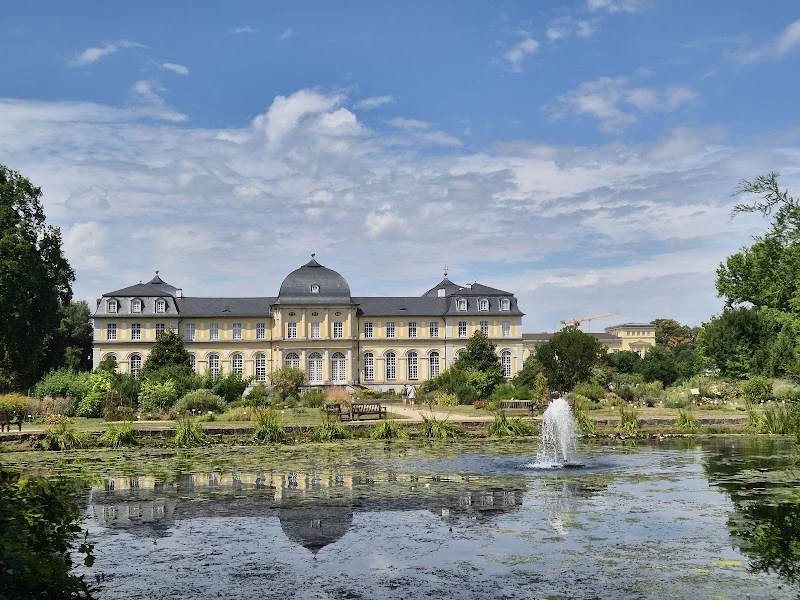
The heart of the Botanical Gardens is the diversity of its individual areas. The palace garden around Poppelsdorf Palace combines historical design and botanical presentation in a particularly harmonious way. Here, record trees meet floral splendor in every season, and even a simple bench by the pond quickly becomes a small nature experience. The greenhouses, on the other hand, open the view into another plant world: There, the fascinating flora of the tropics, subtropics, monsoon areas, and deserts can be discovered. This range makes the visit particularly interesting when the weather outside is rather cool or changeable, as indoors, guests encounter a completely different vegetation with special forms, colors, and living conditions. The vegetable garden at Katzenburgweg complements the ensemble with a completely different focus. Here, cabbage and turnips, grains and legumes, spices, citrus fruits, fragrant plants, and regional specialties stand side by side, showing how closely botanical diversity is linked to nutrition, everyday life, and culture. For many visitors, this contrast is particularly exciting: noble garden architecture on one side, useful and often familiar plants on the other. The Melbgarten is also part of the Botanical Gardens, but is generally not publicly accessible; in spring, it is opened for the open house day and comprises around three hectares according to the official description. Therefore, those looking for the most important highlights should at least plan to visit the palace garden, the greenhouses, and the vegetable garden. Together, they clearly show why this place is not only beautiful but also scientifically and didactically extraordinary. ([botgart.uni-bonn.de](https://www.botgart.uni-bonn.de/de/die-gaerten))
Melbgarten, Collections, and Plant Database
Another key to understanding the Bonn facility is the collections and special areas, as they give the garden its scientific depth. The university emphasizes that large plant collections have been established for research and teaching, and that the carnivorous plant collection is particularly worth seeing. The collections page also mentions further focuses, including titan arum species, carnivorous plants, flowering nettle plants, silver tree plants, geophytes of Europe and Asia Minor, as well as crops from around the world and from the region. This diversity shows that the garden is not only a presenting park but also a living research infrastructure. Particularly practical for guests is the plant database, through which one can check where each plant is located in the gardens. This makes orientation on-site easier and gives a second or third visit a new charm, as one can specifically search for certain species. The Melbgarten, on the other hand, complements the public areas with an outdoor facility that is generally not accessible and therefore has more the character of an extended research and collection space. In summary, this creates an image of a Botanical Garden that is not only a display area but also a workplace. This is particularly exciting for nature-interested visitors, as one can directly experience the connection between collection, documentation, and communication here. So, for those interested in plant photos, biodiversity, and special collections, Bonn offers not just decorative greenery but a place where botanical expertise is visibly nurtured and publicly communicated. ([botgart.uni-bonn.de](https://www.botgart.uni-bonn.de/))
History of the Botanical Gardens and Scientific Significance
The history of the Botanical Gardens of the University of Bonn dates back a long way and continues to shape the special atmosphere of the place today. The official garden history speaks of around 500 years of garden history. Already in the 16th century, there was a garden facility on the site at Poppelsdorf Palace; around 1650, a magnificent Renaissance park with pleasure and utility gardens, pergolas, and orangeries was created. The baroque garden from 1720 is still recognizable in its basic structure, and the design of the paths and beds recalls this time. With the founding of the university in 1818, the park was transformed into a scientific garden under the first director Christian Gottfried Daniel Nees von Esenbeck. This explains why the place is still so strongly associated with research and teaching today. Around 1900, according to the official history, Bonn had one of the most significant gardens of the Prussian state under the direction of Eduard Strasburger. The vegetable garden also has a clear development history: In 1847, the Royal Higher Agricultural School was established in Poppelsdorf near Bonn, whose experimental garden was considered a precursor; in 1867, a large economic-botanical garden was established on Meckenheimer Allee, integrated into the university in 1934, and merged with the palace garden into a central operating unit in 2002. The greenhouses built after World War II are unfortunately no longer accessible to visitors due to their poor condition. Taken together, this creates the image of a garden that is by no means just historical decor but embodies an institutional continuity over several centuries. Those who appreciate history, science, and garden culture equally will experience one of the most traditional botanical places in Germany here. ([botgart.uni-bonn.de](https://www.botgart.uni-bonn.de/de/ueber-uns/gartengeschichte))
Guided Tours, Events, and On-Site Services
The Botanical Gardens are not only for quiet strolling but also an active event venue. The official guided tours take place from April to October on Sundays and public holidays, usually at 3 PM; in July and August, they start at 11 AM. The duration is 60 minutes, and no registration is required for smaller groups, with the meeting point at the main entrance by the Nees Café. Additionally, there is a guided tour in English on the first Sunday of each month, making the gardens attractive for international guests and guests with English-speaking friends. In addition, the Green School organizes themed tours, such as on plant intelligence or winter colors in the Botanical Garden, and there are formats like the Botanical Lunch Break, where gardeners present their favorite plants. The event calendar is continuously updated and shows how lively the program is beyond mere sightseeing. On-site, there are also practical service points: The NEES Café & Restaurant is located directly at the main entrance, restrooms are available in the entrance area, and a barrier-free toilet is designated. The paths in the outdoor area are wheelchair accessible, but the greenhouses are not. Those who like to stay informed can also use the plant database or check the garden maps to find specific areas. Clear rules include that dogs and other animals are not allowed, larger picnics and barbecues are prohibited, and food and drink should only be brought in a way that allows for taking one's own trash back home. All these notes show: The visit is well organized, family-friendly, and still a place with clear protection and usage rules that benefit the collection and the plants. ([botgart.uni-bonn.de](https://www.botgart.uni-bonn.de/de/ihr-besuch/oeffentliche_fuehrungen?utm_source=openai))
Photos, Reviews, and Practical Tips for the Visit
Those looking for photos or reviews will find at the Botanical Gardens Bonn primarily one thing: a place that often appears even more impressive in reality than in pictures. The university itself provides numerous motifs and photo series and points out that private photos are welcome. However, for commercial or journalistic shots, prior consultation with the garden secretariat is required. This is particularly useful for social media posts, personal travel memories, or nature photography, as the palace garden, the greenhouses, and the vegetable garden provide very different motifs. The official plant database also helps to specifically find beautiful or rare plants instead of just wandering randomly through the facility. As a practical rule of thumb: Those who want to experience the greatest variety should choose a weekday, as admission is free then and the garden feels quieter. Those seeking the special atmosphere on weekends should factor in the ticket price and note that access is then through the main entrance at the palace square. It is also very helpful that the NEES Café & Restaurant is located directly at the entrance, allowing visitors to refresh themselves before or after the tour. For relaxed planning, comfortable clothing is recommended, as the outdoor paths invite longer stays. At the same time, it is worth paying attention to the garden rules: no animals, no vehicles on the premises, no larger picnics or barbecues, and consideration for the plants and paths. This way, a photo destination becomes a visit that remains truly pleasant and respectful. Therefore, those seeking reviews should understand the Botanical Gardens not only as a sight but as a well-established Bonn excursion destination with a scientific profile and a high number of visitors. ([botgart.uni-bonn.de](https://www.botgart.uni-bonn.de/en/your-visit/further-information))
Sources:
- Botanical Gardens of the University of Bonn - Official Website
- Botanical Gardens Bonn - Opening Hours and Admission
- Botanical Gardens Bonn - How to Find Us
- Botanical Gardens Bonn - Garden History
- Botanical Gardens Bonn - The Gardens
- Botanical Gardens Bonn - Further Information
- Botanical Gardens Bonn - Public Tours
Show moreShow less
Botanical Gardens of the University of Bonn | Tickets & Directions
The Botanical Gardens of the University of Bonn are much more than a classic excursion destination. Located in the city, next to the Poppelsdorf Palace and in direct proximity to the vegetable garden, they combine research, teaching, species conservation, and recreation into a garden ensemble that has shaped what makes Bonn a green university city for centuries. Visitors experience not only impressive plant collections here but also a place where scientific work becomes visible and ecological connections are immediately understandable. The university itself describes the gardens as its largest showcase, and with over 150,000 guests each year, this place is indeed a magnet for walks, educational visits, and quiet moments in nature. Around 10,000 plant species from 388 plant families clearly demonstrate the breadth of the collection and why a visit is worthwhile in every season. Those looking for photo opportunities, background knowledge, or practical information such as tickets and directions will find a garden that is historically, vibrantly, and modernly organized. ([botgart.uni-bonn.de](https://www.botgart.uni-bonn.de/de/ueber-uns))
Opening Hours, Admission, and Tickets
For planning a visit, the current opening hours are particularly important, as they differ between summer and winter as well as between weekdays and weekends. According to the current regulation, summer opening hours will apply again from April 1, 2026: The Botanical Garden at Poppelsdorf Palace and the vegetable garden at Katzenburgweg are open daily from 10 AM to 6 PM, and on Thursdays even until 8 PM; the greenhouses close 30 minutes earlier. From Monday to Friday, admission is free, making the garden attractive for a spontaneous walk during lunch breaks. On Saturdays, Sundays, and public holidays, an admission fee of 4 euros is charged for visiting the Botanical Garden at Poppelsdorf Palace, reduced to 2 euros. Children up to and including 12 years and members of the Friends' Circle receive free admission, and access on weekends is only possible through the main entrance at the palace square. Important for all those who prefer to travel cashless: The official admission page currently indicates that only cash payment is possible. The vegetable garden at Katzenburgweg 3, on the other hand, remains freely accessible at all times. In the winter season, reduced opening hours apply again from Monday to Friday from 10 AM to 4 PM; on weekends, public holidays, as well as on Christmas Eve and New Year's Eve, the garden remains closed. Therefore, those who cleverly combine tickets, admission, and opening hours can plan their visit either particularly cheaply during the week or with the full experience program on weekends. ([uni-bonn.de](https://www.uni-bonn.de/de/neues/058-2026))
Directions, Parking, and Public Transport
The Botanical Gardens are located so centrally in the Bonn city area that traveling without a car is almost always worthwhile. The Botanical Garden at Poppelsdorf Palace can be reached on foot from Bonn Central Station in about 15 minutes via Poppelsdorfer Allee. The official directions page lists the main address as the entrance at the palace square on Meckenheimer Allee 169; on weekdays, the side entrance at Meckenheimer Allee 171 can also be used. The vegetable garden has its main entrance at Katzenburgweg 3, a small side street near the palace garden. Those traveling by bus and train can reach the gardens with bus lines 601, 602, 603, and 631 and get off at the stops Botanical Garden or Beringstraße. This location is ideal for day visitors, families, and people who want to explore the nearby surroundings on foot, as the visit can be easily combined with a walk through Poppelsdorf. While driving is possible, the university explicitly points out that there are no parking spaces for guests and only a few public parking spaces are available in the vicinity. Therefore, it clearly recommends traveling by public transport. Additionally, it is important to note that bicycles, scooters, and other vehicles are not allowed in the gardens; however, bicycle racks are available in front of the entrances. For those needing barrier-free planning, there is the possibility of drop-off and pick-up with a car at the main entrances, but no designated disabled parking space is available. ([botgart.uni-bonn.de](https://www.botgart.uni-bonn.de/en/your-visit/how_to_find_us))
Palace Garden, Greenhouses, and Vegetable Garden
The heart of the Botanical Gardens is the diversity of its individual areas. The palace garden around Poppelsdorf Palace combines historical design and botanical presentation in a particularly harmonious way. Here, record trees meet floral splendor in every season, and even a simple bench by the pond quickly becomes a small nature experience. The greenhouses, on the other hand, open the view into another plant world: There, the fascinating flora of the tropics, subtropics, monsoon areas, and deserts can be discovered. This range makes the visit particularly interesting when the weather outside is rather cool or changeable, as indoors, guests encounter a completely different vegetation with special forms, colors, and living conditions. The vegetable garden at Katzenburgweg complements the ensemble with a completely different focus. Here, cabbage and turnips, grains and legumes, spices, citrus fruits, fragrant plants, and regional specialties stand side by side, showing how closely botanical diversity is linked to nutrition, everyday life, and culture. For many visitors, this contrast is particularly exciting: noble garden architecture on one side, useful and often familiar plants on the other. The Melbgarten is also part of the Botanical Gardens, but is generally not publicly accessible; in spring, it is opened for the open house day and comprises around three hectares according to the official description. Therefore, those looking for the most important highlights should at least plan to visit the palace garden, the greenhouses, and the vegetable garden. Together, they clearly show why this place is not only beautiful but also scientifically and didactically extraordinary. ([botgart.uni-bonn.de](https://www.botgart.uni-bonn.de/de/die-gaerten))
Melbgarten, Collections, and Plant Database
Another key to understanding the Bonn facility is the collections and special areas, as they give the garden its scientific depth. The university emphasizes that large plant collections have been established for research and teaching, and that the carnivorous plant collection is particularly worth seeing. The collections page also mentions further focuses, including titan arum species, carnivorous plants, flowering nettle plants, silver tree plants, geophytes of Europe and Asia Minor, as well as crops from around the world and from the region. This diversity shows that the garden is not only a presenting park but also a living research infrastructure. Particularly practical for guests is the plant database, through which one can check where each plant is located in the gardens. This makes orientation on-site easier and gives a second or third visit a new charm, as one can specifically search for certain species. The Melbgarten, on the other hand, complements the public areas with an outdoor facility that is generally not accessible and therefore has more the character of an extended research and collection space. In summary, this creates an image of a Botanical Garden that is not only a display area but also a workplace. This is particularly exciting for nature-interested visitors, as one can directly experience the connection between collection, documentation, and communication here. So, for those interested in plant photos, biodiversity, and special collections, Bonn offers not just decorative greenery but a place where botanical expertise is visibly nurtured and publicly communicated. ([botgart.uni-bonn.de](https://www.botgart.uni-bonn.de/))
History of the Botanical Gardens and Scientific Significance
The history of the Botanical Gardens of the University of Bonn dates back a long way and continues to shape the special atmosphere of the place today. The official garden history speaks of around 500 years of garden history. Already in the 16th century, there was a garden facility on the site at Poppelsdorf Palace; around 1650, a magnificent Renaissance park with pleasure and utility gardens, pergolas, and orangeries was created. The baroque garden from 1720 is still recognizable in its basic structure, and the design of the paths and beds recalls this time. With the founding of the university in 1818, the park was transformed into a scientific garden under the first director Christian Gottfried Daniel Nees von Esenbeck. This explains why the place is still so strongly associated with research and teaching today. Around 1900, according to the official history, Bonn had one of the most significant gardens of the Prussian state under the direction of Eduard Strasburger. The vegetable garden also has a clear development history: In 1847, the Royal Higher Agricultural School was established in Poppelsdorf near Bonn, whose experimental garden was considered a precursor; in 1867, a large economic-botanical garden was established on Meckenheimer Allee, integrated into the university in 1934, and merged with the palace garden into a central operating unit in 2002. The greenhouses built after World War II are unfortunately no longer accessible to visitors due to their poor condition. Taken together, this creates the image of a garden that is by no means just historical decor but embodies an institutional continuity over several centuries. Those who appreciate history, science, and garden culture equally will experience one of the most traditional botanical places in Germany here. ([botgart.uni-bonn.de](https://www.botgart.uni-bonn.de/de/ueber-uns/gartengeschichte))
Guided Tours, Events, and On-Site Services
The Botanical Gardens are not only for quiet strolling but also an active event venue. The official guided tours take place from April to October on Sundays and public holidays, usually at 3 PM; in July and August, they start at 11 AM. The duration is 60 minutes, and no registration is required for smaller groups, with the meeting point at the main entrance by the Nees Café. Additionally, there is a guided tour in English on the first Sunday of each month, making the gardens attractive for international guests and guests with English-speaking friends. In addition, the Green School organizes themed tours, such as on plant intelligence or winter colors in the Botanical Garden, and there are formats like the Botanical Lunch Break, where gardeners present their favorite plants. The event calendar is continuously updated and shows how lively the program is beyond mere sightseeing. On-site, there are also practical service points: The NEES Café & Restaurant is located directly at the main entrance, restrooms are available in the entrance area, and a barrier-free toilet is designated. The paths in the outdoor area are wheelchair accessible, but the greenhouses are not. Those who like to stay informed can also use the plant database or check the garden maps to find specific areas. Clear rules include that dogs and other animals are not allowed, larger picnics and barbecues are prohibited, and food and drink should only be brought in a way that allows for taking one's own trash back home. All these notes show: The visit is well organized, family-friendly, and still a place with clear protection and usage rules that benefit the collection and the plants. ([botgart.uni-bonn.de](https://www.botgart.uni-bonn.de/de/ihr-besuch/oeffentliche_fuehrungen?utm_source=openai))
Photos, Reviews, and Practical Tips for the Visit
Those looking for photos or reviews will find at the Botanical Gardens Bonn primarily one thing: a place that often appears even more impressive in reality than in pictures. The university itself provides numerous motifs and photo series and points out that private photos are welcome. However, for commercial or journalistic shots, prior consultation with the garden secretariat is required. This is particularly useful for social media posts, personal travel memories, or nature photography, as the palace garden, the greenhouses, and the vegetable garden provide very different motifs. The official plant database also helps to specifically find beautiful or rare plants instead of just wandering randomly through the facility. As a practical rule of thumb: Those who want to experience the greatest variety should choose a weekday, as admission is free then and the garden feels quieter. Those seeking the special atmosphere on weekends should factor in the ticket price and note that access is then through the main entrance at the palace square. It is also very helpful that the NEES Café & Restaurant is located directly at the entrance, allowing visitors to refresh themselves before or after the tour. For relaxed planning, comfortable clothing is recommended, as the outdoor paths invite longer stays. At the same time, it is worth paying attention to the garden rules: no animals, no vehicles on the premises, no larger picnics or barbecues, and consideration for the plants and paths. This way, a photo destination becomes a visit that remains truly pleasant and respectful. Therefore, those seeking reviews should understand the Botanical Gardens not only as a sight but as a well-established Bonn excursion destination with a scientific profile and a high number of visitors. ([botgart.uni-bonn.de](https://www.botgart.uni-bonn.de/en/your-visit/further-information))
Sources:
- Botanical Gardens of the University of Bonn - Official Website
- Botanical Gardens Bonn - Opening Hours and Admission
- Botanical Gardens Bonn - How to Find Us
- Botanical Gardens Bonn - Garden History
- Botanical Gardens Bonn - The Gardens
- Botanical Gardens Bonn - Further Information
- Botanical Gardens Bonn - Public Tours
Botanical Gardens of the University of Bonn | Tickets & Directions
The Botanical Gardens of the University of Bonn are much more than a classic excursion destination. Located in the city, next to the Poppelsdorf Palace and in direct proximity to the vegetable garden, they combine research, teaching, species conservation, and recreation into a garden ensemble that has shaped what makes Bonn a green university city for centuries. Visitors experience not only impressive plant collections here but also a place where scientific work becomes visible and ecological connections are immediately understandable. The university itself describes the gardens as its largest showcase, and with over 150,000 guests each year, this place is indeed a magnet for walks, educational visits, and quiet moments in nature. Around 10,000 plant species from 388 plant families clearly demonstrate the breadth of the collection and why a visit is worthwhile in every season. Those looking for photo opportunities, background knowledge, or practical information such as tickets and directions will find a garden that is historically, vibrantly, and modernly organized. ([botgart.uni-bonn.de](https://www.botgart.uni-bonn.de/de/ueber-uns))
Opening Hours, Admission, and Tickets
For planning a visit, the current opening hours are particularly important, as they differ between summer and winter as well as between weekdays and weekends. According to the current regulation, summer opening hours will apply again from April 1, 2026: The Botanical Garden at Poppelsdorf Palace and the vegetable garden at Katzenburgweg are open daily from 10 AM to 6 PM, and on Thursdays even until 8 PM; the greenhouses close 30 minutes earlier. From Monday to Friday, admission is free, making the garden attractive for a spontaneous walk during lunch breaks. On Saturdays, Sundays, and public holidays, an admission fee of 4 euros is charged for visiting the Botanical Garden at Poppelsdorf Palace, reduced to 2 euros. Children up to and including 12 years and members of the Friends' Circle receive free admission, and access on weekends is only possible through the main entrance at the palace square. Important for all those who prefer to travel cashless: The official admission page currently indicates that only cash payment is possible. The vegetable garden at Katzenburgweg 3, on the other hand, remains freely accessible at all times. In the winter season, reduced opening hours apply again from Monday to Friday from 10 AM to 4 PM; on weekends, public holidays, as well as on Christmas Eve and New Year's Eve, the garden remains closed. Therefore, those who cleverly combine tickets, admission, and opening hours can plan their visit either particularly cheaply during the week or with the full experience program on weekends. ([uni-bonn.de](https://www.uni-bonn.de/de/neues/058-2026))
Directions, Parking, and Public Transport
The Botanical Gardens are located so centrally in the Bonn city area that traveling without a car is almost always worthwhile. The Botanical Garden at Poppelsdorf Palace can be reached on foot from Bonn Central Station in about 15 minutes via Poppelsdorfer Allee. The official directions page lists the main address as the entrance at the palace square on Meckenheimer Allee 169; on weekdays, the side entrance at Meckenheimer Allee 171 can also be used. The vegetable garden has its main entrance at Katzenburgweg 3, a small side street near the palace garden. Those traveling by bus and train can reach the gardens with bus lines 601, 602, 603, and 631 and get off at the stops Botanical Garden or Beringstraße. This location is ideal for day visitors, families, and people who want to explore the nearby surroundings on foot, as the visit can be easily combined with a walk through Poppelsdorf. While driving is possible, the university explicitly points out that there are no parking spaces for guests and only a few public parking spaces are available in the vicinity. Therefore, it clearly recommends traveling by public transport. Additionally, it is important to note that bicycles, scooters, and other vehicles are not allowed in the gardens; however, bicycle racks are available in front of the entrances. For those needing barrier-free planning, there is the possibility of drop-off and pick-up with a car at the main entrances, but no designated disabled parking space is available. ([botgart.uni-bonn.de](https://www.botgart.uni-bonn.de/en/your-visit/how_to_find_us))
Palace Garden, Greenhouses, and Vegetable Garden
The heart of the Botanical Gardens is the diversity of its individual areas. The palace garden around Poppelsdorf Palace combines historical design and botanical presentation in a particularly harmonious way. Here, record trees meet floral splendor in every season, and even a simple bench by the pond quickly becomes a small nature experience. The greenhouses, on the other hand, open the view into another plant world: There, the fascinating flora of the tropics, subtropics, monsoon areas, and deserts can be discovered. This range makes the visit particularly interesting when the weather outside is rather cool or changeable, as indoors, guests encounter a completely different vegetation with special forms, colors, and living conditions. The vegetable garden at Katzenburgweg complements the ensemble with a completely different focus. Here, cabbage and turnips, grains and legumes, spices, citrus fruits, fragrant plants, and regional specialties stand side by side, showing how closely botanical diversity is linked to nutrition, everyday life, and culture. For many visitors, this contrast is particularly exciting: noble garden architecture on one side, useful and often familiar plants on the other. The Melbgarten is also part of the Botanical Gardens, but is generally not publicly accessible; in spring, it is opened for the open house day and comprises around three hectares according to the official description. Therefore, those looking for the most important highlights should at least plan to visit the palace garden, the greenhouses, and the vegetable garden. Together, they clearly show why this place is not only beautiful but also scientifically and didactically extraordinary. ([botgart.uni-bonn.de](https://www.botgart.uni-bonn.de/de/die-gaerten))
Melbgarten, Collections, and Plant Database
Another key to understanding the Bonn facility is the collections and special areas, as they give the garden its scientific depth. The university emphasizes that large plant collections have been established for research and teaching, and that the carnivorous plant collection is particularly worth seeing. The collections page also mentions further focuses, including titan arum species, carnivorous plants, flowering nettle plants, silver tree plants, geophytes of Europe and Asia Minor, as well as crops from around the world and from the region. This diversity shows that the garden is not only a presenting park but also a living research infrastructure. Particularly practical for guests is the plant database, through which one can check where each plant is located in the gardens. This makes orientation on-site easier and gives a second or third visit a new charm, as one can specifically search for certain species. The Melbgarten, on the other hand, complements the public areas with an outdoor facility that is generally not accessible and therefore has more the character of an extended research and collection space. In summary, this creates an image of a Botanical Garden that is not only a display area but also a workplace. This is particularly exciting for nature-interested visitors, as one can directly experience the connection between collection, documentation, and communication here. So, for those interested in plant photos, biodiversity, and special collections, Bonn offers not just decorative greenery but a place where botanical expertise is visibly nurtured and publicly communicated. ([botgart.uni-bonn.de](https://www.botgart.uni-bonn.de/))
History of the Botanical Gardens and Scientific Significance
The history of the Botanical Gardens of the University of Bonn dates back a long way and continues to shape the special atmosphere of the place today. The official garden history speaks of around 500 years of garden history. Already in the 16th century, there was a garden facility on the site at Poppelsdorf Palace; around 1650, a magnificent Renaissance park with pleasure and utility gardens, pergolas, and orangeries was created. The baroque garden from 1720 is still recognizable in its basic structure, and the design of the paths and beds recalls this time. With the founding of the university in 1818, the park was transformed into a scientific garden under the first director Christian Gottfried Daniel Nees von Esenbeck. This explains why the place is still so strongly associated with research and teaching today. Around 1900, according to the official history, Bonn had one of the most significant gardens of the Prussian state under the direction of Eduard Strasburger. The vegetable garden also has a clear development history: In 1847, the Royal Higher Agricultural School was established in Poppelsdorf near Bonn, whose experimental garden was considered a precursor; in 1867, a large economic-botanical garden was established on Meckenheimer Allee, integrated into the university in 1934, and merged with the palace garden into a central operating unit in 2002. The greenhouses built after World War II are unfortunately no longer accessible to visitors due to their poor condition. Taken together, this creates the image of a garden that is by no means just historical decor but embodies an institutional continuity over several centuries. Those who appreciate history, science, and garden culture equally will experience one of the most traditional botanical places in Germany here. ([botgart.uni-bonn.de](https://www.botgart.uni-bonn.de/de/ueber-uns/gartengeschichte))
Guided Tours, Events, and On-Site Services
The Botanical Gardens are not only for quiet strolling but also an active event venue. The official guided tours take place from April to October on Sundays and public holidays, usually at 3 PM; in July and August, they start at 11 AM. The duration is 60 minutes, and no registration is required for smaller groups, with the meeting point at the main entrance by the Nees Café. Additionally, there is a guided tour in English on the first Sunday of each month, making the gardens attractive for international guests and guests with English-speaking friends. In addition, the Green School organizes themed tours, such as on plant intelligence or winter colors in the Botanical Garden, and there are formats like the Botanical Lunch Break, where gardeners present their favorite plants. The event calendar is continuously updated and shows how lively the program is beyond mere sightseeing. On-site, there are also practical service points: The NEES Café & Restaurant is located directly at the main entrance, restrooms are available in the entrance area, and a barrier-free toilet is designated. The paths in the outdoor area are wheelchair accessible, but the greenhouses are not. Those who like to stay informed can also use the plant database or check the garden maps to find specific areas. Clear rules include that dogs and other animals are not allowed, larger picnics and barbecues are prohibited, and food and drink should only be brought in a way that allows for taking one's own trash back home. All these notes show: The visit is well organized, family-friendly, and still a place with clear protection and usage rules that benefit the collection and the plants. ([botgart.uni-bonn.de](https://www.botgart.uni-bonn.de/de/ihr-besuch/oeffentliche_fuehrungen?utm_source=openai))
Photos, Reviews, and Practical Tips for the Visit
Those looking for photos or reviews will find at the Botanical Gardens Bonn primarily one thing: a place that often appears even more impressive in reality than in pictures. The university itself provides numerous motifs and photo series and points out that private photos are welcome. However, for commercial or journalistic shots, prior consultation with the garden secretariat is required. This is particularly useful for social media posts, personal travel memories, or nature photography, as the palace garden, the greenhouses, and the vegetable garden provide very different motifs. The official plant database also helps to specifically find beautiful or rare plants instead of just wandering randomly through the facility. As a practical rule of thumb: Those who want to experience the greatest variety should choose a weekday, as admission is free then and the garden feels quieter. Those seeking the special atmosphere on weekends should factor in the ticket price and note that access is then through the main entrance at the palace square. It is also very helpful that the NEES Café & Restaurant is located directly at the entrance, allowing visitors to refresh themselves before or after the tour. For relaxed planning, comfortable clothing is recommended, as the outdoor paths invite longer stays. At the same time, it is worth paying attention to the garden rules: no animals, no vehicles on the premises, no larger picnics or barbecues, and consideration for the plants and paths. This way, a photo destination becomes a visit that remains truly pleasant and respectful. Therefore, those seeking reviews should understand the Botanical Gardens not only as a sight but as a well-established Bonn excursion destination with a scientific profile and a high number of visitors. ([botgart.uni-bonn.de](https://www.botgart.uni-bonn.de/en/your-visit/further-information))
Sources:
- Botanical Gardens of the University of Bonn - Official Website
- Botanical Gardens Bonn - Opening Hours and Admission
- Botanical Gardens Bonn - How to Find Us
- Botanical Gardens Bonn - Garden History
- Botanical Gardens Bonn - The Gardens
- Botanical Gardens Bonn - Further Information
- Botanical Gardens Bonn - Public Tours
Upcoming Events

International Study and Internship Fair SUPA 2026
Discover SUPA 2026! Learn more about international study and internship opportunities.

CAMPUS Garden & Festival
Bonn's campus becomes a summer stage: CAMPUS Garden & Festival 2026 brings music, culture, and open-air feeling to Poppelsdorf Campus. Admission free! #Bonn #Festival
Frequently Asked Questions
Reviews
MAnA M
7. September 2025
It’s a very huge park, with a castle and multiple ponds and various types of trees and plants. All the trees and plants are with labels and you can get yourself informed about them. There’s also a toilet free of charge, and also a restaurant. It’s an amazing place to visit on weekends with family and friends.
Kimberly S
23. June 2025
Very beautiful. Really enjoyed my time here. A lot of benches for anyone who needs to rest or just to sit and enjoy the nature around you in the outside gardens. The greenhouses were gorgeous to walk around in as well. Extremely wonderful for a lovely outing. Atmosphere just perfect.
collin berg
22. August 2025
A beautiful place especially the greenhouse and the ponds. And because the gardens are completely free to enter its easy to recommend this place. There is also a lovely cafe with delicious cake and friendly staff.
Kazem
22. August 2025
A very beautiful place to visit for people like me who loves to see variety of plants and tree species. And it is FREE to visit! I highly recommend. I will visit again soon :)
jill rowe
10. August 2025
Beautiful, peaceful gardens with some shady places to escape the sun. Fascinating trees and plants from all over the world. Amazing water lilies, ducks, turtles, geese and staff around to help if you have questions.
