
Bonn
Münsterpl., 53111 Bonn, Deutschland
Bonn Minster | Services & Opening Hours
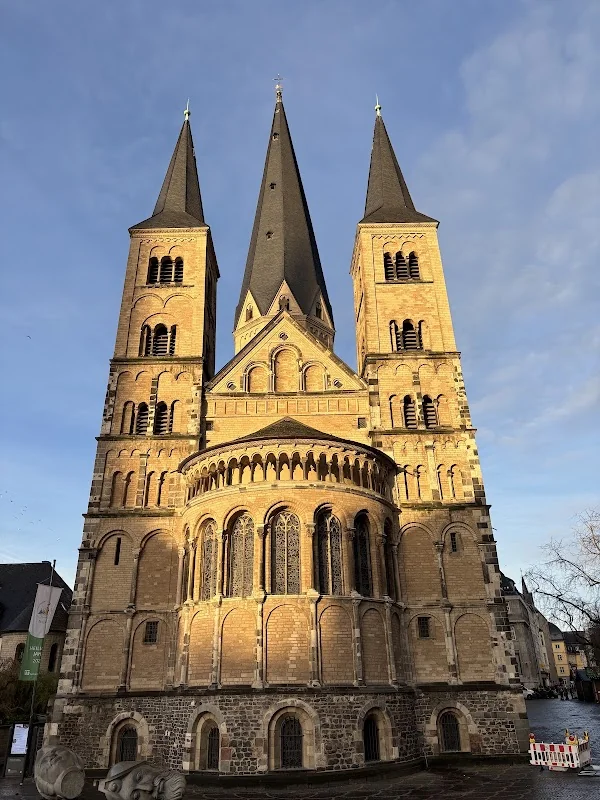
The Bonn Minster is one of the most significant places in the city of Bonn and is much more than just a historical building. In the heart of the city, at Münsterplatz, the five-towered minster basilica rises as a visible sign of centuries-old faith and city history. The official website describes the minster as one of the most important architectural ensembles of Romanesque style in Germany; at the same time, it is a place where liturgy, pilgrimage culture, music, and architecture remain closely connected to this day. Those searching for Bonn Minster services, Bonn Minster opening hours, Bonn Minster tours, or Bonn Minster organ will find here not just a mere sight, but a living house of worship with daily visiting options, clear times for masses and confessions, as well as a diverse program of tours and music. Particularly impressive is the contrast between quiet devotion and urban presence: Outside, Bonn pulses with life, while inside, the crypt, high choir, cloister, and the Romanesque rooms of nearly 1000 years of history open up. The minster is also closely linked to the patron saints of Bonn, Cassius and Florentius, whose veneration continues to shape the history of the place to this day. ([bonner-muenster.de](https://www.bonner-muenster.de/bonner-muenster/kunstfuehrer/index.html))
For visitors, pilgrims, and culture enthusiasts, the Bonn Minster is therefore relevant in many search situations: Those wanting to know if the Bonn Minster service is taking place today, when the Bonn Minster cloister is open, if there is a Bonn Minster livestream, or how to book a tour are not just looking for information, but a concrete plan for their visit. For this reason, the minster basilica offers a remarkably good structure. There are fixed service times, regular confession opportunities, public tours, group offers, themed tours, and a free audio guide with 35 stations available in German and English. Additionally, the proximity to Münsterplatz, the easily findable address, and the strong historical narrative distinguish the minster from many other churches in Germany. Those who take a closer look at the building quickly recognize why it is a landmark for Bonn: History is not displayed here in a museum-like manner, but is kept alive in the everyday life of an active church. ([bonner-muenster.de](https://www.bonner-muenster.de/gottesdienst-glaube/gottesdienste/index.html))
Services, Mass, Livestream, and Confession at Bonn Minster
The search for Bonn Minster services or Bonn Minster mass leads to the official service page of the basilica, and it becomes immediately clear: The Bonn Minster is a place with a clear liturgical order and a dense weekly rhythm. During the week, Holy Masses are regularly held in the crypt, high choir, and at the main altar; there are also fixed mass times on Saturdays and Sundays. Specifically, the official page states Monday to Friday at 8:00 AM in the crypt, 12:15 PM in the high choir, and 6:00 PM at the main altar. On Saturdays, mass is scheduled for 9:00 AM in the crypt and 6:00 PM at the main altar. On Sundays, mass is held at 12:00 PM at the main altar and at 6:00 PM in the high choir, with a special mass for young people in the calendar. Those looking up the Bonn Minster service today will find on the official page an up-to-date overview with individual intentions, notes, and possible deviations. This makes planning easy and simultaneously shows how vibrant the service culture in the minster has remained. ([bonner-muenster.de](https://www.bonner-muenster.de/gottesdienst-glaube/gottesdienste/index.html))
The search term Bonn Minster livestream is also popular for a reason, as the minster has already broadcast its services live on the internet several times. The official news page explicitly states that services are broadcast live on the internet; it also provides information about individual livestreams. For people who cannot be present on-site, this is particularly important, as the minster thus remains accessible beyond the city limits. The area of Bonn Minster confession is also relevant: The official confession times are Monday to Saturday between 4:30 PM and 5:30 PM at the confessionals. This means that the church is well-structured not only for attending mass but also for personal spiritual offerings. Additionally, the rosary prayer is held on several weekdays in the crypt, emphasizing the strong spiritual use of the space. For visitor planning, it is important that the website provides clear times and regularly updates them. Therefore, those looking for a quiet time, a mass, or a confession at Bonn Minster will find not vague hints, but reliable, officially communicated information. ([bonner-muenster.de](https://www.bonner-muenster.de/gottesdienst-glaube/gottesdienste/index.html))
Opening Hours of the Basilica and Cloister
The search cluster Bonn Minster opening hours and Bonn Minster cloister opening hours is particularly practical, as it answers the most important question for many visitors: When can one actually enter the building? The official contact and opening page clearly states that the Bonn Minster is open for visitors daily. The minster basilica is open Monday to Friday from 7:30 AM to 7:00 PM, Saturdays from 8:30 AM to 7:00 PM, and Sundays and public holidays from 11:00 AM to 7:00 PM. The cloister has its own hours: Monday to Saturday from 10:00 AM to 5:00 PM and Sundays and public holidays from 2:00 PM to 5:00 PM. For visitors, this means: If one wants to experience the minster in peace, they should think of the times for the basilica and cloister separately, as not every area is accessible at the same time. This is typical for an active church with liturgical daily life and at the same time a listed building. It is also particularly important to note that visits during services and confession times are not possible. This is not only relevant organizationally but also explains the respectful handling of the sacred character of the place. ([bonner-muenster.de](https://www.bonner-muenster.de/kontakt/kontakt-und-oeffnungszeiten/index.html?utm_source=openai))
The cloister itself is a major attraction and a central reason why many people specifically search for Bonn Minster cloister. It is officially described as a particularly popular place in summer; access is via Gerhard-von-Are-Straße. A recent announcement also highlights that the cloister of Bonn Minster was built around 1140 under Provost Gerhard von Are with the two-story canonical buildings and is considered a Romanesque atrium that is particularly well-preserved north of the Alps. The oldest parts date back to the 11th century, with arcades and chapter houses added in the east later. Visitors interested in Bonn Minster photos will find one of the strongest visual impacts of the entire ensemble here: Stone, shadow, plant beds, and the calm geometry of the cloister create an atmosphere that is simultaneously monastic, urban, and timeless. Therefore, those exploring the minster on their own should plan their visit times so that both the interior and the cloister receive sufficient attention. Because it is here that Bonn Minster unfolds its character as a space of silence and prayer, not just as a sight on a to-do list. ([bonner-muenster.de](https://www.bonner-muenster.de/aktuell/news/Raum-der-Stille-und-des-Gebets-an-fuenf-Freitagabenden-bis-22-Uhr-geoeffnet/))
Tours, Tickets, and Audio Guide
The search term Bonn Minster tour clearly shows that the minster is not only to be visited but understood. The official tour page offers public tours, group tours, and themed tours. The claim is clear: Those who want to see the building not just superficially but grasp its historical and spiritual depth have different formats to choose from. Public tours invite visitors to discover the Bonn Minster basilica together. Group tours allow for individual appointments, and themed tours are aimed at those who wish to go beyond a general overview. The website announces current dates and tickets in the online shop; additionally, tickets are available through BonnTicket and well-known advance booking points. There is also an annual program for tours and walks available for download, which significantly facilitates planning for individual visitors, groups, and pilgrims. This answers many of the search queries that arise around Bonn Minster photos, Bonn Minster Wikipedia, or Bonn Minster tours: Those who really want to know what makes the building special will hardly miss a tour. ([bonner-muenster.de](https://www.bonner-muenster.de/fuehrungen/start/index.html))
A second, very modern approach is the free audio guide, which has been available since May 1, 2024. It allows visitors to explore Bonn Minster on their own using their smartphones. Officially, it includes 35 stations and is available in German and English. Thematically, it covers artworks, the large Klais organ, and the Romanesque cloister as well as the roughly 1000-year history of the minster church. The audio guide can be downloaded for free; flyers with QR codes are available in the basilica. This is particularly practical for visitors, as the classic guided tour and self-directed exploration complement each other effectively. Those with little time can target central stations specifically. Those with more time can discover the minster at their own pace and hear the background information directly on-site. This adds a digital, flexible layer to the search for Bonn Minster tours, which works particularly well in a city center location with many spontaneous visitors. ([bonner-muenster.de](https://www.bonner-muenster.de/bonner-muenster/audioguide/))
The Great Klais Organ and Music at Bonn Minster
The search term Bonn Minster organ refers to one of the most impressive chapters in the history of the minster. The official organ page states that the first sounds echoed through the church around the year 1230, making Bonn Minster one of the first organ installations in Germany. Over the centuries, the organ changed its location and form multiple times. Today, the large Klais organ is particularly prominent, having been thoroughly cleaned and tonally optimized after its general renovation. According to the website, it has more than 5000 pipes, 70 registers, and 4 manuals and pedals. This makes it significant not only for liturgy but also for concert formats. This is where one of the great attractions of Bonn Minster lies: The space is not only a sacred monument but also a musical resonating body. Those who visit the church thus experience not just architecture but sound in a historical setting. This explains why the organ is a major attraction for many seekers. ([bonner-muenster.de](https://www.bonner-muenster.de/musik/muenster-orgel/))
The organ in Bonn Minster is not just an instrument but a narrative space. The current prospect with figures by Manfred Saul connects technology, art, and symbolism. The website explicitly describes the fascination of the instrument as both acoustic and visual. The local history of the organs is also remarkable: After the early installations of the Middle Ages, there were modifications, new constructions, and destructions before the current organ was inaugurated in 1961. It was expanded and re-tuned in 1982, and thoroughly revised again in 2021/22. Those searching for Bonn Minster height will also come across another impressive figure in this context: The crossing tower is described as being 80 meters tall. The Klais organ and the tall tower together convey very well why the minster is perceived as a prominent place in Bonn from afar. For music lovers, the combination of liturgical use, concert aspirations, and technical precision is particularly appealing. Thus, a classic church organ creates a strong profile that can be seen and heard far beyond Bonn. ([bonner-muenster.de](https://www.bonner-muenster.de/musik/muenster-orgel/))
History, City Patrons, and Romanesque Architecture
The history of Bonn Minster extends far beyond the Middle Ages and explains why the place still has such a strong impact today. The official chronicle mentions Roman burials and pagan cult sites around 90, a necropolis around 250, a cella memoriae around 300, and the construction of a hall church around 575. Later, a monastic-like community developed before a new construction of the collegiate church, cloister, and collegiate buildings occurred around 1050. The years 1140, 1153, 1166, 1220, and 1240 mark further significant construction and consecration phases, including the expansion of the east choir, the elevation of the relics of the city patrons, and the completion of the new building with a north portal and raised towers. For visitors, this timeline is not just dry historical knowledge but the key to understanding the current building. Bonn Minster is not a single construction act but an ensemble that has grown over many centuries, whose layers remain visible to this day. ([bonner-muenster.de](https://www.bonner-muenster.de/bonner-muenster/historie/index.html))
Particularly important for the self-understanding of the minster are the city patrons of Bonn, Cassius and Florentius. The official city patron page explains that they suffered martyrdom as Christian soldiers at the end of the 3rd century and that their veneration has played a central role in Bonn since early Christianity. Saint Helena is also closely associated with the place; she is credited with important foundations in the Rhineland, and the Cassius Monastery received relics from her in 1135. Such references explain why the minster is considered the burial church of the city patrons and why pilgrims have found a spiritual anchor point there for centuries. The modern history is also well documented: In 1956, Bonn Minster received the honorary title of papal Basilica minor. This not only means a canonical distinction but also the official recognition of its special rank within the Catholic Church. The cloister itself is another historical highlight: it is considered to be around 900 years old and is the most completely preserved Romanesque cloister north of the Alps. Together with the five-towered minster, it forms one of the most significant Romanesque architectural ensembles in Germany. Those who want to experience history, architecture, and faith in one place will find here a particularly dense and credible example of how city history and sacred history intertwine. ([bonner-muenster.de](https://www.bonner-muenster.de/bonner-muenster/stadtpatrone/index.html?utm_source=openai))
Münsterplatz, Photos, and Practical Tips for Visiting
The search term Bonn Minster square is practically as important as the historical themes, as many visitors want to locate the minster within the urban space. The official address is Gerhard-von-Are-Straße 5, 53111 Bonn, and the church is situated in the middle of Bonn's city center. This makes it very easy to incorporate into a city stroll, a pilgrimage route, or a cultural walk. Those searching for Bonn Minster photos will quickly notice that the location at Münsterplatz provides strong exterior views: The building is urban, monumental, and simultaneously surrounded by calm sightlines. Particularly the five-towered structure, the cloister, and the transition to Gerhard-von-Are-Straße offer motifs that make the various levels of the minster visible. At the same time, it is worthwhile not only to photograph the exterior view but also to capture the atmosphere inside, as long as visiting times and liturgical processes allow it. The building thrives on this interplay between urban openness and sacred gathering. For people planning a visit, it is also helpful that the minster is well organized as a pilgrimage site and that a guest service or pastoral office is available. There, among other things, a pilgrim's passport and pilgrim stamp are provided. ([bonner-muenster.de](https://www.bonner-muenster.de/kontakt/kontakt-und-oeffnungszeiten/index.html?utm_source=openai))
A good visiting tip is to not only view the minster as a single destination but to plan with time for details. Those who take a quiet look at the crypt, high choir, cloister, organ, and historical traces will quickly understand why the church generates so many different search queries: Bonn Minster photos, Bonn Minster height, Bonn Minster cloister opening hours, or Bonn Minster confession are not side topics but expressions of a place that fulfills many needs simultaneously. For a successful visit, it is therefore worthwhile to check the current opening hours, the service page, and the tour offerings. Particularly the combination of daily accessibility, clear liturgical times, and a good information offering makes the visit planable. Those who want to delve deeper into the minster should also use the audio guide, as it makes the history of the place accessible in 35 stations and significantly deepens the tour. Thus, a spontaneous stop at Münsterplatz becomes a visit that not only provides beautiful pictures but also a genuine understanding of Bonn, its city patrons, and its Romanesque architectural culture. ([bonner-muenster.de](https://www.bonner-muenster.de/bonner-muenster/audioguide/))
Sources:
Mehr anzeigenWeniger anzeigen
Bonn Minster | Services & Opening Hours
The Bonn Minster is one of the most significant places in the city of Bonn and is much more than just a historical building. In the heart of the city, at Münsterplatz, the five-towered minster basilica rises as a visible sign of centuries-old faith and city history. The official website describes the minster as one of the most important architectural ensembles of Romanesque style in Germany; at the same time, it is a place where liturgy, pilgrimage culture, music, and architecture remain closely connected to this day. Those searching for Bonn Minster services, Bonn Minster opening hours, Bonn Minster tours, or Bonn Minster organ will find here not just a mere sight, but a living house of worship with daily visiting options, clear times for masses and confessions, as well as a diverse program of tours and music. Particularly impressive is the contrast between quiet devotion and urban presence: Outside, Bonn pulses with life, while inside, the crypt, high choir, cloister, and the Romanesque rooms of nearly 1000 years of history open up. The minster is also closely linked to the patron saints of Bonn, Cassius and Florentius, whose veneration continues to shape the history of the place to this day. ([bonner-muenster.de](https://www.bonner-muenster.de/bonner-muenster/kunstfuehrer/index.html))
For visitors, pilgrims, and culture enthusiasts, the Bonn Minster is therefore relevant in many search situations: Those wanting to know if the Bonn Minster service is taking place today, when the Bonn Minster cloister is open, if there is a Bonn Minster livestream, or how to book a tour are not just looking for information, but a concrete plan for their visit. For this reason, the minster basilica offers a remarkably good structure. There are fixed service times, regular confession opportunities, public tours, group offers, themed tours, and a free audio guide with 35 stations available in German and English. Additionally, the proximity to Münsterplatz, the easily findable address, and the strong historical narrative distinguish the minster from many other churches in Germany. Those who take a closer look at the building quickly recognize why it is a landmark for Bonn: History is not displayed here in a museum-like manner, but is kept alive in the everyday life of an active church. ([bonner-muenster.de](https://www.bonner-muenster.de/gottesdienst-glaube/gottesdienste/index.html))
Services, Mass, Livestream, and Confession at Bonn Minster
The search for Bonn Minster services or Bonn Minster mass leads to the official service page of the basilica, and it becomes immediately clear: The Bonn Minster is a place with a clear liturgical order and a dense weekly rhythm. During the week, Holy Masses are regularly held in the crypt, high choir, and at the main altar; there are also fixed mass times on Saturdays and Sundays. Specifically, the official page states Monday to Friday at 8:00 AM in the crypt, 12:15 PM in the high choir, and 6:00 PM at the main altar. On Saturdays, mass is scheduled for 9:00 AM in the crypt and 6:00 PM at the main altar. On Sundays, mass is held at 12:00 PM at the main altar and at 6:00 PM in the high choir, with a special mass for young people in the calendar. Those looking up the Bonn Minster service today will find on the official page an up-to-date overview with individual intentions, notes, and possible deviations. This makes planning easy and simultaneously shows how vibrant the service culture in the minster has remained. ([bonner-muenster.de](https://www.bonner-muenster.de/gottesdienst-glaube/gottesdienste/index.html))
The search term Bonn Minster livestream is also popular for a reason, as the minster has already broadcast its services live on the internet several times. The official news page explicitly states that services are broadcast live on the internet; it also provides information about individual livestreams. For people who cannot be present on-site, this is particularly important, as the minster thus remains accessible beyond the city limits. The area of Bonn Minster confession is also relevant: The official confession times are Monday to Saturday between 4:30 PM and 5:30 PM at the confessionals. This means that the church is well-structured not only for attending mass but also for personal spiritual offerings. Additionally, the rosary prayer is held on several weekdays in the crypt, emphasizing the strong spiritual use of the space. For visitor planning, it is important that the website provides clear times and regularly updates them. Therefore, those looking for a quiet time, a mass, or a confession at Bonn Minster will find not vague hints, but reliable, officially communicated information. ([bonner-muenster.de](https://www.bonner-muenster.de/gottesdienst-glaube/gottesdienste/index.html))
Opening Hours of the Basilica and Cloister
The search cluster Bonn Minster opening hours and Bonn Minster cloister opening hours is particularly practical, as it answers the most important question for many visitors: When can one actually enter the building? The official contact and opening page clearly states that the Bonn Minster is open for visitors daily. The minster basilica is open Monday to Friday from 7:30 AM to 7:00 PM, Saturdays from 8:30 AM to 7:00 PM, and Sundays and public holidays from 11:00 AM to 7:00 PM. The cloister has its own hours: Monday to Saturday from 10:00 AM to 5:00 PM and Sundays and public holidays from 2:00 PM to 5:00 PM. For visitors, this means: If one wants to experience the minster in peace, they should think of the times for the basilica and cloister separately, as not every area is accessible at the same time. This is typical for an active church with liturgical daily life and at the same time a listed building. It is also particularly important to note that visits during services and confession times are not possible. This is not only relevant organizationally but also explains the respectful handling of the sacred character of the place. ([bonner-muenster.de](https://www.bonner-muenster.de/kontakt/kontakt-und-oeffnungszeiten/index.html?utm_source=openai))
The cloister itself is a major attraction and a central reason why many people specifically search for Bonn Minster cloister. It is officially described as a particularly popular place in summer; access is via Gerhard-von-Are-Straße. A recent announcement also highlights that the cloister of Bonn Minster was built around 1140 under Provost Gerhard von Are with the two-story canonical buildings and is considered a Romanesque atrium that is particularly well-preserved north of the Alps. The oldest parts date back to the 11th century, with arcades and chapter houses added in the east later. Visitors interested in Bonn Minster photos will find one of the strongest visual impacts of the entire ensemble here: Stone, shadow, plant beds, and the calm geometry of the cloister create an atmosphere that is simultaneously monastic, urban, and timeless. Therefore, those exploring the minster on their own should plan their visit times so that both the interior and the cloister receive sufficient attention. Because it is here that Bonn Minster unfolds its character as a space of silence and prayer, not just as a sight on a to-do list. ([bonner-muenster.de](https://www.bonner-muenster.de/aktuell/news/Raum-der-Stille-und-des-Gebets-an-fuenf-Freitagabenden-bis-22-Uhr-geoeffnet/))
Tours, Tickets, and Audio Guide
The search term Bonn Minster tour clearly shows that the minster is not only to be visited but understood. The official tour page offers public tours, group tours, and themed tours. The claim is clear: Those who want to see the building not just superficially but grasp its historical and spiritual depth have different formats to choose from. Public tours invite visitors to discover the Bonn Minster basilica together. Group tours allow for individual appointments, and themed tours are aimed at those who wish to go beyond a general overview. The website announces current dates and tickets in the online shop; additionally, tickets are available through BonnTicket and well-known advance booking points. There is also an annual program for tours and walks available for download, which significantly facilitates planning for individual visitors, groups, and pilgrims. This answers many of the search queries that arise around Bonn Minster photos, Bonn Minster Wikipedia, or Bonn Minster tours: Those who really want to know what makes the building special will hardly miss a tour. ([bonner-muenster.de](https://www.bonner-muenster.de/fuehrungen/start/index.html))
A second, very modern approach is the free audio guide, which has been available since May 1, 2024. It allows visitors to explore Bonn Minster on their own using their smartphones. Officially, it includes 35 stations and is available in German and English. Thematically, it covers artworks, the large Klais organ, and the Romanesque cloister as well as the roughly 1000-year history of the minster church. The audio guide can be downloaded for free; flyers with QR codes are available in the basilica. This is particularly practical for visitors, as the classic guided tour and self-directed exploration complement each other effectively. Those with little time can target central stations specifically. Those with more time can discover the minster at their own pace and hear the background information directly on-site. This adds a digital, flexible layer to the search for Bonn Minster tours, which works particularly well in a city center location with many spontaneous visitors. ([bonner-muenster.de](https://www.bonner-muenster.de/bonner-muenster/audioguide/))
The Great Klais Organ and Music at Bonn Minster
The search term Bonn Minster organ refers to one of the most impressive chapters in the history of the minster. The official organ page states that the first sounds echoed through the church around the year 1230, making Bonn Minster one of the first organ installations in Germany. Over the centuries, the organ changed its location and form multiple times. Today, the large Klais organ is particularly prominent, having been thoroughly cleaned and tonally optimized after its general renovation. According to the website, it has more than 5000 pipes, 70 registers, and 4 manuals and pedals. This makes it significant not only for liturgy but also for concert formats. This is where one of the great attractions of Bonn Minster lies: The space is not only a sacred monument but also a musical resonating body. Those who visit the church thus experience not just architecture but sound in a historical setting. This explains why the organ is a major attraction for many seekers. ([bonner-muenster.de](https://www.bonner-muenster.de/musik/muenster-orgel/))
The organ in Bonn Minster is not just an instrument but a narrative space. The current prospect with figures by Manfred Saul connects technology, art, and symbolism. The website explicitly describes the fascination of the instrument as both acoustic and visual. The local history of the organs is also remarkable: After the early installations of the Middle Ages, there were modifications, new constructions, and destructions before the current organ was inaugurated in 1961. It was expanded and re-tuned in 1982, and thoroughly revised again in 2021/22. Those searching for Bonn Minster height will also come across another impressive figure in this context: The crossing tower is described as being 80 meters tall. The Klais organ and the tall tower together convey very well why the minster is perceived as a prominent place in Bonn from afar. For music lovers, the combination of liturgical use, concert aspirations, and technical precision is particularly appealing. Thus, a classic church organ creates a strong profile that can be seen and heard far beyond Bonn. ([bonner-muenster.de](https://www.bonner-muenster.de/musik/muenster-orgel/))
History, City Patrons, and Romanesque Architecture
The history of Bonn Minster extends far beyond the Middle Ages and explains why the place still has such a strong impact today. The official chronicle mentions Roman burials and pagan cult sites around 90, a necropolis around 250, a cella memoriae around 300, and the construction of a hall church around 575. Later, a monastic-like community developed before a new construction of the collegiate church, cloister, and collegiate buildings occurred around 1050. The years 1140, 1153, 1166, 1220, and 1240 mark further significant construction and consecration phases, including the expansion of the east choir, the elevation of the relics of the city patrons, and the completion of the new building with a north portal and raised towers. For visitors, this timeline is not just dry historical knowledge but the key to understanding the current building. Bonn Minster is not a single construction act but an ensemble that has grown over many centuries, whose layers remain visible to this day. ([bonner-muenster.de](https://www.bonner-muenster.de/bonner-muenster/historie/index.html))
Particularly important for the self-understanding of the minster are the city patrons of Bonn, Cassius and Florentius. The official city patron page explains that they suffered martyrdom as Christian soldiers at the end of the 3rd century and that their veneration has played a central role in Bonn since early Christianity. Saint Helena is also closely associated with the place; she is credited with important foundations in the Rhineland, and the Cassius Monastery received relics from her in 1135. Such references explain why the minster is considered the burial church of the city patrons and why pilgrims have found a spiritual anchor point there for centuries. The modern history is also well documented: In 1956, Bonn Minster received the honorary title of papal Basilica minor. This not only means a canonical distinction but also the official recognition of its special rank within the Catholic Church. The cloister itself is another historical highlight: it is considered to be around 900 years old and is the most completely preserved Romanesque cloister north of the Alps. Together with the five-towered minster, it forms one of the most significant Romanesque architectural ensembles in Germany. Those who want to experience history, architecture, and faith in one place will find here a particularly dense and credible example of how city history and sacred history intertwine. ([bonner-muenster.de](https://www.bonner-muenster.de/bonner-muenster/stadtpatrone/index.html?utm_source=openai))
Münsterplatz, Photos, and Practical Tips for Visiting
The search term Bonn Minster square is practically as important as the historical themes, as many visitors want to locate the minster within the urban space. The official address is Gerhard-von-Are-Straße 5, 53111 Bonn, and the church is situated in the middle of Bonn's city center. This makes it very easy to incorporate into a city stroll, a pilgrimage route, or a cultural walk. Those searching for Bonn Minster photos will quickly notice that the location at Münsterplatz provides strong exterior views: The building is urban, monumental, and simultaneously surrounded by calm sightlines. Particularly the five-towered structure, the cloister, and the transition to Gerhard-von-Are-Straße offer motifs that make the various levels of the minster visible. At the same time, it is worthwhile not only to photograph the exterior view but also to capture the atmosphere inside, as long as visiting times and liturgical processes allow it. The building thrives on this interplay between urban openness and sacred gathering. For people planning a visit, it is also helpful that the minster is well organized as a pilgrimage site and that a guest service or pastoral office is available. There, among other things, a pilgrim's passport and pilgrim stamp are provided. ([bonner-muenster.de](https://www.bonner-muenster.de/kontakt/kontakt-und-oeffnungszeiten/index.html?utm_source=openai))
A good visiting tip is to not only view the minster as a single destination but to plan with time for details. Those who take a quiet look at the crypt, high choir, cloister, organ, and historical traces will quickly understand why the church generates so many different search queries: Bonn Minster photos, Bonn Minster height, Bonn Minster cloister opening hours, or Bonn Minster confession are not side topics but expressions of a place that fulfills many needs simultaneously. For a successful visit, it is therefore worthwhile to check the current opening hours, the service page, and the tour offerings. Particularly the combination of daily accessibility, clear liturgical times, and a good information offering makes the visit planable. Those who want to delve deeper into the minster should also use the audio guide, as it makes the history of the place accessible in 35 stations and significantly deepens the tour. Thus, a spontaneous stop at Münsterplatz becomes a visit that not only provides beautiful pictures but also a genuine understanding of Bonn, its city patrons, and its Romanesque architectural culture. ([bonner-muenster.de](https://www.bonner-muenster.de/bonner-muenster/audioguide/))
Sources:

Frequently Asked Questions
Reviews
Eswiss64
10. July 2026
I am impressed by the church interior. It might be less opulent compared to other churches, but it is refined and one feels at peace. Highly recommended for a visit when you are in the neighborhood.
faye
15. February 2026
A beautiful church inside and outside. The levels of detail are incredible. The inside is magnificent and leaves you in awe. The pipe organ is stunning.
maryam kazemi
16. March 2026
A stunning historic church in the center of Bonn. The architecture is beautiful and the atmosphere inside is calm and inspiring.
Benjamin Mwangi
10. September 2025
Right in the heart of Bonn, this magnificent church is worth paying a visit. The intricate Romanesque design is a fun-filled adventure to explore. The church is still utilized to this day. I recommend going early to avoid crowds.
Cihan E.
18. November 2025
This impressive basilica in the center of Bonn is definitely among the must-see stops in the city. From the outside, it looks simple yet elegant, but once you step inside, it becomes much more impressive with its stained glass windows, columns, and ceiling decorations. In particular, the dim and peaceful prayer area (crypt) downstairs, with its candlelight and quiet atmosphere, is one of the most special parts of the building and really deserves some extra time.