
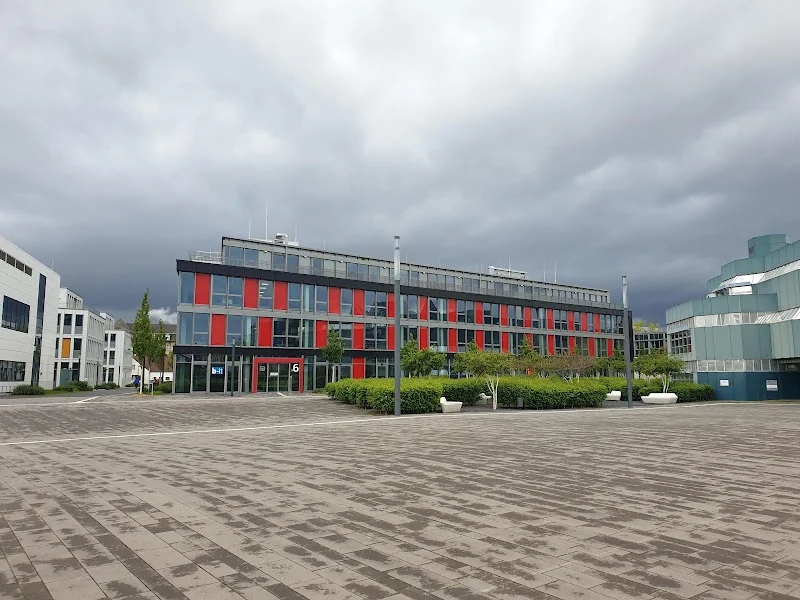
Bonn
Friedrich-Hirzebruch-Allee 6, 53115 Bonn, Deutschland
Bonn-Aachen IT Center (b-it) | Events & Tickets
The Bonn-Aachen International Center for Information Technology, short b-it, is much more than just a scientific address in Bonn. Official annual reports describe the center as an international hub for IT education, research, and networking, which has pursued a clear mission since its founding in 2003. Even the early annual report 2002/2003 presented the b-it as a pilot project for the internationalization and acceleration of IT degree programs, thus as a place where academic quality, international orientation, and practical relevance come together. That is exactly why visitors today are not just looking for an address, but for events, programs, tickets, directions, and rooms. The b-it fulfills these search intentions in a special way: it is not a classic event hall, but a university location where teaching, research, and public professional events intertwine. Current and recurring formats include summer schools, lectures, seminars, and scientific series such as crypt@b-it. Additionally, the location is closely linked with study programs such as Life Science Informatics, Media Informatics, and Autonomous Systems, which makes the profile of the house very tangible for external visitors. ([bit.uni-bonn.de](https://www.bit.uni-bonn.de/fileadmin/user_upload/Downloads/AnnualReports/Annual_Report_2014_2015.pdf?utm_source=openai))
For those searching for an event location in Bonn, the b-it is particularly interesting because it offers a rare mix of academic seriousness and concrete usability. Those interested in a program will encounter clear annual and thematic structures; those looking for tickets often end up with registration, application, or deadlines instead of a classic advance sale; and those wanting to know how to get there will find very precise directions. The official site describes the location as about three kilometers south of Bonn's center, near the Rhine, and especially recommends arriving by public transport to Heussallee/Museumsmeile. The pages on courses and events also feature rooms such as Rheinsaal, b-it-max, and numbered seminar rooms, indicating that the building is used for various sizes of formats. This combination of research campus, event venue, and teaching facility makes the b-it a location that one should know in Bonn when looking for informative, technical, and easily accessible event infrastructure. ([cosec.bit.uni-bonn.de](https://cosec.bit.uni-bonn.de/citylife/travel/?utm_source=openai))
Events and Programs at b-it
Those searching for events at b-it encounter a very characteristic profile: the center is strongly scientifically oriented and organizes its public and semi-public formats not like a theater or multipurpose hall, but like an academic house with thematic series, annual archives, and clearly named lectures. A good example is the official crypt@b-it series, which lists years like 2026, 2024, 2022, 2018, 2016, 2014, and 2013 on its own overview page. There, the invited speakers, topics, and the location of each edition are documented. The fact that the series has existed for many years is important for seekers: it signals continuity, quality, and a genuine substantive rooting in the house. While the 2022 edition took place directly at b-it in Bonn, later entries also show collaborations with other universities and locations. This is typical for the b-it: the event is often part of a larger scientific network, but the Bonn house remains substantively and organizationally visible. ([cryptabit.bit.uni-bonn.de](https://cryptabit.bit.uni-bonn.de/series?utm_source=openai))
Older official pages also confirm that the b-it has served as a venue for scientific events and professional communication for years. The Crypto-Day was organized there as a scientific meeting with lectures, discussions, and networking opportunities for early-career researchers. Numerous courses aimed at students of computer science, mathematics, and related fields also appear on the teaching and seminar pages, indicating that the search term events at b-it often refers not just to a single event, but to a whole range of summer schools, courses, seminars, lecture series, and conferences. For content and SEO, this diversity is crucial because users usually search for the current program, topics like Cryptography, Computer Security, or Computer Science, and specific dates. The b-it provides all this in a structure that combines scientific depth with clear scheduling logic. ([cosec.bit.uni-bonn.de](https://cosec.bit.uni-bonn.de/students/events/kryptotag24/?utm_source=openai))
Another important point for the event profile is the language of the programs. Many b-it events are internationally oriented and therefore documented or conducted in English. This is particularly evident on the crypt@b-it pages, where speakers, institutions, and topics are presented in an international academic format. For visitors, this means: the b-it is not a place for arbitrary public events, but a location where content, professional audience, and scientific quality take center stage. Therefore, those searching for a program usually want to know which lectures or summer school sessions are currently scheduled, whether participation is only possible with registration, and which rooms or building sections are designated for this purpose. Exactly this information is often published on the official pages semester or year-related. This makes the b-it particularly attractive for an audience that wants not only to be informed but also to further their expertise or network with researchers. ([cryptabit.bit.uni-bonn.de](https://cryptabit.bit.uni-bonn.de/series?utm_source=openai))
Tickets, Registration, and Participation
The keyword tickets will be understood somewhat differently at b-it than at a classic cultural or concert venue. The official pages show that many formats at b-it operate through registration, application, or deadlines. For example, at crypt@b-it 2026, it explicitly states that one should wait to pay for a scholarship application until the scholarship decision has been made. Previous Crypto-Day and Kryptotag pages mention specific registration deadlines and participation guidelines for early-career researchers. This suggests that the relevant user intent for tickets in this context often does not refer to the purchase of an admission ticket, but to access to the event, meaning a formal participation confirmation or registration. This is important for SEO planning: those searching for tickets often want to know whether an event is open, free, requires registration, or is only accessible to a specific target group. ([cryptabit.bit.uni-bonn.de](https://cryptabit.bit.uni-bonn.de/2026?utm_source=openai))
The travel page of the b-it indirectly confirms this logic. It does not concern ticket sales for the house itself, but rather public transport tickets for the journey to the location. The page explains that tickets can be purchased online or at SWB machines, names the appropriate fare from Bonn Central Station to b-it, and refers to different ticket types such as Single Ticket 1b, 4-Ticket, Day Ticket, and Weekly Ticket. It becomes clear: the word ticket in the b-it information world is primarily a mobility issue and not automatically an admission ticket. Visitors searching for events should therefore always check whether it is an open lecture, a registration for a summer school, or a closed professional event. This distinction not only helps with planning but also improves the quality of search results because specific questions can be better answered. ([cosec.bit.uni-bonn.de](https://cosec.bit.uni-bonn.de/citylife/travel/?utm_source=openai))
The participation logic is particularly evident in the academic offerings of the house. The official page for the Cryptography program points to various semesters, exercises, lectures, and events aimed at students and researchers. The teaching pages also indicate that some courses are relevant for master's programs and that additional information can be found through the Media Informatics system or campus information systems. For visitors, this means: the b-it works closely with academic registration and administrative structures. Those wishing to participate often need not only to secure a spot but also to pay attention to semester status, target group, possible participation conditions, and the respective location in the building. This makes the location particularly valuable for an SEO set with tickets, programs, and registration because users expect precise answers to their access questions. ([gsg.bit.uni-bonn.de](https://www.gsg.bit.uni-bonn.de/doku.php?id=en%3Aaccounts%3Astudents%3Aaccounts&utm_source=openai))
Directions to b-it: Address, Public Transport, and Orientation
The official directions are one of the strongest practical advantages of the b-it. The location is situated on the Poppelsdorf campus in Bonn, at Friedrich-Hirzebruch-Allee 6. An older official page lists the previous address as Endenicher Allee 19A, indicating that the location has historically developed in the same Bonn university environment. Particularly useful for visitors is the description that the b-it is located about three kilometers south of Bonn's center and near the Rhine. This is not only a geographical piece of information but also a usability signal: the distance is short enough for a combined journey by train and foot or by light rail and a short orientation on site. Those already in Bonn can even take a pleasant walk along the Rhine to the house, according to the official page. ([cryptabit.bit.uni-bonn.de](https://cryptabit.bit.uni-bonn.de/2022?utm_source=openai))
For public transport, the official page names very specific lines and stations. From Bonn Central Station, lines 16 or 63 head towards Bad Godesberg, as well as 66 or 68 towards Bad Honnef or Ramersdorf to the stop Heussallee/Museumsmeile. From there, one should take the Welckerstraße exit, walk along the tram, use two escalators, and then continue the way according to the map. This is gold for a location page because visitors receive a realistic travel plan. Additionally, the page provides information on purchasing tickets via SWB machines at train, bus, and stop stations, as well as information on ticket types such as Single Ticket 1b, 4-Ticket, Day Ticket, and Weekly Ticket. Thus, it is clear: the b-it is well integrated into Bonn's public transport and can be reached without complicated detours. ([cosec.bit.uni-bonn.de](https://cosec.bit.uni-bonn.de/citylife/travel/?utm_source=openai))
The official page also provides orientation for arrivals from further away. Those arriving at Frankfurt Airport should travel to the airport's long-distance train station, continue to Siegburg/Bonn, and then transfer to tram 66. Those arriving via Cologne/Bonn Airport can take bus line 670 to Bonn Central Station and then use the light rail. For train travelers from Siegburg, the page refers to line 66 and a travel time of about 40 minutes to Heussallee/Museumsmeile. This information shows that the b-it is easily accessible not only for Bonn students but also for external guests, international speakers, and participants in workshops. It is also noticeable that the official description does not highlight a dedicated visitor parking garage but clearly emphasizes public transport. For SEO questions regarding access and parking, this is an important and honest statement: the location is very well connected, but in public communication, buses, light rail, and footpaths are clearly in the foreground. ([cosec.bit.uni-bonn.de](https://cosec.bit.uni-bonn.de/citylife/travel/?utm_source=openai))
Rooms, Lecture Halls, and Equipment
The room logic of the b-it is typical for a scientific center: instead of a single large hall, there exists a system of named lecture halls, seminar rooms, and offices. The official pages repeatedly feature names like b-it-max, Rheinsaal, b-it 1.21, and b-it 1.25. This shows that the building is used flexibly and can accommodate both larger lectures and smaller tutorials, seminars, and working meetings. For users asking about seating plans or the best spots, this is important because the room structure significantly determines the type of experience compared to a standard event hall. The b-it-max is described in official documents as a large lecture hall, while the Rheinsaal appears as a place for special sessions, lectures, and teaching formats. The presence of such rooms on the official teaching and event pages conveys that the house is not only organizationally but also spatially set up for events. ([cosec.bit.uni-bonn.de](https://cosec.bit.uni-bonn.de/students/sky/?utm_source=openai))
A particularly interesting detail is that the room designations are used consistently across different formats. In older teaching pages, there are lectures in the Rheinsaal, in other courses, tutorials in b-it 1.25 or b-it 1.21, and in the larger summer school communications, b-it-max is mentioned as the central room. This creates a clear picture: the b-it is a location with defined internal orientation suitable for recurring event formats. Visitors coming for the first time benefit from this because they find not only an abstract event on the pages but also concrete rooms, times, and functional areas. Especially in the academic environment, this is essential because room changes, tutorials, and parallel sessions are often part of the program. Therefore, those searching for a seating plan or the best placement within an event should pay close attention to the respective room designation, as the atmosphere in the Rheinsaal naturally differs from that of a smaller seminar room. ([cosec.bit.uni-bonn.de](https://cosec.bit.uni-bonn.de/students/teaching/09ws/09ws-elliptic/?utm_source=openai))
Additionally, the member pages and research pages provide insights into the office and work structure of the house. Room numbers like b-it 2.114 or b-it 2.121 are mentioned, and there are official mailing addresses with Friedrich-Hirzebruch-Allee 5 and room numbers like 3.115 or 2.114. This underscores that the b-it is a real working center with scientific teams, secretariat, research, and teaching. For practical use, this means: visitors encounter not only an event space but a complete academic environment with offices, group rooms, and teaching areas. This multifaceted nature makes the location particularly relevant for queries about equipment and rooms. Those visiting the b-it experience a mix of research building, teaching place, and event location that is characteristic of Bonn and the Bonn-Aachen region. ([cosec.bit.uni-bonn.de](https://cosec.bit.uni-bonn.de/cosec/members.html?utm_source=openai))
Study Programs and Research at b-it
A central feature of the b-it is its connection of events with real study and research content. The official page for the international master's program Life Science Informatics explains that the program started at b-it in the fall of 2002. It is jointly offered by the University of Bonn and RWTH Aachen and implemented with Fraunhofer Institutes in Sankt Augustin. The degree program is two years, accredited, and comprises 120 credit points. It combines biology, medicine, chemistry, and computer science and includes focuses such as bioinformatics, cheminformatics, data analysis, machine learning, medical imaging, modeling, and systems biology. This strong interdisciplinarity is central to the profile of the house because it shows that the b-it not only organizes events but also provides concrete academic qualifications with high research depth. ([www-bit2.bit.uni-bonn.de](https://www-bit2.bit.uni-bonn.de/study-programs/life-science-informatics/?utm_source=openai))
Other current pages also demonstrate that the b-it is closely linked with the master's programs Media Informatics and Autonomous Systems. An official account page explicitly states that students must be enrolled in these two majors at the b-it. A recent article about a visit to Deutsche Telekom also refers to b-it students in the fields of Autonomous Systems and Media Informatics. It is clear that these programs continue to be part of the institutional everyday life and that the b-it is used as an academic location for practice-oriented and internationally oriented IT education. Those searching for events should be aware of these study contexts because many lectures, labs, and workshops arise from or are aligned with them. This is an important LSI aspect for SEO: not only the location but also the academic topics determine the relevance of the page. ([gsg.bit.uni-bonn.de](https://www.gsg.bit.uni-bonn.de/doku.php?id=en%3Aaccounts%3Astudents%3Aaccounts&utm_source=openai))
Additionally, the research pages of the computer security area show that the b-it is strongly focused on cryptography, computer-based mathematics, and security issues. Topics such as computer algebra, computational number theory, cryptography, and cryptographic hardware are mentioned there. This focus explains why series like crypt@b-it or classic cryptography seminars are so present at the house. The b-it is thus a location where research and teaching visibly converge: students attend lectures, researchers present results, and external guests encounter an environment that is methodologically demanding and internationally connected. For visitors seeking a professionally oriented location, this is a genuine unique selling point. ([cosec.bit.uni-bonn.de](https://cosec.bit.uni-bonn.de/science/research/?utm_source=openai))
History, Profile, and Significance of the Bonn Location
The history of the b-it explains much of its current identity. The annual report 2002/2003 describes the Bonn-Aachen International Center for Information Technology as a pilot project aimed at promoting the internationalization and acceleration of IT degree programs, transitioning from the classic diploma to the bachelor-master system. Later annual reports explicitly state that the b-it has pursued its mission since its founding in 2003. This makes it clear: the center is not a spontaneous event venue but the result of a strategic educational and research initiative for the Bonn-Aachen region and beyond. This background makes the location particularly relevant for queries about history, special features, and location profile. ([bit.uni-bonn.de](https://www.bit.uni-bonn.de/fileadmin/user_upload/Downloads/AnnualReports/Annual_Report_2002_2003.pdf?utm_source=openai))
The profile of the house was conceived early on as both regional and international. The official description refers to the collaboration of partners from Bonn, Aachen, and Fraunhofer Institutes, and the annual reports emphasize that the b-it plays a special role for the economic and scientific region Aachen-Bonn-Cologne. The program areas Media Informatics, Life Science Informatics, and Autonomous Systems underscore this claim as they connect science, application, and professional fields. For Bonn, the b-it is therefore also reputation-strong: it brings international students, researchers, educators, and guests to the city and positions the location as a place for modern IT, bioinformatics, security, and intelligent systems. Those searching for a location with substantive depth will find here not just a mere backdrop but an academic ecosystem. ([bit.uni-bonn.de](https://www.bit.uni-bonn.de/fileadmin/user_upload/Downloads/AnnualReports/Annual_Report_2014_2015.pdf?utm_source=openai))
The historical development of usage is also exciting. The event and teaching pages show that the b-it has hosted lectures, seminars, crypto days, and summer schools for many years. Some of these formats took place in the former Bonn government district near the Rhine, while others are clearly oriented towards the Poppelsdorf campus. The official travel page emphasizes the short distance from Bonn's center and the very good connection to the light rail. This makes the b-it easily accessible for visitors, even though it is highly specialized in content. This mix of professional profile, urban location, and scientific openness makes the house a particularly interesting location in Bonn. Those coming here do not just visit a place with events but a location where the history of IT education, the present of research, and the practical organization of events meet directly. ([cosec.bit.uni-bonn.de](https://cosec.bit.uni-bonn.de/citylife/travel/?utm_source=openai))
Sources:
Show moreShow less
Bonn-Aachen IT Center (b-it) | Events & Tickets
The Bonn-Aachen International Center for Information Technology, short b-it, is much more than just a scientific address in Bonn. Official annual reports describe the center as an international hub for IT education, research, and networking, which has pursued a clear mission since its founding in 2003. Even the early annual report 2002/2003 presented the b-it as a pilot project for the internationalization and acceleration of IT degree programs, thus as a place where academic quality, international orientation, and practical relevance come together. That is exactly why visitors today are not just looking for an address, but for events, programs, tickets, directions, and rooms. The b-it fulfills these search intentions in a special way: it is not a classic event hall, but a university location where teaching, research, and public professional events intertwine. Current and recurring formats include summer schools, lectures, seminars, and scientific series such as crypt@b-it. Additionally, the location is closely linked with study programs such as Life Science Informatics, Media Informatics, and Autonomous Systems, which makes the profile of the house very tangible for external visitors. ([bit.uni-bonn.de](https://www.bit.uni-bonn.de/fileadmin/user_upload/Downloads/AnnualReports/Annual_Report_2014_2015.pdf?utm_source=openai))
For those searching for an event location in Bonn, the b-it is particularly interesting because it offers a rare mix of academic seriousness and concrete usability. Those interested in a program will encounter clear annual and thematic structures; those looking for tickets often end up with registration, application, or deadlines instead of a classic advance sale; and those wanting to know how to get there will find very precise directions. The official site describes the location as about three kilometers south of Bonn's center, near the Rhine, and especially recommends arriving by public transport to Heussallee/Museumsmeile. The pages on courses and events also feature rooms such as Rheinsaal, b-it-max, and numbered seminar rooms, indicating that the building is used for various sizes of formats. This combination of research campus, event venue, and teaching facility makes the b-it a location that one should know in Bonn when looking for informative, technical, and easily accessible event infrastructure. ([cosec.bit.uni-bonn.de](https://cosec.bit.uni-bonn.de/citylife/travel/?utm_source=openai))
Events and Programs at b-it
Those searching for events at b-it encounter a very characteristic profile: the center is strongly scientifically oriented and organizes its public and semi-public formats not like a theater or multipurpose hall, but like an academic house with thematic series, annual archives, and clearly named lectures. A good example is the official crypt@b-it series, which lists years like 2026, 2024, 2022, 2018, 2016, 2014, and 2013 on its own overview page. There, the invited speakers, topics, and the location of each edition are documented. The fact that the series has existed for many years is important for seekers: it signals continuity, quality, and a genuine substantive rooting in the house. While the 2022 edition took place directly at b-it in Bonn, later entries also show collaborations with other universities and locations. This is typical for the b-it: the event is often part of a larger scientific network, but the Bonn house remains substantively and organizationally visible. ([cryptabit.bit.uni-bonn.de](https://cryptabit.bit.uni-bonn.de/series?utm_source=openai))
Older official pages also confirm that the b-it has served as a venue for scientific events and professional communication for years. The Crypto-Day was organized there as a scientific meeting with lectures, discussions, and networking opportunities for early-career researchers. Numerous courses aimed at students of computer science, mathematics, and related fields also appear on the teaching and seminar pages, indicating that the search term events at b-it often refers not just to a single event, but to a whole range of summer schools, courses, seminars, lecture series, and conferences. For content and SEO, this diversity is crucial because users usually search for the current program, topics like Cryptography, Computer Security, or Computer Science, and specific dates. The b-it provides all this in a structure that combines scientific depth with clear scheduling logic. ([cosec.bit.uni-bonn.de](https://cosec.bit.uni-bonn.de/students/events/kryptotag24/?utm_source=openai))
Another important point for the event profile is the language of the programs. Many b-it events are internationally oriented and therefore documented or conducted in English. This is particularly evident on the crypt@b-it pages, where speakers, institutions, and topics are presented in an international academic format. For visitors, this means: the b-it is not a place for arbitrary public events, but a location where content, professional audience, and scientific quality take center stage. Therefore, those searching for a program usually want to know which lectures or summer school sessions are currently scheduled, whether participation is only possible with registration, and which rooms or building sections are designated for this purpose. Exactly this information is often published on the official pages semester or year-related. This makes the b-it particularly attractive for an audience that wants not only to be informed but also to further their expertise or network with researchers. ([cryptabit.bit.uni-bonn.de](https://cryptabit.bit.uni-bonn.de/series?utm_source=openai))
Tickets, Registration, and Participation
The keyword tickets will be understood somewhat differently at b-it than at a classic cultural or concert venue. The official pages show that many formats at b-it operate through registration, application, or deadlines. For example, at crypt@b-it 2026, it explicitly states that one should wait to pay for a scholarship application until the scholarship decision has been made. Previous Crypto-Day and Kryptotag pages mention specific registration deadlines and participation guidelines for early-career researchers. This suggests that the relevant user intent for tickets in this context often does not refer to the purchase of an admission ticket, but to access to the event, meaning a formal participation confirmation or registration. This is important for SEO planning: those searching for tickets often want to know whether an event is open, free, requires registration, or is only accessible to a specific target group. ([cryptabit.bit.uni-bonn.de](https://cryptabit.bit.uni-bonn.de/2026?utm_source=openai))
The travel page of the b-it indirectly confirms this logic. It does not concern ticket sales for the house itself, but rather public transport tickets for the journey to the location. The page explains that tickets can be purchased online or at SWB machines, names the appropriate fare from Bonn Central Station to b-it, and refers to different ticket types such as Single Ticket 1b, 4-Ticket, Day Ticket, and Weekly Ticket. It becomes clear: the word ticket in the b-it information world is primarily a mobility issue and not automatically an admission ticket. Visitors searching for events should therefore always check whether it is an open lecture, a registration for a summer school, or a closed professional event. This distinction not only helps with planning but also improves the quality of search results because specific questions can be better answered. ([cosec.bit.uni-bonn.de](https://cosec.bit.uni-bonn.de/citylife/travel/?utm_source=openai))
The participation logic is particularly evident in the academic offerings of the house. The official page for the Cryptography program points to various semesters, exercises, lectures, and events aimed at students and researchers. The teaching pages also indicate that some courses are relevant for master's programs and that additional information can be found through the Media Informatics system or campus information systems. For visitors, this means: the b-it works closely with academic registration and administrative structures. Those wishing to participate often need not only to secure a spot but also to pay attention to semester status, target group, possible participation conditions, and the respective location in the building. This makes the location particularly valuable for an SEO set with tickets, programs, and registration because users expect precise answers to their access questions. ([gsg.bit.uni-bonn.de](https://www.gsg.bit.uni-bonn.de/doku.php?id=en%3Aaccounts%3Astudents%3Aaccounts&utm_source=openai))
Directions to b-it: Address, Public Transport, and Orientation
The official directions are one of the strongest practical advantages of the b-it. The location is situated on the Poppelsdorf campus in Bonn, at Friedrich-Hirzebruch-Allee 6. An older official page lists the previous address as Endenicher Allee 19A, indicating that the location has historically developed in the same Bonn university environment. Particularly useful for visitors is the description that the b-it is located about three kilometers south of Bonn's center and near the Rhine. This is not only a geographical piece of information but also a usability signal: the distance is short enough for a combined journey by train and foot or by light rail and a short orientation on site. Those already in Bonn can even take a pleasant walk along the Rhine to the house, according to the official page. ([cryptabit.bit.uni-bonn.de](https://cryptabit.bit.uni-bonn.de/2022?utm_source=openai))
For public transport, the official page names very specific lines and stations. From Bonn Central Station, lines 16 or 63 head towards Bad Godesberg, as well as 66 or 68 towards Bad Honnef or Ramersdorf to the stop Heussallee/Museumsmeile. From there, one should take the Welckerstraße exit, walk along the tram, use two escalators, and then continue the way according to the map. This is gold for a location page because visitors receive a realistic travel plan. Additionally, the page provides information on purchasing tickets via SWB machines at train, bus, and stop stations, as well as information on ticket types such as Single Ticket 1b, 4-Ticket, Day Ticket, and Weekly Ticket. Thus, it is clear: the b-it is well integrated into Bonn's public transport and can be reached without complicated detours. ([cosec.bit.uni-bonn.de](https://cosec.bit.uni-bonn.de/citylife/travel/?utm_source=openai))
The official page also provides orientation for arrivals from further away. Those arriving at Frankfurt Airport should travel to the airport's long-distance train station, continue to Siegburg/Bonn, and then transfer to tram 66. Those arriving via Cologne/Bonn Airport can take bus line 670 to Bonn Central Station and then use the light rail. For train travelers from Siegburg, the page refers to line 66 and a travel time of about 40 minutes to Heussallee/Museumsmeile. This information shows that the b-it is easily accessible not only for Bonn students but also for external guests, international speakers, and participants in workshops. It is also noticeable that the official description does not highlight a dedicated visitor parking garage but clearly emphasizes public transport. For SEO questions regarding access and parking, this is an important and honest statement: the location is very well connected, but in public communication, buses, light rail, and footpaths are clearly in the foreground. ([cosec.bit.uni-bonn.de](https://cosec.bit.uni-bonn.de/citylife/travel/?utm_source=openai))
Rooms, Lecture Halls, and Equipment
The room logic of the b-it is typical for a scientific center: instead of a single large hall, there exists a system of named lecture halls, seminar rooms, and offices. The official pages repeatedly feature names like b-it-max, Rheinsaal, b-it 1.21, and b-it 1.25. This shows that the building is used flexibly and can accommodate both larger lectures and smaller tutorials, seminars, and working meetings. For users asking about seating plans or the best spots, this is important because the room structure significantly determines the type of experience compared to a standard event hall. The b-it-max is described in official documents as a large lecture hall, while the Rheinsaal appears as a place for special sessions, lectures, and teaching formats. The presence of such rooms on the official teaching and event pages conveys that the house is not only organizationally but also spatially set up for events. ([cosec.bit.uni-bonn.de](https://cosec.bit.uni-bonn.de/students/sky/?utm_source=openai))
A particularly interesting detail is that the room designations are used consistently across different formats. In older teaching pages, there are lectures in the Rheinsaal, in other courses, tutorials in b-it 1.25 or b-it 1.21, and in the larger summer school communications, b-it-max is mentioned as the central room. This creates a clear picture: the b-it is a location with defined internal orientation suitable for recurring event formats. Visitors coming for the first time benefit from this because they find not only an abstract event on the pages but also concrete rooms, times, and functional areas. Especially in the academic environment, this is essential because room changes, tutorials, and parallel sessions are often part of the program. Therefore, those searching for a seating plan or the best placement within an event should pay close attention to the respective room designation, as the atmosphere in the Rheinsaal naturally differs from that of a smaller seminar room. ([cosec.bit.uni-bonn.de](https://cosec.bit.uni-bonn.de/students/teaching/09ws/09ws-elliptic/?utm_source=openai))
Additionally, the member pages and research pages provide insights into the office and work structure of the house. Room numbers like b-it 2.114 or b-it 2.121 are mentioned, and there are official mailing addresses with Friedrich-Hirzebruch-Allee 5 and room numbers like 3.115 or 2.114. This underscores that the b-it is a real working center with scientific teams, secretariat, research, and teaching. For practical use, this means: visitors encounter not only an event space but a complete academic environment with offices, group rooms, and teaching areas. This multifaceted nature makes the location particularly relevant for queries about equipment and rooms. Those visiting the b-it experience a mix of research building, teaching place, and event location that is characteristic of Bonn and the Bonn-Aachen region. ([cosec.bit.uni-bonn.de](https://cosec.bit.uni-bonn.de/cosec/members.html?utm_source=openai))
Study Programs and Research at b-it
A central feature of the b-it is its connection of events with real study and research content. The official page for the international master's program Life Science Informatics explains that the program started at b-it in the fall of 2002. It is jointly offered by the University of Bonn and RWTH Aachen and implemented with Fraunhofer Institutes in Sankt Augustin. The degree program is two years, accredited, and comprises 120 credit points. It combines biology, medicine, chemistry, and computer science and includes focuses such as bioinformatics, cheminformatics, data analysis, machine learning, medical imaging, modeling, and systems biology. This strong interdisciplinarity is central to the profile of the house because it shows that the b-it not only organizes events but also provides concrete academic qualifications with high research depth. ([www-bit2.bit.uni-bonn.de](https://www-bit2.bit.uni-bonn.de/study-programs/life-science-informatics/?utm_source=openai))
Other current pages also demonstrate that the b-it is closely linked with the master's programs Media Informatics and Autonomous Systems. An official account page explicitly states that students must be enrolled in these two majors at the b-it. A recent article about a visit to Deutsche Telekom also refers to b-it students in the fields of Autonomous Systems and Media Informatics. It is clear that these programs continue to be part of the institutional everyday life and that the b-it is used as an academic location for practice-oriented and internationally oriented IT education. Those searching for events should be aware of these study contexts because many lectures, labs, and workshops arise from or are aligned with them. This is an important LSI aspect for SEO: not only the location but also the academic topics determine the relevance of the page. ([gsg.bit.uni-bonn.de](https://www.gsg.bit.uni-bonn.de/doku.php?id=en%3Aaccounts%3Astudents%3Aaccounts&utm_source=openai))
Additionally, the research pages of the computer security area show that the b-it is strongly focused on cryptography, computer-based mathematics, and security issues. Topics such as computer algebra, computational number theory, cryptography, and cryptographic hardware are mentioned there. This focus explains why series like crypt@b-it or classic cryptography seminars are so present at the house. The b-it is thus a location where research and teaching visibly converge: students attend lectures, researchers present results, and external guests encounter an environment that is methodologically demanding and internationally connected. For visitors seeking a professionally oriented location, this is a genuine unique selling point. ([cosec.bit.uni-bonn.de](https://cosec.bit.uni-bonn.de/science/research/?utm_source=openai))
History, Profile, and Significance of the Bonn Location
The history of the b-it explains much of its current identity. The annual report 2002/2003 describes the Bonn-Aachen International Center for Information Technology as a pilot project aimed at promoting the internationalization and acceleration of IT degree programs, transitioning from the classic diploma to the bachelor-master system. Later annual reports explicitly state that the b-it has pursued its mission since its founding in 2003. This makes it clear: the center is not a spontaneous event venue but the result of a strategic educational and research initiative for the Bonn-Aachen region and beyond. This background makes the location particularly relevant for queries about history, special features, and location profile. ([bit.uni-bonn.de](https://www.bit.uni-bonn.de/fileadmin/user_upload/Downloads/AnnualReports/Annual_Report_2002_2003.pdf?utm_source=openai))
The profile of the house was conceived early on as both regional and international. The official description refers to the collaboration of partners from Bonn, Aachen, and Fraunhofer Institutes, and the annual reports emphasize that the b-it plays a special role for the economic and scientific region Aachen-Bonn-Cologne. The program areas Media Informatics, Life Science Informatics, and Autonomous Systems underscore this claim as they connect science, application, and professional fields. For Bonn, the b-it is therefore also reputation-strong: it brings international students, researchers, educators, and guests to the city and positions the location as a place for modern IT, bioinformatics, security, and intelligent systems. Those searching for a location with substantive depth will find here not just a mere backdrop but an academic ecosystem. ([bit.uni-bonn.de](https://www.bit.uni-bonn.de/fileadmin/user_upload/Downloads/AnnualReports/Annual_Report_2014_2015.pdf?utm_source=openai))
The historical development of usage is also exciting. The event and teaching pages show that the b-it has hosted lectures, seminars, crypto days, and summer schools for many years. Some of these formats took place in the former Bonn government district near the Rhine, while others are clearly oriented towards the Poppelsdorf campus. The official travel page emphasizes the short distance from Bonn's center and the very good connection to the light rail. This makes the b-it easily accessible for visitors, even though it is highly specialized in content. This mix of professional profile, urban location, and scientific openness makes the house a particularly interesting location in Bonn. Those coming here do not just visit a place with events but a location where the history of IT education, the present of research, and the practical organization of events meet directly. ([cosec.bit.uni-bonn.de](https://cosec.bit.uni-bonn.de/citylife/travel/?utm_source=openai))
Sources:
Bonn-Aachen IT Center (b-it) | Events & Tickets
The Bonn-Aachen International Center for Information Technology, short b-it, is much more than just a scientific address in Bonn. Official annual reports describe the center as an international hub for IT education, research, and networking, which has pursued a clear mission since its founding in 2003. Even the early annual report 2002/2003 presented the b-it as a pilot project for the internationalization and acceleration of IT degree programs, thus as a place where academic quality, international orientation, and practical relevance come together. That is exactly why visitors today are not just looking for an address, but for events, programs, tickets, directions, and rooms. The b-it fulfills these search intentions in a special way: it is not a classic event hall, but a university location where teaching, research, and public professional events intertwine. Current and recurring formats include summer schools, lectures, seminars, and scientific series such as crypt@b-it. Additionally, the location is closely linked with study programs such as Life Science Informatics, Media Informatics, and Autonomous Systems, which makes the profile of the house very tangible for external visitors. ([bit.uni-bonn.de](https://www.bit.uni-bonn.de/fileadmin/user_upload/Downloads/AnnualReports/Annual_Report_2014_2015.pdf?utm_source=openai))
For those searching for an event location in Bonn, the b-it is particularly interesting because it offers a rare mix of academic seriousness and concrete usability. Those interested in a program will encounter clear annual and thematic structures; those looking for tickets often end up with registration, application, or deadlines instead of a classic advance sale; and those wanting to know how to get there will find very precise directions. The official site describes the location as about three kilometers south of Bonn's center, near the Rhine, and especially recommends arriving by public transport to Heussallee/Museumsmeile. The pages on courses and events also feature rooms such as Rheinsaal, b-it-max, and numbered seminar rooms, indicating that the building is used for various sizes of formats. This combination of research campus, event venue, and teaching facility makes the b-it a location that one should know in Bonn when looking for informative, technical, and easily accessible event infrastructure. ([cosec.bit.uni-bonn.de](https://cosec.bit.uni-bonn.de/citylife/travel/?utm_source=openai))
Events and Programs at b-it
Those searching for events at b-it encounter a very characteristic profile: the center is strongly scientifically oriented and organizes its public and semi-public formats not like a theater or multipurpose hall, but like an academic house with thematic series, annual archives, and clearly named lectures. A good example is the official crypt@b-it series, which lists years like 2026, 2024, 2022, 2018, 2016, 2014, and 2013 on its own overview page. There, the invited speakers, topics, and the location of each edition are documented. The fact that the series has existed for many years is important for seekers: it signals continuity, quality, and a genuine substantive rooting in the house. While the 2022 edition took place directly at b-it in Bonn, later entries also show collaborations with other universities and locations. This is typical for the b-it: the event is often part of a larger scientific network, but the Bonn house remains substantively and organizationally visible. ([cryptabit.bit.uni-bonn.de](https://cryptabit.bit.uni-bonn.de/series?utm_source=openai))
Older official pages also confirm that the b-it has served as a venue for scientific events and professional communication for years. The Crypto-Day was organized there as a scientific meeting with lectures, discussions, and networking opportunities for early-career researchers. Numerous courses aimed at students of computer science, mathematics, and related fields also appear on the teaching and seminar pages, indicating that the search term events at b-it often refers not just to a single event, but to a whole range of summer schools, courses, seminars, lecture series, and conferences. For content and SEO, this diversity is crucial because users usually search for the current program, topics like Cryptography, Computer Security, or Computer Science, and specific dates. The b-it provides all this in a structure that combines scientific depth with clear scheduling logic. ([cosec.bit.uni-bonn.de](https://cosec.bit.uni-bonn.de/students/events/kryptotag24/?utm_source=openai))
Another important point for the event profile is the language of the programs. Many b-it events are internationally oriented and therefore documented or conducted in English. This is particularly evident on the crypt@b-it pages, where speakers, institutions, and topics are presented in an international academic format. For visitors, this means: the b-it is not a place for arbitrary public events, but a location where content, professional audience, and scientific quality take center stage. Therefore, those searching for a program usually want to know which lectures or summer school sessions are currently scheduled, whether participation is only possible with registration, and which rooms or building sections are designated for this purpose. Exactly this information is often published on the official pages semester or year-related. This makes the b-it particularly attractive for an audience that wants not only to be informed but also to further their expertise or network with researchers. ([cryptabit.bit.uni-bonn.de](https://cryptabit.bit.uni-bonn.de/series?utm_source=openai))
Tickets, Registration, and Participation
The keyword tickets will be understood somewhat differently at b-it than at a classic cultural or concert venue. The official pages show that many formats at b-it operate through registration, application, or deadlines. For example, at crypt@b-it 2026, it explicitly states that one should wait to pay for a scholarship application until the scholarship decision has been made. Previous Crypto-Day and Kryptotag pages mention specific registration deadlines and participation guidelines for early-career researchers. This suggests that the relevant user intent for tickets in this context often does not refer to the purchase of an admission ticket, but to access to the event, meaning a formal participation confirmation or registration. This is important for SEO planning: those searching for tickets often want to know whether an event is open, free, requires registration, or is only accessible to a specific target group. ([cryptabit.bit.uni-bonn.de](https://cryptabit.bit.uni-bonn.de/2026?utm_source=openai))
The travel page of the b-it indirectly confirms this logic. It does not concern ticket sales for the house itself, but rather public transport tickets for the journey to the location. The page explains that tickets can be purchased online or at SWB machines, names the appropriate fare from Bonn Central Station to b-it, and refers to different ticket types such as Single Ticket 1b, 4-Ticket, Day Ticket, and Weekly Ticket. It becomes clear: the word ticket in the b-it information world is primarily a mobility issue and not automatically an admission ticket. Visitors searching for events should therefore always check whether it is an open lecture, a registration for a summer school, or a closed professional event. This distinction not only helps with planning but also improves the quality of search results because specific questions can be better answered. ([cosec.bit.uni-bonn.de](https://cosec.bit.uni-bonn.de/citylife/travel/?utm_source=openai))
The participation logic is particularly evident in the academic offerings of the house. The official page for the Cryptography program points to various semesters, exercises, lectures, and events aimed at students and researchers. The teaching pages also indicate that some courses are relevant for master's programs and that additional information can be found through the Media Informatics system or campus information systems. For visitors, this means: the b-it works closely with academic registration and administrative structures. Those wishing to participate often need not only to secure a spot but also to pay attention to semester status, target group, possible participation conditions, and the respective location in the building. This makes the location particularly valuable for an SEO set with tickets, programs, and registration because users expect precise answers to their access questions. ([gsg.bit.uni-bonn.de](https://www.gsg.bit.uni-bonn.de/doku.php?id=en%3Aaccounts%3Astudents%3Aaccounts&utm_source=openai))
Directions to b-it: Address, Public Transport, and Orientation
The official directions are one of the strongest practical advantages of the b-it. The location is situated on the Poppelsdorf campus in Bonn, at Friedrich-Hirzebruch-Allee 6. An older official page lists the previous address as Endenicher Allee 19A, indicating that the location has historically developed in the same Bonn university environment. Particularly useful for visitors is the description that the b-it is located about three kilometers south of Bonn's center and near the Rhine. This is not only a geographical piece of information but also a usability signal: the distance is short enough for a combined journey by train and foot or by light rail and a short orientation on site. Those already in Bonn can even take a pleasant walk along the Rhine to the house, according to the official page. ([cryptabit.bit.uni-bonn.de](https://cryptabit.bit.uni-bonn.de/2022?utm_source=openai))
For public transport, the official page names very specific lines and stations. From Bonn Central Station, lines 16 or 63 head towards Bad Godesberg, as well as 66 or 68 towards Bad Honnef or Ramersdorf to the stop Heussallee/Museumsmeile. From there, one should take the Welckerstraße exit, walk along the tram, use two escalators, and then continue the way according to the map. This is gold for a location page because visitors receive a realistic travel plan. Additionally, the page provides information on purchasing tickets via SWB machines at train, bus, and stop stations, as well as information on ticket types such as Single Ticket 1b, 4-Ticket, Day Ticket, and Weekly Ticket. Thus, it is clear: the b-it is well integrated into Bonn's public transport and can be reached without complicated detours. ([cosec.bit.uni-bonn.de](https://cosec.bit.uni-bonn.de/citylife/travel/?utm_source=openai))
The official page also provides orientation for arrivals from further away. Those arriving at Frankfurt Airport should travel to the airport's long-distance train station, continue to Siegburg/Bonn, and then transfer to tram 66. Those arriving via Cologne/Bonn Airport can take bus line 670 to Bonn Central Station and then use the light rail. For train travelers from Siegburg, the page refers to line 66 and a travel time of about 40 minutes to Heussallee/Museumsmeile. This information shows that the b-it is easily accessible not only for Bonn students but also for external guests, international speakers, and participants in workshops. It is also noticeable that the official description does not highlight a dedicated visitor parking garage but clearly emphasizes public transport. For SEO questions regarding access and parking, this is an important and honest statement: the location is very well connected, but in public communication, buses, light rail, and footpaths are clearly in the foreground. ([cosec.bit.uni-bonn.de](https://cosec.bit.uni-bonn.de/citylife/travel/?utm_source=openai))
Rooms, Lecture Halls, and Equipment
The room logic of the b-it is typical for a scientific center: instead of a single large hall, there exists a system of named lecture halls, seminar rooms, and offices. The official pages repeatedly feature names like b-it-max, Rheinsaal, b-it 1.21, and b-it 1.25. This shows that the building is used flexibly and can accommodate both larger lectures and smaller tutorials, seminars, and working meetings. For users asking about seating plans or the best spots, this is important because the room structure significantly determines the type of experience compared to a standard event hall. The b-it-max is described in official documents as a large lecture hall, while the Rheinsaal appears as a place for special sessions, lectures, and teaching formats. The presence of such rooms on the official teaching and event pages conveys that the house is not only organizationally but also spatially set up for events. ([cosec.bit.uni-bonn.de](https://cosec.bit.uni-bonn.de/students/sky/?utm_source=openai))
A particularly interesting detail is that the room designations are used consistently across different formats. In older teaching pages, there are lectures in the Rheinsaal, in other courses, tutorials in b-it 1.25 or b-it 1.21, and in the larger summer school communications, b-it-max is mentioned as the central room. This creates a clear picture: the b-it is a location with defined internal orientation suitable for recurring event formats. Visitors coming for the first time benefit from this because they find not only an abstract event on the pages but also concrete rooms, times, and functional areas. Especially in the academic environment, this is essential because room changes, tutorials, and parallel sessions are often part of the program. Therefore, those searching for a seating plan or the best placement within an event should pay close attention to the respective room designation, as the atmosphere in the Rheinsaal naturally differs from that of a smaller seminar room. ([cosec.bit.uni-bonn.de](https://cosec.bit.uni-bonn.de/students/teaching/09ws/09ws-elliptic/?utm_source=openai))
Additionally, the member pages and research pages provide insights into the office and work structure of the house. Room numbers like b-it 2.114 or b-it 2.121 are mentioned, and there are official mailing addresses with Friedrich-Hirzebruch-Allee 5 and room numbers like 3.115 or 2.114. This underscores that the b-it is a real working center with scientific teams, secretariat, research, and teaching. For practical use, this means: visitors encounter not only an event space but a complete academic environment with offices, group rooms, and teaching areas. This multifaceted nature makes the location particularly relevant for queries about equipment and rooms. Those visiting the b-it experience a mix of research building, teaching place, and event location that is characteristic of Bonn and the Bonn-Aachen region. ([cosec.bit.uni-bonn.de](https://cosec.bit.uni-bonn.de/cosec/members.html?utm_source=openai))
Study Programs and Research at b-it
A central feature of the b-it is its connection of events with real study and research content. The official page for the international master's program Life Science Informatics explains that the program started at b-it in the fall of 2002. It is jointly offered by the University of Bonn and RWTH Aachen and implemented with Fraunhofer Institutes in Sankt Augustin. The degree program is two years, accredited, and comprises 120 credit points. It combines biology, medicine, chemistry, and computer science and includes focuses such as bioinformatics, cheminformatics, data analysis, machine learning, medical imaging, modeling, and systems biology. This strong interdisciplinarity is central to the profile of the house because it shows that the b-it not only organizes events but also provides concrete academic qualifications with high research depth. ([www-bit2.bit.uni-bonn.de](https://www-bit2.bit.uni-bonn.de/study-programs/life-science-informatics/?utm_source=openai))
Other current pages also demonstrate that the b-it is closely linked with the master's programs Media Informatics and Autonomous Systems. An official account page explicitly states that students must be enrolled in these two majors at the b-it. A recent article about a visit to Deutsche Telekom also refers to b-it students in the fields of Autonomous Systems and Media Informatics. It is clear that these programs continue to be part of the institutional everyday life and that the b-it is used as an academic location for practice-oriented and internationally oriented IT education. Those searching for events should be aware of these study contexts because many lectures, labs, and workshops arise from or are aligned with them. This is an important LSI aspect for SEO: not only the location but also the academic topics determine the relevance of the page. ([gsg.bit.uni-bonn.de](https://www.gsg.bit.uni-bonn.de/doku.php?id=en%3Aaccounts%3Astudents%3Aaccounts&utm_source=openai))
Additionally, the research pages of the computer security area show that the b-it is strongly focused on cryptography, computer-based mathematics, and security issues. Topics such as computer algebra, computational number theory, cryptography, and cryptographic hardware are mentioned there. This focus explains why series like crypt@b-it or classic cryptography seminars are so present at the house. The b-it is thus a location where research and teaching visibly converge: students attend lectures, researchers present results, and external guests encounter an environment that is methodologically demanding and internationally connected. For visitors seeking a professionally oriented location, this is a genuine unique selling point. ([cosec.bit.uni-bonn.de](https://cosec.bit.uni-bonn.de/science/research/?utm_source=openai))
History, Profile, and Significance of the Bonn Location
The history of the b-it explains much of its current identity. The annual report 2002/2003 describes the Bonn-Aachen International Center for Information Technology as a pilot project aimed at promoting the internationalization and acceleration of IT degree programs, transitioning from the classic diploma to the bachelor-master system. Later annual reports explicitly state that the b-it has pursued its mission since its founding in 2003. This makes it clear: the center is not a spontaneous event venue but the result of a strategic educational and research initiative for the Bonn-Aachen region and beyond. This background makes the location particularly relevant for queries about history, special features, and location profile. ([bit.uni-bonn.de](https://www.bit.uni-bonn.de/fileadmin/user_upload/Downloads/AnnualReports/Annual_Report_2002_2003.pdf?utm_source=openai))
The profile of the house was conceived early on as both regional and international. The official description refers to the collaboration of partners from Bonn, Aachen, and Fraunhofer Institutes, and the annual reports emphasize that the b-it plays a special role for the economic and scientific region Aachen-Bonn-Cologne. The program areas Media Informatics, Life Science Informatics, and Autonomous Systems underscore this claim as they connect science, application, and professional fields. For Bonn, the b-it is therefore also reputation-strong: it brings international students, researchers, educators, and guests to the city and positions the location as a place for modern IT, bioinformatics, security, and intelligent systems. Those searching for a location with substantive depth will find here not just a mere backdrop but an academic ecosystem. ([bit.uni-bonn.de](https://www.bit.uni-bonn.de/fileadmin/user_upload/Downloads/AnnualReports/Annual_Report_2014_2015.pdf?utm_source=openai))
The historical development of usage is also exciting. The event and teaching pages show that the b-it has hosted lectures, seminars, crypto days, and summer schools for many years. Some of these formats took place in the former Bonn government district near the Rhine, while others are clearly oriented towards the Poppelsdorf campus. The official travel page emphasizes the short distance from Bonn's center and the very good connection to the light rail. This makes the b-it easily accessible for visitors, even though it is highly specialized in content. This mix of professional profile, urban location, and scientific openness makes the house a particularly interesting location in Bonn. Those coming here do not just visit a place with events but a location where the history of IT education, the present of research, and the practical organization of events meet directly. ([cosec.bit.uni-bonn.de](https://cosec.bit.uni-bonn.de/citylife/travel/?utm_source=openai))
Sources:
Upcoming Events
No events found
Frequently Asked Questions
Reviews
Mohammed Abdelgadir
20. May 2017
Love it
Abdullah Shams
19. June 2016
Quite
Enrique Lehner
8. February 2023
No comment
Filip Miljković
25. November 2022
No comment
evenezer kidanemariam
2. February 2022
No comment