
Bonn
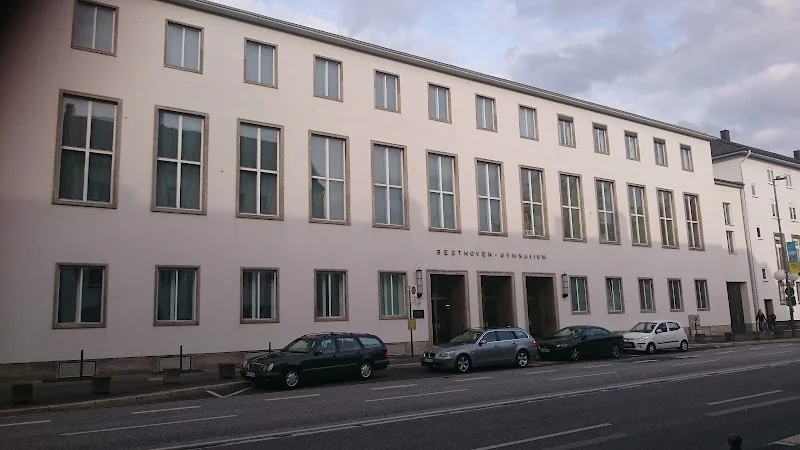
Adenauerallee 51-53, 53113 Bonn, Deutschland
Beethoven-Gymnasium Bonn | Dates & Faculty
The Beethoven-Gymnasium Bonn is a school with an exceptionally long tradition and a clear connection to the present: founded in 1626, it is now located in the center of Bonn, in close proximity to the Rhine. The motto 'Modern from Tradition' aptly describes the profile of the school, as historical continuity, modernized buildings, digital learning tools, strong subject profiles, and a vibrant school life come together here. The current building at Adenauerallee 51-53 dates from the early 1950s, has been largely modernized, and is officially presented with the claim to preserve what is tried and tested while embracing openness to new ideas. For inquiries regarding Beethoven-Gymnasium Bonn, dates, teachers, or faculty, the school is not just a name but a complex profile of history, teaching, support, music, STEM, and community. The website also makes it clear that the gymnasium is working within a special anniversary framework in 2026 and provides many current updates about dates, events, and school life. ([beethoven-gymnasium.de](https://www.beethoven-gymnasium.de/sites/default/files/2024-08/BG_Flyer2024_homepage.pdf))
History, Year of Foundation, and Location by the Rhine
The history of Beethoven-Gymnasium begins archivally in 1626. At that time, classes began in Brüdergasse, near the present-day Remigiuskirche; initially, the Minorites were the sponsors, and later the Jesuits took over the school. This early transition already shows a pattern that continues to shape the school today: stability despite change. In the 17th and 18th centuries, buildings, sponsorships, and conditions changed multiple times. In 1673, the school moved to buildings at the corner of Gudenaugasse and Wenzelgasse, in 1732 construction began on the new building in Bonngasse, the building was completed in 1736, and in 1773/74 the school was transformed into a princely and thus state educational institution following the dissolution of the Jesuit order. A famous connection also belongs to this Bonn educational landscape: in 1789, Ludwig van Beethoven was enrolled as a student. Later, French and Prussian times, war destruction, reconstruction, and modernization changed the location again. In 1816, the school became a Royal Prussian Gymnasium, in 1884 the decision was made for a new building on Koblenzer Straße, the current location at Adenauerallee, and in 1891 the school moved to its present site. In 1925, it officially received the name Beethoven-Gymnasium. World War II left severe damage; in 1944, the school building was partially destroyed, classes were temporarily suspended, and from 1945, classes had to begin anew at alternative locations. In 1951 and 1952, the new building was constructed at the old site with extensions towards the riverbank, in 1964/65 a gymnasium and rowing cellar were added, and in 2023/2024, a raised new building with six classrooms was erected in the schoolyard. This long development explains why Beethoven-Gymnasium Bonn today radiates both historical depth and modern learning architecture. ([beethoven-gymnasium.de](https://www.beethoven-gymnasium.de/unsere-geschichte))
Languages, Upper School, and Teacher Training
The profile of the school is particularly evident in the upper school: the focus is on ancient and modern languages as well as mathematics and natural sciences. This combination shapes the course offerings up to the Abitur. In the qualification phase, in addition to German, English, history, mathematics, and biology, French, Greek, physics, and chemistry can also be chosen as advanced subjects, partly in cooperation with Clara-Schumann-Gymnasium. For the upper school, this means an exceptionally broad academic selection that combines humanistic tradition with a scientific orientation. The language aspect is also strongly developed: French, Italian, and Hebrew are offered as newly introduced foreign languages, along with computer science. This structure is already evident earlier in the school organization: even in the introductory phase, students are divided into homogeneous course groups to ensure continuity, planning, and a smooth transition into the qualification phase. For inquiries such as Beethoven-Gymnasium Bonn teachers or faculty, it is also important that the website provides dedicated areas for school management, faculty, and teacher training. This is not just an information offer but part of a close interconnection between school and training. In collaboration with the Bonn Center for Teacher Education at the Rheinische Friedrich-Wilhelms-University and the Center for Practical Teacher Training Bonn, aspiring teachers gain insights into suitability and orientation internships, field internships, practical semesters, and preparatory service. Thus, Beethoven-Gymnasium Bonn also becomes a place where pedagogical practice, scientific perspective, and school reality come together. For families interested in a school education that is both traditional and modern, this connection of expertise, proximity to universities, and school practice is a strong argument. ([beethoven-gymnasium.de](https://www.beethoven-gymnasium.de/oberstufe))
STEM, Natural Sciences, and Digital Learning Spaces
In addition to the linguistic focus, Beethoven-Gymnasium Bonn has a second, very clearly defined focus on mathematics and natural sciences. The school was first awarded the title of STEM-friendly school in 2014; the award was confirmed again in 2017, 2020, and 2023. This is more than just a label, as the scientific focus is evident in subject offerings, rooms, and projects in daily school life. In lower secondary, mathematics, biology, chemistry, physics, and computer science are taught, partly with additional supplementary hours; in upper secondary, there are basic and advanced courses in these subjects, again partly in cooperation with Clara-Schumann-Gymnasium. The facilities are visibly set up for this: the school has two physics rooms, two chemistry rooms, and three biology rooms, which were newly established in 2012; there are also two computer rooms with 27 workstations each. In the subject rooms, smartboards and internet-capable multimedia units have been integrated, and in 2021, Apple TV was added for iPad use. Digital media are thus not understood as a contradiction to tradition but as a tool for interactive, differentiated teaching. This is particularly evident in the projects: eighth graders typically go to the DLR School Lab in Porz-Wahn, the EF year visits extracurricular learning locations such as the University of Bonn, astronomy or geodesy institutes, the DLR, or the Baylab in Monheim, and in year 8, school visits from the Hausdorff Center for Mathematics take place. This is complemented by a mathematics workshop, computer science clubs in grades 7 and 8, the event technology club, and numerous competitions. Thus, a learning environment is created that understands STEM not as an addition but as a lived part of the school culture. ([beethoven-gymnasium.de](https://www.beethoven-gymnasium.de/mint))
Lower School, Middle School, and Individual Support
For families with younger children, the question of settling in is crucial. Beethoven-Gymnasium Bonn answers it with a very clear concept for the trial phase: grades 5 and 6 form a pedagogical and legal unit. They serve for observation, support, and trial, so that a well-founded decision about the further school career can be made together with the parents. To ensure a successful transition from primary school, the school relies on welcome and encounter programs, close collaboration with parents, student mentors, intensive teamwork among teaching teams, a small parent-teacher conference in November, and a student-teacher conference in the first half of the year. For social learning, there is the Lions Quest program in grade 5 with one hour per week; there are also day trips, class parties, and depending on the year, a class trip in grade 5 or 6. The academic start is also well supported: additional hours facilitate the entry into foreign languages, for Latin classes, English is offered as a continuing language, and language and mathematics competitions are explicitly supported. In middle school, the school pursues goals such as self-esteem, self-responsibility, communication, partnership, care, and social responsibility. These values are supported by scientific preparatory work, a stronger connection between theory and practice, and the inclusion of life experience and reality. In addition, there is individual support in the area of learning: learning offices exist, among others, in mathematics, English, Latin, French, spelling, and German, supplemented by learning coaching and a tutoring program starting in grade 9. The Silentium for grades 5 and 6 is open Monday to Thursday by appointment and creates a reliable space for homework, support, and quiet. Thus, the school demonstrates in everyday life that a gymnasium means not only selection but also support and development. ([beethoven-gymnasium.de](https://www.beethoven-gymnasium.de/unterstufe))
Music, Sports, Clubs, and Lived School Community
The name Beethoven almost automatically commits to music and cultural education, and this is precisely where Beethoven-Gymnasium Bonn has a particularly visible strength. On the school website, music is described as an essential component of comprehensive education. Musical activities range from lower school to upper school, with a lower school choir, choir for middle and upper school, school orchestra, and big band. There are also rehearsal days, musicals, concerts, and performances at summer festivals and church services. The event club also contributes significantly to the profile: it takes care of planning, technical advice, and execution of events in the auditorium, school building, and schoolyard. This is not only important organizationally but also shapes the image of a school that thinks of stage, technology, and community together. In the sports area, the school has a special tradition. The upper school sports course rowing benefits from the location directly on the Rhine and the close connection to the GRV, the student rowing club. There is also the Gymnasium Turnverein, which is described as the second oldest school gymnastics club in Germany. That sports here is not just a subject but an identity is also evident in further offerings such as volleyball club, Bonn marathon projects, skiing trips, and school events. The school community also includes the GFF, the support association, in which parents, colleagues, and former students are involved. The school emphasizes that community is not bound to a single year but is supported by families, alumni, and engaged staff. The cafeteria and canteen complement this togetherness, as do regular school celebrations, the Beethoven Ball, project days, and open events. This mix of music, movement, engagement, and historically grown identity makes Beethoven-Gymnasium Bonn more than just a school for many inquiries: it is a social place with a strong character. ([beethoven-gymnasium.de](https://www.beethoven-gymnasium.de/Musik?utm_source=openai))
Trips, Exchanges, and Practical Information for Parents and Interested Parties
The travel program is one of the most visible features of the school and an important reason why many search for Beethoven-Gymnasium Bonn dates or travel programs. Even in lower or middle school, there are multi-day school trips, followed by skiing trips in grades 7 and 8 and trips to England in grade 9 with exchanges at the Skinners' School for Boys in Tunbridge Wells or stays with English host families with school visits in Canterbury or Rochester. In the introductory phase of upper school, France and the exchange with Lycée Alexandre Dumas in Saint Cloud are the focus, in Q1 the exchange with Liceo linguistico Cavalleri in Parabiago near Milan, and in Q2 study trips to Greece, Poland, France, and other destinations are undertaken. This fits a gymnasium that consciously integrates languages, Europe, and cultural encounters into the school career. Practically, the school is also well organized: the office is open Monday to Wednesday from 7:15 AM to 3:30 PM, Thursday until 2:30 PM, and Friday until 2:00 PM. The address is Adenauerallee 51-53, 53113 Bonn, and the phone number is 0228 77-7430. There is a separate contact address for historical documents. The website also features a current calendar, report conferences, the enrollment day for new 5th graders on September 2, 2026, and many current announcements, making it easy for interested parties to find dates. According to the school flyer, the school day starts at 7:55 AM and typically includes six hours per day; Silentium and other support offers further facilitate daily life. Therefore, those interested not only in the school as an institution but also in the concrete processes, contact paths, and current data will find an unusually transparent information structure at Beethoven-Gymnasium Bonn. ([beethoven-gymnasium.de](https://www.beethoven-gymnasium.de/fahrtenprogramm))
Sources:
- Beethoven-Gymnasium Bonn - Our History. ([beethoven-gymnasium.de](https://www.beethoven-gymnasium.de/unsere-geschichte))
- Beethoven-Gymnasium Bonn - Upper School. ([beethoven-gymnasium.de](https://www.beethoven-gymnasium.de/oberstufe))
- Beethoven-Gymnasium Bonn - STEM. ([beethoven-gymnasium.de](https://www.beethoven-gymnasium.de/mint))
- Beethoven-Gymnasium Bonn - Lower School. ([beethoven-gymnasium.de](https://www.beethoven-gymnasium.de/unterstufe))
- Beethoven-Gymnasium Bonn - Travel Program. ([beethoven-gymnasium.de](https://www.beethoven-gymnasium.de/fahrtenprogramm))
- Beethoven-Gymnasium Bonn - Contact and Imprint. ([beethoven-gymnasium.de](https://www.beethoven-gymnasium.de/kontakt))
- Beethoven-Gymnasium Bonn - School Flyer 2024. ([beethoven-gymnasium.de](https://www.beethoven-gymnasium.de/sites/default/files/2024-08/BG_Flyer2024_homepage.pdf))
Mehr anzeigenWeniger anzeigen
Beethoven-Gymnasium Bonn | Dates & Faculty
The Beethoven-Gymnasium Bonn is a school with an exceptionally long tradition and a clear connection to the present: founded in 1626, it is now located in the center of Bonn, in close proximity to the Rhine. The motto 'Modern from Tradition' aptly describes the profile of the school, as historical continuity, modernized buildings, digital learning tools, strong subject profiles, and a vibrant school life come together here. The current building at Adenauerallee 51-53 dates from the early 1950s, has been largely modernized, and is officially presented with the claim to preserve what is tried and tested while embracing openness to new ideas. For inquiries regarding Beethoven-Gymnasium Bonn, dates, teachers, or faculty, the school is not just a name but a complex profile of history, teaching, support, music, STEM, and community. The website also makes it clear that the gymnasium is working within a special anniversary framework in 2026 and provides many current updates about dates, events, and school life. ([beethoven-gymnasium.de](https://www.beethoven-gymnasium.de/sites/default/files/2024-08/BG_Flyer2024_homepage.pdf))
History, Year of Foundation, and Location by the Rhine
The history of Beethoven-Gymnasium begins archivally in 1626. At that time, classes began in Brüdergasse, near the present-day Remigiuskirche; initially, the Minorites were the sponsors, and later the Jesuits took over the school. This early transition already shows a pattern that continues to shape the school today: stability despite change. In the 17th and 18th centuries, buildings, sponsorships, and conditions changed multiple times. In 1673, the school moved to buildings at the corner of Gudenaugasse and Wenzelgasse, in 1732 construction began on the new building in Bonngasse, the building was completed in 1736, and in 1773/74 the school was transformed into a princely and thus state educational institution following the dissolution of the Jesuit order. A famous connection also belongs to this Bonn educational landscape: in 1789, Ludwig van Beethoven was enrolled as a student. Later, French and Prussian times, war destruction, reconstruction, and modernization changed the location again. In 1816, the school became a Royal Prussian Gymnasium, in 1884 the decision was made for a new building on Koblenzer Straße, the current location at Adenauerallee, and in 1891 the school moved to its present site. In 1925, it officially received the name Beethoven-Gymnasium. World War II left severe damage; in 1944, the school building was partially destroyed, classes were temporarily suspended, and from 1945, classes had to begin anew at alternative locations. In 1951 and 1952, the new building was constructed at the old site with extensions towards the riverbank, in 1964/65 a gymnasium and rowing cellar were added, and in 2023/2024, a raised new building with six classrooms was erected in the schoolyard. This long development explains why Beethoven-Gymnasium Bonn today radiates both historical depth and modern learning architecture. ([beethoven-gymnasium.de](https://www.beethoven-gymnasium.de/unsere-geschichte))
Languages, Upper School, and Teacher Training
The profile of the school is particularly evident in the upper school: the focus is on ancient and modern languages as well as mathematics and natural sciences. This combination shapes the course offerings up to the Abitur. In the qualification phase, in addition to German, English, history, mathematics, and biology, French, Greek, physics, and chemistry can also be chosen as advanced subjects, partly in cooperation with Clara-Schumann-Gymnasium. For the upper school, this means an exceptionally broad academic selection that combines humanistic tradition with a scientific orientation. The language aspect is also strongly developed: French, Italian, and Hebrew are offered as newly introduced foreign languages, along with computer science. This structure is already evident earlier in the school organization: even in the introductory phase, students are divided into homogeneous course groups to ensure continuity, planning, and a smooth transition into the qualification phase. For inquiries such as Beethoven-Gymnasium Bonn teachers or faculty, it is also important that the website provides dedicated areas for school management, faculty, and teacher training. This is not just an information offer but part of a close interconnection between school and training. In collaboration with the Bonn Center for Teacher Education at the Rheinische Friedrich-Wilhelms-University and the Center for Practical Teacher Training Bonn, aspiring teachers gain insights into suitability and orientation internships, field internships, practical semesters, and preparatory service. Thus, Beethoven-Gymnasium Bonn also becomes a place where pedagogical practice, scientific perspective, and school reality come together. For families interested in a school education that is both traditional and modern, this connection of expertise, proximity to universities, and school practice is a strong argument. ([beethoven-gymnasium.de](https://www.beethoven-gymnasium.de/oberstufe))
STEM, Natural Sciences, and Digital Learning Spaces
In addition to the linguistic focus, Beethoven-Gymnasium Bonn has a second, very clearly defined focus on mathematics and natural sciences. The school was first awarded the title of STEM-friendly school in 2014; the award was confirmed again in 2017, 2020, and 2023. This is more than just a label, as the scientific focus is evident in subject offerings, rooms, and projects in daily school life. In lower secondary, mathematics, biology, chemistry, physics, and computer science are taught, partly with additional supplementary hours; in upper secondary, there are basic and advanced courses in these subjects, again partly in cooperation with Clara-Schumann-Gymnasium. The facilities are visibly set up for this: the school has two physics rooms, two chemistry rooms, and three biology rooms, which were newly established in 2012; there are also two computer rooms with 27 workstations each. In the subject rooms, smartboards and internet-capable multimedia units have been integrated, and in 2021, Apple TV was added for iPad use. Digital media are thus not understood as a contradiction to tradition but as a tool for interactive, differentiated teaching. This is particularly evident in the projects: eighth graders typically go to the DLR School Lab in Porz-Wahn, the EF year visits extracurricular learning locations such as the University of Bonn, astronomy or geodesy institutes, the DLR, or the Baylab in Monheim, and in year 8, school visits from the Hausdorff Center for Mathematics take place. This is complemented by a mathematics workshop, computer science clubs in grades 7 and 8, the event technology club, and numerous competitions. Thus, a learning environment is created that understands STEM not as an addition but as a lived part of the school culture. ([beethoven-gymnasium.de](https://www.beethoven-gymnasium.de/mint))
Lower School, Middle School, and Individual Support
For families with younger children, the question of settling in is crucial. Beethoven-Gymnasium Bonn answers it with a very clear concept for the trial phase: grades 5 and 6 form a pedagogical and legal unit. They serve for observation, support, and trial, so that a well-founded decision about the further school career can be made together with the parents. To ensure a successful transition from primary school, the school relies on welcome and encounter programs, close collaboration with parents, student mentors, intensive teamwork among teaching teams, a small parent-teacher conference in November, and a student-teacher conference in the first half of the year. For social learning, there is the Lions Quest program in grade 5 with one hour per week; there are also day trips, class parties, and depending on the year, a class trip in grade 5 or 6. The academic start is also well supported: additional hours facilitate the entry into foreign languages, for Latin classes, English is offered as a continuing language, and language and mathematics competitions are explicitly supported. In middle school, the school pursues goals such as self-esteem, self-responsibility, communication, partnership, care, and social responsibility. These values are supported by scientific preparatory work, a stronger connection between theory and practice, and the inclusion of life experience and reality. In addition, there is individual support in the area of learning: learning offices exist, among others, in mathematics, English, Latin, French, spelling, and German, supplemented by learning coaching and a tutoring program starting in grade 9. The Silentium for grades 5 and 6 is open Monday to Thursday by appointment and creates a reliable space for homework, support, and quiet. Thus, the school demonstrates in everyday life that a gymnasium means not only selection but also support and development. ([beethoven-gymnasium.de](https://www.beethoven-gymnasium.de/unterstufe))
Music, Sports, Clubs, and Lived School Community
The name Beethoven almost automatically commits to music and cultural education, and this is precisely where Beethoven-Gymnasium Bonn has a particularly visible strength. On the school website, music is described as an essential component of comprehensive education. Musical activities range from lower school to upper school, with a lower school choir, choir for middle and upper school, school orchestra, and big band. There are also rehearsal days, musicals, concerts, and performances at summer festivals and church services. The event club also contributes significantly to the profile: it takes care of planning, technical advice, and execution of events in the auditorium, school building, and schoolyard. This is not only important organizationally but also shapes the image of a school that thinks of stage, technology, and community together. In the sports area, the school has a special tradition. The upper school sports course rowing benefits from the location directly on the Rhine and the close connection to the GRV, the student rowing club. There is also the Gymnasium Turnverein, which is described as the second oldest school gymnastics club in Germany. That sports here is not just a subject but an identity is also evident in further offerings such as volleyball club, Bonn marathon projects, skiing trips, and school events. The school community also includes the GFF, the support association, in which parents, colleagues, and former students are involved. The school emphasizes that community is not bound to a single year but is supported by families, alumni, and engaged staff. The cafeteria and canteen complement this togetherness, as do regular school celebrations, the Beethoven Ball, project days, and open events. This mix of music, movement, engagement, and historically grown identity makes Beethoven-Gymnasium Bonn more than just a school for many inquiries: it is a social place with a strong character. ([beethoven-gymnasium.de](https://www.beethoven-gymnasium.de/Musik?utm_source=openai))
Trips, Exchanges, and Practical Information for Parents and Interested Parties
The travel program is one of the most visible features of the school and an important reason why many search for Beethoven-Gymnasium Bonn dates or travel programs. Even in lower or middle school, there are multi-day school trips, followed by skiing trips in grades 7 and 8 and trips to England in grade 9 with exchanges at the Skinners' School for Boys in Tunbridge Wells or stays with English host families with school visits in Canterbury or Rochester. In the introductory phase of upper school, France and the exchange with Lycée Alexandre Dumas in Saint Cloud are the focus, in Q1 the exchange with Liceo linguistico Cavalleri in Parabiago near Milan, and in Q2 study trips to Greece, Poland, France, and other destinations are undertaken. This fits a gymnasium that consciously integrates languages, Europe, and cultural encounters into the school career. Practically, the school is also well organized: the office is open Monday to Wednesday from 7:15 AM to 3:30 PM, Thursday until 2:30 PM, and Friday until 2:00 PM. The address is Adenauerallee 51-53, 53113 Bonn, and the phone number is 0228 77-7430. There is a separate contact address for historical documents. The website also features a current calendar, report conferences, the enrollment day for new 5th graders on September 2, 2026, and many current announcements, making it easy for interested parties to find dates. According to the school flyer, the school day starts at 7:55 AM and typically includes six hours per day; Silentium and other support offers further facilitate daily life. Therefore, those interested not only in the school as an institution but also in the concrete processes, contact paths, and current data will find an unusually transparent information structure at Beethoven-Gymnasium Bonn. ([beethoven-gymnasium.de](https://www.beethoven-gymnasium.de/fahrtenprogramm))
Sources:
- Beethoven-Gymnasium Bonn - Our History. ([beethoven-gymnasium.de](https://www.beethoven-gymnasium.de/unsere-geschichte))
- Beethoven-Gymnasium Bonn - Upper School. ([beethoven-gymnasium.de](https://www.beethoven-gymnasium.de/oberstufe))
- Beethoven-Gymnasium Bonn - STEM. ([beethoven-gymnasium.de](https://www.beethoven-gymnasium.de/mint))
- Beethoven-Gymnasium Bonn - Lower School. ([beethoven-gymnasium.de](https://www.beethoven-gymnasium.de/unterstufe))
- Beethoven-Gymnasium Bonn - Travel Program. ([beethoven-gymnasium.de](https://www.beethoven-gymnasium.de/fahrtenprogramm))
- Beethoven-Gymnasium Bonn - Contact and Imprint. ([beethoven-gymnasium.de](https://www.beethoven-gymnasium.de/kontakt))
- Beethoven-Gymnasium Bonn - School Flyer 2024. ([beethoven-gymnasium.de](https://www.beethoven-gymnasium.de/sites/default/files/2024-08/BG_Flyer2024_homepage.pdf))
Beethoven-Gymnasium Bonn | Dates & Faculty
The Beethoven-Gymnasium Bonn is a school with an exceptionally long tradition and a clear connection to the present: founded in 1626, it is now located in the center of Bonn, in close proximity to the Rhine. The motto 'Modern from Tradition' aptly describes the profile of the school, as historical continuity, modernized buildings, digital learning tools, strong subject profiles, and a vibrant school life come together here. The current building at Adenauerallee 51-53 dates from the early 1950s, has been largely modernized, and is officially presented with the claim to preserve what is tried and tested while embracing openness to new ideas. For inquiries regarding Beethoven-Gymnasium Bonn, dates, teachers, or faculty, the school is not just a name but a complex profile of history, teaching, support, music, STEM, and community. The website also makes it clear that the gymnasium is working within a special anniversary framework in 2026 and provides many current updates about dates, events, and school life. ([beethoven-gymnasium.de](https://www.beethoven-gymnasium.de/sites/default/files/2024-08/BG_Flyer2024_homepage.pdf))
History, Year of Foundation, and Location by the Rhine
The history of Beethoven-Gymnasium begins archivally in 1626. At that time, classes began in Brüdergasse, near the present-day Remigiuskirche; initially, the Minorites were the sponsors, and later the Jesuits took over the school. This early transition already shows a pattern that continues to shape the school today: stability despite change. In the 17th and 18th centuries, buildings, sponsorships, and conditions changed multiple times. In 1673, the school moved to buildings at the corner of Gudenaugasse and Wenzelgasse, in 1732 construction began on the new building in Bonngasse, the building was completed in 1736, and in 1773/74 the school was transformed into a princely and thus state educational institution following the dissolution of the Jesuit order. A famous connection also belongs to this Bonn educational landscape: in 1789, Ludwig van Beethoven was enrolled as a student. Later, French and Prussian times, war destruction, reconstruction, and modernization changed the location again. In 1816, the school became a Royal Prussian Gymnasium, in 1884 the decision was made for a new building on Koblenzer Straße, the current location at Adenauerallee, and in 1891 the school moved to its present site. In 1925, it officially received the name Beethoven-Gymnasium. World War II left severe damage; in 1944, the school building was partially destroyed, classes were temporarily suspended, and from 1945, classes had to begin anew at alternative locations. In 1951 and 1952, the new building was constructed at the old site with extensions towards the riverbank, in 1964/65 a gymnasium and rowing cellar were added, and in 2023/2024, a raised new building with six classrooms was erected in the schoolyard. This long development explains why Beethoven-Gymnasium Bonn today radiates both historical depth and modern learning architecture. ([beethoven-gymnasium.de](https://www.beethoven-gymnasium.de/unsere-geschichte))
Languages, Upper School, and Teacher Training
The profile of the school is particularly evident in the upper school: the focus is on ancient and modern languages as well as mathematics and natural sciences. This combination shapes the course offerings up to the Abitur. In the qualification phase, in addition to German, English, history, mathematics, and biology, French, Greek, physics, and chemistry can also be chosen as advanced subjects, partly in cooperation with Clara-Schumann-Gymnasium. For the upper school, this means an exceptionally broad academic selection that combines humanistic tradition with a scientific orientation. The language aspect is also strongly developed: French, Italian, and Hebrew are offered as newly introduced foreign languages, along with computer science. This structure is already evident earlier in the school organization: even in the introductory phase, students are divided into homogeneous course groups to ensure continuity, planning, and a smooth transition into the qualification phase. For inquiries such as Beethoven-Gymnasium Bonn teachers or faculty, it is also important that the website provides dedicated areas for school management, faculty, and teacher training. This is not just an information offer but part of a close interconnection between school and training. In collaboration with the Bonn Center for Teacher Education at the Rheinische Friedrich-Wilhelms-University and the Center for Practical Teacher Training Bonn, aspiring teachers gain insights into suitability and orientation internships, field internships, practical semesters, and preparatory service. Thus, Beethoven-Gymnasium Bonn also becomes a place where pedagogical practice, scientific perspective, and school reality come together. For families interested in a school education that is both traditional and modern, this connection of expertise, proximity to universities, and school practice is a strong argument. ([beethoven-gymnasium.de](https://www.beethoven-gymnasium.de/oberstufe))
STEM, Natural Sciences, and Digital Learning Spaces
In addition to the linguistic focus, Beethoven-Gymnasium Bonn has a second, very clearly defined focus on mathematics and natural sciences. The school was first awarded the title of STEM-friendly school in 2014; the award was confirmed again in 2017, 2020, and 2023. This is more than just a label, as the scientific focus is evident in subject offerings, rooms, and projects in daily school life. In lower secondary, mathematics, biology, chemistry, physics, and computer science are taught, partly with additional supplementary hours; in upper secondary, there are basic and advanced courses in these subjects, again partly in cooperation with Clara-Schumann-Gymnasium. The facilities are visibly set up for this: the school has two physics rooms, two chemistry rooms, and three biology rooms, which were newly established in 2012; there are also two computer rooms with 27 workstations each. In the subject rooms, smartboards and internet-capable multimedia units have been integrated, and in 2021, Apple TV was added for iPad use. Digital media are thus not understood as a contradiction to tradition but as a tool for interactive, differentiated teaching. This is particularly evident in the projects: eighth graders typically go to the DLR School Lab in Porz-Wahn, the EF year visits extracurricular learning locations such as the University of Bonn, astronomy or geodesy institutes, the DLR, or the Baylab in Monheim, and in year 8, school visits from the Hausdorff Center for Mathematics take place. This is complemented by a mathematics workshop, computer science clubs in grades 7 and 8, the event technology club, and numerous competitions. Thus, a learning environment is created that understands STEM not as an addition but as a lived part of the school culture. ([beethoven-gymnasium.de](https://www.beethoven-gymnasium.de/mint))
Lower School, Middle School, and Individual Support
For families with younger children, the question of settling in is crucial. Beethoven-Gymnasium Bonn answers it with a very clear concept for the trial phase: grades 5 and 6 form a pedagogical and legal unit. They serve for observation, support, and trial, so that a well-founded decision about the further school career can be made together with the parents. To ensure a successful transition from primary school, the school relies on welcome and encounter programs, close collaboration with parents, student mentors, intensive teamwork among teaching teams, a small parent-teacher conference in November, and a student-teacher conference in the first half of the year. For social learning, there is the Lions Quest program in grade 5 with one hour per week; there are also day trips, class parties, and depending on the year, a class trip in grade 5 or 6. The academic start is also well supported: additional hours facilitate the entry into foreign languages, for Latin classes, English is offered as a continuing language, and language and mathematics competitions are explicitly supported. In middle school, the school pursues goals such as self-esteem, self-responsibility, communication, partnership, care, and social responsibility. These values are supported by scientific preparatory work, a stronger connection between theory and practice, and the inclusion of life experience and reality. In addition, there is individual support in the area of learning: learning offices exist, among others, in mathematics, English, Latin, French, spelling, and German, supplemented by learning coaching and a tutoring program starting in grade 9. The Silentium for grades 5 and 6 is open Monday to Thursday by appointment and creates a reliable space for homework, support, and quiet. Thus, the school demonstrates in everyday life that a gymnasium means not only selection but also support and development. ([beethoven-gymnasium.de](https://www.beethoven-gymnasium.de/unterstufe))
Music, Sports, Clubs, and Lived School Community
The name Beethoven almost automatically commits to music and cultural education, and this is precisely where Beethoven-Gymnasium Bonn has a particularly visible strength. On the school website, music is described as an essential component of comprehensive education. Musical activities range from lower school to upper school, with a lower school choir, choir for middle and upper school, school orchestra, and big band. There are also rehearsal days, musicals, concerts, and performances at summer festivals and church services. The event club also contributes significantly to the profile: it takes care of planning, technical advice, and execution of events in the auditorium, school building, and schoolyard. This is not only important organizationally but also shapes the image of a school that thinks of stage, technology, and community together. In the sports area, the school has a special tradition. The upper school sports course rowing benefits from the location directly on the Rhine and the close connection to the GRV, the student rowing club. There is also the Gymnasium Turnverein, which is described as the second oldest school gymnastics club in Germany. That sports here is not just a subject but an identity is also evident in further offerings such as volleyball club, Bonn marathon projects, skiing trips, and school events. The school community also includes the GFF, the support association, in which parents, colleagues, and former students are involved. The school emphasizes that community is not bound to a single year but is supported by families, alumni, and engaged staff. The cafeteria and canteen complement this togetherness, as do regular school celebrations, the Beethoven Ball, project days, and open events. This mix of music, movement, engagement, and historically grown identity makes Beethoven-Gymnasium Bonn more than just a school for many inquiries: it is a social place with a strong character. ([beethoven-gymnasium.de](https://www.beethoven-gymnasium.de/Musik?utm_source=openai))
Trips, Exchanges, and Practical Information for Parents and Interested Parties
The travel program is one of the most visible features of the school and an important reason why many search for Beethoven-Gymnasium Bonn dates or travel programs. Even in lower or middle school, there are multi-day school trips, followed by skiing trips in grades 7 and 8 and trips to England in grade 9 with exchanges at the Skinners' School for Boys in Tunbridge Wells or stays with English host families with school visits in Canterbury or Rochester. In the introductory phase of upper school, France and the exchange with Lycée Alexandre Dumas in Saint Cloud are the focus, in Q1 the exchange with Liceo linguistico Cavalleri in Parabiago near Milan, and in Q2 study trips to Greece, Poland, France, and other destinations are undertaken. This fits a gymnasium that consciously integrates languages, Europe, and cultural encounters into the school career. Practically, the school is also well organized: the office is open Monday to Wednesday from 7:15 AM to 3:30 PM, Thursday until 2:30 PM, and Friday until 2:00 PM. The address is Adenauerallee 51-53, 53113 Bonn, and the phone number is 0228 77-7430. There is a separate contact address for historical documents. The website also features a current calendar, report conferences, the enrollment day for new 5th graders on September 2, 2026, and many current announcements, making it easy for interested parties to find dates. According to the school flyer, the school day starts at 7:55 AM and typically includes six hours per day; Silentium and other support offers further facilitate daily life. Therefore, those interested not only in the school as an institution but also in the concrete processes, contact paths, and current data will find an unusually transparent information structure at Beethoven-Gymnasium Bonn. ([beethoven-gymnasium.de](https://www.beethoven-gymnasium.de/fahrtenprogramm))
Sources:
- Beethoven-Gymnasium Bonn - Our History. ([beethoven-gymnasium.de](https://www.beethoven-gymnasium.de/unsere-geschichte))
- Beethoven-Gymnasium Bonn - Upper School. ([beethoven-gymnasium.de](https://www.beethoven-gymnasium.de/oberstufe))
- Beethoven-Gymnasium Bonn - STEM. ([beethoven-gymnasium.de](https://www.beethoven-gymnasium.de/mint))
- Beethoven-Gymnasium Bonn - Lower School. ([beethoven-gymnasium.de](https://www.beethoven-gymnasium.de/unterstufe))
- Beethoven-Gymnasium Bonn - Travel Program. ([beethoven-gymnasium.de](https://www.beethoven-gymnasium.de/fahrtenprogramm))
- Beethoven-Gymnasium Bonn - Contact and Imprint. ([beethoven-gymnasium.de](https://www.beethoven-gymnasium.de/kontakt))
- Beethoven-Gymnasium Bonn - School Flyer 2024. ([beethoven-gymnasium.de](https://www.beethoven-gymnasium.de/sites/default/files/2024-08/BG_Flyer2024_homepage.pdf))
Frequently Asked Questions
Reviews
No reviews found