
Münsterpl. 11, Bonn
Münsterpl. 11, 53111 Bonn, Germany
Beethoven Monument | Münsterplatz & Photos
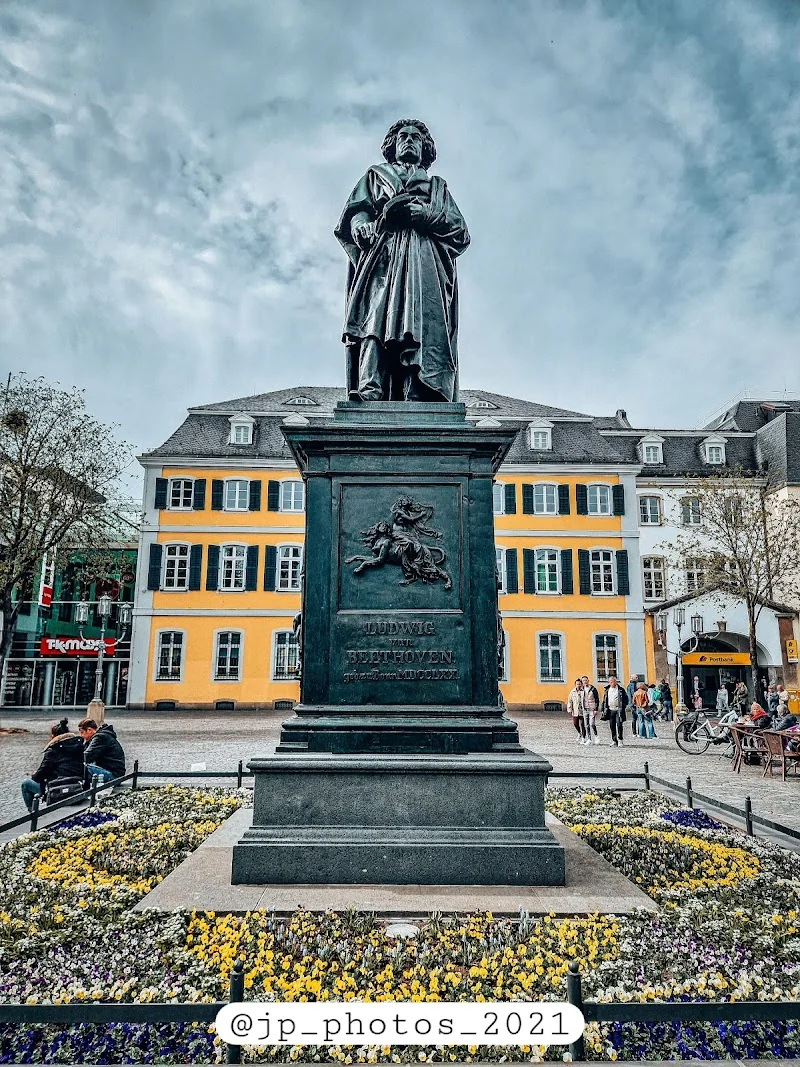
The Beethoven Monument on Bonn's Münsterplatz is much more than a well-known statue. It is an urban symbol, a historical memorial site, and for many visitors, one of the first points where Bonn as the city of Beethoven becomes visible. In the center of the historic downtown, art meets city history, and this connection has made the place attractive for generations. When entering Münsterplatz, one does not stand before an isolated monument, but before a memorial that is embedded in a vibrant urban space: surrounded by the Bonn Minster, striking facades, and a square that is considered the heart of the pedestrian zone. The city of Bonn even describes the place as the most photographed Bonn site. This fits well with a monument that was inaugurated in 1845, emerged after a long prehistory, and is still regarded as one of the most visible signs of Bonn's reverence for Beethoven. At the same time, the square is an ideal starting point for a city tour, as many other Beethoven references are within short distance. Therefore, those interested in music history find not only a bronze figure here but a place where the cultural memory of the city can be experienced very concretely. ([bonn.de](https://www.bonn.de/bonn-erleben/besichtigen-entdecken/kultur-freizeit-bonn.php))
History and Inauguration of the Beethoven Monument
The history of the Beethoven Monument does not begin with a spontaneous installation but with a civic cultural project that took many years. The initiative came from Heinrich Carl Breidenstein, the first professor of musicology in the German-speaking world. As early as 1835, citizens founded the Bonn Association for Beethoven's Monument, and Robert Schumann helped spread the fundraising appeal across Europe. When ten years later, funds were still lacking, Franz Liszt stepped in and not only provided the final financial boost but also ensured that a wooden concert hall could be erected in just ten days for the Beethoven Festival in 1845. This mix of civic spirit, international musical enthusiasm, and organizational energy is typical of the monument's origin story. At the same time, it shows the high regard Beethoven already had in the mid-19th century: not only as a great composer but as a personality who could culturally enhance Bonn itself. The ceremonial unveiling on August 12, 1845, finally marked the conclusion of a complicated process lasting more than 13 years. Previously, the political circumstances had made it difficult to establish a monument in a public square, as Bonn had been under Prussian rule since 1815, requiring royal approval. Only Friedrich Wilhelm IV granted permission and personally attended the inauguration. The celebration was also attended by Queen Victoria, Alexander von Humboldt, and significant musicians from across Europe. This makes it clear that the monument was perceived not only locally but also throughout Europe from the very beginning. ([beethoven-rundgang.bonn.de](https://beethoven-rundgang.bonn.de/standorte-in-bonn/chronoskop-8-beethoven-denkmal.php))
Münsterplatz in Bonn: Location, Surroundings, and Orientation
The location of the Beethoven Monument is crucial for its impact. Münsterplatz is located in the center of Bonn's downtown and, together with the Bonn Minster, historic buildings, and modern facades, creates a space where several layers of time in the city meet. The city of Bonn describes Münsterplatz as the seedbed of post-Roman Bonn and as the heart of the closed pedestrian zone. It is precisely here that the Beethoven Monument stands. Although the monument is not positioned in the middle of the square, it attracts attention from all corners and thus remains permanently present. For visitors, this is practical, as one can easily orient oneself upon arrival: Those coming through the pedestrian zone or entering the square from the vicinity of the Minster church recognize the statue almost immediately. In the Beethoven tour, the location is described as opposite the Minster church and next to the emergency exit of an underground parking garage. This precise location indicates how closely the monument is integrated into the daily use of the square. The place is thus both a monument site, a meeting point, and a passageway. This gives it a special atmosphere, as tourism, city life, and cultural memory meet here. Even those who are only briefly in Bonn often perceive the square as a very typical urban space: open, central, historic, and yet practical for everyday use. This mix explains why the Beethoven Monument works so well not only for Beethoven fans but also for strolls, city tours, and spontaneous visits. ([bonn.de](https://www.bonn.de/bonn-erleben/besichtigen-entdecken/kultur-freizeit-bonn.php))
Photos of the Beethoven Monument: Why the Square is So Popular
Those looking for photos of the Beethoven Monument in Bonn usually mean more than a simple souvenir picture. Münsterplatz provides a backdrop that makes the monument appear striking from many angles: wide square areas, clear sight lines, historic architecture, and the bronze figure as the central motif. Because the monument is well visible from different sides, very different moods can be created in photographs. In the morning, the square often appears calm and tidy, during the day lively and open, and in the evening, light and shadow can particularly emphasize the contours of the statue. This is precisely why the place is equally popular for travel photos, cultural portraits, and city views. The city of Bonn describes the monument as its most photographed Bonn site, which summarizes its visual appeal well. The fact that the monument returned to Münsterplatz in July 2022 after about six months of restoration has further strengthened its presence. The aim was not to remove the historical patina but to eliminate harmful layers of dirt and secure the monument's condition in the long term. This careful maintenance is important because it preserves the character of the monument while ensuring that the bronze appears clear and well-maintained. For many guests, this is precisely a reason for a photo: the feeling of having a genuine, historically grown city symbol in front of the lens that is still in very good condition. At the same time, the square itself is part of the picture. When taking a photo, one documents not only Beethoven but also Bonn as a cultural city with a strong public space. ([bonn.de](https://www.bonn.de/bonn-erleben/besichtigen-entdecken/kultur-freizeit-bonn.php))
The Artistic Design by Ernst Julius Hähnel
The Bonn Beethoven Monument is also art historically interesting because it clearly reflects the 19th-century attitude toward great personalities. The design comes from Ernst Julius Hähnel, a sculptor who was successful in Dresden and Munich at the time, whose concept was perceived as modern and elevated in Bonn. Hähnel did not depict Beethoven as a decorative side note but as a concentrated, intellectual presence. The figure stands in a slight walking stance, with the right hand raised and holding a quill. This not only provides a portrait but also an image of inspiration, work, and creative energy. Beethoven wears the clothing of his time, complemented by a lavish cloak that makes the figure appear more monumental. This combination of bourgeois respectability and dignity was typical for artist monuments of the 19th century but is particularly effectively implemented here. The pedestal is also richly designed. The four reliefs depict allegorical representations of music: sacred music, fantasy, symphony, and dramatic music. This honors Beethoven not only as a man but as a composer in various musical dimensions. The reliefs received great approval early on because they convincingly illustrated the intellectual breadth of his art. The monument was cast by Jakob Daniel Burgschmiet in Nuremberg. Together, this creates a monument that does not merely exhaust itself in representation or pure monumentality. It conveys movement, ambition, and seriousness at the same time. Therefore, those standing before it today see not only a statue but a carefully composed artistic statement about Beethoven and his impact. ([internet.beethoven.de](https://internet.beethoven.de/de/ausstellung/beethoven-denkmaeler-des-19-und-20-jahrhunderts/))
Directions, Parking, and Practical Tips for Visiting
The good news for visiting the Beethoven Monument is that its location in the center of Bonn makes it very easy to reach. Those walking can head directly to Münsterplatz from downtown. Those arriving by public transport benefit from the fact that the square is located in a densely developed urban area. This is ideal for a short cultural stop, as the monument can easily be incorporated into a city stroll. However, one should consider the central location when arriving by car. The city of Bonn points out that there are about 4,500 parking spaces available in parking garages in the city center, operated among others by Bonn City Parking GmbH. Additionally, there are nine park-and-ride parking lots in the city area with a total of 850 parking spaces. For visitors, this means: While the destination is right in the city, parking should be better planned in a municipal parking garage or via P+R rather than searching directly at the monument. This is also sensible because Münsterplatz is part of a pedestrian zone, and the space there is primarily reserved for people. Those who want to make the visit more convenient can take advantage of the proximity to other downtown points, such as the Bonn Information at Münsterplatz or other attractions in the immediate vicinity. It is also practical that the city of Bonn supports its parking offers digitally and with app payment. This allows for flexible planning of the stay without having to search for a parking space on-site for a long time. Therefore, the Beethoven Monument is very uncomplicated for photo visits, city walks, and a short stop, as long as one keeps the logic of the city center in mind: first park or arrive, then experience the square on foot. ([bonn.de](https://www.bonn.de/themen-entdecken/verkehr-mobilitaet/Autos-parken-in-Bonn.php))
Sources:
- Federal City of Bonn – Beethoven. The Monuments. ([bonn.de](https://www.bonn.de/bonn-erleben/beethoven/beethoven-denkmaeler.php?utm_source=openai))
- Beethoven House Bonn – The Beethoven Monument on Bonn's Münsterplatz. ([internet.beethoven.de](https://internet.beethoven.de/de/ausstellung/beethoven-denkmaeler-des-19-und-20-jahrhunderts/))
- Beethoven Tour – Chronoskop 8: Beethoven Monument. ([beethoven-rundgang.bonn.de](https://beethoven-rundgang.bonn.de/standorte-in-bonn/chronoskop-8-beethoven-denkmal.php))
- Federal City of Bonn – Parking in Bonn. ([bonn.de](https://www.bonn.de/themen-entdecken/verkehr-mobilitaet/Autos-parken-in-Bonn.php))
Show moreShow less
Beethoven Monument | Münsterplatz & Photos
The Beethoven Monument on Bonn's Münsterplatz is much more than a well-known statue. It is an urban symbol, a historical memorial site, and for many visitors, one of the first points where Bonn as the city of Beethoven becomes visible. In the center of the historic downtown, art meets city history, and this connection has made the place attractive for generations. When entering Münsterplatz, one does not stand before an isolated monument, but before a memorial that is embedded in a vibrant urban space: surrounded by the Bonn Minster, striking facades, and a square that is considered the heart of the pedestrian zone. The city of Bonn even describes the place as the most photographed Bonn site. This fits well with a monument that was inaugurated in 1845, emerged after a long prehistory, and is still regarded as one of the most visible signs of Bonn's reverence for Beethoven. At the same time, the square is an ideal starting point for a city tour, as many other Beethoven references are within short distance. Therefore, those interested in music history find not only a bronze figure here but a place where the cultural memory of the city can be experienced very concretely. ([bonn.de](https://www.bonn.de/bonn-erleben/besichtigen-entdecken/kultur-freizeit-bonn.php))
History and Inauguration of the Beethoven Monument
The history of the Beethoven Monument does not begin with a spontaneous installation but with a civic cultural project that took many years. The initiative came from Heinrich Carl Breidenstein, the first professor of musicology in the German-speaking world. As early as 1835, citizens founded the Bonn Association for Beethoven's Monument, and Robert Schumann helped spread the fundraising appeal across Europe. When ten years later, funds were still lacking, Franz Liszt stepped in and not only provided the final financial boost but also ensured that a wooden concert hall could be erected in just ten days for the Beethoven Festival in 1845. This mix of civic spirit, international musical enthusiasm, and organizational energy is typical of the monument's origin story. At the same time, it shows the high regard Beethoven already had in the mid-19th century: not only as a great composer but as a personality who could culturally enhance Bonn itself. The ceremonial unveiling on August 12, 1845, finally marked the conclusion of a complicated process lasting more than 13 years. Previously, the political circumstances had made it difficult to establish a monument in a public square, as Bonn had been under Prussian rule since 1815, requiring royal approval. Only Friedrich Wilhelm IV granted permission and personally attended the inauguration. The celebration was also attended by Queen Victoria, Alexander von Humboldt, and significant musicians from across Europe. This makes it clear that the monument was perceived not only locally but also throughout Europe from the very beginning. ([beethoven-rundgang.bonn.de](https://beethoven-rundgang.bonn.de/standorte-in-bonn/chronoskop-8-beethoven-denkmal.php))
Münsterplatz in Bonn: Location, Surroundings, and Orientation
The location of the Beethoven Monument is crucial for its impact. Münsterplatz is located in the center of Bonn's downtown and, together with the Bonn Minster, historic buildings, and modern facades, creates a space where several layers of time in the city meet. The city of Bonn describes Münsterplatz as the seedbed of post-Roman Bonn and as the heart of the closed pedestrian zone. It is precisely here that the Beethoven Monument stands. Although the monument is not positioned in the middle of the square, it attracts attention from all corners and thus remains permanently present. For visitors, this is practical, as one can easily orient oneself upon arrival: Those coming through the pedestrian zone or entering the square from the vicinity of the Minster church recognize the statue almost immediately. In the Beethoven tour, the location is described as opposite the Minster church and next to the emergency exit of an underground parking garage. This precise location indicates how closely the monument is integrated into the daily use of the square. The place is thus both a monument site, a meeting point, and a passageway. This gives it a special atmosphere, as tourism, city life, and cultural memory meet here. Even those who are only briefly in Bonn often perceive the square as a very typical urban space: open, central, historic, and yet practical for everyday use. This mix explains why the Beethoven Monument works so well not only for Beethoven fans but also for strolls, city tours, and spontaneous visits. ([bonn.de](https://www.bonn.de/bonn-erleben/besichtigen-entdecken/kultur-freizeit-bonn.php))
Photos of the Beethoven Monument: Why the Square is So Popular
Those looking for photos of the Beethoven Monument in Bonn usually mean more than a simple souvenir picture. Münsterplatz provides a backdrop that makes the monument appear striking from many angles: wide square areas, clear sight lines, historic architecture, and the bronze figure as the central motif. Because the monument is well visible from different sides, very different moods can be created in photographs. In the morning, the square often appears calm and tidy, during the day lively and open, and in the evening, light and shadow can particularly emphasize the contours of the statue. This is precisely why the place is equally popular for travel photos, cultural portraits, and city views. The city of Bonn describes the monument as its most photographed Bonn site, which summarizes its visual appeal well. The fact that the monument returned to Münsterplatz in July 2022 after about six months of restoration has further strengthened its presence. The aim was not to remove the historical patina but to eliminate harmful layers of dirt and secure the monument's condition in the long term. This careful maintenance is important because it preserves the character of the monument while ensuring that the bronze appears clear and well-maintained. For many guests, this is precisely a reason for a photo: the feeling of having a genuine, historically grown city symbol in front of the lens that is still in very good condition. At the same time, the square itself is part of the picture. When taking a photo, one documents not only Beethoven but also Bonn as a cultural city with a strong public space. ([bonn.de](https://www.bonn.de/bonn-erleben/besichtigen-entdecken/kultur-freizeit-bonn.php))
The Artistic Design by Ernst Julius Hähnel
The Bonn Beethoven Monument is also art historically interesting because it clearly reflects the 19th-century attitude toward great personalities. The design comes from Ernst Julius Hähnel, a sculptor who was successful in Dresden and Munich at the time, whose concept was perceived as modern and elevated in Bonn. Hähnel did not depict Beethoven as a decorative side note but as a concentrated, intellectual presence. The figure stands in a slight walking stance, with the right hand raised and holding a quill. This not only provides a portrait but also an image of inspiration, work, and creative energy. Beethoven wears the clothing of his time, complemented by a lavish cloak that makes the figure appear more monumental. This combination of bourgeois respectability and dignity was typical for artist monuments of the 19th century but is particularly effectively implemented here. The pedestal is also richly designed. The four reliefs depict allegorical representations of music: sacred music, fantasy, symphony, and dramatic music. This honors Beethoven not only as a man but as a composer in various musical dimensions. The reliefs received great approval early on because they convincingly illustrated the intellectual breadth of his art. The monument was cast by Jakob Daniel Burgschmiet in Nuremberg. Together, this creates a monument that does not merely exhaust itself in representation or pure monumentality. It conveys movement, ambition, and seriousness at the same time. Therefore, those standing before it today see not only a statue but a carefully composed artistic statement about Beethoven and his impact. ([internet.beethoven.de](https://internet.beethoven.de/de/ausstellung/beethoven-denkmaeler-des-19-und-20-jahrhunderts/))
Directions, Parking, and Practical Tips for Visiting
The good news for visiting the Beethoven Monument is that its location in the center of Bonn makes it very easy to reach. Those walking can head directly to Münsterplatz from downtown. Those arriving by public transport benefit from the fact that the square is located in a densely developed urban area. This is ideal for a short cultural stop, as the monument can easily be incorporated into a city stroll. However, one should consider the central location when arriving by car. The city of Bonn points out that there are about 4,500 parking spaces available in parking garages in the city center, operated among others by Bonn City Parking GmbH. Additionally, there are nine park-and-ride parking lots in the city area with a total of 850 parking spaces. For visitors, this means: While the destination is right in the city, parking should be better planned in a municipal parking garage or via P+R rather than searching directly at the monument. This is also sensible because Münsterplatz is part of a pedestrian zone, and the space there is primarily reserved for people. Those who want to make the visit more convenient can take advantage of the proximity to other downtown points, such as the Bonn Information at Münsterplatz or other attractions in the immediate vicinity. It is also practical that the city of Bonn supports its parking offers digitally and with app payment. This allows for flexible planning of the stay without having to search for a parking space on-site for a long time. Therefore, the Beethoven Monument is very uncomplicated for photo visits, city walks, and a short stop, as long as one keeps the logic of the city center in mind: first park or arrive, then experience the square on foot. ([bonn.de](https://www.bonn.de/themen-entdecken/verkehr-mobilitaet/Autos-parken-in-Bonn.php))
Sources:
- Federal City of Bonn – Beethoven. The Monuments. ([bonn.de](https://www.bonn.de/bonn-erleben/beethoven/beethoven-denkmaeler.php?utm_source=openai))
- Beethoven House Bonn – The Beethoven Monument on Bonn's Münsterplatz. ([internet.beethoven.de](https://internet.beethoven.de/de/ausstellung/beethoven-denkmaeler-des-19-und-20-jahrhunderts/))
- Beethoven Tour – Chronoskop 8: Beethoven Monument. ([beethoven-rundgang.bonn.de](https://beethoven-rundgang.bonn.de/standorte-in-bonn/chronoskop-8-beethoven-denkmal.php))
- Federal City of Bonn – Parking in Bonn. ([bonn.de](https://www.bonn.de/themen-entdecken/verkehr-mobilitaet/Autos-parken-in-Bonn.php))
Beethoven Monument | Münsterplatz & Photos
The Beethoven Monument on Bonn's Münsterplatz is much more than a well-known statue. It is an urban symbol, a historical memorial site, and for many visitors, one of the first points where Bonn as the city of Beethoven becomes visible. In the center of the historic downtown, art meets city history, and this connection has made the place attractive for generations. When entering Münsterplatz, one does not stand before an isolated monument, but before a memorial that is embedded in a vibrant urban space: surrounded by the Bonn Minster, striking facades, and a square that is considered the heart of the pedestrian zone. The city of Bonn even describes the place as the most photographed Bonn site. This fits well with a monument that was inaugurated in 1845, emerged after a long prehistory, and is still regarded as one of the most visible signs of Bonn's reverence for Beethoven. At the same time, the square is an ideal starting point for a city tour, as many other Beethoven references are within short distance. Therefore, those interested in music history find not only a bronze figure here but a place where the cultural memory of the city can be experienced very concretely. ([bonn.de](https://www.bonn.de/bonn-erleben/besichtigen-entdecken/kultur-freizeit-bonn.php))
History and Inauguration of the Beethoven Monument
The history of the Beethoven Monument does not begin with a spontaneous installation but with a civic cultural project that took many years. The initiative came from Heinrich Carl Breidenstein, the first professor of musicology in the German-speaking world. As early as 1835, citizens founded the Bonn Association for Beethoven's Monument, and Robert Schumann helped spread the fundraising appeal across Europe. When ten years later, funds were still lacking, Franz Liszt stepped in and not only provided the final financial boost but also ensured that a wooden concert hall could be erected in just ten days for the Beethoven Festival in 1845. This mix of civic spirit, international musical enthusiasm, and organizational energy is typical of the monument's origin story. At the same time, it shows the high regard Beethoven already had in the mid-19th century: not only as a great composer but as a personality who could culturally enhance Bonn itself. The ceremonial unveiling on August 12, 1845, finally marked the conclusion of a complicated process lasting more than 13 years. Previously, the political circumstances had made it difficult to establish a monument in a public square, as Bonn had been under Prussian rule since 1815, requiring royal approval. Only Friedrich Wilhelm IV granted permission and personally attended the inauguration. The celebration was also attended by Queen Victoria, Alexander von Humboldt, and significant musicians from across Europe. This makes it clear that the monument was perceived not only locally but also throughout Europe from the very beginning. ([beethoven-rundgang.bonn.de](https://beethoven-rundgang.bonn.de/standorte-in-bonn/chronoskop-8-beethoven-denkmal.php))
Münsterplatz in Bonn: Location, Surroundings, and Orientation
The location of the Beethoven Monument is crucial for its impact. Münsterplatz is located in the center of Bonn's downtown and, together with the Bonn Minster, historic buildings, and modern facades, creates a space where several layers of time in the city meet. The city of Bonn describes Münsterplatz as the seedbed of post-Roman Bonn and as the heart of the closed pedestrian zone. It is precisely here that the Beethoven Monument stands. Although the monument is not positioned in the middle of the square, it attracts attention from all corners and thus remains permanently present. For visitors, this is practical, as one can easily orient oneself upon arrival: Those coming through the pedestrian zone or entering the square from the vicinity of the Minster church recognize the statue almost immediately. In the Beethoven tour, the location is described as opposite the Minster church and next to the emergency exit of an underground parking garage. This precise location indicates how closely the monument is integrated into the daily use of the square. The place is thus both a monument site, a meeting point, and a passageway. This gives it a special atmosphere, as tourism, city life, and cultural memory meet here. Even those who are only briefly in Bonn often perceive the square as a very typical urban space: open, central, historic, and yet practical for everyday use. This mix explains why the Beethoven Monument works so well not only for Beethoven fans but also for strolls, city tours, and spontaneous visits. ([bonn.de](https://www.bonn.de/bonn-erleben/besichtigen-entdecken/kultur-freizeit-bonn.php))
Photos of the Beethoven Monument: Why the Square is So Popular
Those looking for photos of the Beethoven Monument in Bonn usually mean more than a simple souvenir picture. Münsterplatz provides a backdrop that makes the monument appear striking from many angles: wide square areas, clear sight lines, historic architecture, and the bronze figure as the central motif. Because the monument is well visible from different sides, very different moods can be created in photographs. In the morning, the square often appears calm and tidy, during the day lively and open, and in the evening, light and shadow can particularly emphasize the contours of the statue. This is precisely why the place is equally popular for travel photos, cultural portraits, and city views. The city of Bonn describes the monument as its most photographed Bonn site, which summarizes its visual appeal well. The fact that the monument returned to Münsterplatz in July 2022 after about six months of restoration has further strengthened its presence. The aim was not to remove the historical patina but to eliminate harmful layers of dirt and secure the monument's condition in the long term. This careful maintenance is important because it preserves the character of the monument while ensuring that the bronze appears clear and well-maintained. For many guests, this is precisely a reason for a photo: the feeling of having a genuine, historically grown city symbol in front of the lens that is still in very good condition. At the same time, the square itself is part of the picture. When taking a photo, one documents not only Beethoven but also Bonn as a cultural city with a strong public space. ([bonn.de](https://www.bonn.de/bonn-erleben/besichtigen-entdecken/kultur-freizeit-bonn.php))
The Artistic Design by Ernst Julius Hähnel
The Bonn Beethoven Monument is also art historically interesting because it clearly reflects the 19th-century attitude toward great personalities. The design comes from Ernst Julius Hähnel, a sculptor who was successful in Dresden and Munich at the time, whose concept was perceived as modern and elevated in Bonn. Hähnel did not depict Beethoven as a decorative side note but as a concentrated, intellectual presence. The figure stands in a slight walking stance, with the right hand raised and holding a quill. This not only provides a portrait but also an image of inspiration, work, and creative energy. Beethoven wears the clothing of his time, complemented by a lavish cloak that makes the figure appear more monumental. This combination of bourgeois respectability and dignity was typical for artist monuments of the 19th century but is particularly effectively implemented here. The pedestal is also richly designed. The four reliefs depict allegorical representations of music: sacred music, fantasy, symphony, and dramatic music. This honors Beethoven not only as a man but as a composer in various musical dimensions. The reliefs received great approval early on because they convincingly illustrated the intellectual breadth of his art. The monument was cast by Jakob Daniel Burgschmiet in Nuremberg. Together, this creates a monument that does not merely exhaust itself in representation or pure monumentality. It conveys movement, ambition, and seriousness at the same time. Therefore, those standing before it today see not only a statue but a carefully composed artistic statement about Beethoven and his impact. ([internet.beethoven.de](https://internet.beethoven.de/de/ausstellung/beethoven-denkmaeler-des-19-und-20-jahrhunderts/))
Directions, Parking, and Practical Tips for Visiting
The good news for visiting the Beethoven Monument is that its location in the center of Bonn makes it very easy to reach. Those walking can head directly to Münsterplatz from downtown. Those arriving by public transport benefit from the fact that the square is located in a densely developed urban area. This is ideal for a short cultural stop, as the monument can easily be incorporated into a city stroll. However, one should consider the central location when arriving by car. The city of Bonn points out that there are about 4,500 parking spaces available in parking garages in the city center, operated among others by Bonn City Parking GmbH. Additionally, there are nine park-and-ride parking lots in the city area with a total of 850 parking spaces. For visitors, this means: While the destination is right in the city, parking should be better planned in a municipal parking garage or via P+R rather than searching directly at the monument. This is also sensible because Münsterplatz is part of a pedestrian zone, and the space there is primarily reserved for people. Those who want to make the visit more convenient can take advantage of the proximity to other downtown points, such as the Bonn Information at Münsterplatz or other attractions in the immediate vicinity. It is also practical that the city of Bonn supports its parking offers digitally and with app payment. This allows for flexible planning of the stay without having to search for a parking space on-site for a long time. Therefore, the Beethoven Monument is very uncomplicated for photo visits, city walks, and a short stop, as long as one keeps the logic of the city center in mind: first park or arrive, then experience the square on foot. ([bonn.de](https://www.bonn.de/themen-entdecken/verkehr-mobilitaet/Autos-parken-in-Bonn.php))
Sources:
- Federal City of Bonn – Beethoven. The Monuments. ([bonn.de](https://www.bonn.de/bonn-erleben/beethoven/beethoven-denkmaeler.php?utm_source=openai))
- Beethoven House Bonn – The Beethoven Monument on Bonn's Münsterplatz. ([internet.beethoven.de](https://internet.beethoven.de/de/ausstellung/beethoven-denkmaeler-des-19-und-20-jahrhunderts/))
- Beethoven Tour – Chronoskop 8: Beethoven Monument. ([beethoven-rundgang.bonn.de](https://beethoven-rundgang.bonn.de/standorte-in-bonn/chronoskop-8-beethoven-denkmal.php))
- Federal City of Bonn – Parking in Bonn. ([bonn.de](https://www.bonn.de/themen-entdecken/verkehr-mobilitaet/Autos-parken-in-Bonn.php))
Frequently Asked Questions
Reviews
Dani Baal
22. November 2025
The Beethoven-Denkmal in Bonn is an impressive bronze monument honoring the legendary composer. Set in a spacious, tree-lined square, it offers a peaceful spot to reflect and take photos. The statue captures Beethoven’s intensity and genius, making it a must-see for music lovers. Surrounded by historical buildings and the city’s cultural vibe, the area combines artistry, history, and a serene atmosphere in the heart of Bonn.
Mahira Priharta
1. October 2025
Cute must see statue! Also a very big plaza where you can seat and run and do whatever!
Dominika
23. February 2026
Beautiful statue. Definitely must see in Bonn.
Scott G. Hopkins
5. April 2025
Situated right in the centre of Bonn it is a nice area to reflect on Beethoven his works and his life there in the city of Bond. There’s also a nice café next to this “Denkmal” Statue / monument and worth the walk into the city. We definitely enjoyed Bonn and recommended to Anyone who might stumble upon this post.
N I K A
9. June 2025
Surrounded by beautiful architecture and cafés, the square is a perfect spot to pause, reflect, and maybe even hear some street musicians playing his work nearby.