
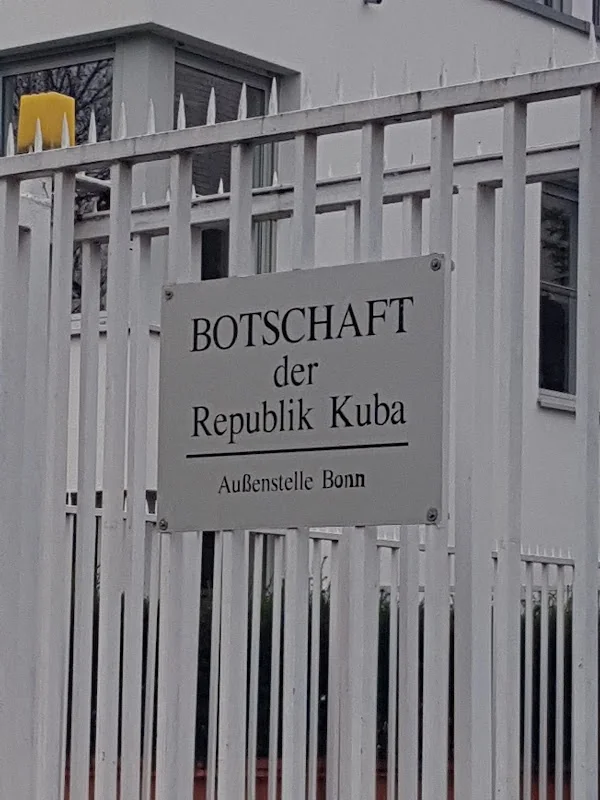
Bonn
Kennedyallee 22-24, 53175 Bonn-Bad Godesberg, Deutschland
Branch of the Embassy of Cuba Bonn | Contact & Opening Hours
The branch of the Embassy of Cuba in Bonn is a location with diplomatic character, a clear address, and a strong historical anchoring in Bad Godesberg. Those searching for Kennedyallee 22-24 will not find just any office building, but a place where Cuban representation, cultural work, and consular services have been bundled for many years. For most visitors, the focus is not on the large public spectacle, but on a specific reason: an appointment, an inquiry, a request for documents, a cultural event, or the search for a reliable contact point. The impact of the place is therefore more factual than touristy, and that is exactly what makes it so interesting for many inquiries. With a rating base of 3.2 stars from 60 reviews, it also shows that experiences on-site are apparently strongly influenced by personal errands, waiting times, and practical accessibility. Therefore, anyone wanting to understand the branch should not view it as a classic event location, but as a diplomatic contact point with public visibility in a historically significant Bonn location. ([auswaertiges-amt.de](https://www.auswaertiges-amt.de/de/service/laender/kuba-node/vertretungenkuba-212216?isLocal=false&isPreview=false&utm_source=openai))
Contact, Opening Hours, and Responsibilities at Kennedyallee
The Federal Foreign Office operates the branch of the Embassy of Cuba in Bonn at the address Kennedyallee 22-24, 53175 Bonn, and provides a phone number, fax, and email. The opening hours are stated as Monday to Thursday from 09:00 to 12:00. These basic details are particularly important for visitors as they form the most reliable publicly accessible framework. The Bonn branch is also expressly designated in the official entry as a place with a cultural department. This is an important indication as it shows that the facility in Bonn is not just an inconspicuous administrative office, but a part of the Cuban presence in Germany with its own substantive profile. For users searching for the branch of the Embassy of Cuba in Bonn, contact, or opening hours, these data points are the first reliable anchor points. Anyone planning a visit should therefore prepare for the officially stated time frame and organize their journey to arrive within the short morning window. ([auswaertiges-amt.de](https://www.auswaertiges-amt.de/de/service/laender/kuba-node/vertretungenkuba-212216?isLocal=false&isPreview=false&utm_source=openai))
At the same time, it is worth looking at the various directories, as they show that opening hours and listings can differ in detail. An international directory service states that the Bonn branch is open Monday to Friday from 08:30 to 12:00 and notes that the office is closed on weekends. This is not a contradiction in terms of a completely different address, but a practical example of why one should always verify directly with a diplomatic representation before heading out. The Federal Foreign Office also expressly points out that basic information is regularly updated and contact details may change. This wording is important for seekers as it describes the character of the branch as an official but not static location. Therefore, anyone searching for opening hours of the Embassy of Cuba, Cuba Bonn phone number, or contact Embassy Cuba should take the official information as a starting point and obtain the latest confirmation by phone. This saves trips, time, and uncertainty. ([embassypages.com](https://www.embassypages.com/cuba-embassybranchoffice-bonn-germany))
Directions to Kennedyallee 22-24 in Bad Godesberg
The location of the branch is pleasantly clear for orientation in Bonn: Kennedyallee 22-24 in Bad Godesberg, which is in a part of the city traditionally characterized by diplomatic and political addresses. Map and directory services classify the location as a building on Kennedyallee and also refer to it as the branch of the Embassy of Cuba or cultural department. Additionally, limited accessibility is noted, which is an important practical point for mobility-impaired visitors. The surroundings are not an anonymous outskirt but a well-defined area with several known reference points. In the immediate vicinity, among others, the Central Cemetery Bad Godesberg, the Holy Cross Church, and the German Museum Bonn are mentioned. Anyone who knows Bonn a little will immediately recognize that the address is thus located in a well-developed urban area. Especially for visitors who are not from Bonn, this spatial classification is helpful as it anchors the branch in the cityscape and makes searching for the right street easier. ([mapcarta.com](https://mapcarta.com/W150015727))
The public transport connections are also useful for getting there. An event flyer that explicitly mentions the address Kennedyallee 22-24 refers to the U-stop Hochkreuz. At the same time, a directory for the branch lists the Bonn-Bad Godesberg train station as a reference and estimates the distance at about 1.9 kilometers or around 23 minutes on foot. Practically, this means: The branch is accessible but not designed as a major transport hub, rather as a classic inner-city address to which one drives purposefully or plans a manageable walk. Anyone coming by car should clarify in advance where parking is possible, as no reliable official parking information is found in the verified sources. For this reason, public transport is often the less stressful choice. The orientation via Kennedyallee, Hochkreuz, and Bonn-Bad Godesberg is usually sufficient to find the location without detours. ([fgbrdkuba.de](https://www.fgbrdkuba.de/termine/flyer/20190201-frauen-in-kuba.pdf?utm_source=openai))
The immediate neighborhood also emphasizes that the branch does not appear isolated but is situated within a developed urban fabric. On the map, it appears as part of a neighborhood with closed building structures and places that serve well as orientation points. This is often typical for diplomatic buildings: They do not stand on a noisy exhibition mile but in an area with administrative and residential character that is still well connected. For visitors, this location is an advantage if they prefer exact addresses and want to combine their visit with other errands in Bad Godesberg. Additionally, the proximity to well-known city points is practical when planning a route or relying on Google Maps, public transport apps, or personal knowledge of the area. Therefore, anyone searching for directions Cuba Bonn, Cuba Bonn address, or Kennedyallee 22-24 receives a clear, stable location reference with meaningful reference points. The branch is thus easily findable, but intentionally without exaggerated public staging. ([mapcarta.com](https://mapcarta.com/W150015727))
History of the Cuban Representation in Bonn
The current branch has a long prehistory that goes far beyond the current address line. According to historical records, Cuba was represented in the Federal Republic of Germany from 1952 with a legation, initially with a provisional seat in Bad Neuenahr. By 1954, the representation moved to Cologne-Marienburg and was upgraded to an embassy in the same year. Around 1960, there was another relocation within Cologne to Kaiser-Wilhelm-Ring. These early stations show that the Cuban presence in West Germany did not arise by chance but developed gradually during the years of the Federal Republic. For Bonn, it is important that Cuba reopened an embassy at the then government seat in 1975 after the resumption of diplomatic relations. Initially, it was located in the Hotel Königshof, later at Kölner Straße 54 in Bad Godesberg. The branch on Kennedyallee eventually became the permanent location in the southern part of Bonn or the northern part of Bad Godesberg in this development. ([de.wikipedia.org](https://de.wikipedia.org/wiki/Botschaft_der_Republik_Kuba_%28Bonn%29))
Particularly interesting is the phase after the relocation of the government seat to Berlin. The sources indicate that Cuba did not completely abandon its presence in Bonn but maintained a branch at the previous chancery building. This decision is historically typical for many diplomatic missions that did not immediately disappear after the federal government's move to Berlin but continued to operate for practical and symbolic reasons. In the case of Cuba, the Bonn address remained as a branch, among other things with a cultural department and consular functions. The Kennedyallee itself also represents this Bonn of diplomacy, as it is one of the streets that were strongly characterized by foreign representations during the time of the federal capital. Thus, the Cuban branch is not only a current office but also a piece of continuation history: a location that has survived the political shifts from Bonn to Berlin and remains visible to this day. Therefore, anyone searching for the term history Cuba Bonn, branch Bonn, or Kennedyallee Cuba will always encounter this longer diplomatic line. ([de.wikipedia.org](https://de.wikipedia.org/wiki/Botschaft_der_Republik_Kuba_%28Bonn%29))
The history also explains why the location appears in many directories under different names. Sometimes it is referred to as the Embassy of the Republic of Cuba in Bonn, sometimes as the branch of the Embassy of Cuba, and sometimes as the cultural department. This is because the function of the building has changed over the years, but the address itself has remained a reliable fixed point. This is particularly important for SEO and user searches: When someone remembers Bonn, they do not automatically mean a classic embassy like in a capital but often a residual presence from the Bonn era of diplomacy. The history of the branch makes it clear why the location is so frequently combined with terms like address, opening hours, consular department, or cultural department in search queries. Behind these search terms is not a large event operation but a diplomatic continuity that extends from the Bonn Republic into the present. This gives the location a special historical layering and simultaneously explains why it is relevant for those interested in Cuba, applicants, and those interested in cultural policy alike. ([de.wikipedia.org](https://de.wikipedia.org/wiki/Botschaft_der_Republik_Kuba_%28Bonn%29))
Cultural Department and Events at the Location
The Federal Foreign Office explicitly lists a cultural department for Bonn. This official designation is a strong signal, as it shows that the location cannot be reduced to just files and appointments. Cultural departments are important bridging spaces in diplomatic everyday life: They make the country, language, memory, and relationships more visible and often serve as a place for presentations, encounters, and informational events. It is well documented that cultural and solidarity formats have taken place at the Bonn branch. An event call mentions, for example, the Fiesta Moncada in Bonn directly at the branch of the Embassy of Cuba, Kennedyallee 22-24. Cuban cuisine, live music, and information were announced there. This clearly shows that the location was also used as an open event venue for Cuba-related meetings at times. Therefore, anyone searching for program, event, or cultural department Cuba Bonn will not encounter mere theory here but documented practice. ([auswaertiges-amt.de](https://www.auswaertiges-amt.de/de/service/laender/kuba-node/vertretungenkuba-212216?isLocal=false&isPreview=false&utm_source=openai))
Another flyer from 2017 also documents the use as a place for thematic meetings. There, a Cuba-related event with Franco Cavalli was announced at the Bonn branch of the Embassy of Cuba. The announcement not only shows that the address was known and usable but also that the location served as a meeting point for political, solidarity, and professional discussions. Such events are important for understanding the location as they bring the branch out of the purely administrative shadow. It is not just a counter for individual inquiries but part of Cuba's cultural public relations work in Germany. This also explains why search queries with the words events, culture, or program in this context are not entirely out of place, even though it is not a classic hall. The branch in Bonn is rather a hybrid place: diplomatic, cultural, communication-oriented, and at times also used communally. This mixture makes it interesting for websites that want to not only capture location data but also provide real utility. ([fgbrdkuba.de](https://www.fgbrdkuba.de/termine/flyer/20170218-medicuba-bonn.pdf))
However, it is important to set the context correctly. The Bonn branch is not a concert hall with fixed seating, not a theater, and not a large event arena, but a diplomatic institution with culture-related activities. Therefore, search terms like seating plan or seats are only very limitedly meaningful here. More relevant are terms like cultural department, event, contact, or opening hours. Those who understand this will also evaluate the location more realistically: The exciting aspect lies not in spectacular architecture or a huge number of visitors but in the combination of political history, cultural presence, and clear local positioning. Especially in Bonn, where many diplomatic houses once shaped the cityscape, this is an important context. The Bonn branch of the Embassy of Cuba is thus an example of how a diplomatic location remains visible over decades while continuously adopting new forms of use. ([de.wikipedia.org](https://de.wikipedia.org/wiki/Botschaft_der_Republik_Kuba_%28Bonn%29))
Reviews, Visitor Reality, and Practical Tips
With 3.2 stars from 60 reviews, the public rating of the branch is not in the top range, but also not in the realm of complete rejection. For a diplomatic address, this is not unusual, as ratings there are usually shaped by very practical experiences: accessibility, waiting time, clarity of information, appointment organization, and the question of how pleasant a necessary visit was perceived. Unlike a leisure location, the focus here is not on entertainment but on the completion of a specific concern. For this reason, a rating at such a place often turns out to be more sober than at tourist attractions. Therefore, anyone searching for reviews of the branch of the Embassy of Cuba in Bonn should always read the numbers in context. The place is not a venue for spontaneous audiences but for people with a factual mandate. This classification helps to realistically assess the star rating without giving it more significance than it has in an administrative and diplomatic context.
Practically, it is especially important that the official information is relatively clear but should still be verified before the visit. The Federal Foreign Office expressly points out that basic information is regularly updated and contact details may change. At the same time, the available directories show that there may be small deviations in the opening hours. For visitors, this means: Call in advance, confirm current accessibility, and plan enough buffer time for longer journeys. The location at Kennedyallee is well usable for access but not designed for mass public traffic. Those coming by public transport are usually on the safe side; those driving should check parking options in advance, as no official parking list is mentioned in the verified sources. The limited accessibility, as noted in map sources, should also be kept in mind. Thus, the branch is a location where good preparation is more important than spontaneity. This is especially true for anyone wanting to submit a document, obtain information, or attend an appointment. ([auswaertiges-amt.de](https://www.auswaertiges-amt.de/de/service/laender/kuba-node/vertretungenkuba-212216?isLocal=false&isPreview=false&utm_source=openai))
Sources:
- Federal Foreign Office - Representations of Cuba in Germany
- Wikipedia - Embassy of the Republic of Cuba (Bonn)
- Embassypages - Embassy Branch Office of Cuba in Bonn
- Mapcarta - Branch of Embassy of Cuba, Bonn
- Friendship Society BRD-Cuba - Dates
- Friendship Society BRD-Cuba - Fiesta Moncada Flyer
- Friendship Society BRD-Cuba - mediCuba Bonn Flyer
Show moreShow less
Branch of the Embassy of Cuba Bonn | Contact & Opening Hours
The branch of the Embassy of Cuba in Bonn is a location with diplomatic character, a clear address, and a strong historical anchoring in Bad Godesberg. Those searching for Kennedyallee 22-24 will not find just any office building, but a place where Cuban representation, cultural work, and consular services have been bundled for many years. For most visitors, the focus is not on the large public spectacle, but on a specific reason: an appointment, an inquiry, a request for documents, a cultural event, or the search for a reliable contact point. The impact of the place is therefore more factual than touristy, and that is exactly what makes it so interesting for many inquiries. With a rating base of 3.2 stars from 60 reviews, it also shows that experiences on-site are apparently strongly influenced by personal errands, waiting times, and practical accessibility. Therefore, anyone wanting to understand the branch should not view it as a classic event location, but as a diplomatic contact point with public visibility in a historically significant Bonn location. ([auswaertiges-amt.de](https://www.auswaertiges-amt.de/de/service/laender/kuba-node/vertretungenkuba-212216?isLocal=false&isPreview=false&utm_source=openai))
Contact, Opening Hours, and Responsibilities at Kennedyallee
The Federal Foreign Office operates the branch of the Embassy of Cuba in Bonn at the address Kennedyallee 22-24, 53175 Bonn, and provides a phone number, fax, and email. The opening hours are stated as Monday to Thursday from 09:00 to 12:00. These basic details are particularly important for visitors as they form the most reliable publicly accessible framework. The Bonn branch is also expressly designated in the official entry as a place with a cultural department. This is an important indication as it shows that the facility in Bonn is not just an inconspicuous administrative office, but a part of the Cuban presence in Germany with its own substantive profile. For users searching for the branch of the Embassy of Cuba in Bonn, contact, or opening hours, these data points are the first reliable anchor points. Anyone planning a visit should therefore prepare for the officially stated time frame and organize their journey to arrive within the short morning window. ([auswaertiges-amt.de](https://www.auswaertiges-amt.de/de/service/laender/kuba-node/vertretungenkuba-212216?isLocal=false&isPreview=false&utm_source=openai))
At the same time, it is worth looking at the various directories, as they show that opening hours and listings can differ in detail. An international directory service states that the Bonn branch is open Monday to Friday from 08:30 to 12:00 and notes that the office is closed on weekends. This is not a contradiction in terms of a completely different address, but a practical example of why one should always verify directly with a diplomatic representation before heading out. The Federal Foreign Office also expressly points out that basic information is regularly updated and contact details may change. This wording is important for seekers as it describes the character of the branch as an official but not static location. Therefore, anyone searching for opening hours of the Embassy of Cuba, Cuba Bonn phone number, or contact Embassy Cuba should take the official information as a starting point and obtain the latest confirmation by phone. This saves trips, time, and uncertainty. ([embassypages.com](https://www.embassypages.com/cuba-embassybranchoffice-bonn-germany))
Directions to Kennedyallee 22-24 in Bad Godesberg
The location of the branch is pleasantly clear for orientation in Bonn: Kennedyallee 22-24 in Bad Godesberg, which is in a part of the city traditionally characterized by diplomatic and political addresses. Map and directory services classify the location as a building on Kennedyallee and also refer to it as the branch of the Embassy of Cuba or cultural department. Additionally, limited accessibility is noted, which is an important practical point for mobility-impaired visitors. The surroundings are not an anonymous outskirt but a well-defined area with several known reference points. In the immediate vicinity, among others, the Central Cemetery Bad Godesberg, the Holy Cross Church, and the German Museum Bonn are mentioned. Anyone who knows Bonn a little will immediately recognize that the address is thus located in a well-developed urban area. Especially for visitors who are not from Bonn, this spatial classification is helpful as it anchors the branch in the cityscape and makes searching for the right street easier. ([mapcarta.com](https://mapcarta.com/W150015727))
The public transport connections are also useful for getting there. An event flyer that explicitly mentions the address Kennedyallee 22-24 refers to the U-stop Hochkreuz. At the same time, a directory for the branch lists the Bonn-Bad Godesberg train station as a reference and estimates the distance at about 1.9 kilometers or around 23 minutes on foot. Practically, this means: The branch is accessible but not designed as a major transport hub, rather as a classic inner-city address to which one drives purposefully or plans a manageable walk. Anyone coming by car should clarify in advance where parking is possible, as no reliable official parking information is found in the verified sources. For this reason, public transport is often the less stressful choice. The orientation via Kennedyallee, Hochkreuz, and Bonn-Bad Godesberg is usually sufficient to find the location without detours. ([fgbrdkuba.de](https://www.fgbrdkuba.de/termine/flyer/20190201-frauen-in-kuba.pdf?utm_source=openai))
The immediate neighborhood also emphasizes that the branch does not appear isolated but is situated within a developed urban fabric. On the map, it appears as part of a neighborhood with closed building structures and places that serve well as orientation points. This is often typical for diplomatic buildings: They do not stand on a noisy exhibition mile but in an area with administrative and residential character that is still well connected. For visitors, this location is an advantage if they prefer exact addresses and want to combine their visit with other errands in Bad Godesberg. Additionally, the proximity to well-known city points is practical when planning a route or relying on Google Maps, public transport apps, or personal knowledge of the area. Therefore, anyone searching for directions Cuba Bonn, Cuba Bonn address, or Kennedyallee 22-24 receives a clear, stable location reference with meaningful reference points. The branch is thus easily findable, but intentionally without exaggerated public staging. ([mapcarta.com](https://mapcarta.com/W150015727))
History of the Cuban Representation in Bonn
The current branch has a long prehistory that goes far beyond the current address line. According to historical records, Cuba was represented in the Federal Republic of Germany from 1952 with a legation, initially with a provisional seat in Bad Neuenahr. By 1954, the representation moved to Cologne-Marienburg and was upgraded to an embassy in the same year. Around 1960, there was another relocation within Cologne to Kaiser-Wilhelm-Ring. These early stations show that the Cuban presence in West Germany did not arise by chance but developed gradually during the years of the Federal Republic. For Bonn, it is important that Cuba reopened an embassy at the then government seat in 1975 after the resumption of diplomatic relations. Initially, it was located in the Hotel Königshof, later at Kölner Straße 54 in Bad Godesberg. The branch on Kennedyallee eventually became the permanent location in the southern part of Bonn or the northern part of Bad Godesberg in this development. ([de.wikipedia.org](https://de.wikipedia.org/wiki/Botschaft_der_Republik_Kuba_%28Bonn%29))
Particularly interesting is the phase after the relocation of the government seat to Berlin. The sources indicate that Cuba did not completely abandon its presence in Bonn but maintained a branch at the previous chancery building. This decision is historically typical for many diplomatic missions that did not immediately disappear after the federal government's move to Berlin but continued to operate for practical and symbolic reasons. In the case of Cuba, the Bonn address remained as a branch, among other things with a cultural department and consular functions. The Kennedyallee itself also represents this Bonn of diplomacy, as it is one of the streets that were strongly characterized by foreign representations during the time of the federal capital. Thus, the Cuban branch is not only a current office but also a piece of continuation history: a location that has survived the political shifts from Bonn to Berlin and remains visible to this day. Therefore, anyone searching for the term history Cuba Bonn, branch Bonn, or Kennedyallee Cuba will always encounter this longer diplomatic line. ([de.wikipedia.org](https://de.wikipedia.org/wiki/Botschaft_der_Republik_Kuba_%28Bonn%29))
The history also explains why the location appears in many directories under different names. Sometimes it is referred to as the Embassy of the Republic of Cuba in Bonn, sometimes as the branch of the Embassy of Cuba, and sometimes as the cultural department. This is because the function of the building has changed over the years, but the address itself has remained a reliable fixed point. This is particularly important for SEO and user searches: When someone remembers Bonn, they do not automatically mean a classic embassy like in a capital but often a residual presence from the Bonn era of diplomacy. The history of the branch makes it clear why the location is so frequently combined with terms like address, opening hours, consular department, or cultural department in search queries. Behind these search terms is not a large event operation but a diplomatic continuity that extends from the Bonn Republic into the present. This gives the location a special historical layering and simultaneously explains why it is relevant for those interested in Cuba, applicants, and those interested in cultural policy alike. ([de.wikipedia.org](https://de.wikipedia.org/wiki/Botschaft_der_Republik_Kuba_%28Bonn%29))
Cultural Department and Events at the Location
The Federal Foreign Office explicitly lists a cultural department for Bonn. This official designation is a strong signal, as it shows that the location cannot be reduced to just files and appointments. Cultural departments are important bridging spaces in diplomatic everyday life: They make the country, language, memory, and relationships more visible and often serve as a place for presentations, encounters, and informational events. It is well documented that cultural and solidarity formats have taken place at the Bonn branch. An event call mentions, for example, the Fiesta Moncada in Bonn directly at the branch of the Embassy of Cuba, Kennedyallee 22-24. Cuban cuisine, live music, and information were announced there. This clearly shows that the location was also used as an open event venue for Cuba-related meetings at times. Therefore, anyone searching for program, event, or cultural department Cuba Bonn will not encounter mere theory here but documented practice. ([auswaertiges-amt.de](https://www.auswaertiges-amt.de/de/service/laender/kuba-node/vertretungenkuba-212216?isLocal=false&isPreview=false&utm_source=openai))
Another flyer from 2017 also documents the use as a place for thematic meetings. There, a Cuba-related event with Franco Cavalli was announced at the Bonn branch of the Embassy of Cuba. The announcement not only shows that the address was known and usable but also that the location served as a meeting point for political, solidarity, and professional discussions. Such events are important for understanding the location as they bring the branch out of the purely administrative shadow. It is not just a counter for individual inquiries but part of Cuba's cultural public relations work in Germany. This also explains why search queries with the words events, culture, or program in this context are not entirely out of place, even though it is not a classic hall. The branch in Bonn is rather a hybrid place: diplomatic, cultural, communication-oriented, and at times also used communally. This mixture makes it interesting for websites that want to not only capture location data but also provide real utility. ([fgbrdkuba.de](https://www.fgbrdkuba.de/termine/flyer/20170218-medicuba-bonn.pdf))
However, it is important to set the context correctly. The Bonn branch is not a concert hall with fixed seating, not a theater, and not a large event arena, but a diplomatic institution with culture-related activities. Therefore, search terms like seating plan or seats are only very limitedly meaningful here. More relevant are terms like cultural department, event, contact, or opening hours. Those who understand this will also evaluate the location more realistically: The exciting aspect lies not in spectacular architecture or a huge number of visitors but in the combination of political history, cultural presence, and clear local positioning. Especially in Bonn, where many diplomatic houses once shaped the cityscape, this is an important context. The Bonn branch of the Embassy of Cuba is thus an example of how a diplomatic location remains visible over decades while continuously adopting new forms of use. ([de.wikipedia.org](https://de.wikipedia.org/wiki/Botschaft_der_Republik_Kuba_%28Bonn%29))
Reviews, Visitor Reality, and Practical Tips
With 3.2 stars from 60 reviews, the public rating of the branch is not in the top range, but also not in the realm of complete rejection. For a diplomatic address, this is not unusual, as ratings there are usually shaped by very practical experiences: accessibility, waiting time, clarity of information, appointment organization, and the question of how pleasant a necessary visit was perceived. Unlike a leisure location, the focus here is not on entertainment but on the completion of a specific concern. For this reason, a rating at such a place often turns out to be more sober than at tourist attractions. Therefore, anyone searching for reviews of the branch of the Embassy of Cuba in Bonn should always read the numbers in context. The place is not a venue for spontaneous audiences but for people with a factual mandate. This classification helps to realistically assess the star rating without giving it more significance than it has in an administrative and diplomatic context.
Practically, it is especially important that the official information is relatively clear but should still be verified before the visit. The Federal Foreign Office expressly points out that basic information is regularly updated and contact details may change. At the same time, the available directories show that there may be small deviations in the opening hours. For visitors, this means: Call in advance, confirm current accessibility, and plan enough buffer time for longer journeys. The location at Kennedyallee is well usable for access but not designed for mass public traffic. Those coming by public transport are usually on the safe side; those driving should check parking options in advance, as no official parking list is mentioned in the verified sources. The limited accessibility, as noted in map sources, should also be kept in mind. Thus, the branch is a location where good preparation is more important than spontaneity. This is especially true for anyone wanting to submit a document, obtain information, or attend an appointment. ([auswaertiges-amt.de](https://www.auswaertiges-amt.de/de/service/laender/kuba-node/vertretungenkuba-212216?isLocal=false&isPreview=false&utm_source=openai))
Sources:
- Federal Foreign Office - Representations of Cuba in Germany
- Wikipedia - Embassy of the Republic of Cuba (Bonn)
- Embassypages - Embassy Branch Office of Cuba in Bonn
- Mapcarta - Branch of Embassy of Cuba, Bonn
- Friendship Society BRD-Cuba - Dates
- Friendship Society BRD-Cuba - Fiesta Moncada Flyer
- Friendship Society BRD-Cuba - mediCuba Bonn Flyer
Branch of the Embassy of Cuba Bonn | Contact & Opening Hours
The branch of the Embassy of Cuba in Bonn is a location with diplomatic character, a clear address, and a strong historical anchoring in Bad Godesberg. Those searching for Kennedyallee 22-24 will not find just any office building, but a place where Cuban representation, cultural work, and consular services have been bundled for many years. For most visitors, the focus is not on the large public spectacle, but on a specific reason: an appointment, an inquiry, a request for documents, a cultural event, or the search for a reliable contact point. The impact of the place is therefore more factual than touristy, and that is exactly what makes it so interesting for many inquiries. With a rating base of 3.2 stars from 60 reviews, it also shows that experiences on-site are apparently strongly influenced by personal errands, waiting times, and practical accessibility. Therefore, anyone wanting to understand the branch should not view it as a classic event location, but as a diplomatic contact point with public visibility in a historically significant Bonn location. ([auswaertiges-amt.de](https://www.auswaertiges-amt.de/de/service/laender/kuba-node/vertretungenkuba-212216?isLocal=false&isPreview=false&utm_source=openai))
Contact, Opening Hours, and Responsibilities at Kennedyallee
The Federal Foreign Office operates the branch of the Embassy of Cuba in Bonn at the address Kennedyallee 22-24, 53175 Bonn, and provides a phone number, fax, and email. The opening hours are stated as Monday to Thursday from 09:00 to 12:00. These basic details are particularly important for visitors as they form the most reliable publicly accessible framework. The Bonn branch is also expressly designated in the official entry as a place with a cultural department. This is an important indication as it shows that the facility in Bonn is not just an inconspicuous administrative office, but a part of the Cuban presence in Germany with its own substantive profile. For users searching for the branch of the Embassy of Cuba in Bonn, contact, or opening hours, these data points are the first reliable anchor points. Anyone planning a visit should therefore prepare for the officially stated time frame and organize their journey to arrive within the short morning window. ([auswaertiges-amt.de](https://www.auswaertiges-amt.de/de/service/laender/kuba-node/vertretungenkuba-212216?isLocal=false&isPreview=false&utm_source=openai))
At the same time, it is worth looking at the various directories, as they show that opening hours and listings can differ in detail. An international directory service states that the Bonn branch is open Monday to Friday from 08:30 to 12:00 and notes that the office is closed on weekends. This is not a contradiction in terms of a completely different address, but a practical example of why one should always verify directly with a diplomatic representation before heading out. The Federal Foreign Office also expressly points out that basic information is regularly updated and contact details may change. This wording is important for seekers as it describes the character of the branch as an official but not static location. Therefore, anyone searching for opening hours of the Embassy of Cuba, Cuba Bonn phone number, or contact Embassy Cuba should take the official information as a starting point and obtain the latest confirmation by phone. This saves trips, time, and uncertainty. ([embassypages.com](https://www.embassypages.com/cuba-embassybranchoffice-bonn-germany))
Directions to Kennedyallee 22-24 in Bad Godesberg
The location of the branch is pleasantly clear for orientation in Bonn: Kennedyallee 22-24 in Bad Godesberg, which is in a part of the city traditionally characterized by diplomatic and political addresses. Map and directory services classify the location as a building on Kennedyallee and also refer to it as the branch of the Embassy of Cuba or cultural department. Additionally, limited accessibility is noted, which is an important practical point for mobility-impaired visitors. The surroundings are not an anonymous outskirt but a well-defined area with several known reference points. In the immediate vicinity, among others, the Central Cemetery Bad Godesberg, the Holy Cross Church, and the German Museum Bonn are mentioned. Anyone who knows Bonn a little will immediately recognize that the address is thus located in a well-developed urban area. Especially for visitors who are not from Bonn, this spatial classification is helpful as it anchors the branch in the cityscape and makes searching for the right street easier. ([mapcarta.com](https://mapcarta.com/W150015727))
The public transport connections are also useful for getting there. An event flyer that explicitly mentions the address Kennedyallee 22-24 refers to the U-stop Hochkreuz. At the same time, a directory for the branch lists the Bonn-Bad Godesberg train station as a reference and estimates the distance at about 1.9 kilometers or around 23 minutes on foot. Practically, this means: The branch is accessible but not designed as a major transport hub, rather as a classic inner-city address to which one drives purposefully or plans a manageable walk. Anyone coming by car should clarify in advance where parking is possible, as no reliable official parking information is found in the verified sources. For this reason, public transport is often the less stressful choice. The orientation via Kennedyallee, Hochkreuz, and Bonn-Bad Godesberg is usually sufficient to find the location without detours. ([fgbrdkuba.de](https://www.fgbrdkuba.de/termine/flyer/20190201-frauen-in-kuba.pdf?utm_source=openai))
The immediate neighborhood also emphasizes that the branch does not appear isolated but is situated within a developed urban fabric. On the map, it appears as part of a neighborhood with closed building structures and places that serve well as orientation points. This is often typical for diplomatic buildings: They do not stand on a noisy exhibition mile but in an area with administrative and residential character that is still well connected. For visitors, this location is an advantage if they prefer exact addresses and want to combine their visit with other errands in Bad Godesberg. Additionally, the proximity to well-known city points is practical when planning a route or relying on Google Maps, public transport apps, or personal knowledge of the area. Therefore, anyone searching for directions Cuba Bonn, Cuba Bonn address, or Kennedyallee 22-24 receives a clear, stable location reference with meaningful reference points. The branch is thus easily findable, but intentionally without exaggerated public staging. ([mapcarta.com](https://mapcarta.com/W150015727))
History of the Cuban Representation in Bonn
The current branch has a long prehistory that goes far beyond the current address line. According to historical records, Cuba was represented in the Federal Republic of Germany from 1952 with a legation, initially with a provisional seat in Bad Neuenahr. By 1954, the representation moved to Cologne-Marienburg and was upgraded to an embassy in the same year. Around 1960, there was another relocation within Cologne to Kaiser-Wilhelm-Ring. These early stations show that the Cuban presence in West Germany did not arise by chance but developed gradually during the years of the Federal Republic. For Bonn, it is important that Cuba reopened an embassy at the then government seat in 1975 after the resumption of diplomatic relations. Initially, it was located in the Hotel Königshof, later at Kölner Straße 54 in Bad Godesberg. The branch on Kennedyallee eventually became the permanent location in the southern part of Bonn or the northern part of Bad Godesberg in this development. ([de.wikipedia.org](https://de.wikipedia.org/wiki/Botschaft_der_Republik_Kuba_%28Bonn%29))
Particularly interesting is the phase after the relocation of the government seat to Berlin. The sources indicate that Cuba did not completely abandon its presence in Bonn but maintained a branch at the previous chancery building. This decision is historically typical for many diplomatic missions that did not immediately disappear after the federal government's move to Berlin but continued to operate for practical and symbolic reasons. In the case of Cuba, the Bonn address remained as a branch, among other things with a cultural department and consular functions. The Kennedyallee itself also represents this Bonn of diplomacy, as it is one of the streets that were strongly characterized by foreign representations during the time of the federal capital. Thus, the Cuban branch is not only a current office but also a piece of continuation history: a location that has survived the political shifts from Bonn to Berlin and remains visible to this day. Therefore, anyone searching for the term history Cuba Bonn, branch Bonn, or Kennedyallee Cuba will always encounter this longer diplomatic line. ([de.wikipedia.org](https://de.wikipedia.org/wiki/Botschaft_der_Republik_Kuba_%28Bonn%29))
The history also explains why the location appears in many directories under different names. Sometimes it is referred to as the Embassy of the Republic of Cuba in Bonn, sometimes as the branch of the Embassy of Cuba, and sometimes as the cultural department. This is because the function of the building has changed over the years, but the address itself has remained a reliable fixed point. This is particularly important for SEO and user searches: When someone remembers Bonn, they do not automatically mean a classic embassy like in a capital but often a residual presence from the Bonn era of diplomacy. The history of the branch makes it clear why the location is so frequently combined with terms like address, opening hours, consular department, or cultural department in search queries. Behind these search terms is not a large event operation but a diplomatic continuity that extends from the Bonn Republic into the present. This gives the location a special historical layering and simultaneously explains why it is relevant for those interested in Cuba, applicants, and those interested in cultural policy alike. ([de.wikipedia.org](https://de.wikipedia.org/wiki/Botschaft_der_Republik_Kuba_%28Bonn%29))
Cultural Department and Events at the Location
The Federal Foreign Office explicitly lists a cultural department for Bonn. This official designation is a strong signal, as it shows that the location cannot be reduced to just files and appointments. Cultural departments are important bridging spaces in diplomatic everyday life: They make the country, language, memory, and relationships more visible and often serve as a place for presentations, encounters, and informational events. It is well documented that cultural and solidarity formats have taken place at the Bonn branch. An event call mentions, for example, the Fiesta Moncada in Bonn directly at the branch of the Embassy of Cuba, Kennedyallee 22-24. Cuban cuisine, live music, and information were announced there. This clearly shows that the location was also used as an open event venue for Cuba-related meetings at times. Therefore, anyone searching for program, event, or cultural department Cuba Bonn will not encounter mere theory here but documented practice. ([auswaertiges-amt.de](https://www.auswaertiges-amt.de/de/service/laender/kuba-node/vertretungenkuba-212216?isLocal=false&isPreview=false&utm_source=openai))
Another flyer from 2017 also documents the use as a place for thematic meetings. There, a Cuba-related event with Franco Cavalli was announced at the Bonn branch of the Embassy of Cuba. The announcement not only shows that the address was known and usable but also that the location served as a meeting point for political, solidarity, and professional discussions. Such events are important for understanding the location as they bring the branch out of the purely administrative shadow. It is not just a counter for individual inquiries but part of Cuba's cultural public relations work in Germany. This also explains why search queries with the words events, culture, or program in this context are not entirely out of place, even though it is not a classic hall. The branch in Bonn is rather a hybrid place: diplomatic, cultural, communication-oriented, and at times also used communally. This mixture makes it interesting for websites that want to not only capture location data but also provide real utility. ([fgbrdkuba.de](https://www.fgbrdkuba.de/termine/flyer/20170218-medicuba-bonn.pdf))
However, it is important to set the context correctly. The Bonn branch is not a concert hall with fixed seating, not a theater, and not a large event arena, but a diplomatic institution with culture-related activities. Therefore, search terms like seating plan or seats are only very limitedly meaningful here. More relevant are terms like cultural department, event, contact, or opening hours. Those who understand this will also evaluate the location more realistically: The exciting aspect lies not in spectacular architecture or a huge number of visitors but in the combination of political history, cultural presence, and clear local positioning. Especially in Bonn, where many diplomatic houses once shaped the cityscape, this is an important context. The Bonn branch of the Embassy of Cuba is thus an example of how a diplomatic location remains visible over decades while continuously adopting new forms of use. ([de.wikipedia.org](https://de.wikipedia.org/wiki/Botschaft_der_Republik_Kuba_%28Bonn%29))
Reviews, Visitor Reality, and Practical Tips
With 3.2 stars from 60 reviews, the public rating of the branch is not in the top range, but also not in the realm of complete rejection. For a diplomatic address, this is not unusual, as ratings there are usually shaped by very practical experiences: accessibility, waiting time, clarity of information, appointment organization, and the question of how pleasant a necessary visit was perceived. Unlike a leisure location, the focus here is not on entertainment but on the completion of a specific concern. For this reason, a rating at such a place often turns out to be more sober than at tourist attractions. Therefore, anyone searching for reviews of the branch of the Embassy of Cuba in Bonn should always read the numbers in context. The place is not a venue for spontaneous audiences but for people with a factual mandate. This classification helps to realistically assess the star rating without giving it more significance than it has in an administrative and diplomatic context.
Practically, it is especially important that the official information is relatively clear but should still be verified before the visit. The Federal Foreign Office expressly points out that basic information is regularly updated and contact details may change. At the same time, the available directories show that there may be small deviations in the opening hours. For visitors, this means: Call in advance, confirm current accessibility, and plan enough buffer time for longer journeys. The location at Kennedyallee is well usable for access but not designed for mass public traffic. Those coming by public transport are usually on the safe side; those driving should check parking options in advance, as no official parking list is mentioned in the verified sources. The limited accessibility, as noted in map sources, should also be kept in mind. Thus, the branch is a location where good preparation is more important than spontaneity. This is especially true for anyone wanting to submit a document, obtain information, or attend an appointment. ([auswaertiges-amt.de](https://www.auswaertiges-amt.de/de/service/laender/kuba-node/vertretungenkuba-212216?isLocal=false&isPreview=false&utm_source=openai))
Sources:
- Federal Foreign Office - Representations of Cuba in Germany
- Wikipedia - Embassy of the Republic of Cuba (Bonn)
- Embassypages - Embassy Branch Office of Cuba in Bonn
- Mapcarta - Branch of Embassy of Cuba, Bonn
- Friendship Society BRD-Cuba - Dates
- Friendship Society BRD-Cuba - Fiesta Moncada Flyer
- Friendship Society BRD-Cuba - mediCuba Bonn Flyer
Frequently Asked Questions
Reviews
No reviews found