
Bonn
Bornheimer Str., 53111 Bonn, Deutschland
Old Cemetery Bonn | Tours & Opening Hours
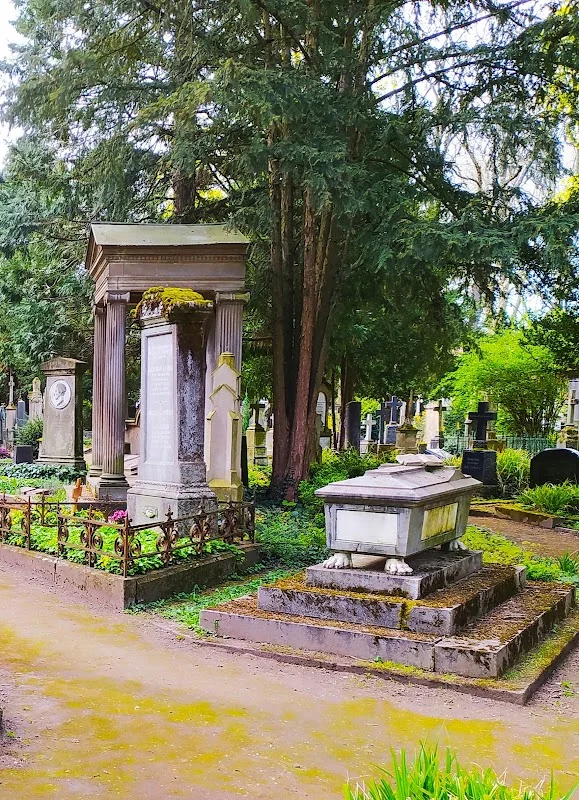
The Old Cemetery Bonn is much more than a classic burial site. It is a historical monument, a green oasis in a central location, and a quiet cultural space where urban history, memory culture, and nature meet in a special way. Walking through the grounds, one experiences not only artistic tombstones and old trees but also an atmosphere that is almost unique in Bonn. The cemetery is located near the town hall and thus in the midst of urban life, yet it feels remarkably calm and sheltered inside. This contrast is precisely what makes it appealing: outside, traffic and urbanity; inside, collection, history, and a nearly park-like feeling. The graves primarily reflect the cultural and intellectual history of the 19th and 20th centuries, including great names from music, science, politics, and literature. Particularly well-known are Clara and Robert Schumann, as well as Beethoven's mother. Additionally, there is the Georg Chapel, regular tours, concerts, and events that keep the place lively without disturbing its dignified character. Three of the old trees are even under nature protection. Thus, the Old Cemetery Bonn connects memory, nature, and the present in a site that invites visitors to discover and pause alike. ([alterfriedhofbonn.de](https://alterfriedhofbonn.de/))
Tours and Opening Hours at the Old Cemetery Bonn
Those who wish to visit the Old Cemetery Bonn not just spontaneously but also want to understand it more deeply should take advantage of the tours. The support association offers art-historical guided tours in collaboration with the Office for Urban Greenery of the Federal City of Bonn from March 1 to October 31 every Saturday at 2:00 PM and every Sunday at 11:00 AM. These tours include a visit to the medieval chapel and provide a structured approach to the most important graves, sculptures, and historical contexts. For many guests, this is the best introduction, as the place may seem quiet and manageable at first glance, but reveals a very complex history. Particularly convenient is that no registration is required for the regular tours. Those who prefer to come individually can plan their visit well: In summer, the cemetery is open from 7:30 AM to 8:00 PM, and in winter from 8:00 AM to 5:00 PM. This makes a visit flexible, whether for a short walk, targeted research, or a longer stay with a break among the graves. ([alterfriedhofbonn.de](https://alterfriedhofbonn.de/fuehrungen))
The themed tours are also a strong argument for a visit. The association's website regularly highlights themes ranging from significant women to angel and image themes, music city, professors' graves, British burial sites, or the cemetery as a park. This clearly shows that the Old Cemetery is not only a place of remembrance but also a place of learning, where art, social, and urban history can be observed in concentrated form. The themes reflect the complexity of the site and make it interesting for both locals and guests who already know Bonn. Group tours are also possible year-round upon request, in English and French as well. This is particularly helpful for travel groups, school classes, clubs, or international guests. Those who wish to prepare their tour can also refer to an information sheet and a map marking central graves. This transforms a quiet walk into a well-planned cultural appointment with clear added value. ([alterfriedhofbonn.de](https://alterfriedhofbonn.de/onewebmedia/Sonstiges/Alter%20Friedhof%20Informationsblatt%202024.pdf))
Map, Entrance, and Parking at the Old Cemetery Bonn
For orientation, the official map of the Old Cemetery Bonn is very useful, as it highlights several significant graves. So, if you want to get an overview first, you can prepare for your visit based on the map and arrange the most important stations in a sensible order. This is especially practical if you have already researched specific keywords like map, entrance, or photos in advance. The main entrance is located at the corner of Bornheimer Str. 1 and Am Alten Friedhof, 53111 Bonn, near the town hall. This location is a real advantage because the site is in the middle of the city yet maintains a sheltered, quiet atmosphere. Those visiting the cemetery for the first time should remember this corner, as it marks the beginning of the easiest and most logical tour. For guests arriving by car, the town hall garage is the most convenient solution. According to BCP, it is about 75 meters from the Old Cemetery, is open 24 hours, and provides direct access to the town hall and the town hall passage. This makes getting there particularly uncomplicated if you do not want to search long for a parking space. ([alterfriedhofbonn.de](https://alterfriedhofbonn.de/plan))
Even without a car, the Old Cemetery is easily accessible. In the immediate vicinity, the town hall stop is served by several lines, including tram lines and buses, which keep the walking distance to the entrance short. For rough orientation, it is sufficient to remember the direction from the town hall to the Old Cemetery; from there, it is only a few minutes on foot. It is also practical that the area is not only intended for a short visit. The proximity to the city center, authorities, gastronomy, and other cultural points allows the cemetery to be included as part of a larger walk through Bonn. Therefore, when considering parking, entrance, and map together, one can organize the visit stress-free and without time pressure. Especially since the site has grown historically and was not designed like a modern excursion destination, a little preparation is worthwhile. Thus, a spontaneous search for the entrance quickly becomes a relaxed tour with a clear route, where the most important stations are not overlooked. ([bcp-bonn.de](https://bcp-bonn.de/stadthausgarage/))
History of the Old Cemetery Bonn from 1715 to Today
The history of the Old Cemetery dates back to 1715. At that time, Elector Joseph Clemens of Bavaria had the burial site established outside the city gates to improve sanitary conditions and relieve the overcrowded churchyards. Initially, the site was primarily for poor people, strangers, passersby, and soldiers, i.e., for groups that stood outside the more religiously and socially ordered burial culture. Only in 1787 was the cemetery designated as the only burial ground for all Christian citizens of the city. This gave it a new role, as it was no longer just a peripheral site but the central urban burial place. In the following decades, the character of the site shifted with the political circumstances: After 1814, the Rhineland fell to Prussia, Bonn received its university early on, and many tombstones from this time belong to professors, scholars, and public figures. This explains the noticeable concentration of significant names in a small area. The cemetery is thus not simply old but a direct reflection of Bonn's urban and educational history. ([alterfriedhofbonn.de](https://alterfriedhofbonn.de/geschichte))
In the 19th century, the site changed further. Between 1839 and 1842, the cemetery was expanded, and during this phase, a distinctly park-like design became established. Peter Joseph Lenné was significantly involved in the planning, and Leopold Kaufmann promoted the redesign from horticultural and aesthetic perspectives. In 1868, the so-called West Facility was created, which was intended to separate the cemetery from the railway tracks and simultaneously provide visitors with a pleasant setting for strolling. As a result, the area grew to about 3.5 hectares, and the transition from strictly ordered rows of graves to looser, landscape-embedded areas became increasingly visible. In 1884, the Old Cemetery was closed for general burials but remained usable for existing private graves. In World War II, it was largely spared, and in the 1970s, it was preserved from further interventions through civic engagement. Since 1984, the entire site has been under monument protection. Thus, the Old Cemetery is not only historically significant but also an example of successful civic and heritage responsibility. ([kuladig.de](https://www.kuladig.de/Objektansicht/Drucken/O-105203-20141008-2))
A central feature of the Old Cemetery Bonn is the Georg Chapel, which gives the site a special spatial and emotional quality. The late Romanesque chapel originally comes from Ramersdorf, where it was built in the 13th century for the Teutonic Order's commandery. When it was to be demolished in the 19th century, Johann Claudius von Lassaulx advocated for its rescue. In 1847, it was transferred stone by stone to the Old Cemetery, and the consecration took place on November 2, 1850. Thus, the cemetery not only received a chapel but also a medieval architectural monument, which today is one of the strongest identity features of the site. The chapel is included in the tours and shapes the atmosphere of the place just like the old tombstones. It is particularly important for visitors that the space has good acoustics but is not heated. This mixture makes it so interesting for cultural events: historical, intimate, but also a little simple and immediate. ([kuladig.de](https://www.kuladig.de/Objektansicht/Drucken/O-105203-20141008-2))
From May to September, the support association organizes benefit concerts and readings in the Ramersdorf Chapel together with partners, with most events taking place in the Georg Chapel. The seats are limited, so registration is requested for many dates. Depending on the format, admission is charged or donations are requested, and for some projects, the respective partner takes care of ticket organization. For visitors, this is a good opportunity to get to know the Old Cemetery not only during the day as a place for walks and remembrance but also in the evening or as part of special occasions. The events show that the cemetery is not a closed monument space but a place where culture continues to take place. Particularly impressive are the recurring memorial services, such as on the anniversary of Clara and Robert Schumann's wedding or Beethoven-related anniversaries. In this way, the chapel connects memory, music, and the present and gives the Old Cemetery an almost chamber music dignity. ([alterfriedhofbonn.de](https://www.alterfriedhofbonn.de/konzerte))
Famous Personalities, Beethoven and Schumann
The Old Cemetery Bonn is particularly interesting for many visitors because of its famous graves. At the top of the list is Beethoven's mother, Maria Magdalena, who has an honorary grave dedicated to her. The Beethoven tour also remembers Franz Anton Ries, Beethoven's violin teacher, the publisher Nikolaus Simrock, and the friend Bartholomäus Fischenich, who are also buried there. The grave of Clara and Robert Schumann is also particularly well-known, with its striking monument being one of the most sought-after motifs in the cemetery. These names are not randomly gathered in a small area but show how closely Bonn is connected to music history, bourgeoisie, and intellectual culture. The cemetery thus becomes a very concentrated place of remembrance for the Beethoven and Schumann tradition of the city. Those who consciously take the tour can trace a whole chain of relationships here: teachers, friends, publishers, relatives, and admirers. This density makes the place so valuable for music lovers, cultural travelers, and those interested in history. ([beethoven-rundgang.bonn.de](https://beethoven-rundgang.bonn.de/standorte-in-bonn/stele-9-alter-friedhof.php?utm_source=openai))
However, the Old Cemetery is not just a place of music history. It is also home to numerous personalities from science, politics, literature, and society. The support association mentions, among others, Mildred Scheel, Norbert Blüm, and various scholars from the early days of Bonn University. The documentation from KuLaDig adds further prominent names such as Ernst Moritz Arndt, August Wilhelm von Schlegel, Clemens-August Freiherr Droste zu Hülshoff, Elisabeth Erdmann-Macke, Marie von Bunsen, Wilhelm Schmidtbonn, Ferdinand August Schmidt, Hermann Wandersleb, and many others. This breadth makes the cemetery so interesting because it not only gathers individual stars of the city's history but also makes a whole network of historical biographies visible. Therefore, those who stroll here move through a biographical archive in the open air. Furthermore, it has recently become possible again to have a burial if a sponsorship for a grave to be maintained is taken on. This shows that the cemetery is not only preserved in a museum-like manner but also continues to possess a living, albeit very special, burial culture. ([alterfriedhofbonn.de](https://alterfriedhofbonn.de/?utm_source=openai))
Nature, Monument Preservation, and Current Burials
A significant part of the fascination of the Old Cemetery Bonn lies in its natural effect. The site is not only historically significant but also a small green island in the dense urban fabric. Among the old trees, the cemetery can almost be experienced like a park, without losing its character as a burial site. The support association points out that three of the magnificent tree specimens are protected as natural monuments. At the same time, the trees, like the tombstones themselves, are susceptible to pollution and long dry periods. This tension between beauty and vulnerability strongly shapes the place. On the paths, one experiences not only stones, metal, and inscriptions but also shade, birdsong, and a sense of tranquility that has become rare in the city center. KuLaDig explicitly describes the Old Cemetery as a place of peace and relaxation in the heart of Bonn. This makes it clear why it is attractive not only for culture enthusiasts but also for walkers, those seeking peace, and nature lovers. The cemetery thus remains a place where memory and relaxation meaningfully complement each other. ([alterfriedhofbonn.de](https://alterfriedhofbonn.de/))
Monument preservation also plays a significant role. Since the 1970s, the support association has been committed to preservation, restoration, and maintenance; the association's website reports that since 2013, numerous grates and memorial signs have been restored. This makes it clear that the Old Cemetery is not simply managed but lives from civic engagement. The site is thus also an example of how monument preservation, volunteer work, and urban responsibility can work together. At the same time, the cemetery remains open for current uses: tours, musical programs, readings, and memorial services keep it present in the cultural life of the city. Even burials are again possible under certain conditions if a sponsorship for a supervised grave is taken on. This is a remarkable form of development because it does not displace the historical substance but respectfully complements it. Therefore, those who visit the Old Cemetery do not experience a closed museum but a living space of remembrance that must reinvent itself with each generation without losing its core. This is precisely what makes its special charm and explains why it is one of the most significant cemeteries in Germany. ([alterfriedhofbonn.de](https://alterfriedhofbonn.de/verein?utm_source=openai))
Sources:
- Support Association Old Cemetery Bonn e.V. - Homepage
- Support Association Old Cemetery Bonn e.V. - History
- Support Association Old Cemetery Bonn e.V. - Tours
- Support Association Old Cemetery Bonn e.V. - Events
- Support Association Old Cemetery Bonn e.V. - Map
- KuLaDig - Old Cemetery Bonn
- BCP Bonn - Town Hall Garage
- Beethoven Tour Bonn - Stele 9 Old Cemetery
- KG-Bonn - Directions
Show moreShow less
Old Cemetery Bonn | Tours & Opening Hours
The Old Cemetery Bonn is much more than a classic burial site. It is a historical monument, a green oasis in a central location, and a quiet cultural space where urban history, memory culture, and nature meet in a special way. Walking through the grounds, one experiences not only artistic tombstones and old trees but also an atmosphere that is almost unique in Bonn. The cemetery is located near the town hall and thus in the midst of urban life, yet it feels remarkably calm and sheltered inside. This contrast is precisely what makes it appealing: outside, traffic and urbanity; inside, collection, history, and a nearly park-like feeling. The graves primarily reflect the cultural and intellectual history of the 19th and 20th centuries, including great names from music, science, politics, and literature. Particularly well-known are Clara and Robert Schumann, as well as Beethoven's mother. Additionally, there is the Georg Chapel, regular tours, concerts, and events that keep the place lively without disturbing its dignified character. Three of the old trees are even under nature protection. Thus, the Old Cemetery Bonn connects memory, nature, and the present in a site that invites visitors to discover and pause alike. ([alterfriedhofbonn.de](https://alterfriedhofbonn.de/))
Tours and Opening Hours at the Old Cemetery Bonn
Those who wish to visit the Old Cemetery Bonn not just spontaneously but also want to understand it more deeply should take advantage of the tours. The support association offers art-historical guided tours in collaboration with the Office for Urban Greenery of the Federal City of Bonn from March 1 to October 31 every Saturday at 2:00 PM and every Sunday at 11:00 AM. These tours include a visit to the medieval chapel and provide a structured approach to the most important graves, sculptures, and historical contexts. For many guests, this is the best introduction, as the place may seem quiet and manageable at first glance, but reveals a very complex history. Particularly convenient is that no registration is required for the regular tours. Those who prefer to come individually can plan their visit well: In summer, the cemetery is open from 7:30 AM to 8:00 PM, and in winter from 8:00 AM to 5:00 PM. This makes a visit flexible, whether for a short walk, targeted research, or a longer stay with a break among the graves. ([alterfriedhofbonn.de](https://alterfriedhofbonn.de/fuehrungen))
The themed tours are also a strong argument for a visit. The association's website regularly highlights themes ranging from significant women to angel and image themes, music city, professors' graves, British burial sites, or the cemetery as a park. This clearly shows that the Old Cemetery is not only a place of remembrance but also a place of learning, where art, social, and urban history can be observed in concentrated form. The themes reflect the complexity of the site and make it interesting for both locals and guests who already know Bonn. Group tours are also possible year-round upon request, in English and French as well. This is particularly helpful for travel groups, school classes, clubs, or international guests. Those who wish to prepare their tour can also refer to an information sheet and a map marking central graves. This transforms a quiet walk into a well-planned cultural appointment with clear added value. ([alterfriedhofbonn.de](https://alterfriedhofbonn.de/onewebmedia/Sonstiges/Alter%20Friedhof%20Informationsblatt%202024.pdf))
Map, Entrance, and Parking at the Old Cemetery Bonn
For orientation, the official map of the Old Cemetery Bonn is very useful, as it highlights several significant graves. So, if you want to get an overview first, you can prepare for your visit based on the map and arrange the most important stations in a sensible order. This is especially practical if you have already researched specific keywords like map, entrance, or photos in advance. The main entrance is located at the corner of Bornheimer Str. 1 and Am Alten Friedhof, 53111 Bonn, near the town hall. This location is a real advantage because the site is in the middle of the city yet maintains a sheltered, quiet atmosphere. Those visiting the cemetery for the first time should remember this corner, as it marks the beginning of the easiest and most logical tour. For guests arriving by car, the town hall garage is the most convenient solution. According to BCP, it is about 75 meters from the Old Cemetery, is open 24 hours, and provides direct access to the town hall and the town hall passage. This makes getting there particularly uncomplicated if you do not want to search long for a parking space. ([alterfriedhofbonn.de](https://alterfriedhofbonn.de/plan))
Even without a car, the Old Cemetery is easily accessible. In the immediate vicinity, the town hall stop is served by several lines, including tram lines and buses, which keep the walking distance to the entrance short. For rough orientation, it is sufficient to remember the direction from the town hall to the Old Cemetery; from there, it is only a few minutes on foot. It is also practical that the area is not only intended for a short visit. The proximity to the city center, authorities, gastronomy, and other cultural points allows the cemetery to be included as part of a larger walk through Bonn. Therefore, when considering parking, entrance, and map together, one can organize the visit stress-free and without time pressure. Especially since the site has grown historically and was not designed like a modern excursion destination, a little preparation is worthwhile. Thus, a spontaneous search for the entrance quickly becomes a relaxed tour with a clear route, where the most important stations are not overlooked. ([bcp-bonn.de](https://bcp-bonn.de/stadthausgarage/))
History of the Old Cemetery Bonn from 1715 to Today
The history of the Old Cemetery dates back to 1715. At that time, Elector Joseph Clemens of Bavaria had the burial site established outside the city gates to improve sanitary conditions and relieve the overcrowded churchyards. Initially, the site was primarily for poor people, strangers, passersby, and soldiers, i.e., for groups that stood outside the more religiously and socially ordered burial culture. Only in 1787 was the cemetery designated as the only burial ground for all Christian citizens of the city. This gave it a new role, as it was no longer just a peripheral site but the central urban burial place. In the following decades, the character of the site shifted with the political circumstances: After 1814, the Rhineland fell to Prussia, Bonn received its university early on, and many tombstones from this time belong to professors, scholars, and public figures. This explains the noticeable concentration of significant names in a small area. The cemetery is thus not simply old but a direct reflection of Bonn's urban and educational history. ([alterfriedhofbonn.de](https://alterfriedhofbonn.de/geschichte))
In the 19th century, the site changed further. Between 1839 and 1842, the cemetery was expanded, and during this phase, a distinctly park-like design became established. Peter Joseph Lenné was significantly involved in the planning, and Leopold Kaufmann promoted the redesign from horticultural and aesthetic perspectives. In 1868, the so-called West Facility was created, which was intended to separate the cemetery from the railway tracks and simultaneously provide visitors with a pleasant setting for strolling. As a result, the area grew to about 3.5 hectares, and the transition from strictly ordered rows of graves to looser, landscape-embedded areas became increasingly visible. In 1884, the Old Cemetery was closed for general burials but remained usable for existing private graves. In World War II, it was largely spared, and in the 1970s, it was preserved from further interventions through civic engagement. Since 1984, the entire site has been under monument protection. Thus, the Old Cemetery is not only historically significant but also an example of successful civic and heritage responsibility. ([kuladig.de](https://www.kuladig.de/Objektansicht/Drucken/O-105203-20141008-2))
A central feature of the Old Cemetery Bonn is the Georg Chapel, which gives the site a special spatial and emotional quality. The late Romanesque chapel originally comes from Ramersdorf, where it was built in the 13th century for the Teutonic Order's commandery. When it was to be demolished in the 19th century, Johann Claudius von Lassaulx advocated for its rescue. In 1847, it was transferred stone by stone to the Old Cemetery, and the consecration took place on November 2, 1850. Thus, the cemetery not only received a chapel but also a medieval architectural monument, which today is one of the strongest identity features of the site. The chapel is included in the tours and shapes the atmosphere of the place just like the old tombstones. It is particularly important for visitors that the space has good acoustics but is not heated. This mixture makes it so interesting for cultural events: historical, intimate, but also a little simple and immediate. ([kuladig.de](https://www.kuladig.de/Objektansicht/Drucken/O-105203-20141008-2))
From May to September, the support association organizes benefit concerts and readings in the Ramersdorf Chapel together with partners, with most events taking place in the Georg Chapel. The seats are limited, so registration is requested for many dates. Depending on the format, admission is charged or donations are requested, and for some projects, the respective partner takes care of ticket organization. For visitors, this is a good opportunity to get to know the Old Cemetery not only during the day as a place for walks and remembrance but also in the evening or as part of special occasions. The events show that the cemetery is not a closed monument space but a place where culture continues to take place. Particularly impressive are the recurring memorial services, such as on the anniversary of Clara and Robert Schumann's wedding or Beethoven-related anniversaries. In this way, the chapel connects memory, music, and the present and gives the Old Cemetery an almost chamber music dignity. ([alterfriedhofbonn.de](https://www.alterfriedhofbonn.de/konzerte))
Famous Personalities, Beethoven and Schumann
The Old Cemetery Bonn is particularly interesting for many visitors because of its famous graves. At the top of the list is Beethoven's mother, Maria Magdalena, who has an honorary grave dedicated to her. The Beethoven tour also remembers Franz Anton Ries, Beethoven's violin teacher, the publisher Nikolaus Simrock, and the friend Bartholomäus Fischenich, who are also buried there. The grave of Clara and Robert Schumann is also particularly well-known, with its striking monument being one of the most sought-after motifs in the cemetery. These names are not randomly gathered in a small area but show how closely Bonn is connected to music history, bourgeoisie, and intellectual culture. The cemetery thus becomes a very concentrated place of remembrance for the Beethoven and Schumann tradition of the city. Those who consciously take the tour can trace a whole chain of relationships here: teachers, friends, publishers, relatives, and admirers. This density makes the place so valuable for music lovers, cultural travelers, and those interested in history. ([beethoven-rundgang.bonn.de](https://beethoven-rundgang.bonn.de/standorte-in-bonn/stele-9-alter-friedhof.php?utm_source=openai))
However, the Old Cemetery is not just a place of music history. It is also home to numerous personalities from science, politics, literature, and society. The support association mentions, among others, Mildred Scheel, Norbert Blüm, and various scholars from the early days of Bonn University. The documentation from KuLaDig adds further prominent names such as Ernst Moritz Arndt, August Wilhelm von Schlegel, Clemens-August Freiherr Droste zu Hülshoff, Elisabeth Erdmann-Macke, Marie von Bunsen, Wilhelm Schmidtbonn, Ferdinand August Schmidt, Hermann Wandersleb, and many others. This breadth makes the cemetery so interesting because it not only gathers individual stars of the city's history but also makes a whole network of historical biographies visible. Therefore, those who stroll here move through a biographical archive in the open air. Furthermore, it has recently become possible again to have a burial if a sponsorship for a grave to be maintained is taken on. This shows that the cemetery is not only preserved in a museum-like manner but also continues to possess a living, albeit very special, burial culture. ([alterfriedhofbonn.de](https://alterfriedhofbonn.de/?utm_source=openai))
Nature, Monument Preservation, and Current Burials
A significant part of the fascination of the Old Cemetery Bonn lies in its natural effect. The site is not only historically significant but also a small green island in the dense urban fabric. Among the old trees, the cemetery can almost be experienced like a park, without losing its character as a burial site. The support association points out that three of the magnificent tree specimens are protected as natural monuments. At the same time, the trees, like the tombstones themselves, are susceptible to pollution and long dry periods. This tension between beauty and vulnerability strongly shapes the place. On the paths, one experiences not only stones, metal, and inscriptions but also shade, birdsong, and a sense of tranquility that has become rare in the city center. KuLaDig explicitly describes the Old Cemetery as a place of peace and relaxation in the heart of Bonn. This makes it clear why it is attractive not only for culture enthusiasts but also for walkers, those seeking peace, and nature lovers. The cemetery thus remains a place where memory and relaxation meaningfully complement each other. ([alterfriedhofbonn.de](https://alterfriedhofbonn.de/))
Monument preservation also plays a significant role. Since the 1970s, the support association has been committed to preservation, restoration, and maintenance; the association's website reports that since 2013, numerous grates and memorial signs have been restored. This makes it clear that the Old Cemetery is not simply managed but lives from civic engagement. The site is thus also an example of how monument preservation, volunteer work, and urban responsibility can work together. At the same time, the cemetery remains open for current uses: tours, musical programs, readings, and memorial services keep it present in the cultural life of the city. Even burials are again possible under certain conditions if a sponsorship for a supervised grave is taken on. This is a remarkable form of development because it does not displace the historical substance but respectfully complements it. Therefore, those who visit the Old Cemetery do not experience a closed museum but a living space of remembrance that must reinvent itself with each generation without losing its core. This is precisely what makes its special charm and explains why it is one of the most significant cemeteries in Germany. ([alterfriedhofbonn.de](https://alterfriedhofbonn.de/verein?utm_source=openai))
Sources:
- Support Association Old Cemetery Bonn e.V. - Homepage
- Support Association Old Cemetery Bonn e.V. - History
- Support Association Old Cemetery Bonn e.V. - Tours
- Support Association Old Cemetery Bonn e.V. - Events
- Support Association Old Cemetery Bonn e.V. - Map
- KuLaDig - Old Cemetery Bonn
- BCP Bonn - Town Hall Garage
- Beethoven Tour Bonn - Stele 9 Old Cemetery
- KG-Bonn - Directions
Old Cemetery Bonn | Tours & Opening Hours
The Old Cemetery Bonn is much more than a classic burial site. It is a historical monument, a green oasis in a central location, and a quiet cultural space where urban history, memory culture, and nature meet in a special way. Walking through the grounds, one experiences not only artistic tombstones and old trees but also an atmosphere that is almost unique in Bonn. The cemetery is located near the town hall and thus in the midst of urban life, yet it feels remarkably calm and sheltered inside. This contrast is precisely what makes it appealing: outside, traffic and urbanity; inside, collection, history, and a nearly park-like feeling. The graves primarily reflect the cultural and intellectual history of the 19th and 20th centuries, including great names from music, science, politics, and literature. Particularly well-known are Clara and Robert Schumann, as well as Beethoven's mother. Additionally, there is the Georg Chapel, regular tours, concerts, and events that keep the place lively without disturbing its dignified character. Three of the old trees are even under nature protection. Thus, the Old Cemetery Bonn connects memory, nature, and the present in a site that invites visitors to discover and pause alike. ([alterfriedhofbonn.de](https://alterfriedhofbonn.de/))
Tours and Opening Hours at the Old Cemetery Bonn
Those who wish to visit the Old Cemetery Bonn not just spontaneously but also want to understand it more deeply should take advantage of the tours. The support association offers art-historical guided tours in collaboration with the Office for Urban Greenery of the Federal City of Bonn from March 1 to October 31 every Saturday at 2:00 PM and every Sunday at 11:00 AM. These tours include a visit to the medieval chapel and provide a structured approach to the most important graves, sculptures, and historical contexts. For many guests, this is the best introduction, as the place may seem quiet and manageable at first glance, but reveals a very complex history. Particularly convenient is that no registration is required for the regular tours. Those who prefer to come individually can plan their visit well: In summer, the cemetery is open from 7:30 AM to 8:00 PM, and in winter from 8:00 AM to 5:00 PM. This makes a visit flexible, whether for a short walk, targeted research, or a longer stay with a break among the graves. ([alterfriedhofbonn.de](https://alterfriedhofbonn.de/fuehrungen))
The themed tours are also a strong argument for a visit. The association's website regularly highlights themes ranging from significant women to angel and image themes, music city, professors' graves, British burial sites, or the cemetery as a park. This clearly shows that the Old Cemetery is not only a place of remembrance but also a place of learning, where art, social, and urban history can be observed in concentrated form. The themes reflect the complexity of the site and make it interesting for both locals and guests who already know Bonn. Group tours are also possible year-round upon request, in English and French as well. This is particularly helpful for travel groups, school classes, clubs, or international guests. Those who wish to prepare their tour can also refer to an information sheet and a map marking central graves. This transforms a quiet walk into a well-planned cultural appointment with clear added value. ([alterfriedhofbonn.de](https://alterfriedhofbonn.de/onewebmedia/Sonstiges/Alter%20Friedhof%20Informationsblatt%202024.pdf))
Map, Entrance, and Parking at the Old Cemetery Bonn
For orientation, the official map of the Old Cemetery Bonn is very useful, as it highlights several significant graves. So, if you want to get an overview first, you can prepare for your visit based on the map and arrange the most important stations in a sensible order. This is especially practical if you have already researched specific keywords like map, entrance, or photos in advance. The main entrance is located at the corner of Bornheimer Str. 1 and Am Alten Friedhof, 53111 Bonn, near the town hall. This location is a real advantage because the site is in the middle of the city yet maintains a sheltered, quiet atmosphere. Those visiting the cemetery for the first time should remember this corner, as it marks the beginning of the easiest and most logical tour. For guests arriving by car, the town hall garage is the most convenient solution. According to BCP, it is about 75 meters from the Old Cemetery, is open 24 hours, and provides direct access to the town hall and the town hall passage. This makes getting there particularly uncomplicated if you do not want to search long for a parking space. ([alterfriedhofbonn.de](https://alterfriedhofbonn.de/plan))
Even without a car, the Old Cemetery is easily accessible. In the immediate vicinity, the town hall stop is served by several lines, including tram lines and buses, which keep the walking distance to the entrance short. For rough orientation, it is sufficient to remember the direction from the town hall to the Old Cemetery; from there, it is only a few minutes on foot. It is also practical that the area is not only intended for a short visit. The proximity to the city center, authorities, gastronomy, and other cultural points allows the cemetery to be included as part of a larger walk through Bonn. Therefore, when considering parking, entrance, and map together, one can organize the visit stress-free and without time pressure. Especially since the site has grown historically and was not designed like a modern excursion destination, a little preparation is worthwhile. Thus, a spontaneous search for the entrance quickly becomes a relaxed tour with a clear route, where the most important stations are not overlooked. ([bcp-bonn.de](https://bcp-bonn.de/stadthausgarage/))
History of the Old Cemetery Bonn from 1715 to Today
The history of the Old Cemetery dates back to 1715. At that time, Elector Joseph Clemens of Bavaria had the burial site established outside the city gates to improve sanitary conditions and relieve the overcrowded churchyards. Initially, the site was primarily for poor people, strangers, passersby, and soldiers, i.e., for groups that stood outside the more religiously and socially ordered burial culture. Only in 1787 was the cemetery designated as the only burial ground for all Christian citizens of the city. This gave it a new role, as it was no longer just a peripheral site but the central urban burial place. In the following decades, the character of the site shifted with the political circumstances: After 1814, the Rhineland fell to Prussia, Bonn received its university early on, and many tombstones from this time belong to professors, scholars, and public figures. This explains the noticeable concentration of significant names in a small area. The cemetery is thus not simply old but a direct reflection of Bonn's urban and educational history. ([alterfriedhofbonn.de](https://alterfriedhofbonn.de/geschichte))
In the 19th century, the site changed further. Between 1839 and 1842, the cemetery was expanded, and during this phase, a distinctly park-like design became established. Peter Joseph Lenné was significantly involved in the planning, and Leopold Kaufmann promoted the redesign from horticultural and aesthetic perspectives. In 1868, the so-called West Facility was created, which was intended to separate the cemetery from the railway tracks and simultaneously provide visitors with a pleasant setting for strolling. As a result, the area grew to about 3.5 hectares, and the transition from strictly ordered rows of graves to looser, landscape-embedded areas became increasingly visible. In 1884, the Old Cemetery was closed for general burials but remained usable for existing private graves. In World War II, it was largely spared, and in the 1970s, it was preserved from further interventions through civic engagement. Since 1984, the entire site has been under monument protection. Thus, the Old Cemetery is not only historically significant but also an example of successful civic and heritage responsibility. ([kuladig.de](https://www.kuladig.de/Objektansicht/Drucken/O-105203-20141008-2))
A central feature of the Old Cemetery Bonn is the Georg Chapel, which gives the site a special spatial and emotional quality. The late Romanesque chapel originally comes from Ramersdorf, where it was built in the 13th century for the Teutonic Order's commandery. When it was to be demolished in the 19th century, Johann Claudius von Lassaulx advocated for its rescue. In 1847, it was transferred stone by stone to the Old Cemetery, and the consecration took place on November 2, 1850. Thus, the cemetery not only received a chapel but also a medieval architectural monument, which today is one of the strongest identity features of the site. The chapel is included in the tours and shapes the atmosphere of the place just like the old tombstones. It is particularly important for visitors that the space has good acoustics but is not heated. This mixture makes it so interesting for cultural events: historical, intimate, but also a little simple and immediate. ([kuladig.de](https://www.kuladig.de/Objektansicht/Drucken/O-105203-20141008-2))
From May to September, the support association organizes benefit concerts and readings in the Ramersdorf Chapel together with partners, with most events taking place in the Georg Chapel. The seats are limited, so registration is requested for many dates. Depending on the format, admission is charged or donations are requested, and for some projects, the respective partner takes care of ticket organization. For visitors, this is a good opportunity to get to know the Old Cemetery not only during the day as a place for walks and remembrance but also in the evening or as part of special occasions. The events show that the cemetery is not a closed monument space but a place where culture continues to take place. Particularly impressive are the recurring memorial services, such as on the anniversary of Clara and Robert Schumann's wedding or Beethoven-related anniversaries. In this way, the chapel connects memory, music, and the present and gives the Old Cemetery an almost chamber music dignity. ([alterfriedhofbonn.de](https://www.alterfriedhofbonn.de/konzerte))
Famous Personalities, Beethoven and Schumann
The Old Cemetery Bonn is particularly interesting for many visitors because of its famous graves. At the top of the list is Beethoven's mother, Maria Magdalena, who has an honorary grave dedicated to her. The Beethoven tour also remembers Franz Anton Ries, Beethoven's violin teacher, the publisher Nikolaus Simrock, and the friend Bartholomäus Fischenich, who are also buried there. The grave of Clara and Robert Schumann is also particularly well-known, with its striking monument being one of the most sought-after motifs in the cemetery. These names are not randomly gathered in a small area but show how closely Bonn is connected to music history, bourgeoisie, and intellectual culture. The cemetery thus becomes a very concentrated place of remembrance for the Beethoven and Schumann tradition of the city. Those who consciously take the tour can trace a whole chain of relationships here: teachers, friends, publishers, relatives, and admirers. This density makes the place so valuable for music lovers, cultural travelers, and those interested in history. ([beethoven-rundgang.bonn.de](https://beethoven-rundgang.bonn.de/standorte-in-bonn/stele-9-alter-friedhof.php?utm_source=openai))
However, the Old Cemetery is not just a place of music history. It is also home to numerous personalities from science, politics, literature, and society. The support association mentions, among others, Mildred Scheel, Norbert Blüm, and various scholars from the early days of Bonn University. The documentation from KuLaDig adds further prominent names such as Ernst Moritz Arndt, August Wilhelm von Schlegel, Clemens-August Freiherr Droste zu Hülshoff, Elisabeth Erdmann-Macke, Marie von Bunsen, Wilhelm Schmidtbonn, Ferdinand August Schmidt, Hermann Wandersleb, and many others. This breadth makes the cemetery so interesting because it not only gathers individual stars of the city's history but also makes a whole network of historical biographies visible. Therefore, those who stroll here move through a biographical archive in the open air. Furthermore, it has recently become possible again to have a burial if a sponsorship for a grave to be maintained is taken on. This shows that the cemetery is not only preserved in a museum-like manner but also continues to possess a living, albeit very special, burial culture. ([alterfriedhofbonn.de](https://alterfriedhofbonn.de/?utm_source=openai))
Nature, Monument Preservation, and Current Burials
A significant part of the fascination of the Old Cemetery Bonn lies in its natural effect. The site is not only historically significant but also a small green island in the dense urban fabric. Among the old trees, the cemetery can almost be experienced like a park, without losing its character as a burial site. The support association points out that three of the magnificent tree specimens are protected as natural monuments. At the same time, the trees, like the tombstones themselves, are susceptible to pollution and long dry periods. This tension between beauty and vulnerability strongly shapes the place. On the paths, one experiences not only stones, metal, and inscriptions but also shade, birdsong, and a sense of tranquility that has become rare in the city center. KuLaDig explicitly describes the Old Cemetery as a place of peace and relaxation in the heart of Bonn. This makes it clear why it is attractive not only for culture enthusiasts but also for walkers, those seeking peace, and nature lovers. The cemetery thus remains a place where memory and relaxation meaningfully complement each other. ([alterfriedhofbonn.de](https://alterfriedhofbonn.de/))
Monument preservation also plays a significant role. Since the 1970s, the support association has been committed to preservation, restoration, and maintenance; the association's website reports that since 2013, numerous grates and memorial signs have been restored. This makes it clear that the Old Cemetery is not simply managed but lives from civic engagement. The site is thus also an example of how monument preservation, volunteer work, and urban responsibility can work together. At the same time, the cemetery remains open for current uses: tours, musical programs, readings, and memorial services keep it present in the cultural life of the city. Even burials are again possible under certain conditions if a sponsorship for a supervised grave is taken on. This is a remarkable form of development because it does not displace the historical substance but respectfully complements it. Therefore, those who visit the Old Cemetery do not experience a closed museum but a living space of remembrance that must reinvent itself with each generation without losing its core. This is precisely what makes its special charm and explains why it is one of the most significant cemeteries in Germany. ([alterfriedhofbonn.de](https://alterfriedhofbonn.de/verein?utm_source=openai))
Sources:
- Support Association Old Cemetery Bonn e.V. - Homepage
- Support Association Old Cemetery Bonn e.V. - History
- Support Association Old Cemetery Bonn e.V. - Tours
- Support Association Old Cemetery Bonn e.V. - Events
- Support Association Old Cemetery Bonn e.V. - Map
- KuLaDig - Old Cemetery Bonn
- BCP Bonn - Town Hall Garage
- Beethoven Tour Bonn - Stele 9 Old Cemetery
- KG-Bonn - Directions
Frequently Asked Questions
Reviews
P B
5. May 2022
Beautiful cemetery in the middle of the busy city of Bonn. It gives peace and some rest as well. Even the gate helps by giving a scary squeaking sound when opening it. Mother of Beethoven is buried here, among many others. Site is still in use, as to be seen by the data on the tombstones.
Roel Wouters
9. April 2018
Beautiful old graveyard with a lot of old tombstones. All entrances are closed except for the eastern entrance. There is a bus, tram and metro stop on 400 meters of the entrance. Be respectful because it is still being used by today.
David Smith
21. August 2020
Large cemetery with some notable graves, such as Beethoven's mother. A good place in the summer to cool down in greenery & silence. Very near the train station and the main attractions of Bonn.
Kentaro Wada
31. May 2024
Very peaceful cemetery where Roberto and Clara Schumann have been buried together.
Can Agbaba
15. May 2019
The most beautiful cemetery I have seen! I went here in August 2017 and visited Robert and Clara Schumann's grave (romantic era composer). The trees and the garden-like landscaping were so gorgeous that I spent probably 2 hours there photographing and filming the beauty. And this was on a dark cloudy day too! It is very well kept, with respect and deep devotion by the staff, who should be commended for their immeasurable dedication to doing an excellent job!