
Bonn
Elisabethstr, Zufahrt, Petersbergstraße 18, 53177 Bonn-Bad Godesberg, Deutschland
Aloisiuskolleg - Upper Church and Crypt | Church & Jesuits
The Aloisiuskolleg in Bonn-Bad Godesberg is much more than a school campus with a chapel. Those looking for the Upper Church, Collegiate Church, Crypt, or a Jesuit-influenced location in Bonn will find a place where faith, education, art, and community are consciously thought together. The official website describes the college as a school in the tradition of the Jesuits, as part of a global network of Jesuit schools, and as a community that aims to guide young people towards responsibility, creativity, and a life in the spirit of “people for others.” At the same time, the Collegiate Church serves as a space for services, silence, and special events, while the Crypt is considered the spiritual heart of the house. This very mixture makes the location so interesting: it is simultaneously a liturgical space, an event venue, and part of a vibrant campus structure. ([aloisiuskolleg.de](https://www.aloisiuskolleg.de/))
Upper Church, Collegiate Church, and Auditorium: a space between liturgy and culture
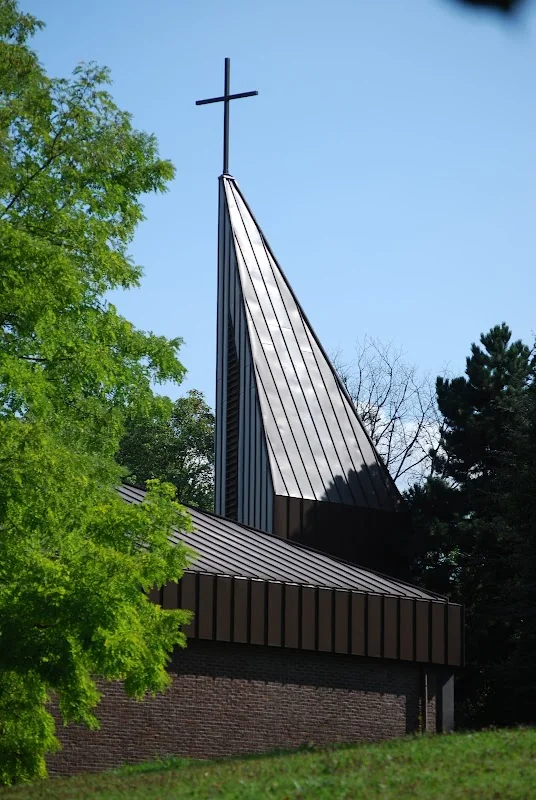
The Upper Church of the Aloisiuskolleg is the upper, publicly perceivable church space of the ensemble as the Collegiate Church. According to the official description, it was built in the early 1980s in the form of an octagon; a dilapidated church from the 1960s previously stood in its place. This architectural decision is not only functional but also a clear sign of the college's ambition to connect sacred architecture with school life. The church features an organ and artistically designed bronze furnishings, such as altar, ambo, and Easter candle stand. Particularly striking is the bronze sculpture of an angel by Ewald Mataré, which gives the space an independent artistic presence. Thus, the Upper Church is not merely a liturgical hall but a space with character, materiality, and a very conscious design language. ([aloisiuskolleg.de](https://www.aloisiuskolleg.de/kollegskirche-krypta))
Especially for search queries related to “aloisiuskolleg upper church” or “aloisiuskolleg church,” it is important to note: The upper church space is not limited to services. The website explicitly states that the church can also be used as an auditorium for special events because the Blessed Sacrament and the fixed altar have been placed in the Crypt. This makes the space flexible and can be opened for concerts, theater performances, and larger school or college formats. In practice, this means: Depending on the occasion, a sacred atmosphere, a concentrated stage atmosphere, or a mixed setting for ceremonial events is possible. This multipurpose use is an essential part of the identity of the place and explains why the Upper Church repeatedly plays a central role in events at the college. ([aloisiuskolleg.de](https://www.aloisiuskolleg.de/kollegskirche-krypta))
The Upper Church is also present in the everyday life of the Aloisiuskolleg. The college's Big Band rehearses in the Upper Church on Wednesdays from 5 to 7 PM, according to the website; this shows that the space is not only representative but also practical and acoustically suitable for music. At the same time, theater productions take place there, for example, when the upper-level theater group brings a classic like “The Inspector General” to the stage. The official communication explicitly invites a full Upper Church, confirming the space as a lively event venue. Thus, the Upper Church combines the tranquility of a church space with the energy of a performance space. For SEO, but also for real visitors, this is a strong unique selling point: a place where spiritual depth, school community, and cultural use are experienced not separately but together. ([aloisiuskolleg.de](https://www.aloisiuskolleg.de/big-band?utm_source=openai))
Crypt and Room of Silence: the spiritual heart of the college
Under the church lies the Crypt of the Aloisiuskolleg, and the website unequivocally refers to it as the spiritual heart of the college. Here, Eucharistic celebrations and other services with students take place several times a week. This wording is important because it shows that the Crypt is not merely a small side room but a liturgically central place for the daily or weekly spiritual life of the college. At the same time, it is designed as a “Room of Silence”: a place where one can come to rest, be contemplative, and arrive in a state of gathering. This connection of prayer, silence, and reflection is a defining element, especially for a Jesuit school. The Crypt exemplifies the Ignatian profile of the house, which makes faith not abstract but spatial and experiential. ([aloisiuskolleg.de](https://www.aloisiuskolleg.de/kollegskirche-krypta))
Architecturally and atmospherically, the Crypt is consciously different from the Upper Church. It is integrated into the octagon, designed by Franz Gutmann, and accommodates up to one hundred people. The website's description highlights the subdued light impression, the powerful round door, and the arrangement of ambo, tabernacle, and candlesticks that mark the path to the altar. This creates a space that focuses not on size but on concentration and symbolic density. Therefore, those searching for “aloisiuskolleg crypt” are not just looking for a room but a place that brings together silence, liturgy, and conscious experience. This deliberate dramaturgy is a strong feature of the location and makes it interesting for church celebrations, devotions, and spiritual formats. ([aloisiuskolleg.de](https://www.aloisiuskolleg.de/kollegskirche-krypta))
It is also important to note the functional separation between the Crypt and the Upper Church. Because the Blessed Sacrament and the fixed altar have been placed in the Crypt, the upper church space can be flexibly used as an auditorium. This is a rare and very clever solution as it respects the sacred while simultaneously allowing for the cultural use of the upper space. For the college itself, this means a special form of spatial economy: a place for Eucharist, a place for silence, and at the same time a place for large events. For guests and visitors, this means that the Crypt is not just a small side room but the spiritual center from which the multipurpose use of the entire Collegiate Church becomes meaningful. This combination of liturgy and functionality shapes the special value of the ensemble. ([aloisiuskolleg.de](https://www.aloisiuskolleg.de/kollegskirche-krypta))
Jesuit Tradition and History: from Sittard to Godesberg
The history of the Aloisiuskolleg does not begin in Bonn but rather in 1900 in the Netherlands. According to the official website, the AKO initially emerged in Sittard as a school for Catholic students before the Jesuits took over the Godesberg “Hubertinum” in 1920 and reestablished the Aloisiuskolleg at its current location in 1921. Only later could the current property be acquired and a new school built. This historical development is very important for the positioning of the site as it embeds the current Collegiate Church and Crypt into a longer history marked by breaks and new beginnings. Those who know the Aloisiuskolleg only as a Bonn school see only the last section of a much older tradition. The official website also points out that the Third Reich brought an interruption, openly naming the historical depth and the burdens of the institution's history. ([aloisiuskolleg.de](https://www.aloisiuskolleg.de/))
The Jesuit influence is not merely a label but the guiding principle of the college. The website states that the Jesuits had already called their first schools “collegium” four hundred years ago; from the beginning, their aim has been to combine good education with holistic upbringing, supplemented by experiences in creativity and sports. This profile also shapes the current Aloisiuskolleg with school, boarding school, and AKO Forum. For the Upper Church and Crypt, this is relevant because they do not appear in isolation as church spaces but are embedded in a pedagogy that brings together spiritual, cultural, and social dimensions. This is also why the place is so fitting for many search queries related to “aloisiuskolleg jesuits” or a Catholic-Jesuit church in Bonn: The architecture and use here follow a clear institutional stance. ([aloisiuskolleg.de](https://www.aloisiuskolleg.de/aloisiuskolleg))
The recent history also shows that the college has evolved. In 2024, the sponsorship changed from the previous society to the Ignatian School Sponsor Aloisiuskolleg Bonn gGmbH. The website describes the college today as part of a network of Jesuit schools and refers to a current school program work that aims to structurally anchor Ignatian pedagogy. This is important for the perception of the location as it explains why the Upper Church and Crypt are not merely historical relics. They belong to a school that consciously renews its tradition and translates it into a modern educational and event structure. For visitors, this means: Here, long history meets current use, and that is precisely why the Aloisiuskolleg is such an interesting location for religion, culture, and encounters. ([aloisiuskolleg.de](https://www.aloisiuskolleg.de/aloisiuskolleg))
Directions, Address, and Orientation on Campus
For practical orientation, the address of the college is clear: Elisabethstraße 18, 53177 Bonn. The website lists this address both on the contact page and on other service pages and additionally provides the phone number and email address of the college. For visitors searching for “alois church” or “directions aloisiuskolleg,” this is particularly helpful because the grounds are not organized as a freely accessible individual church but as part of a larger school and college complex. Accordingly, it is important to choose the right access and to know the orientation on site. The college is located in Bonn-Bad Godesberg and is part of an extensive area where several special rooms and buildings are situated. Thus, those visiting the Upper Church or the Crypt enter a campus with a clear structure and not just a single event space. ([aloisiuskolleg.de](https://www.aloisiuskolleg.de/kontakt))
The official directions emphasize the route by public transport and on foot. The U-Bahn lines 16 and 63 are mentioned up to the Stadthalle stop; from there, it is about a ten-minute uphill walk. Alternatively, Bonn-Bad Godesberg station is mentioned, from which the walk takes about fifteen minutes. Additionally, bus line 637 runs hourly from Godesberg station to the Aloisiuskolleg stop. The description also shows how to reach the grounds: Cross the Kurfürstenallee at Rigalsche Wiese, pass by the small church, and follow Friedrich-Ebert-Straße uphill. These instructions are useful because the pathways are based on the hilly character of the site. Those coming from the city center or the station should plan for a bit of walking. ([aloisiuskolleg.de](https://www.aloisiuskolleg.de/sites/default/files/pdf/anfahrtsbeschreibung_schulleitung.pdf?utm_source=openai))
It is also important for practical visits to distinguish between the main entrance and the accesses for evening events. The official description explains that the main entrance is opposite on school days, while in the evenings and on other days, one should go right around the school to Petersbergstraße and through the large gate. This is a crucial hint, especially for concerts, theater evenings, or special services, as the Upper Church is often integrated into the event operations. Even though the website primarily describes the arrival via bus and train, the orientation on the grounds is clear enough to enable reliable arrival for visitors. The combination of address, directions, and campus structure is a central part of the service quality of the location. ([aloisiuskolleg.de](https://www.aloisiuskolleg.de/sites/default/files/pdf/anfahrtsbeschreibung_schulleitung.pdf?utm_source=openai))
Special Rooms, Events, and the Vibrant Campus Life
The Upper Church and Crypt are part of a significantly larger spatial concept at the Aloisiuskolleg. On the page “Special Rooms at AKO,” the website lists, among other things, the library, rotunda, sports and tennis courts, Collegiate Church and Crypt, the forum, and the observatory. This overview shows that the college is organized as a campus with several functionally specialized places. For the positioning of the location, this is important because the Collegiate Church does not appear in isolation but is embedded in a network of learning, leisure, sports, and event spaces. So, those searching for a church in Bonn do not just receive a place for devotion at the Aloisiuskolleg but a location where school, culture, and community are spatially close together. The special quality lies particularly in the diversity of the spaces that coexist on the same grounds. ([aloisiuskolleg.de](https://www.aloisiuskolleg.de/besondere-raeume-am-ako))
Events play a visible role on campus. The website refers to concerts and theater performances in the converted Collegiate Church, school services in the Upper Church, and performances by the upper-level theater group. Additionally, musical formats such as the Big Band, which regularly rehearses in the Upper Church, are included. This creates a profile that goes far beyond the classic function of a church. The Upper Church is not only a space for liturgy but also an acoustic and cultural resonance space. For search queries related to “concerts upper church” or “theater upper church,” this is the central added value: There is a real, recurring use as a performance venue, not just a theoretical suitability. This makes the place attractive for school members as well as for guests, parents, and culture-interested visitors. ([aloisiuskolleg.de](https://www.aloisiuskolleg.de/kollegskirche-krypta))
The school life itself also contributes to the aura of the location. On the college's website, school life is described as a community shaped by faith, education, and personal development. The boarding school, the AKO Forum, and the diverse afternoon offerings complement the lessons and ensure that the grounds are used not only in the mornings but throughout the day. For the perception of the Upper Church and Crypt, this means: They are not merely historical or religious individual objects but part of a vibrant everyday space. This is precisely why they also function particularly well as an SEO topic, as they connect hard facts like history, location, and capacity with emotional terms like silence, community, stage, and spiritual heart. Those visiting the Aloisiuskolleg or researching online encounter a place that consciously wants to be more than a school. ([aloisiuskolleg.de](https://www.aloisiuskolleg.de/))
In summary, a rare interplay emerges at the Aloisiuskolleg: an Upper Church that is open for worship and culture; a Crypt that functions as a room of silence and liturgical center; a Jesuit educational institution with a deep history; and a campus that is enlivened by events, music, theater, and special rooms. This combination makes the location unique for Bonn and remarkable for visitors. Those looking for a place where religious tradition, architectural clarity, and school vitality come together will find a very dense and credible answer here. The Aloisiuskolleg exemplifies a space where identity is not only told but spatially experienced. ([aloisiuskolleg.de](https://www.aloisiuskolleg.de/kollegskirche-krypta))
Sources:
Mehr anzeigenWeniger anzeigen
Aloisiuskolleg - Upper Church and Crypt | Church & Jesuits
The Aloisiuskolleg in Bonn-Bad Godesberg is much more than a school campus with a chapel. Those looking for the Upper Church, Collegiate Church, Crypt, or a Jesuit-influenced location in Bonn will find a place where faith, education, art, and community are consciously thought together. The official website describes the college as a school in the tradition of the Jesuits, as part of a global network of Jesuit schools, and as a community that aims to guide young people towards responsibility, creativity, and a life in the spirit of “people for others.” At the same time, the Collegiate Church serves as a space for services, silence, and special events, while the Crypt is considered the spiritual heart of the house. This very mixture makes the location so interesting: it is simultaneously a liturgical space, an event venue, and part of a vibrant campus structure. ([aloisiuskolleg.de](https://www.aloisiuskolleg.de/))
Upper Church, Collegiate Church, and Auditorium: a space between liturgy and culture
The Upper Church of the Aloisiuskolleg is the upper, publicly perceivable church space of the ensemble as the Collegiate Church. According to the official description, it was built in the early 1980s in the form of an octagon; a dilapidated church from the 1960s previously stood in its place. This architectural decision is not only functional but also a clear sign of the college's ambition to connect sacred architecture with school life. The church features an organ and artistically designed bronze furnishings, such as altar, ambo, and Easter candle stand. Particularly striking is the bronze sculpture of an angel by Ewald Mataré, which gives the space an independent artistic presence. Thus, the Upper Church is not merely a liturgical hall but a space with character, materiality, and a very conscious design language. ([aloisiuskolleg.de](https://www.aloisiuskolleg.de/kollegskirche-krypta))
Especially for search queries related to “aloisiuskolleg upper church” or “aloisiuskolleg church,” it is important to note: The upper church space is not limited to services. The website explicitly states that the church can also be used as an auditorium for special events because the Blessed Sacrament and the fixed altar have been placed in the Crypt. This makes the space flexible and can be opened for concerts, theater performances, and larger school or college formats. In practice, this means: Depending on the occasion, a sacred atmosphere, a concentrated stage atmosphere, or a mixed setting for ceremonial events is possible. This multipurpose use is an essential part of the identity of the place and explains why the Upper Church repeatedly plays a central role in events at the college. ([aloisiuskolleg.de](https://www.aloisiuskolleg.de/kollegskirche-krypta))
The Upper Church is also present in the everyday life of the Aloisiuskolleg. The college's Big Band rehearses in the Upper Church on Wednesdays from 5 to 7 PM, according to the website; this shows that the space is not only representative but also practical and acoustically suitable for music. At the same time, theater productions take place there, for example, when the upper-level theater group brings a classic like “The Inspector General” to the stage. The official communication explicitly invites a full Upper Church, confirming the space as a lively event venue. Thus, the Upper Church combines the tranquility of a church space with the energy of a performance space. For SEO, but also for real visitors, this is a strong unique selling point: a place where spiritual depth, school community, and cultural use are experienced not separately but together. ([aloisiuskolleg.de](https://www.aloisiuskolleg.de/big-band?utm_source=openai))
Crypt and Room of Silence: the spiritual heart of the college
Under the church lies the Crypt of the Aloisiuskolleg, and the website unequivocally refers to it as the spiritual heart of the college. Here, Eucharistic celebrations and other services with students take place several times a week. This wording is important because it shows that the Crypt is not merely a small side room but a liturgically central place for the daily or weekly spiritual life of the college. At the same time, it is designed as a “Room of Silence”: a place where one can come to rest, be contemplative, and arrive in a state of gathering. This connection of prayer, silence, and reflection is a defining element, especially for a Jesuit school. The Crypt exemplifies the Ignatian profile of the house, which makes faith not abstract but spatial and experiential. ([aloisiuskolleg.de](https://www.aloisiuskolleg.de/kollegskirche-krypta))
Architecturally and atmospherically, the Crypt is consciously different from the Upper Church. It is integrated into the octagon, designed by Franz Gutmann, and accommodates up to one hundred people. The website's description highlights the subdued light impression, the powerful round door, and the arrangement of ambo, tabernacle, and candlesticks that mark the path to the altar. This creates a space that focuses not on size but on concentration and symbolic density. Therefore, those searching for “aloisiuskolleg crypt” are not just looking for a room but a place that brings together silence, liturgy, and conscious experience. This deliberate dramaturgy is a strong feature of the location and makes it interesting for church celebrations, devotions, and spiritual formats. ([aloisiuskolleg.de](https://www.aloisiuskolleg.de/kollegskirche-krypta))
It is also important to note the functional separation between the Crypt and the Upper Church. Because the Blessed Sacrament and the fixed altar have been placed in the Crypt, the upper church space can be flexibly used as an auditorium. This is a rare and very clever solution as it respects the sacred while simultaneously allowing for the cultural use of the upper space. For the college itself, this means a special form of spatial economy: a place for Eucharist, a place for silence, and at the same time a place for large events. For guests and visitors, this means that the Crypt is not just a small side room but the spiritual center from which the multipurpose use of the entire Collegiate Church becomes meaningful. This combination of liturgy and functionality shapes the special value of the ensemble. ([aloisiuskolleg.de](https://www.aloisiuskolleg.de/kollegskirche-krypta))
Jesuit Tradition and History: from Sittard to Godesberg
The history of the Aloisiuskolleg does not begin in Bonn but rather in 1900 in the Netherlands. According to the official website, the AKO initially emerged in Sittard as a school for Catholic students before the Jesuits took over the Godesberg “Hubertinum” in 1920 and reestablished the Aloisiuskolleg at its current location in 1921. Only later could the current property be acquired and a new school built. This historical development is very important for the positioning of the site as it embeds the current Collegiate Church and Crypt into a longer history marked by breaks and new beginnings. Those who know the Aloisiuskolleg only as a Bonn school see only the last section of a much older tradition. The official website also points out that the Third Reich brought an interruption, openly naming the historical depth and the burdens of the institution's history. ([aloisiuskolleg.de](https://www.aloisiuskolleg.de/))
The Jesuit influence is not merely a label but the guiding principle of the college. The website states that the Jesuits had already called their first schools “collegium” four hundred years ago; from the beginning, their aim has been to combine good education with holistic upbringing, supplemented by experiences in creativity and sports. This profile also shapes the current Aloisiuskolleg with school, boarding school, and AKO Forum. For the Upper Church and Crypt, this is relevant because they do not appear in isolation as church spaces but are embedded in a pedagogy that brings together spiritual, cultural, and social dimensions. This is also why the place is so fitting for many search queries related to “aloisiuskolleg jesuits” or a Catholic-Jesuit church in Bonn: The architecture and use here follow a clear institutional stance. ([aloisiuskolleg.de](https://www.aloisiuskolleg.de/aloisiuskolleg))
The recent history also shows that the college has evolved. In 2024, the sponsorship changed from the previous society to the Ignatian School Sponsor Aloisiuskolleg Bonn gGmbH. The website describes the college today as part of a network of Jesuit schools and refers to a current school program work that aims to structurally anchor Ignatian pedagogy. This is important for the perception of the location as it explains why the Upper Church and Crypt are not merely historical relics. They belong to a school that consciously renews its tradition and translates it into a modern educational and event structure. For visitors, this means: Here, long history meets current use, and that is precisely why the Aloisiuskolleg is such an interesting location for religion, culture, and encounters. ([aloisiuskolleg.de](https://www.aloisiuskolleg.de/aloisiuskolleg))
Directions, Address, and Orientation on Campus
For practical orientation, the address of the college is clear: Elisabethstraße 18, 53177 Bonn. The website lists this address both on the contact page and on other service pages and additionally provides the phone number and email address of the college. For visitors searching for “alois church” or “directions aloisiuskolleg,” this is particularly helpful because the grounds are not organized as a freely accessible individual church but as part of a larger school and college complex. Accordingly, it is important to choose the right access and to know the orientation on site. The college is located in Bonn-Bad Godesberg and is part of an extensive area where several special rooms and buildings are situated. Thus, those visiting the Upper Church or the Crypt enter a campus with a clear structure and not just a single event space. ([aloisiuskolleg.de](https://www.aloisiuskolleg.de/kontakt))
The official directions emphasize the route by public transport and on foot. The U-Bahn lines 16 and 63 are mentioned up to the Stadthalle stop; from there, it is about a ten-minute uphill walk. Alternatively, Bonn-Bad Godesberg station is mentioned, from which the walk takes about fifteen minutes. Additionally, bus line 637 runs hourly from Godesberg station to the Aloisiuskolleg stop. The description also shows how to reach the grounds: Cross the Kurfürstenallee at Rigalsche Wiese, pass by the small church, and follow Friedrich-Ebert-Straße uphill. These instructions are useful because the pathways are based on the hilly character of the site. Those coming from the city center or the station should plan for a bit of walking. ([aloisiuskolleg.de](https://www.aloisiuskolleg.de/sites/default/files/pdf/anfahrtsbeschreibung_schulleitung.pdf?utm_source=openai))
It is also important for practical visits to distinguish between the main entrance and the accesses for evening events. The official description explains that the main entrance is opposite on school days, while in the evenings and on other days, one should go right around the school to Petersbergstraße and through the large gate. This is a crucial hint, especially for concerts, theater evenings, or special services, as the Upper Church is often integrated into the event operations. Even though the website primarily describes the arrival via bus and train, the orientation on the grounds is clear enough to enable reliable arrival for visitors. The combination of address, directions, and campus structure is a central part of the service quality of the location. ([aloisiuskolleg.de](https://www.aloisiuskolleg.de/sites/default/files/pdf/anfahrtsbeschreibung_schulleitung.pdf?utm_source=openai))
Special Rooms, Events, and the Vibrant Campus Life
The Upper Church and Crypt are part of a significantly larger spatial concept at the Aloisiuskolleg. On the page “Special Rooms at AKO,” the website lists, among other things, the library, rotunda, sports and tennis courts, Collegiate Church and Crypt, the forum, and the observatory. This overview shows that the college is organized as a campus with several functionally specialized places. For the positioning of the location, this is important because the Collegiate Church does not appear in isolation but is embedded in a network of learning, leisure, sports, and event spaces. So, those searching for a church in Bonn do not just receive a place for devotion at the Aloisiuskolleg but a location where school, culture, and community are spatially close together. The special quality lies particularly in the diversity of the spaces that coexist on the same grounds. ([aloisiuskolleg.de](https://www.aloisiuskolleg.de/besondere-raeume-am-ako))
Events play a visible role on campus. The website refers to concerts and theater performances in the converted Collegiate Church, school services in the Upper Church, and performances by the upper-level theater group. Additionally, musical formats such as the Big Band, which regularly rehearses in the Upper Church, are included. This creates a profile that goes far beyond the classic function of a church. The Upper Church is not only a space for liturgy but also an acoustic and cultural resonance space. For search queries related to “concerts upper church” or “theater upper church,” this is the central added value: There is a real, recurring use as a performance venue, not just a theoretical suitability. This makes the place attractive for school members as well as for guests, parents, and culture-interested visitors. ([aloisiuskolleg.de](https://www.aloisiuskolleg.de/kollegskirche-krypta))
The school life itself also contributes to the aura of the location. On the college's website, school life is described as a community shaped by faith, education, and personal development. The boarding school, the AKO Forum, and the diverse afternoon offerings complement the lessons and ensure that the grounds are used not only in the mornings but throughout the day. For the perception of the Upper Church and Crypt, this means: They are not merely historical or religious individual objects but part of a vibrant everyday space. This is precisely why they also function particularly well as an SEO topic, as they connect hard facts like history, location, and capacity with emotional terms like silence, community, stage, and spiritual heart. Those visiting the Aloisiuskolleg or researching online encounter a place that consciously wants to be more than a school. ([aloisiuskolleg.de](https://www.aloisiuskolleg.de/))
In summary, a rare interplay emerges at the Aloisiuskolleg: an Upper Church that is open for worship and culture; a Crypt that functions as a room of silence and liturgical center; a Jesuit educational institution with a deep history; and a campus that is enlivened by events, music, theater, and special rooms. This combination makes the location unique for Bonn and remarkable for visitors. Those looking for a place where religious tradition, architectural clarity, and school vitality come together will find a very dense and credible answer here. The Aloisiuskolleg exemplifies a space where identity is not only told but spatially experienced. ([aloisiuskolleg.de](https://www.aloisiuskolleg.de/kollegskirche-krypta))
Sources:
Aloisiuskolleg - Upper Church and Crypt | Church & Jesuits
The Aloisiuskolleg in Bonn-Bad Godesberg is much more than a school campus with a chapel. Those looking for the Upper Church, Collegiate Church, Crypt, or a Jesuit-influenced location in Bonn will find a place where faith, education, art, and community are consciously thought together. The official website describes the college as a school in the tradition of the Jesuits, as part of a global network of Jesuit schools, and as a community that aims to guide young people towards responsibility, creativity, and a life in the spirit of “people for others.” At the same time, the Collegiate Church serves as a space for services, silence, and special events, while the Crypt is considered the spiritual heart of the house. This very mixture makes the location so interesting: it is simultaneously a liturgical space, an event venue, and part of a vibrant campus structure. ([aloisiuskolleg.de](https://www.aloisiuskolleg.de/))
Upper Church, Collegiate Church, and Auditorium: a space between liturgy and culture
The Upper Church of the Aloisiuskolleg is the upper, publicly perceivable church space of the ensemble as the Collegiate Church. According to the official description, it was built in the early 1980s in the form of an octagon; a dilapidated church from the 1960s previously stood in its place. This architectural decision is not only functional but also a clear sign of the college's ambition to connect sacred architecture with school life. The church features an organ and artistically designed bronze furnishings, such as altar, ambo, and Easter candle stand. Particularly striking is the bronze sculpture of an angel by Ewald Mataré, which gives the space an independent artistic presence. Thus, the Upper Church is not merely a liturgical hall but a space with character, materiality, and a very conscious design language. ([aloisiuskolleg.de](https://www.aloisiuskolleg.de/kollegskirche-krypta))
Especially for search queries related to “aloisiuskolleg upper church” or “aloisiuskolleg church,” it is important to note: The upper church space is not limited to services. The website explicitly states that the church can also be used as an auditorium for special events because the Blessed Sacrament and the fixed altar have been placed in the Crypt. This makes the space flexible and can be opened for concerts, theater performances, and larger school or college formats. In practice, this means: Depending on the occasion, a sacred atmosphere, a concentrated stage atmosphere, or a mixed setting for ceremonial events is possible. This multipurpose use is an essential part of the identity of the place and explains why the Upper Church repeatedly plays a central role in events at the college. ([aloisiuskolleg.de](https://www.aloisiuskolleg.de/kollegskirche-krypta))
The Upper Church is also present in the everyday life of the Aloisiuskolleg. The college's Big Band rehearses in the Upper Church on Wednesdays from 5 to 7 PM, according to the website; this shows that the space is not only representative but also practical and acoustically suitable for music. At the same time, theater productions take place there, for example, when the upper-level theater group brings a classic like “The Inspector General” to the stage. The official communication explicitly invites a full Upper Church, confirming the space as a lively event venue. Thus, the Upper Church combines the tranquility of a church space with the energy of a performance space. For SEO, but also for real visitors, this is a strong unique selling point: a place where spiritual depth, school community, and cultural use are experienced not separately but together. ([aloisiuskolleg.de](https://www.aloisiuskolleg.de/big-band?utm_source=openai))
Crypt and Room of Silence: the spiritual heart of the college
Under the church lies the Crypt of the Aloisiuskolleg, and the website unequivocally refers to it as the spiritual heart of the college. Here, Eucharistic celebrations and other services with students take place several times a week. This wording is important because it shows that the Crypt is not merely a small side room but a liturgically central place for the daily or weekly spiritual life of the college. At the same time, it is designed as a “Room of Silence”: a place where one can come to rest, be contemplative, and arrive in a state of gathering. This connection of prayer, silence, and reflection is a defining element, especially for a Jesuit school. The Crypt exemplifies the Ignatian profile of the house, which makes faith not abstract but spatial and experiential. ([aloisiuskolleg.de](https://www.aloisiuskolleg.de/kollegskirche-krypta))
Architecturally and atmospherically, the Crypt is consciously different from the Upper Church. It is integrated into the octagon, designed by Franz Gutmann, and accommodates up to one hundred people. The website's description highlights the subdued light impression, the powerful round door, and the arrangement of ambo, tabernacle, and candlesticks that mark the path to the altar. This creates a space that focuses not on size but on concentration and symbolic density. Therefore, those searching for “aloisiuskolleg crypt” are not just looking for a room but a place that brings together silence, liturgy, and conscious experience. This deliberate dramaturgy is a strong feature of the location and makes it interesting for church celebrations, devotions, and spiritual formats. ([aloisiuskolleg.de](https://www.aloisiuskolleg.de/kollegskirche-krypta))
It is also important to note the functional separation between the Crypt and the Upper Church. Because the Blessed Sacrament and the fixed altar have been placed in the Crypt, the upper church space can be flexibly used as an auditorium. This is a rare and very clever solution as it respects the sacred while simultaneously allowing for the cultural use of the upper space. For the college itself, this means a special form of spatial economy: a place for Eucharist, a place for silence, and at the same time a place for large events. For guests and visitors, this means that the Crypt is not just a small side room but the spiritual center from which the multipurpose use of the entire Collegiate Church becomes meaningful. This combination of liturgy and functionality shapes the special value of the ensemble. ([aloisiuskolleg.de](https://www.aloisiuskolleg.de/kollegskirche-krypta))
Jesuit Tradition and History: from Sittard to Godesberg
The history of the Aloisiuskolleg does not begin in Bonn but rather in 1900 in the Netherlands. According to the official website, the AKO initially emerged in Sittard as a school for Catholic students before the Jesuits took over the Godesberg “Hubertinum” in 1920 and reestablished the Aloisiuskolleg at its current location in 1921. Only later could the current property be acquired and a new school built. This historical development is very important for the positioning of the site as it embeds the current Collegiate Church and Crypt into a longer history marked by breaks and new beginnings. Those who know the Aloisiuskolleg only as a Bonn school see only the last section of a much older tradition. The official website also points out that the Third Reich brought an interruption, openly naming the historical depth and the burdens of the institution's history. ([aloisiuskolleg.de](https://www.aloisiuskolleg.de/))
The Jesuit influence is not merely a label but the guiding principle of the college. The website states that the Jesuits had already called their first schools “collegium” four hundred years ago; from the beginning, their aim has been to combine good education with holistic upbringing, supplemented by experiences in creativity and sports. This profile also shapes the current Aloisiuskolleg with school, boarding school, and AKO Forum. For the Upper Church and Crypt, this is relevant because they do not appear in isolation as church spaces but are embedded in a pedagogy that brings together spiritual, cultural, and social dimensions. This is also why the place is so fitting for many search queries related to “aloisiuskolleg jesuits” or a Catholic-Jesuit church in Bonn: The architecture and use here follow a clear institutional stance. ([aloisiuskolleg.de](https://www.aloisiuskolleg.de/aloisiuskolleg))
The recent history also shows that the college has evolved. In 2024, the sponsorship changed from the previous society to the Ignatian School Sponsor Aloisiuskolleg Bonn gGmbH. The website describes the college today as part of a network of Jesuit schools and refers to a current school program work that aims to structurally anchor Ignatian pedagogy. This is important for the perception of the location as it explains why the Upper Church and Crypt are not merely historical relics. They belong to a school that consciously renews its tradition and translates it into a modern educational and event structure. For visitors, this means: Here, long history meets current use, and that is precisely why the Aloisiuskolleg is such an interesting location for religion, culture, and encounters. ([aloisiuskolleg.de](https://www.aloisiuskolleg.de/aloisiuskolleg))
Directions, Address, and Orientation on Campus
For practical orientation, the address of the college is clear: Elisabethstraße 18, 53177 Bonn. The website lists this address both on the contact page and on other service pages and additionally provides the phone number and email address of the college. For visitors searching for “alois church” or “directions aloisiuskolleg,” this is particularly helpful because the grounds are not organized as a freely accessible individual church but as part of a larger school and college complex. Accordingly, it is important to choose the right access and to know the orientation on site. The college is located in Bonn-Bad Godesberg and is part of an extensive area where several special rooms and buildings are situated. Thus, those visiting the Upper Church or the Crypt enter a campus with a clear structure and not just a single event space. ([aloisiuskolleg.de](https://www.aloisiuskolleg.de/kontakt))
The official directions emphasize the route by public transport and on foot. The U-Bahn lines 16 and 63 are mentioned up to the Stadthalle stop; from there, it is about a ten-minute uphill walk. Alternatively, Bonn-Bad Godesberg station is mentioned, from which the walk takes about fifteen minutes. Additionally, bus line 637 runs hourly from Godesberg station to the Aloisiuskolleg stop. The description also shows how to reach the grounds: Cross the Kurfürstenallee at Rigalsche Wiese, pass by the small church, and follow Friedrich-Ebert-Straße uphill. These instructions are useful because the pathways are based on the hilly character of the site. Those coming from the city center or the station should plan for a bit of walking. ([aloisiuskolleg.de](https://www.aloisiuskolleg.de/sites/default/files/pdf/anfahrtsbeschreibung_schulleitung.pdf?utm_source=openai))
It is also important for practical visits to distinguish between the main entrance and the accesses for evening events. The official description explains that the main entrance is opposite on school days, while in the evenings and on other days, one should go right around the school to Petersbergstraße and through the large gate. This is a crucial hint, especially for concerts, theater evenings, or special services, as the Upper Church is often integrated into the event operations. Even though the website primarily describes the arrival via bus and train, the orientation on the grounds is clear enough to enable reliable arrival for visitors. The combination of address, directions, and campus structure is a central part of the service quality of the location. ([aloisiuskolleg.de](https://www.aloisiuskolleg.de/sites/default/files/pdf/anfahrtsbeschreibung_schulleitung.pdf?utm_source=openai))
Special Rooms, Events, and the Vibrant Campus Life
The Upper Church and Crypt are part of a significantly larger spatial concept at the Aloisiuskolleg. On the page “Special Rooms at AKO,” the website lists, among other things, the library, rotunda, sports and tennis courts, Collegiate Church and Crypt, the forum, and the observatory. This overview shows that the college is organized as a campus with several functionally specialized places. For the positioning of the location, this is important because the Collegiate Church does not appear in isolation but is embedded in a network of learning, leisure, sports, and event spaces. So, those searching for a church in Bonn do not just receive a place for devotion at the Aloisiuskolleg but a location where school, culture, and community are spatially close together. The special quality lies particularly in the diversity of the spaces that coexist on the same grounds. ([aloisiuskolleg.de](https://www.aloisiuskolleg.de/besondere-raeume-am-ako))
Events play a visible role on campus. The website refers to concerts and theater performances in the converted Collegiate Church, school services in the Upper Church, and performances by the upper-level theater group. Additionally, musical formats such as the Big Band, which regularly rehearses in the Upper Church, are included. This creates a profile that goes far beyond the classic function of a church. The Upper Church is not only a space for liturgy but also an acoustic and cultural resonance space. For search queries related to “concerts upper church” or “theater upper church,” this is the central added value: There is a real, recurring use as a performance venue, not just a theoretical suitability. This makes the place attractive for school members as well as for guests, parents, and culture-interested visitors. ([aloisiuskolleg.de](https://www.aloisiuskolleg.de/kollegskirche-krypta))
The school life itself also contributes to the aura of the location. On the college's website, school life is described as a community shaped by faith, education, and personal development. The boarding school, the AKO Forum, and the diverse afternoon offerings complement the lessons and ensure that the grounds are used not only in the mornings but throughout the day. For the perception of the Upper Church and Crypt, this means: They are not merely historical or religious individual objects but part of a vibrant everyday space. This is precisely why they also function particularly well as an SEO topic, as they connect hard facts like history, location, and capacity with emotional terms like silence, community, stage, and spiritual heart. Those visiting the Aloisiuskolleg or researching online encounter a place that consciously wants to be more than a school. ([aloisiuskolleg.de](https://www.aloisiuskolleg.de/))
In summary, a rare interplay emerges at the Aloisiuskolleg: an Upper Church that is open for worship and culture; a Crypt that functions as a room of silence and liturgical center; a Jesuit educational institution with a deep history; and a campus that is enlivened by events, music, theater, and special rooms. This combination makes the location unique for Bonn and remarkable for visitors. Those looking for a place where religious tradition, architectural clarity, and school vitality come together will find a very dense and credible answer here. The Aloisiuskolleg exemplifies a space where identity is not only told but spatially experienced. ([aloisiuskolleg.de](https://www.aloisiuskolleg.de/kollegskirche-krypta))
Sources:
Upcoming Events
No events found
Frequently Asked Questions
Reviews
Thomas Diwischek
25. September 2023
Bad Godesberg
Claudia
20. February 2026
I found the decor too dark, with black stuffed ravens, stuffed deer, huge portraits that matched the stuffed animals' vibe.. Food and service were very good, rather pricey.
Markus Eichin
16. May 2026
Interesting chapel with an extraordinary entrance door.
Gilly Gilaly
14. April 2024
I've had the chance to experience many concerts here, with very nice, lovely teachers and also very gifted musical students ... Simply beautiful 😘
Anna
13. June 2023
The crypt is just amazing! It looks almost mystical, like from another time, great for meditating. (A must-see for pen-and-paper players. When you see it, you'll know what I mean). Go check it out!