
Konrad Adenauer
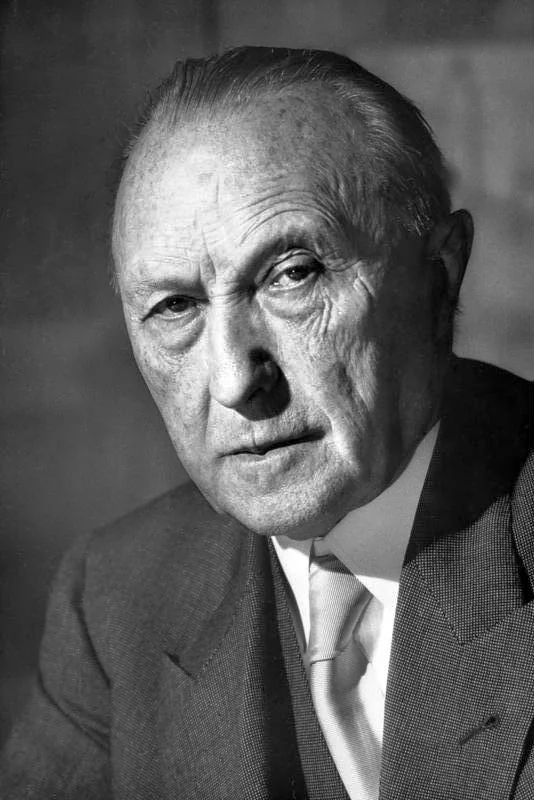
Image from Wikipedia
Image from Wikipedia
Konrad Adenauer: The Architect of the Federal Republic and the Sound of a New Post-War Order in Germany
A Statesman Who Redefined Germany After 1945
Konrad Adenauer is one of the defining figures of 20th-century German history. Born on January 5, 1876, in Cologne, this lawyer became the first Chancellor of the Federal Republic of Germany in 1949 and shaped this office until 1963 with a political authority that extended far beyond his time in office. As a co-founder of the CDU, a long-serving party chairman, and the first Federal Minister of Foreign Affairs, he set standards for the political reorganization of West Germany. ([britannica.com](https://www.britannica.com/biography/Konrad-Adenauer?utm_source=openai))
His life journey did not begin on an international stage but in Cologne, in municipal practice and administration. Adenauer rapidly ascended to high politics through legal positions and became the Lord Mayor of Cologne in 1917, a position he held until 1933. His biography intertwines municipal modernization, church-affiliated environments, political perseverance, and the experience of authoritarian breaks during the Nazi era to create an extraordinarily dense portrait of a statesman. ([kas.de](https://www.kas.de/de/statische-inhalte-detail/-/content/biografie-konrad-adenauer?utm_source=openai))
Early Years, Legal Shaping, and the Rise in Cologne
Adenauer studied law and made a name for himself in Cologne's administration and judiciary before rising to municipal politics. His connection to the Catholic Center Party and his talent for organizational power-building accompanied him from the start. In the years of the German Empire, he developed the strategic instinct that would later shape his national career: a clear power architecture, sober alliance politics, and a pronounced will to shape. ([kas.de](https://www.kas.de/de/statische-inhalte-detail/-/content/biografie-konrad-adenauer?utm_source=openai))
As the Lord Mayor of Cologne, he stepped into a role where administration, urban development, and political representation converged. The years in Cologne are regarded as a decisive school for his political thinking because it was here he learned to handle economic, social, and confessional tensions. This municipal experience later became the foundation of his federal political authority. ([kas.de](https://www.kas.de/de/statische-inhalte-detail/-/content/biografie-konrad-adenauer?utm_source=openai))
Breach with National Socialism and Political Reorganization
With the takeover of the National Socialists, Adenauer's municipal career ended abruptly. He was dismissed from his offices and briefly imprisoned, which sharply interrupted his political biography and shaped his later stance towards authoritarian systems. The years of persecution, exclusion, and political uncertainty strengthened his distance from totalitarian ideologies and his commitment to rule-of-law orders. ([kas.de](https://www.kas.de/de/statische-inhalte-detail/-/content/biografie-konrad-adenauer?utm_source=openai))
After the war, Adenauer did not simply return to politics but emerged as the re-architect of a democratic West Germany. He was one of the founders of the CDU and played a key role as President of the Parliamentary Council in drafting the Basic Law. His return was not merely a rehabilitation but the beginning of a new political era in which he set the course for statehood, western alignment, and sovereignty. ([kas.de](https://www.kas.de/de/statische-inhalte-detail/-/content/biografie-konrad-adenauer?utm_source=openai))
The Chancellorship: Bonn, Western Alignment, and European Integration
In 1949, Adenauer was elected the first Chancellor of the Federal Republic of Germany at the age of 73. This late assumption of power is one of the most remarkable careers in modern political history: An experienced municipal politician and party strategist became the central figure in West Germany's new beginning. During his chancellorship, he favored Bonn as the federal capital, the firm integration of the Federal Republic into the West, and European unification as a historic future project. ([britannica.com](https://www.britannica.com/biography/Konrad-Adenauer?utm_source=openai))
Adenauer's policy of Western alignment was closely linked to NATO, the sovereignty of the Federal Republic, and a clear anti-communist line. At the same time, he represented the socio-economic system of the Social Market Economy, which became the central ordering model of the young republic in the early post-war decades. His governance combined stability, foreign policy anchoring, and economic consolidation into a characteristic Adenauer era. ([hdg.de](https://www.hdg.de/lemo/biografie/konrad-adenauer?utm_source=openai))
Political Style, Understanding of Power, and Cultural Influence
Adenauer's style was pragmatic, authoritative, and deeply shaped by the idea of order. He understood politics as the art of the possible, not as a stage for grand emotions. It was precisely in this that his historical impact lay: He restored a minimum of security, reliability, and international orientation to a shaken country. ([britannica.com](https://www.britannica.com/biography/Konrad-Adenauer?utm_source=openai))
His influence extends well beyond party boundaries. The Adenauer era remains a cipher for the construction of the Federal Republic, for Germany's return to the western community of states, and for the connection of democracy, prosperity, and European integration. Even critics of his policies acknowledge that he significantly shaped the political grammar of the post-war period. ([hdg.de](https://www.hdg.de/lemo/biografie/konrad-adenauer?utm_source=openai))
Discography, Publications, and Media Presence
Konrad Adenauer is not a musician and does not have a discography in the cultural sense. His journalistic legacy consists mainly of political speeches, contemporary statements, and later memoirs about his activities after 1945, which have been translated into several languages. These texts and documents today form the most important source for analyzing his political thinking and historical influence. ([de.wikipedia.org](https://de.wikipedia.org/wiki/Konrad_Adenauer?utm_source=openai))
Those searching for "current projects" will not find new publications from Adenauer but rather the ongoing reception of his work in biographies, foundations, and historical narratives. His presence lives on in archives, research projects, and public debates about the beginnings of the Federal Republic. It is precisely this historical impact that explains why his name still possesses enormous cultural and political resonance today. ([kas.de](https://www.kas.de/de/statische-inhalte-detail/-/content/biografie-konrad-adenauer?utm_source=openai))
Critical Reception and Historical Legacy
The historical valuation of Adenauer is marked by great recognition but also by critical distance. As Chancellor of Western integration, he is considered by many to be the father of the stable Federal Republic, a conservative pragmatist, and a guarantor of institutional continuity. At the same time, there is ongoing discussion about how much his policies shaped or narrowed the Cold War, German division, and certain processes of social modernization. ([britannica.com](https://www.britannica.com/biography/Konrad-Adenauer?utm_source=openai))
His legacy lies in the connection of statehood and self-assertion. Adenauer represents a political new beginning that worked not with pathos but with institutional discipline, foreign policy clarity, and long-term power thinking. For this reason, he remains a key figure in German post-war history and a lasting reference point for political culture. ([kas.de](https://www.kas.de/de/statische-inhalte-detail/-/content/biografie-konrad-adenauer?utm_source=openai))
Conclusion: Why Konrad Adenauer Still Fascinates Today
Konrad Adenauer fascinates because, in a time of historical crisis, he did not rely on symbolism, but on structure, alliances, and reliability. He was a municipal politician, party founder, chancellor, foreign policy expert, and architect of a new order – a biography that is rare in its consistency. Anyone who wants to understand the history of the Federal Republic cannot overlook Adenauer. ([britannica.com](https://www.britannica.com/biography/Konrad-Adenauer?utm_source=openai))
His political legacy shows how instability can transform into a democratic state. This enduring tension lies in the combination of personal toughness, strategic intelligence, and historical impact. Adenauer remains a statesman who should not only be read but also understood in the context of his entire era. ([encyclopedia.com](https://www.encyclopedia.com/people/history/german-history-biographies/konrad-adenauer?utm_source=openai))
Official Channels of Konrad Adenauer:
- Instagram: No official profile found
- Facebook: No official profile found
- YouTube: No official profile found
- Spotify: No official profile found
- TikTok: No official profile found