Regional Cuisine & Slow Food in Bonn – Enjoyment Guide
Regional Cuisine & Slow Food in Bonn: Enjoyment with Principle – Dates, Orientation, and Ideas for the Coming Months
This enjoyment guide looks ahead: Which formats, restaurant checks, and enjoyment occasions will become important next in Bonn and the Rhine region if you want to eat and shop "good, clean, fair".
"Good, Clean, Fair" as a Compass: How the Enjoyment Guide Will Lead You in the Future
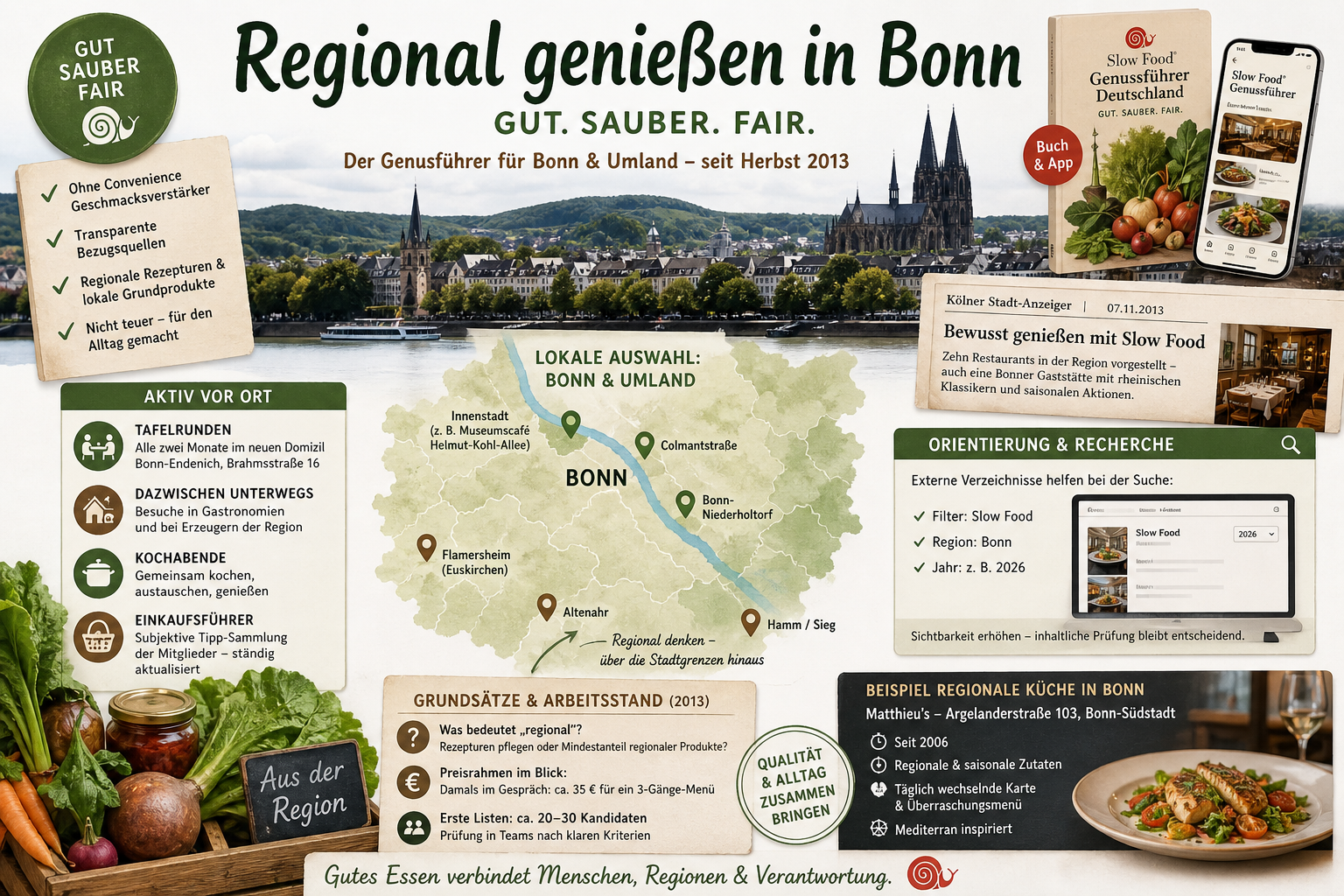
If you want to orient yourself to Slow Food in Bonn in the future, the standard will remain clear: good, clean, fair. This guiding principle will become especially visible where businesses focus on craftsmanship in their kitchens, avoid unnecessary additives, and transparently explain their purchasing decisions.
How You Will Recognize "Good, Clean, Fair" in Everyday Life in the Future
- Good: Careful preparation, clear flavors, noticeable quality in basic products (e.g., bread, vegetables, broths, sauces).
- Clean: Seasonal focus, resource-saving selection, less waste (e.g., nose-to-tail/leaf-to-root, smaller menus, better planning).
- Fair: Respect in the supply chain: realistic prices, reliable purchasing, transparent partnerships.
For you as a guest, this will practically mean: On your next restaurant visits, you will be able to ask good questions more often – and in good establishments, you will get concrete answers (without evasions). Examples of effective questions can be found in the Checklist.
Thinking Regionally in the Future: Bonn, Rhine, and Surroundings
In Bonn, "regional" will be understood less as a city boundary in the coming months, but rather as a culinary radius along the Rhine, foothills, Eifel, and Sieg. For your planning, this will be good news: Many convincing products (vegetables, fruit, dairy products, bread grains, wine/cider, honey) will be available in a reachable surrounding area – and restaurants will increasingly use this proximity as an advantage.
If you want to consciously choose regional cuisine in the future, a simple principle will prove itself: The more specifically a business names the origin, the more reliable "regional" becomes. Therefore, pay attention to:
- specifically named farms, bakeries, roasteries, cheese dairies, or butcher shops,
- clear seasonal reference (instead of "always everything"),
- dishes that "follow" the region (e.g., early summer vegetables, summer fruits, autumn mushrooms, winter roots).
Upcoming Slow Food Formats: Round Table, Cooking Evenings, Shopping Orientation
In the coming months, Slow Food in Bonn will be experienced above all as a participatory culture. If you are looking to connect, three formats will be particularly typical: regular discussion rounds, cooking evenings, and joint visits to producers or restaurants.
Round Table: Exchange, Planning, Shared Meals
In the coming months, round tables will serve as open meeting points: People from different backgrounds will exchange ideas there about regional products, seasonal cuisine, restaurant transparency, and practical shopping paths. If you are new to Bonn, this format will be particularly suitable for quickly gaining orientation and collecting concrete recommendations.
Cooking Evenings: Translating the Season into Practice
Cooking evenings will help to make the principle of "seasonal" tangible in the future. The added value does not lie in "show cooking", but in practice: You will experience how regional ingredients can be transferred into modern dishes without it becoming expensive or complicated. Typical topics will be:
- Vegetables as the main role (instead of a side dish),
- simple basic techniques (broths, preserving, small-scale fermentation),
- Rhenish classics in lighter, contemporary versions.
Shopping Orientation: Making Everyday Life Easier
For your everyday life, shopping orientation (e.g., via weekly markets, farm shops, artisanal bakeries, and small manufactories) will be particularly valuable in the coming months. The key will not be "everything at once", but a reliable basic selection:
- one or two sources for seasonal vegetables and fruit,
- a bakery with transparent production,
- a protein source with traceable origin (e.g., eggs, cheese, legumes, meat only in moderation).
Transparency & Price: Which Questions Will Come Up in the Future
In the coming months, the discussion around regional cuisine in Bonn will continue to revolve around a core question: How can enjoyment be fair without becoming elitist? You will feel two opposing realities:
- Craftsmanship and good raw materials will have their price.
- Accessibility will determine whether regional cuisine becomes part of everyday life.
For your restaurant choice, this will mean: A "fair" offer will not only be determined by the final price, but by openness. Businesses that are convincing in the future will be able to explain:
- why a dish is priced as it is,
- what quality is behind it (e.g., animal husbandry, craftsmanship, season),
- where to find alternatives (e.g., smaller portions, lunch offers, vegetarian options).
If you want to become active yourself, a simple approach will work in the coming months: more often good vegetarian (seasonal, regional) and rarely, but consciously animal products – then quality remains more affordable without losing enjoyment.
How to Find Suitable Addresses (Without Empty Promises)
So that your search does not end in marketing fog in the coming months, a combination will prove itself:
- Principles first: Specifically look for businesses that make "good, clean, fair" traceable (suppliers, season, craftsmanship).
- Check for up-to-dateness: Look at current menus, seasonal notes, and opening times.
- Ask once: Ask a concrete question about origin on site. The reaction will tell you a lot.
- Keep your own notes: Record where transparency and quality fit together – this will become your personal Bonn map.
If you use digital directories, filters like "Slow Food" or "regional" will only be the starting point in the future. Your best quality control will continue to be the traceable information: Origin, season, and kitchen craftsmanship can be quickly checked in conversation.
Practical Checklist for Your Next Restaurant and Market Visit
With this checklist, you will quickly find out in the coming weeks whether an offer shows real principle or just uses buzzwords:
In the Restaurant: 8 Friendly Questions That Work
- "Which business does your vegetable come from today – or from which region do you source it?"
- "Which dishes are truly seasonal right now?"
- "Do you bake/cook stocks, sauces, and desserts mostly yourself?"
- "Is there a dish where you are particularly proud of the producer?"
- "How often does your menu change – and why?"
- "Is there a vegetarian main option that is not just a 'side dish'?"
- "How do you deal with leftovers and food waste?"
- "Where can I also buy your products (market stall/farm shop/manufactory)?"
At the Market or in the Shop: 6 Quick Quality Markers
- Origin is clearly named (region, business, cultivation/production).
- Seasonal goods visibly dominate the offer.
- Price and quality are explained convincingly (no evasive answers).
- Processing is recognizably artisanal (e.g., bread, cheese, sausage, spreads).
- Assortment is plausible (not "everything always", but focus + season).
- You get concrete tips for preparation and storage.