Heat Break in Bonn: Discover Cool Places & Activities
Heat Break in Bonn: Refreshing Places & Cool Activities for the Next Hot Days
Digital Map: How to Find Cool Places (if available)
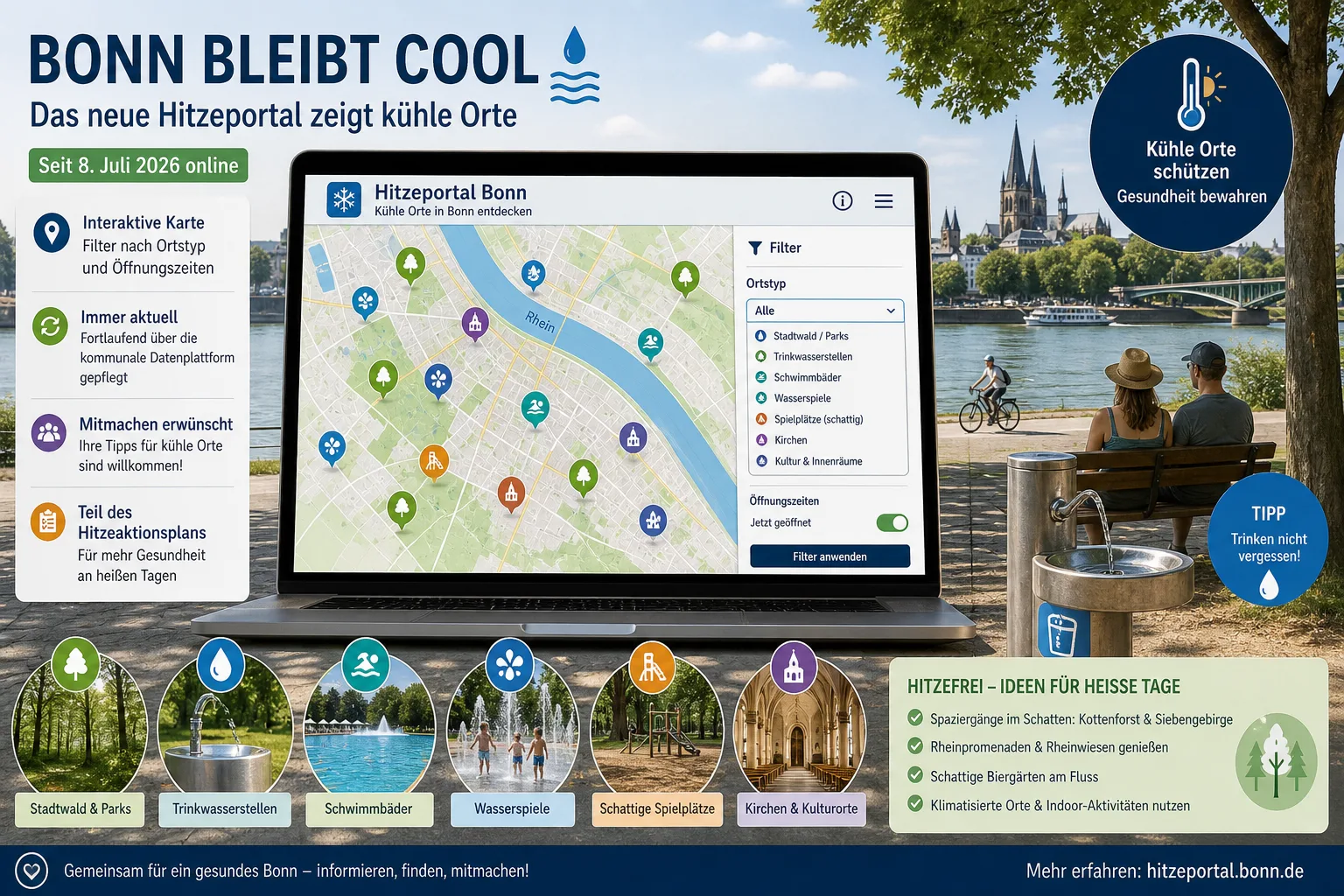
For the next heat wave, you'll find what you need fastest if you use an official, up-to-date map that bundles cool places (for example, a municipal heat portal, if the city of Bonn provides or expands such an overview).
How to Use a Heat Map Effectively
- Set filters: Specifically search for parks/green areas, water spots, drinking water stations, and air-conditioned indoor spaces.
- Check opening hours: Plan indoor spaces (e.g., libraries, museums) so you can safely enter during the hottest midday hours.
- Plan routes: Choose paths that keep you in the shade as long as possible (through parks, tree-lined streets, waterfront areas with wind).
- Plan a backup: For every outing, set at least one alternative retreat (indoor space + drinking water option).
Important for your planning: On hot days, don't rely on habits, but on up-to-date information (opening hours, construction sites, temporarily closed areas, event situations). This reduces stress and unnecessary sun exposure.
Refreshing Outdoors: Rhine, Forests, Parks
You don't have to "stay inside" on your next hot day to protect yourself. You can schedule and design your time outdoors so that shade and air movement work for you—and so you can switch to cooling off at any time.
By the Rhine: Wind, Open Spaces, Breaks in the Shade
If you head towards the Rhine on the next hot day, you can use the air movement by the water as a natural advantage. Plan your break so that you:
- sit under trees or in shaded riverside sections (instead of on open sunny areas),
- have enough drinking water with you or plan a refill option nearby,
- don't have to start your way back during the hottest phase.
Kottenforst & Siebengebirge: Forest as a "Climate Buffer"
For your next outing, you can consciously choose destinations with dense leaf canopies. A forest walk (e.g., in Kottenforst or Siebengebirge) can be planned so that you:
- schedule the route for early morning or late evening,
- take regular short breaks,
- make sure you have enough fluids and avoid overexertion.
Inner-City Parks: Short Distances, Big Impact
If you are in densely built-up neighborhoods, you can route your next walk so that you include several park stops. What matters is not "the most beautiful park," but the quickly accessible shade—and a bench or quiet corner that really relieves you.
Indoor Spaces, Drinking Water & Everyday Heat Tips
On very hot days, your best strategy is often an alternation: short time outside (with shade) and targeted time inside (cool). For the next hot days, you can build a simple structure for this.
Cool Indoor Spaces: Your Safety Anchor at Midday
If even the shade becomes too much, you can next plan publicly accessible indoor spaces as your destination, for example libraries, museums, or other facilities that (depending on the offer) provide more stable temperatures. For your visit, pay attention to:
- barrier-free access (if relevant),
- seating and toilets,
- enough time buffer so you don't have to rush.
Drinking Water: Early, Regular, Plannable
For the next hot day: Drink before you get thirsty—and firmly plan refill options. A practical routine:
- You start with a filled bottle (ideally 0.5–1.0 l, depending on duration).
- You set fixed drinking anchors (e.g., a few sips every 20–30 minutes, depending on activity).
- You combine routes with drinking water stations or buy water before entering heat-exposed areas.
Everyday Tips You Can Use Immediately for Upcoming Heat
- Plan route with shade: Prefer parks and tree-lined streets over wide, open sunny axes.
- Shift exertion: Do errands in the early morning or later evening.
- Force breaks: Set reminders so you don't "push through."
- Choose clothing: Light, bright, airy fabrics; head covering for longer walks.
- Cooling on the go: Lukewarm water over wrists/forearms, short stay in a cool indoor space instead of long sun exposure.
Safe on the Go: Warning Signs, Ozone & Vulnerable Groups
For the next hot days, safety is part of the planning—especially if you are out with children, elderly people, or people with pre-existing conditions. Even when alone, a quick check is worthwhile: How do you recognize overheating early and when is retreat the best decision?
Early Warning Signs You Should Respond to Immediately
- Dizziness, headache, nausea
- unusual fatigue, concentration problems
- strong palpitations, circulatory problems
- muscle cramps
- unusually hot, dry skin or confusion (warning signs for more serious heat problems)
If such symptoms occur, the next step is crucial: immediately move to the shade or a cool indoor space, drink (if possible), stop physical exertion, and in case of severe symptoms, organize medical help.
Ozone & "Hot Hours"
During upcoming high-pressure periods, high temperatures can coincide with increased ozone levels. For sports activities or long walks, you can then be especially consistent in switching to the cooler times at the edges of the day and avoid intense exertion during midday and afternoon hours.
Planning Rule for Groups
If someone in your group "can't go on," that's not a slump, but a planning signal: Break in the shade, fluids, cooling off—and if necessary, stop without discussion.
Note: This guide is for orientation for the coming hot days and does not replace medical advice. In case of acute complaints or emergencies, call the emergency numbers valid in Germany.
Sources
- Robert Koch Institute (RKI): Heat Protection — Background and recommendations for health protection during heat (accessed 2026-09-23)
- Federal Environment Agency (UBA): Heat and Health — Assessment of health risks and preventive measures (accessed 2026-09-23)
- German Weather Service (DWD): Heat Warnings — Warning situation and information on heat stress (accessed 2026-09-23)
- Federal Environment Agency (UBA): Ozone — Information on ozone pollution and behavioral recommendations (accessed 2026-09-23)