Discover Tech Meetups & Hackathons in Bonn
Tech Meetups & Hackathons in Bonn: Find Upcoming Events, Participate, and Contribute Meaningfully
8 min readLaura Müller
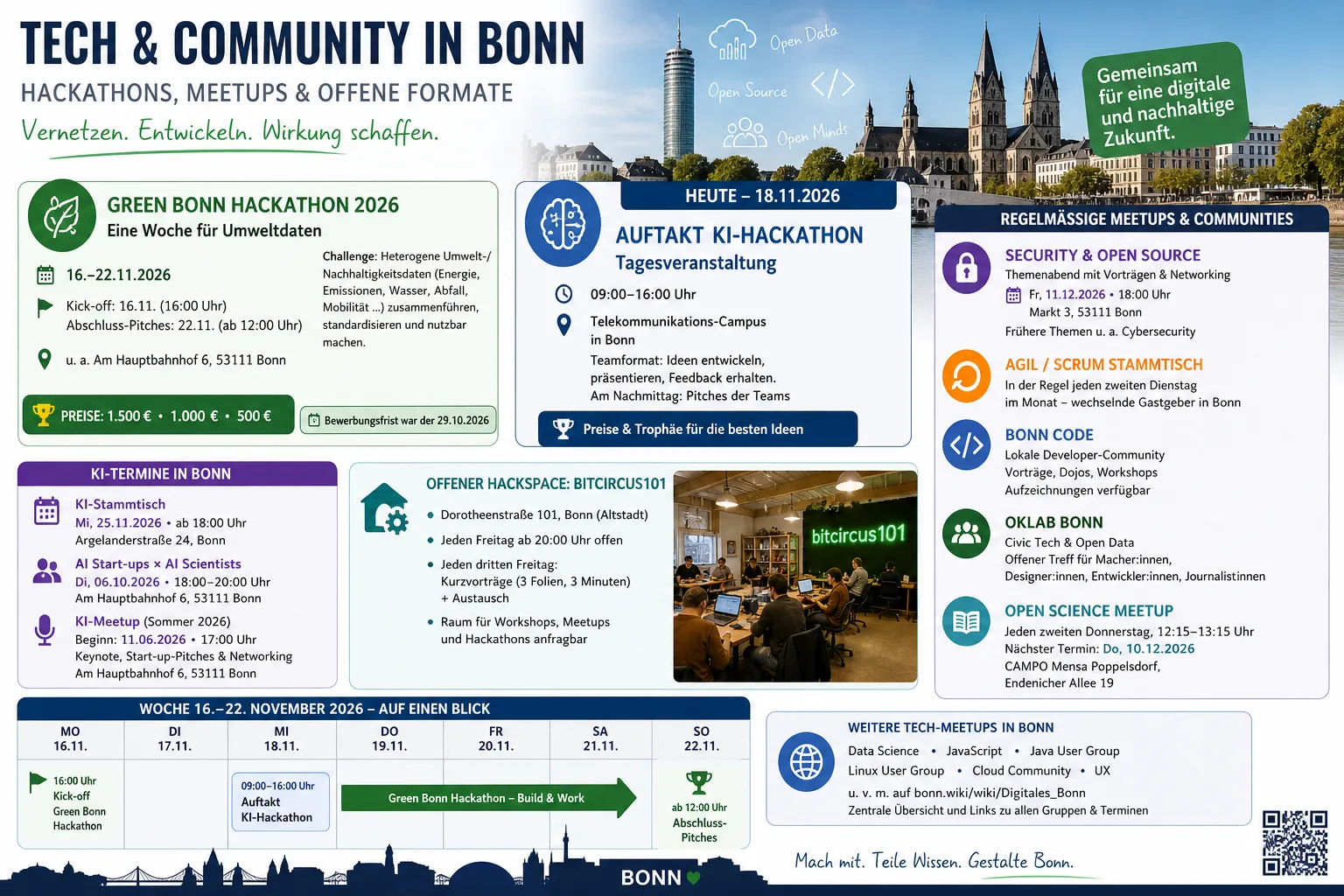
Bonn has an active tech community – from AI and Green Tech to Open Source & Security, Civic Tech, and Open Science. This guide helps you find upcoming meetups and hackathons in Bonn, prepare realistically, and quickly connect on site (even without a “perfect” tech background).
What Types of Events to Expect (Meetup, Hackathon, Stammtisch)
Meetups (Evening or Lunch Formats)
Meetups are usually compact (often 60–120 minutes) and combine short talks, demos, or discussion rounds with networking. In Bonn, you typically find both open beginner formats and deep-dive evenings for advanced participants (e.g., on Cloud, Security, or AI).
Hackathons (Days to a Week)
Hackathons are build formats: You work in teams on a challenge and present a prototype, concept, or demo at the end. In Bonn, you will likely continue to find hackathons around environmental/sustainability data and AI applications – often with practical questions, mentoring, and final pitches.
Typical process: Kick-off → Challenge briefing → Team formation → Build phase(s) → Demo/presentation. Prizes, participation fees, and rules vary depending on the organizer.
Stammtisch (Exchange Without Presentation Pressure)
Stammtisch events are ideal if you want to build contacts without having to “deliver” a project right away. They often focus on exchanging experiences, professional practice, methods (agility), or trends (e.g., AI and tools).
Topics in Bonn: Green Tech, AI, Dev, Security, Civic Tech, Open Science, Hardware
Green Tech & Data: From Environmental Indicators to Prototypes
When hackathons or meetup workshops on environmental and sustainability data are announced in Bonn, these goals are often the focus:
- Making data usable: Standardizing formats, documenting data sources, checking quality.
- Making insights visible: Maps, dashboards, storytelling, or simple web tools.
- Concrete applications: Idea sketches or prototypes that administration, research, or civil society can reuse.
Tip: Read in advance whether there are open datasets, APIs, or problem statements, and whether you need accounts or permissions for access.
AI Events: Prototyping Instead of Buzzwords
At AI meetups and AI hackathons in Bonn, the focus is often on quickly testing ideas: prompting, retrieval, classification, text analysis, image/audio workflows, or assistant systems for internal processes. Pay special attention in the announcement to:
- Data basis: Are you bringing your own data or are there sample datasets?
- Rules: Are cloud models allowed? Are there compliance requirements?
- Evaluation: Is it judged by impact, feasibility, UX, or technical quality?
Developer Meetups: From Coding Dojo to Architecture Talks
Developer communities in Bonn typically offer recurring formats such as live coding, tool showcases, project experience reports, and occasional workshops. If you are new, “dojo” or “hands-on” evenings are often the best entry point: you learn directly by participating.
Open Source & Security: Basics, Practice, and Responsibility
Security and open source evenings are deliberately “open” in many cities: You can come as a beginner as long as you are respectful and willing to learn. Good announcements clearly state whether the focus is on awareness (e.g., phishing, secure passwords), development (e.g., dependency management), or advanced topics (e.g., threat modeling).
If you want to contribute something yourself: A short experience report (“What I learned in a security audit”) is often more valuable than a perfect presentation.
Civic Tech: Open Data for Urban Society and Services
Civic tech meetings often connect people from development, design, journalism, initiatives, and sometimes administration. For Bonn, this practically means: If an event is announced, it may be about prototypes that directly benefit citizens – e.g., better information, data visualizations, or low-threshold participation formats.
Pay special attention to license and usage rules at civic tech hackathons: Open data and open source are not automatically the same, and publication conditions should be clarified in advance.
Open Science: Exchange for Research, Teaching, and Data Practice
Open science formats (often at lunchtime or early evening) typically revolve around open access, research data management, reproducibility, and software in science. If you want to participate in an open science meetup in Bonn in the future, bring a concrete topic, e.g.:
- How do I document data so that it is reusable?
- Which licenses fit data vs. code?
- What minimum information does a dataset need (metadata)?
Hardware & Hackspace: Build, Repair, Showcase
In Bonn, you will likely continue to find community spaces focused on hardware projects, tinkering, repair, and short demos. For beginners: Ask in advance what tools are available on site, whether you need to bring materials, and what the safety rules are (e.g., soldering, power supplies).
How to Reliably Find Upcoming Dates
To really find upcoming meetups and hackathons in Bonn (and not outdated announcements), use this approach:
- Check event platforms: Search for “Bonn” plus topic (e.g., “AI”, “Open Source”, “Civic Tech”, “Agile”). Check if the group is active (recent posts, new dates, current location info).
- Use official community channels: Many groups maintain newsletters, chat servers, or social channels for short-term updates (location changes, waitlists, entry).
- Calendar hygiene: Only add the date once you have confirmation (ticket/RSVP) and check the start time and location again on the event day.
- Vary search terms: In addition to “meetup”, also try “Stammtisch”, “hackathon”, “workshop”, “community night”, “user group”, “lightning talks”.
How to Prepare for Meetups & Hackathons
For Meetups
- Prepare a one-sentence intro: Who you are, what you are working on, what interests you.
- Bring a question: A concrete question helps you start a conversation (e.g., “Which tools do you use for dependency scanning?”).
- Take notes: Name + topic + “How can I help?”; this makes follow-ups easy.
For Hackathons
- Clarify your role: Dev, data, design, PM, research, pitching – teams need everything, not just code.
- Test tooling in advance: Notebook setup, Git, containers, cloud accounts (if allowed), demo stack.
- Keep the scope small: The goal is a demo, not a finished product. A “narrow” prototype often wins over an oversized vision.
- Documentation: Short README, data sources, assumptions, license notes – this increases the chance that the result will live on.
How to Appear Confident On Site (Networking Without Stress)
Many underestimate how low-threshold tech communities often are: A friendly “Hi, I’m new here” is enough. These three strategies work especially well:
- “Who/What/Where to?”: “Who are you? What are you working on right now? Where can I go next?”
- Mini-contribution: Share a link, a tool, or a brief experience. That immediately adds value.
- Follow-up within 24 hours: A short message (“Thanks for the tip about X”) turns contacts into real connections.
Security, Data & Ethics: What You Should Watch Out For
At AI, data, and civic tech events, you should pay particular attention to responsible handling:
- No sensitive data in demos: Use anonymized or synthetic data if possible.
- Respect licenses: Check whether datasets are really open and under what conditions you may publish results.
- Security-by-default: Even prototypes should not contain unnecessarily open keys, tokens, or unsecured endpoints.
- AI transparency: If AI is used, briefly document the model/approach, limitations, and possible sources of error.
This article does not replace legal or security advice. In case of doubt: Organizer rules and the respective guidelines of the platforms/data owners are decisive.