Discover Fashion, Design & Concept Stores in Bonn
Fashion, Design & Concept Stores in Bonn: Dates, Districts & Shopping Ideas for the Coming Months
Brief Overview: This guide helps you plan your next visits to Bonn around fashion, design, and concept stores. It focuses on recurring, plannable occasions (e.g., weekly markets, seasonal shopping times, and the cherry blossom in spring) and organizes Bonn's shopping districts so you can derive concrete routes for upcoming days, weeks, and seasons.
City Center: Compact Walking Routes, Lots of Choice
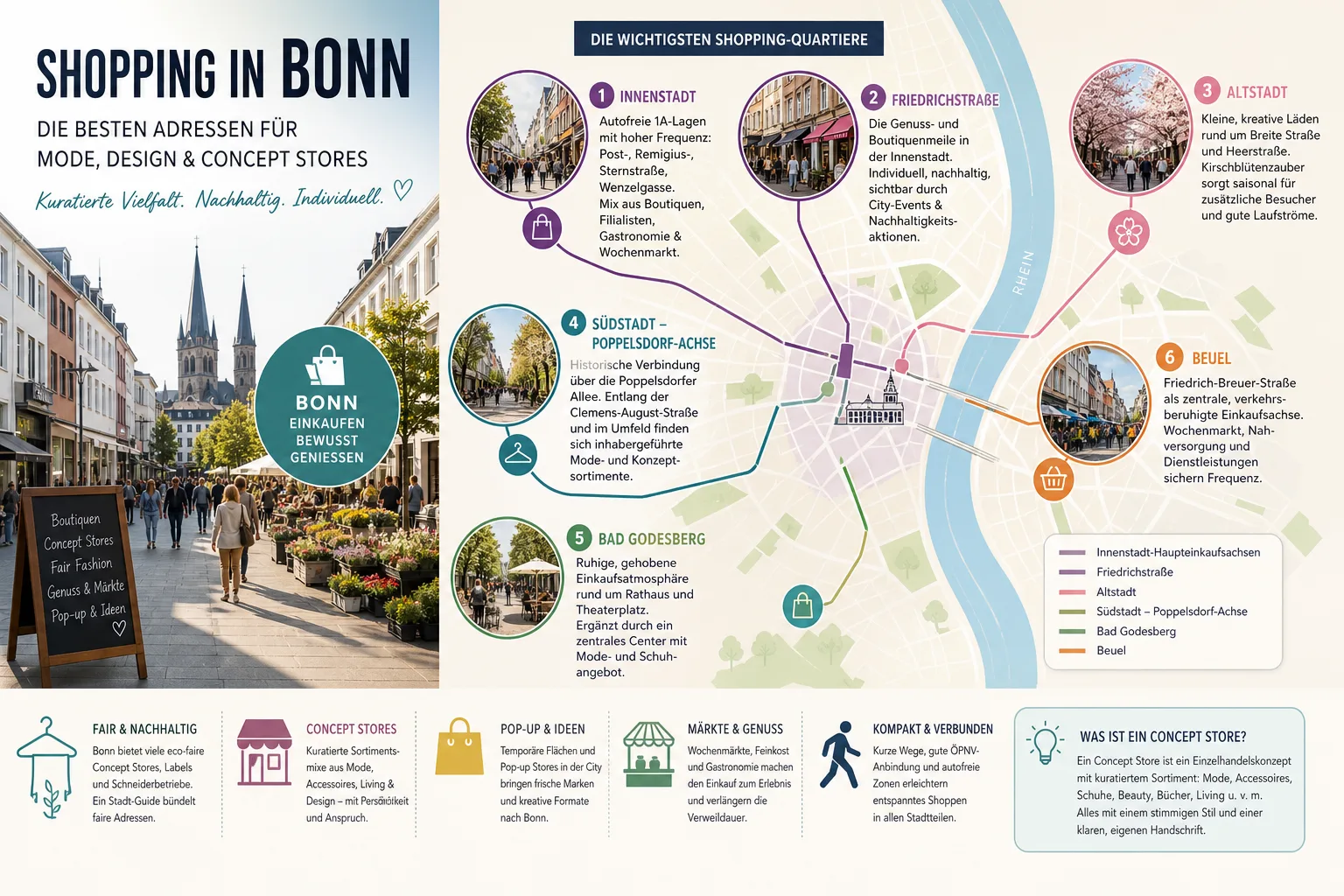
For your next visit to Bonn, the city center will likely remain the most efficient zone if you want to see many stores in a short time. In the central axes (including around Poststraße, Remigiusstraße, Sternstraße, and Wenzelgasse), you can put together a route that ranges from classic fashion offerings to curated concept spaces.
What You Can Specifically Plan for in the City in the Future
- “Concept Stops” Between Main Routes: Deliberately plan time for shops that combine fashion with accessories, home objects, fragrance, stationery, or jewelry. Advice is especially worthwhile here, as assortments often change seasonally.
- Café Breaks as Pacemakers: If you plan to try on several items, a break is strategically sensible: You return more relaxed and make better purchasing decisions.
- Market + City as a Reliable Duo: If you schedule your visit on a market day, the market visit can be a good starting point before you move on to the shopping streets.
If you consciously want to shop locally, it is worthwhile to ask about curated brands, small capsule collections, and craftsmanship references (e.g., alteration/customization, material knowledge, origin of fabrics). This is often better represented in smaller boutiques than in purely standardized assortment concepts.
Friedrichstraße: Boutiques, Advice & Culinary Delights as a Day Program
If you are specifically looking for personal advice, small labels, and a "stroll with character" in the coming weeks or months, Friedrichstraße will be a logical program point for you. The street is especially suitable if you want to combine shopping with culinary experiences.
This Is How Friedrichstraße Becomes a Meaningful Route
- Start with a Clear Shopping List: e.g., "coat/knitwear," "shoes," "jewelry," "gift" – this keeps the stroll focused.
- Schedule Advice Appointments: If you are looking for a higher-quality item (e.g., occasion wear, shoes, custom fitting), it is worth arranging an appointment by phone in advance.
- Set Culinary Stops as Fixed Points: Plan 1–2 breaks firmly. This makes the visit plannable and reduces "quick buy" decisions.
For visitors who want to shop more sustainably in the future, this setting is particularly practical: In curated boutiques, you can more often ask about certifications, material mix, care, and repairability without the conversation becoming impractical.
Old Town & Cherry Blossom (Spring): Shopping Around Photo Spots
For spring 2027, increased visitor numbers are again expected in Bonn's old town around the famous cherry blossom streets. If you want to take advantage of this time, you can plan your visit so that shopping, café stops, and photo spots fit together without stress.
Practical Planning for Cherry Blossom Time
- Start Early in the Day: Those who visit the old town early can take photos more relaxed and then browse smaller shops at their leisure.
- Focus on Small-Scale Concepts: In districts with a lot of walk-in customers, gift items, stationery, jewelry, and selected fashion are often curated so that you can find special pieces more quickly.
- Plan for a “Souvenir That Lasts”: If you are coming for the cherry blossom anyway, it is worth budgeting for a durable piece (e.g., jewelry, accessory, design object) instead of short-lived souvenirs.
If you want to avoid crowds, you can choose the old town as your first program point and then move on to quieter districts (e.g., towards Poppelsdorf or Südstadt) to bundle fittings or advice appointments there.
Südstadt, Poppelsdorf & Bad Godesberg: Quieter, Curated, Often with Regular Customers
If you would prefer to shop away from the busiest city center in the coming months, Südstadt and Poppelsdorf will be interesting alternatives for you. Here, shopping can be easily combined with a walk through architecturally influenced streets and with culinary stops.
Poppelsdorf as a Route for a “Half Day”
Plan a route that combines fittings and advice with a fixed time window. In districts with a stronger neighborhood connection, assortments are often put together so that you find everyday pieces and small design labels side by side.
Bad Godesberg: Relaxed Shopping as an Excursion Component
If you are looking for a quieter shopping atmosphere in the future, Bad Godesberg can be a sensible program point on its own. Here, shopping can be combined with cultural or culinary plans without necessarily having to go through the city center. For many visitors, this is attractive when comfort, quality, and a less hectic pace are the focus.
Beuel: Shopping on the Right Bank, Plan for the Weekly Market
For your next visits, a detour to Beuel is also worthwhile: The shopping zone around Friedrich-Breuer-Straße is ideal if you want to combine "everyday errands + boutique/concept store" in one go. Beuel is also a practical district to discover local concepts that are more neighborhood-oriented.
This Is How You Make Beuel Plannable
- Market Visit as a Frequency Anchor: If your appointment falls on a market day, the visit can be easily combined with a shopping round.
- Short Distances Instead of Large Shopping Centers: Opt for a manageable route and plan specifically for 2–4 stops so there is enough time for advice.
- Look for a Local Signature: If you want something more unique, specifically ask for manufactured goods, small series, or regional labels.
Shop More Sustainably: Criteria You Can Check On Site in the Future
If you want to shop more sustainably in Bonn in the coming months, concrete check questions that you can ask directly in the store will help. This way, you avoid relying solely on buzzwords.
Checklist for Your Next Purchase
- Material: Which fibers are included (e.g., cotton, wool, viscose, polyester)? Is there information about the origin?
- Seals & Standards: Which independent standards are used (e.g., GOTS, Fairtrade Textile Standard, OEKO-TEX)?
- Care & Durability: How should the product be washed/stored so that it lasts a long time?
- Repair/Alteration: Are there alteration services or recommendations for repair shops?
- Transparency: Can the brand or retailer explain where it is made and why certain materials were chosen?
Note on Reliability: Sustainability assessments are complex. Statements should ideally be supported by comprehensible evidence (e.g., certificates, supply chain information, transparent product data). For consumer information, you can additionally consult official or standard-setting bodies (see sources).
Sources & Further Links
- City of Bonn (Official Website) — City information, mobility, visitor information (accessed 2026-11-11)
- Global Organic Textile Standard (GOTS) — Standard and seal information for textiles (accessed 2026-11-11)
- Fairtrade Textile Standard — Information on requirements and testing mechanisms (accessed 2026-11-11)
- OEKO-TEX — Information on product testing and standards (accessed 2026-11-11)
- Textile Exchange — Industry knowledge on fibers, standards, and material trends (accessed 2026-11-11)