Discover Digital Art & NFT Exhibitions in Bonn
Digital Art & NFT Exhibitions in Bonn (from Fall/Winter 2026): Between Museum and Metaverse
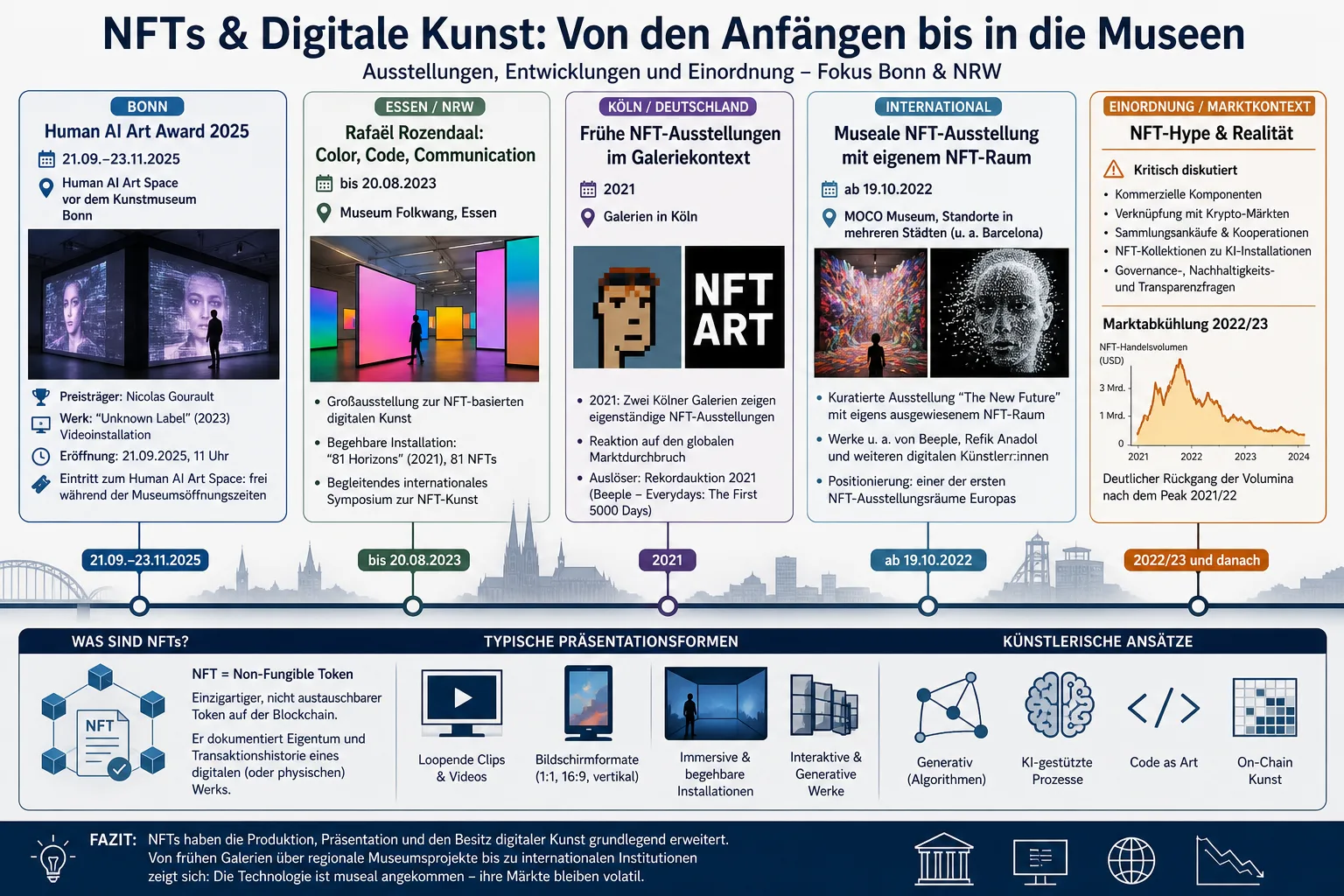
How does the perspective on art change when a work is no longer bound to canvas, frame, or pedestal, but exists as a data set on a blockchain—and at the same time can be experienced as a projection, screen installation, or immersive space in Bonn? This outlook summarizes which formats in Bonn are particularly likely and relevant in the coming months, how to reliably find them, and what visitors should pay attention to regarding NFT and blockchain references.
Which digital art formats can be expected in Bonn from Fall 2026
Bonn has a strong museum and cultural scene—and at the same time an environment in which AI, data culture, and media art are topics that are increasingly present. For the coming season (from October 2026), these formats are particularly realistic and exciting in Bonn:
1) Short-term Installations in Urban Space: Screen/Video Art with Free Access
In Bonn's urban space, low-threshold presentation forms are particularly effective: You stop briefly, spontaneously engage, and perceive a work without an entry barrier. In such settings, digital art is often curated as a loop, projection, or changing program. NFT references can appear as context (catalog, talk, accompanying text) without dominating the presentation.
2) Theme Evenings & Mediation: “Blockchain Made Understandable” Instead of Sales Event
In Bonn, mediation formats that demystify the technology are especially to be expected in the coming months: What does an NFT actually store? What does “on-chain” vs. “off-chain” mean? What happens if a platform disappears? Good programs clearly separate artistic content from financial speculation.
3) Exhibitions with AI/Generative Focus (With or Without NFT)
Many current digital positions work with generative systems (code, randomness, data, AI). In the 2026/27 season, it is therefore particularly plausible that Bonn programs will curate AI aesthetics, data policy, and authorship. NFTs can appear here as an edition or provenance mechanism—but do not have to be the focus.
4) Regional Cooperations (Bonn–Cologne–Ruhr Area): Exchange Instead of Hype
In NRW, the density of media art and digital culture actors is high. For Bonn, it is particularly valuable in the coming months if exhibitions are combined with panels, symposia, or guest contributions—so that not only works are shown, but also standards, legal issues, and sustainability are discussed.
Between Museum, Urban Space, and Metaverse: How the Experiences Differ
“NFT exhibition” can mean very different things. For your visit (and your expectations), this classification helps:
- Museum/Institution: Focus on context, mediation, conservation/archival questions, long-term collection logic. Often with accompanying texts, talks, and clear curatorial framing.
- Urban Space/Pop-up: Direct access, short attention span, strong impact through location and public presence. NFT information more as an addition than as the main content.
- Online/Metaverse: Location-independent accessibility, often more experimental, but also more dependent on platforms, accounts, and technical maintenance. For exhibition quality, crucial: good moderation, clear access, stable technical basis.
For the audience, it is often not decisive whether a work “has an NFT,” but whether the exhibition, context, and technology are designed so that the work remains understandable, accessible, and permanently documented.
Practical Tips: How to Plan Your Visit (Without Crypto Stress)
Before the Visit: 5-Minute Check
- Clarify format: Is it a physical exhibition, a screen in urban space, a talk, or a hybrid event?
- Check access: Free entry or ticket? Are there time slots? Is VR/interaction easily accessible?
- Look for curatorial context: Is there a statement, press text, or mediation (audio/guide/workshop)?
- Ask the NFT question correctly: “What does NFT mean here specifically—edition, provenance, financing, community, or just a label?”
- Data protection/accounts: Do you have to install apps or create accounts? Serious offers also allow participation without a wallet.
During the Visit: Good Questions That Really Help
- Which parts of the work are permanently documented (video, code, interaction, sound)?
- If an NFT is mentioned: Is the art file “on-chain” or just a reference/hash—and why?
- Which rights does a buyer receive (ownership of the token, usage rights, exhibition permission)?
- What conservation strategy is there for file formats, hardware, and platform changes?
Critical Points: Energy, Copyright, Platform Risks
For a serious classification (and E‑E‑A‑T-compliant cultural reporting), risks and critical points belong in every outlook—especially when NFTs, crypto, or smart contracts are discussed.
Energy & Sustainability
The ecological footprint depends heavily on the respective blockchain and its consensus mechanism. Many discussions refer to energy-intensive proof-of-work models; at the same time, for some major ecosystems, changes towards proof-of-stake are a central reference point. For exhibitions from Fall 2026, it will be relevant that institutions make transparent which technical basis is used and how sustainability goals are taken into account.
Copyright & Usage Rights
Buying an NFT does not automatically mean that usage rights (e.g., reproduction, commercial use) are transferred. For visitors, it is therefore important that exhibitions clearly distinguish between token ownership and rights to the work.
Platform and Accessibility Risks
Digital art needs long-term care: Links can become outdated, platforms can close, file hosting can disappear. High-quality programs in the 2026/27 season will therefore work with archival and documentation strategies (e.g., redundant storage, standardized metadata, curatorial documentation).
Note: If an exhibition actively encourages the purchase of NFTs or tokens, special caution is advised. Cultural formats should inform and contextualize—not create the impression that artistic relevance is automatically linked to expectations of returns.
Outlook: How Bonn Can Further Develop Digital Art Beyond the Hype
For Bonn, the opportunity in the coming season lies in not treating digital art as a short-term trend, but as a permanent extension of cultural practice: with good mediation, clear technical transparency, and collaborations that bring together art, research, and urban society. From Fall/Winter 2026, programs are particularly convincing when they:
- Prioritize content over speculation (AI, data policy, public sphere, authorship, culture of remembrance).
- Take mediation seriously (glossaries, short tours, school/university formats, accessible entry points).
- Show long-term perspectives (archiving, conservation issues, rights clarification).
- Use regional networking (NRW as a practice space, but with a Bonn profile).
In this way, Bonn can become visible as a place where digital art is not just “new technology,” but a cultural space in which the present is negotiated—between museum, urban space, and digital publics.